AIUEO JLPT Grammar
Meaning
This sentence pattern expresses that it is acceptable or within the permissible range to do something. It means that taking an action will not cause any significant issues, and it is used to indicate permission or tolerance. “差し支えない” is similar in meaning to “no problem” or “it’s okay”.
How to use it
Verb (て-form) ても + 差し支えない; i-adjective て-form ても + 差し支えない; na-adjective でも + 差し支えない; Noun でも + 差し支えない
In context 5 examples
この書類にサインしても差し支えないですか?
Is it okay if I sign this document?
少しくらい遅れても差し支えないです。
It’s okay if you’re a little late.
この部屋で写真を撮っても差し支えないですか?
Is it okay to take photos in this room?
食事の後に薬を飲んでも差し支えないです。
It’s okay to take the medicine after eating.
少し休んでも差し支えないと思います。
I think it’s okay if you take a short break.
Read the original source text
Meaning
This sentence pattern expresses that it is acceptable or within the permissible range to do something. It means that taking an action will not cause any significant issues, and it is used to indicate permission or tolerance. “差し支えない” is similar in meaning to “no problem” or “it’s okay”.
How to use it
動詞て形ても+差し支えない形容詞て形ても+差し支えない形容動詞でも+差し支えない名詞でも+差し支えない
Explanation · 日本語
この文型は、ある行動をしても問題がない、許容範囲内であることを表す表現です。何かを行っても大きな支障がないという意味を持ち、許可や許容を示すときに使われます。「差し支えない」は「問題ない」「大丈夫」の意味に近い表現です。
Bunpro Grammar Reference
Meaning
May, Is it a bother if, Do you mind if, Is it a problem if
How to use it
Verb[ても] + 差し支え + ありません(1)(か)
Noun[でも] + 差し支え + ありません(1)(か)
[な]Adjective[でも] + 差し支え + ありません(1)(か)
[い]Adjective[ても] + 差し支え + ありません(1)(か)
(1) ないでしょう、ございません
Nuance
A polite expression, used when asking or giving permission about something that may be a bother. (A) is a thing that may require support.
Explanation
ても差し支えない is a polite expression used in a similar way to てもいい 'may I', or 'do you mind'. This is a combination of ても (or でも when following nouns or な-Adjectives), and the る-Verb 差し支える 'to interfere', or 'to hinder' in its negative form, 差し支えない. It may be used either for asking for or granting permission. Due to this pattern being polite, ありません will almost always be used in place of ない by itself.
The more literal translation is 'it is not a hindrance if (A)'. In cases where permission is being asked for, か will be added to the end of ありません.
ここに座ってもらっても差し支えありません。どうぞお座りください。
I don't mind if you sat there. Please sit down.
お風呂は熱くても差し支えません。むしろ熱い方がありがたいです。
I don't mind if the bath is hot. In fact, I like hotter baths.
私はまだ初心者です。下手でも差し支えありませんか。
I am still a beginner. Do you mind if I'm not very good at it?
今週はものすごく忙しいので来週でも差し支えありませんか。
I'm extremely busy this week, so would you mind if we do it next week?
Caution
Although ても差し支える is used in polite sentences, the verb 差し支える itself is not strictly reserved for use in polite language, and will appear in sentences when implying that (A) has or will have a negative impact on (B).
明日の大会に差し支えるので、焼肉に行くのは大会の後にしましょう。
Since it will interfere with tomorrow's tournament, let's go to the yakiniku after the tournament.
タバコは健康に差し支えるので、吸わないようにしています。
I do not smoke cigarettes because it is hazardous to my health.
In context 19 examples
- 「ミーティングは明後日でも差し支えありません。」
'I don't mind if the meeting is the day after tomorrow.'
- お風呂は熱くても差し支えません。むしろ熱い方がありがたいです。
I don't mind if the bath is hot. In fact, I like hotter baths.
- ここに座ってもらっても差し支えありません。どうぞお座りください。
I don't mind if you sat there. Please sit down.
- 私はまだ初心者です。下手でも差し支えありませんか。
I am still a beginner. Do you mind if I'm not very good at it?
- 今週はものすごく忙しいので来週でも差し支えありませんか。
I'm extremely busy this week, so would you mind if we do it next week?
- 電車:「ここに座っても差し支えありませんか?」
On a Train: 'Would it bother you if I sit here?'
- 部下:「今日は定時に帰っても差し支えありませんか?」
Subordinate: ‘Is it a problem if I go home at the regular time today?’
- 医者に:「この薬とその薬を一緒に飲んでも差し支えないでしょうか?」
To a doctor: 'May I take that medicine together with this one?'
- 営業担当者:「明日、お電話差し上げても差し支えございませんか?」
クライアント:「はい、問題ありません。」Sales representative: 'Would it bother you if I call you tomorrow?' Client: 'No problem at all.'
- 目上の人に:「書類は宅配サービスを利用してお送りしても差し支えないでしょうか?」
To superior: 'Would it bother you if I send the documents using the courier service?'
- どうせ私がいなくても差し支えないだろうから、次の企画は是非私抜きでやって下さい。
Seeing as though it won’t be a problem even if I am not there, please make the next plan minus me.
- 医者:「この飲み薬は風邪の症状が治まりましたら、服用を停止しても差し支えありません。」
Doctor: 'You may stop taking this medicine when your cold symptoms have subsided.'
- 確かにこの職業には学歴がなくても差し支えないが、学歴があれば必ず役に立つだろう。
Although it is certainly true that it is not a problem even if you don’t have an academic record in this job, if you have it, it is sure to be of use.
- 上司:「これからは会社に遅れる時、電話じゃなくてメールでも差し支えないからね。」
Boss: ‘In the future when you will be late for work, rather than calling, it is not a problem if you just send an email.’
- 優しい先生:「宿題の提出期限の事ですが、二、三日くらいなら遅れても差し支えありません。」
Kind teacher: ‘This is about the homework submission deadline, but it’s not a bother if it is two or three days late.’
- 彼女のSNSのフォロワーは三百万人を超えています。今一番人気なインフルエンサーと言っても差し支えないでしょう。
She has more than 3 million followers on social media. You may even say that she is the most popular influencer right now.
- 患者:「今日は頭を洗っても差し支えないですか?」
医師:「まだ傷口が完璧には塞がっていないので、今日と明日は我慢して下さい。」Patient: ‘Do you mind if I wash my head today?’ Doctor: ‘Since the wound is not perfectly sealed, please hold off for today and tomorrow.’
- 明日の大会に差し支えるので、焼肉に行くのは大会の後にしましょう。
Since it will interfere with tomorrow's tournament, let's go to the yakiniku after the tournament.
- タバコは健康に差し支えるので、吸わないようにしています。
I do not smoke cigarettes because it is hazardous to my health.
どんなときどう使う 日本語表現文型辞典
Meaning
no problem even if
How to use it
Vても / イAくても / ナAでも / Nでも + さしつかえない
Explanation
~ても問題ない
B:ええ、どうぞ。
「~ても・~でも」で表される条件でも支障はない、と言いたいときに使う。「てもいい・てもかまわない」とだいたい同じ意味だが、「てもさしつかえない」の方が消極的な許可、消極的な譲歩、または遠慮した質問になる。
Means no problem with situation described before ても・でも. Nearly same as てもいい or てもかまわないbut てもさしつかえない conveys more passive granting of permission or compromise, or is more reserved question.
In context 5 examples
A:この写真、見てもさしつかえないですか。
A: Would it be all right if I looked at this photograph?
医者:少しぐらいならお酒を飲んでもさしつかえありませんよ。
Doctor: It’s all right to drink a little alcohol.
申込用紙はコピーでもさしつかえありません。
A photocopy of the application form is acceptable.
支払いは今すぐでなくてもさしつかえありません。後でもいいですよ。
It’s all right if you don’t pay right away. You can pay later.
ぼくは寝るときは部屋が明るくてもさしつかえない。どこでも寝られる。
I don’t mind if the room is bright when I sleep. I can sleep anywhere.
Read the original source text
Meaning
no problem even if
How to use it
Vても/イAくても/ナAでも/Nでも+さしつかえない
Explanation
~ても問題ない
B:ええ、どうぞ。
「~ても・~でも」で表される条件でも支障はない、と言いたいときに使う。「てもいい・てもかまわない」とだいたい同じ意味だが、「てもさしつかえない」の方が消極的な許可、消極的な譲歩、または遠慮した質問になる。
Means no problem with situation described before ても・でも. Nearly same as てもいい or てもかまわないbut てもさしつかえない conveys more passive granting of permission or compromise, or is more reserved question.
絵でわかる日本語
Meaning
It is all right to...
How to use it
Verb [て-form] + ても差し支えない
い-adjective [remove い] + くても差し支えない
な-adjective [remove な] + でも差し支えない
Noun [dictionary form] + でも差し支えない
Explanation
“〜ても差し支えない” is a sentence pattern meaning “it is all right to...” or “there is no problem with....” It is more formal than “〜てもいい” or “〜てもかまわない.” The form “〜ても差し支えはない” is also used. To use the negative form, say “〜なくても差し支えない.”
[Example]
You don’t have to submit the report today.
There is also the form “差し支えなければ〜,” so remember it.
[Example]
If it’s not too much trouble, could you tell me your name?
Learn “〜ても差し支えない” together with “〜てもかまわない.” 😊
[Related grammar patterns]
In context 6 examples
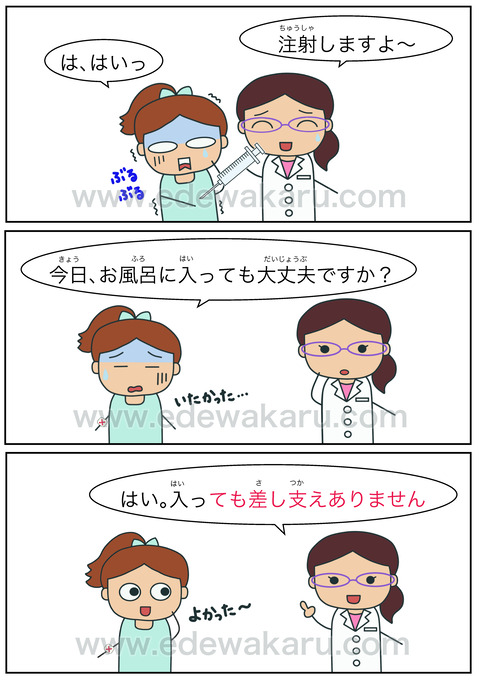
患者:今日、お風呂に入っても大丈夫ですか?医者:はい。お風呂に入っても差し支えありません
→お風呂に入ってもいいですPatient: Is it all right to take a bath today? Doctor: Yes. There’s no problem with taking a bath. → It’s all right to take a bath.
スマホがあれば、パソコンを持っていなくても差し支えない
→パソコンを持っていなくてもいいIf you have a smartphone, it’s all right if you don’t have a computer. → You don’t have to have a computer.
パーティーに遅れても差し支えないだろう
→パーティーに遅れてもいいだろうIt should be all right to arrive late to the party. → It should be all right to arrive late to the party.
連絡は電話でも差し支えありません
→連絡は電話でもいいですIt’s all right to contact us by phone. → It’s all right to contact us by phone.
レポートの提出は明日でも差し支えありません
→明日でもいいですIt’s all right to submit the report tomorrow. → Tomorrow is fine.
彼女は、日本一有名だと言っても差し支えないだろう
→彼女は日本一有名だと言ってもいいだろうIt would be all right to say that she is the most famous person in Japan. → It would be all right to say that she is the most famous person in Japan.
Read the original source text
Meaning
〜てもいい
How to use it
動詞[て形]+ても差し支えない
い形容詞[ーい]+くても差し支えない
な形容詞[ーな]+でも差し支えない
名詞[辞書形]+でも差し支えない
Explanation
「〜ても差し支えない」は「〜てもいい」「〜ても支障がない」という意味を表す文型です。「〜てもいい」や「〜てもかまわない」よりもかたい言い方です。「〜ても差し支えはない」と言う場合もあります。否定形を使う場合は「〜なくても差し支えない」になります。
[例]
レポートは、今日提出し
なくても差し支えありません
また、
「差し支えなければ〜」
という形もありますので覚えておきましょう。
[例]
差し支えなければ、
お名前を教えていただけますか?
「〜ても差し支えない」は「〜てもかまわない」と一緒に覚えておきましょう😊
【関連文型】
毎日のんびり日本語教師
How to use it
Verb て-form + も差し支えない
い-adjective stem + くて + も差し支えない
な-adjective stem + で + も差し支えない
Noun + で + も差し支えない
Explanation
Expresses reluctant permission or acceptance.
It is a relatively formal expression, so it is often used in official situations.
「~ても構わない」 (“it doesn’t matter if ~”) has the same meaning but is a softer expression.
Notes
Related grammar: 「~ても構わない(かまわない)」
In context 8 examples
年賀状などあってもなくても全く差し支えない。
It makes no difference at all whether or not there are New Year’s cards and the like.
副業しなくても差し支えないくらいの給料が欲しい。(想要一份不做副业也能维持生活的工资。)
I want a salary that lets me get by without having a side job. (I want a salary enough to live on without a side job.)
楽器の演奏は、手が覚えれば見えなくても差し支えない。
Once your hands have memorized how to play an instrument, it’s all right if you can’t see.
死ぬ訳じゃないので、絵は描けなくても差し支えない。
It’s not like you’ll die, so it’s fine if you can’t draw.
最新作は前作を見ていなくても差し支えなく理解できるそうだ。
Apparently, you can understand the latest installment perfectly well even if you haven’t seen the previous one.
私一人くらい行かなくても差し支えないだろう。
It probably wouldn’t make any difference if I, just one person, didn’t go.
水商売は学歴がなくても差し支えない職業ではある。
It is a profession in the nightlife industry where not having an educational background is not a problem.
この会社にとっての私は、いてもいなくても差し支えのない存在だ。
As far as this company is concerned, I’m someone whose presence or absence makes no difference.
Read the original source text
How to use it
動て形+も差し支えない
い形容詞語幹+くて+も差し支えない
な形容詞語幹+で+も差し支えない
名詞+で+も差し支えない
Explanation
消極的な許可・許容を表します。
比較的硬い表現なので、正式な場面で使われることが多いです。
意味の同じ「~ても構わない」はこれよりも柔らかい表現です。
Notes
関連文法「~ても構わない(かまわない)」
NINJAL 日本語文型データベース
Meaning
[1] Used to grant permission, express that something will not cause a problem, or indicate that something is an available option. It focuses on there being no problem from a personal, subjective point of view, and can also be used to gently and politely show consideration for the other person, or to ask with some hesitation, more so than “~てもいい・~てもかまわない.”
[2] Used to express that a situation is acceptable, though it is not the most desirable or entirely problem-free. It focuses on there being no problem from a personal, subjective point of view, and can also be used to gently and politely show consideration for the other person, or to ask with some hesitation, more so than “〜てもいい・~てもかまわない.”
Question words such as “何、いつ、どんな” can also be used in the sentence; in that case, it expresses that all situations are acceptable.
The forms “~ても差し支えないから・~ても差し支えないので,” which state a condition one can concede, are often used in sentences expressing the speaker’s intention or wishes, or prompting the listener to do something.
These forms are used when “~” is a verb or an i-adjective.
How to use it
Notes
[1] In polite speech, “~ても差し支えありません” is more commonly used than “〜ても差し支えないです.”
[2] In polite speech, “~ても差し支えありません” is more commonly used than “〜ても差し支えないです.”
In context 14 examples
医師「この注射をした日はお風呂に入っても差し支えありませんが、お酒は控えたほうがいいでしょう」
Doctor: “It’s all right to bathe on the day you have this injection, but you should avoid alcohol.”
「その書類、ちょっと見せていただいても差し支えありませんか」
“Would you mind if I took a quick look at those documents?”
「もしもし、そちらのジムには駐車場がありますか。車で行っても差し支えないでしょうか」
“Hello, does your gym have a parking lot? Would it be all right if I came by car?”
相談室ではいつでもご相談を受け付けています。お電話で匿名でご相談くださっても差し支えありません。
Our counseling office is always available for consultations. You may consult us anonymously by phone without any problem.
注文した服が今日届いたのですが、サイズが合いません。一度試着してしまったんですが、返品しても差し支えないですか。
The clothes I ordered arrived today, but they don’t fit. I did try them on once, but would it be all right to return them?
建築業者「この材料で三方に塀を作るとかなりの額になってしまいます。100万円を超えても差し支えないでしょうか」
Builder: “Building walls on three sides with these materials will cost quite a lot. Would it be all right if the cost exceeds one million yen?”
子どもの成長には自己主張も必要だ。他人に迷惑をかけるのでなければ、自己主張を大目に見ても差し支えないだろう。
Self-assertion is also necessary for children’s growth. As long as it doesn’t inconvenience others, it would probably be all right to be lenient about their self-assertion.
3日のイベント「出会いの場」には、何時に参加しても、どのグループに参加しても差し支えありません。ご自由にご参加ください。
At the event “A Place to Meet” on the 3rd, you may join at any time and join any group. Please feel free to participate.
客「古民家に似合いそうな、和の家具を居間に置きたいんです。少々傷があっても差し支えありません」
Customer: “I’d like to put some Japanese-style furniture in the living room that would suit an old traditional house. It’s all right if it has a few scratches.”
当法律事務所では予約なしでもご相談に応じております。いつおいでくださってもさしつかえありませんので、お気軽においでください。
Our law office accepts consultations even without an appointment. You may come whenever you like, so please feel free to visit.
ご家庭で余っている紙袋を何枚かお持ちいただけませんか。幼稚園のバザーで使います。古くても差し支えありません。
Could you bring us a few paper bags you have spare at home? We’ll use them at the kindergarten bazaar. It’s all right if they’re old.
勉強会の会員「明日の会には、小さいお子さん連れの方が5、6人いらっしゃいますが……」勉強会の幹事「そうですか。大丈夫ですよ。少々騒がしくても差し支えないでしょう」
Study group member: “There’ll be five or six people bringing small children to tomorrow’s meeting, though…” Study group organizer: “I see. That’s fine. It won’t be a problem if it gets a little noisy.”
医師「けがの処置はひとまずこれで大丈夫だと思います。今日一日安静にしてださい。何かありましたら、夜遅くても差し支えありませんので、ご連絡ください」
Doctor: “I think this should be enough for treating your injury for now. Please rest for the rest of today. If anything comes up, please contact me, even late at night.”
この会は自由参加なので、参加者の人数が確定できない。予想以上に多くてもさしつかえないように、広めの部屋を予約しておこう。
Since this gathering is open to anyone, we can’t know for sure how many people will attend. Let’s reserve a large room so that it won’t be a problem even if there are more than expected.
Read the original source text
Meaning
[1] ~することを許可するときや支障がないことを表すとき、または選択可能な方法であることを表すときに使います。個人的・主観的に見て支障がないことに焦点を当てており、「~てもいい・~てもかまわない」よりも、相手に対する配慮を柔らかく丁寧に示したり、遠慮しながら聞いたりする言い方としても使います。
[2] 最も望ましい状況や完全に問題がない状況ではないが、許容できるということを表すときに使います。個人的・主観的に見て支障がないことに焦点を当てており、「〜てもいい・~てもかまわない」よりも、相手に対する配慮を柔らかく丁寧に示したり、遠慮しながら聞いたりするときにも使います。
文中に「何、いつ、どんな」などの疑問詞を使うこともでき、その場合はすべての状況が許容できることを表します。
話し手の意志・希望を表す文や相手への働きかけの文で、譲歩できる条件を示す「~ても差し支えないから・~ても差し支えないので」の形もよく使います。
「~」が動詞とイ形容詞の場合の形です。
How to use it
Notes
[1] 丁寧体で使うときは、「〜ても差し支えないです」より「~ても差し支えありません」のほうをよく使います。
[2] 丁寧体で使うときは、「〜ても差し支えないです」より「~ても差し支えありません」のほうをよく使います。