AIUEO JLPT Grammar
Meaning
This sentence pattern expresses that time or situational constraints prevent continuing a specific action. It is often used when the speaker wants to emphasize the change of circumstances or urgency.
How to use it
Verb (て-form) ては + いられない
In context 5 examples
試験が近いので、遊んではいられない。
With exams coming up, I can’t afford to be playing around.
納期があるから、こんなところで迷ってはいられません。
I have a deadline, so I can't afford to get lost.
このままだとまずいので、何か手を打たなくてはいられない。
If things continue like this, things will get bad, so we have to do something.
結果がどうなるかわからないが、やってみないではいられない。
I don’t know how it will turn out, but I can’t help trying.
ここで諦めてはいられないです。
We can't give up now.
Read the original source text
Meaning
This sentence pattern expresses that time or situational constraints prevent continuing a specific action. It is often used when the speaker wants to emphasize the change of circumstances or urgency.
How to use it
動詞て形ては+いられない
Explanation · 日本語
この文型は、時間や状況に制約があり、特定の行動を続けることができないことを表す表現です。話し手が状況の変化や切迫感を強調したいときによく使われます。
文法
Meaning
Cannot keep the current state going any longer
Used when one is in a situation with little time or emotional leeway and wants to say that one cannot continue doing something.
How to use it
V(て-form)+ はいられない
Notes
・A casual way to say this is 「〜てちゃいられない」.
・In speech, 「は」 is often omitted, as in 「〜ていられない」, or both 「は」 and 「い」 are omitted, as in 「〜てられない」.
In context 10 examples
もういい年だし、いつまでも親に頼ってはいられない。
I'm old enough now, and I can't keep relying on my parents forever.
これ以上ぐずぐずしてはいられない。
We can't keep dawdling any longer.
もう1時間も待ってるのにまだ来ない。もうこれ以上待ってられないよ。
I’ve already been waiting for an hour, and they still haven’t come. I can’t wait any longer.
給料は安いし、お金が無いから贅沢は言ってられない。
My salary is low and I don't have any money, so I can't afford to be picky.
あと半年で試験だから、のんびりしてはいられない。
The exam is in six months, so I can't take it easy.
納期までもう時間が無いから、休んではいられない。
There's not much time left before the deadline, so I can't take a break.
もうすぐ試験だから遊んでちゃいられない。勉強に集中しなきゃ。
The exam is coming up soon, so I can't just play around. I have to focus on studying.
危なすぎて、見てられないよ。私が切るから包丁貸して。
It's too dangerous to watch. Give me the knife; I'll cut it.
友達が虐められている姿を見て、僕は黙ってはいられなかった。
Seeing my friend being bullied, I couldn't stay silent.
森林の火災で動物たちが苦しむ姿を見てはいられなかった。
I couldn't bear to watch the animals suffer in the forest fire.
Read the original source text
Meaning
このままの状態を維持し続けることはできない
時間的に、あるいは精神的に余裕がない状態にあり、そうすることができないと言いたい時に使う。
How to use it
V(テ形)+ はいられない
Notes
・カジュアルな言い方は「〜てちゃいられない」
・話す時は「〜ていられない」のように「は」を省略したり、「〜てられない」のように「は」と「い」を省略して使うことが多い。
Bunpro Grammar Reference
Meaning
Can't afford to, Unable to
How to use it
Verb[て]+ はいられない
[い]Adjective[て]+ はいられない
[な]Adjective + では(1) + いられない
Noun + では(1) + いられない
(1) じゃ
Verb[て]+ はいられません
[い]Adjective[て]+ はいられません
[な]Adjective + では(1) + いられません
Noun + では(1) + いられません
(1) じゃ
Nuance
A phrase used to express that one cannot afford to do (A), by literally indicating that they cannot live with it.
Explanation
てはいられない is a grammar pattern which consists of the conjunction-particle て, は, and the negated-potential form of the る-Verb いる 'to be'. Common translations include 'to be unable to (A)', and 'cannot afford to (A)'. The literal meaning of 'to not be able to be with (A)' just reflects the impossibility of the word that this structure is attached to.
This structure is almost exclusively seen with verbs, but may occasionally be seen with い-Adjectives, な-Adjectives or nouns as well.
明日までに提出しないといけないレポートがあるから、遊んではいられない。
I have an essay I need to submit by tomorrow, so I can't afford to hangout.
あと30分で家を出ないといけないので、のんびりご飯を食べてはいられない。
I have to leave the house in 30 minutes, so I am unable to relax and eat my food.
午後までに終わらせるように先輩に頼まれたから、休んではいられない。
My senpai asked me to finish by this afternoon, so I can't afford to take a break.
The verb that てはいられない is connected to is often considered to be something that cannot continue on due to either some time-based or feeling-based limitation. In this way, it regularly has the nuance of '(A) cannot continue due to (B)', with the reason of (B) mentioned in another part of the sentence.
When appearing with い-Adjectives, な-Adjectives or nouns, the nuance will change slightly, and simply reflects the meaning of いられない itself in conveying that (A) 'cannot be', or is 'impossible' in some way. As always, ては will be replaced by では in the case of nouns and な-Adjectives.
次の大会で勝つには、こんな遅くてはいられない。
We can't afford to be this slow if we want to win the next tournament.
お父さんもいつまでも元気ではいられないんだから、そろそろ健康に気をつけな。
Dad, you can't stay healthy forever, so you should start taking better care of yourself.
もうこんな会社の社員ではいられない。
I can no longer be an employee of this company.
In context 18 examples
- 時間がない。下書きしては居られない。
There is no time. I can't afford to make a rough draft.
- 明日までに提出しないといけないレポートがあるから、遊んではいられない。
I have an essay I need to submit by tomorrow, so I can't afford to hangout.
- あと30分で家を出ないといけないので、のんびりご飯を食べてはいられない。
I have to leave the house in 30 minutes, so I am unable to relax and eat my food.
- 午後までに終わらせるように先輩に頼まれたから、休んではいられない。
My senpai asked me to finish by this afternoon, so I can't afford to take a break.
- 次の大会で勝つには、こんな遅くてはいられない。
We can't afford to be this slow if we want to win the next tournament.
- お父さんもいつまでも元気ではいられないんだから、そろそろ健康に気をつけな。
Dad, you can't stay healthy forever, so you should start taking better care of yourself.
- もうこんな会社の社員ではいられない。
I can no longer be an employee of this company.
- 彼は実績を上げています。負けては居られません。
He is achieving results. He can't afford to lose.
- 寒すぎて写生してはいられません。
It is too cold. I am unable to do drawings from nature.
- もう働くしかない。受験しては居られない。
I have no choice but to work. I can't afford to take an exam.
- こんなひどい商品、宣伝しては居られません。
Such a terrible product, we can't afford to advertise it.
- 髭を剃っては居られない。緊急事態だ。
I can't afford to shave. It is a state of emergency.
- あまりにも量が多すぎて、番号を揃えては居られない。
There are way too many. I cannot afford to gather the numbers.
- 私は一日たりとも日本語の勉強なしでは居られない。
I can't afford to even go a day without learning Japanese.
- 待ち合わせに間に合わないから、シャッターを閉めては居られない。
Since (it would mean that) I would not be on time for my appointment, I can't afford to close the shutter.
- 対立しては居られない。協力しないと大変なことになります。
I cannot afford to confront them. If we do not cooperate, there will be hell to pay.
- 小野:「カラオケに行こう!」
岩本:「ごめん、明日の朝までに数学の宿題をしなくちゃいけないから、カラオケしては居られないんだ。」Ono: 'Let's go to karaoke!' Iwamoto: 'Sorry, I have math homework to finish by tomorrow morning, so I can't afford to go to karaoke.'
- 友達に自身の仕事の愚痴を漏らす:「また週末上司に仕事をさせられた。このままじゃ居られない。転職するつもりだよ。」
Spilling your personal complaints about work to a friend: 'I have been forced to work on the weekend again by the boss. It cannot be like this. I plan to change jobs.'
DoJG 日本語文法辞典(全集)
Meaning
Cannot/shouldn’t be ~ing; cannot/shouldn’t keep ~ing; cannot/shouldn’t (stay/remain/etc.); cannot/shouldn’t waste time ~ing; cannot afford to; cannot help ~ing
How to use it
(i) Verb | てはいられない | |
| 寝てはいられない | Cannot stay in bed |
(ii) Vnegative | ではいられない | |
| 話さないではいられない | Cannot keep from talking |
(iii) {Adjectiveなstem/ Noun} | ではいられない | |
| 平静ではいられない | Cannot remain calm |
| いつまでも子供ではいられない | Cannot be a child forever |
Explanation
A phrase that is used when someone cannot be doing something or be in some state due to a given situation.
In context 12 examples
将来のことを考えると、いつまでもこんな仕事をしてはいられない。
When I think about the future, (I realise) I can't keep doing this kind of work forever.
彼女があまりにも自分勝手だったので、一言言わないではいられなかった。
Because she was acting so selfishly, I couldn't resist saying something to her.
彼が好きだと気づいた時から、もうただの友達ではいられなくなった。
Once I realised that I loved him, I couldn't be just a friend anymore.
もうすぐ飛行機が出るのでぐずぐずしてはいられない。
My plane is departing soon, so I cannot afford to dawdle.
やることがたくさんあるのでパーティーなんかに行ってはいられない。
I have so many things to do that I can't spend my time going to parties.
自分にも同じ口癖があるので人のことを笑ってはいられない。
I have the same speech habits, so I can't afford to laugh at other people.
あの教え方を見ていると時代錯誤を感じないではいられない。
When I see that teaching method, I can't help thinking how outdated it is.
忙しい時代に生まれ、時間に追われがちな今の子供たちを案じないではいられない。
I cannot help being concerned about today's children, who were born in such a busy age and who tend to be pressed for time.
私は一日も本なしではいられない。
I can't go even a day without books.
よその国の事件とは言え、同じようなことはこの国でも起きる可能性がある。とても無関心ではいられない。
Although that incident was in another country, it could happen in this country, too. I simply can't remain indifferent.
彼女は日本中のみんなに期待されているので、もう普通の選手ではいられなくなった。
With Japan's hopes riding on her, she can no longer be just an ordinary player.
地球環境は急速に悪化している。いつまでもこのままではいられない。
The earth's environment is worsening rapidly. We just can't continue to do nothing.
絵でわかる日本語
Usage 1
Read this source entry ↗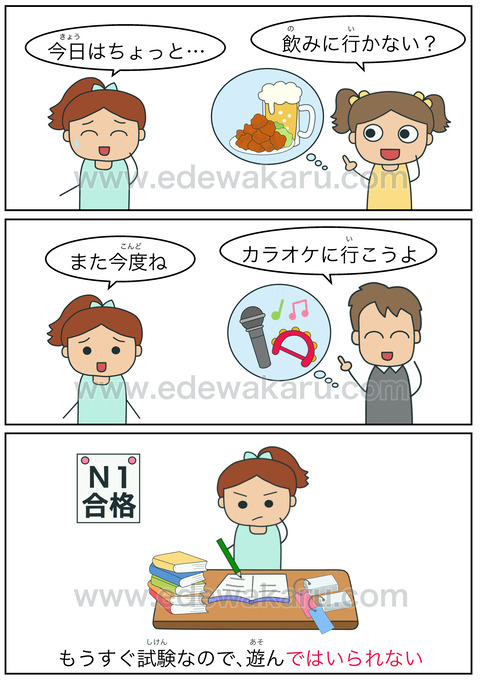
Meaning
Cannot continue being in the state of ~
Not in a state where one can ~
How to use it
Verb [て-form] + てはいられない
Explanation
“〜てはいられない” is a sentence pattern meaning “cannot continue being in the state of ~.” It is used when you lack the time or emotional leeway and want to say “I can’t continue being in this state,” as in “I can’t ~ because there’s no time” or “given the situation, I can’t keep doing ~.” It is also used when the speaker wants to express the feeling that “it’s no good to stay in this state.” In spoken language, “〜ちゃいられない,” “〜ていられない” (omitting [は]), and “〜てられない” (omitting [い] and [は]) are also used. The polite form is “〜てはいられません.”
[Examples]
遊ん
ではいられない
= 遊ん
じゃいられない
= 遊ん
でいられない
= 遊ん
でられない
= 遊ん
ではいられません
A similar pattern is “〜てばかりはいられない・〜てばかりもいられない,” so let’s learn that too 😊
In context 5 examples
もうすぐ試験なので、遊んではいられない
→遊んでいられる状態ではないThe exam is coming up soon, so I can’t keep playing. →I’m not in a position to keep playing.
彼女が悲しんでいるのを見てはいられなかった
→見ていることができる状態ではないI couldn’t bear to watch her being sad. →I’m not in a state where I can watch.
今日は大事な会議があるから、休んではいられない
→休める状態ではないI have an important meeting today, so I can’t take the day off. →I’m not in a position to take the day off.
バカだと言われて、黙ってはいられなかった
→黙っている状態を続けられなかったWhen I was called stupid, I couldn’t just stay silent. →I couldn’t keep staying silent.
嫌だからといって、いつまでも逃げてはいられない
→いつまでも逃げている状態を続けていてはダメだJust because you don’t like it, you can’t keep running away forever. →You can’t go on running away forever.
Read the original source text
Meaning
〜の状態を続けることはできない
〜できる状態ではない
How to use it
動詞[て形]+てはいられない
Explanation
「〜てはいられない」は「〜の状態を続けることはできない」という意味の文型です。「時間がないので〜できない」「状況を考えると〜し続けることはできない」というように、【時間】や【気持ち】に余裕がなくて「このまま〜の状態を続けられない」と言いたい時に使います。話者が「この状態のままではダメだ」と思っている気持ちを表したい場合にも使われます。話し言葉では
「〜ちゃいられない」「〜ていられない([は]の省略)」「〜てられない([い]と[は]の省略)」
も使われます。また、丁寧形は
「〜てはいられません」
になります。
[例]
遊ん
ではいられない
=遊ん
じゃいられない
=遊ん
でいられない
=遊ん
でられない
=遊ん
ではいられません
似ている文型に「〜てばかりはいられない・〜てばかりもいられない」がありますので、一緒に覚えておきましょう😊
Usage 2
Read this source entry ↗Meaning
Cannot continue being in the state of ~
Not in a state where one can ~
How to use it
Verb [て-form] + てはいられない
Explanation
“〜てはいられない” is a sentence pattern meaning “cannot continue being in the state of ~.” It is used when you lack the time or emotional leeway and want to say “I can’t continue being in this state,” as in “I can’t ~ because there’s no time” or “given the situation, I can’t keep doing ~.” It is also used when the speaker wants to express the feeling that “it’s no good to stay in this state.” In spoken language, “〜ちゃいられない,” “〜ていられない” (omitting [は]), and “〜てられない” (omitting [い] and [は]) are also used. The polite form is “〜てはいられません.”
[Examples]
遊ん
ではいられない
= 遊ん
じゃいられない
= 遊ん
でいられない
= 遊ん
でられない
= 遊ん
ではいられません
A similar pattern is “〜てばかりはいられない・〜てばかりもいられない,” so let’s learn that too 😊
In context 5 examples
もうすぐ試験なので、遊んではいられない
→遊んでいられる状態ではないThe exam is coming up soon, so I can’t keep playing. →I’m not in a position to keep playing.
彼女が悲しんでいるのを見てはいられなかった
→見ていることができる状態ではないI couldn’t bear to watch her being sad. →I’m not in a state where I can watch.
今日は大事な会議があるから、休んではいられない
→休める状態ではないI have an important meeting today, so I can’t take the day off. →I’m not in a position to take the day off.
バカだと言われて、黙ってはいられなかった
→黙っている状態を続けられなかったWhen I was called stupid, I couldn’t just stay silent. →I couldn’t keep staying silent.
嫌だからといって、いつまでも逃げてはいられない
→いつまでも逃げている状態を続けていてはダメだJust because you don’t like it, you can’t keep running away forever. →You can’t go on running away forever.
Read the original source text
Meaning
〜の状態を続けることはできない
〜できる状態ではない
How to use it
動詞[て形]+てはいられない
Explanation
「〜てはいられない」は「〜の状態を続けることはできない」という意味の文型です。「時間がないので〜できない」「状況を考えると〜し続けることはできない」というように、【時間】や【気持ち】に余裕がなくて「このまま〜の状態を続けられない」と言いたい時に使います。話者が「この状態のままではダメだ」と思っている気持ちを表したい場合にも使われます。話し言葉では
「〜ちゃいられない」「〜ていられない([は]の省略)」「〜てられない([い]と[は]の省略)」
も使われます。また、丁寧形は
「〜てはいられません」
になります。
[例]
遊ん
ではいられない
=遊ん
じゃいられない
=遊ん
でいられない
=遊ん
でられない
=遊ん
ではいられません
似ている文型に「〜てばかりはいられない・〜てばかりもいられない」がありますので、一緒に覚えておきましょう😊
日本語文型辞典
Meaning
“Nでいる” means to remain in the state of being N, while “いられない” means that one cannot continue in the same state indefinitely.
It expresses that, because the situation is urgent, one must not continue doing that, or wants to act quickly. It is often accompanied by adverbs such as “のんびり,” “うかうか,” and “じっと.”
How to use it
Nではいられない
V-てはいられない
In context 12 examples
きみは大人になりたくないと言うが、人はいつまでも子供ではいられない。
You say you don’t want to grow up, but people can’t remain children forever.
ずっと大学にいたいが、いつまでも学生のままではいられない。
I want to stay at university forever, but I can’t remain a student indefinitely.
わたしは同級生の彼と友達でいたいのに、彼はこのままではいられないと言う。
I want to stay friends with my classmate, but he says he can’t go on like this.
ずっとお世話になりっぱなしではいられないし、仕事を探すつもりです。
I can’t keep relying on people indefinitely, so I’m planning to look for a job.
時間がないから、遅れて来る人を待ってはいられない。すぐ始めよう。
We don’t have time, so we can’t wait for people who are late. Let’s start right away.
A:すっかりよくなるまで寝ていないと。
B:こんなに忙しいときに寝てはいられないよ。A: You should stay in bed until you’re completely better. B: I can’t stay in bed when I’m this busy.
あしたは試験だから、こんなところでのんびり遊んではいられない。
I have an exam tomorrow, so I can’t relax and play around here.
今晩はお客が何人か来るし、テニスなんかしてはいられない。早く買い物に行かなければならない。
We have several guests coming over tonight, so I can’t play tennis or anything. I have to go shopping soon.
今うちの商品はよく売れているが、うかうかしてはいられない。新しい製品がどんどん出てくるからだ。
Our products are selling well now, but we can’t afford to be complacent. New products keep coming out.
この事態を傍観してはいられない。
We can’t just stand by and watch this situation.
スキーのシーズンが始まると、わたしはじっとしてはいられない。
When ski season starts, I can’t sit still.
こうしてはいられない。早く、知らせなくちゃ。
I can’t stay like this. I have to let them know quickly.
Read the original source text
Meaning
「Nでいる」は、Nという状態にとどまるという意味で、「いられない」で、ずっと同じ状態を続けることはできないという意味。
切迫した状況なので、そのようなことを続けるのはいけない、あるいは、急いで行動に移りたいという意味を表す。「のんびり」「うかうか」「じっと」などの副詞を伴うことが多い。
How to use it
Nではいられない
V-てはいられない
日本語文型辞典 英語版
Meaning
Nでいる means that the subject will remain in the condition signified by N; use of いられない indicates that the present situation cannot continue as it is.
B:こんなに忙しいときに寝てはいられないよ。
There’s no way I can stay in bed when I’m this busy.
Used to indicate situations of urgency which should not continue, or for which quick action is desired. Often accompanied by adverbs such as のんびり (in a leisurely manner), うかうか (carelessly), and じっと (fixedly, steadily).
How to use it
1. Nではいられない
2. V-てはいられない
In context 12 examples
きみは大人になりたくないと言うが、人はいつまでも子供ではいられない。
You may say that you don’t want to become an adult, but no one can stay a child forever.
ずっと大学にいたいが、いつまでも学生のままではいられない。
I want to stay in college longer, but I can’t be a student for the rest of my life.
わたしは同級生の彼と友達でいたいのに、彼はこのままではいられないと言う。
Even though I want to stay friends with that classmate, he says it isn’t possible to go on like this.
ずっとお世話になりっぱなしではいられないし、仕事を探すつもりです。
I really shouldn’t stay here forever taking advantage of your generosity, so I intend to look for a job.
時間がないから、遅れて来る人を待ってはいられない。すぐ始めよう。
There’s no time, so we can’t wait for latecomers. Let’s get started right away.
A:すっかりよくなるまで寝ていないと。
You should stay in bed until you’ve recovered completely.
あしたは試験だから、こんなところでのんびり遊んではいられない。
I can’t relax and have a good time with a big test coming up tomorrow.
今晩はお客が何人か来るし、テニスなんかしてはいられない。早く買い物に行かなければならない。
I have guests coming this evening, so playing tennis is out of the question. I have to go shopping right away.
今うちの商品はよく売れているが、うかうかしてはいられない。新しい製品がどんどん出てくるからだ。
Our product is selling well now, but we can’t afford to get careless. There are new products coming out one after the other, you know.
この事態を傍観してはいられない。
I can’t just sit back and watch this situation from the sidelines.
スキーのシーズンが始まると、わたしはじっとしてはいられない。
Once the skiing season starts, I can’t keep still.
こうしてはいられない。早く、知らせなくちゃ。
We can’t go on like this. We’ve got to hurry up and tell them what happened.
Read the original source text
Meaning
Nでいる means that the subject will remain in the condition signified by N; use of いられない indicates that the present situation cannot continue as it is.
B:こんなに忙しいときに寝てはいられないよ。
There’s no way I can stay in bed when I’m this busy.
Used to indicate situations of urgency which should not continue, or for which quick action is desired. Often accompanied by adverbs such as のんびり (in a leisurely manner), うかうか (carelessly), and じっと (fixedly, steadily).
How to use it
1. Nではいられない
2. V-てはいられない
日本語NET JLPT文法解説まとめ
Meaning
Cannot continue to maintain the current state.
Used when one is in a state of having no time or mental leeway, and wants to say one cannot keep things as they are.
How to use it
V(て-form)+ はいられない
Explanation
It's used to convey the lack of time or mental capacity to sustain the current situation, indicating an inability to do so.
・The casual way of saying it is 「〜てちゃいられない」.
・In speech, は is often omitted, as in 「〜ていられない」, or both は and い are omitted, as in 「〜てられない」.
In context 10 examples
もういい年だし、いつまでも親に頼ってはいられない。
I'm old enough now, and I can't keep relying on my parents forever.
これ以上ぐずぐずしてはいられない。
We can't keep dawdling any longer.
もう1時間も待ってるのにまだ来ない。もうこれ以上待ってはいられないよ。
I've already been waiting for an hour, but they still haven't come. I can't wait any longer.
給料は安いし、お金が無いから贅沢は言ってられない。
My salary is low and I don't have any money, so I can't afford to be picky.
あと半年で試験だから、のんびりしてはいられない。
The exam is in six months, so I can't take it easy.
納期までもう時間が無いから、休んではいられない。
There's not much time left before the deadline, so I can't take a break.
もうすぐ試験だから遊んでちゃいられない。勉強に集中しなきゃ。
The exam is coming up soon, so I can't just play around. I have to focus on studying.
危なすぎて、見てられないよ。私が切るから包丁貸して。
It's too dangerous to watch. Give me the knife; I'll cut it.
友達が虐められている姿を見て、僕は黙ってはいられなかった。
Seeing my friend being bullied, I couldn't stay silent.
森林の火災で動物たちが苦しむ姿を見てはいられなかった。
I couldn't bear to watch the animals suffer in the forest fire.
Read the original source text
Meaning
このままの状態を維持し続けることはできない
時間的に、あるいは精神的に余裕がない状態にあり、そうすることができないと言いたい時に使う。
How to use it
V(テ形)+ はいられない
Explanation
It's used to convey the lack of time or mental capacity to sustain the current situation, indicating an inability to do so.
・カジュアルな言い方は「〜てちゃいられない」
・話す時は「〜ていられない」のように「は」を省略したり、「〜てられない」のように「は」と「い」を省略して使うことが多い。
NINJAL 日本語文型データベース
Meaning
Expresses that because the situation is urgent (for example, because there is no time), one must not act in a way such as ~.
How to use it
Vてはいられない
Notes
It is often used with adverbs such as “ゆっくり・のんびり・うかうか・じっと.”
In context 6 examples
明日は英語のテストがあるから、ゆっくりしてはいられない。早く単語を覚えなくてはいけない。
I have an English test tomorrow, so I can’t take it easy. I have to memorize the vocabulary quickly.
「待ち合わせまで時間がないんです。のんびりしてはいられません」
“There isn’t much time before we’re supposed to meet. We can’t take it easy.”
「今日はお客さんが来るから、いつものように昼まで寝てはいられません。料理の準備があるんです」
“We have guests coming today, so I can’t sleep until noon like I usually do. I have to get the food ready.”
「資格試験は来週なのだから、いつまでも休んではいられませんよ」
“The certification exam is next week, so you can’t keep taking a break forever.”
レポートの締切は明後日だから、こんなふうに家でゆっくりしてはいられない。
The report is due the day after tomorrow, so I can’t relax at home like this.
次から次へと仕事を依頼される。1つのミスにいつまでも悩んではいられない。早く次の仕事を片付けなきゃ。
I keep getting one job after another. I can’t dwell forever on one mistake. I have to finish the next job quickly.
Read the original source text
Meaning
(時間がないなど)切迫した状況なので、~のような行動をしてはいけないという意味を表します。
How to use it
Vてはいられない
Notes
「ゆっくり・のんびり・うかうか・じっと」などの副詞と使うことが多いです。
毎日のんびり日本語教師
How to use it
Verb て-form + てはいられない
Verb て-form + てもいられない
Verb て-form + ばかりはいられない
Verb て-form + ばかりもいられない
Explanation
Expresses that, because the situation is urgent, it is difficult to continue as before. This sentence pattern conveys the speaker’s strong anxiety and impatience about the current situation, as well as their will to change it.
It is based on the grammar ~でいる, which means to remain in that state. Example sentences (6).
・I want to stay a child.
・No one can remain a child forever.
「居ても立ってもいられない」(to be unable to sit or stand still, to be extremely restless) is an idiomatic expression.
Notes
The 「ばかり」 series
In context 14 examples
こうしてはいられない。早く行こう。
We can’t go on like this. Let’s hurry.
いつまでも嫌いなことから逃げてはいられない。(不能总是逃避讨厌的事情。)
You can’t keep running away from things you dislike forever. (You can’t always avoid the things you hate.)
仕事もまだ残ってるから、休んでもいられない。
I still have work left, so I can’t take a break.
試験も近いし遊んではいられない。
Exams are coming up, so I can’t goof off.
事態は刻一刻と変化しており、のんびりしてはいられない。
The situation is changing moment by moment, so we can’t take it easy.
人は誰も子供のままではいられない。
No one can remain a child forever.
やらないといけないことが多くて遊んでばかりもいられない。
I have so many things I need to do that I can’t just keep playing.
人生は甘いこと言ってばかりもいられない。
Life doesn’t let you go on saying only nice things.
ずっと泣いてばかりもいられないから、前に進むしかないと思っている。
I can’t keep crying forever, so I think I have no choice but to move forward.
まず一勝できたけど、喜んでばかりもいられない。次は強豪だ。
We managed to win once, but we can’t just celebrate. Our next opponent is a powerhouse.
嫌な事には極力関わりたくないけど、ずっと逃げてばかりもいられない。
I want to avoid unpleasant things as much as possible, but I can’t keep running away forever.
奨学金返済とか貯金とか考えると、笑ってばかりもいられない。
When I think about repaying my student loans and saving money, I can’t just keep laughing.
昇進はしたが仕事が増えそうなので喜んでばかりはいられない。
I got promoted, but it looks like I’ll have more work, so I can’t just be happy about it.
今回は何とかなったが、次もあるし安心してばかりもいられない。
We managed to get through it this time, but there’s a next time, too, so we can’t just relax.
Read the original source text
How to use it
動て形+てはいられない
動て形+てもいられない
動て形+ばかりはいられない
動て形+ばかりもいられない
Explanation
状況が緊迫しているため、以前の状態の継続が困難であることを表します。話者の現状に対する強い不安や焦燥感、更にその現状を変えようとする意志も感じられる文型です。
その状態を保つ意味を表す文法「~でいる」が元になっています。例文(6)。
・子どものままでいたい。
・誰も子どものままではいられない。
「居ても立ってもいられない(坐立不安/坐卧不宁)」は慣用表現です。
Notes
「ばかり」シリーズ