DoJG 日本語文法辞典(全集)
Meaning
Intend to ~; be convinced that ~; believe; feel sure that ~; be going to; mean
How to use it
(i) Vinformal | つもりだ | |
| {話す /話した} つもりだ | Intend to talk/someone is convinced he talked |
(ii) Adjective い informal nonpast | つもりだ | |
| 強いつもりだ | Someone is convinced that he is strong |
(iii) Adjective な stem | なつもりだ | |
| 元気なつもりだ | Someone is convinced that he is healthy |
(iv) Noun | のつもりだ | |
| 先生のつもりだ | Someone is convinced that he is a teacher |
Explanation
An intention or conviction of a speaker (or a person with whom the speaker can empathise) about his future or past actions or current state.
In context 11 examples
私は来年結婚するつもりだ・です。
I intend to get married next year.
父はまだ若いつもりだ・です。
My father is convinced that he is still young.
私はよく読んだつもりだ・です。
I'm convinced that I read it carefully.
これはお礼のつもりだ・です。
This is my intention of appreciation.
休みには何をするつもりですか。
What do you intend to do during the vacation?
僕は大学に行くつもりはない。
I have no intention of going to college.
あんな人にはもう会わないつもりです。
I do not intend to see that kind of person.
私はまだ元気なつもりだ。
I'm convinced that I'm still healthy.
話したつもりでしたが、話さなかったんですね。
I thought I talked to you about it, but I didn't, did I?
この仕事は遊びのつもりです。
This work is intended to be a pastime.
それで勉強しているつもりですか。
Are you sure you can study like that?
日本語文型辞典
Meaning
a. V-る/V-ないつもりだ
Expresses intention or resolve. The intention may be that of the speaker or a third party. “V-ないつもりだ” indicates the intention not to perform an action. When the verb is omitted, “その” is added, as in ⑤. Saying “はい、つもりです” is incorrect.
b. V-るつもりはない
Used to deny that the speaker has the intention to do something. When using this expression, the speaker assumes an action that the listener might expect or anticipate in the situation, then denies having any intention of doing that. As in ③ and ④, the speaker may mention what the listener is likely to expect as a preface.
c. V-るつもりではない
Used to deny that the speaker has the intention to do something. It is often used to explain or defend oneself by saying, “I really don't/didn't mean that,” when one's actions or attitude may cause a misunderstanding. It can be rephrased as “つもりはない.”
d. V-るつもりで
Means “with that intention.”
a. …つもりだ [belief]
When the subject is first person, this means that the speaker thinks or believes this; it does not matter whether that differs from what other people consider to be true.
b. …つもりだ [contrary to fact]
When the subject is second or third person, this means that what the person believes differs from what the speaker or others consider to be true.
c. V-たつもりはない
Used to deny another person's interpretation or judgment of one's actions. ③ can also be expressed as “そんなつもりはないんだけどな.”
Means to suppose something hypothetically as a premise for doing an action. It can be paraphrased as “considering it done,” “thinking of it as done,” or “assuming it has been done.” “死んだつもりで” is an idiomatic expression describing doing something with strong determination, as if one were already dead.
How to use it
V-るつもり
…つもりだ
Nのつもりだ
Naなつもりだ
Aつもりだ
V-た/V-ている つもりだ
V-たつもりで
In context 34 examples
来年はヨーロッパヘ旅行するつもりだ。
I intend to travel to Europe next year.
友達が来たら、東京を案内するつもりだ。
If my friend comes, I intend to show them around Tokyo.
たばこは、もう決してすわないつもりだ。
I intend never to smoke again.
山本さんも参加するつもりだったのですが、都合で来られなくなってしまいました。
Mr. Yamamoto had intended to participate too, but circumstances made it impossible for him to come.
A:これから、美術館へもいらっしゃいますか。
B:ええ、そのつもりです。A: Will you be visiting the art museum as well from here? B: Yes, that's the plan.
この授業を聴講してみたい。続けて出るつもりはないけれど。
I'd like to sit in on this class, though I don't intend to keep attending.
趣味で措いていた絵が展覧会で入選して、売れたが、プロになるつもりはない。
A painting I had done as a hobby was selected for an exhibition and sold, but I don't intend to become a professional.
今すぐ行くつもりはないが、アメリカのことを勉強しておきたい。
I don't intend to go right now, but I want to study about America beforehand.
この失敗であきらめるつもりはないけれど、やはりひどくショックなのには変わりがない。
I don't intend to give up because of this failure, but it doesn't change the fact that I'm deeply shocked.
このけんかはあの人達が始めたことで、わたしにはそんなことをするつもりは全くなかったんです。
Those people started this fight; I had absolutely no intention of doing anything like that.
A:この条件で何とか売っていただけないでしょうか。
B:いくらお金をもらっても、この土地を売るつもりはない。帰ってください。A: Could you possibly sell it to me at this price? B: No matter how much money you offer me, I have no intention of selling this land. Please leave.
すみません、あなたの邪魔をするつもりではなかったんです。
I'm sorry; I didn't mean to get in your way.
A:彼はあなたが批判したといって気にしていましたよ。
B:あの、そんなつもりではなかったんです。A: He was upset, saying you'd criticized him. B: I, um, didn't mean it that way.
今日限りでやめるつもりで、上司に話しに行った。
Intending to quit as of today, I went to talk to my supervisor.
彼女は彼と結婚するつもりでずっと待っていた。
She had been waiting all along, intending to marry him.
今回の試合には絶対負けないつもりで練習に励んで来た。
I have been practicing hard, intending absolutely not to lose this match.
ミスが多かったが、今日の試合は練習のつもりだったからそれほど気にしていない。
I made a lot of mistakes, but I don't mind that much because I intended today's match to be practice.
まだまだ元気なつもりだったけど、あの程度のハイキングでこんなに疲れてしまうとはねえ。もう年かなあ。
I thought I was still full of energy, but I can't believe I got this tired from a hike of that length. I guess I'm getting old.
まだまだ気は若いつもりだよ。
I still think of myself as young at heart.
よく調べて書いたつもりですが、まだ間違いがあるかもしれません。
I believe I researched and wrote it carefully, but there may still be mistakes.
A:君の仕事ぶり、評判いいよ。
B:そうですか。ありがとうございます。お客様にご満足いただけるよう、毎日ベストをつくしているつもりです。A: People have a good opinion of your work. B: Is that so? Thank you. I believe I do my best every day to satisfy our customers.
なによ、あの人、女王のつもりかしら。
Honestly, does that person think she's a queen or something?
あの人は自分では有能なつもりだが、その仕事ぶりに対する周囲の評価は低い。
He thinks he's capable, but those around him have a low opinion of his work.
彼女のあの人を小ばかにしたような態度は好きじゃないな。自分ではよほど賢いつもりなんだろうけどね。
I don't like the way she acts as if she looks down on that person. She must think she's awfully smart, though.
君はちゃんと説明したつもりかもしれないが、先方は聞いてないといっているよ。
You may think you explained it properly, but the other party says they didn't hear you.
彼女はすべてを知っているつもりだが、本当は何も知らない。
She thinks she knows everything, but in reality she knows nothing.
私はそんなことを言ったつもりはない。
I don't intend to have said anything like that.
あの人、怒ってるの?からかったつもりはないんだけどねえ。
Is that person angry? I didn't mean to tease them.
A:彼、あなたに服をほめられたって喜んでたわよ。
B:こまったな。ほめたつもりはないんだけどな。A: He was happy, saying you complimented his clothes. B: Oh dear. I didn't mean it as a compliment.
旅行したつもりで、お金は貯金することにした。
I decided to save the money as if I had gone on a trip.
学生たちはプロのモデルになったつもりで、いろいろなポーズをとった。
The students struck various poses as if they had become professional models.
昔にもどったつもりで、もう一度一からやり直してみます。
I'll try starting over from scratch as if I had gone back to the past.
完成までまだ一週間かかるのに、もう終わったつもりで、飲みに行った。
It will still take a week to finish, but I went out drinking as if it were already done.
死んだつもりで頑張ればできないことはない。
If you try hard as if your life depended on it, there's nothing you can't do.
Read the original source text
Meaning
a. V-る/V-ないつもりだ
意志、意図を表す。話し手の意志でも、第三者の意志でもかまわない。「V一ないつもりだ」は、ある行為を行わないという意志を示す。また、動詞部分を省略する場合は、⑤のように「その」をつける。「はい、つもりです」というのは間違い。
b. V-るつもりはない
話し手の「…しよう」という意志の存在を否定するのに用いる。この表現を用いる場合、話し手は、その状況で聞き手が予想あるいは期待しそうな行為を想定した上で、そのようなことをする意志はな いと否定する。③④のように、聞き手の予測しそうな内容について述べて、前置きとする場合もある。
c. V-るつもりではない
話し手の「…しよう」という意志の存在を否定するのに用いる。自分のとった行為や態度について誤解を招きそうな場合に、「本当はそんな意図はない/なかった」と弁解したり、自己弁護したりするために用いることが多い。「つもりはない」に言いかえられる。
d. V-るつもりで
「そういう意志をもって」の意味。
a. …つもりだ【信念】
主語が1人称の場合、話し手がそう思っている、そう信じている、という意味を表し、それが他の人が事実だと考えることとくいちがっているかどうかは関係がない。
b. …つもりだ【反事実】
主語が2人称や3人称の場合、その人が信じていることが(話し手や他の人の考える)事実とくいちがっている、という意味。
c. V-たつもりはない
自分の行為に対する相手の解釈・判断を否定する場合に使う。③は「そんなつもりはないんだけどな」とも言える。
ある行為をする前提として、仮に想定してという意味を表す。「したと見なして、したと考えて」「したと仮定して」などに言いかえられる。「死んだつもりで」は強い決心で何かをする様子を表す慣用的表現。
How to use it
V-るつもり
…つもりだ
Nのつもりだ
Naなつもりだ
Aつもりだ
V一た/V-ている つもりだ
V-たつもりで
絵でわかる日本語
Usage 1
Read this source entry ↗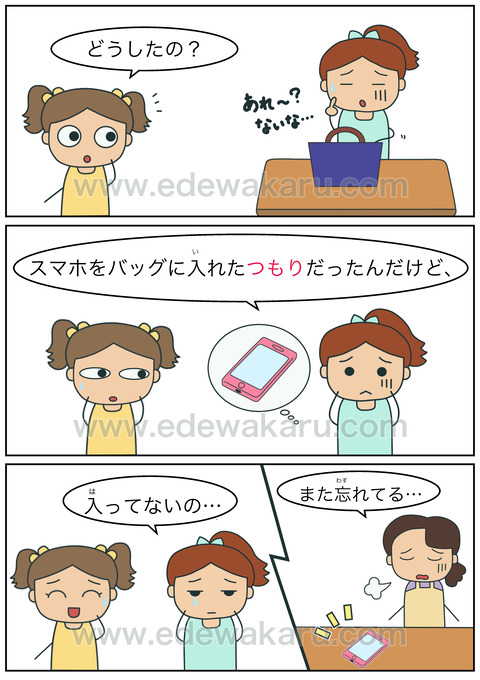
Meaning
I thought ~, but in reality it wasn’t ~
I thought I had done ~, but in reality I hadn’t
How to use it
Verb [た-form or ている-form] + つもり
い-adjective [ーい] + つもり
な-adjective [ーな] + つもり
Noun [dictionary form] + のつもり
Explanation
「〜つもり」 means “I thought ~, but in reality it wasn’t ~” or “I thought I had done ~, but in reality I hadn’t.” It is used when what you thought differs from the facts. The form 「〜つもりだったが、〜だった」 is often used.
There are many grammar patterns with 「つもり」, so let’s review them. 😊
[Grammar patterns with 「つもり」]
In context 5 examples
A:どうしたの?B:スマホをバッグに入れたつもりだったんだけど、入っていないの…
→スマホを入れたと思っていたが、実際は入れていなかったA: What’s wrong? B: I thought I’d put my phone in my bag, but it isn’t in there… →I thought I’d put my phone in, but in reality I hadn’t.
ちゃんと注意したつもりだったが、まったく伝わらなかったようだ
→注意したと思っていたが、実際はちゃんと注意したことが伝わっていたなかったI thought I’d warned them properly, but it seems my message didn’t get across at all. →I thought the warning had gotten through, but in reality it seems it hadn’t gotten through properly.
彼女:なんでメールしてくれなかったの?彼氏:メールしたつもりだったんだけど、送れてなかったんだ…ごめんね
→メールしたと思っていたが、メールが送れていなかったGirlfriend: Why didn’t you email me? Boyfriend: I thought I’d sent you an email, but it didn’t go through… I’m sorry. →I thought I’d sent an email, but it hadn’t gone through.
娘:お父さん、お母さんはどうして怒っているの?怒らせた?父:今日は帰りが遅くなるって言ったつもりだったんだけど、言ってなかったみたいなんだ娘:なるほど。それで怒っていたのね
→遅くなると言ったと思っていたが、言っていなかったみたいだDaughter: Dad, why is Mom angry? Did you make her angry? Father: I thought I told her I’d be home late today, but it seems I didn’t. Daughter: I see. That’s why she was angry. →I thought I’d told her I’d be late, but it seems I hadn’t.
秘密にしていたつもりだが、バレていた
→秘密にしていると思っていたが、バレていたI thought I’d kept it a secret, but they found out. →I thought I was keeping it secret, but they found out.
Read the original source text
Meaning
〜と思っていたが、実際は〜ではなかった
〜したと思っていたが、実際は〜していなかった
How to use it
動詞[た形・ている形]+つもり
い形容詞[ーい]+つもり
な形容詞[ーな]+つもり
名詞[辞書形]+のつもり
Explanation
「〜つもり」は「〜したと思っていたが、実際は〜していなかった」「〜と思っていたが、実際は〜ではなかった」という意味の文型です。 自分が思っていたことと、事実が違うという時に使われます。「〜つもりだったが、〜だった」という形がよく使用されます。
「つもり」がつく文型はたくさんありますので、復習しておきましょう😊
【「つもり」がつく文型】
Usage 2
Read this source entry ↗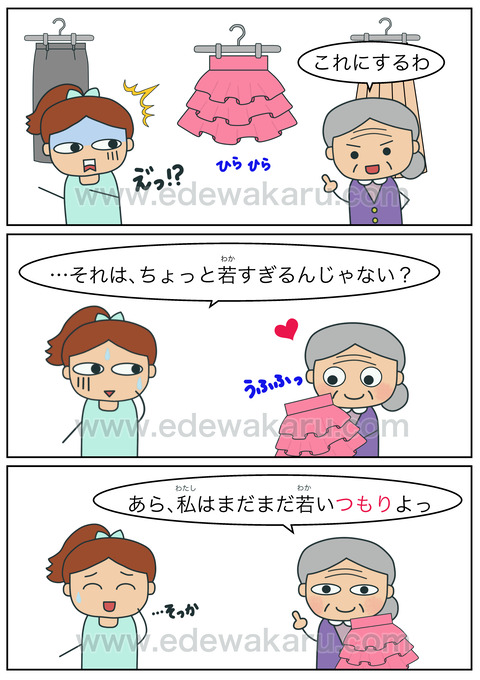
Meaning
others may not think ~, but I think ~
in reality, it isn’t ~, but I alone think ~
How to use it
Verb [た-form or ている-form] + つもり
い-adjective [ーい] + つもり
な-adjective [ーな] + つもり
Noun [dictionary form] + のつもり
Explanation
「Aつもり」 means “others may not think A, but I think A” or “in reality, it isn’t A, but I alone think A.” It is used when you want to say, “I think A!” or “I believe A,” regardless of what others think or whether it differs from the facts.
[Examples]
①I still consider myself young~
→I’m not actually young, but I think I’m still very young.
②Even though I thought I’d studied hard…
→Others may not think I studied properly, but I think I studied hard.
③I think I’m doing my best in my own way.
→Others may not think I’m doing my best, but I think I am.
④I thought I was in good shape, but the fact that I get tired just from walking the dog shows I’m getting old…
→I thought I was healthy, but it seems I wasn’t actually that healthy or young.
There are many grammar patterns with 「つもり」, so let’s review them. 😉
[Grammar patterns with 「つもり」]
In context 4 examples
孫:そのスカートはおばあちゃんには若すぎるんじゃない?おばあちゃん:あら、私はまだまだ若いつもりよ〜
Grandchild: Isn’t that skirt too young for you, Grandma? Grandmother: Oh, I still consider myself young~
母:70点?もっとしっかり勉強しなさい!娘:私は一生懸命(いっしょうけんめい)勉強したつもりなのに…
Mother: 70 points? Study harder! Daughter: But I thought I’d studied as hard as I could…
私なりにがんばっているつもりです
I think I’m doing my best in my own way.
元気なつもりだったが犬の散歩に行っただけで疲れてしまうとは、私も年をとったものだ…
I thought I was in good shape, but the fact that I get tired just from walking the dog shows I’m getting old…
Read the original source text
Meaning
みんなは〜と思っていないかもしれないが、自分は〜と思っている
実際は〜ではないが、自分だけが〜と思っている
How to use it
動詞[た形・ている形]+つもり
い形容詞[ーい]+つもり
な形容詞[ーな]+つもり
名詞[辞書形]+のつもり
Explanation
「Aつもり」は「みんなはAと思っていないかもしれないが、自分はAと思っている」「実際はAではないが、自分だけがAと思っている」という意味の文型です。他の人がどう思っているかや、事実とは違っていることでも関係なく、「私はAと思っている!」「自分はAと信じている」と言いたい時に使われます。
[例]
①私はまだまだ若い
つもり
よ〜
→実際は若くないが、私はまだまだ若いと思っているよ
②私は一生懸命勉強した
つもり
なのに…
→みんなはちゃんと勉強したと思っていないかもしれないが、私は一生懸命勉強したと思っている
③私なりにがんばっている
つもり
です
→みんなはがんばっていると思わないかもしれないが、私はがんばっていると思っている
④元気な
つもり
だったが犬の散歩に行っただけで疲れてしまうとは、私も年をとったものだ…
→元気だと思っていたが、実際はそんなに元気で若くなかったようだ
「つもり」がつく文型はたくさんありますので、復習しておきましょう😉
【「つもり」がつく文型】
Usage 3
Read this source entry ↗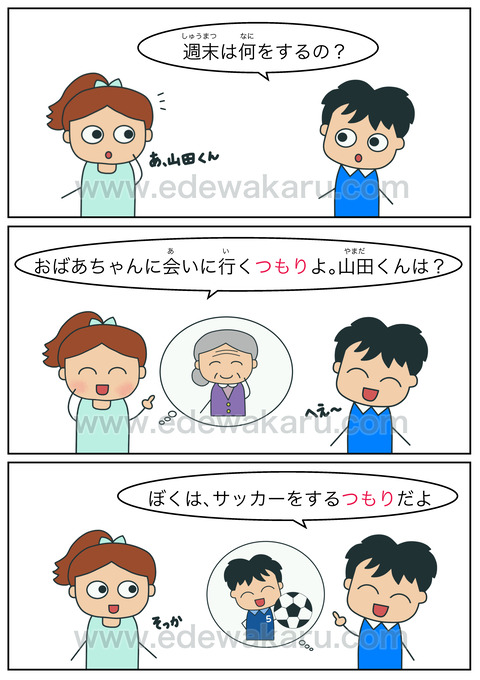
Meaning
Expresses intention or a plan.
How to use it
Verb [dictionary form] + つもり
Verb [ない-form] + つもり
Explanation
“〜つもり” is a sentence pattern that expresses “intention or a plan.” It often expresses the speaker’s intention, but it can also express a third party’s intention. When expressing a third party’s intention, it often conveys a sense of conjecture. Also, when the verb is omitted in conversation, it becomes “そのつもり.”
[Example]
A: Are you going to the party today?
B: Yeah, that’s the plan~
(= Yeah, I’m planning to go~)
There are many sentence patterns that include “つもり,” so review them 😉
In context 6 examples
A:週末は何をするの?B:おばあちゃんに会いに行くつもりだよ〜
→「おばあちゃんに会いに行く」という予定A: What are you doing this weekend? B: I’m planning to go see my grandma. → A plan to “go see my grandma”.
来年、日本に留学するつもりだ
→「来年、日本に留学する」という意志・計画I plan to study abroad in Japan next year. → The intention and plan to “study abroad in Japan next year.”
卒業しても、日本語の勉強は続けるつもりです
→「日本語の勉強は続ける」という意志Even after I graduate, I plan to keep studying Japanese. → The intention to “keep studying Japanese.”
雨が降ったら、イベントには行かないつもりだ
→「雨が降ったら行かない」という予定If it rains, I don’t plan to go to the event. → A plan not to go if it rains.
もう二度とお酒を飲まないつもりだ
→「もう二度とお酒を飲まない」という意志I don’t plan to drink alcohol ever again. → The intention to “never drink alcohol again.”
あ、山田くんったら、また掃除をサボるつもりよ!
→「掃除をサボろう」という山田くんの意志Oh, Yamada is planning to skip cleaning again! → Yamada’s intention to “skip cleaning.”
Read the original source text
Meaning
意志や計画を表す
How to use it
動詞[辞書形]+つもり
動詞[ない形]+つもり
Explanation
「〜つもり」は「意志や計画」を表す文型です。話し手の意志を表す場合が多いですが、第三者の意志を表すこともあります。第三者の意志を表す場合は、推量の気持ちを込めて使われることが多いです。また、会話で動詞を省略する場合は
「そのつもり」
になります。
[例]
A:今日のパーティーに参加する?
B:うん、
そのつもり
だよ〜
(=うん、参加するつもりだよ〜)
「つもり」がつく文型はたくさんありますので、復習しておきましょう😉
日本語文型辞典 英語版
Meaning
B:ええ、そのつもりです。
Yes, that’s my plan.
Expresses will/intention. Can be used either for the speaker’s will or that of a third person. V-ないつもりだ expresses the intention of not doing a certain act. When omitting the verb, その is attached, as in example
(5)
. はい、つもりです is an incorrect usage.
b. V-るつもりはない
B:いくらお金をもらっても、この土地を売るつもりはない。帰ってください。
I don’t want to sell this land no matter how much money I receive. Please go away.
Used to deny the speaker’s intention to do something. When using this sentence pattern, the speaker denies his intention to do what the listener is likely to predict or expect under a certain circumstance. In some cases, as in examples
(3)
and
(4)
, つもり is used when the speaker describes what the listener is likely to expect first, at the outset.
c. V-るつもりではない
B:あの、そんなつもりではなかったんです。
Oh, I didn’t mean to.
Denies the speaker’s intention to do something. Often used for explanation or self-defense when one’s action or attitude is likely to be misinterpreted, by expressing that one actually doesn’t or didn’t intend to do something. Can be replaced by つもりはない.
d. V-るつもりで
Means “with the intention or will to do....”
B:そうですか。ありがとうございます。お客様にご満足いただけるよう、毎日ベストをつくしているつもりです。
Is that so? Thank you. I have been doing my best in order to have our customers be satisfied.
When the subject is in first person, this expresses the meaning that the speaker thinks so or believes so, regardless of whether this is contrary to what other persons may think.
b. ...つもりだ〈counter-factual〉
When the subject is in the second or third person, this is used to mean that the person’s belief differs from what the speaker or others perceive to be the fact.
c. V-たつもりはない
B:こまったな。ほめたつもりはないんだけどな。
Oh, dear. I didn’t think I was complimenting him, but...
Used for denying one’s perception or judgment about the other’s action. The sentence in
(3)
can be replaced by そんなつもりはないんだけどな.
Expresses the meaning of provisionally imagining something as a prerequisite for an action, and can be replaced by したと見なして, したと考えて or したと仮定して. 死んだつもりで is an idiomatic expression for showing a strong determination to do something.
How to use it
1. V-るつもりa. V-る/V-ない つもりだ
2. ...つもりだ[Nのつもりだ][Na なつもりだ][Aつもりだ][V-た/V-ている つもりだ]a. ...つもりだ〈conviction〉
3. V-たつもりで
In context 34 examples
来年はヨーロッパへ旅行するつもりだ。
I intend to travel to Europe next year.
友達が来たら、東京を案内するつもりだ。
When my friend comes, I intend to guide him around Tokyo.
たばこは、もう決してすわないつもりだ。
I will never smoke again.
山本さんも参加するつもりだったのですが、都合で来られなくなってしまいました。
Yamamoto-san was going to participate, too, but something came up that kept him from coming.
A:これから、美術館へいらっしゃいますか。
Will you be going to the art museum now?
この授業を聴講してみたい。続けて出るつもりはないけれど。
I want to try to attend this lecture. However, I don’t intend to continue attending (future lectures).
趣味で描いていた絵が展覧会で入選して、売れたが、プロになるつもりはない。
The picture I drew for fun was selected for an exhibition and sold, but I have no intention of becoming a professional.
今すぐ行くつもりはないが、アメリカのことを勉強しておきたい。
I don’t intend to go right away, but for now I’d like to study about the U.S.
この失敗であきらめるつもりはないけれど、やはりひどくショックなのには変わりがない。
I don’t intend to quit because of this failure, but that obviously doesn’t change the fact that I’m deeply shocked by it.
このけんかはあの人達が始めたことで、わたしにはそんなことをするつもりは全くなかったんです。
This fight was started by them, and I had no intention of doing anything like that at all.
A:この条件で何とか売っていただけないでしょうか。
Can’t you sell it to me on this condition?
すみません、あなたの邪魔をするつもりではなかったんです。
I’m sorry, I didn’t mean to disturb you.
A:彼はあなたが批判したといって気にしていましたよ。
He was concerned, saying that you criticized it.
今日限りでやめるつもりで、上司に話しに行った。
With the intent to quit this very day, I went to talk to my boss.
彼女は彼と結婚するつもりでずっと待っていた。
Intending to marry him, she waited all the while.
今回の試合には絶対負けないつもりで練習に励んで来た。
I have been practicing hard, definitely intending not to lose this match.
ミスが多かったが、今日の試合は練習のつもりだったからそれほど気にしていない。
There were a lot of mistakes today, but I considered the match today to be practice, so I’m not too concerned.
まだまだ元気なつもりだったけど、あの程度のハイキングでこんなに疲れてしまうとはねえ。もう年かなあ。
I thought I was still in good shape, but to be this exhausted after only that much of a hike...I must be getting old.
まだまだ気は若いつもりだよ。
I still consider myself young in spirit.
よく調べて書いたつもりですが、まだ間違いがあるかもしれません。
I believe I have carefully checked everything I wrote, but there may still be some errors.
A:君の仕事ぶり、評判いいよ。
I have good feedback on the way you work.
なによ、あの人、女王のつもりかしら。
Who does she think she is—a queen?
あの人は自分では有能なつもりだが、その仕事ぶりに対する周囲の評価は低い。
He thinks he’s capable, but the people around him don’t think very much of his work.
彼女のあの人を小ばかにしたような態度は好きじゃないな。自分ではよほど賢いつもりなんだろうけどね。
I don’t like her attitude of belittling him. She may consider herself to be rather clever, but...
君はちゃんと説明したつもりかもしれないが、先方は聞いてないといっているよ。
You may have thought that you had explained it clearly, but they say they weren’t aware of it.
彼女はすべてを知っているつもりだが、本当は何も知らない。
She thinks she knows it all, but in fact she doesn’t know anything.
私はそんなことを言ったつもりはない。
That’s not what I meant to say.
あの人、怒ってるの? からかったつもりはないんだけどねえ。
Is he angry? I didn’t mean to make fun of him, you know.
A:彼、あなたに服をほめられたって喜んでたわよ。
He was pleased, saying that you complimented him on his outfit.
旅行したつもりで、お金は貯金することにした。
I decided to save money, telling myself that I had spent it traveling.
学生たちはプロのモデルになったつもりで、いろいろなポーズをとった。
With the idea that they were professional models, the students struck all sorts of poses.
昔にもどったつもりで、もう一度一からやり直してみます。
I intend to go back into the past and start over again from the beginning.
完成までまだ一週間かかるのに、もう終わったつもりで、飲みに行った。
It will still take a week for completion, and yet he’s gone drinking as if it were completed.
死んだつもりで頑張ればできないことはない。
There’s nothing you can’t do if you’re ready to give it your all (lit. lay down your life) to try it.
Read the original source text
Meaning
B:ええ、そのつもりです。
Yes, that’s my plan.
Expresses will/intention. Can be used either for the speaker’s will or that of a third person. V-ないつもりだ expresses the intention of not doing a certain act. When omitting the verb, その is attached, as in example
(5)
. はい、つもりです is an incorrect usage.
b. V-るつもりはない
B:いくらお金をもらっても、この土地を売るつもりはない。帰ってください。
I don’t want to sell this land no matter how much money I receive. Please go away.
Used to deny the speaker’s intention to do something. When using this sentence pattern, the speaker denies his intention to do what the listener is likely to predict or expect under a certain circumstance. In some cases, as in examples
(3)
and
(4)
, つもり is used when the speaker describes what the listener is likely to expect first, at the outset.
c. V-るつもりではない
B:あの、そんなつもりではなかったんです。
Oh, I didn’t mean to.
Denies the speaker’s intention to do something. Often used for explanation or self-defense when one’s action or attitude is likely to be misinterpreted, by expressing that one actually doesn’t or didn’t intend to do something. Can be replaced by つもりはない.
d. V-るつもりで
Means “with the intention or will to do....”
B:そうですか。ありがとうございます。お客様にご満足いただけるよう、毎日ベストをつくしているつもりです。
Is that so? Thank you. I have been doing my best in order to have our customers be satisfied.
When the subject is in first person, this expresses the meaning that the speaker thinks so or believes so, regardless of whether this is contrary to what other persons may think.
b. ...つもりだ〈counter-factual〉
When the subject is in the second or third person, this is used to mean that the person’s belief differs from what the speaker or others perceive to be the fact.
c. V-たつもりはない
B:こまったな。ほめたつもりはないんだけどな。
Oh, dear. I didn’t think I was complimenting him, but...
Used for denying one’s perception or judgment about the other’s action. The sentence in
(3)
can be replaced by そんなつもりはないんだけどな.
Expresses the meaning of provisionally imagining something as a prerequisite for an action, and can be replaced by したと見なして, したと考えて or したと仮定して. 死んだつもりで is an idiomatic expression for showing a strong determination to do something.
How to use it
1. V-るつもりa. V-る/V-ない つもりだ
2. ...つもりだ[Nのつもりだ][Na なつもりだ][Aつもりだ][V-た/V-ている つもりだ]a. ...つもりだ〈conviction〉
3. V-たつもりで
AIUEO JLPT Grammar
Usage 1
Meaning
This sentence pattern is used to express future intentions or plans, emphasizing the speaker’s intended action or schedule.
How to use it
Verb dictionary form + つもり
In context 5 examples
週末に友達と会うつもりです。
I intend to meet my friends over the weekend.
彼は夏休みに日本語を勉強するつもりです。
He intends to study Japanese during the summer vacation.
彼女は新しいドレスを買うつもりです。
She intends to buy a new dress.
彼は今夜パーティーに行くつもりです。
He intends to go to the party tonight.
今日は、学校に行かないつもりだ。
I'm not going to school today.
Read the original source text
Meaning
This sentence pattern is used to express future intentions or plans, emphasizing the speaker’s intended action or schedule.
How to use it
動詞辞書形+つもり
Explanation · 日本語
この文型は、将来の意図や予定を表すために使われる表現で、話者が意図している行動や予定を強調します。
Usage 2
Meaning
This sentence pattern is used to express that the speaker’s intention or belief differs from reality, or that they are pretending to do something. It emphasizes the discrepancy between the speaker’s intention and the actual situation.
How to use it
Verb た-form + つもり; verb て-form + いる + つもり; adjective dictionary form + つもり; な-adjective + な + つもり; noun + の + つもり
In context 5 examples
その問題は解決しているつもりだった。
I thought that the problem was solved.
若いつもりで無理をしていると、体を壊しますよ。
If you overdo it thinking you’re still young, you’ll harm your health.
彼は冗談のつもりで言ったのだが、みんなに本気にされた。
He said it as a joke, but everyone took it seriously.
彼女は完璧なつもりかもしれないが、誰にでも欠点はある。
She might think she is perfect, but everyone has flaws.
もう終わったつもりだったが、まだ残っていた。
I thought I had finished, but there were still things left to do.
Read the original source text
Meaning
This sentence pattern is used to express that the speaker’s intention or belief differs from reality, or that they are pretending to do something. It emphasizes the discrepancy between the speaker’s intention and the actual situation.
How to use it
動詞た形+つもり動詞て形+いる+つもり形容詞辞書形+つもり形容動詞な+つもり名詞の+つもり
Explanation · 日本語
この文型は、自分が思っていたことと事実が違う場合や、何かをしているふりをすることを表します。自身の考えや意図が現実と異なることを強調します。