AIUEO JLPT Grammar
Meaning
「〜っぱなし」is used when an action or state continues as it is, often implying neglect or incompleteness, and is usually used in negative contexts to draw attention to an unfinished state.
How to use it
Verb masu-stem + っぱなし
In context 5 examples
電気をつけっぱなしにして寝てしまった。
I left the lights on and fell asleep.
ドアを開けっぱなしにしないでください。
Please don’t leave the door open.
水を出しっぱなしですよ。
You forgot to turn off the tap.
車をエンジンかけっぱなしにしておくと、バッテリーが上がるかもしれない。
If you leave the car engine running, the battery might die.
彼はなんでも、やりっぱなし!
He does everything and leaves it at that!
Read the original source text
Meaning
「〜っぱなし」is used when an action or state continues as it is, often implying neglect or incompleteness, and is usually used in negative contexts to draw attention to an unfinished state.
How to use it
動詞ます形+っぱなし
Explanation · 日本語
「〜っぱなし」は、ある動作や状態がそのまま継続していることを表す表現です。通常は、放置や未完了のニュアンスを伴い、否定的な状況や注意を喚起する場合に使われることが多いです。
文法
Meaning
To leave something as it is
Expresses leaving something in that state without doing something that should be done.
How to use it
V (ます-form) ます + っぱなし
Notes
It is often used with a negative meaning and conveys dissatisfaction or exasperation.
In context 13 examples
クーラーをつけっぱなしで寝てしまい、母にさんざん怒られた。
I fell asleep with the air conditioner left on and got scolded badly by my mother.
家に帰ると、妻がテレビをつけっぱなしで寝ていた。
When I got home, my wife was asleep with the TV left on.
もう、だれよ!水を出しっぱなしにしたのは。
Hey, who left the water running?
服が脱ぎっぱなしよ。ちゃんと洗濯機に入れなさい。
Your clothes are lying around. Put them in the washing machine properly.
ポケットにお金を入れっぱなしで洗濯してしまった。
I accidentally did the laundry with money left in my pocket.
さっきからずっと立ちっぱなしだけど、座らなくて大丈夫?
You've been standing this whole time. Are you sure you don't want to sit down?
ガソリンがもったいないから、エンジンのつけっぱなしは良くないよ。
Leaving the engine running is a waste of gas, so it's not a good idea.
また、おもちゃが出しっぱなしだよ。使ったらちゃんと片付けなさい!
The toys are left out again. Put them away properly when you're done with them!
授業中、トムさんとジェシカさんがずっと話っぱなしで困ったよ。
I was annoyed because Tom and Jessica talked nonstop throughout class.
そういえば、図書館の本を借りっぱなしだった。
Come to think of it, I still have the library book I borrowed.
今年が始まってから、ずっとチームは負けっぱなしだ。
Since the beginning of this year, the team has been on a losing streak.
1時間ずっと歩きっぱなしでさすがに疲れた。
I walked for an entire hour without stopping, and I'm finally tired.
ドアを開けっぱなしにしないでください。
Please don't leave the door open.
Read the original source text
Meaning
〜したままだ
すべきことがあるのに、しないでそのままの状態にしてしまうことを表す。
How to use it
V(ます形)ます + っぱなし
Notes
マイナスに意味で使われることが多く、不満や呆れた気持ちが含まれる。
Bunpro Grammar Reference
Meaning
Leaving something in a certain state, Left as is, Keep on -ing
How to use it
Verb[stem]+ っぱなし
Nuance
A grammar point that expresses something left or released in an ongoing state, often negatively.
Explanation
っぱなし is a suffix that originally comes from the う - Verb 放す 'to let loose'. When attached to the conjunctive form of verbs, it is used to indicate that something has been 'left' in a certain state. っぱなし is almost exclusively used negatively.
また電気点けっぱなしじゃん!何回言えば消してくれるの?
You left the light on again! How many times do I have to tell you to turn it off?
冷蔵庫を開けっ放しにしないでください。
Please don't leave the refrigerator open.
歯を磨いている間、水を出しっぱなしにしていたら、お母さんに怒られた。
Because I left the water on while I was brushing my teeth, my mother scolded me.
Fun Fact
Although 放す means 'to let loose', っぱなし conveys a feeling that is closer to 'being unchecked'. This means っぱなし can be used to convey that 'the act of (A)' is continuing without anyone there to stop it, or that the 'state of (A)' is continuing without anyone there to stop it. Which meaning is conveyed will depend mostly on the (A) verb.
勝ちっぱなしだとつまらないね、たまには負けを味わいたい。
Don't you think it is boring to keep winning? I want to taste defeat sometimes. (I want to lose sometimes)
秋の間は窓を開けっぱなしにして寝ています。
During autumn, I sleep with the windows left open.
In context 17 examples
- 誰かがそのドアを開けっ放しにした。
Someone left the door open.
- また電気点けっぱなしじゃん!何回言えば消してくれるの?
You left the light on again! How many times do I have to tell you to turn it off?
- 冷蔵庫を開けっ放しにしないでください。
Please don't leave the refrigerator open.
- 歯を磨いている間、水を出しっぱなしにしていたら、お母さんに怒られた。
Because I left the water on while I was brushing my teeth, my mother scolded me.
- ライトをつけっ放しにしないで。
Don't leave the light on.
- 電話が鳴りっ放しだけど…大丈夫?
Your phone keeps ringing... Is that not a problem?
- いつも開けっ放しで、ちゃんと閉めてよね。
You always leave it open, make sure you close it ok?
- 水を出しっ放しにするのはやめてください。
Please stop leaving the water on.
- エアコンをつけっ放しで寝てしまった。
I fell asleep with the air conditioner left on.
- カバンを置きっ放しでみんなどこに行ったの?
Where did everyone go with their bags left here?
- 彼はいつも仕事中は動きっ放しだ。
He always keeps moving while he is working.
- 一日中パソコンの前で座りっ放しはやめて。
Please stop sitting in front of the computer all day.
- 渋滞のせいで、10分間止まりっ放しだった。
Because of the traffic, I was at a standstill for ten minutes.
- 3時間も立ちっ放しで、足が棒になってしまいました。
I kept standing for 3 hours straight, and my legs became stiff.
- 洗濯物を干しっ放しで出てきたのに、雨が降ってきた。
I left the laundry to dry when I left and now it's starting to rain.
- 勝ちっぱなしだとつまらないね、たまには負けを味わいたい。
Don't you think it is boring to keep winning? I want to taste defeat sometimes. (I want to lose sometimes)
- 秋の間は窓を開けっぱなしにして寝ています。
During autumn, I sleep with the windows left open.
Read the original source text
Meaning
Leaving something in a certain state, Left as is, Keep on -ing
How to use it
Verb[stem]+ っぱなし
Nuance
A grammar point that expresses something left or released in an ongoing state, often negatively.
Explanation
っぱなし is a suffix that originally comes from the う - Verb 放す 'to let loose'. When attached to the conjunctive form of verbs, it is used to indicate that something has been 'left' in a certain state. っぱなし is almost exclusively used negatively.
また電気点けっぱなしじゃん!何回言えば消してくれるの?
You left the light on again! How many times do I have to tell you to turn it off?
冷蔵庫を開けっ放しにしないでください。
Please don't leave the refrigerator open.
歯を磨いている間、水を出しっぱなしにしていたら、お母さんに怒られた。
Because I left the water on while I was brushing my teeth, my mother scolded me.
Fun Fact
Although 放す means 'to let loose', っぱなし conveys a feeling that is closer to 'being unchecked'. This means っぱなし can be used to convey that 'the act of (A)' is continuing without anyone there to stop it, or that the 'state of (A)' is continuing without anyone there to stop it. Which meaning is conveyed will depend mostly on the (A) verb.
勝ちっぱなしだとつまらないね、たまには負けを味わいたい。
Don't you think it is boring to keep winning? I want to taste defeat sometimes. (I want to lose sometimes)
秋の間は窓を開けっぱなしにして寝ています。
During autumn, I sleep with the windows left open.
Nuance · 日本語
何かが進行中であるのに放置された、又は解放されたということを表す文法。ネガティブな意味で使われることが多い。
Explanation · 日本語
「っぱなし」は五段動詞「放す」から生まれた接尾語です。動詞の連用形のあとに付いて、「その状態のままにされている」ことを表します。「っぱなし」はほとんどの場合、否定的な場面で使われます。
また電気点けっぱなしじゃん!何回言えば消してくれるの?
You left the light on again! How many times do I have to tell you to turn it off?
冷蔵庫を開けっ放しにしないでください。
Please don't leave the refrigerator open.
歯を磨いている間、水を出しっぱなしにしていたら、お母さんに怒られた。
Because I left the water on while I was brushing my teeth, my mother scolded me.
豆知識
「放す」そのものは「掴むことを止める」や「自由にさせる」という意味を持ちます。これが、「っぱなし」という文法になると、(A) の行動・状態が「誰にも止められずに続いている」というニュアンスになります。行動か状態のどちらを指すかは、(A) に入る動詞で決まります。
勝ちっぱなしだとつまらないね、たまには負けを味わいたい。
Don't you think it is boring to keep winning? I want to taste defeat sometimes. (I want to lose sometimes)
秋の間は窓を開けっぱなしにして寝ています。
During autumn, I sleep with the windows left open.
DoJG 日本語文法辞典(全集)
Meaning
Keep -ing; have been -ing; leave
How to use it
Vます | っぱなし | |
| 座りっぱなし | (volitional) have been sitting |
| つけっぱなし | (volitional) leave something on |
Explanation
An auxiliary which expresses the idea that someone or something keeps doing something, or someone leaves something in an improper state.
In context 10 examples
新幹線が満員で東京から京都までずっと立ちっぱなしだった。
The Shinkansen was so crowded that I stood all the way (literally: kept standing) from Tokyo to Kyoto.
友達にまだお金を借りっぱなしだ。
I borrowed money from a friend of mine and still haven't paid it back.
和彦はラジオをかけっぱなしでどこかへ行ってしまった。
Kazuhiko went out, leaving his radio on.
ブラジルのバレーボール・チームは今日まだ勝ちっぱなしだ。
Brazil's volleyball team hasn't lost a game up to now. (literally: Brazil's volleyball team has been winning up to today.)
今日は朝から電話が鳴りっぱなしだ。
The telephone has been ringing since this morning (literally: since morning today).
朝からしゃべりっぱなしで喉が痛い。
I have been talking since this morning and my throat is sore.
車のヘッドライトを一晩中つけっぱなしだったのでバッテリーが上がってしまった。
Because I left my car headlights on all night, the battery died.
光子は水を出しっぱなしで友達と電話で話している。
Mitsuko is talking with her friend on the phone while leaving the water running.
茂はやかんをコンロにかけっぱなしにして出て行った。
Shigeru went out somewhere leaving a kettle on the stove.
開けっぱなしの窓から蚊が沢山入ってきた。
Many mosquitoes came in through the window which was left open.
どんなときどう使う 日本語表現文型辞典
Meaning
leave on; leave out; leave as is
How to use it
Vます + っぱなしS
Explanation
~したままだ
1)「~したままで、後の当然しなければならないことをしないでいる」という意味である。
2) ❸ ❹ は、「その状態がずっと続く」という意味になる。
3)マイナスの評価をもって使われることが多い。
1)After an action is taken, some sub-sequent action that should be taken is left undone.
2)In sentences ❸ and ❹ , means the situation continues.
3)Often used in negative evaluations.
In context 4 examples
道具が出しっぱなしだよ。使ったら、かたづけなさい。
You've left the tools out. Put them away after you use them.
あのメーカーは売りっぱなしではなく、アフターケアがしっかりしている。
That manufacturer doesn't just sell and forget; its after-sales care is excellent.
この仕事は立ちっぱなしのことが多いので、疲れる。
I often have to stand the whole time at this job, so it's tiring.
講演会では休憩もなしに2時間も話しっぱなしで、とても疲れた。
At the lecture, I talked nonstop for two hours without even a break, and I got very tired.
Read the original source text
Meaning
leave on; leave out; leave as is
How to use it
Vます+っぱなしS
Explanation
~したままだ
1)「~したままで、後の当然しなければならないことをしないでいる」という意味である。
2) ❸ ❹ は、「その状態がずっと続く」という意味になる。
3)マイナスの評価をもって使われることが多い。
1)After an action is taken, some sub-sequent action that should be taken is left undone.
2)In sentences ❸ and ❹ , means the situation continues.
3)Often used in negative evaluations.
絵でわかる日本語
Meaning
leave something as it is after doing ~
leave something in the state it is in after doing ~
remain in the same state
How to use it
Verb [ます-form] + っぱなし
Verb [ます-form] + っぱなし + noun
Explanation
「〜っぱなし」 means “leave something as it is” or “leave something in a certain state,” and is used with a negative connotation. As the kanji 「〜っ放し」 suggests, it carries the sense of “leaving something unattended in that state.” 😊 It is also used to mean that the same state continues for a long time, as in Example ⑤. 😀
[Additional explanation]
Unlike the N4 pattern 「〜たまま」, which indicates that a state continues, 「〜っぱなし」 always carries a negative meaning when describing a continuing state.
「〜っぱなし」 is a good fit when you want to say, “Actually, I should be doing something, but I’m leaving things as they are without doing it.” 😆
クーラーを
つけたままにする
→クーラーが
ついている状態が続いている
という説明
クーラーを
つけっぱなしにする
→クーラーを
切らなければいけないのにつけたままの状態にしている
1時間
立ったまま
だった→1時間
立っている状態が続いた
という説明
1時間
立ちっぱなし
だった→1時間も
ずっと立っていたから、とても疲れた
「〜っぱなし」 is also commonly used in conversation, so be sure to learn it well. 😉
In context 5 examples
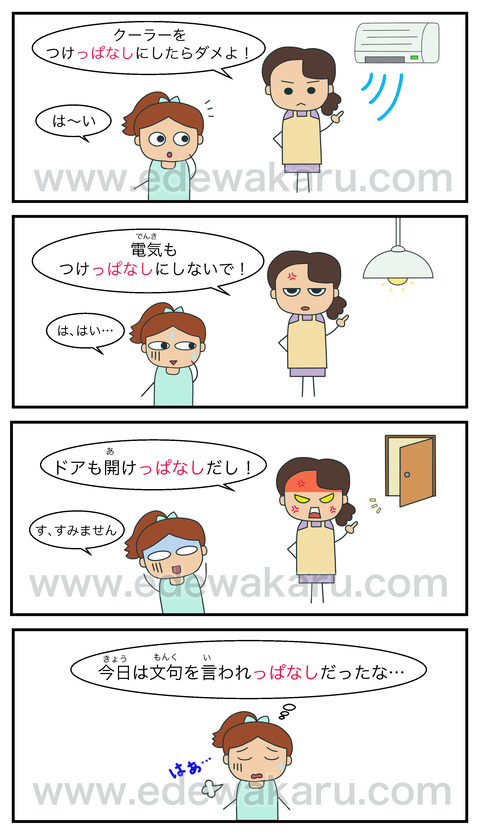
クーラーをつけっぱなしにする
→クーラーをつけたまま放っておくLeave the air conditioner running. →Leave the air conditioner on.
電気をつけっぱなしで出かける
→電気をつけたままの状態で出かけるGo out with the lights left on. →Go out while leaving the lights on.
ドアを開けっぱなしにするな
→ドアを開けたままにするなDon’t leave the door open. →Don’t leave the door open.
今日はお母さんに文句を言われっぱなしだったな…
→今日はお母さんにずっと文句を言わ続けたな…Mom kept complaining at me all day today… →Mom kept complaining at me all day today…
バスがすごく混んでいたので、1時間立ちっぱなしだった
→バスがすごく混んでいたので、1時間ずっと立ったままの状態だったThe bus was really crowded, so I stood the whole time for an hour. →The bus was really crowded, so I was standing the whole time for an hour.
Read the original source text
Meaning
〜したまま放っておく
〜したままにしておく
〜の状態がずっと続いている
How to use it
動詞[ます形]+っぱなし
動詞[ます形]+っぱなしの+名詞
Explanation
「〜っぱなし」は「〜まま放っておく」「〜たままにしておく」という意味を表し、マイナスの意味で使われる文型です。「〜っぱなし」は漢字で「〜っ放し」と書くように
「〜ままの状態で放置しておく」
という意味が含まれます😊また、例文⑤のように、
同じ状態がずっと続くという意味でも使われます
😀
【補足説明】
N4の「〜たまま」が状態が続いているということを表すのに比べて、「〜っぱなし」は状態が続いていることに必ずマイナスの意味が入ります。
「本当は〜しなければならないのに〜しないでそのままの状態にしている」と言いたい時に「〜っぱなし」を使うとぴったりです
😆
クーラーを
つけたままにする
→クーラーが
ついている状態が続いている
という説明
クーラーを
つけっぱなしにする
→クーラーを
切らなければいけないのにつけたままの状態にしている
1時間
立ったまま
だった→1時間
立っている状態が続いた
という説明
1時間
立ちっぱなし
だった→1時間も
ずっと立っていたから、とても疲れた
「〜っぱなし」は会話でもよく使いますので、しっかりと覚えておきましょう😉
くらべてわかる日本語表現文型辞典
Meaning
Meaning 1: After action A is performed, the necessary steps or cleanup are not done, and things are left as they are. The state is B, with A left undone afterward.
Meaning 2: Indicates that action A continues for a long time or occurs frequently.
How to use it
Aっぱなし (AっぱなしでB)
[Verb—ます form] っぱなし
Explanation
【Contrasts 1 and 2】
“AままB” (Meaning 3, p. 296)
“AままB” focuses on the state of A and means that doing B while in that state is undesirable. “Aっぱなし” focuses on failing to take care of or clean up after action A, and can also express the speaker’s dissatisfaction or exasperation.
○彼は電気をつけっぱなしで、出かけていった。(消さないで) — He went out leaving the lights on. (Without turning them off.)
○彼は電気をつけたままで、出かけていった。(つけた状態で) — He went out with the lights still on. (While they were on.)
“Aっぱなし” cannot be used in situations where no follow-up action or cleanup is needed; in those cases it has Meaning 2.
○ジムさんは靴をはいたままで、部屋に入ってきた。 — Jim came into the room with his shoes on.
×ジムさんは靴をはきっぱなしで、部屋に入ってきた。 — Jim came into the room having left his shoes on.
○掃除しっぱなしで、掃除機も片付けない。(意味1) — I left the vacuum cleaner out after cleaning and didn’t put it away. (Meaning 1)
○朝から掃除しっぱなしで疲れた。(意味2) — I’ve been cleaning nonstop since this morning and I’m tired. (Meaning 2)
“Aたきりだ (AたきりBない)” (Meaning 1, p. 112)
In context 8 examples
窓を開けっぱなしで寝たので、風邪をひいてしまった。
I slept with the window left open, so I caught a cold.
荷物を置きっぱなしにして、席を離れないでください。
Please don’t leave your belongings lying around and walk away from your seat.
食べっぱなしで出かけないで、きちんと片付けなさい。
Don’t go out leaving the dishes after eating; clean up properly.
あの子はいつも道具を使ったら使いっぱなしだ。
That child always leaves the tools lying around after using them.
パソコンもつなぎっぱなしが当たり前の時代になった。
We’ve reached an age where leaving the computer connected all the time is normal.
彼はよくミスをするので、部長に叱られっぱなしだ。
He often makes mistakes, so he is constantly being scolded by the department manager.
今日は一日中、座りっぱなしだったので、お尻が痛くなってしまった。
I sat all day today, so my bottom started to hurt.
朝からしゃべりっぱなしだったので、疲れた。
I talked nonstop from this morning, so I’m tired.
Read the original source text
Meaning
意味1:Aという行為が行われた後、しなければならない処置や始末をしないで、そのままの状態にしてある。Aをしたまま放置してある状態でB。
意味2:Aという行為がずっと続いていたり、頻繁にAが起こることを示す。
How to use it
Aっぱなし(AっぱなしでB)
[動詞-ます形]っぱなし
Explanation
【対比1,2】
「AままB」(意味3 P296)
「AままB」はAの状態でBをするのは好ましくないという意味で、Aの状態に視点があるが、「Aっぱなし」はAの行為に対して処置・始末をしないことに視点があるため、話し手の不満・あきれなどを表すこともある。
○彼は電気をつけっぱなしで、出かけていった。(消さないで)
○彼は電気をつけたままで、出かけていった。(つけた状態で)
「Aっぱなし」は処置・始末が不要な場面では、使えず、意味2となる。
○ジムさんは靴をはいたままで、部屋に入ってきた。
×ジムさんは靴をはきっぱなしで、部屋に入ってきた。
○掃除しっぱなしで、掃除機も片付けない。(意味1)
○朝から掃除しっぱなしで疲れた。(意味2)
「Aたきりだ(AたきりBない)」(意味1 P.112)
日本語NET JLPT文法解説まとめ
Meaning
To leave something as it is
Expresses leaving something in that state without doing something that should be done.
How to use it
V(ます-form)ます + っぱなし
Explanation
“leave on / leave out / leave as is”
To leave things as they are without doing what should be done.
Often used in a negative sense, implying dissatisfaction or exasperation.
Often used in a negative sense, implying dissatisfaction or exasperation.
In context 13 examples
クーラーをつけっぱなしで寝てしまい、母にさんざん怒られた。
I fell asleep with the air conditioner left on and got scolded badly by my mother.
家に帰ると、妻がテレビをつけっぱなしで寝ていた。
When I got home, my wife was asleep with the TV left on.
もう、だれよ!水を出しっぱなしにしたのは。
Hey, who left the water running?
服が脱ぎっぱなしよ。ちゃんと洗濯機に入れなさい。
Your clothes are lying around. Put them in the washing machine properly.
ポケットにお金を入れっぱなしで洗濯してしまった。
I accidentally did the laundry with money left in my pocket.
さっきからずっと立ちっぱなしだけど、座らなくて大丈夫?
You've been standing this whole time. Are you sure you don't want to sit down?
ガソリンがもったいないから、エンジンのつけっぱなしは良くないよ。
Leaving the engine running is a waste of gas, so it's not a good idea.
また、おもちゃが出しっぱなしだよ。使ったらちゃんと片付けなさい!
The toys are left out again. Put them away properly when you're done with them!
授業中、トムさんとジェシカさんがずっと話っぱなしで困ったよ。
I was annoyed because Tom and Jessica talked nonstop throughout class.
そういえば、図書館の本を借りっぱなしだった。
Come to think of it, I still have the library book I borrowed.
今年が始まってから、ずっとチームは負けっぱなしだ。
Since the beginning of this year, the team has been on a losing streak.
1時間ずっと歩きっぱなしでさすがに疲れた。
I walked for an entire hour without stopping, and I'm finally tired.
ドアを開けっぱなしにしないでください。
Please don't leave the door open.
Read the original source text
Meaning
〜したままだ
すべきことがあるのに、しないでそのままの状態にしてしまうことを表す。
How to use it
V(ます形)ます + っぱなし
Explanation
"leave on / leave out / leave as is"
To leave things as they are without doing what should be done.
マイナスに意味で使われることが多く、不満や呆れた気持ちが含まれる。
Often used in a negative sense, implying dissatisfaction or exasperation.
毎日のんびり日本語教師
How to use it
Verb ます-form + っぱなし
Explanation
There are two meanings.
① Leaving something that should normally be done unattended, and the resulting state continues.
② A certain state continues.
In both cases, the speaker conveys a negative attitude toward the situation, so this is often used for undesirable things.
Recently, it is also used in much the same way as 「~放題」 (“as much as one likes”), as in 「ゴルフの打ちっぱなし」 (a golf driving range) and 「歌いっぱなし」 (singing nonstop). In these cases, it has no negative nuance.
Notes
Nothing in particular.
In context 9 examples
車に鍵を差しっぱなしで買い物に行ってしまった。
I left the key in the car and went shopping.
電気をつけっぱなしで寝た。
I went to sleep with the lights left on.
換気のため窓を開けっぱなしにしたせいで空き巣に入られた。
I left the window open for ventilation, and as a result, a burglar broke in.
車上荒らしが多発していますので、車内に荷物を置きっぱなしにしないようにしましょう。
There have been many car break-ins, so please don’t leave belongings in your car.
あの変顔を見てからずっと笑いっぱなしだった。
I couldn’t stop laughing after seeing that funny face.
ずっと親に迷惑かけっぱなしなので、いつか親孝行したい。
I’ve been nothing but a burden on my parents, so I want to do something for them someday.
先月から休みがなくずっと働きっぱなしだ。
I’ve had no days off since last month and have been working nonstop.
自由席で立ちっぱなしはしんどい。(在自由席一直站着很累。)
Standing the whole time in an unreserved seat is exhausting. (Standing the whole time in an unreserved seat is tiring.)
座りっぱなしでお尻が痛い。(一直坐着屁股疼。)
My butt hurts from sitting the whole time. (My butt hurts from sitting the whole time.)
Read the original source text
How to use it
動ます形+っぱなし
Explanation
2つの意味があります。
①本来すべきことを放置して、その状態が持続していること
②ある状態が持続していること
いずれの場合も話者の物事に対するマイナスのニュアンスがありますので、良くないことに使う場合が多いです。
最近では「ゴルフの打ちっぱなし」「歌いっぱなし」みたいに、「~放題」と同じような使い方もあります。この場合は悪いニュアンスはありません。
Notes
特になし