DoJG 日本語文法辞典(全集)
Meaning
Nothing/nobody/no ~ but; only
How to use it
(i) Noun | しか | |
先生が(subject)→ | 先生しか | No one but the teacher |
先生を(direct object)→ | 先生しか | No one but the teacher |
(ii) Noun+(Particle) | しか | |
東京へ・に(direction)→ | 東京(へ・に)しか | To nowhere but Tokyo |
先生に(indirect object, agent)→ | 先生(に)しか | No one but the teacher |
日曜日に(time)→ | 日曜日(に)しか | Only on Sunday |
東京に(location)→ | 東京(に)しか | Only in Tokyo |
(iii) Noun+Particle | しか | |
東京で(location)→ | 東京でしか | Only in Tokyo |
車で(means)→ | 車でしか | Only by car |
山田さんと(reciprocal)→ | 山田さんとしか | Only with Mr. Yamada |
東京から(starting point/source)→ | 東京からしか | Only from Tokyo |
五時まで(ending point)→ | 五時までしか | Only till five o’clock |
(iv) Quantifier | しか | |
| 少ししか | Only a little |
Explanation
A particle which marks an element X when nothing but X makes the expressed proposition true.
In context 11 examples
戸田さんしか煙草を吸わない・吸いません。
No one but Mr. Toda smokes.
私は日本語しか知らない・知りません。
I know nothing but Japanese.
それは江口さんにしか話していない・いません。
I haven't told it to anybody but Mr. Eguchi.
私はご飯を一杯しか食べなかった・食べませんでした。
I had only one bowl of rice.
パーティーには学生しか来なかった。
Only students came to the party.
田村さんはサラダしか食べなかった。
Mr. Tamura ate only salad.
私は日曜日(に)しか来られません。
I can come only on Sunday.
この本はこの図書館(に)しかありません。
Only this library has this book.
そこは車でしか行けない。
You can go there only by car. / The only way you can go there is by car.
私は山田さんとしか話をしない。
I talk only with Mr. Yamada.
この学校は学生が百人しかない。
This school has only a hundred students.
絵でわかる日本語
Meaning
Nothing except…
Nothing beyond…
How to use it
Noun [dictionary form] + しか〜ない
Explanation
“AしかBない” is a sentence pattern meaning “no B except A” or “no more B than A.” A negative expression goes in place of “B.”
“〜だけしか〜ない”
is an even more emphatic way of saying it.
[Examples]
In the morning, I only drink coffee.
→ In the morning, I drink nothing but coffee.
I can only speak Japanese.
→ I can speak nothing but Japanese.
“〜しか〜ない” is often used in conversation, so review it 😉
[Related articles]
In context 6 examples
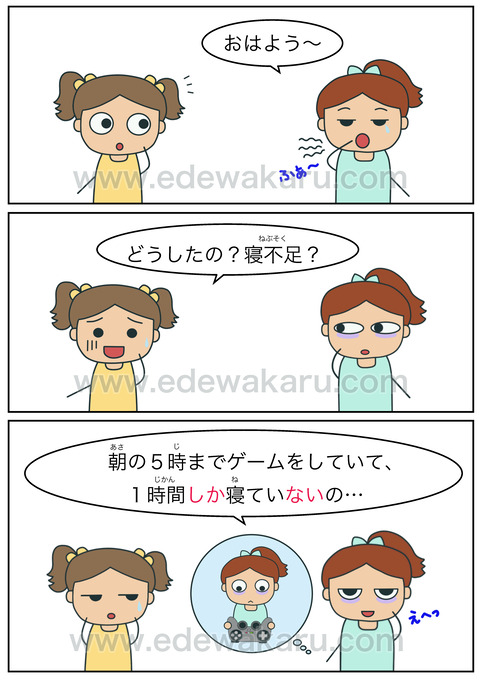
A:どうしたの?寝不足?B:朝の5時までゲームをしていて、1時間しか寝ていないの
→1時間以上寝ていないのA: What’s wrong? Didn’t get enough sleep? B: I was gaming until five in the morning, so I’ve only slept for an hour. → I haven’t slept for more than an hour.
A:今日の朝ごはんは何を食べたの?B:朝はコーヒーしか飲まないのA :え!?お腹が空かないの?
→コーヒー以外は飲まないのA: What did you have for breakfast this morning? B: I only drink coffee in the morning. A: What!? Don’t you get hungry? → I don’t drink anything except coffee.
A:カラオケに行かない?B:ごめん、今100円しか持っていないの
→財布には100円以上入っていないA: Want to go to karaoke? B: Sorry, I only have 100 yen on me right now. → I don’t have more than 100 yen in my wallet.
のどが痛くて、水しか飲めない…
→水以外飲めないMy throat hurts, so I can only drink water… → I can’t drink anything except water.
私は日本語しか話せません
→日本語以外話せませんI can only speak Japanese. → I can’t speak anything except Japanese.
何か食べようと思ったが、冷蔵庫には水しか入っていなかった
→水以外入っていなかったI thought I’d eat something, but there was only water in the refrigerator. → There was nothing except water.
Read the original source text
Meaning
〜以外は〜ない
〜以上は〜ない
How to use it
名詞[辞書形]+しか〜ない
Explanation
「AしかBない」は「A以外はBない」「A以上はBない」という意味の文型です。「B」には否定表現(ひていひょうげん)が入ります。
「〜だけしか〜ない」
は、さらに強調した言い方です。
[例]
朝はコーヒー
しか
飲ま
ない
→朝はコーヒー
だけしか
飲ま
ない
日本語
しか
話せ
ない
→日本語
だけしか
話せ
ない
「〜しか〜ない」は、会話でもよく使いますので復習をしておきましょう😉
【関連記事】
日本語文型辞典
Meaning
a. N (+ particle) しか…ない
Used with a negative expression to single out one thing and exclude everything else. As in ⑦ and ⑧, it can also be used with “だけ” to further emphasize the meaning.
b. N でしかない
An emphatic way of saying “N だ,” but it is often used to suggest that the N is not highly regarded, or that its value is limited to just that. It can be rephrased as “にすぎない.”
c. V-るしかない
Means “just do that”; it is often used in contexts where there is no other method or possibility, and nothing else can be done.
Used to strongly insist that other possibilities are ruled out and that this is the only one. It is used with negative forms of “V-れる,” which express possibility, such as “言えない” and “思えない.” The form “V-ようがない,” as in “申し上げようがない” in ②, is also used.
How to use it
しか…ない
…としか…ない
In context 21 examples
朝はコーヒーしか飲まない。
I only drink coffee in the morning.
1時間しか待てません。
I can only wait for one hour.
月曜しか空いている日はないんで、打ち合せはその日にしてもらえませんか。
Monday is the only day I’m free, so could we have the meeting that day?
こんなことは友だちにしか話せません。
I can only talk about something like this with my friends.
この映画は18歳からしか見ることはできない。
You can only see this movie from age 18 onward.
あそこの店は6時までしかやっていない。
That shop is open only until six.
かれは自然のものだけしか食べない。
He eats only natural foods.
今月はもうこれだけしかない。
This is all that’s left for this month.
どんなに社会的な地位のある人でも死ぬときはひとりの人間でしかない。
No matter how high a person’s social status, when they die, they are nothing but a human being.
かれは学長にまでなったが、親の目から見るといつまでも子どもでしかないようだ。
He even became a university president, but in his parents’ eyes, it seems he’ll always be just a child.
会社でいばってはいるが、家では子どもに相手にされないさびしい父親でしかない。
He acts important at work, but at home he is nothing but a lonely father whom his children ignore.
時間がなくて出来ないと言っているが、そんなのは口実でしかない。ほんとうはやりたくないのだろう。
He says he can’t do it because he has no time, but that’s nothing but an excuse. He probably doesn’t really want to do it.
高すぎて買えないから、借りるしかないでしょう。
It’s too expensive to buy, so I suppose we have no choice but to rent it.
そんなに学校がいやならやめるしかない。
If you dislike school that much, you have no choice but to quit.
燃料がなくなったら、飛行機は落ちるしかない。
If the fuel runs out, the plane will have no choice but to crash.
ここまで来ればもう頑張ってやるしかほかに方法はありませんね。
Having come this far, there’s no other way but to do our best.
今はただ悪かったとしか言えない。
All I can say now is that I was wrong.
今の時点ではわからないとしか申し上げようがありません。
At this point, all I can say is that we don’t know.
彼の立場なら知っているはずだ。隠しているとしか思えない。
Given his position, he ought to know. I can only think he’s hiding it.
風邪で行けないというのは口実としか思えない。
I can only think that saying he can’t go because of a cold is an excuse.
この時刻になっても連絡がないのはおかしい。どこかで事故にあったとしか考えられない。
It’s strange that there’s still no word at this hour. I can only assume there’s been an accident somewhere.
Read the original source text
Meaning
a. N(+助詞)しか…ない
否定表現と共に使い、ひとつの事だけを取りあげて、他を排除するのに用いる。⑦⑧のように「だけ」と共に使い、意味をいっそう強調することもある。
b. Nでしかない
「Nだ」ということを強調する言い方だが、Nにくるものをあまり評価しない、価値がそれだけに限られるという意味で使うことが多い。「にすぎない」に言いかえられる。
c. V-るしかない
「そうするだけだ」という意味で、他に方法がない、他の可能性がないから仕方がないという文脈で使われることが多い。
他の可能性を否定して、それだけだと強く主張するのに用いる。「言えない」「思えない」などの可能を表す「V-れる」の否定形と共に使う。また②の「申し上げようがない」のように「V-ようがない」という形も使われる。
How to use it
しか…ない
…としか…ない
日本語文型辞典 英語版
Meaning
Used with a negative expression. Indicates focus on one thing only, at the exclusion of all else.
The meaning of しか...ない can be further intensified by combining it with だけ (only, just), as in
(7)
and
(8)
.
b. Nでしかない
Used to emphasize that something “is N,” but often conveys the meaning that N is not evaluated very highly or has limited value. Can be replaced by にすぎない (be nothing but..., be no more than...).
c. V-るしかない
Means “can only do....” Often used in contexts where there is no other available method or possibility, and thus no other choice.
Used to refute other possibilities and insist strongly on just one. Used with the negative form of V-れる potential forms, such as 言えない and 思えない. The form V-ようがない, as in
(2)
申し上げようがない (nothing to say) is also used.
How to use it
1. しか...ない a. N(+ particle)しか...ない
2. ...としか...ない
In context 21 examples
朝はコーヒーしか飲まない。
I don’t drink anything but coffee in the morning.
1時間しか待てません。
I can only wait for an hour.
月曜しか空いている日はないんで、打ち合せはその日にしてもらえませんか。
Since Monday is the only day I have open, could you schedule the meeting on that day?
こんなことは友だちにしか話せません。
I can talk about this kind of thing only to my friends.
この映画は 18 歳からしか見ることはできない。
This movie is restricted to persons eighteen years and over.
あそこの店は6時までしかやっていない。
The shop over there is only open until six o’clock.
かれは自然のものだけしか食べない。
He eats nothing but organic food.
今月はもうこれだけしかない。
This is all we have left this month.
どんなに社会的な地位のある人でも死ぬときはひとりの人間でしかない。
No matter how much social status a person has, when he dies, he’s just a single human being.
彼女は学長にまでなったが、親の目から見るといつまでも子どもでしかないようだ。
She rose all the way to president of the college, but it seems that in her parents’ eyes she’ll always be nothing more than a child.
会社でいばってはいるが、家では子どもに相手にされないさびしい父親でしかない。
At work he can throw his weight around, but at home he’s just a lonely father whose children ignore him.
時間がなくて出来ないと言っているが、そんなのは口実でしかない。ほんとうはやりたくないのだろう。
Even though he says he can’t do it because there’s no time, that’s nothing but an excuse. The truth is he doesn’t want to do it.
高すぎて買えないから、借りるしかないでしょう。
Since it’s too expensive to buy, we don’t have any other choice but to rent it, do we?
そんなに学校がいやならやめるしかない。
If you hate school that much, all you can do is quit.
燃料がなくなったら、飛行機は落ちるしかない。
If the fuel runs out, the plane can only go down.
ここまで来ればもう頑張ってやるしかほかに方法はありませんね。
Since we’ve come this far, there’s nothing else to do but give it our best, is there.
今はただ悪かったとしか言えない。
All I can say now is that I’m sorry.
今の時点ではわからないとしか申し上げようがありません。
The only thing I can say at this point is that we don’t know.
彼の立場なら知っているはずだ。隠しているとしか思えない。
Given his position, he should know. I can’t help but think that he’s hiding something.
風邪で行けないというのは口実としか思えない。
It seems to me that her saying she can’t go because of a cold is only an excuse.
この時刻になっても連絡がないのはおかしい。どこかで事故にあったとしか考えられない。
It’s strange that we haven’t heard anything by this time. I can only think that there’s been an accident somewhere.
Read the original source text
Meaning
Used with a negative expression. Indicates focus on one thing only, at the exclusion of all else.
The meaning of しか...ない can be further intensified by combining it with だけ (only, just), as in
(7)
and
(8)
.
b. Nでしかない
Used to emphasize that something “is N,” but often conveys the meaning that N is not evaluated very highly or has limited value. Can be replaced by にすぎない (be nothing but..., be no more than...).
c. V-るしかない
Means “can only do....” Often used in contexts where there is no other available method or possibility, and thus no other choice.
Used to refute other possibilities and insist strongly on just one. Used with the negative form of V-れる potential forms, such as 言えない and 思えない. The form V-ようがない, as in
(2)
申し上げようがない (nothing to say) is also used.
How to use it
1. しか...ないa. N(+助詞)しか...ない
2. ...としか...ない
毎日のんびり日本語教師
How to use it
Noun (+ particle) + しか~ない
Explanation
Added after a noun or quantity word, this expresses that something is limited. It conveys the speaker's dissatisfaction or regret.
A more emphatic expression is 「~だけしか~ない」.
To state objectively that a quantity is small, without conveying dissatisfaction, use 「【N5文法】~だけ」.
Notes
Related grammar: 「【N5文法】~だけ」
Similar grammar: 「【N2文法】~のは~くらいだ/~のは~くらいのものだ/~のは~ぐらいだ/~のは~ぐらいのものだ」
In context 10 examples
お互い忙しくて、1ヶ月で1回しか会えていない。
We're both busy, so we've only been able to meet once a month.
雑誌でしか見たことが無い。
I've only ever seen it in magazines.
彼は手伝いもせずに文句しか言わない。
He does nothing to help and only complains.
出発まであと10分しかない。(离出发只剩下10分钟了。)
There are only ten minutes left until departure. (There are only 10 minutes left before departure.)
事前に予約した方しか食べられない限定スイーツ。(只有事先预定好才能品尝到的甜点。)
A limited-edition dessert that only those who reserved in advance can eat. (A dessert that can only be enjoyed by those who reserved in advance.)
今回の試験で、満点は1人しかいなかった。
Only one person got a perfect score on this exam.
一社しか受けていないので、落ちてしまったら滑り止めもない。
I only applied to one company, so if I get rejected, I won't have a backup.
注文したものは家まで送ってくれず、コンビニでしか受け取れないらしい。
Apparently, they won't deliver what I ordered to my home; I can only pick it up at a convenience store.
若い時は”今だけしかできないこと”になかなか気付けない。
When you're young, it's hard to notice the things you can only do “right now.”
財布の中には500円しかない。(钱包里只有500日元了。)
I only have 500 yen in my wallet. (I only have 500 yen left in my wallet.)
Read the original source text
How to use it
名詞(+助詞)+しか~ない
Explanation
名詞や数量詞の後について、物事が限定的であることを表します。話者の不満や残念な感情を含みます。
さらに強調する言い方として「~だけしか~ない」があります。
数量が少ないことを客観的かつ不満の感情を含まないで表すには「【N5文法】~だけ」が用いられます。
Notes
関連文法「【N5文法】~だけ」
似ている文法「【N2文法】~のは~くらいだ/~のは~くらいのものだ/~のは~ぐらいだ/~のは~ぐらいのものだ」
Yokubi — The Common Grammar Guide (https://yoku.bi)
Explanation
だけ, のみ, and ばかり are variations of "just" or "only". しか is similar, but it can only be used in negative statements.
だけ means "just so", in terms of amount. It acts like a particle.
のみ is like a less colloquial だけ.
ばかり is yet another "only" word. It can also be pronounced ばっか or ばっかり. Xばかり focuses on everything falling within the definition of X as being true, whereas だけ and のみ focus on things that fall outside of the statement being false. Think of the difference in vibes between "There is only this" and "There is nothing else".
The structure \<verb\>てばかりいる is often used to convey a critical attitude towards someone stating they do just one thing over and over to the point where it's detrimental.
ばかり can also be used with temporal statements to convey how soon or early something happened.
しか is used with negative statements to convey the same meaning as だけ but with the focus on everything else that is not what is being marked.
The compound だけしか exists too. It works exactly the same as しか but has stronger emphasis.
In context 1 examples
僕しかいない
There is no one else other than me here
IMABI
Shika & Hoka
Read this IMABI lesson ↗Explanation
The Particles しか & ほか
These particles are very similar to だけ, but they’re syntactically different.
The Particles しか & ほか
しか must be used with the negative form of a verb. It may follow nouns and even other particles such as those with に, で, and まで. In translation, it is close to “just/only” but with a nuance of “there is no choice but to,” especially after verbal phrases.
Particle Note: The particle に may be deleted before しか!
1. 後あとたった(の)一週間いっしゅうかんしかありません。
There’s only one week left.
2. セミナーのレポートの締しめ切きりは明日あしただ。徹夜てつやするしかない。
The deadline for the seminar report is tomorrow. I have no choice but to work on it all night long.
3. 今日のおやつこれしかないの。(Casual)
Is this all there is for snacks today?
4. (事前じぜんに・あらかじめ)伝つたえるしかない。
I have no choice but to tell.
5. 歩くしかありません。
You have no choice but to just walk.
6a. ローマ字だけ書けます。 I can only write Roman letters.
6b. ローマ字しか書けません。 I can’t write anything but Roman letters.
Particle Note: Although だけを is possible and relatively common, the equivalent with しか, をしか, is very literary and doesn’t show up often.
7. 私が目に見える美をしか信じなかった以上、この態度は当然である。
Since I could only believe the beauty that I could see in my eyes, this attitude is natural.
From 金閣寺 by 三島由紀夫.
8. いつしか時が流れた。
Time slid by.
Set Phrase Note: いつしか = いつの間にか知らないうちに. It doesn’t need to be used to be with the negative.
You may also use だけ and しか together creating だけしか. Also, しか may be seen as しきゃ and っきゃ in slang.
9. やるっきゃないな。
I have no choice but to do it.
ほか Continued
ほか means “aside from.” Technically, it can also be seen in ~ほかない, which is synonymous to ~しかない.
10. 社長しゃちょうほか五名ごめいが出席しゅっせき
Five in attendance aside from the company president.
11. どこかほかを探さがす。
To search the rest.
12. 彼はこのほかに何なんと言った?
What else did he say?
13a. 弁護士べんごしは文書ぶんしょだけでなく、口頭こうとうでも説明せつめいしてくれた。
13b. 弁護士は文書をもってするほか、口頭でも説明してくれた。
The lawyer explained orally aside from the use of documents.
In context 15 examples
後あとたった(の)一週間いっしゅうかんしかありません。
There’s only one week left.
セミナーのレポートの締しめ切きりは明日あしただ。徹夜てつやするしかない。
The deadline for the seminar report is tomorrow. I have no choice but to work on it all night long.
今日のおやつこれしかないの。(Casual)
Is this all there is for snacks today?
(事前じぜんに・あらかじめ)伝つたえるしかない。
I have no choice but to tell.
歩くしかありません。
You have no choice but to just walk.
ローマ字だけ書けます。 I can only write Roman letters.
I can only write Roman letters.
ローマ字しか書けません。 I can’t write anything but Roman letters.
I can’t write anything but Roman letters.
私が目に見える美をしか信じなかった以上、この態度は当然である。
Since I could only believe the beauty that I could see in my eyes, this attitude is natural.
いつしか時が流れた。
Time slid by.
やるっきゃないな。
I have no choice but to do it.
社長しゃちょうほか五名ごめいが出席しゅっせき
Five in attendance aside from the company president.
どこかほかを探さがす。
To search the rest.
彼はこのほかに何なんと言った?
What else did he say?
弁護士べんごしは文書ぶんしょだけでなく、口頭こうとうでも説明せつめいしてくれた。
The lawyer explained orally aside from the use of documents.
弁護士は文書をもってするほか、口頭でも説明してくれた。
The lawyer explained orally aside from the use of documents.
Read the original source text
Explanation
The Particles しか & ほか
These particles are very similar to だけ, but they’re syntactically different.
The Particles しか & ほか
しか must be used with the negative form of a verb. It may follow nouns and even other particles such as those with に, で, and まで. In translation, it is close to “just/only” but with a nuance of “there is no choice but to,” especially after verbal phrases.
Particle Note: The particle に may be deleted before しか!
1. 後あとたった(の)一週間いっしゅうかんしかありません。
There’s only one week left.
2. セミナーのレポートの締しめ切きりは明日あしただ。徹夜てつやするしかない。
The deadline for the seminar report is tomorrow. I have no choice but to work on it all night long.
3. 今日のおやつこれしかないの。(Casual)
Is this all there is for snacks today?
4. (事前じぜんに・あらかじめ)伝つたえるしかない。
I have no choice but to tell.
5. 歩くしかありません。
You have no choice but to just walk.
6a. ローマ字だけ書けます。 I can only write Roman letters.
6b. ローマ字しか書けません。 I can’t write anything but Roman letters.
Particle Note: Although だけを is possible and relatively common, the equivalent with しか, をしか, is very literary and doesn’t show up often.
7. 私が目に見える美をしか信じなかった以上、この態度は当然である。
Since I could only believe the beauty that I could see in my eyes, this attitude is natural.
From 金閣寺 by 三島由紀夫.
8. いつしか時が流れた。
Time slid by.
Set Phrase Note: いつしか = いつの間にか知らないうちに. It doesn’t need to be used to be with the negative.
You may also use だけ and しか together creating だけしか. Also, しか may be seen as しきゃ and っきゃ in slang.
9. やるっきゃないな。
I have no choice but to do it.
ほか Continued
ほか means “aside from.” Technically, it can also be seen in ~ほかない, which is synonymous to ~しかない.
10. 社長しゃちょうほか五名ごめいが出席しゅっせき
Five in attendance aside from the company president.
11. どこかほかを探さがす。
To search the rest.
12. 彼はこのほかに何なんと言った?
What else did he say?
13a. 弁護士べんごしは文書ぶんしょだけでなく、口頭こうとうでも説明せつめいしてくれた。
13b. 弁護士は文書をもってするほか、口頭でも説明してくれた。
The lawyer explained orally aside from the use of documents.
こそあど VI: Older Expressions
Read this IMABI lesson ↗Explanation
こそあど VI: Older Expressions
Of the various kinds of words that exist in Japanese, demonstratives, colloquially referred to as こそあど, are no exception to how words fall out of use and become reinvented over time. In Modern Japanese, the overwhelming majority of these phrases can be neatly referred to as a proximal (近称), a mesioproximal (中称), a distal (遠称), or an indefinite (不定称) demonstrative that will start with the corresponding initial-mora for said category – /ko/, /so/, /a/, and /do/ in that order.
Though these terms may be rather technical, as an advanced Japanese learner, you should have a fairly strong understanding of when to distinguish the various sets of demonstratives and how they relate to place, people, and time depending on the situation. Think of, for instance, how こちら can refer to oneself, someone in one’s in-group, or quite literally “this direction (which is closest to the speaker), and all of this is made possible by the phrase’s inherent directionality.
Even into the present day, however, other demonstratives which never quite expanded into the same array of expressions persist, although they are always parallel to a corresponding directionality.
To get things started, let’s look at how the basic demonstratives of Japanese would have been listed just a century ago.
Curriculum Note: This lesson will later be moved into a more advanced division of IMABI planned for launch in 2023.
近称 中称 遠称 不定称
Thing これ・この それ・その あれ・あのかれ・かの いづれ
どれ
Place ここ そこ あそこ/あすこ・かしこ かなた いづこ・いづく
どこ
Direction こなた こち そなた そちあなた・かなた
あちいづかた>どなた
いづち>どち
Adjectival Forms: Forms ending in の are understood to be adjectival renditions of the base demonstrative in question.
Most of these words will be familiar, but stark differences accumulate in the columns to the right. Our first goal will be to investigate the differences that can be taken from this chart, then we’ll direct our attention to lesser prevalent demonstratives.
The /ka/ Group of Demonstratives
Intrinsically, the /ka/ group of demonstratives have been quite synonymous with each other throughout Japanese history. It is only within the last century that 彼(かれ) in particular was repurposed to mean “he” and then later
かれ・かの
In ancient times, かれ was the antonym of これ and is most likely an offshoot of it. In the Heian Period, あ(れ) began to appear, and for centuries, the two coexisted. かれ・かの could refer to things, people, direction, time, etc.
1. 彼誰時
Possible Readings: かはたそどき・かはたれどき・あれはたそどき・あれはたれどき・たそがれどき
Time when (it’s so dark that you can’t tell) who is who = dusk/twilight
Etymology Note: This word is where the modern word たそがれ comes from. Upon entering early Modern Japanese, /so/-demonstratives overtook the /a/ and /ka/ group from referring to people that are medially distant from the speaker.
2. 誰そ彼(かれ)と問はば答へむすべをなみ君が使を帰しつるかも。
Because I asked the person, “who are you?” but had no way of getting an answer, I sent your messenger home.
From the 万葉集 #2545.
Entering into early modern times, かれ・かの would be used when the speaker wished to secretly refer to an entity both known by the speaker and listener but didn’t want to outright state it.
3. かのとは誰ぢゃ?
Who is you-know-who?
At this point, かの could be seen fossilized in this sense and didn’t need to be followed with a noun like 人 or the such.
4. そりゃあそうと、かのに極めたか!
That’s right, of course it’d be that person!
Nowadays, かの is still occasionally used to refer to something/someone in a rather distant fashion, but it is far more literary in tone than あの. On the other hand, 彼 became relegated as the word “for “he” due to influence from Western languages. This is also how 彼女(かのじょ) came about to mean “she.”
5. かの有名な人はこう言っています。
A certain person puts it this way.
6. あの人は名もなきかの地へ去ってしまった。
That person went off to that nameless, far off place.
Incidentally, か can be still be seen in set phrases as a demonstrative. In fact, they beautifully demonstrate how it could refer to things in the broadest sense possible.
何やかや Something or other
誰もかも Anyone and everyone
何もかも Anything and everything
どこもかも Anywhere and everywhere
7. 何やかやとお金がかかり無償どころでないことは誰しも知っている。
Everyone knows that it costs money doing this and that, making it far from “free.”
8. 何もかも嘘に聞こえる。
Anything and everything sounds like a lie.
かなた
The demonstrative かなた is synonymous with あちら, but the difference is that かなた makes the direction/place being referenced seem distant in a temporal sense as well, or at the very least, something that is so far away that it could never be seen from one’s viewpoint. In modern speech, it has a very poetic, literary tone.
9. 山のかなたの土地へ目指してゆこう。
Let’s head for the land far beyond the mountain(s).
10. 忘却の彼方
Beyond oblivion
こなた & そなた & あなた
In their basic understanding, these three words related to direction, but when they were ever used to refer to people, things got a little convoluted.
漢字 Meanings
こなた此方①This direction/this way/here※Replaced by こちら
②㋐Since (a time in the recent past before now)
②㋑Prior to (a time in the near future from now)
※Replaced by このかた.③Third person “this person here”④First person “I”
※Replaced by こちら.⑤Second person “You” (archaic casual)
※Replaced by あなた.
そなた 其方①That direction/place (away from the speaker)②You (toward an inferior※)
あなた 彼方貴方④①Over there (far away)
※Replaced by あちら・あの向こう
②Distant past
※Replaced by あれ以来.③Third person “that person”
※あのかた④Second person “You”※
どなた
いづかた 何方①Which direction?(formal)
※Replaced by どちら・どの方向.
②Which one? (formal)
③Who? (formal)
※そなた was the second person pronoun of choice by lords to their retainers or by any superior to their inferior. It could be made plural as そなたら or そなたたち, the latter, which can occasionally be heard it purposely old-fashioned speech.
※In Modern Japanese, あなた has two distinct usages. It may be the second person pronoun used towards equals or those below you, often in a familial or polite tone. Or, it is used by someone to refer to their husband. To reflect the sex of the person being referred to, the Kanji spellings 貴女・貴男 also exist accordingly. It may be made plural as あなたたち.
※This meaning was inherited from its older form いづかた, which possessed all three meanings.
The minority of meanings that have not been lost to history in modern speech are seldom used, so the examples below heavily incorporate Classical Japanese to demonstrate how they were once used. Any other archaism found in these texts can be postponed for future study.
11. 見渡す海原の彼方此方には三本檣 (マスト) の大きな漁船が往来 (ゆきき) して居る。From 『ふらんす物語』 by 永井荷風.
12. 己(をの)があらむこなた・・・
In this time while I’m still alive…
From the 源氏物語.
13. やあ、こなたは誰じゃ?
Why, who might you be?
14.「さなむ。」と、あなたにも語らひのたまひければ、いみじくうれしく、思ふことかなひはつる心地して・・・
When Genji had told her “that being so,” she was quite happy and felt that what she had hoped for had come about…
From the 源氏物語.
15. この北の障子のあなたに人の気配するを、こなたや、かくいふ人の隠れたる方ならむ?
Since I sense someone over there past this screen to the north, I wonder if this is where the woman I was speaking of earlier is hiding?
From the 源氏物語.
16. 少女はそなたを注視して俄かに顔を赤らめた。
The girl’s face reddened oh-so slightly as she gazed there.
17. いつかそなたの心にも、 我らに通ずる何かが宿るやも知れぬ。
Eventually, there might be something that resides in your heart that will get through to us.
18. いづかたへもしのばせ給へ。
Go hide anyway.
From the 平家物語.
19. あの方はどなたでしょうか。(Very formal, modern)
Who is that person.
こち・そち・あち
These word forms are the predecessors to こっち, そっち, and あっち respectively. Even today, these old forms are highly recognized. You will hear them when people attempt to sound old-fashioned, history dramas, and other similar situations.
漢字 Meanings
こち 此方①This way/direction.②First person plural “we”
そち 其方①That way/direction.②You (toward an inferior)
あち 彼方 ①That way/direction (far away)
20. こちやと言へば、ついゐたり。
When (she) said “get over here,” she sat down.
From the 源氏物語.
21. こちも知らぬぞ。
I don’t know either.
22. 御膳をそちへ拵えよ。
Prepare the meal there.
23. そちが戻ったあと、古麻呂様はいたくご満悦であった。
Since you have returned, Sir Komaro has been so pleased.
From 風の陣 by 高橋克彦.
24. あちへ廻り、こちへ廻りした。
I’ve circled over there and over here.
あすこ・かしこ
In many dialects of Japanese, あそこ is still alternatively pronounced あすこ or even as あしこ. What might be more of a surprise is the existence of かしこ. Written in Kanji as 彼処, it indicated a place that is far away from the speaker and listener in the same way that あそこ does. Unlike かなた, it doesn’t have quite the fantasy-like ring to it when it is used in modern speech. Rather, it is often still heard in the phrase どこもかしこも, which means “everywhere and anywhere.”
25. どこもかしこも満員だ。
Anywhere and everywhere is full.
26. あすこにも富士山が見えるぞ。
You can see Mt. Fuji from over there as well.
いずれ
いずれ lives on despite being どれ’s predecessor with the following meanings.
① Which (formal) ※Usually used with the particle も to mean “whichever.”
② Eventually (pretty soon/in the near future)
27. いずれにせよ、我らの太陽も衰亡期を迎えるのである。
Eventually, our Sun will also face its stage of decline and death.
28. いずれも正解だ。
Either is the correct answer.
いづこ・いづく
These word forms are the variants of the predecessor to どこ.
29. いづこにとまるべきにか。
Where should I stay?
From the 源氏物語.
30. いづくか王地ならぬ。
Where would the king’s land not be?
斯(か)く
かく is the predecessor to こう. When a medial /k/ was dropped out of a word in older stages of Japanese, the resulting diphthong /au/ would necessarily contract to /o:/, as it still does in dialectal speech.
31. かくも大勢の方にお集まり頂き誠に感謝いたします。
I am so very grateful that so many of you have gathered.
32. かくなる上はやむを得ない。
Now that it has come to this, it cannot be helped.
33. かく言う私もお酒が好物です。
Even for myself, if I don’t say so, is a favorite.
Nuance Note: Although it would seem that かく言う would be formal due to its etymology, it is not appropriate to use in business language as it is too direct about one’s own viewpoint.
In even older speech, it even had the form かくて. In modern speech, this would be replaced by こうして.
34. かくて明けゆく空の景色、昨日に変はりたりとは見えねど。
Looking at how the sky is so bright like this, it doesn’t appear any different than how it did yesterday, though.
From the 徒然草.
History Note: In ancient Japanese, かく was the antonym of か from earlier as the word こ was used to make nominal phrases rather than adverbial phrases like かく.
The word form 斯様(かよう)exists as an old-fashioned variant of このよう and can still be seldom encountered in modern speech.
35. しばし考えて執筆したところ、斯様な内容になりました。
After deliberating for a while then writing it, the content came out as such.
36. かように無邪気で多芸の士が多いとは、いや初めて知りましたな。
My, this is the first time I’ve known that there we so many samurai innocent like this who are jacks of all trades!
From 『上杉謙信』 by 吉川謙信.
37. かような重大事が、戯れに口に出せようか。
How could I possibly utter a word in gest about such a serious matter as this?
From 『上杉謙信』 by 吉川謙信.
然(さ)
The adverb そう comes from 然(さ). This uncontracted form is still used with the particle も, but the tone of さも tends to be formal, literary, and/or refined. As it is etymologically identical to そうも, it is frequently used to express how something seems absolutely so, which isn’t dissimilar to how そう can be used.
38. さも嬉しげにカクテルを一気に飲み干した。
(He) happily downed that cocktail.
39. ただ、さほど気にならないので、強調と考えてもよいだろう。
However, since it isn’t that much of a concern, it may also be fine to view it as (a way of) emphasizing it.
40. さもないと世界が終わりかねない。
If not, the world might come to an end.
さもないと
さもないと, despite containing an archaism, is fairly common in heated exchanges. Word for word, it contains さ, the predecessor of the Kosoado そう meaning “like that,” the particle も which emphasizes the adverb, and ない, which is used instead of しない to give a more literal interpretation of “if things don’t go down like this,” the next situation that follows will be bad.
さもないと is used to give a stern warning. In fact, a sentence in the imperative (命令形) almost always precedes it. As such, it is not appropriate in polite registers and should always be used with だ体 or literary language.
さもないと in a literal sense means “if you do not do so”, or more simply put, “or (else)/otherwise”. It may also be seen as さもなければ and さもなくば, with the latter being its traditional rendition that is often used to mimic samurai talk. The difference between using the particle と or the particle ば is negligible as it is the difference between “if you do this mistake, Y consequence will happen” and “when you make this mistake, Y consequence will happen.”
41. そこをどけ!さもないと痛い目に遭うぞ!
Get out of the way! If you don’t, you’ll suffer for it!
42. 出て行け。さもないと警察呼ぶぞ。
Get out. If you don’t, I’ll call the police!
43. そうせよ!さもなくば必ずや命を失おう。
Do it! If not you will surely lose your life.
44. 水を溜めよ。さもないと、旱魃が起こったときに、喉が渇いて死んじまうぞ。
Save up water. Or else, if a drought were to occur, you could dehydrate and end up near to your death.
45a. 7時半までに出なさい。さもなければ、電車に遅れますよ。△
45b. 7時半までに出なさい。そうしなければ、電車に遅れますよ。〇
45c. 7時半までに出なさい!電車に遅れますよ。◎
Leave (the house) by 7:30. Or else, you’ll be late to your train.
Speech Register Note: As the command ending ~なさい is not as coarse as the plain imperative, using さもなければ isn’t entirely wrong to use in the ます体, but it is certainly more natural to either paraphrase it or remove it out of the sentence entirely. The purpose of explicitly using these Japanese equivalents of “otherwise” would be indicate a severe outcome. Whether missing the train really is as severe as being shot or having the police called on you may very well be a personal call.
In even older language, さもなくば can be seen used more like それとも to be a more literal translation of “or, if not X, then Y.”
46. お茶でござるか、さもなくば珈琲でござるか。
Will you have tea? If not, how about coffee?
然様(さよう)
It should come as no surprise that 然様(さよう) is an old-fashioned variant of そのよう. Alternatively written in Kanji as 左様, this relic especially lives on in the phrase さようなら, but it was quite common in the refined speech at the start of the 21st century.
47. はい、さようでございます。
Yes, that is so.
48. さよう、あれは間違いであったと認めよう。
Indeed, I will admit that that was a mistake.
然(しか)
然(しか) is an ancient synonym of そのように・さように, surviving in Modern Japanese in the expression 然も (also written as 而も), meaning “moreover.” If you were to paraphrase しかも into more modern expressions, though, you would get そのうえ or それでも depending on whether something else is being added to the dialogue in a positive fashion or a negative (reflective) fashion.
49. ご主人は私のすべてで、しかも命の恩人です。
My husband/master is my everything, and what’s more, I owe my life to him.
50. あれだけ勉強てしかも合格できなかった。
I studied all that much and yet couldn’t pass.
51. しかも片目足なえという不具者だ。
Moreover, the man is a one-eyed, lame disabled person.
From 『上杉謙信』 by 吉川謙信.
と
Another demonstrative from Old Japanese that has survived in Modern Japanese in set phrases is と, which functioned like そ. It is found mostly in とにかく and its variants. The variants, though, come about via the particle も. In either case, it is noteworthy how the farthest to closest ordering has been maintained in Japanese since its earlier stages.
とにかく translates as “anyway,” setting aside matter(s) to switch topics to what is really at hand. Its emphasized/intensified form is とにかくにも. No change of meaning occurs, but the tone will be more serious with the addition of も.
ともかく(も), with the inclusion of the second も not as common but more emphatic nonetheless, this phrase is most synonymous to とにかく with the only nuance difference being that what is put aside will likely remain unresolved, which is not necessarily meant with とにかく. It is often seen in Xはともかく(として), in which it translates as “apart from…,” in which case it is not interchangeable with とにかく.
52. とにもかくにも、死ぬのは嫌だ。いつまでも長生きしたい。
At any rate, dying is awful. I want to live forever.
53. 匂いや味はともかく、栄養があるから食べたほうがいい。
Putting aside smell or flavor, it is nutritious, so it’s best to eat it.
54. 将来日本で働くかどうかはともかくとして、まずは短期間だけでも、日本に住んでみたいと思う。
Putting aside whether I’ll be working in Japan in the future, I want to try living in Japan first even if it’s for a small period of time.
ともあれ, meaning “anyhow/in any case,” is also a great example of this old demonstrative. The あれ is not another demonstrative but actually the 已然形 of ある.
55. ともあれかくて遠征の越軍は、ひとまず春日山の城へ入った。
Anyhow, the Echigo Forces on expedition went into Kasugayama Castle for the time being as such.
From 『上杉謙信』 by 吉川謙信.
56. 何はともあれ無事でよかった。
No matter what happened, I’m glad that you’re safe.
Variant Note: ともあれかくもあれ, also seen as とまれかくまれ or even とまれこうまれ, are its emphatic forms, although they are exceptionally rare to find in modern speech.
In context 58 examples
彼誰時
彼誰時
誰そ彼(かれ)と問はば答へむすべをなみ君が使を帰しつるかも。
Because I asked the person, “who are you?” but had no way of getting an answer, I sent your messenger home.
かのとは誰ぢゃ?
Who is you-know-who?
そりゃあそうと、かのに極めたか!
That’s right, of course it’d be that person!
かの有名な人はこう言っています。
A certain person puts it this way.
あの人は名もなきかの地へ去ってしまった。
That person went off to that nameless, far off place.
何やかやとお金がかかり無償どころでないことは誰しも知っている。
Everyone knows that it costs money doing this and that, making it far from “free.”
何もかも嘘に聞こえる。
Anything and everything sounds like a lie.
山のかなたの土地へ目指してゆこう。
Let’s head for the land far beyond the mountain(s).
忘却の彼方
Beyond oblivion
見渡す海原の彼方此方には三本檣 (マスト) の大きな漁船が往来 (ゆきき) して居る。From 『ふらんす物語』 by 永井荷風.
In this time while I’m still alive…
己(をの)があらむこなた・・・
In this time while I’m still alive…
やあ、こなたは誰じゃ?
Why, who might you be?
「さなむ。」と、あなたにも語らひのたまひければ、いみじくうれしく、思ふことかなひはつる心地して・・・
When Genji had told her “that being so,” she was quite happy and felt that what she had hoped for had come about…
この北の障子のあなたに人の気配するを、こなたや、かくいふ人の隠れたる方ならむ?
Since I sense someone over there past this screen to the north, I wonder if this is where the woman I was speaking of earlier is hiding?
少女はそなたを注視して俄かに顔を赤らめた。
The girl’s face reddened oh-so slightly as she gazed there.
いつかそなたの心にも、 我らに通ずる何かが宿るやも知れぬ。
Eventually, there might be something that resides in your heart that will get through to us.
いづかたへもしのばせ給へ。
Go hide anyway.
あの方はどなたでしょうか。(Very formal, modern)
Who is that person.
こちやと言へば、ついゐたり。
When (she) said “get over here,” she sat down.
こちも知らぬぞ。
I don’t know either.
御膳をそちへ拵えよ。
Prepare the meal there.
そちが戻ったあと、古麻呂様はいたくご満悦であった。
Since you have returned, Sir Komaro has been so pleased.
あちへ廻り、こちへ廻りした。
I’ve circled over there and over here.
どこもかしこも満員だ。
Anywhere and everywhere is full.
あすこにも富士山が見えるぞ。
You can see Mt. Fuji from over there as well.
いずれにせよ、我らの太陽も衰亡期を迎えるのである。
Eventually, our Sun will also face its stage of decline and death.
いずれも正解だ。
Either is the correct answer.
いづこにとまるべきにか。
Where should I stay?
いづくか王地ならぬ。
Where would the king’s land not be?
かくも大勢の方にお集まり頂き誠に感謝いたします。
I am so very grateful that so many of you have gathered.
かくなる上はやむを得ない。
Now that it has come to this, it cannot be helped.
かく言う私もお酒が好物です。
Even for myself, if I don’t say so, is a favorite.
かくて明けゆく空の景色、昨日に変はりたりとは見えねど。
Looking at how the sky is so bright like this, it doesn’t appear any different than how it did yesterday, though.
しばし考えて執筆したところ、斯様な内容になりました。
After deliberating for a while then writing it, the content came out as such.
かように無邪気で多芸の士が多いとは、いや初めて知りましたな。
My, this is the first time I’ve known that there we so many samurai innocent like this who are jacks of all trades!
かような重大事が、戯れに口に出せようか。
How could I possibly utter a word in gest about such a serious matter as this?
さも嬉しげにカクテルを一気に飲み干した。
(He) happily downed that cocktail.
ただ、さほど気にならないので、強調と考えてもよいだろう。
However, since it isn’t that much of a concern, it may also be fine to view it as (a way of) emphasizing it.
さもないと世界が終わりかねない。
If not, the world might come to an end.
そこをどけ!さもないと痛い目に遭うぞ!
Get out of the way! If you don’t, you’ll suffer for it!
出て行け。さもないと警察呼ぶぞ。
Get out. If you don’t, I’ll call the police!
そうせよ!さもなくば必ずや命を失おう。
Do it! If not you will surely lose your life.
水を溜めよ。さもないと、旱魃が起こったときに、喉が渇いて死んじまうぞ。
Save up water. Or else, if a drought were to occur, you could dehydrate and end up near to your death.
7時半までに出なさい。さもなければ、電車に遅れますよ。△
Leave (the house) by 7:30. Or else, you’ll be late to your train.
7時半までに出なさい。そうしなければ、電車に遅れますよ。〇
Leave (the house) by 7:30. Or else, you’ll be late to your train.
7時半までに出なさい!電車に遅れますよ。◎
Leave (the house) by 7:30. Or else, you’ll be late to your train.
お茶でござるか、さもなくば珈琲でござるか。
Will you have tea? If not, how about coffee?
はい、さようでございます。
Yes, that is so.
さよう、あれは間違いであったと認めよう。
Indeed, I will admit that that was a mistake.
ご主人は私のすべてで、しかも命の恩人です。
My husband/master is my everything, and what’s more, I owe my life to him.
あれだけ勉強てしかも合格できなかった。
I studied all that much and yet couldn’t pass.
しかも片目足なえという不具者だ。
Moreover, the man is a one-eyed, lame disabled person.
とにもかくにも、死ぬのは嫌だ。いつまでも長生きしたい。
At any rate, dying is awful. I want to live forever.
匂いや味はともかく、栄養があるから食べたほうがいい。
Putting aside smell or flavor, it is nutritious, so it’s best to eat it.
将来日本で働くかどうかはともかくとして、まずは短期間だけでも、日本に住んでみたいと思う。
Putting aside whether I’ll be working in Japan in the future, I want to try living in Japan first even if it’s for a small period of time.
ともあれかくて遠征の越軍は、ひとまず春日山の城へ入った。
Anyhow, the Echigo Forces on expedition went into Kasugayama Castle for the time being as such.
何はともあれ無事でよかった。
No matter what happened, I’m glad that you’re safe.
Read the original source text
Explanation
こそあど VI: Older Expressions
Of the various kinds of words that exist in Japanese, demonstratives, colloquially referred to as こそあど, are no exception to how words fall out of use and become reinvented over time. In Modern Japanese, the overwhelming majority of these phrases can be neatly referred to as a proximal (近称), a mesioproximal (中称), a distal (遠称), or an indefinite (不定称) demonstrative that will start with the corresponding initial-mora for said category – /ko/, /so/, /a/, and /do/ in that order.
Though these terms may be rather technical, as an advanced Japanese learner, you should have a fairly strong understanding of when to distinguish the various sets of demonstratives and how they relate to place, people, and time depending on the situation. Think of, for instance, how こちら can refer to oneself, someone in one’s in-group, or quite literally “this direction (which is closest to the speaker), and all of this is made possible by the phrase’s inherent directionality.
Even into the present day, however, other demonstratives which never quite expanded into the same array of expressions persist, although they are always parallel to a corresponding directionality.
To get things started, let’s look at how the basic demonstratives of Japanese would have been listed just a century ago.
Curriculum Note: This lesson will later be moved into a more advanced division of IMABI planned for launch in 2023.
近称 中称 遠称 不定称
Thing これ・この それ・その あれ・あのかれ・かの いづれ
どれ
Place ここ そこ あそこ/あすこ・かしこ かなた いづこ・いづく
どこ
Direction こなた こち そなた そちあなた・かなた
あちいづかた>どなた
いづち>どち
Adjectival Forms: Forms ending in の are understood to be adjectival renditions of the base demonstrative in question.
Most of these words will be familiar, but stark differences accumulate in the columns to the right. Our first goal will be to investigate the differences that can be taken from this chart, then we’ll direct our attention to lesser prevalent demonstratives.
The /ka/ Group of Demonstratives
Intrinsically, the /ka/ group of demonstratives have been quite synonymous with each other throughout Japanese history. It is only within the last century that 彼(かれ) in particular was repurposed to mean “he” and then later
かれ・かの
In ancient times, かれ was the antonym of これ and is most likely an offshoot of it. In the Heian Period, あ(れ) began to appear, and for centuries, the two coexisted. かれ・かの could refer to things, people, direction, time, etc.
1. 彼誰時
Possible Readings: かはたそどき・かはたれどき・あれはたそどき・あれはたれどき・たそがれどき
Time when (it’s so dark that you can’t tell) who is who = dusk/twilight
Etymology Note: This word is where the modern word たそがれ comes from. Upon entering early Modern Japanese, /so/-demonstratives overtook the /a/ and /ka/ group from referring to people that are medially distant from the speaker.
2. 誰そ彼(かれ)と問はば答へむすべをなみ君が使を帰しつるかも。
Because I asked the person, “who are you?” but had no way of getting an answer, I sent your messenger home.
From the 万葉集 #2545.
Entering into early modern times, かれ・かの would be used when the speaker wished to secretly refer to an entity both known by the speaker and listener but didn’t want to outright state it.
3. かのとは誰ぢゃ?
Who is you-know-who?
At this point, かの could be seen fossilized in this sense and didn’t need to be followed with a noun like 人 or the such.
4. そりゃあそうと、かのに極めたか!
That’s right, of course it’d be that person!
Nowadays, かの is still occasionally used to refer to something/someone in a rather distant fashion, but it is far more literary in tone than あの. On the other hand, 彼 became relegated as the word “for “he” due to influence from Western languages. This is also how 彼女(かのじょ) came about to mean “she.”
5. かの有名な人はこう言っています。
A certain person puts it this way.
6. あの人は名もなきかの地へ去ってしまった。
That person went off to that nameless, far off place.
Incidentally, か can be still be seen in set phrases as a demonstrative. In fact, they beautifully demonstrate how it could refer to things in the broadest sense possible.
何やかや Something or other
誰もかも Anyone and everyone
何もかも Anything and everything
どこもかも Anywhere and everywhere
7. 何やかやとお金がかかり無償どころでないことは誰しも知っている。
Everyone knows that it costs money doing this and that, making it far from “free.”
8. 何もかも嘘に聞こえる。
Anything and everything sounds like a lie.
かなた
The demonstrative かなた is synonymous with あちら, but the difference is that かなた makes the direction/place being referenced seem distant in a temporal sense as well, or at the very least, something that is so far away that it could never be seen from one’s viewpoint. In modern speech, it has a very poetic, literary tone.
9. 山のかなたの土地へ目指してゆこう。
Let’s head for the land far beyond the mountain(s).
10. 忘却の彼方
Beyond oblivion
こなた & そなた & あなた
In their basic understanding, these three words related to direction, but when they were ever used to refer to people, things got a little convoluted.
漢字 Meanings
こなた此方①This direction/this way/here※Replaced by こちら
②㋐Since (a time in the recent past before now)
②㋑Prior to (a time in the near future from now)
※Replaced by このかた.③Third person “this person here”④First person “I”
※Replaced by こちら.⑤Second person “You” (archaic casual)
※Replaced by あなた.
そなた 其方①That direction/place (away from the speaker)②You (toward an inferior※)
あなた 彼方貴方④①Over there (far away)
※Replaced by あちら・あの向こう
②Distant past
※Replaced by あれ以来.③Third person “that person”
※あのかた④Second person “You”※
どなた
いづかた 何方①Which direction?(formal)
※Replaced by どちら・どの方向.
②Which one? (formal)
③Who? (formal)
※そなた was the second person pronoun of choice by lords to their retainers or by any superior to their inferior. It could be made plural as そなたら or そなたたち, the latter, which can occasionally be heard it purposely old-fashioned speech.
※In Modern Japanese, あなた has two distinct usages. It may be the second person pronoun used towards equals or those below you, often in a familial or polite tone. Or, it is used by someone to refer to their husband. To reflect the sex of the person being referred to, the Kanji spellings 貴女・貴男 also exist accordingly. It may be made plural as あなたたち.
※This meaning was inherited from its older form いづかた, which possessed all three meanings.
The minority of meanings that have not been lost to history in modern speech are seldom used, so the examples below heavily incorporate Classical Japanese to demonstrate how they were once used. Any other archaism found in these texts can be postponed for future study.
11. 見渡す海原の彼方此方には三本檣 (マスト) の大きな漁船が往来 (ゆきき) して居る。From 『ふらんす物語』 by 永井荷風.
12. 己(をの)があらむこなた・・・
In this time while I’m still alive…
From the 源氏物語.
13. やあ、こなたは誰じゃ?
Why, who might you be?
14.「さなむ。」と、あなたにも語らひのたまひければ、いみじくうれしく、思ふことかなひはつる心地して・・・
When Genji had told her “that being so,” she was quite happy and felt that what she had hoped for had come about…
From the 源氏物語.
15. この北の障子のあなたに人の気配するを、こなたや、かくいふ人の隠れたる方ならむ?
Since I sense someone over there past this screen to the north, I wonder if this is where the woman I was speaking of earlier is hiding?
From the 源氏物語.
16. 少女はそなたを注視して俄かに顔を赤らめた。
The girl’s face reddened oh-so slightly as she gazed there.
17. いつかそなたの心にも、 我らに通ずる何かが宿るやも知れぬ。
Eventually, there might be something that resides in your heart that will get through to us.
18. いづかたへもしのばせ給へ。
Go hide anyway.
From the 平家物語.
19. あの方はどなたでしょうか。(Very formal, modern)
Who is that person.
こち・そち・あち
These word forms are the predecessors to こっち, そっち, and あっち respectively. Even today, these old forms are highly recognized. You will hear them when people attempt to sound old-fashioned, history dramas, and other similar situations.
漢字 Meanings
こち 此方①This way/direction.②First person plural “we”
そち 其方①That way/direction.②You (toward an inferior)
あち 彼方 ①That way/direction (far away)
20. こちやと言へば、ついゐたり。
When (she) said “get over here,” she sat down.
From the 源氏物語.
21. こちも知らぬぞ。
I don’t know either.
22. 御膳をそちへ拵えよ。
Prepare the meal there.
23. そちが戻ったあと、古麻呂様はいたくご満悦であった。
Since you have returned, Sir Komaro has been so pleased.
From 風の陣 by 高橋克彦.
24. あちへ廻り、こちへ廻りした。
I’ve circled over there and over here.
あすこ・かしこ
In many dialects of Japanese, あそこ is still alternatively pronounced あすこ or even as あしこ. What might be more of a surprise is the existence of かしこ. Written in Kanji as 彼処, it indicated a place that is far away from the speaker and listener in the same way that あそこ does. Unlike かなた, it doesn’t have quite the fantasy-like ring to it when it is used in modern speech. Rather, it is often still heard in the phrase どこもかしこも, which means “everywhere and anywhere.”
25. どこもかしこも満員だ。
Anywhere and everywhere is full.
26. あすこにも富士山が見えるぞ。
You can see Mt. Fuji from over there as well.
いずれ
いずれ lives on despite being どれ’s predecessor with the following meanings.
① Which (formal) ※Usually used with the particle も to mean “whichever.”
② Eventually (pretty soon/in the near future)
27. いずれにせよ、我らの太陽も衰亡期を迎えるのである。
Eventually, our Sun will also face its stage of decline and death.
28. いずれも正解だ。
Either is the correct answer.
いづこ・いづく
These word forms are the variants of the predecessor to どこ.
29. いづこにとまるべきにか。
Where should I stay?
From the 源氏物語.
30. いづくか王地ならぬ。
Where would the king’s land not be?
斯(か)く
かく is the predecessor to こう. When a medial /k/ was dropped out of a word in older stages of Japanese, the resulting diphthong /au/ would necessarily contract to /o:/, as it still does in dialectal speech.
31. かくも大勢の方にお集まり頂き誠に感謝いたします。
I am so very grateful that so many of you have gathered.
32. かくなる上はやむを得ない。
Now that it has come to this, it cannot be helped.
33. かく言う私もお酒が好物です。
Even for myself, if I don’t say so, is a favorite.
Nuance Note: Although it would seem that かく言う would be formal due to its etymology, it is not appropriate to use in business language as it is too direct about one’s own viewpoint.
In even older speech, it even had the form かくて. In modern speech, this would be replaced by こうして.
34. かくて明けゆく空の景色、昨日に変はりたりとは見えねど。
Looking at how the sky is so bright like this, it doesn’t appear any different than how it did yesterday, though.
From the 徒然草.
History Note: In ancient Japanese, かく was the antonym of か from earlier as the word こ was used to make nominal phrases rather than adverbial phrases like かく.
The word form 斯様(かよう)exists as an old-fashioned variant of このよう and can still be seldom encountered in modern speech.
35. しばし考えて執筆したところ、斯様な内容になりました。
After deliberating for a while then writing it, the content came out as such.
36. かように無邪気で多芸の士が多いとは、いや初めて知りましたな。
My, this is the first time I’ve known that there we so many samurai innocent like this who are jacks of all trades!
From 『上杉謙信』 by 吉川謙信.
37. かような重大事が、戯れに口に出せようか。
How could I possibly utter a word in gest about such a serious matter as this?
From 『上杉謙信』 by 吉川謙信.
然(さ)
The adverb そう comes from 然(さ). This uncontracted form is still used with the particle も, but the tone of さも tends to be formal, literary, and/or refined. As it is etymologically identical to そうも, it is frequently used to express how something seems absolutely so, which isn’t dissimilar to how そう can be used.
38. さも嬉しげにカクテルを一気に飲み干した。
(He) happily downed that cocktail.
39. ただ、さほど気にならないので、強調と考えてもよいだろう。
However, since it isn’t that much of a concern, it may also be fine to view it as (a way of) emphasizing it.
40. さもないと世界が終わりかねない。
If not, the world might come to an end.
さもないと
さもないと, despite containing an archaism, is fairly common in heated exchanges. Word for word, it contains さ, the predecessor of the Kosoado そう meaning “like that,” the particle も which emphasizes the adverb, and ない, which is used instead of しない to give a more literal interpretation of “if things don’t go down like this,” the next situation that follows will be bad.
さもないと is used to give a stern warning. In fact, a sentence in the imperative (命令形) almost always precedes it. As such, it is not appropriate in polite registers and should always be used with だ体 or literary language.
さもないと in a literal sense means “if you do not do so”, or more simply put, “or (else)/otherwise”. It may also be seen as さもなければ and さもなくば, with the latter being its traditional rendition that is often used to mimic samurai talk. The difference between using the particle と or the particle ば is negligible as it is the difference between “if you do this mistake, Y consequence will happen” and “when you make this mistake, Y consequence will happen.”
41. そこをどけ!さもないと痛い目に遭うぞ!
Get out of the way! If you don’t, you’ll suffer for it!
42. 出て行け。さもないと警察呼ぶぞ。
Get out. If you don’t, I’ll call the police!
43. そうせよ!さもなくば必ずや命を失おう。
Do it! If not you will surely lose your life.
44. 水を溜めよ。さもないと、旱魃が起こったときに、喉が渇いて死んじまうぞ。
Save up water. Or else, if a drought were to occur, you could dehydrate and end up near to your death.
45a. 7時半までに出なさい。さもなければ、電車に遅れますよ。△
45b. 7時半までに出なさい。そうしなければ、電車に遅れますよ。〇
45c. 7時半までに出なさい!電車に遅れますよ。◎
Leave (the house) by 7:30. Or else, you’ll be late to your train.
Speech Register Note: As the command ending ~なさい is not as coarse as the plain imperative, using さもなければ isn’t entirely wrong to use in the ます体, but it is certainly more natural to either paraphrase it or remove it out of the sentence entirely. The purpose of explicitly using these Japanese equivalents of “otherwise” would be indicate a severe outcome. Whether missing the train really is as severe as being shot or having the police called on you may very well be a personal call.
In even older language, さもなくば can be seen used more like それとも to be a more literal translation of “or, if not X, then Y.”
46. お茶でござるか、さもなくば珈琲でござるか。
Will you have tea? If not, how about coffee?
然様(さよう)
It should come as no surprise that 然様(さよう) is an old-fashioned variant of そのよう. Alternatively written in Kanji as 左様, this relic especially lives on in the phrase さようなら, but it was quite common in the refined speech at the start of the 21st century.
47. はい、さようでございます。
Yes, that is so.
48. さよう、あれは間違いであったと認めよう。
Indeed, I will admit that that was a mistake.
然(しか)
然(しか) is an ancient synonym of そのように・さように, surviving in Modern Japanese in the expression 然も (also written as 而も), meaning “moreover.” If you were to paraphrase しかも into more modern expressions, though, you would get そのうえ or それでも depending on whether something else is being added to the dialogue in a positive fashion or a negative (reflective) fashion.
49. ご主人は私のすべてで、しかも命の恩人です。
My husband/master is my everything, and what’s more, I owe my life to him.
50. あれだけ勉強てしかも合格できなかった。
I studied all that much and yet couldn’t pass.
51. しかも片目足なえという不具者だ。
Moreover, the man is a one-eyed, lame disabled person.
From 『上杉謙信』 by 吉川謙信.
と
Another demonstrative from Old Japanese that has survived in Modern Japanese in set phrases is と, which functioned like そ. It is found mostly in とにかく and its variants. The variants, though, come about via the particle も. In either case, it is noteworthy how the farthest to closest ordering has been maintained in Japanese since its earlier stages.
とにかく translates as “anyway,” setting aside matter(s) to switch topics to what is really at hand. Its emphasized/intensified form is とにかくにも. No change of meaning occurs, but the tone will be more serious with the addition of も.
ともかく(も), with the inclusion of the second も not as common but more emphatic nonetheless, this phrase is most synonymous to とにかく with the only nuance difference being that what is put aside will likely remain unresolved, which is not necessarily meant with とにかく. It is often seen in Xはともかく(として), in which it translates as “apart from…,” in which case it is not interchangeable with とにかく.
52. とにもかくにも、死ぬのは嫌だ。いつまでも長生きしたい。
At any rate, dying is awful. I want to live forever.
53. 匂いや味はともかく、栄養があるから食べたほうがいい。
Putting aside smell or flavor, it is nutritious, so it’s best to eat it.
54. 将来日本で働くかどうかはともかくとして、まずは短期間だけでも、日本に住んでみたいと思う。
Putting aside whether I’ll be working in Japan in the future, I want to try living in Japan first even if it’s for a small period of time.
ともあれ, meaning “anyhow/in any case,” is also a great example of this old demonstrative. The あれ is not another demonstrative but actually the 已然形 of ある.
55. ともあれかくて遠征の越軍は、ひとまず春日山の城へ入った。
Anyhow, the Echigo Forces on expedition went into Kasugayama Castle for the time being as such.
From 『上杉謙信』 by 吉川謙信.
56. 何はともあれ無事でよかった。
No matter what happened, I’m glad that you’re safe.
Variant Note: ともあれかくもあれ, also seen as とまれかくまれ or even とまれこうまれ, are its emphatic forms, although they are exceptionally rare to find in modern speech.
Bunpro Grammar Reference
Meaning
No more than, Not exceeding, As few as・as little as, Only
How to use it
Number + しか + Verb[ない]
Nuance
A phrase showing that the only things that exist are a specific number of (A).
Explanation
The adverbial particle しか is often compared to だけ, in that it also expresses 'only'. However, unlike だけ, しか can only be used in negative statements. Due to this, しか~ない is regularly translated as 'there's only (A)', or 'there's nothing but (A)'. しか~ない may be used to express numbers, or nouns. In this lesson we will examine numbers.
To use this construction, the number that you want to express as being 'all that exists' will go before しか, then しか will be followed by a verb in its ない, or ありません form.
今日は五キロしか走れない。
I can only run 5 km today.
今日は100円しか持っていない。
I have nothing but 100 yen on me.
今日はたくさんの宿題があるから2時間しか遊べない。
I have a lot of homework today, so I can only hang out for 2 hours.
Fun Fact
The main difference between しか and だけ, is that だけ suggests that (A) was 'chosen' from among a group where several other choices exist. しか on the other hand, implies that there are no other choices, and (A) is the only possibility/thing that exists.
冷蔵庫の中には色々な物が入っていたけど、リンゴだけを取り出した。
There were a lot of things in the refrigerator, but I just took out an apple.
冷蔵庫の中にはリンゴしかなかったから、リンゴを食べた。
Apples were all that was in the refrigerator, so I ate an apple.
In context 17 examples
- 彼女にはまだ1回しか会っていない。
I have met her no more than once.
- 今日はたくさんの宿題があるから2時間しか遊べない。
I have a lot of homework today, so I can only hang out for 2 hours.
- 今日は五キロしか走れない。
I can only run 5 km today.
- 今日は100円しか持っていない。
I have nothing but 100 yen on me.
- 計画書は1枚しか提出できない。
You can submit only one plan.
- 髪の毛が3本しか生えていない。
He has no more than three hairs on his head.
- 一ヶ月しか期間がないのに、あなたは変われるの?
You only have (the period of) one month. Can you change?
- 彼には1度しか勝っていない。
He has won no more than once.
- 半年で1回しか喧嘩しなかった。
In half a year, we fought no more than once.
- 研究したいけど48時間しかない。
I want to do some research, but I have no more than 48 hours.
- 5人しか見物客がいなくて寂しい。
It will be lonely with only five spectators.
- うちの研究室には本が10冊しかない。
There are no more than 10 books our laboratory.
- 2回しか経験していないのに、自信満々だね。
(You) have experienced (it) no more than twice, and yet (you) are brimming with confidence.
- お金持ちなのに現金は1000円しか持っていない。
Even though (they) are rich, (they) have no more than 1000 yen in cash.
- 先生が厳しすぎて、2節しか進まなかった。
The teacher is so strict that he advanced through no more than two paragraphs.
- 冷蔵庫の中には色々な物が入っていたけど、リンゴだけを取り出した。
There were a lot of things in the refrigerator, but I just took out an apple.
- 冷蔵庫の中にはリンゴしかなかったから、リンゴを食べた。
Apples were all that was in the refrigerator, so I ate an apple.
Read the original source text
Meaning
No more than, Not exceeding, As few as・as little as, Only
How to use it
Number + しか + Verb[ない]
Nuance
A phrase showing that the only things that exist are a specific number of (A).
Explanation
The adverbial particle しか is often compared to だけ, in that it also expresses 'only'. However, unlike だけ, しか can only be used in negative statements. Due to this, しか~ない is regularly translated as 'there's only (A)', or 'there's nothing but (A)'. しか~ない may be used to express numbers, or nouns. In this lesson we will examine numbers.
To use this construction, the number that you want to express as being 'all that exists' will go before しか, then しか will be followed by a verb in its ない, or ありません form.
今日は五キロしか走れない。
I can only run 5 km today.
今日は100円しか持っていない。
I have nothing but 100 yen on me.
今日はたくさんの宿題があるから2時間しか遊べない。
I have a lot of homework today, so I can only hang out for 2 hours.
Fun Fact
The main difference between しか and だけ, is that だけ suggests that (A) was 'chosen' from among a group where several other choices exist. しか on the other hand, implies that there are no other choices, and (A) is the only possibility/thing that exists.
冷蔵庫の中には色々な物が入っていたけど、リンゴだけを取り出した。
There were a lot of things in the refrigerator, but I just took out an apple.
冷蔵庫の中にはリンゴしかなかったから、リンゴを食べた。
Apples were all that was in the refrigerator, so I ate an apple.
Nuance · 日本語
ここに存在しているのは特定の数の(A)だけだということを表す表現。