Bunpro Grammar Reference
Meaning
Let's do something, Why don't we
How to use it
Verb[おう] + ではないか
Verb[おう] + じゃないか
Nuance
A formal expression asking whether someone does not have the will to do (A) with you, coming across as why don't we (A).
Explanation
ようではないか is a construction that will primarily be used for making suggestions for mutual activities. This is a combination of either of the auxiliary verbs う or よう, ではない, and the sentence-ending particle, か. う and よう primarily express will or intent like 'shall' in English. Due to the negation following them, the literal translation will be similar to 'shall we not do (A)?'. For ease of translation, this structure can be remembered as simply 'let's do (A)', or 'why don't we do (A)'.
As with all structures that use う or よう, ようではないか will be attached to the end of a verb indicating the action which is being suggested.
正々堂々と戦おうではないか。
Why don't we fight fair and square?
この問題をどう解決するかみんなで考えようではないか。
Why don't we all think about how we can solve this problem?
Alternatively, the abbreviated form of じゃない may be used in place of ではない.
こういう時こそお互い助け合おうじゃないか。
Why don't we help each other, especially in times like this.
せっかく日本に来たのだから、食べれるだけの日本食を食べようじゃないか。
Since we have come all the way to Japan, why don't we eat as much Japanese food as we can.
Despite this, ようではないか is primarily a formal grammar structure, so will most often use the unabbreviated version, or even more polite ようではありませんか construction.
Fun-fact
Occasionally, this grammar structure may be seen preceded by もらう. In these cases, it is usually challenging the listener to do something. This can be interpreted as 'why don't I have you do (A) then'.
もっと綺麗に壁紙の張り替えができるのなら、張り替えてもらおうではないか。
If you think that you're able to reapply the wallpaper better, then why don't I just get you to do it?
乗せていってくれるって言っているんだから乗せて行ってもらおうではないか。
They said that they will give us a ride, so why don't we have them give us a ride.
In context 18 examples
- 彼の成功を信じようではないか。
Why don't we trust that he will be successful?
- こういう時こそお互い助け合おうじゃないか。
Why don't we help each other, especially in times like this.
- 正々堂々と戦おうではないか。
Why don't we fight fair and square?
- この問題をどう解決するかみんなで考えようではないか。
Why don't we all think about how we can solve this problem?
- せっかく日本に来たのだから、食べれるだけの日本食を食べようじゃないか。
Since we have come all the way to Japan, why don't we eat as much Japanese food as we can.
- 共に素晴らしい世界を創っていこうではないか。
Why don't we (go and) build a wonderful world together.
- 日本語を身につけるために頑張ろうではないか。
Why don't we try our best in order to learn Japanese.
- この瀬戸物をちゃんと鑑定してもらおうではないか。
Why don't we get this porcelain appraised?
- 意見の相違があっても、話し合おうではないか。
Even if our opinions differ, why don't we discuss it?
- 南北を統一しようではないか。
Why don't we unify north and south?
- 大変でも毎日トレーニングを行おうではないか。
Even if it is hard, why don't we perform training everyday?
- 簡単なことではないが、憎しみを捨てようではないか。
It isn't a simple thing, but why don't we throw away our hatred?
- 遊んでばかりいないで勉強でもしようではないか。
Instead of doing nothing but play, why don't we do something like study.
- 立場は変わっても、率直に語り合おうではないか。
Even if you change your standpoint, why don't we talk about it together?
- いつまで意地を張っているんだ。仲直りしようではないか。
How long are you going to keep acting like that. Why don't we make up?
- 勝手に判断せず、診断が出るのを待とうではないか。
Why don't we wait for the diagnosis, without passing arbitrary judgment?
- もっと綺麗に壁紙の張り替えができるのなら、張り替えてもらおうではないか。
If you think that you're able to reapply the wallpaper better, then why don't I just get you to do it?
- 乗せていってくれるって言っているんだから乗せて行ってもらおうではないか。
They said that they will give us a ride, so why don't we have them give us a ride.
Read the original source text
Meaning
Let's do something, Why don't we
How to use it
Verb[おう] + ではないか
Verb[おう] + じゃないか
Nuance
A formal expression asking whether someone does not have the will to do (A) with you, coming across as why don't we (A).
Explanation
ようではないか is a construction that will primarily be used for making suggestions for mutual activities. This is a combination of either of the auxiliary verbs う or よう, ではない, and the sentence-ending particle, か. う and よう primarily express will or intent like 'shall' in English. Due to the negation following them, the literal translation will be similar to 'shall we not do (A)?'. For ease of translation, this structure can be remembered as simply 'let's do (A)', or 'why don't we do (A)'.
As with all structures that use う or よう, ようではないか will be attached to the end of a verb indicating the action which is being suggested.
正々堂々と戦おうではないか。
Why don't we fight fair and square?
この問題をどう解決するかみんなで考えようではないか。
Why don't we all think about how we can solve this problem?
Alternatively, the abbreviated form of じゃない may be used in place of ではない.
こういう時こそお互い助け合おうじゃないか。
Why don't we help each other, especially in times like this.
せっかく日本に来たのだから、食べれるだけの日本食を食べようじゃないか。
Since we have come all the way to Japan, why don't we eat as much Japanese food as we can.
Despite this, ようではないか is primarily a formal grammar structure, so will most often use the unabbreviated version, or even more polite ようではありませんか construction.
Fun-fact
Occasionally, this grammar structure may be seen preceded by もらう. In these cases, it is usually challenging the listener to do something. This can be interpreted as 'why don't I have you do (A) then'.
もっと綺麗に壁紙の張り替えができるのなら、張り替えてもらおうではないか。
If you think that you're able to reapply the wallpaper better, then why don't I just get you to do it?
乗せていってくれるって言っているんだから乗せて行ってもらおうではないか。
They said that they will give us a ride, so why don't we have them give us a ride.
Nuance · 日本語
誰かがあなたと(A)をしたくない時に(A)を一緒にやりませんかということを相手に聞く時に使われる丁寧な表現。
Explanation · 日本語
「ようではないか」は、一緒に何かしようと強く呼びかけるときによく使われる表現です。これは意思や勧誘を表す助動詞「う」または「よう」、「ではない」、そして終助詞「か」を組み合わせてできています。「一緒に (A) をしよう」や「(A) しませんか」というような意味で使われます。
この文法は、「う」や「よう」を使った他の文型と同じく、話し手が提案した行動を指す動詞の終わりに置かれます。
正々堂々と戦おうではないか。
Why don't we fight fair and square?
この問題をどう解決するかみんなで考えようではないか。
Why don't we all think about how we can solve this problem?
また、「ではない」の代わりに、これを縮めた「じゃない」が使われることもあります。
こういう時こそお互い助け合おうじゃないか。
Why don't we help each other, especially in times like this.
せっかく日本に来たのだから、食べれるだけの日本食を食べようじゃないか。
Since we have come all the way to Japan, why don't we eat as much Japanese food as we can.
ただし、「ようではないか」は形式的な表現なので、大抵はそのまま「ではない」が使われます。また、「ようではありませんか」というもっと丁寧な言い方もあります。
豆知識
「ようではないか」の前には「もらう」が付くこともあります。この場合は大抵、相手に対して少し強気で挑発的なニュアンスがあります。
もっと綺麗に壁紙の張り替えができるのなら、張り替えてもらおうではないか。
If you think that you're able to reapply the wallpaper better, then why don't I just get you to do it?
乗せていってくれるって言っているんだから乗せて行ってもらおうではないか。
They said that they will give us a ride, so why don't we have them give us a ride.
どんなときどう使う 日本語表現文型辞典
Meaning
don't you think we should
How to use it
Vよう + ではないか
Explanation
~しよう
1)「いっしょにそうしよう」と強く誘いかけたり提案したりする言い方。自分の意志を表明する言い方。「ましょう」の書き言葉。
2)話し言葉で使う場合は主として男性が使う、やや硬い言葉。
3) ❸ は女性も使う話し言葉。
1)Strongly recommends or suggests doing something together. Expresses spea-ker's volition. Written form of ~ましょう.
2)Somewhat formal expression used main-ly by men when in spoken form.
3)Sen-tence ❸ is spoken form used by women as well as men.
In context 4 examples
これからは少しでも人の役に立つことを考えようではないか。
From now on, why don't we think of things we can do to help others, even in small ways?
環境を守るために、具体的に自分はどんなことができるのか、一つ一つリストに書いてみようではないか。
To protect the environment, why don't we make a list, one by one, of the concrete things we ourselves can do?
旅行の費用を積み立てるというのはいい考えですね。早速、わたしたちも来月から始めようじゃありませんか。
Saving up for travel expenses is a good idea. Let's get started next month, too.
ごみ問題はまず、身の回りの問題から話し合おうではないか。
Let's first discuss the garbage problem by starting with issues in our own surroundings.
Read the original source text
Meaning
don't you think we should
How to use it
Vよう+ではないか
Explanation
~しよう
1)「いっしょにそうしよう」と強く誘いかけたり提案したりする言い方。自分の意志を表明する言い方。「ましょう」の書き言葉。
2)話し言葉で使う場合は主として男性が使う、やや硬い言葉。
3) ❸ は女性も使う話し言葉。
1)Strongly recommends or suggests doing something together. Expresses spea-ker's volition. Written form of ~ましょう.
2)Somewhat formal expression used main-ly by men when in spoken form.
3)Sen-tence ❸ is spoken form used by women as well as men.
絵でわかる日本語
Meaning
let’s do ~ together
won’t you do ~ together?
How to use it
Verb [volitional form] + ようではないか
Verb [volitional form] + ようではありませんか
Verb [volitional form] + ようじゃないか
Explanation
「Aようではないか」 means “Let’s do A together.” The 「A」 is a verb expressing an intentional action. It is used to strongly invite someone to do A together. This is a somewhat formal way of speaking, so 「〜よう」 and 「〜ましょう」 are more commonly used in everyday conversation. 「では」 can be changed to 「じゃ」.
There are many grammar patterns with 「よう」, so let’s review them. 😉
[List of grammar patterns with 「よう」]
In context 5 examples
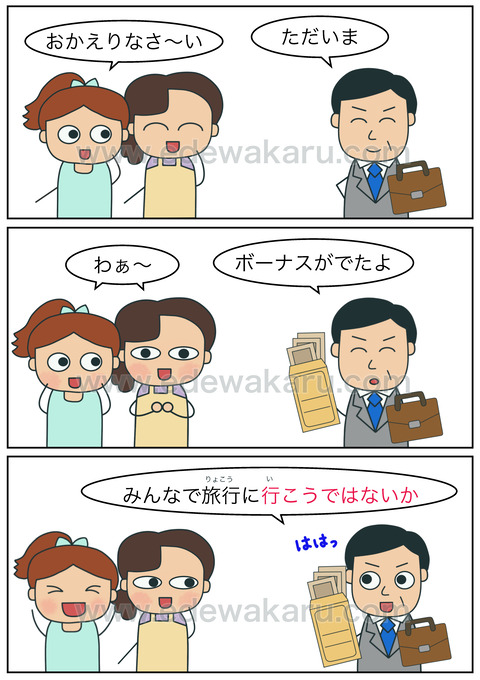
ボーナスもでたことだし、旅行に行こうではないか
→ボーナスもでたことだし、みんなで旅行に行こうWe got a bonus, so let’s go on a trip together! →We got a bonus, so let’s all go on a trip.
仕事のことは忘れて、楽しく飲もうではないか
→仕事のことは忘れて、一緒に楽しく飲もうLet’s forget about work and enjoy a drink together! →Let’s forget about work and enjoy a drink together.
A:もう少しで、完成しますね!B:はい。みんなでがんばろうじゃありませんか
→みんなで一緒にがんばりましょうA: It’ll be finished soon! B: Yes. Let’s all do our best together! →Let’s all do our best together.
部下:お腹がすきましたね…上司:そうだな。どこかで食事をしようじゃないか
→一緒にどこかで食事をしようEmployee: I’m getting hungry… Boss: Yeah. Let’s go get a meal somewhere together. →Let’s go get a meal somewhere together.
みんなそろったね。では会議を始めようじゃないか
→ではみんなで会議を始めようEveryone’s here. Well, let’s start the meeting together. →Well, let’s all start the meeting.
Read the original source text
Meaning
一緒に〜しよう
一緒に〜しませんか
How to use it
動詞[意向形]+ようではないか
動詞[意向形]+ようではありませんか
動詞[意向形]+ようじゃないか
Explanation
「Aようではないか」は「一緒にAしよう」という意味の文型です。「A」には、意志的な動作を表す動詞が入ります。相手に「一緒にAしよう」と、強く誘う場合に使われます。少しかたい言い方ですので、日常会話(にちじょうかいわ)では「〜よう」「〜ましょう」の方がよく使用されます。「では」は「じゃ」にチェンジすることができます。
「よう」がつく文型は、たくさんありますので復習しておきましょう😉
【「よう」がつく文型リスト】
くらべてわかる日本語表現文型辞典
Meaning
Meaning 1: An expression used to lead or urge the person in front of you to do A together.
Meaning 2: An expression used when accepting the other person’s challenge.
Meaning 3: In the form “Aてもらおうでは(じゃ)ないか,” an expression that challenges the other person.
How to use it
Aようではないか(Aようじゃないか/Aてもらおうでは(じゃ)ないか)
Connections 1 and 2:
[Verb—volitional form] ではないか
Connection 3:
[Verb—て-form] もらおうでは(じゃ)ないか
In context 12 examples
みんなで一致団結し、この苦しい戦いを勝ち抜こうではないか。
Let’s unite as one and win this grueling battle!
ここで話していても始まらない。部長に直訴しようじゃないか。
Talking here won’t get us anywhere. Let’s make a direct appeal to the department head.
いま諦めるのはまだ早い。もう一度頑張ってみようじゃないか。
It’s too soon to give up now. Let’s try our best one more time!
新しいゲームがどれくらいのものか、試してみようじゃないか。
Let’s try out this new game and see what it’s like.
君があくまでそう言い張るのなら、試してみようじゃないか。
If you insist on saying that, then let’s put it to the test.
その挑戦、受けて立とうじゃないか。
I accept your challenge!
言い分があるというなら、聞こうじゃないか。
If you have an argument to make, let’s hear it.
「君には無理だろう」「無理かどうかやってやろうじゃないか」
“You can’t do it.” “Whether I can or not, I’ll show you—I’ll do it!”
これ以上にいい考えがあるというなら、出してもらおうじゃないか。
If you say you have a better idea than this, let’s hear it.
彼を説得できるというなら、お手並み拝見させてもらおうじゃないか。
If you say you can persuade him, let’s see what you can do.
君が許可を出したんだから、責任を取ってもらおうじゃないか。
You gave your approval, so let’s have you take responsibility.
この待遇に不満があるなら、やめてもらおうではないか。
If you’re dissatisfied with these conditions, then let’s have you quit.
Read the original source text
Meaning
意味1:目の前にいる人に対して、一緒にAをしようと先導したり、訴えたりする表現。
意味2:相手の挑発を受け、それに応じるときの表現。
意味3:「Aてもらおうでは(じゃ)ないか」の形で。相手を挑発する表現。
How to use it
Aようではないか(Aようじゃないか/Aてもらおうでは(じゃ)ないか)
接続1,2:
[動詞-意向形]ではないか
接続3:
[動詞-て形]もらおうでは(じゃ)ないか