くらべてわかる日本語表現文型辞典
Meaning
Meaning 1: One is not consciously doing A, but is unconsciously doing something akin to A.
Meaning 2: In the form “疑問詞+(から・へ・に)ともなく.” Regarding A, one is unsure, but B.
How to use it
AともなくB (AともなしにB/疑問詞(から・へ・に)ともなくB)
Connection 1:
[Verb—る form] ともなく
Connection 2:
[Question word] + (から・へ・に) + ともなく
Explanation
[Comparison 1]
“AでもなくB” (Meaning 1, p. 147)
Notes
[Note 2]
・Many expressions of this form are idiomatic.
In context 8 examples
隣のカップルの話を聞くともなく聞いていた。
I was listening to the couple next door talking without really intending to.
私は見るともなしに、その男を眺めていた。
I was gazing at the man without really looking at him.
彼女は読むともなしに、ただページを繰っている。
She is just turning the pages without really reading.
母が料理人なので、味付けは覚えるともなしに自然と身についた。
Since my mother is a cook, I naturally picked up how to season food without consciously trying to learn.
魚を焼く匂いがどこからともなく漂ってきた。
The smell of grilled fish drifted in from who knows where.
「あ~疲れた」と、だれにともなくつぶやいた。
“Ah, I’m tired,” I muttered, not addressing anyone in particular.
タンポポの種は風にのって、どこへともなく飛んでいった。
The dandelion seeds rode the wind and flew off to who knows where.
仕事量は膨大で、いつ果てるともなく続く作業に思われた。
The workload was enormous, and the work seemed to go on without any end in sight.
Read the original source text
Meaning
意味1:意識してAするわけではないが、無意識にAに類することをしている。
意味2:「疑問詞+(から・へ・に)ともなく」の形で。Aについては、はっきりしないがB。
How to use it
AともなくB(AともなしにB/疑問詞(から・へ・に)ともなくB)
接続1:
[動詞-る形]ともなく
接続2:
[疑問詞]+(から・へ・に)+ともなく
Explanation
【対比1】
「AでもなくB」(意味1 P.147)
Notes
【注意2】
・この形は慣用的なものが多い。
DoJG 日本語文法辞典(全集)
Meaning
Without intending to; without paying much attention; unconsciously; mindlessly; don’t know (exactly) who/where/etc. (but); cannot tell (exactly) who/where/etc. (but); (to/from) no particular (person, etc.)
How to use it
(i) V1informal nonpast | ともなくV2 | Where V1=V2 |
| 見るともなく見る | Look at something unconsciously |
(ii) Wh-word+Particle | ともなく | |
| どこからともなく | (Cannot tell from where but) from somewhere |
| 誰にともなく | To no one in particular |
Explanation
A phrase indicating that the subject does something without paying much attention, or that when, where, to whom, etc., something took place is unclear.
In context 8 examples
散歩をしているうちに、来るともなく駅まで来てしまった。
While I was taking a walk, I came as far as the station without intending to.
我が家ではいつからともなく正月にスキーに行く習慣が始まった。
We do not know when, but my family started a tradition of going skiing on New Year's Day.
聴くともなく聴いていたら、だんだんその演奏に引き込まれていった。
As I was listening to the performance without paying much attention, I was gradually pulled into it.
大学時代のことを考えるともなく考えていると、次々にクラスメートの顔が浮かんできた。
When I was thinking mindlessly about my university days, the faces of my classmates came to my mind one after another.
目撃者の話を聞くともなく後ろで聞いていたが、突然その話の中に事件解決のための重要な情報が含まれていることに気がついた。
I was listening to the witness's story from behind without paying much attention when, all of sudden, I realised that it contained an important piece of information for solving the case.
どこからともなくいい匂いが漂ってきた。
(I couldn't tell from where, but) a good smell wafted from somewhere.
「やっと終わった」。彼は誰にともなくつぶやいた。
Finally, it's over, he muttered (literally: muttered to no one in particular).
二人はどちらからともなく顔を見合わせて微笑んだ。
The two smiled at each other almost at the same time. (literally: I cannot tell which one did it first, but the two looked at each other and smiled.)
日本語文型辞典
Meaning
Follows interrogative words such as 「どこ、いつ、だれ、どちら」 and means “somewhere/sometime/someone/something, though it cannot be specified exactly.” When a particle is used, it follows the interrogative word directly.
Follows verbs expressing intentional human actions, such as “see,” “speak,” “say,” and “think,” and describes an action being performed without a clear intention or purpose. It is often preceded by an interrogative such as 「何、どこ」.
How to use it
Interrogative word+(particle)+ともなく
V-るともなく
In context 8 examples
どこからともなく、沈丁花のいい香りが漂ってくる。
A lovely fragrance of daphne drifts from somewhere.
明くる朝、旅人はどこへともなく立ち去って行った。
The following morning, the traveler departed, heading off to who knows where.
誰からともなく拍手が起こり、やがて会場は拍手喝采の渦に包まれた。
Applause began from no one in particular, and before long the hall was filled with a thunderous ovation.
生徒達は夜遅くまで騒いでいたが、いつともなくそれぞれの部屋に戻っていった。
The students were making noise until late at night, but at some point they each returned to their rooms.
二人は、どちらからともなく走り寄り固く抱きあった。
Without either of them knowing who started it, the two ran to each other and embraced tightly.
どこを眺めるともなく、ぼんやり遠くを見つめている。
Without really looking at any particular place, he gazes blankly into the distance.
老人は誰に言うともなく「もう秋か」とつぶやいた。
The old man murmured, “It's autumn already,” without directing it at anyone in particular.
何を考えるともなく、一日中物思いにふけっていた。
Without thinking about anything in particular, I spent the whole day lost in thought.
Read the original source text
Meaning
「どこ、いつ、だれ、どちら」などの疑問詞を受けて、場所、時間、人物、物などの、「どの部分かは特定はできないが」という意味を表す。助詞が用いられる場合は、疑問詞の直後に付く。
「見る、話す、言う、考える」のような、人間の意志的な行為を表す動詞を受けて、その動作がはっきりした意図や目的なしに行われている様子を表す。その前に「何、どこ」などの疑問詞を伴うことが多い。
How to use it
疑問詞+(助詞)+ともなく
V-るともなく
絵でわかる日本語
Usage 1
Read this source entry ↗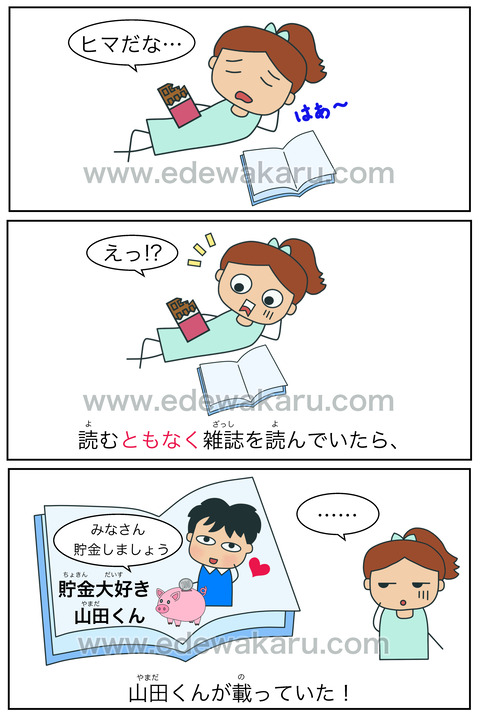
Meaning
Do ~ without intending to do so
How to use it
Verb [dictionary form] + ともなく
Explanation
“〜ともなく” is a sentence pattern meaning “do ~ without intending to, just casually.” It means “do ~ without a clear purpose” and is used when someone does something unconsciously. In many cases, the same verb is repeated, as in “AともなくA.” Remember a few verbs commonly used with it 😊
[Verbs often used with “〜ともなく”]
・見るともなく
・話すともなく
・聞くともなく
・言うともなく
・考えるともなく
“〜ともなく” also has a use that expresses [uncertainty], so remember that as well 😀
In context 5 examples
読むともなく雑誌を読んでいたら、山田くんが載っていた
→なんとなく雑誌を読んでいたら、山田くんが載っていたI was casually reading a magazine when I saw Yamada in it. →I was reading a magazine without any particular purpose when I saw Yamada in it.
毎日韓ドラを見ていたら、韓国語を覚えるともなく覚えてしまった→韓国語を覚えようというつもりはなかったが覚えてしまった*「韓ドラ」とは「韓国ドラマ」のことです😊
I watched Korean dramas every day, and before I knew it, I had learned Korean without even trying to. → I didn’t intend to learn Korean, but I ended up learning it. *“韓ドラ” means “Korean drama” 😊
ラジオを聞くともなく聞いているうちに寝てしまった
→なんとなくラジオを聞いていたら、寝てしまったI fell asleep while casually listening to the radio. →I was listening to the radio without any particular purpose and fell asleep.
何を考えるともなく、一日中(いちにちじゅう)ぼうっとしていた
→特に何も考えずに、一日中ぼうっとしていたI spent the whole day zoning out without thinking about anything in particular. →I spent the whole day zoning out without thinking about anything in particular.
子供は、誰から習うともなく言葉を覚えてしまう
→習おうという意志がなくても、自然に覚えてしまうChildren learn language naturally without anyone deliberately teaching them. →They learn naturally even without any intention to study.
Read the original source text
Meaning
〜しようというつもりなく、〜する
How to use it
動詞[辞書形]+ともなく
Explanation
「〜ともなく」は「〜しようというつもりなく、なんとなく〜する」という意味の文型です。この文型は、
「はっきりとした目的がなく〜する」
という意味を表すもので、無意識に何かをするという時に使われます。
多くの場合「AともなくA」というように、同じ動詞を繰り返して使います。
よく一緒に使われる動詞をいくつか覚えておきましょう😊
[「〜ともなく」とよく一緒に使われる動詞]
・
見るともなく
・
話すともなく
・
聞くともなく
・
言うともなく
・
考えるともなく
「〜ともなく」には【不確か】を表すものもありますので、一緒に覚えておきましょう😀
Usage 2
Read this source entry ↗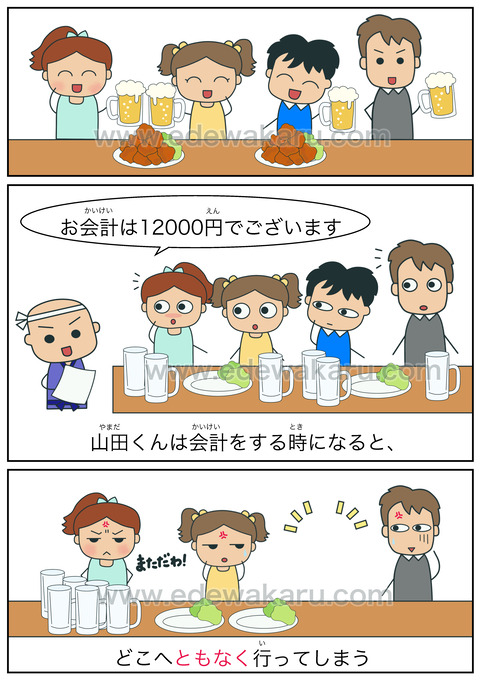
Meaning
I don’t really know whether ~, but ~
I don’t clearly know whether ~, but ~
How to use it
Question word + ともなく
Explanation
“〜ともなく” is used together with question words and means “I don’t really know where/when/who ~, but ~” or “I can’t say exactly where/when/who ~, but ~.” In many cases, it is used in the form “question word + particle + ともなく.”
[Examples]
① When it’s time for Yamada to pay, he goes off somewhere, no one knows where.
→He goes somewhere, though it’s unclear exactly where.
② A nice smell of bread is coming from somewhere.
→A nice smell of bread is coming from somewhere, though I’m not sure where.
③ A beautiful singing voice can be heard from somewhere.
→A beautiful singing voice can be heard from somewhere, though I’m not sure where.
④ In Japan, at some point, people came to eat fried chicken at Christmas.
→At some point, though it’s unclear exactly when, people came to eat fried chicken at Christmas.
⑤ When the concert ended, applause broke out from someone, no one knows who.
→Applause broke out, though it’s unclear who started it.
⑥ After graduation, my friend and I stopped contacting each other, without either of us knowing exactly who stopped first.
→We stopped contacting each other, though it’s unclear which of us stopped first.
Also, “〜ともなく,” which expresses [uncertainty], can be changed to “〜ともなしに.”
[Example]
A nice smell of bread came from somewhere.
=A nice smell of bread came from somewhere.
“〜ともなく” also means [doing ~ unconsciously], so remember that as well 😊
In context 6 examples
山田くんは会計をする時になると、どこへともなく行ってしまう
When it’s time for Yamada to pay, he goes off somewhere.
どこからともなく、パンのいいにおいがする
A nice smell of bread is coming from somewhere.
どこからともなくきれいな歌声が聞こえてくる
A beautiful singing voice can be heard from somewhere.
日本では、いつからともなくクリスマスにフライドチキンを食べるようになった
In Japan, at some point, people came to eat fried chicken at Christmas.
コンサートが終わると、誰からともなく拍手が起こった
When the concert ended, applause broke out from somewhere.
卒業してから友達とは、どちらからともなく連絡をしなくなった
After graduating, neither my friend nor I contacted the other anymore.
Read the original source text
Meaning
〜か、よくわからないが〜
〜か、はっきりわからないが〜
How to use it
疑問詞+ともなく
Explanation
「〜ともなく」は疑問詞と一緒に使われ、「〜か、よくわからないが〜」「〜か、はっきりわからないが〜」という意味を表す文型です。多くの場合は
「疑問詞+助詞+ともなく」
という形で使われます。
[例]
①山田くんは会計をする時になると、
どこへともなく
行ってしまう
→どこへか、はっきりわからないが行ってしまう
②
どこからともなく、パンのいいにおいがする
→どこからかよくわからないが、パンのいいにおいがする
③どこから
ともなく
きれいな歌声が聞こえてくる
→どこからかよくわからないが、きれいな歌声が聞こえてくる
④日本では、いつから
ともなく
クリスマスにフライドチキンを食べるようになった
→いつからかはっきりわからないが、フライドチキンを食べるようになった
⑤コンサートが終わると、誰から
ともなく
拍手が起こった
→誰からかわからないが、拍手が起こった
⑥卒業してから友達とは、どちらから
ともなく
連絡をしなくなった
→どちらからかわからないが、連絡をしなくなった
また[不確か]を表す「〜ともなく」は、「〜ともなしに」にチェンジすることができます。
[例]
どこから
ともなく、パンのいいにおいがしてきた
=どこから
ともなしに、パンのいいにおいがしてきた
「〜ともなく」には【無意識に〜する】という意味もありますので、一緒に覚えておきましょう😊
どんなときどう使う 日本語表現文型辞典
Meaning
unconsciously; without paying attention
How to use it
Vる+ともなく
Explanation
特にそうしようというつもりでなく
「特に目的や意図がなくある行為をする」と言いたいときに使う。「ともなく」の前後には同じ意味の動作性の動詞(見る・言う・聞く・考える、など)が来る。「ふと~すると(なんとなく~していたら)、こんな意外なことが起こった」と言いたいときによく使われる。 ❹ ❺ のような慣用的な使い方もある。
Act with no particular purpose or intent in mind. Verbs of same type of action precede and follow, such as 見る、言う、聞く、考える、etc. Often used when unconsciously doing something and an unexpected event occurs. Also used in idiomatic expressions, as in sentences ❹ and ❺ .
In context 5 examples
祖父は何を見るともなく窓の外をながめている。
My grandfather gazes out the window without looking at anything in particular.
ラジオを聞くともなしに聞いていたら、とつぜん飛行機墜落のニュースが耳に入ってきた。
I was listening to the radio without really paying attention when news of a plane crash suddenly reached my ears.
夜、考えるともなしに会社でのことを考えていたら、課長に大切な伝言があったことを思い出した。
At night, I was thinking about work without really meaning to, when I remembered that the section chief had an important message for me.
彼はいつからともなく、みんなに帝王と呼ばれるようになった。
At some point, he came to be called the Emperor by everyone.
彼は置き手紙をすると、どこへともなく去って行った。
After leaving a note, he went off to who knows where.
Read the original source text
Meaning
unconsciously; without paying attention
How to use it
Vる+ともなく
Explanation
特にそうしようというつもりでなく
「特に目的や意図がなくある行為をする」と言いたいときに使う。「ともなく」の前後には同じ意味の動作性の動詞(見る・言う・聞く・考える、など)が来る。「ふと~すると(なんとなく~していたら)、こんな意外なことが起こった」と言いたいときによく使われる。 ❹ ❺ のような慣用的な使い方もある。
Act with no particular purpose or intent in mind. Verbs of same type of action precede and follow, such as 見る、言う、聞く、考える、etc. Often used when unconsciously doing something and an unexpected event occurs. Also used in idiomatic expressions, as in sentences ❹ and ❺ .
日本語NET JLPT文法解説まとめ
Meaning
① Without particularly intending to do something; expresses performing an action unconsciously.
② Without being clear about ...; expresses that an action or place, etc. is not clearly specified.
How to use it
① V (dictionary form) + ともなく / ともなしに
Attaches to volitional verbs such as “見る” (see), “聞く” (hear), “読む” (read), and “覚える” (memorize).
② Interrogative word + ともなく / ともなしに
Explanation
① "Without particularly intending to do ~"
Indicates that the action is being performed unconsciously.
② "Although it's not clear about ~, ..."
Expresses that the action or location is not clearly defined.
In context 8 examples
気がつけば、カフェで隣に座っているサラリーマン同士の会話を聞くともなく聞いていた。
Before I knew it, I was listening, without really meaning to, to the conversation between the salarymen sitting next to me in the café.
見るともなくテレビを見ていると、会社の同僚が出てきてびっくりした。
As I was watching TV without really watching, I was surprised to see one of my coworkers appear.
毎日、お店で流れている歌なので、覚えるともなく歌詞を覚えてしまった。
Since it's a song that plays in the shop every day, I ended up memorizing the lyrics without really trying.
彼女は本を読むともなく、ただページをめくっている。
She isn't really reading the book; she's just turning the pages.
歩いていると、どこからともなくカレーの匂いが漂ってきた。
As I was walking, the smell of curry wafted over from somewhere or other.
誰にともなく、今日あった出来事を聞いて欲しい。
I want someone, anyone, to listen to what happened today.
山田さんは突然、誰にともなく「マジでムカつく!」と言った。
Yamada suddenly said, to no one in particular, “I'm seriously pissed off!”
Instagramの影響か、いつからともなく、彼女は海外で有名人になっていた。
Perhaps because of Instagram, at some point she had become famous overseas.
Read the original source text
Meaning
① 特に意識して〜しようというつもりはなく
無意識に動作をしていることを表す。
② 〜についてははっきりないが、・・・
動作や場所などがはっきりとしないことを表す。
How to use it
① V(辞書形)+ ともなく / ともなしに
「見る」、「聞く」、「読む」、「覚える」などの意志動詞に接続する
② 疑問詞 + ともなく / ともなしに
Explanation
① "Without particularly intending to do ~"
Indicates that the action is being performed unconsciously.
② "Although it's not clear about ~, ..."
Expresses that the action or location is not clearly defined.
毎日のんびり日本語教師
How to use it
Interrogative word (+ particle) + ともなく
Interrogative word (+ particle) + ともなしに
Explanation
Used with an interrogative word to express that the action, place, time, etc. cannot be specified.
・どこからともなく
・誰にともなく
・どちらからともなく
・どこへともなく
Notes
Nothing in particular.
In context 7 examples
二人はどちらからともなく手を繫ぎ、歩き出した。
Without either of them knowing who started it, the two joined hands and began walking.
いつもガムを噛んでいることから、彼を「ガム男」と誰ともなく呼ぶようになった。
Since he was always chewing gum, people began calling him “Gum Guy,” without anyone in particular having coined the name.
窓開けてるとどこからともなく良い匂いしてきた。
With the window open, a nice smell wafted in from somewhere.
陽も落ちて辺りが暗くなり始めた頃から、どこからともなく人々が集まってきました。
Around the time the sun had set and it was starting to get dark, people began gathering from who knows where.
不思議な光がどこからともなく現れ、どこへともなく消えていった。
A mysterious light appeared from who knows where and disappeared to who knows where.
いい感じの雰囲気になってどちらともなくキスをした。
The mood turned just right, and without either of us taking the lead, we kissed.
文句を誰ともなしに言ったところで世の中が変わる訳でもない。
Even if you complain without directing it at anyone in particular, it’s not as if the world will change.
Read the original source text
How to use it
疑問詞(+助詞)+ともなく
疑問詞(+助詞)+ともなしに
Explanation
疑問詞について、動作や場所、時間等が特定できないことを表します。
・どこからともなく
・誰にともなく
・どちらからともなく
・どこへともなく
Notes
特になし
日本語文型辞典 英語版
Meaning
When used with a question word such as どこ (where), いつ (when), だれ (who) or どちら (which), ともなく means “but it is not possible to specify the exact place, time, person, or thing.” When a particle is used, it is placed immediately after the question word.
When used with a verb expressing an intentional human act, such as 見る (look at), 話す (speak), 言う (say), or 考える (think), ともなく indicates that the action is being carried out without any clear intention or aim. It is often preceded by a question word such as 何 (what) or どこ (where).
How to use it
1. question word(+ particle)+ともなく
2. V-dictionary formともなく
In context 8 examples
どこからともなく、沈丁花のいい香りが漂ってくる。
The pleasant fragrance of daphne wafted in from somewhere.
明くる朝、旅人はどこへともなく立ち去って行った。
The next morning, the traveler left to go nowhere in particular.
誰からともなく拍手が起こり、やがて会場は拍手喝采の渦に包まれた。
Someone started clapping, and soon the hall was filled with gales of thunderous applause.
生徒達は夜遅くまで騒いでいたが、いつともなくそれぞれの部屋に戻っていった。
The students were making noise until late at night, but at some point they all went back to their rooms.
二人はどちらからともなく走り寄り固く抱きあった。
The two of them—I don’t know who went first—ran up to each other and locked each other in a tight embrace.
どこを眺めるともなく、ぼんやり遠くを見つめている。
He is gazing absently into the distance, at nothing in particular.
老人は誰に言うともなく「もう秋か」とつぶやいた。
“It’s already fall,” the old man murmured to no one in particular.
何を考えるともなく、一日中物思いにふけっていた。
I was lost in thought all day about nothing in particular.
Read the original source text
Meaning
When used with a question word such as どこ (where), いつ (when), だれ (who) or どちら (which), ともなく means “but it is not possible to specify the exact place, time, person, or thing.” When a particle is used, it is placed immediately after the question word.
When used with a verb expressing an intentional human act, such as 見る (look at), 話す (speak), 言う (say), or 考える (think), ともなく indicates that the action is being carried out without any clear intention or aim. It is often preceded by a question word such as 何 (what) or どこ (where).
How to use it
1. 疑問詞(+助詞)+ともなく
2. V-るともなく
AIUEO JLPT Grammar
Meaning
This sentence pattern is used to express performing an action without a clear intention or purpose. It describes actions that are done naturally or absentmindedly, often depicting unintentional or casual occurrences.
How to use it
Verb dictionary form + ともなく; verb dictionary form + ともなしに
In context 5 examples
窓の外を見るともなく見ていたら、雪が降ってきた。
I was absentmindedly looking out the window when it started snowing.
歩くともなく歩いていたら、知らない街に来てしまった。
I was walking aimlessly and ended up in an unfamiliar town.
スマホをいじるともなくいじっていたら、友達からメッセージが来た。
I was absentmindedly playing with my phone when I received a message from a friend.
聞くともなしにラジオを聞いていたら、懐かしい声が聞こえてきた。
I was casually listening to the radio when I heard a familiar voice.
頷くともなしにぼんやり話を聞いていたら、決定してしまった。
I listened absentmindedly to what he said without nodding or anything, and then the decision was made.
Read the original source text
Meaning
This sentence pattern is used to express performing an action without a clear intention or purpose. It describes actions that are done naturally or absentmindedly, often depicting unintentional or casual occurrences.
How to use it
動詞辞書形とも+なく動詞辞書形とも+なしに
Explanation · 日本語
この文型は、明確な意識や目的を持たずに何かを行っていることを表す表現です。自然に、またはぼんやりとその行動をしている様子を表現します。特に集中していない状況や偶然の出来事を描写するときに使われます。
文法
Meaning
① Indicates doing something unconsciously, without specifically intending to do it.
② … with no clear idea of …; indicates that the action or location, etc. is not clearly specified.
How to use it
① V (dictionary form) + ともなく / ともなしに
Connects to volitional verbs such as 「見る」、「聞く」、「読む」、「覚える」.
② Interrogative + ともなく / ともなしに
In context 8 examples
気がつけば、カフェで隣に座っているサラリーマン同士の会話を聞くともなく聞いていた。
Before I knew it, I was listening, without really meaning to, to the conversation between the salarymen sitting next to me in the café.
見るともなくテレビを見ていると、会社の同僚が出てきてびっくりした。
As I was watching TV without really watching, I was surprised to see one of my coworkers appear.
毎日、お店で流れている歌なので、覚えるともなく歌詞を覚えてしまった。
Since it's a song that plays in the shop every day, I ended up memorizing the lyrics without really trying.
彼女は本を読むともなく、ただページをめくっている
She isn’t really reading the book; she’s just turning the pages.
歩いていると、どこからともなくカレーの匂いが漂ってきた。
As I was walking, the smell of curry wafted over from somewhere or other.
誰にともなく、今日あった出来事を聞いて欲しい。
I want someone, anyone, to listen to what happened today.
山田さんは突然、誰にともなく「マジでムカつく!」と言った。
Yamada suddenly said, to no one in particular, “I'm seriously pissed off!”
Instagramの影響か、いつからともなく、彼女は海外で有名人になっていた。
Perhaps because of Instagram, at some point she had become famous overseas.
Read the original source text
Meaning
① 特に意識して〜しようというつもりはなく
無意識に動作をしていることを表す。
② 〜についてははっきりないが、・・・
動作や場所などがはっきりとしないことを表す。
How to use it
① V(辞書形)+ ともなく / ともなしに
「見る」、「聞く」、「読む」、「覚える」などの意志動詞に接続する
② 疑問詞 + ともなく / ともなしに
Bunpro Grammar Reference
Meaning
Absentmindedly, Mindlessly, Unconsciously, Without paying attention
How to use it
Verb[る](A) + ともなく(1) + Verb[たら](2)(A)
(1) ともなしに
(2) Verb + と
Nuance
A phrase highlighting that the action of (A) was happening absentmindedly. While not even sure that (A) was happening, (B).
Explanation
ともなく and ともなしに are structures used to indicate that (A) was being done absentmindedly when (B) happened. It will be translated as 'unconsciously (A) when (B)', or 'without paying attention to (A), (B)'.
This pattern is a combination of the case-marking particle と, the adverbial particle も, and the conjunctive form of the い-Adjective ない. It will be seen after the dictionary form of verbs, and can be thought of as literally meaning something similar to 'even while not intending to (B), while (A), (B)'.
昨日テレビを見るともなく見ていたら、急にお母さんが出てきたから驚いた。
When I was absentmindedly watching TV yesterday, I was surprised when my mother suddenly appeared.
話を聞くともなく、先生と黒板の方向をぼーっと見ていた。
I absentmindedly listened while spacing out in the direction of my teacher and the blackboard.
ともなしに is similar, but pairs the noun なし 'without' with に, instead of using the conjugative form of ない.
飲み会で上司の話を聞くともなしに聞いていたら、「お前はどう思う」と聞かれたから適当に返事した。
When I was at a drinking party and was absentmindedly listening to my boss, he asked what I thought, so I gave him a random response.
暇だったから近所を歩くともなしに歩いていたら、高校の同級生にばったりあった。
When I was mindlessly walking in my neighborhood because I had nothing to do, I met my classmate from high school.
ともなく and ともなしに will often be seen in sentences that use たら. This puts emphasis on the specific time that something happened while performing another action absentmindedly. Despite translating this way, the action that precedes ともなく itself will be intentional, but the thing that comes about as a result of performing that action will not be what the doer was aiming to achieve.
In context 16 examples
- この曲は行きつけのバーでいつも流れているため、覚えるともなく覚えてしまった。
Since this song is always playing at my favorite bar, I unconsciously memorized it.
- 話を聞くともなく、先生と黒板の方向をぼーっと見ていた。
I absentmindedly listened while spacing out in the direction of my teacher and the blackboard.
- 暇だったから近所を歩くともなしに歩いていたら、高校の同級生にばったりあった。
When I was mindlessly walking in my neighborhood because I had nothing to do, I met my classmate from high school.
- 昨日テレビを見るともなく見ていたら、急にお母さんが出てきたから驚いた。
When I was absentmindedly watching TV yesterday, I was surprised when my mother suddenly appeared.
- 飲み会で上司の話を聞くともなしに聞いていたら、「お前はどう思う」と聞かれたから適当に返事した。
When I was at a drinking party and was absentmindedly listening to my boss, he asked what I thought, so I gave him a random response.
- 隣人の窓を見るとも無く見ると、驚いたことに裸の人がいた。
I looked at my neighbor's window without paying attention, and, to my surprise, there was a naked person.
- 勝者の発表を聞くとも無く聞いていたら、なんと私の名前が挙がっていた。
I listened absentmindedly to the announcements of the winners, when, to my disbelief, my name came up.
- ノベル:「彼は夜遅くテレビを見るとも無く見ているうちにいつのまにか寝入ってしまったようだ。」
Novel: 'It seems that he fell asleep while he was mindlessly watching TV late at night.'
- 昨日、考えるとも無く考えているところに、スズメバチにひどく刺されて「痛っ!」思わず叫んでしまった。
Yesterday, when I was thinking about nothing in particular, I was badly stung by a wasp, and without thinking shouted: 'Ouch!' (mindlessly)
- 見るともなくテレビを見ていると、ビールの広告に友達が出演していて驚きました。
While watching TV without paying too much attention, I was surprised to see a friend appear in a beer commercial.
- 「何も無い」とはどういう事なのか、考えるともなく考えてしまう事がたまにあります。
There are occasionally times where I unconsciously contemplate what 'there being nothing' means.
- 嫌な事があると、その事を考えるともなく考えてしまうので、そういう時は早く寝るようにしている。
If there is something that I dislike, since I'll absentmindedly think about it, I do my best to go to sleep quickly at those times.
- カフェでぼんやりしていると気づけば隣に座っている主婦たちの会話を聞くともなく聞いていました。
When lazing around in a cafe, upon reflection, I was listening to the conversation of the couple sitting next to me without paying attention.
- 山田さんと晩御飯を食べるとも無く食べていたら、急に彼が告白してきて驚いた。
When I was absentmindedly eating dinner with Yamada-san, he suddenly confessed (his feelings for me) and it really surprised me.
- ライトノベル、あまくささん:「家に帰るとも無く帰っていたら、突然美少女が空から落ちてきてびっくりした。」
Light Novel, Amakusa: 'When I was absentmindedly on my way back home, a beautiful girl fell from the sky and startled me.'
- 学生の頃は親友と何を話すともなく話す時間が好きだったが、今はそんなに暇な時間が無い。
When I was a student, I loved the times when I would mindlessly talk about something with my best friend, but now I don't have that much free time.
NINJAL 日本語文型データベース
Meaning
[1] Expresses a state in which there is no particular intention to do ~. It is used to mean doing things such as “見る・聞く・考える” (look, listen, think) without a clear intention or purpose.
[2] Expresses doing something or something happening without being able to specify exactly ~.
How to use it
Vるともなく
Vるともなく
Nともなく
Other
Notes
[1] “~” is limited to certain verbs such as “見る・聞く・考える” (look, listen, think), where the will or awareness involved in the action is not clearly expressed. The sentence following “~ともなく” also uses the same or a similar verb.
[2] “~” is a question word such as “誰” (who), a question word with a particle attached, such as “どこへ・いつから” (where to, since when), or a sentence containing a question word. The sentence following “~ともなく” expresses an action or event that occurs in that state.
In context 12 examples
ラジオから流れる音楽やトークや朗読を、聞くともなく聞いている時間が好きだ。
I like the time I spend listening, without really meaning to, to the music, talk, and readings coming from the radio.
最近、将来のことを考えるともなく考えていることが多くなった。
Recently, I’ve found myself thinking about the future without really meaning to more often.
窓の外を見るともなく眺めていたら、どこからか珍しい鳥が庭に飛んできて木の枝にとまった。
I was gazing out the window without really looking when an unusual bird flew into the garden from somewhere and landed on a branch.
誰に聞かせるともなく、母はよく子守歌を歌っていた。
My mother often sang lullabies without singing them for anyone in particular.
祭りに参加した人たちは、祭りが終わると誰が言い出すともなく、周りのごみを拾い集めた。
After the festival ended, the participants began picking up the litter around them without anyone having to suggest it.
昨日は休日だったが、疲れていたので何をするともなく過ごした。
Yesterday was a day off, but I was tired, so I spent it without doing anything in particular.
ホテルに荷物を置いた後、どこへ行くともなく街中を歩いてみた。
After leaving my luggage at the hotel, I walked around town without heading anywhere in particular.
大雪が降れば、誰ともなく、近所の家の雪下ろしを手伝いはじめる。
When heavy snow falls, someone or other starts helping clear snow from the neighboring houses.
何故ともなく、この頃子どものときのことがしきりに思い出される。
For some reason, I’ve been remembering things from my childhood a lot lately.
庭でウグイスが鳴いていたが、どこへともなく飛んでいってしまった。
A Japanese bush warbler was singing in the garden, but it flew off somewhere.
いつからともなく私は西洋美術に興味を持つようになった。
At some point, I became interested in Western art.
長い結婚生活の中で、次第に考え方のずれがはっきりしてきた。今年になってどちらからともなく、別れ話が出てきた。
Over the course of our long marriage, our differences in outlook gradually became clear. This year, the idea of separating came up without either of us bringing it up in particular.
Read the original source text
Meaning
[1] 〜する意図が特にない状態を表します。はっきりした意図や目的がない状態で「見る・聞く・考える」などの動作をするという意味で使います。
[2] はっきり〜と特定できない状態で、あることをする・あることが起きるということを表します。
How to use it
Vるともなく
Vるともなく
Nともなく
その他
Notes
[1] 「~」は行為の意志・意識がはっきり表に出ない「見る・聞く・考える」など限られた動詞だけです。「~ともなく」の後の文にも「〜」と同じか似た意味の動詞を使います。
[2] ~には「誰」などの疑問詞か、「どこへ・いつから」など疑問詞に助詞がついた形、または疑問詞を含む文が来ます。「〜ともなく」の後には、その状態で生じる動作や出来事を表す文がきます。