AIUEO JLPT Grammar
Meaning
This sentence pattern expresses the effort to adopt a particular behavior or habit, used when intentionally trying to change one’s actions.
How to use it
Verb dictionary form + ように + する; Verb ない-form + ように + する
In context 5 examples
毎日運動するようにしている。
I try to exercise every day.
宿題を忘れないようにしてください。
Please try not to forget your homework.
交通ルールを守るようにしてください。
Please try to follow the traffic rules.
健康のために、毎日野菜を食べるようにします。
I will try to eat vegetables every day for my health.
アラームが7時に鳴るようにした。
I set the alarm to go off at 7 o'clock.
Read the original source text
Meaning
This sentence pattern expresses the effort to adopt a particular behavior or habit, used when intentionally trying to change one’s actions.
How to use it
動詞辞書形+ように+する動詞ない形+ように+する
Explanation · 日本語
この文型は、特定の行動や習慣を身につけるために努力することを表す表現で、意識的に行動を変えようとするときに使われます。
文法
Meaning
Make an effort to … / Try hard to …
Used when the speaker consciously decides to work hard at doing or avoiding something and states that decision.
How to use it
V (dictionary form) + ようにする
V (ない-form) + ようにする
In context 5 examples
体がことが心配になって来たので、しばらくタバコは吸わないようにします。
I've started worrying about my health, so I'll try not to smoke for a while.
医者:健康のために野菜もしっかり食べてください。
患者:わかりました。じゃあ、今日から毎日野菜を食べるようにします。Doctor: Please make sure to eat vegetables too, for your health. Patient: Understood. Then, starting today, I’ll make a point of eating vegetables every day.
A:このまま痩せなければ、入院することになりますよ!
B:じゃあ、明日から毎朝10分ジョギングするようにします。
B:それから、スナックやカロリーの高いものは食べないようにします。A: If you keep losing weight like this, you’ll have to be hospitalized! B: Then, starting tomorrow, I’ll jog for ten minutes every morning. B: Also, I’ll stop eating snacks and other high-calorie foods.
A:トムさんは今日も遅刻ですよ!いつになったら時間通りに来れるんですか?
B:すみません、明日からは絶対に遅刻しないようにします。A: You’re late again today, Tom! When are you going to start arriving on time? B: Sorry. Starting tomorrow, I’ll make sure not to be late.
A:もっとナチュラルな日本語を話したいなら、毎日シャドーイングの練習をしてみたらどうですか?
B:じゃあ、今日から毎日朝と夜にシャドーイングの練習をするようにします。A: If you want to speak more natural Japanese, why don’t you try practicing shadowing every day? B: Then, starting today, I’ll make a point of practicing shadowing every morning and evening.
Read the original source text
Meaning
〜ように 努力する/ 頑張って〜する
話し手が意識的に頑張って〜すると決めて、それを述べる時に使う。
How to use it
V(辞書形)+ ようにする
V(ない形)+ ようにする
Bunpro Grammar Reference
Meaning
To try to, To make sure to, To endeavor to
How to use it
Verb[る](1) + ように + する
(1) Verb[ない]
Verb[る](1) + ように + します
(1) Verb[ない]
Nuance
A phrase that expresses attempting to do something in the manner of (A).
Explanation
(A) ようにする is an expression in Japanese which combines the auxiliary verb ようだ, with する (indicating that you will 'try' to do something). As ようだ is being linked to the verb する, it will take on its adverbial form, ように. This structure emphasizes that the (A) action (always a verb) is something that the speaker is going out of their way to do, and implies effort.
最近太ってきたので、毎日走るようにしています。
Recently, I have been gaining weight, so I try to run every day.
次の試合で勝てるようにする。
I will try to be able to win the next tournament.
Naturally, this structure may also be used with a negative verb, to imply that (A) being done is something that is actively being avoided. This translates as 'to make sure not to do (A)'.
「空気が汚れるので乗り物に乗らないようにする」と弟が言いました。
My brother said 'I try not to ride vehicles, because it pollutes the air'.
成績が悪いから学校を休まないようにする。
Because my grades are bad, I will try not to miss school.
Fun Fact
Because ようだ comes from the kanji 様 'manner', it carries the nuance that the 'way' that someone is doing (A) is specifically in a way that has success as the goal. Literally it translates quite closely to 'to do (A) in the manner of getting it done', and therefore just strengthens the (A) action, by using 'to do' twice.
In context 16 examples
- 妻にばれないようにしてくれ!
Try not to let my wife find out about it!
- 最近太ってきたので、毎日走るようにしています。
Recently, I have been gaining weight, so I try to run every day.
- 成績が悪いから学校を休まないようにする。
Because my grades are bad, I will try not to miss school.
- 「空気が汚れるので乗り物に乗らないようにする」と弟が言いました。
My brother said 'I try not to ride vehicles, because it pollutes the air'.
- 次の試合で勝てるようにする。
I will try to be able to win the next tournament.
- 予約に間に合うようにしましょう。
Let's try to be on time for the reservation.
- そのコップを落とさないようにしてください。
Please try not to drop that cup.
- あまり音が出ないようにしてください。
Please try not to make much noise.
- 綺麗に包むようにします。
I will try to wrap it beautifully.
- 途中迷わないようにしてね。
Try not to get lost en route.
- 来月までに家を建てるようにする。
We will try to build the house by next month.
- 毎日、日本語の文法を勉強するようにしている。
I am always making sure to study Japanese grammar every day.
- 子供の前で駄目とか、無理とか言わないようにしましょう。
Let's try not to say things like 'no' or 'that's impossible' in front of children.
- 医者:「B(ビー)さんは高血圧なので、お菓子を避けるようにした方がいいですよ。」
Doctor: 'Mr. B, because you have high blood pressure you should make sure to avoid sweets.'
- 悪役:「彼を誰とも話せないようにした。」
Villain: 'I made sure that he won't talk with anyone.'
- 毎日野菜を食べるようにしないといけない。
You have to try to eat vegetables every day.
DoJG 日本語文法辞典(全集)
Meaning
Do ~ in such a way that ~; see to it that ~; make sure that ~; bring it about that ~
How to use it
Vinformal nonpast | ようにする | |
| {話す /話さない}ようにする | Someone makes sure that he/someone else talks/doesn’t talk |
| {食べる /食べない}ようにする | Someone makes sure that he/someone else eats/doesn’t eat |
Explanation
Someone causes some circumstantial or behavioural change to take place.
In context 7 examples
私は毎日運動するようにする・します。
I'll make sure that I do exercises everyday.
出来るだけ日本語で話すようにしています。
I'm making sure I speak Japanese as much as possible.
山川には会わないようにした。
I've made sure that I won't see Yamakawa.
分からないことは先生に聞くようにしている。
I made a point of asking my teacher about the things I don't understand.
毎朝八時に来るようにして下さい。
Please make sure that you come at eight every morning.
後ろからもよく見えるようにしました。
I've seen to it that people can see from the rear seats, too.
成績がよくなるようにした。
I’ve made sure that my grades will improve.
どんなときどう使う 日本語表現文型辞典
Meaning
make a point of
How to use it
Vる / Vない + ようにする
Explanation
習慣的に心がけていることを表す。
Habitual attitude toward something.
In context 6 examples
人に会うときは、約束の時間を守るようにしましょう。
When you meet someone, make sure to keep the agreed time.
アルバイトを休むときは、できるだけ早めに言うようにしてください。
When you need to miss your part-time job, please let them know as early as possible.
わたしは健康のために、毎晩、1時間ぐらい歩くようにしている。
For my health, I make a point of walking for about an hour every evening.
夜、ごみを外に出さないようにしましょう。
Let’s make sure not to put the garbage outside at night.
できるだけ遅刻しないようにしているけど、ときどき遅れてしまう。
I try not to be late as much as possible, but sometimes I end up arriving late.
パソコンは長い時間、続けてしないようにしています。
I try not to use the computer continuously for a long time.
Read the original source text
Meaning
make a point of
How to use it
Vる/Vない+ようにする
Explanation
習慣的に心がけていることを表す。
Habitual attitude toward something.
絵でわかる日本語
Meaning
Make an effort to〜
Make an effort not to〜
Put something into a particular state
Put something into a state where it is not〜
How to use it
Verb [dictionary form] + ようにする
Verb [ない-form] + ようにする
Explanation
“Aようにする・Aないようにする” means “make an effort to do A” or “make an effort not to do A.” Use this pattern when you want to say that you are “working hard with the goal of achieving A” or “working hard with the goal of not achieving A” 😊 When a non-volitional verb is used for “A,” as in Example ⑤, it means “put something into a state where A” or “put something into a state where A does not happen” 😮
[Example]
I cut the vegetables into small pieces and made them easy for even small children to eat.
→I cut the vegetables into small pieces and put them into a state where even small children could eat them.
There are many sentence patterns that use “〜よう,” so be sure to learn to distinguish them 😀
(Review: “〇〇” series list)
In context 5 examples
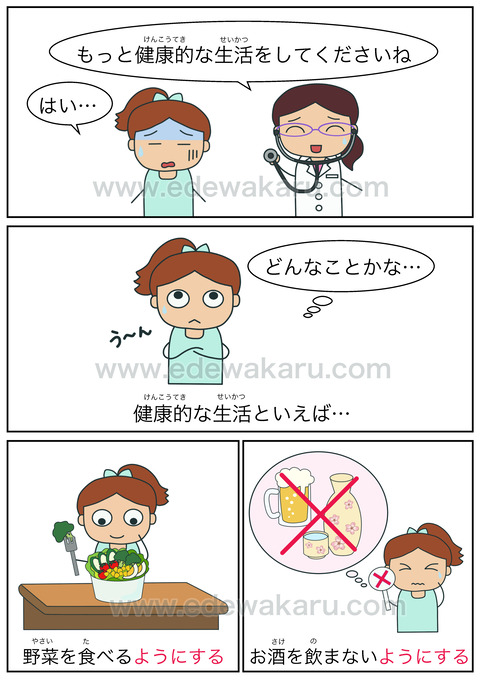
健康のために野菜を食べるようにする
→健康のために野菜を食べるように努力する(復習:〜ために(目的))I’ll try to eat vegetables for my health. →I’ll make an effort to eat vegetables for my health (Review: 〜ために (purpose)).
これからは、お酒を飲まないようにしよう
→これからは、お酒を飲まないように努力しようFrom now on, I’ll try not to drink alcohol. →From now on, I’ll make an effort not to drink alcohol.
毎日日本語を勉強するようにする
→毎日日本語を勉強するように努力するI’ll try to study Japanese every day. →I’ll make an effort to study Japanese every day.
明日は遅刻しないようにしなきゃ
→明日は遅刻しないようにがんばらなきゃ(復習:〜なきゃ)I have to make sure not to be late tomorrow. →I have to try hard not to be late tomorrow (Review: 〜なきゃ).
字を大きく書いて、みんなに見えるようにした
→字を大きく書いて、みんなに見える状態にしたI wrote in large letters so everyone could see. →I put it in a state where everyone could see by writing in large letters.
Read the original source text
Meaning
〜ように努力する
〜ないように努力する
〜状態にする
〜ない状態にする
How to use it
動詞[辞書形]+ようにする
動詞[ない形]+ようにする
Explanation
「Aようにする・Aないようにする」は「Aように努力する・Aないように努力する」という意味を表す文型です。
「Aを達成することを目標にしてがんばる」「Aを達成しないことを目標にしてがんばる」
言いたい時に使います😊例文⑤のように
「A」に無意志動詞が入る場合は「〜状態にする」「〜ない状態にする」という意味になります
😮
[例]
野菜を小さく切って、小さな子供でも食べられる
ようにした
→野菜を小さく切って、小さな子供でも食べられる
状態にした
「〜よう」を使う文型はとてもたくさんありますので、しっかりと区別をして覚えておきましょう😀
(復習:「〇〇」シリーズリスト)
日本語NET JLPT文法解説まとめ
Meaning
Make an effort to … / Try hard to …
Used when the speaker consciously decides to work hard at doing or avoiding something and states that decision.
How to use it
V (dictionary form) + ようにする
V (ない-form) + ようにする
Explanation
"to make a conscious effort to do something"
This sentence pattern is used when the speaker consciously decides to do something with effort and expresses their determination to do so.
In context 5 examples
体がことが心配になって来たので、しばらくタバコは吸わないようにします。
I've started worrying about my health, so I'll try not to smoke for a while.
医者:健康のために野菜もしっかり食べてください。
Doctor: Please make sure to eat vegetables as well for your health.
A:このまま痩せなければ、入院することになりますよ!
A: If you keep losing weight like this, you'll have to be hospitalized!
A:トムさんは今日も遅刻ですよ!いつになったら時間通りに来れるんですか?
A: Tom is late again today! When are you going to start arriving on time?
A:もっとナチュラルな日本語を話したいなら、毎日シャドーイングの練習をしてみたらどうですか?
A: If you want to speak more natural Japanese, why don't you try practicing shadowing every day?
Read the original source text
Meaning
〜ように 努力する/ 頑張って〜する
話し手が意識的に頑張って〜すると決めて、それを述べる時に使う。
How to use it
V(辞書形)+ ようにする
V(ない形)+ ようにする
Explanation
"to make a conscious effort to do something"
This sentence pattern is used when the speaker consciously decides to do something with effort and expresses their determination to do so.
毎日のんびり日本語教師
How to use it
Verb dictionary form + ようにする
Verb ない-form + ないようにする
Explanation
Indicates making an effort to achieve a certain goal.
Using the ている form, as in 「~ようにしている/~ないようにしている」, indicates making a continuous effort to achieve a goal—in other words, that it has become a habit.
Notes
The “よう” series
In context 8 examples
今は手が離せませんが、終わり次第できるだけ早く着くようにします。
I can't leave what I'm doing right now, but I'll get there as soon as I can once I'm done.
期待すると失望するから、初めから期待しないようにしている。
If I get my hopes up, I'll be disappointed, so I try not to expect anything from the start.
来年はロリ系の服買って着たい。髪型とかもそれに似合うようにしたい。
Next year I want to buy and wear Lolita-style clothes. I also want to do my hair in a way that suits them.
辛かったら無理しないようにしてね。
If it's painful, don't push yourself, okay?
デートの最後は『次はいつ会う?』って話を必ずするようにしている。
At the end of every date, I make sure to say, “When will we see each other next?”
リラックスしているときは良いアイディアが浮かびやすい。思い付いたらすぐメモするようにしている。
Good ideas tend to come to me when I'm relaxed. When I think of one, I make sure to jot it down right away.
周りに迷惑が掛からないようにする。
Make sure not to cause trouble for those around you.
失敗はしても後悔はしないようにしている。(即使失败了也尽量做到不后悔。)
Even if I fail, I try not to regret it.
Read the original source text
How to use it
動辞形+ようにする
動ない形+ないようにする
Explanation
ある目的を達成するために努力することを表します。
「~ようにしている/~ないようにしている」とテイル形を用いると、目的を達成するために継続的に努力していること、つまり習慣となっていることを表します。
Notes
「よう」シリーズ
NINJAL 日本語文型データベース
Meaning
Expresses making a conscious effort to do ~ as a habitual practice.
“〜ようにしている” is used when the speaker wants to say they are making a sustained effort.
Also, “〜ようにしてください・〜ようにしましょう” is used to give a gentle instruction or to call on people broadly to make an effort toward a goal.
How to use it
Vるようにする/Vないようにする
Notes
“〜” is a verb expressing a volitional action, such as “使う・食べる・運動する” (“use,” “eat,” “exercise”).
In context 7 examples
「遅刻はしないでね」「わかりました。もっと早く来るようにします」
“Don’t be late.” “Understood. I’ll make sure to come earlier.”
無理をして体調を崩したので、今はできるだけ規則正しい生活をするようにしています。
I overdid it and fell ill, so now I try to live as regularly as possible.
最近太ってきたので、甘いものはなるべく食べないようにしている。
I’ve been gaining weight lately, so I try not to eat sweets as much as possible.
お子さんには、できるだけ自分のことは自分でやらせるようにしてください。
Please have your child do things for themselves as much as possible.
資源の節約のために、ごみはできるだけ減らすようにしましょう。
To conserve resources, let’s try to reduce our garbage as much as possible.
過ぎてしまったことを後悔してもしょうがない。もう思い出さないようにしよう。
There’s no point regretting what’s already happened. I’ll try not to think about it anymore.
「ありがとう」という挨拶を忘れないようにしたい。
I want to make sure I don’t forget to say “thank you.”
Read the original source text
Meaning
~の行為を、意志をもって習慣的に心がけることを表します。
「~ようにしている」は、話し手が継続的に努力していると言いたいときに使います。
また、「~ようにしてください・~ようにしましょう」は、柔らかい指示を出したり、広く努力目標を呼びかけたりするときに使います。
How to use it
Vるようにする/Vないようにする
Notes
「~」には、「使う・食べる・運動する」など、意志的な行為を表す動詞がきます。
IMABI
Try II
Read this IMABI lesson ↗Explanation
Try II: ~ようにする & ~ようとする
The pattern ~ようにする, when used in the sense of “to try…” – Usage I discussed in this lesson – is often confused with ~ようとする, which indicates active execution of an agent’s willpower to do something. Putting aside their different morphology, many learners confuse these patterns due to how they are often so similarly translated.
Previously in Try I: ~てみる・みたい・みせる, we learned how ~てみる is used to denote a trial at doing something.
i. 和牛を食べてみる?
Care to try wagyu?
Even before we get started, it is important to understand that “trial-based” attempts are not what either ~ようにする and ~ようとする describe. It may be inevitable at first to get stuck on the word “try” popping up to describe all three patterns, but learning what sorts of scenarios “try” can cover and how those scenarios are handled in Japanese is the point of this second installment.
~ようにする
As a recap, ~ようにする, as it pertains to habitual behavior, denotes a serious attempt on the part of the agent to perform/bring to fruition some conduct/behavior. Whether the action itself is a one-off occasion or will successfully result in habitual change depends on the context, but the take away is that attempt(s) are being taken. Not only that, but there is some benefit to be gained by the agent if said change holds.
Affirmative連体形 + ~ようにするto try to…
Negative未然形 + ~ないようにするto try not to…
As can be deduced from how this pattern connects to verbal predicates, it must be noted that ~ようにする itself attaches to the 連体形. This is because よう derives from 様 which literally means “condition” and still functions as a noun. In the case of the verbal element being negative before よう, that phrase is still in the 連体形, but to simplify things1, the learner is reminded that ~ない attaches to the 未然形 of verbs.
1. お肉を食べないようにしています。
I am trying not to eat meat.
2. 毎朝歯を磨くようにしています。
I am trying to brush my teeth every morning.
3. 遅れないようにしてください。
Please try not to be late.
4. 無理しないようにしてくださいね。
Try not to push yourself, okay.
Incidentally, it is not impossible for ~ようにする to be combined with ~てみる, especially when “try to…” for the former is stilted toward “make sure to…”
5a. 後で見てみますね。
5b. 後で見てみるようにしますね。
5a. I’ll check it out later.
5b. I’ll make sure to check it out later.
“To check it out” makes it clear that the act of 見る pertains to giving something the chance at being watched. From a plain reading of the text, Ex. 5a is a direct, affirmative statement, whereas Ex. 5b avoids this direct statement and pivots to only promising that “make sure to…,” which is why the pattern ~ようにする is still often translated as “to try…” because if the effort does not hold (habitual nature hinging on whether the situation at hand is a one-off scenario), then the agent is not actually doing said thing – hitting on the possibility that the agent could be lying. But, as any of us have surely experienced in any language that we speak, lying is always possible, and so tonality would be crucial in telling whether the agent is going to make sure, and if it does sound sincere, then the nuance layer of “effort (努力)” would make sense.
~ようとする
Before even delving into how ~ようとする differs semantically from ~ようにする, let’s go over the most blatant difference: that being the ~よう is not even the noun 様 and that this pattern will look different depending on the 未然形 of the verb that it attaches to.
What we are actually looking at here is the volitional auxiliary ~(よ)う attaching to verbs which is then followed by the citation particle と used in tandem with a citation verb, which in this instance, する fills that role – something to keep in mind when we see instances of it being replaced with other verbs. So, without further ado, let’s recap how to conjugate with ~(よ)う in the context of this pattern.
Verb ClassExample未然形+~(よ)うとする
一段 食べるtabe– 食べようとする
五段 飲むnomo2– 飲もうとする
サ変 するshi–3 しようとする
カ変 来るko- 来(こ)ようとする
Understanding What “Try…” Means
At its basic understanding, ~(よ)うとする indicates a volitional attempt in motion at completing said action. Thus, the action is in the present and cannot be construed as a continuous effort, which is a stark difference between it and ~ようにする.
6a. バッタを食べるようにしている。
6b. バッタを食べようとしている。
6c. バッタを食べてみた。
6a. I’m trying to eat grasshoppers.
6b. I’m trying to eat the grasshopper(s).
6c. I tried eating grasshopper.
With this grotesque example, we see how both patterns can take ~ている but that the duration implied is completely different. Ex. 6a suggests going on a grasshopper diet, whereas Ex. 6b. depicts a single yet ongoing attempt to eat whatever grasshopper(s) have been presented to the agent. We can also distinguish Ex. 6b from Ex. 6c, which is a mere trial of grasshoppers taste, by honing in one what the exercise of volition implied by ~(よ)う truly entails. With this volitional auxiliary, the goal “eating the grasshopper(s)” is firmly rooted, and the agent is exerting their freewill to complete said goal.
7. ワインを飲もうとしました。
I tried to drink (the) wine.
Like, ~ようにする, however, the attempt may still fail with ~(よ)うとする, but if the attempt fails, that is simply the end of that single attempt. Meaning, there is nothing implied that the effort is being perpetuated.
8. 起きようとしましたが、起きられませんでした。
I tried/attempted to get up, but I couldn’t.
Interrupted Attempts: “Just about to…”
In some contexts, the attempt onset by ~(よ)うとする can be interrupted. This is made apparent when it constitutes a dependent clause that is then followed by what ends up happening instead. This is an extension of the logic behind what happens when such attempts fail like in Ex. 8 but with a new context being introduced. This usage can be translated on the lines of “just about to…”
9. 朝ご飯を食べようとした時、電話がかかってきました。
Just when I was going to eat breakfast, I got a telephone call.
Because of the phone call, the act of “eating breakfast” could not actually come into fruition. The agent only got so far as to set the process in motion – perhaps putting fork and spoon in hand – only to be interrupted. This aspect restriction on the nature of V1 with ~(よ)うとする crucial to proper understanding.
10. エレベーターに乗ろうとした時、後ろから走ってきた男に押おされたんです。
Just as I was about to get onto the elevator, I was pushed by a man who came running from behind.
11. その後、店で財布を出そうとしたけれど、何もなかったんです。
After that, just as I tried to take out my wallet in the store, nothing was in it.
Restrictions on ~(よ)うとする
Providing that ~(よ)うとする, without any added morphology, pertains to the onset of an attempt in the sense that the agent is setting themselves out to complete said action. Yet, because failure is possible, in the non-past tense at least, the action at hand has not actually occurred, although it is fair to say that it is right before possible success. To put that back into perspective, let’s go back to our grasshopper eating example.
6b’. バッタを食べようとする。
To try/attempt to eat the grasshopper(s).
What if the grasshoppers are still very much flying around? The agent would have to potentially go through some serious hurdles before the grasshoppers gets into their mouth.
Imagine if you are in the planning stage. When you are planning to attempt to do something, the thought of that attempt is still there, but then that needs to be accounted for as a thought, and the ongoing nature of that thought would need to be accounted for by ~ている. With all that in mind, we get Ex. 12.
12a. 日本へ留学しようとします。X
12b. 日本へ留学しようと思っています。〇
Intended: I will try to study abroad in Japan.
⇒I am thinking about studying abroad in Japan.
What if something spurs that desire to attempt something? In that moment in which the thought hit you mind, you might get something like:
13. それじゃ、一回だけ行ってみようと思います。
In that case, I think I’ll try/attempt going just once.
Here, we actually see ~てみる used in tandem with ~(よ)うと to capture this reactionary thought about the agent being comfortable contemplating whether they will go about doing said action, which is the volitional aspect.
Incidentally, there is nothing preventing us from combining the notion of trial and announcing one’s volition to bring about said trial. Thus, we go back to grasshoppers.
6c’. バッタを食べてみようと思う。
6c”. バッタを食べてみようと思っています。
6c’. I think I’ll try eating a grasshopper.
6c”. I’m thinking/planning on trying to eat a grasshopper.
It may go without saying at this point, but it is also worth noting how the English translations we have seen so far exhibit an equal degree of complexity in how similar structures combine.
Next, in Ex. 14a, there are two grammatical issues. The first issue is that すぐ and ~(よ)とする contradict each other. If the pattern in the non-past only captures the onset before it gets to happen, throwing “immediately/right away” into the mix would just be bizarre, as the ungrammatical state of the English translation confirms. The second is the use of ~んですか. Granted that there was some conversation about Tomoko’s itinerary, we would still need a basis for her desired quick departure to be tied to some bigger picture, which unfortunately cannot be grasped, making ~んですか’s use sound unnecessarily obtuse.
14a. 友子、すぐ出かけようとするんですか。X
14b. 友子、すぐ出かけようとしていますか。〇
Intended: Is she trying to leave immediately?
14a. Is she to immediately be about to leave? X
14b. Is she trying/aiming to leave immediately?
In the following examples, in addition to the typical translation of the pattern as “try to…,” other clearer alternatives are provided so that you may get a better sense at what is exactly the agent(s) are doing.
15. 蟻ありが自分よりも大きな食べ物を巣すの方へ運ぼうとしていますよ。
The ants are trying/attempting to carry food that is larger than themselves to their hill.
16. 大学院に進むため、留学しようとしていたんです。
I was trying/aiming to go abroad to get into graduate school.
17. 僕は氷が張はるくらい寒いところにある川に氷の裂さけ目から落ちてしまった犬を助けようとしたのです。
I tried/aimed to save a dog that had fallen from an ice crack into a river in an area that was cold with ice.
Non-First Person Volition
Excluding personification, narration, and similar literary devices in which non-first person volition is ascertainable without inference, making such statements are deemed unnatural in Japanese discourse. This principle also applies to ~(よ)うとする, as it fundamentally pertains to volition being executed.
18. 日が昇のぼり、男の顔を照らそうとする。男は目を覚さまし、起き上がろうとする。そのとき、鋭するどく刺さすような胸の痛みを感じた。まぶしい。男は太陽が怖かった。何とかして歩こうとする赤ちゃんの姿が、微笑ほほえましかった。
The sun rose and shined on the man’s face. The man opened his eyes and tried to get up. Then, he felt a sharp pain in his chest. He was dizzy. The man was afraid of the sun. For some reason the figure of his baby trying to walk was pleasing.
In Ex. 18, there are three instances of third-person statements of volition utilizing ~(よ)うとする, but because it is clearly narration, the author has control over the thoughts and actions of the characters, thus not violating the aforementioned principle.
19. どうして、わざわざ、そんなところへ行こうとするんだ!?やめとけ。
Why are you trying to take the efforts to go to such a place!? Quit it.
Asking about the volition of someone else does not violate the notion of affirmatively stating their volition. You are confirming it. Thus, second-person volition in question format is valid for this structure.
No Overt Agent ⇒ Foreboding Event
When ~(よ)うとする is used with verbs of non-volition, it instead, shows foreboding of a situation, as if there were an active agent at play. This is often figuratively employed with natural phenomenon.
20. 稲妻いなずまが走って、雷が鳴り、今にも雨が降り出そうとしていたんだよ。
Lightning was striking, thunder was roaring, and it was going to rain at any moment.
In the case of Ex. 21, the passive form of 食う (to eat) is used in combination with ~(よ)うとする. While the alligator is an agent, the passivization process causes the phrase to sound more like an imminent reality. In other words, while we know the alligator is very eager about eating the guy, that is not what is being focused on, as the attention is on the guy’s actions throughout this harrowing time.
21. ワニに食くわれようとして、目が覚めたが、恐怖きょうふのあまり、身みが強張こわばっていた。
About to be eaten by an alligator, his eyes opened, but his body was rigid out of fear.
The unsimplified iteration of the chain of conjugation when the embedded clause contains ~ない is: Verb未然形 + ない連体形 + ようにする. ↩︎
The realization of the /o/-ending 未然形 with the volitional auxiliary ~う due to sound change /a.u/ → /o:/ is why 五段 verbs are named as such – all five vowels are represented in their bases. ↩︎
The sound changes which led to しよう, and thus an irregular 未然形 of する are as follows: せむ → せん → せう → しよう. It is worth noting that at the stage in which せう would have been written down, /se/ was rendered as [she] in many dialects. As such, if /e.u/ already triggered the sound change /ɔː/ before eventually becoming /o:/, an intermediary not captured well by the kana syllabary, せう → しよう is not as big of a jump as it might seem. ↩︎
In context 26 examples
お肉を食べないようにしています。
I am trying not to eat meat.
毎朝歯を磨くようにしています。
I am trying to brush my teeth every morning.
遅れないようにしてください。
Please try not to be late.
無理しないようにしてくださいね。
Try not to push yourself, okay.
後で見てみますね。
5a. I’ll check it out later.
後で見てみるようにしますね。
5a. I’ll check it out later.
バッタを食べるようにしている。
6a. I’m trying to eat grasshoppers.
バッタを食べようとしている。
6a. I’m trying to eat grasshoppers.
バッタを食べてみた。
6a. I’m trying to eat grasshoppers.
ワインを飲もうとしました。
I tried to drink (the) wine.
起きようとしましたが、起きられませんでした。
I tried/attempted to get up, but I couldn’t.
朝ご飯を食べようとした時、電話がかかってきました。
Just when I was going to eat breakfast, I got a telephone call.
エレベーターに乗ろうとした時、後ろから走ってきた男に押おされたんです。
Just as I was about to get onto the elevator, I was pushed by a man who came running from behind.
その後、店で財布を出そうとしたけれど、何もなかったんです。
After that, just as I tried to take out my wallet in the store, nothing was in it.
日本へ留学しようとします。X
Intended: I will try to study abroad in Japan.
日本へ留学しようと思っています。〇
Intended: I will try to study abroad in Japan.
それじゃ、一回だけ行ってみようと思います。
In that case, I think I’ll try/attempt going just once.
友子、すぐ出かけようとするんですか。X
Intended: Is she trying to leave immediately?
友子、すぐ出かけようとしていますか。〇
Intended: Is she trying to leave immediately?
蟻ありが自分よりも大きな食べ物を巣すの方へ運ぼうとしていますよ。
The ants are trying/attempting to carry food that is larger than themselves to their hill.
大学院に進むため、留学しようとしていたんです。
I was trying/aiming to go abroad to get into graduate school.
僕は氷が張はるくらい寒いところにある川に氷の裂さけ目から落ちてしまった犬を助けようとしたのです。
I tried/aimed to save a dog that had fallen from an ice crack into a river in an area that was cold with ice.
日が昇のぼり、男の顔を照らそうとする。男は目を覚さまし、起き上がろうとする。そのとき、鋭するどく刺さすような胸の痛みを感じた。まぶしい。男は太陽が怖かった。何とかして歩こうとする赤ちゃんの姿が、微笑ほほえましかった。
The sun rose and shined on the man’s face. The man opened his eyes and tried to get up. Then, he felt a sharp pain in his chest. He was dizzy. The man was afraid of the sun. For some reason the figure of his baby trying to walk was pleasing.
どうして、わざわざ、そんなところへ行こうとするんだ!?やめとけ。
Why are you trying to take the efforts to go to such a place!? Quit it.
稲妻いなずまが走って、雷が鳴り、今にも雨が降り出そうとしていたんだよ。
Lightning was striking, thunder was roaring, and it was going to rain at any moment.
ワニに食くわれようとして、目が覚めたが、恐怖きょうふのあまり、身みが強張こわばっていた。
About to be eaten by an alligator, his eyes opened, but his body was rigid out of fear.
Object Marking: が VS を
Read this IMABI lesson ↗Explanation
Object Marking: が VS を
In previous lessons, we learned that the particle が marks the subject, that the particle を marks the direct object, but that が may also mark the object of stative-transitive predicates which manifest in Japanese as no longer being transitive, therefore が marks what still semantically fills the role of the object. Then, when we learned about the auxiliary ~たい, we learned that this logic stems from a phenomenon known as ergativity, in which objects are treated as the subjects of intransitive verbs, with this only occurring with certain predicate types in Japanese, all of which exhibit this issue between が vs を that must be sorted out.
The purpose of this lesson will be to reexamine the differences between が・を from other angles, and in doing so, we will better understand how these particles function.
Established Interchangeability
Before we dive into this lesson’s analysis, let’s recap the instances we have learned が・を are absolutely NOT interchangeable and when they are interchangeable.
■NOT Interchangeable: In Typical Intransitive/Transitive Predicates
Typical intransitive predicates do not possess objects, and so the particle が cannot be interpreted as an object marker in said clauses. In turn, with a standard transitive predicate, が marks the subject and を marks the object.
1. 災害が起きた。(w/ Intransitive Predicate)
A natural disaster occurred.
2. 神々が災害を起こした。
The gods caused a natural disaster.
■Limited to Full-Fledged Interchangeability
In ergative-like stative-transitive predicates, we come across the notion that が is the most linguistically pure choice for the object marker wherever its use appears, and that it is a growing consequence of said predicates exhibiting heightened control on the part of their agents that allows for を to appear in those contexts, despite not having appeared in those contexts traditionally.
Incidentally, in modern speech, this has resulted in a spectrum of naturalness between が and を, with agency playing a major role. So far, we have delved into the following scenarios:
①With the Potential
In many potential statements, が・を may be interchanged with no apparent change in nuance in the simplest of statements in the spoken language.
3a. 韓国語が話せます。
3b. 韓国語を話せます。
I can speak Korean.
If one were to ponder how 3a and 3b would differ in nuance, the particle を would be akin to the simple exercise of freewill, whereas the particle が would highlight the object of capability as being a natural association with the ability manifesting.
The more typical an action is when the potential form is used, the more likely を is seen. Likewise, when the object’s importance in the situation cannot be ignored and places a quintessential role in the state at hand, が is used, to the point that を becomes unnatural.
4. 美恵子は自然に美しい歌詞{が 〇・を △}書けた。
Mieko was naturally able to write beautiful lyrics.
5. ホームラン{が 〇・を △}打てた。
I was able to hit a home run.
6. この漢字{が ◎・を 〇}書ける人はあまりいないでしょうね。
There probably isn’t a lot of people who can write this Kanji.
②With the Auxiliary ~たい
The same dynamic is found with the auxiliary ~たい, and in modern speech, there is a 50% likelihood of either が・を appearing as the object marker. Aside from が being preferred to highlight the object and を appearing with typical statements of desired action, が is preferred in simpler predicates, whereas を is found most frequently when other things are interjected between the object and the predicate.
7. SFが読みたい!
I want to read science fiction!
8. 自分のやることすべてを完璧にやりたいから。
Because I want to do everything I do perfectly.
9. 私はポケットモンスター新作{が・を}買いたいです。
I want to buy the latest Pokémon game.
③With 好きだ & 嫌いだ
These adjectival nouns derive from transitive verbs, similarly to how ~たい also ultimately derive from transitive verb forms—好く and 嫌う respectively. This provides a basis for how their predicates became ergative-like predicates which correspond to stative-transitive predicates in English.
Currently, the use of を is not quite accepted as other instances of it being interchangeable with が, only appearing ironically in simpler predicates void of other complex sentence structures.
10. 私は自分のこと{が ◎・を △}好きになった。
I’ve gotten to like myself.
④With 分かる
~を分かる has traditionally been incorrect, being the poster child for stative-transitive predicates manifesting as intransitive verbs in Japanese grammar, but the use of を marking the object with it has been observed since the late 1800s, and it is here to stay. The trigger for why を is being acceptable is a change in perceptible control implied by 分かる over an emotional circumstance.
11. 誰もあたしの気持ちを分かるはずなんてない!
There’s no way anyone understands my feelings!
⑤With 欲しい
In a rather limited capacity, we have also seen how ~をほしい is becoming possible, at least in very colloquial speech. The reasoning for the appearance of を here can be explained by what has already been occurring to ~たい.
12. ちゅーる{をほしくて △・がほしくて 〇・をほしがって ◎}待ち構えてるのに無反応な猫も超可愛い!
Cats with no reaction even though they’re waiting so much for that churu (kind of cat food treat) are so cute!
Sentence Note: Ex. 12 exhibits other relatively newer grammatical phenomena as well, most notably the use of な instead of の after 無反応.
⑥With ~やすい & ~にくい
Although both these endings are adjectival, when attached to transitive verbs, we find that を appears regardless of whether the agent is willfully acting or not as the subject-transitive predicate still has an object.
13. お腹を壊しやすい普段食べているものと腸内細菌の関係を知りたいです。
I want to know the relationship between the foods that I normally eat which often upset my stomach and my gut bacteria.
14. 体が柔らかいと怪我をしにくい。
You’re less likely to get injured if your body is flexible.
Particle Distribution w/ The Potential
Japanese phraseology generally frowns upon the same particle showing up more than once in a single clause, and this tendency becomes outright ungrammatical if the particle is being used to serve the same function.
In the context of a potential sentence, in which the object is marked by が by default, the subject, in theory, ought to be capable of being marked by が out of grammatical necessity. In practice, this is not what ends up happening. This then begs question: what can naturally follow the subject here? Also, how do those options pair up with the option between が and を for the object marker?
To get down to the bottom of things, let’s posit that there are four types of outcomes regarding particle choice with potential verb predicates. These types manifest as follows:
15a. 百合さんが英語が話せます。X (Type 1a)
15b. 百合さんは英語が話せます (Type 1b)
15c. 百合さんは英語を話せます。(Type 2a)
15d. 百合さんが英語を話せます。(Type 2b)
15e. 百合さんに英語が話せます。△ (Type 3)
15f. 百合さんに英語を話せます。X (Type 4)
The archetypal structure seen in 15a (XがYがZ) in which Z is a potential verb predicate1 is ungrammatical when spoken; however, it is nonetheless the underlining (deep sentence) structure for Type 1b. As we know, the particle は, when following a subject, prevents the subject marker が from manifesting.
Aside from が, of course, the particles that do overtly follow the grammatical subject varies between が, は, に, には, and にも in potential sentences, but to provide full coverage of its distribution, we must also keep in mind what is marking the object: が or を.
The chart illustrates the percentage each combination of case markings found for potential verb predicates as can be found in natural speech. Combinations that are marked as being 0-1% are indicative of ungrammatical statements to native speakers.
Particle w/ SubjectObject Marker がObject Marker を
が≧0%50%
は25%49%
に8%0%
には51%≧1%
にも16%≧0%
Chart Note: These statistics reflect neither the subject nor the object being dropped from a potential verb predicate as well as the sentence pattern [X (subject) が Y (object) が Z] in relative isolation. As such, when the object is dropped, the likelihood of が marking the subject is just as likely as when an overt object is marked with を.
From these statistics, we also see that on seldom occasion, [subject + に] occurs, albeit usually with は or も following. However, because this use of に derives from its role of marking the agent (doer) in passive as well as spontaneity grammar, and because the potential form derives from said passive grammar, the object marker does not manifest as を here when に takes on this role.
16a. 俺は涙を流せない。◎
16b. 俺には涙を流せない。△・X
I can’t shed a tear.
17. [人間には涙が流せる]し、[自分は涙を流せない]が、[涙を流す理由は理解できた]。
Man can cry, and so though I myself cannot shed tears, I have now understood the reason for crying.
In the final clause [涙を流す理由は理解できた], we see that the particle after the grammatical direct object is は, but は’s inherently adverbial nature trumps the use of が and を2.
Stative Predicates 状態的述語
The concept of the stative-(transitive) predicate cannot be overlooked. So far, we have seen how が is intrinsically tied to these predicates with various grammar points – the potential and the auxiliary ~たい being exemplary of this.
The biggest take away from the interchangeability seen between が・を is undoubtedly the shift in emphasis. This can be visualized as follows:
18a. 友里さんは英語が話せます。
18b.友里さんは英語を話せます。
Yuri can speak English.
19a. 僕はパンを食べたい。
19b. 僕はパンが食べたい。
I want to eat bread.
20a. その文型が説明できません。
20b. その文型を説明できません。
I can’t explain that grammar structure.
21. 北朝鮮はいつでもミサイルを発射できる状態だ。
North Korea is in the state of being able to fire a missile whenever.
We will see again this concept of whether the ending is modifying the verb only or the entire phrase itself. Also, you may be wondering why を is used in Ex. 21 even though the subject is clearly in the state of being able to do the action. That is because of the next factor: control.
Ultimate Control 最大限のコントロール
We have touched briefly on how を is associated with typical willpower, but what if control over what the speaker/agent does is truly within the hands of the speaker/agent? In Ex. 18a-b, we find that を is the natural choice.
22a. あいつは他人{を ◎・が △/X}偽れる男だ。
22b. あいつは自分{を ◎・が △/X}偽れる男だ。
22a. That guy is a man who can deceive others.
22b. That guy is a man who can deceive himself.
With を, the focus is on the action, and just from hearing the verb 偽る, how the agent goes about deceiving people is immediately on the mind. Deception is also inflammatory, meaning if the particle が were to be used before it, it would be hard to not view it as the subject marker. If, though, that ambiguity were to be alleviated in context, that would at least elevate the naturalness of が to a degree.
23. 俺に自分が偽れるだろうか?
Do I have it in me to be able to deceive myself?
~ようになる・~ようにする
~ようになる is inherently intransitive. When the subordinate clause that modifies ~よう is also intransitive, を marking the object with potential verbs that may happen to compose said subordinate clause becomes far less likely.
24. 毎日やっているうちに[自然に漢字{が ◎・を ?}書けるように]なりました。
I became able to naturally write Kanji while I was studying every day.
25. 乃理子は独学で[ハングル{が 〇・を ?}書けるように]なった。
Noriko became able to write Hangul through self-study.
That does not mean を is not possible. So long as the object does not bear the majority of the emphasis, を will at best sound colloquial.
26. 文法だけをひたすら勉強してても、フランス語を話せるようになるわけじゃないですよ。
Even if you’re wholeheartedly studying grammar alone, that doesn’t mean you’ll become able to speak French.
In contrast, ~ようにする is transitive, and we find that because する is the main verb of the overall sentence, [potential verb + よう]に truly behaves as an adverbial clause modifying する. Meaning, する’s direct object must be found elsewhere, and that direct object, must be marked by を. That direct object may happen to be placed right before the [potential verb + よう] clause, or it could appear earlier in the sentence. That much is irrelevant as to why the direct object must take を.
27. 4年生が終わるまでに常用漢字{が X・を 〇}[書けるように]します。
I will have (the students) able to write the Joyo Kanji by the time the fourth year students end.
28. 乃理子はハングル{が X・を 〇}独学で[読めるように]した。
Noriko had herself able to read Hangul through self-study.
The necessity for the transitive verb する to have its direct object marked by を is not obscured whenever する happens to be used in another complex structure. In Exs. 29-30, the presence of a potential verb in the clause containing ~ように is irrelevant as to why を is present.
29. 運転中は、絶対にスマホ{が X・を 〇}使えないようにしなくてはいけない。
You must make it that you can’t use your smartphone ever while you drive.
30. 引っ越しの前に、不要なもの{が X・を 〇}捨てられるようにしておけ。
Before moving, have it that you are able to throw away unneeded things.
Agency 動作主性
Control is directly tied to a sense of agency. An agent is the grammatical entity which carries out an action. In non-passive constructs, the agent is synonymous with the subject. When the agent has no control over an outcome at all, we find that を becomes unnatural. Conversely, when freewill is exercised and the object of desire/potential is not dwelled upon, を becomes the most natural choice – although が cannot be ruled out due to aforementioned etymological reasons.
31. 中国に長く住んでいて、英語を話す機会がほとんどなくなったので、英語{が 〇・を ??}話せなくなった。
I lived in China for a long time, and because I basically lost my chances to speak English, I became unable to speak English.
32. いつでも野良猫{を 〇・が ?}殺せるわけではない。
You aren’t able to just kill the stray cats whenever.
33. 思ったより早くエッセイを書けてよかった。
I’m so glad I was able to write the essay earlier than I thought.
34. 冬の間はあの洞窟にある氷柱を溶かせない。
You can’t melt the icicles in that cave during the winter.
35. 量が多すぎて、ビール{を 〇・が ?}{飲み干せなかった・飲み切れなかった}。
I was unable to {douse down/completely drink} all of the beer because there was just too much.
In Ex. 36a, [potential verb + よう] is a part of a larger subordinate clause preventing the subject of that clause, 山口さん, from being topicalized with は. This alleviates the unnaturalness of [subject + が object + が] somewhat.
36a. [山口さんがフランス語{を 〇・が △}話せる]ように、私はフランス人も招待しました。
So that Yamaguchi-san could speak French, I also invited French people.
Another possible route to alleviate this issue is by adding adverbial phrases to the clause containing the subject and object of the potential verb. Here, we see that this in tandem with both being in a subordinate clause makes [subject + が object + が] valid, but this ought not be extrapolated to independent clauses.
36b. 山口さんが、フランス語{が 〇・を ◎}好きなだけに話せる場を作るために、私はフランス人も招待しました。
When a supplementary verb that has a high level of volition behind it is used in combination with the main verb but the auxiliary ~たい still concludes the predicate, we find that the supplementary verb has just enough autonomy to cause the ergative-like nature of ~たい to not prevail in the sentence, allowing for を to appear in the previous clause ending in ~て.
37. [神経科学試験の前に韓国語の宿題{を 〇・が X}して]しまいたい。
I want to get my Korean homework over before my neurology exam.
38. [子供たちが来る前に、テーブル{を 〇・が X}片づけて]おきたい。
I want to have the table cleared off before the children come.
Confusing Intransitive & Potential Forms Together
There are instances in which the potential form of a transitive form looks just like the intransitive form in a transitive-intransitive pair. This renders Ex. 35 ambiguous.
39a. パンが焼ける。
For bread to bake.
I can bake bread.
This ambiguity is often left unnoticed depending on whether an agent is implied. Here, the difference would be negligible because for bread to bake, there must be an agent baking it and the ability to make it happen. Potential verbs also tend to be spontaneous in nature just like intransitive verbs. In their case, the agent can so happen to perform the action, whereas with intransitive verbs, spontaneity implies that the predicate just happens to occur. In either case, が is the best fit.
Of course, 39b is also possible but without this happenstance ambiguity. However, the use of を greatly diminishes the focus on bread and shifts it to being able to get the act of “baking” done.
39b. パンを焼ける。
I can bake bread.
Spontaneity 自発性
There is a subset of verbs in Japanese known as spontaneous verbs (自発動詞) in which the event/action described naturally happens on its own. All such verbs have transitive forms, with the spontaneous form being the most derived. These verbs, unsurprisingly are all viewed as intransitive with the focus of attention being marked with が.
This sense of spontaneity (自発性) bleeds into how が may be chosen over を whenever there is a total lack of control over the action. Of course, in actual practice, so long as no other critical grammatical restraint is present, the particle を may be seen used nonetheless, with spontaneity being beside the point.
40. セス先生は日本語の天才だから、次から次にとめどなく新しいレッスン{が・を ?/△}作れたんだ。
Because Seth Sensei is a genius at Japanese, he was able create new lessons nonstop one after the other.
41. 俺はお前{が 〇・を 〇 ?/△}好きで好きでたまらねーんだよ。
I like you so, so much I can’t stand it.
42. 僕はきのうから豚骨スープ{が・を ?/△}食べたくて、食べたくて仕方なかったので、あの屋台に行ってみた。
I wanted to eat tonkotsu soup so bad since yesterday, and so I tried that stand over there out.
Lines drawn in grey zones such as these truly rests in the individual speaker: how does each person internalizes spontaneity versus control and how both factors interrelate with potential (可能)and desire(願望).
Control ≈ Will
Though this connection has already been touched on to a degree, it goes without saying that when one has control over something, one usually willfully exercises said control.
Because of this sense of control, を is never possible with true spontaneous verbs. Meaning, ~を聞こえる or ~を見える are not grammatical; not only do these verbs express completely spontaneous actions, they fundamentally lack willpower (有意志性) in both a literal and a grammatical sense.
43. 山が見える。
I can see the mountain(s).
44. 音(が)聞こえてない?
Can’t you hear a sound?
Grey zones such as those seen in Exs. 40-42, although touching on the idea of spontaneity, show where separate semantic domains overlap. When no overlap exists and we are looking at the extreme case of a phenomenon being true, we cannot expect interchangeability that is only found in said overlap to hold true for that extremity.
The Ungrammaticality of ~をできる
This point of spontaneity is being brought up so heavily because of the tendency of mainstream textbooks to introduce 聞こえる and 見える as potential verbs, when in fact, they are not.
What, then, about 出来る? 出来る is often described as the potential form of する. This relationship, however, is a relatively recent development. Its primary means are still, in fact, describing something that used to not exist coming into existence. The idea of potential was borne from the idea of one’s ability to do something innately coming into being.
Meaning, 出来る has a naturally higher degree of spontaneity than other potential verbs, resulting in ~を出来る still being ungrammatical – although instances are starting to appear in highly colloquial speech.
45. 知也君は英語{が 〇・を X}出来る。
Tomoya can speak English.
46. 知也君は英語{が 〇・を X}出来るようになった。
Tomoya became able to speak English.
We saw earlier how ~ようになる and ~ようにする influence the interchangeability between が and を by how phrase boundaries function.
47. 知也君は英語{が 〇・を X}出来るようになりたいと思っている。
Tomoya wants to become able to speak English.
48. 知也君は英語{が ◎・を 〇}出来るようにしたいと思っている。
Tomoya wants to have himself able to speak English.
Yet, in Ex. 48, we find that が is far more common than を, which can be explained by 出来る’s high level of spontaneity. Using ~ようにする with it is not problematic, as the speaker is expressing the want to make themselves get to that level of capacity.
Next, let’s see examples of ~ておく used in conjunction with 出来る.
49. これまでに出来なかった問題{が・を}できるようにしておくことを願います。
We ask that you prepare yourself to be able to answer the problems that you haven’t been able to up to now.
50. 休み時間になったら、噂話{が・を}できるようにしておいた。
We had that we cold gossip once we were in free time.
51. 学校で使っている問題集の問題が出来るようにしておくこと。
Have it that you can do the problems in the problem set used at school.
52. お金の管理{が・を}できるようにしておくことが、自分の生活を守る上でも大切になってくる。
Being able to manage one’s money before will become even more important than protecting one’s way of life.
53. みだりに青年が埋立地に立ち入るのを防止すること{が 〇・を X}できるようにしておくこと。
Have it that you can prevent youths from trespassing recklessly into the land reclamation site.
Under normal circumstances, we see that が and を appear interchangeable, but the internalized clause boundaries will still differ. Whereas ~ができるよう functions as a subordinate clause, [~を][できるように~] constitutes as two separate clauses. Even so, ~が出来る will still usually prevail.
As for Ex. 53, we see that under no condition does ~することができる, an extended means of creating the potential form for する verbs, get altered to allow for を to appear inside it.
Speaking of する verbs, when 出来る creates their potential form, が・を interchangeability may be observed with transitive verbs so long as they are before the noun composing the する verb. This is allowed because できる is rendered as a supplementary verb, which means it loses its literal interpretation to simply serve the grammatical role of marking potential.
54. 汚染{が・を}防止できる。
(We) can prevent pollution.
When a する verb is in isolation, particles may be interjected in between the noun and する, but when turned into the potential, only が can mark the object. This is because 出来る regains its autonomy.
55. これで再発防止{が 〇・を X}できるのか?
Can (we) prevent it from happening again with this?
Returning to 見える・聞こえる briefly, the phenomenon seen with ~ておく and 出来る holds true for them. Either が or を may be used, but the clause boundaries will still differ.
56. 通学路の近くでは、どこからでも交通標識{が・を}見えるようにしておきなさい。
Please make sure that the traffic signs are visible from any direction near the school zone.
W/ 分かる
Traditionally, 分かる is viewed as an intransitive verb with all the hallmarks of being a stative predicate. Because its object is marked with が, it can also be viewed as being an ergative-like predicate.
The use of ~を分かる, though, has been on the rise, but for it to be made grammatical, a bending of its definition had to take place. When we see examples of this, the intended meaning is instead “emotionally understanding someone out of one’s own volition,” not intrinsically understanding something.
Through this redefining, we find 分かる used with a range of endings which pertain to one’s volition that it traditionally had no access to. Because of this redefining, though, 分かる is no longer being used as an intransitive verb, making が ironically ungrammatical.
57. 相手が自分のことを分かってくれないと気にするよりも、自分が相手のことを分かろうとしないことを気にしなさい。
Rather than worry about the other person not understanding you, worry about you yourself not trying to understand the other person.
58. 俺の気持ち{を 〇・が X}分かってくれ!
Understand my feelings!
参照
「~が~できる」と「~を~できる」について by 田村泰男.
While [X (subject) が Y (object) が Z] is possible for various predicate types, even for others featured in this lesson such as stative-transitive predicates, the pattern does not manifest with potential verb predicates due to the ergative-like nature of the potential affix(es) themselves. Ergo, the intransitive-like nature of the grammar structure is incompatibility with the exclusivity nuance of the exhaustive focus marking function of X which is inherent to the aforementioned sentence structure, which would direct focus onto the agent; yet, for potential grammar in the traditional sense, innate ability is spontaneous in nature and not reflective of a willful agent exercising said ability. If that were to be the case, を would be invoked as the object marker, at which point が could resume its focus marker function. ↩︎
Either particle would still have to be in the underlining, deep structure of the potential verb clauses. ↩︎
In context 71 examples
災害が起きた。(w/ Intransitive Predicate)
A natural disaster occurred.
神々が災害を起こした。
The gods caused a natural disaster.
韓国語が話せます。
I can speak Korean.
韓国語を話せます。
I can speak Korean.
美恵子は自然に美しい歌詞{が 〇・を △}書けた。
Mieko was naturally able to write beautiful lyrics.
ホームラン{が 〇・を △}打てた。
I was able to hit a home run.
この漢字{が ◎・を 〇}書ける人はあまりいないでしょうね。
There probably isn’t a lot of people who can write this Kanji.
SFが読みたい!
I want to read science fiction!
自分のやることすべてを完璧にやりたいから。
Because I want to do everything I do perfectly.
私はポケットモンスター新作{が・を}買いたいです。
I want to buy the latest Pokémon game.
私は自分のこと{が ◎・を △}好きになった。
I’ve gotten to like myself.
誰もあたしの気持ちを分かるはずなんてない!
There’s no way anyone understands my feelings!
ちゅーる{をほしくて △・がほしくて 〇・をほしがって ◎}待ち構えてるのに無反応な猫も超可愛い!
Cats with no reaction even though they’re waiting so much for that churu (kind of cat food treat) are so cute!
お腹を壊しやすい普段食べているものと腸内細菌の関係を知りたいです。
I want to know the relationship between the foods that I normally eat which often upset my stomach and my gut bacteria.
体が柔らかいと怪我をしにくい。
You’re less likely to get injured if your body is flexible.
百合さんが英語が話せます。X (Type 1a)
Ms. Yuriko can speak English. X (Type 1a)
百合さんは英語が話せます (Type 1b)
Ms. Yuriko can speak English. (Type 1b)
百合さんは英語を話せます。(Type 2a)
Ms. Yuriko can speak English. (Type 2a)
百合さんが英語を話せます。(Type 2b)
Ms. Yuriko can speak English. (Type 2b)
百合さんに英語が話せます。△ (Type 3)
Ms. Yuriko can speak English. △ (Type 3)
百合さんに英語を話せます。X (Type 4)
Ms. Yuriko can speak English. X (Type 4)
俺は涙を流せない。◎
I can’t shed a tear.
俺には涙を流せない。△・X
I can’t shed a tear.
[人間には涙が流せる]し、[自分は涙を流せない]が、[涙を流す理由は理解できた]。
Man can cry, and so though I myself cannot shed tears, I have now understood the reason for crying.
友里さんは英語が話せます。
Yuri can speak English.
友里さんは英語を話せます。
Yuri can speak English.
僕はパンを食べたい。
I want to eat bread.
僕はパンが食べたい。
I want to eat bread.
その文型が説明できません。
I can’t explain that grammar structure.
その文型を説明できません。
I can’t explain that grammar structure.
北朝鮮はいつでもミサイルを発射できる状態だ。
North Korea is in the state of being able to fire a missile whenever.
あいつは他人{を ◎・が △/X}偽れる男だ。
22a. That guy is a man who can deceive others.
あいつは自分{を ◎・が △/X}偽れる男だ。
22a. That guy is a man who can deceive others.
俺に自分が偽れるだろうか?
Do I have it in me to be able to deceive myself?
毎日やっているうちに[自然に漢字{が ◎・を ?}書けるように]なりました。
I became able to naturally write Kanji while I was studying every day.
乃理子は独学で[ハングル{が 〇・を ?}書けるように]なった。
Noriko became able to write Hangul through self-study.
文法だけをひたすら勉強してても、フランス語を話せるようになるわけじゃないですよ。
Even if you’re wholeheartedly studying grammar alone, that doesn’t mean you’ll become able to speak French.
4年生が終わるまでに常用漢字{が X・を 〇}[書けるように]します。
I will have (the students) able to write the Joyo Kanji by the time the fourth year students end.
乃理子はハングル{が X・を 〇}独学で[読めるように]した。
Noriko had herself able to read Hangul through self-study.
運転中は、絶対にスマホ{が X・を 〇}使えないようにしなくてはいけない。
You must make it that you can’t use your smartphone ever while you drive.
引っ越しの前に、不要なもの{が X・を 〇}捨てられるようにしておけ。
Before moving, have it that you are able to throw away unneeded things.
中国に長く住んでいて、英語を話す機会がほとんどなくなったので、英語{が 〇・を ??}話せなくなった。
I lived in China for a long time, and because I basically lost my chances to speak English, I became unable to speak English.
いつでも野良猫{を 〇・が ?}殺せるわけではない。
You aren’t able to just kill the stray cats whenever.
思ったより早くエッセイを書けてよかった。
I’m so glad I was able to write the essay earlier than I thought.
冬の間はあの洞窟にある氷柱を溶かせない。
You can’t melt the icicles in that cave during the winter.
量が多すぎて、ビール{を 〇・が ?}{飲み干せなかった・飲み切れなかった}。
I was unable to {douse down/completely drink} all of the beer because there was just too much.
[山口さんがフランス語{を 〇・が △}話せる]ように、私はフランス人も招待しました。
So that Yamaguchi-san could speak French, I also invited French people.
山口さんが、フランス語{が 〇・を ◎}好きなだけに話せる場を作るために、私はフランス人も招待しました。
Since Yamaguchi-san can speak French so well, I also invited French people so that we could create an opportunity for conversation.
[神経科学試験の前に韓国語の宿題{を 〇・が X}して]しまいたい。
I want to get my Korean homework over before my neurology exam.
[子供たちが来る前に、テーブル{を 〇・が X}片づけて]おきたい。
I want to have the table cleared off before the children come.
パンが焼ける。
For bread to bake.
パンを焼ける。
I can bake bread.
セス先生は日本語の天才だから、次から次にとめどなく新しいレッスン{が・を ?/△}作れたんだ。
Because Seth Sensei is a genius at Japanese, he was able create new lessons nonstop one after the other.
俺はお前{が 〇・を 〇 ?/△}好きで好きでたまらねーんだよ。
I like you so, so much I can’t stand it.
僕はきのうから豚骨スープ{が・を ?/△}食べたくて、食べたくて仕方なかったので、あの屋台に行ってみた。
I wanted to eat tonkotsu soup so bad since yesterday, and so I tried that stand over there out.
山が見える。
I can see the mountain(s).
音(が)聞こえてない?
Can’t you hear a sound?
知也君は英語{が 〇・を X}出来る。
Tomoya can speak English.
知也君は英語{が 〇・を X}出来るようになった。
Tomoya became able to speak English.
知也君は英語{が 〇・を X}出来るようになりたいと思っている。
Tomoya wants to become able to speak English.
知也君は英語{が ◎・を 〇}出来るようにしたいと思っている。
Tomoya wants to have himself able to speak English.
これまでに出来なかった問題{が・を}できるようにしておくことを願います。
We ask that you prepare yourself to be able to answer the problems that you haven’t been able to up to now.
休み時間になったら、噂話{が・を}できるようにしておいた。
We had that we cold gossip once we were in free time.
学校で使っている問題集の問題が出来るようにしておくこと。
Have it that you can do the problems in the problem set used at school.
お金の管理{が・を}できるようにしておくことが、自分の生活を守る上でも大切になってくる。
Being able to manage one’s money before will become even more important than protecting one’s way of life.
みだりに青年が埋立地に立ち入るのを防止すること{が 〇・を X}できるようにしておくこと。
Have it that you can prevent youths from trespassing recklessly into the land reclamation site.
汚染{が・を}防止できる。
(We) can prevent pollution.
これで再発防止{が 〇・を X}できるのか?
Can (we) prevent it from happening again with this?
通学路の近くでは、どこからでも交通標識{が・を}見えるようにしておきなさい。
Please make sure that the traffic signs are visible from any direction near the school zone.
相手が自分のことを分かってくれないと気にするよりも、自分が相手のことを分かろうとしないことを気にしなさい。
Rather than worry about the other person not understanding you, worry about you yourself not trying to understand the other person.
俺の気持ち{を 〇・が X}分かってくれ!
Understand my feelings!
Read the original source text
Explanation
Object Marking: が VS を
In previous lessons, we learned that the particle が marks the subject, that the particle を marks the direct object, but that が may also mark the object of stative-transitive predicates which manifest in Japanese as no longer being transitive, therefore が marks what still semantically fills the role of the object. Then, when we learned about the auxiliary ~たい, we learned that this logic stems from a phenomenon known as ergativity, in which objects are treated as the subjects of intransitive verbs, with this only occurring with certain predicate types in Japanese, all of which exhibit this issue between が vs を that must be sorted out.
The purpose of this lesson will be to reexamine the differences between が・を from other angles, and in doing so, we will better understand how these particles function.
Established Interchangeability
Before we dive into this lesson’s analysis, let’s recap the instances we have learned が・を are absolutely NOT interchangeable and when they are interchangeable.
■NOT Interchangeable: In Typical Intransitive/Transitive Predicates
Typical intransitive predicates do not possess objects, and so the particle が cannot be interpreted as an object marker in said clauses. In turn, with a standard transitive predicate, が marks the subject and を marks the object.
1. 災害が起きた。(w/ Intransitive Predicate)
A natural disaster occurred.
2. 神々が災害を起こした。
The gods caused a natural disaster.
■Limited to Full-Fledged Interchangeability
In ergative-like stative-transitive predicates, we come across the notion that が is the most linguistically pure choice for the object marker wherever its use appears, and that it is a growing consequence of said predicates exhibiting heightened control on the part of their agents that allows for を to appear in those contexts, despite not having appeared in those contexts traditionally.
Incidentally, in modern speech, this has resulted in a spectrum of naturalness between が and を, with agency playing a major role. So far, we have delved into the following scenarios:
①With the Potential
In many potential statements, が・を may be interchanged with no apparent change in nuance in the simplest of statements in the spoken language.
3a. 韓国語が話せます。
3b. 韓国語を話せます。
I can speak Korean.
If one were to ponder how 3a and 3b would differ in nuance, the particle を would be akin to the simple exercise of freewill, whereas the particle が would highlight the object of capability as being a natural association with the ability manifesting.
The more typical an action is when the potential form is used, the more likely を is seen. Likewise, when the object’s importance in the situation cannot be ignored and places a quintessential role in the state at hand, が is used, to the point that を becomes unnatural.
4. 美恵子は自然に美しい歌詞{が 〇・を △}書けた。
Mieko was naturally able to write beautiful lyrics.
5. ホームラン{が 〇・を △}打てた。
I was able to hit a home run.
6. この漢字{が ◎・を 〇}書ける人はあまりいないでしょうね。
There probably isn’t a lot of people who can write this Kanji.
②With the Auxiliary ~たい
The same dynamic is found with the auxiliary ~たい, and in modern speech, there is a 50% likelihood of either が・を appearing as the object marker. Aside from が being preferred to highlight the object and を appearing with typical statements of desired action, が is preferred in simpler predicates, whereas を is found most frequently when other things are interjected between the object and the predicate.
7. SFが読みたい!
I want to read science fiction!
8. 自分のやることすべてを完璧にやりたいから。
Because I want to do everything I do perfectly.
9. 私はポケットモンスター新作{が・を}買いたいです。
I want to buy the latest Pokémon game.
③With 好きだ & 嫌いだ
These adjectival nouns derive from transitive verbs, similarly to how ~たい also ultimately derive from transitive verb forms—好く and 嫌う respectively. This provides a basis for how their predicates became ergative-like predicates which correspond to stative-transitive predicates in English.
Currently, the use of を is not quite accepted as other instances of it being interchangeable with が, only appearing ironically in simpler predicates void of other complex sentence structures.
10. 私は自分のこと{が ◎・を △}好きになった。
I’ve gotten to like myself.
④With 分かる
~を分かる has traditionally been incorrect, being the poster child for stative-transitive predicates manifesting as intransitive verbs in Japanese grammar, but the use of を marking the object with it has been observed since the late 1800s, and it is here to stay. The trigger for why を is being acceptable is a change in perceptible control implied by 分かる over an emotional circumstance.
11. 誰もあたしの気持ちを分かるはずなんてない!
There’s no way anyone understands my feelings!
⑤With 欲しい
In a rather limited capacity, we have also seen how ~をほしい is becoming possible, at least in very colloquial speech. The reasoning for the appearance of を here can be explained by what has already been occurring to ~たい.
12. ちゅーる{をほしくて △・がほしくて 〇・をほしがって ◎}待ち構えてるのに無反応な猫も超可愛い!
Cats with no reaction even though they’re waiting so much for that churu (kind of cat food treat) are so cute!
Sentence Note: Ex. 12 exhibits other relatively newer grammatical phenomena as well, most notably the use of な instead of の after 無反応.
⑥With ~やすい & ~にくい
Although both these endings are adjectival, when attached to transitive verbs, we find that を appears regardless of whether the agent is willfully acting or not as the subject-transitive predicate still has an object.
13. お腹を壊しやすい普段食べているものと腸内細菌の関係を知りたいです。
I want to know the relationship between the foods that I normally eat which often upset my stomach and my gut bacteria.
14. 体が柔らかいと怪我をしにくい。
You’re less likely to get injured if your body is flexible.
Particle Distribution w/ The Potential
Japanese phraseology generally frowns upon the same particle showing up more than once in a single clause, and this tendency becomes outright ungrammatical if the particle is being used to serve the same function.
In the context of a potential sentence, in which the object is marked by が by default, the subject, in theory, ought to be capable of being marked by が out of grammatical necessity. In practice, this is not what ends up happening. This then begs question: what can naturally follow the subject here? Also, how do those options pair up with the option between が and を for the object marker?
To get down to the bottom of things, let’s posit that there are four types of outcomes regarding particle choice with potential verb predicates. These types manifest as follows:
15a. 百合さんが英語が話せます。X (Type 1a)
15b. 百合さんは英語が話せます (Type 1b)
15c. 百合さんは英語を話せます。(Type 2a)
15d. 百合さんが英語を話せます。(Type 2b)
15e. 百合さんに英語が話せます。△ (Type 3)
15f. 百合さんに英語を話せます。X (Type 4)
The archetypal structure seen in 15a (XがYがZ) in which Z is a potential verb predicate1 is ungrammatical when spoken; however, it is nonetheless the underlining (deep sentence) structure for Type 1b. As we know, the particle は, when following a subject, prevents the subject marker が from manifesting.
Aside from が, of course, the particles that do overtly follow the grammatical subject varies between が, は, に, には, and にも in potential sentences, but to provide full coverage of its distribution, we must also keep in mind what is marking the object: が or を.
The chart illustrates the percentage each combination of case markings found for potential verb predicates as can be found in natural speech. Combinations that are marked as being 0-1% are indicative of ungrammatical statements to native speakers.
Particle w/ SubjectObject Marker がObject Marker を
が≧0%50%
は25%49%
に8%0%
には51%≧1%
にも16%≧0%
Chart Note: These statistics reflect neither the subject nor the object being dropped from a potential verb predicate as well as the sentence pattern [X (subject) が Y (object) が Z] in relative isolation. As such, when the object is dropped, the likelihood of が marking the subject is just as likely as when an overt object is marked with を.
From these statistics, we also see that on seldom occasion, [subject + に] occurs, albeit usually with は or も following. However, because this use of に derives from its role of marking the agent (doer) in passive as well as spontaneity grammar, and because the potential form derives from said passive grammar, the object marker does not manifest as を here when に takes on this role.
16a. 俺は涙を流せない。◎
16b. 俺には涙を流せない。△・X
I can’t shed a tear.
17. [人間には涙が流せる]し、[自分は涙を流せない]が、[涙を流す理由は理解できた]。
Man can cry, and so though I myself cannot shed tears, I have now understood the reason for crying.
In the final clause [涙を流す理由は理解できた], we see that the particle after the grammatical direct object is は, but は’s inherently adverbial nature trumps the use of が and を2.
Stative Predicates 状態的述語
The concept of the stative-(transitive) predicate cannot be overlooked. So far, we have seen how が is intrinsically tied to these predicates with various grammar points – the potential and the auxiliary ~たい being exemplary of this.
The biggest take away from the interchangeability seen between が・を is undoubtedly the shift in emphasis. This can be visualized as follows:
18a. 友里さんは英語が話せます。
18b.友里さんは英語を話せます。
Yuri can speak English.
19a. 僕はパンを食べたい。
19b. 僕はパンが食べたい。
I want to eat bread.
20a. その文型が説明できません。
20b. その文型を説明できません。
I can’t explain that grammar structure.
21. 北朝鮮はいつでもミサイルを発射できる状態だ。
North Korea is in the state of being able to fire a missile whenever.
We will see again this concept of whether the ending is modifying the verb only or the entire phrase itself. Also, you may be wondering why を is used in Ex. 21 even though the subject is clearly in the state of being able to do the action. That is because of the next factor: control.
Ultimate Control 最大限のコントロール
We have touched briefly on how を is associated with typical willpower, but what if control over what the speaker/agent does is truly within the hands of the speaker/agent? In Ex. 18a-b, we find that を is the natural choice.
22a. あいつは他人{を ◎・が △/X}偽れる男だ。
22b. あいつは自分{を ◎・が △/X}偽れる男だ。
22a. That guy is a man who can deceive others.
22b. That guy is a man who can deceive himself.
With を, the focus is on the action, and just from hearing the verb 偽る, how the agent goes about deceiving people is immediately on the mind. Deception is also inflammatory, meaning if the particle が were to be used before it, it would be hard to not view it as the subject marker. If, though, that ambiguity were to be alleviated in context, that would at least elevate the naturalness of が to a degree.
23. 俺に自分が偽れるだろうか?
Do I have it in me to be able to deceive myself?
~ようになる・~ようにする
~ようになる is inherently intransitive. When the subordinate clause that modifies ~よう is also intransitive, を marking the object with potential verbs that may happen to compose said subordinate clause becomes far less likely.
24. 毎日やっているうちに[自然に漢字{が ◎・を ?}書けるように]なりました。
I became able to naturally write Kanji while I was studying every day.
25. 乃理子は独学で[ハングル{が 〇・を ?}書けるように]なった。
Noriko became able to write Hangul through self-study.
That does not mean を is not possible. So long as the object does not bear the majority of the emphasis, を will at best sound colloquial.
26. 文法だけをひたすら勉強してても、フランス語を話せるようになるわけじゃないですよ。
Even if you’re wholeheartedly studying grammar alone, that doesn’t mean you’ll become able to speak French.
In contrast, ~ようにする is transitive, and we find that because する is the main verb of the overall sentence, [potential verb + よう]に truly behaves as an adverbial clause modifying する. Meaning, する’s direct object must be found elsewhere, and that direct object, must be marked by を. That direct object may happen to be placed right before the [potential verb + よう] clause, or it could appear earlier in the sentence. That much is irrelevant as to why the direct object must take を.
27. 4年生が終わるまでに常用漢字{が X・を 〇}[書けるように]します。
I will have (the students) able to write the Joyo Kanji by the time the fourth year students end.
28. 乃理子はハングル{が X・を 〇}独学で[読めるように]した。
Noriko had herself able to read Hangul through self-study.
The necessity for the transitive verb する to have its direct object marked by を is not obscured whenever する happens to be used in another complex structure. In Exs. 29-30, the presence of a potential verb in the clause containing ~ように is irrelevant as to why を is present.
29. 運転中は、絶対にスマホ{が X・を 〇}使えないようにしなくてはいけない。
You must make it that you can’t use your smartphone ever while you drive.
30. 引っ越しの前に、不要なもの{が X・を 〇}捨てられるようにしておけ。
Before moving, have it that you are able to throw away unneeded things.
Agency 動作主性
Control is directly tied to a sense of agency. An agent is the grammatical entity which carries out an action. In non-passive constructs, the agent is synonymous with the subject. When the agent has no control over an outcome at all, we find that を becomes unnatural. Conversely, when freewill is exercised and the object of desire/potential is not dwelled upon, を becomes the most natural choice – although が cannot be ruled out due to aforementioned etymological reasons.
31. 中国に長く住んでいて、英語を話す機会がほとんどなくなったので、英語{が 〇・を ??}話せなくなった。
I lived in China for a long time, and because I basically lost my chances to speak English, I became unable to speak English.
32. いつでも野良猫{を 〇・が ?}殺せるわけではない。
You aren’t able to just kill the stray cats whenever.
33. 思ったより早くエッセイを書けてよかった。
I’m so glad I was able to write the essay earlier than I thought.
34. 冬の間はあの洞窟にある氷柱を溶かせない。
You can’t melt the icicles in that cave during the winter.
35. 量が多すぎて、ビール{を 〇・が ?}{飲み干せなかった・飲み切れなかった}。
I was unable to {douse down/completely drink} all of the beer because there was just too much.
In Ex. 36a, [potential verb + よう] is a part of a larger subordinate clause preventing the subject of that clause, 山口さん, from being topicalized with は. This alleviates the unnaturalness of [subject + が object + が] somewhat.
36a. [山口さんがフランス語{を 〇・が △}話せる]ように、私はフランス人も招待しました。
So that Yamaguchi-san could speak French, I also invited French people.
Another possible route to alleviate this issue is by adding adverbial phrases to the clause containing the subject and object of the potential verb. Here, we see that this in tandem with both being in a subordinate clause makes [subject + が object + が] valid, but this ought not be extrapolated to independent clauses.
36b. 山口さんが、フランス語{が 〇・を ◎}好きなだけに話せる場を作るために、私はフランス人も招待しました。
When a supplementary verb that has a high level of volition behind it is used in combination with the main verb but the auxiliary ~たい still concludes the predicate, we find that the supplementary verb has just enough autonomy to cause the ergative-like nature of ~たい to not prevail in the sentence, allowing for を to appear in the previous clause ending in ~て.
37. [神経科学試験の前に韓国語の宿題{を 〇・が X}して]しまいたい。
I want to get my Korean homework over before my neurology exam.
38. [子供たちが来る前に、テーブル{を 〇・が X}片づけて]おきたい。
I want to have the table cleared off before the children come.
Confusing Intransitive & Potential Forms Together
There are instances in which the potential form of a transitive form looks just like the intransitive form in a transitive-intransitive pair. This renders Ex. 35 ambiguous.
39a. パンが焼ける。
For bread to bake.
I can bake bread.
This ambiguity is often left unnoticed depending on whether an agent is implied. Here, the difference would be negligible because for bread to bake, there must be an agent baking it and the ability to make it happen. Potential verbs also tend to be spontaneous in nature just like intransitive verbs. In their case, the agent can so happen to perform the action, whereas with intransitive verbs, spontaneity implies that the predicate just happens to occur. In either case, が is the best fit.
Of course, 39b is also possible but without this happenstance ambiguity. However, the use of を greatly diminishes the focus on bread and shifts it to being able to get the act of “baking” done.
39b. パンを焼ける。
I can bake bread.
Spontaneity 自発性
There is a subset of verbs in Japanese known as spontaneous verbs (自発動詞) in which the event/action described naturally happens on its own. All such verbs have transitive forms, with the spontaneous form being the most derived. These verbs, unsurprisingly are all viewed as intransitive with the focus of attention being marked with が.
This sense of spontaneity (自発性) bleeds into how が may be chosen over を whenever there is a total lack of control over the action. Of course, in actual practice, so long as no other critical grammatical restraint is present, the particle を may be seen used nonetheless, with spontaneity being beside the point.
40. セス先生は日本語の天才だから、次から次にとめどなく新しいレッスン{が・を ?/△}作れたんだ。
Because Seth Sensei is a genius at Japanese, he was able create new lessons nonstop one after the other.
41. 俺はお前{が 〇・を 〇 ?/△}好きで好きでたまらねーんだよ。
I like you so, so much I can’t stand it.
42. 僕はきのうから豚骨スープ{が・を ?/△}食べたくて、食べたくて仕方なかったので、あの屋台に行ってみた。
I wanted to eat tonkotsu soup so bad since yesterday, and so I tried that stand over there out.
Lines drawn in grey zones such as these truly rests in the individual speaker: how does each person internalizes spontaneity versus control and how both factors interrelate with potential (可能)and desire(願望).
Control ≈ Will
Though this connection has already been touched on to a degree, it goes without saying that when one has control over something, one usually willfully exercises said control.
Because of this sense of control, を is never possible with true spontaneous verbs. Meaning, ~を聞こえる or ~を見える are not grammatical; not only do these verbs express completely spontaneous actions, they fundamentally lack willpower (有意志性) in both a literal and a grammatical sense.
43. 山が見える。
I can see the mountain(s).
44. 音(が)聞こえてない?
Can’t you hear a sound?
Grey zones such as those seen in Exs. 40-42, although touching on the idea of spontaneity, show where separate semantic domains overlap. When no overlap exists and we are looking at the extreme case of a phenomenon being true, we cannot expect interchangeability that is only found in said overlap to hold true for that extremity.
The Ungrammaticality of ~をできる
This point of spontaneity is being brought up so heavily because of the tendency of mainstream textbooks to introduce 聞こえる and 見える as potential verbs, when in fact, they are not.
What, then, about 出来る? 出来る is often described as the potential form of する. This relationship, however, is a relatively recent development. Its primary means are still, in fact, describing something that used to not exist coming into existence. The idea of potential was borne from the idea of one’s ability to do something innately coming into being.
Meaning, 出来る has a naturally higher degree of spontaneity than other potential verbs, resulting in ~を出来る still being ungrammatical – although instances are starting to appear in highly colloquial speech.
45. 知也君は英語{が 〇・を X}出来る。
Tomoya can speak English.
46. 知也君は英語{が 〇・を X}出来るようになった。
Tomoya became able to speak English.
We saw earlier how ~ようになる and ~ようにする influence the interchangeability between が and を by how phrase boundaries function.
47. 知也君は英語{が 〇・を X}出来るようになりたいと思っている。
Tomoya wants to become able to speak English.
48. 知也君は英語{が ◎・を 〇}出来るようにしたいと思っている。
Tomoya wants to have himself able to speak English.
Yet, in Ex. 48, we find that が is far more common than を, which can be explained by 出来る’s high level of spontaneity. Using ~ようにする with it is not problematic, as the speaker is expressing the want to make themselves get to that level of capacity.
Next, let’s see examples of ~ておく used in conjunction with 出来る.
49. これまでに出来なかった問題{が・を}できるようにしておくことを願います。
We ask that you prepare yourself to be able to answer the problems that you haven’t been able to up to now.
50. 休み時間になったら、噂話{が・を}できるようにしておいた。
We had that we cold gossip once we were in free time.
51. 学校で使っている問題集の問題が出来るようにしておくこと。
Have it that you can do the problems in the problem set used at school.
52. お金の管理{が・を}できるようにしておくことが、自分の生活を守る上でも大切になってくる。
Being able to manage one’s money before will become even more important than protecting one’s way of life.
53. みだりに青年が埋立地に立ち入るのを防止すること{が 〇・を X}できるようにしておくこと。
Have it that you can prevent youths from trespassing recklessly into the land reclamation site.
Under normal circumstances, we see that が and を appear interchangeable, but the internalized clause boundaries will still differ. Whereas ~ができるよう functions as a subordinate clause, [~を][できるように~] constitutes as two separate clauses. Even so, ~が出来る will still usually prevail.
As for Ex. 53, we see that under no condition does ~することができる, an extended means of creating the potential form for する verbs, get altered to allow for を to appear inside it.
Speaking of する verbs, when 出来る creates their potential form, が・を interchangeability may be observed with transitive verbs so long as they are before the noun composing the する verb. This is allowed because できる is rendered as a supplementary verb, which means it loses its literal interpretation to simply serve the grammatical role of marking potential.
54. 汚染{が・を}防止できる。
(We) can prevent pollution.
When a する verb is in isolation, particles may be interjected in between the noun and する, but when turned into the potential, only が can mark the object. This is because 出来る regains its autonomy.
55. これで再発防止{が 〇・を X}できるのか?
Can (we) prevent it from happening again with this?
Returning to 見える・聞こえる briefly, the phenomenon seen with ~ておく and 出来る holds true for them. Either が or を may be used, but the clause boundaries will still differ.
56. 通学路の近くでは、どこからでも交通標識{が・を}見えるようにしておきなさい。
Please make sure that the traffic signs are visible from any direction near the school zone.
W/ 分かる
Traditionally, 分かる is viewed as an intransitive verb with all the hallmarks of being a stative predicate. Because its object is marked with が, it can also be viewed as being an ergative-like predicate.
The use of ~を分かる, though, has been on the rise, but for it to be made grammatical, a bending of its definition had to take place. When we see examples of this, the intended meaning is instead “emotionally understanding someone out of one’s own volition,” not intrinsically understanding something.
Through this redefining, we find 分かる used with a range of endings which pertain to one’s volition that it traditionally had no access to. Because of this redefining, though, 分かる is no longer being used as an intransitive verb, making が ironically ungrammatical.
57. 相手が自分のことを分かってくれないと気にするよりも、自分が相手のことを分かろうとしないことを気にしなさい。
Rather than worry about the other person not understanding you, worry about you yourself not trying to understand the other person.
58. 俺の気持ち{を 〇・が X}分かってくれ!
Understand my feelings!
参照
「~が~できる」と「~を~できる」について by 田村泰男.
While [X (subject) が Y (object) が Z] is possible for various predicate types, even for others featured in this lesson such as stative-transitive predicates, the pattern does not manifest with potential verb predicates due to the ergative-like nature of the potential affix(es) themselves. Ergo, the intransitive-like nature of the grammar structure is incompatibility with the exclusivity nuance of the exhaustive focus marking function of X which is inherent to the aforementioned sentence structure, which would direct focus onto the agent; yet, for potential grammar in the traditional sense, innate ability is spontaneous in nature and not reflective of a willful agent exercising said ability. If that were to be the case, を would be invoked as the object marker, at which point が could resume its focus marker function. ↩︎
Either particle would still have to be in the underlining, deep structure of the potential verb clauses. ↩︎
The Supplementary Verb する
Read this IMABI lesson ↗Explanation
The Supplementary Verb する
Essentially all material in this lesson should be review. What this lesson will try to do is showcase the various usages of the supplementary verb する, which by now you should be accustomed to seeing and using.
With Bound Particles
Bound particles are often placed after a base and followed by the supplementary verb する. For example, the particles は, も, and や may follow the 連用形 and are then followed by する to greatly emphasize the verb.
1. 彼女は褒めこそすれ、非難したことはない。
She does speaks highly (of others), but she never criticizes.
2. 聞きもしないで批評すんな。
Don’t criticize without listening.
3. 彼女は日本語が話せはするが、うまくはないね。
She can speak Japanese, but she’s not good.
4. 責めやしないのはいつまでも最良の決定です。
Not blaming (others) is the best decision no matter what.
5. 彼は顔の前で両手を広げ、それからぱたんとあわせる。「世の中にはいっぱい納屋があって、それらがみんな僕に焼かれるのを待っているような気がするんです。海辺にぽつんと建った納屋やら、たんぼのまん中に建った納屋やら・・・・・・とにかく、いろんな納屋です。十五分もあれば綺麗きれいに燃えつきちゃうんです。まるでそもそもの最初からそんなもの存在もしなかったみたいにね。誰も悲しみやしません。ただ―消えちゃうんです。ぷつん﹅﹅﹅ってね」
He spread out his hands in front of his face, clapped them together with a bang and then said, ”There are a lot of barns in this world, and I feel like waiting for them all to burn. Whether it is the barn standing up all alone on the seashore, the barn built in the middle of a field, just a wide variety of barns. Given fifteen minutes, one can burn down completely quite nicely. It’s as if from the very beginning like those barns had no existence. No one is saddened by this. They just disappear, with a snap.”
From 納屋を焼く by 村上春樹.
Grammar Note: Notice how は may contract in the construction ”連用形+はする”.
In Honorifics
する is a very important verb in humble speech. It is seen after the stems of verbs to show first person action.
6. ご案内します。
I will guide you.
7. ご奉納します。
I will offer (this).
8. お待ちします。
I will wait.
With the Particles たり and など
The auxiliary verb ~たり attaches to the 連用形 to primarily show back and forth action and must always be used with する. In the same fashion, など may also list actions by following the 連体形 of a verb.
9. 休日に雑誌を読むなどして過ごすのは本当につまらない。
To spend the holidays doing stuff like reading magazines is really boring.
10. 彼は泣いたり笑ったりばかりしている男だ。
He’s only a guy that cries and laughs.
11. 遊んだり働いたりしているというのが若さの意味だ。
The meaning of youth is to play and work.
12. 彼女は掃除をするなどして暮らしていた。
She lived on doing things such as cleaning.
With the Volitional Form
With the auxiliary verbs ~う, ~よう, and ~まい + と it shows volition in trying to (not) do something. Of course, the first two auxiliaries are positive and the last is negative.
13. 嘘をつこうとしたが、つけなかった。
I tried to lie, but I couldn’t.
14. 負けるまいとする。
To try not to lose.
15. 彼は歌おうとしたが、うまくなかった。
He tried to sing, but it wasn’t good.
~ようにする
This usage is translated as “to try…”. This is to try to do something for the long run, unlike above. Furthermore, the よう in this pattern is from 様: it’s not the volitional ending. The volitional ending ~よう came from a sound change when the original volitional contracted from む → ん and then → う. With some verb classes, this resulted in the birth of ~よう, most certainly because of pronunciation ease.
16. できるだけ野菜を食べるようにする。
I’ll try to eat vegetables as much as possible.
17. もう二度と会わないようにした。
I tried to not see him a second time.
18. 遅れないようにしてください。
Please try not be late.
~ことにする
In this speech pattern the speaker shows what he or she decided with his or her own will. Remember that this pattern can also be seen as ~こととする, which is deemed to be more punctual and formal.
19. 私は酒を飲むのをやめることとしました。
I have decided to quit drinking liquor.
20. 東京に引っ越すことにした。
I have decided to move to Tokyo.
21. たばこをやめることにしましたよ。
I’ve decided to quit smoking!
~としたことが
Being equivalent to ~ともあろうものが, it shows dismay and regret for someone’s abnormal misbehavior.
22. 彼女としたことが、大変なことを言ってしまった。
Of all people, she accidentally said something that bad!
~と[すると・したら・すれば]
~と[すると・したら・すれば] means “if there were.” The slightly different nuances of the conditional patterns still apply.
23. 十時に出たとすればもう着いているだろう?
If we had left at 10 o’ clock, wouldn’t we already have arrived?
24. 四次元よじげんの世界せかいがあるとすれば、どのようなものだと思いますか。
What do you think of what kind of a world it would be if we assumed that there was a 4 dimensional world?
25. 仮に戦争が起ったとしたら、何千、何百万の人々の命が失われるだろう。
Supposed that war broke out, tens, hundreds of millions of lives would be lost.
26. 温泉に行くとしたら、どこがいいのでしょうか。
If we were to go to a hot spring, where would be good?
27. 雨だとすると、中止だろう。
If there’s rain, it’ll probably be postponed.
28. 大地震が起こるとすると、どうすればいいのか。
If there were to be a big earthquake, what would we do?
29. 大学とすれば、抗議こうぎしないといけない。
Assuming it’s the university, we must protest.
In context 29 examples
彼女は褒めこそすれ、非難したことはない。
She does speaks highly (of others), but she never criticizes.
聞きもしないで批評すんな。
Don’t criticize without listening.
彼女は日本語が話せはするが、うまくはないね。
She can speak Japanese, but she’s not good.
責めやしないのはいつまでも最良の決定です。
Not blaming (others) is the best decision no matter what.
彼は顔の前で両手を広げ、それからぱたんとあわせる。「世の中にはいっぱい納屋があって、それらがみんな僕に焼かれるのを待っているような気がするんです。海辺にぽつんと建った納屋やら、たんぼのまん中に建った納屋やら・・・・・・とにかく、いろんな納屋です。十五分もあれば綺麗きれいに燃えつきちゃうんです。まるでそもそもの最初からそんなもの存在もしなかったみたいにね。誰も悲しみやしません。ただ―消えちゃうんです。ぷつん﹅﹅﹅ってね」
He spread out his hands in front of his face, clapped them together with a bang and then said, ”There are a lot of barns in this world, and I feel like waiting for them all to burn. Whether it is the barn standing up all alone on the seashore, the barn built in the middle of a field, just a wide variety of barns. Given fifteen minutes, one can burn down completely quite nicely. It’s as if from the very beginning like those barns had no existence. No one is saddened by this. They just disappear, with a snap.”
ご案内します。
I will guide you.
ご奉納します。
I will offer (this).
お待ちします。
I will wait.
休日に雑誌を読むなどして過ごすのは本当につまらない。
To spend the holidays doing stuff like reading magazines is really boring.
彼は泣いたり笑ったりばかりしている男だ。
He’s only a guy that cries and laughs.
遊んだり働いたりしているというのが若さの意味だ。
The meaning of youth is to play and work.
彼女は掃除をするなどして暮らしていた。
She lived on doing things such as cleaning.
嘘をつこうとしたが、つけなかった。
I tried to lie, but I couldn’t.
負けるまいとする。
To try not to lose.
彼は歌おうとしたが、うまくなかった。
He tried to sing, but it wasn’t good.
できるだけ野菜を食べるようにする。
I’ll try to eat vegetables as much as possible.
もう二度と会わないようにした。
I tried to not see him a second time.
遅れないようにしてください。
Please try not be late.
私は酒を飲むのをやめることとしました。
I have decided to quit drinking liquor.
東京に引っ越すことにした。
I have decided to move to Tokyo.
たばこをやめることにしましたよ。
I’ve decided to quit smoking!
彼女としたことが、大変なことを言ってしまった。
Of all people, she accidentally said something that bad!
十時に出たとすればもう着いているだろう?
If we had left at 10 o’ clock, wouldn’t we already have arrived?
四次元よじげんの世界せかいがあるとすれば、どのようなものだと思いますか。
What do you think of what kind of a world it would be if we assumed that there was a 4 dimensional world?
仮に戦争が起ったとしたら、何千、何百万の人々の命が失われるだろう。
Supposed that war broke out, tens, hundreds of millions of lives would be lost.
温泉に行くとしたら、どこがいいのでしょうか。
If we were to go to a hot spring, where would be good?
雨だとすると、中止だろう。
If there’s rain, it’ll probably be postponed.
大地震が起こるとすると、どうすればいいのか。
If there were to be a big earthquake, what would we do?
大学とすれば、抗議こうぎしないといけない。
Assuming it’s the university, we must protest.
The Result Markers に & と
Read this IMABI lesson ↗Explanation
The Result Markers に & と
Both the case particles に and と may mark the result of an action, effect, and/or change.
1. テイラー君は、大学を卒業したあと、動物園の飼育員{に・と}なった。
Taylor-kun became a zookeeper after graduating college.
2. みぞれが雪{に・と}なった。
The sleet turned into snow.
Yet, there are also contexts in which only に is deemed the correct particle despite still relating to transformation.
3. クラーク・ケントは急いでスーパーマン{に 〇・と X}変身した。
Clark Kent hurriedly transformed into Superman.
Conversely, there are contexts in which only と is deemed the correct particle.
4a. 町は廃墟と化した。
The town was turned into ruins.
End Result = End Point
The first observation that can be made as to how に functions here is that its ability to mark an “(end) result/transformation” derives from its ability to mark an end point. This becomes even more apparent when a から constituent is added to the sentence.
5. 水は蒸発すると、液体から気体に変わる。
When water evaporates, it changes from being a liquid to a gas.
The change from a “liquid” to a “gaseous” state can also be viewed as a gradual process, implying that such a transformation inherently occurs over a duration (temporal anchoring) and that the process itself can be viewed as reaching a destined state. Truly, the reason for why に may mark a result is because results are borne from its ability to mark destination and duration.
6. 世界は大混乱に陥りました。
The world fell into a state of utter chaos.
Here, we see that [utter chaos] is both the result of said change indicated by 陥る as well as the location in which [the world] has fallen.
Whereas for the particle と, the results feel instantaneous, spontaneous even. Returning back to Ex. 4, the town was once normal, but due to calamity, it is now in ruins.
4b. 町は原爆で廃墟と化した。
The town was turned to ruins by the nuclear bomb.
Such a spontaneous transformation (転化) starkly contrasts with a naturally occurring change. In turn, if a change cannot be viewed in an instantaneous light, と becomes ungrammatical.
7. その子はやがて大人{に・と X}なった。
The child, in the end, became an adult.
Birth of a New State vs Altered State of an Unchanged circumstance
Another means of differentiating に and と is truly thinking about what is changing. With the particle に, we find that X noun enters some new state of being which overrides the previous state.
8. 信号が赤になった。
The light turned red.
The light is no longer blue. Its state as being red has begun.
We find this nuancing to hold true in various transformations such as in trading/substituting one thing for another, making alterations to settings, etc. that fundamentally onset a new era/stage of sorts.
9. 表示言語を日本語{に 〇・と X}設定しました。
I set my display language to Japanese.
10a. 試験は火曜日{に 〇・と X}延期されました。
The exam was delayed to Tuesday.
11. 金{に 〇・と X}なる商売を思いつきました。
I thought of a business that will turn into money.
On the other hand, と indicates a far more discrete change, in which the entity X does not fundamentally change; rather, it metamorphizes.
12. 芋虫は蛹{に 〇・と X}なってやがて蝶{と・に}なる。
The caterpillar turns into a pupa, then finally, it becomes a butterfly.
In this sentence, と is not possible in the first instance because of how the transformation is a process, but in the second instance, we find both に and と but for different purposes. As for に, becoming a butterfly is the end result of a long process, but the butterfly’s metamorphized state also does not detract from it being the same animal. In other words, it has merely entered an altered state and has not fundamentally entered a different existence.
4a. 町は廃墟と化した。
The town was turned into ruins.
As severely altered as the town might be, it is still, in fact, a town.
13. 災い転じて福{と 〇・に X}なす。
Turning a disaster into a blessing.
Putting aside how Ex. 13 is an idiom, given that set phrases are generally not flexible grammatically, “turning a disaster into a blessing” is meant to be an action taken then and there, meaning it is not indicative of an end result per se so much as it is the result specifically brought into being on the spot.
Restrictions on interchangeability
It would appear from the last few sentences that there may be more behind the interchangeability between に and と.
It turns out that verbs like 化する and 成す are in the minority for only being grammatical with と, and that generally speaking, に holds supreme in the majority of instances. In fact, if a verbal predicate which is not typically viewed as a verb indicating change is coupled with a constituent that marks a result, we find that と is not grammatical.
14. 窓を粉々{に 〇・と X}砕いた。
I shattered the window into pieces.
The major factor which truly defines と in terms of marking result is whether Y can be viewed as X. This also gives us insight into how the result と is actually derived from its use as a citation particle.
15. XをY{と 〇・ に X}しましょう。
Let’s posit that X is Y.
The ungrammaticality of に indicates how と’s ability to mark result is actually merely a means of (re-)defining, and since defining is not within the scope of に, that also corroborates the ungrammaticality of its presence in Ex. 15.
Be that as it may, we still have sentences such as Ex. 16 which account for many of the instances in which the two particles seem completely interchangeable at the surface.
16. 岸田文雄は首相{に・と}なった。
Fumio Kishida became the prime minister.
To demonstrate how と does not inherently mark result, imagine for a second if the sentence did not contain a verb of change (変化の動詞).
16′. 岸田文雄は首相と
Fumio Kishida… with the prime minister
We see that と defaults to being interpreted as marking the person with whom an activity is jointly done. Even for it to be interpreted as the citation と, a citation verb would need to be at least discernible in context.
Yet, Ex. 16 does provide us enough context to discern に from と. に is the default marker of change/result, and so for a speaker to go out of their way to use と, the speaker does so out of a desire to define the moment. This magnanimous, discrete, defining of X as Y ends up sounding more formal in tone than に, but it also still means that と remains restricted in the nature of the change just as we have seen.
10b. 試験は火曜日となりました。
The exam is (established to be on) Tuesday.
In fact, in order for と to be used to mark a transition but in the sense of redefining, it must be accompanied with the particle へ, which also serves as a bridging context for how と is perceived as being formal but also proves that it does not inherently mark result/change – serving as a nuanced (re-)defining element.
10a. 試験は火曜日と延期されました。X
10c. 試験は火曜日へと延期されました。〇
17. 昨晩からついに雪景色{へと 〇・と X}変わりました。
It has at last switched to a snowy scenery (outside) since last evening.
18. 今{と 〇・に X}なってはもう遅い。
It is too late now.
In Ex. 18, に is ungrammatical as the speaker is defining how “now” is, in fact, too late and is not so much indicative of a transition as it stating how the situation X is forgone for it to head into a truly new direction (Y).
19. 生徒の模範{に 〇・と ◎}なる先生になりたいです。
I want to become a teacher who is a role model for my students.
In Ex. 19, we find と to be more suitable for, again, its ability to define and the power behind the speaker’s intent to define themselves.
20. いよいよ運動会の日となりました。
It is now finally field day.
21. 期末試験は二週間後と決まった。
The final exam has been set to two weeks from now.
なる vs する
Now that we have gone over how に and と differ when used with verbs of change, let’s now step back to go over two of the most fundamental verbs of change in Japanese, those being: なる (intransitive contexts) and する (transitive contexts).
The Patterns ~{に・く・と}なる
The verb なる describes a change in state. When the altered state is represented with another noun, we see that に or と is possible, but in line with what we have learned, we will label the second noun as Y (for に) and X’ (for と) based on the nature of the change involved.
22. 去年、わたしが2代目の社長{に・と}なりました。
Last year, I became the second company chairman.
23. 朝{に・と}なりました。
It is now morning.
24. 私はセス先生のよう{に 〇・と X}なりたいです。
I want to become like Seth Sensei.
Grammar Notes:
①It is not possible for X (私) to be redefined as X’ (先生のよう), for the likeness of another entity (Y) can never be misconstrued as an alteration of X itself (X’).
②The pattern ~ようになる may translate directly as “to reach the point where…”
It is also possible for the altered state to be described with adverbs derived from adjectives (形容詞) or adjectival nouns (形容動詞). In both cases, the 連用形 is used to achieve this.
形容詞・連用形(~く)+なる形容動詞・連用形(~に)+なる
新しい → 新しくなる (to become new)簡単だ → 簡単になる (to become easy)
You may notice that the 連用形 of adjectival nouns (形容動詞) is also incidentally に. In fact, this adverbial rendition of the copula – with the copula itself being etymologically tied to に – is not just coincidentally parallel in function to に marking transition but yet another example of how に’s usages are so intricately interrelated1.
25. 写真がもっとかわいくなる!
(Your) photos will become cuter!
26. 眼が赤くなった!
My eyes are red (literally: “have become red”)!
27. 日本銀行の発行する紙幣のデザインが2024年7月に新しくなる。
The designs for the paper currency issued by the Bank of Japan will become new ones in July 2024.
28. なんでも簡単になった世界が「面白い」と言えるのか?。
Can you call a world in which everything has become easy “interesting”?
29. ブランコや滑り台がとっても冷たくなっているよ。
The swings and slides have gotten really cold.
30. 辺りは静かになった。
(Our) surroundings became quiet.
Note that ~なくなる is also seen with auxiliaries that conjugate as adjectives such as ~ない for negation.
31. 説明を聞けば聞くほど分からなくなる。
The more I listen to (their) explanation, the more I don’t understand.
形容動詞[±名詞性]+~となる
In principle, the 連用形 of a 形容動詞, that being に, ought NOT be replaced by the particle と. For one, the particle と is not a conjugational base for them2, and two, adverbs modify the predicate なる, which is not the same thing as a case particle modifying a preceding noun. In other words, since there is not another noun (Y) for the particle と to redefine, it becomes ungrammatical, whereas for に, it happens to manifest in both situations, but its exact nature is, of course, not the same.
32. 元気となる。X
To become well.
Yet, in actual practice, you may encounter examples such as the following:
33. 道義に合った正しい心を持っていれば、大きな元気となる。
If you have the right heart that is in line with morals, that will become a huge (source of) vitality.
34. 特に今後重要となってくる生成AIによるサポート関連のところは、すでに日本語で詳しく纏まっています。
There are already support-related pages (generated) by generative AI, which will particularly become important moving forward, that are compiled in Japanese in great detail.
35. 問題別に必要となる情報を記載しております。
We have compiled information that will be of necessity to you by problem.
36. 顧客満足度調査を実施したところ、80%超の高評価をいただいたことが明らか{と X/△3・に 〇}なりました。
Upon carrying out a customer satisfaction survey, it became evident that we have received favorable review of 80%+.
Many 形容動詞, especially those of Sino-Japanese origin, may be perceived as pure nouns in certain contexts, which is perceivable for 元気 (vitality), 重要 (importance), and 必要 (necessity).
This noun-like behavior is referred to as 名詞性. When this feature is low or non-existent, ~となる becomes ungrammatical. Nonetheless, it does appear on occasion with some words like 明らかだ which have zero 名詞性 such as in Ex. 34. While it is clear that the formal, news/business-like language is to blame for this error, it is still grammatically flawed at best and can be viewed as hypercorrected formal speech.
The Patterns ~{に・く・と}する
As mentioned above, なる is indicative of intransitive contexts because there is no object involved. When an object is involved – to have X be Y – we see する is used.
The transitive contexts in which we find する used as a verb of change are parallel grammatically to those we have just seen with なる, but because we are still adding another element to the basic sentence structure, let’s go over each scenario.
Noun X + Noun Y + にする
When you are having one noun, which we will call Noun X, behave/become/act as/be another noun, which we will call Noun Y, this is the sentence structure involved. To simplify this, it is often translated as “to make/have X be Y.”
37. 今年こそ素晴らしい年にしたいと思います!
I want to have this year, for sure, be a wonderful year!
38. 毎週火曜日を休みにしています。
I take Tuesdays off every week.
39. 殺人事件を小説にするところから物語は幕を開ける。
The story kick-starts with turning a murder mystery into a novel.
40. またお会いできることを楽しみにしています。
Literally: I’m having being able to meet you be (what my) anticipation is.
I’m looking forward to being able to meet you again.
41. 待ち合わせ場所はどこにしますか?
Where shall we have our rendezvous point be?
42. 「何になさいますか?」「天麩羅にします」
“What will you have (your meal be)?” “I’ll have (my meal be) tempura.”
With Other する Verbs
The sentence structure “Noun X + Noun Y + にする” is also valid when する is used to create other verbs so long as said する verb can be logically perceived as turning one entity into another.
43. ポンドを円に両替してください。
Please exchange (these) pounds into yen.
44. 新しいパスワードに変更してください。
Please change (it) to a new password.
With Other Forms of する
The sentence structure also holds true when する is conjugated into other forms. As self-explanatory as that may be, some forms do take some getting used to with this structure, most notably its potential form できる and especially its causative form させる.
45. 想いが4言葉にできません。
I cannot put my feelings into words.
46. 一人にさせないでください。
Literally: Do not [make me/allow me to] be by myself.
Don’t leave me alone.
Causative forms are often translated with “let/make someone… do…” Although the word “make” is also occasionally seen when translating the basic sentence structure Noun X + Noun Y + にする, causation implies that the agent – doer of the action – has complete control over the action of the present, and in exercising that control, MAKES someone else carry through the situation/action at hand. For comparison, see how Ex. 46 contrasts with Ex. 47.
47. 一人にしておいてください。
Please, have me be alone.
~ようにする
Although the exact English phrasing will differ depending on the inflection that follows, ~ようにする is the transitive version of ~ようになる seen briefly above. Broadly speaking, it indicates what state the agent is bringing about. This, however, is only one of its applications.
48. 管理者しかアクセスできないようにしました。
I made it so only administrators can access (the website).
49. 字を大きく書いて、みんなに見えるようにした。
I write in big letters, making it so that everyone could see them.
The Purpose Marker に
Though this usage of に deserves an entire discussion in and of itself, に’s ability to mark, in other words, what something is for, derives from the meaning of “having X be Y.” In these contexts, Noun Y does not completely supplant X, nor is it redefining, per se, what Noun X is; rather, Noun Y is the reason for the action of the predicate that is being applied to Noun X.
50. 写真を趣味にする。
To do pictures for a hobby.
51. 寿司を昼ご飯にする。
To have sushi for lunch.
52. 岩を枕にして眠る。
To sleep with a rock for one’s pillow.
Sentence Note: Ex. 52, in particular, is a great example of a bridging context between these two usages of に. The purpose of the rock is “to be” a pillow, but the speaker is also “having” the rock be the pillow.
Decision Making
Yet another facet of “Noun X + Noun Y + にする” is when the verb is not する but still indicates a decision that is made, similar to how する is used in Exs. 39-40. In Ex. 53, Noun X is 仕事 and Noun Y is [やめること].
53. 仕事をやめることに決めました。
I [decided/chose] to quit my job.
Noun X + Noun X’ +とする
In light of what we have learned about the particle と and its relation to change, it would be a mistake to also blanketly label ~とする as being a formal iteration of ~にする. In fact, the two could not be more different. For the time being, however, ~とする may be simply understood as (re)defining what Noun X is. As such, viewing it as “as” is the easiest way to understand its basic function here.
54. 2億円を身代金とする。
To have 200 million yen as ransom.
55. 2億円を身代金として要求する。
To demand with 200 million yen as the ransom.
56. 状況は事実としましょう。
Literally: Let’s have the circumstance as being the truth.
Let’s posit that the circumstance is true.
Noun X + Adjective (連用形・~く)+する
Noun X + Adjective Noun (連用形・~に)+する
Just as was the case with なる, the basic pattern “Noun X + Noun Y + にする” can be adapted so that instead of there being Noun Y, Noun X is being changed in such a way that Noun X itself is not changing, just a quality of Noun X, which is denoted by an adjective turned adverb.
To do so, we are once again conjugating the adjectives in question into their 連用形(~く) to be used as adverbs. In the case of adjectival nouns (形容動詞) , the same can be done with their 連用形(~に).
形容詞・連用形(~く)+する形容動詞・連用形(~に)+する
新しい → 新しくする (to make anew)簡単だ → 簡単にする (to simplify)
57. 音楽のボリュームを高くしました。
I turned up the music’s volume.
58. セスさんは夫のためにお風呂を熱くしに行ったのよ。
Seth-san went to go make the bath warm for his husband.
59. このカレー、辛すぎます。何を入れて甘くするといいでしょうか?
This curry is too spicy. What would be good for me to add to it to make it sweeter?
60. 美容院に行って髪を短くしました。
I went to a salon and cut my hair short.
61. 和室の襖の滑りを良くしました。
I improved how the fusuma (Japanese sliding screen) in (our) washitsu (Japanese-style room) slides.
62. 今回は、幸せにしてくれる彼氏の特徴について話したいと思います。
This time, I’d like to talk about the characteristics of a boyfriend who will make you happy.
63. 静かにしてください。
Literally: Please have (yourself) be quiet.
Please be quiet.
64. 部屋を綺麗にしなさい!
Clean your room!
Many adverbial instances of に that are defined as being of its use as a case particle include its role in ~ずに as well as how it may show the manner in which a state of being manifests or how an action/effect is carried out:
Ex. 直角に交わる
To intersect perpendicularly. ↩︎
と does happen to form the 連用形 of a defunct class of adjectival nouns known as タル形容動詞, which have almost entirely lost their ability to conjugate but still utilize the adverbial function of their 連用形.
Ex. 堂々と (magnificently)
This と is related to the と found in other adverbial expressions, but it is not related to the case particle と. ↩︎
Grammaticality is ultimately determined by the eye of the beholder. Hypercorrected formal speech is still ‘naturally’ used and perceived by speakers who use it, but this, of course, does not detract from it being ungrammatical in the greatest context of Japanese grammar. ↩︎
The use of が to mark the object of the verbal predicate [言葉にできる] does not rewrite the basic sentence structure; rather, the presence of potential grammar merely inserts ergativity. ↩︎
In context 68 examples
テイラー君は、大学を卒業したあと、動物園の飼育員{に・と}なった。
Taylor-kun became a zookeeper after graduating college.
みぞれが雪{に・と}なった。
The sleet turned into snow.
クラーク・ケントは急いでスーパーマン{に 〇・と X}変身した。
Clark Kent hurriedly transformed into Superman.
町は廃墟と化した。
The town was turned into ruins.
水は蒸発すると、液体から気体に変わる。
When water evaporates, it changes from being a liquid to a gas.
世界は大混乱に陥りました。
The world fell into a state of utter chaos.
町は原爆で廃墟と化した。
The town was turned to ruins by the nuclear bomb.
その子はやがて大人{に・と X}なった。
The child, in the end, became an adult.
信号が赤になった。
The light turned red.
表示言語を日本語{に 〇・と X}設定しました。
I set my display language to Japanese.
試験は火曜日{に 〇・と X}延期されました。
The exam was delayed to Tuesday.
金{に 〇・と X}なる商売を思いつきました。
I thought of a business that will turn into money.
芋虫は蛹{に 〇・と X}なってやがて蝶{と・に}なる。
The caterpillar turns into a pupa, then finally, it becomes a butterfly.
災い転じて福{と 〇・に X}なす。
Turning a disaster into a blessing.
窓を粉々{に 〇・と X}砕いた。
I shattered the window into pieces.
XをY{と 〇・ に X}しましょう。
Let’s posit that X is Y.
岸田文雄は首相{に・と}なった。
Fumio Kishida became the prime minister.
試験は火曜日となりました。
The exam is (established to be on) Tuesday.
試験は火曜日と延期されました。X
It has at last switched to a snowy scenery (outside) since last evening.
試験は火曜日へと延期されました。〇
It has at last switched to a snowy scenery (outside) since last evening.
昨晩からついに雪景色{へと 〇・と X}変わりました。
It has at last switched to a snowy scenery (outside) since last evening.
今{と 〇・に X}なってはもう遅い。
It is too late now.
生徒の模範{に 〇・と ◎}なる先生になりたいです。
I want to become a teacher who is a role model for my students.
いよいよ運動会の日となりました。
It is now finally field day.
期末試験は二週間後と決まった。
The final exam has been set to two weeks from now.
去年、わたしが2代目の社長{に・と}なりました。
Last year, I became the second company chairman.
朝{に・と}なりました。
It is now morning.
私はセス先生のよう{に 〇・と X}なりたいです。
I want to become like Seth Sensei.
写真がもっとかわいくなる!
(Your) photos will become cuter!
眼が赤くなった!
My eyes are red (literally: “have become red”)!
日本銀行の発行する紙幣のデザインが2024年7月に新しくなる。
The designs for the paper currency issued by the Bank of Japan will become new ones in July 2024.
なんでも簡単になった世界が「面白い」と言えるのか?。
Can you call a world in which everything has become easy “interesting”?
ブランコや滑り台がとっても冷たくなっているよ。
The swings and slides have gotten really cold.
辺りは静かになった。
(Our) surroundings became quiet.
説明を聞けば聞くほど分からなくなる。
The more I listen to (their) explanation, the more I don’t understand.
元気となる。X
To become well.
道義に合った正しい心を持っていれば、大きな元気となる。
If you have the right heart that is in line with morals, that will become a huge (source of) vitality.
特に今後重要となってくる生成AIによるサポート関連のところは、すでに日本語で詳しく纏まっています。
There are already support-related pages (generated) by generative AI, which will particularly become important moving forward, that are compiled in Japanese in great detail.
問題別に必要となる情報を記載しております。
We have compiled information that will be of necessity to you by problem.
顧客満足度調査を実施したところ、80%超の高評価をいただいたことが明らか{と X/△3・に 〇}なりました。
Upon carrying out a customer satisfaction survey, it became evident that we have received favorable review of 80%+.
今年こそ素晴らしい年にしたいと思います!
I want to have this year, for sure, be a wonderful year!
毎週火曜日を休みにしています。
I take Tuesdays off every week.
殺人事件を小説にするところから物語は幕を開ける。
The story kick-starts with turning a murder mystery into a novel.
またお会いできることを楽しみにしています。
Literally: I’m having being able to meet you be (what my) anticipation is.
待ち合わせ場所はどこにしますか?
Where shall we have our rendezvous point be?
「何になさいますか?」「天麩羅にします」
“What will you have (your meal be)?” “I’ll have (my meal be) tempura.”
ポンドを円に両替してください。
Please exchange (these) pounds into yen.
新しいパスワードに変更してください。
Please change (it) to a new password.
想いが4言葉にできません。
I cannot put my feelings into words.
一人にさせないでください。
Literally: Do not [make me/allow me to] be by myself.
一人にしておいてください。
Please, have me be alone.
管理者しかアクセスできないようにしました。
I made it so only administrators can access (the website).
字を大きく書いて、みんなに見えるようにした。
I write in big letters, making it so that everyone could see them.
写真を趣味にする。
To do pictures for a hobby.
寿司を昼ご飯にする。
To have sushi for lunch.
岩を枕にして眠る。
To sleep with a rock for one’s pillow.
仕事をやめることに決めました。
I [decided/chose] to quit my job.
2億円を身代金とする。
To have 200 million yen as ransom.
2億円を身代金として要求する。
To demand with 200 million yen as the ransom.
状況は事実としましょう。
Literally: Let’s have the circumstance as being the truth.
音楽のボリュームを高くしました。
I turned up the music’s volume.
セスさんは夫のためにお風呂を熱くしに行ったのよ。
Seth-san went to go make the bath warm for his husband.
このカレー、辛すぎます。何を入れて甘くするといいでしょうか?
This curry is too spicy. What would be good for me to add to it to make it sweeter?
美容院に行って髪を短くしました。
I went to a salon and cut my hair short.
和室の襖の滑りを良くしました。
I improved how the fusuma (Japanese sliding screen) in (our) washitsu (Japanese-style room) slides.
今回は、幸せにしてくれる彼氏の特徴について話したいと思います。
This time, I’d like to talk about the characteristics of a boyfriend who will make you happy.
静かにしてください。
Literally: Please have (yourself) be quiet.
部屋を綺麗にしなさい!
Clean your room!
~ようになる& ~ようにする
Read this IMABI lesson ↗Explanation
~ようになる& ~ようにする
Having learned about the result marker に in Lesson 75, it is now time we take a close look at the patterns ~ようになる and ~ようにする, which go hand in hand in demonstrating how changes come about.
The Noun 様
It goes without saying that both patterns, ~ようになる and ~ようにする, are made possible by the noun 様, which has the literal, utmost basic meaning of “state/condition.”
By understanding that the particle に serves to indicate a result/change, we already know a great deal about how these patterns work. Ultimately, both patterns represent change in state, condition, or circumstance, but what is meant by “change” and how that all comes about must all be taken into consideration.
~ようになる
While it is tempting to simply define ~ようになる as indicating a change in state, there is, of course, more to it than that.
Firstly, it is crucial to view what ~ようになる directly follows as an embedded clause (埋め込み文) that it is a part of. The embedded clauses that work with it exhibit the following two semantic restrictions:
The state, condition, or circumstance described does not intrinsically exhibit a sense of progression, as that role is held by ~ようになる itself.
The state, condition, or circumstance at hand occurs without active (volitional) input by an agent, including when an agent happens to be present.
These restrictions can be proven with the naturalness and interpretations of the following sentences.
1. だんだん疲れるようになった。?
Intended Meaning: I’ve gradually become tired.
Actual Meaning: Gradually, that would result in me becoming tired.
2. 太郎君が、毎日遊びにくるようになった。
Taro came to play every day.
3. テイラー君は本を読むようになった。
Taylor-kun reads books now.
The reason for why Ex. 1 is typically unnatural is because the verb 疲れる (to tire) is intrinsically a state that worsens over time, so for the sentence to be valid, that has to be put to the side, and in place of a moment, multiple occurrences leads the experiencer to be in the position of tiring in the first place.
On the flip side, what makes Ex. 3 natural even though the agent Taylor-kun is presumably reading those books of his own free will is the habitual nature of said conduct.
Next, taking a step back to Ex. 2, we see that while the verb phrase used in the embedded clause does not intrinsically relate to a situation that progresses over time, it is perceived as such thanks to ~ようになる.
By combining these factors together, five unique environments can be isolated which involve ~ようになる describing “reaching” said points as a progression.
Inanimate entity subjects exhibiting a change in state. The inanimate nature of the subject prevents it from being an agent of willful change, and volitional control is not a factor, even if the change at hand does sway the circumstances at hand in a significant way.
An object being rendered as the subject of a passive sentence, void of volitional=emotional input on the part of the subject, coming to a certain state.
With a verb in its potential form, it describes the agent reaching the point in which said action is within their capability – not to be confused with willfully exercising said ability.
With verbs pertaining to thought, it describes coming to said realization – connecting via the natural course of events.
Multiple instances resulting in a condition at hand coming to be so.
To get a sense for each of these environments, consider the following examples.
4. ネット上の言論が、政治を左右するようになっている。(Environment 1)
Online discussions have now been swaying politics.
5. その概念が受け入れられるようになった。(Environment 2)
That concept has/had come to be accepted.
6. 日本語を流暢に話すことができるようになった。(Environment 3)
I now can speak Japanese fluently.
7. 亮君と本気で付き合いたいと考えるようになった。(Environment 4)
That’s when I came to think seriously about wanting to date Ryo-kun.
8. そうして、リスさんたちが毎日のように窓際にやってくるようになった。(Environment 5)
And so, the squirrels began coming to the window almost every day.
Taking points that we can deduce from these examples include:
These new states that have been brought about, however they may have come about, are currently so.
Whether the verb used with ~ようになる is volitional in nature or not, the change in state comes about naturally.
When a habit coming into fruition is at hand, we get a sense of just how much time that progress took as well as the realization that the situation was not so beforehand – much like knowing a second language now as opposed to not knowing one a year ago.
Given that the exact reasoning behind using ~ようになる may slightly differ between these various environments, it is not feasible for there to be one direct translation into English. As such, you will even see translations such as “come to,” “start to,” etc. used in addition to “reach the point where” depending on the individual circumstance at hand.
Many mistakes made by learners involving ~ようになる fail to capture how the grammar point itself necessitates a perpetual state of being and that it does not denote one-off changes, even if one-off changes occur over time. First, let’s think back to Ex. 1.
1a. だんだん疲れるようになった。#
1b. だんだん疲れてきた。〇
I gradually got tired.
For the stated definition, 1b is the correct rendering. Here, with 疲れる and any other verb happens to pertain to change in state, ~ようになる is only valid for establishing the adherence to a certain repetition/habit. Otherwise, other grammar points like ~てくる or ~た may come into play instead.
9a. 5年前と比べて、お米の消費量が減った。〇
9b. 5年前と比べて、お米の消費量が減るようになった。X
9a. The consumption of rice has decreased compared to (what it was) 5 years ago.
9b. Compared to five years ago, it’s come to the point that the consumption of rice decreases. ???
~ようにする
While not explicitly mentioned above, a great segue for relating ~ようになる with ~ようにする is the notion of transitivity. The non-volitional representation of change in state denoted by ~ようになる touches on how intransitive structures work in Japanese, especially the ones that are not always rendered intransitive upon being translated into English. Whereas for ~ようにする, transitive structures by nature beg the question how the active agent is involved and on what.
With that in mind, while ~ようになる depicts changes in circumstances which come about through some process, endowed by its presence no less, oftentimes through building habits/skills, painting ~ようにする as merely the transitive version of this, with someone actively building a habit/skill, only describes how it is used when the agent actively addresses their own conduct (Usage 1).
Usage 1: “Try to…” = Building a Habit
For this usage, ~ようにする denotes a serious attempt on the part of the agent to perform some conduct/behavior. This is the transitive rendition of executing a habit, although it is worth noting that whether this constitutes a “change” in circumstance cannot be deduced from context like is the case for ~ようになる.
10. お酒を飲まないようにしています。
I am trying not to drink alcohol.
11. 遅れないようにしてください。
Please try not to be late.
12. 少すこしずつ野菜やさいを摂とるようにしています。
I am trying to have vegetables little by little.
13. 銀行口座ぎんこうこうざはまめにチェックするようにしています。
As for my bank account, I am trying to check it diligently.
14. できるだけ毎日運動するようにしています。
I’m making sure to exercise every day as much as possible.
As simple as these sentences are, the basic sentence structure implemented is as follows: Xは([X’1]が)Z, with ようにする being an extension of Z.
In this light, we see that the topicalized agent (X) of the main clause and the subject (X’), even when they are the same entity as is the case in these sentences, both elements must be accounted for, as this is also the syntactic basis for when X and X’ are not the same entities.
Usage II: Have/Make (…) So”
Incidentally, Usage II is the most complex of ~ようにする’s usages, and this is reflected by an additional element made available in its basic sentence structure.
Usage II adds the possibility of there being an object in the embedded clause Z. To accommodate for this, we will render its basic sentence structure as follows:
Xは[X’が(Y’2を)]=Z
15. 管理者しかアクセスできないようにしました。
I made it so only administrators can access (the website).
16. 本文のページ番号は、1から始まるようにした方がいいと思う。
I think it would be best to have the page numbers of the text start with 1.
17. クリックすると表示が変わるようにした。
I had it so that the display will change when you click (it).
One feature that is true of ~ようになる but is not necessarily the case for ~ようにする is that the changes in state set in place by ~ようにする CAN be framed as one-time events or as setting a new norm (by one-time events or implied progression like is the case with ~ようになる). In either event, the agent has what it is acting upon be in a state. If that so happens to be a helping hand reach that state in contexts that mirror ~ようになる, great, but that is by no means a limitation.
One ramification of this is that verbs like 減る (to decrease), 増える (to increase), etc. can be used just fine with ~ようにする without having to go through any mental gymnastics on framing such changes as constants under some certain circumstance.
18. この半年、体重が増えるようになった。X
During this first half of the year, I came to the point that I would gain weight. ???
19. 生活習慣が変化して子供たちも体重が増えるようになった。
With change(s) in lifestyle habits, the children would also begin to gain weight.
20. 幅広い世代の利用が増えるようにしたほうがいい。
It would be best to have it so that utilization increases across a wide range of generations.
21. ユーザーが動画をより長く視聴することで収入が増えるようにした。△
By users watching (my) videos longer, (the Youtuber) had it so his earnings would increase. △3
As for how volition is involved, we see that ~ようにする does represent the volition of the agent X, but whether Z itself is indicative of volition or not is irrelevant. For one, there might not even be an object in the embedded clause, and even if there is an embedded subject present, that subject might not be an agent.
22. 油をさしてドアがスムーズに開くようにした。
I oiled the door so that it would open smoothly.
Note: ドア = X’, and X’ is a subject, not an agent.
23. 僕は毎朝ゴミを出すようにした。
I made it a rule to take out the trash every morning.
Note: ゴミ = Y’, and X’ = X as the subject and agent. Meaning, this sentence is actually Usage 1. You also get to see how Usage 1 might be translated when ~ている is taken out of the equation.
24. 飲み会が嫌いなテイラー君は、いつも飲み会の時間と就寝時間が重なるようにしているんだ。
Taylor-kun, who hates drinking parties, always makes sure that drinking particles always coincide with his bedtime (so that he doesn’t have to go them).
Note: [いつも飲み会の時間と就寝時間] = X’, and X’ is a subject; the agent (X) is [飲み会が嫌いなテイラー君].
While it may be tempting to relate volitional embedded clauses (Z) with personal habit like in Exs. 10-14, 23, the volitional/non-volitional nature of Z is irrelevant. In Ex. 24, Z involves a repeated circumstance that the agent (Taylor-kun) sets in motion, even though Z is non-volitional in nature. Moreover, the Z clauses in Exs. 22-24 could all be interpreted as one-time events in isolation. Rather than volition or lack thereof determining whether Z is habitual or not, context clues such as adverbs like いつも (always) and 毎朝 (every morning) are what clues us in to that dynamic.
Negation w/ ~ように{なる・する}
Something that has been glossed over so far is how ~ようになる and ~ようにする manifest when Z is in the negative. In other words, how we go about the following:
Situation A undergoing change such that it is no longer so.
Have it so that Situation A is no longer so.
These scenarios are not the same as said changes not occurring at all, as that would simply involve なる・する being rendered in their negative forms.
25. なぜ大学や高校には希望すれば誰でも入れるようにはならないんですか。
Why can’t anyone get into the college or high school if they so wish to go there?
26. どうしてオフラインで使えるようにしてくれないんですか。
Why don’t you make (this) available offline?
In practice, the negation of Z for ~ようになる is usually expressed by means of ~なくなる, while the negation of Z for ~ようにする is usually expressed by means of ~ないようにする.
27. もう中国語を勉強していないので、話せなくなりました。
I haven’t been studying Chinese anymore, so I can no longer speak it anymore.
28. 彼はテレビを見なくなりました。
He stopped watching TV.
29. 傷が目立たないようにした。
(They) had it so (their) scars wouldn’t stand out.
30. 初めから期待しないようにしている。
I try not to get my hopes up from the start.
While most sentences involving ~ようになる・ようにする are rendered this way when Z is negated, there are, naturally, two questions that must be answered:
Why are these patterns rendered so morphologically different?
Are there parallel structures, and if so, how do they differ?
In answering the first question, many resources pivot to claiming that the alternative, at least in the case of ~ようになる, is too wordy and that by the grace of adjectival morphology inherited by the use of ~ない, ~なくなる is just more feasible than ~ないようになる. However, if that logic were entirely true, then ~なくする ought to be just as common as ~ないようにする. Putting frequency of use aside, the reality of the situation comes about from the answer to the second question.
Answer: There are two routes to negating Z for ~ようになる・ようにする and those routes are morphologically parallel, but the fundamental differences between the patterns cause these routes to have such skewed frequencies of use and, especially in the case of ~ようにする, consequential grammatical differences.
As a visualization, here are the four combinations at hand:
~ないようになる~ないようにする
~なくなる~なくする
~なくなる vs ~ないようになる
First, to compare these two forms, let’s consider what the basic sentence structure of both is, as that alone may clue us in to any concrete differences or limitations they might have at the grammatical level.
In the case of ~ないようになる, or ~ようになる for that matter, the basic sentence structure mirrors that of ~ようにする: XはYがZ. Incidentally, this is the basic sentence structure for the overwhelming majority of sentences in Japanese. So, the real question may be what can constitute Z. In this context, what we ought to be looking for is what all can go into the embedded clause.
Before seeing complicated embedded clauses, though, let’s start with basic examples then see if interchangeability holds and/or nuance differences emerge when modifiers are added to Z.
31a. 石田さんはお酒を飲まないようになった。
31b. 石田さんはお酒を飲まなくなった。
31a. Ishida-san has come to the point he doesn’t drink alcohol.
31b. Ishida-san doesn’t drink alcohol now.
Just as is the case for the English translation, Ex. 31a does indeed appear to be unnecessarily wordy. However, a minute change in nuance is still ascertainable. Due to the sense of progression endowed by ~ようになる, we can presume that it took Ishida-san effort to habitually no longer drink alcohol, whereas in Ex. 31b, which does not exhibit it, we just know that a change has occurred in his behavior, which is that he isn’t drinking alcohol now.
Incidentally, this difference does affect how these negation routes differ with adverbs that pertain to duration. This, though, is a matter of semantics and not an indicator as to whether modifiers can go inside embedded clauses within Z.
31c. 石田さんは急にお酒を飲まなくなった。〇
31d. 石田さんは急にお酒を飲まないようになった。△
31c. Ishida-san suddenly got to the point that he doesn’t drink alcohol. ??
31d. Ishida-san suddenly doesn’t drink alcohol now.
Let’s say the embedded clause in Z also has a clause inside it.
32. [ログインしないと閲覧できない]ようになっている。
Literal Meaning: It’s constructed in a way that you cannot view it unless you login.
Typical Translation: You cannot view it unless you login.
The short answer is that when an embedded clause is in Z, which conditional clauses are the main culprit, it is structurally impossible to replace ~ようになる with ~くなる, putting aside negation, which likewise does not allow for ~ないようになる to be replaced with ~なくなる. If that replacement were to occur, then the conditional phrase, adverbial in nature itself, would somehow only be applied to ~ない and not ~ている. This is proven by Ex. 33 being grammatical.
33. ログインしないと、閲覧できなくなるよ。
If you don’t login, you’ll end up unable to view it.
While the context at hand has been fundamentally altered, we can recognize [ログインしないと] as not being in the same clause as [閲覧できな-] as was the case in Ex. 32.
To avoid this clause-boundary/adverb scope extent issue altogether, many resources treat ~ようになっている as a separate grammar point. This is with good reason, as sentences with ~ようになっている, regardless of whether the embedded clause in Z is in the affirmative or in the negative, always have an IMPLICIT agent in the background which “designed” their situations to be how they are – without, of course, explicitly stating said agents.
34. スマホは、しばらく放置すると、画面が消えるようになっている。
If you leave your smartphone unattended (with its screen on), it’s set so that the screen will turn off.
8. そうして、リスさんたちが毎日のように窓際にやってくるようになった。
And so, the squirrels began coming to the window almost every day.
35. それから、リスさんたちが毎日のように窓際にやってくるようになっている。
Since then, the squirrels have been coming to the window almost every day.
Ex. 35’s translation does not go so far as to naturally insert a word “set” or “have it so that” to capture how, or better yet, who has gone about coaxing the squirrels to show up every day. Even if it can be presumed that someone did something, that exercise of willful control is simply not pertinent to the statement. This is in stark contrast with Ex. 34, in which case the designer=agent is readily assumed.
What if, though, we stripped the conditional from Ex. 34?
36. 画面が消えるようになっている。
(As for the device,) its screen is meant to turn off.
Even if the conditional is stripped from Ex. 34, the process itself begs the question as to how that comes about, which at this point, treating ~ようになっている as a separate grammar point seems almost certain. But, this means we would then need a way of differentiating sentences like Exs. 34 and 36 from those like Exs. 4 and 35, as both groups clearly manifest ~ようになっている. Is it really just the presence of a conditional clause?
In both groups, ~ている is simply an aspect marker that marks the change in state – putting aside how it came about – is still ongoing, but what we have not considered yet is how に works in both cases. In ~ようになる, に is a result marker, but in the group of sentences that contain Exs. 32, 34, and 36, it behaves more like its purpose marker function4, in which case ~ように is more like how it behaves in sentences like Ex. 37.
37. 画面が消えないように設定する。
To set (a device) so that its screen does not turn off.
With this now in mind, one could say that the presence of the conditional triggers the mind to interpret ~ように for denoting a desired outcome (purpose), although it is worth noting that this rabbit hole is not even possible via the ~なくなる route.
To conclude…
Z in Zようになる can come in two types: single clause or double clause.
When Z is a single clause, ~ようになる pertains to change in state, and so long as the duration is not particularly emphasized, it can be reduced to ~なくなる for when Z is in the negative.
When Z is a double clause, ~ようになる pertains to a purpose being fulfilled, and in practice, the aspect marker ~ている accompanies to highlight the lasting effect.
~ないようにする vs ~なくする
After having gone down what might have seemed like an unnecessary rabbit hole to come to the conclusion that two things are basically the same in a given context, it may come as a relief to hear that there are major differences between ~ないようにする and ~なくする, even if it means having to delve into more grammar.
To begin learning how these two options differ, taking a step back and learning how “having so that one thing is a certain way” is not the same thing as the causative form5 will aid in your understanding. That being said, first consider the following.
38a. 愛猫の愛莉ちゃんがいつでもうちの部屋に入れるようにしています。
38b. 愛猫の愛莉ちゃんをいつでもうちの部屋に入らせています。
38a. I have it so that my beloved cat Airi-chan can go in my room at all times.
38b. I allow my beloved cat Airi-chan to go into my room at all times.
While 38b. implies that the agent is actively allowing/having the cat go into the room, 38a. only goes so far as to set up the environment for the cat to go into the room. As such, despite the sentences being superficially similar, external factors like the cat’s own demeanor could drastically change the reality of these statements.
That being said, let’s return to Ex. 29 and compare it to the following alteration:
29a. 少年は傷が目立たないようにした。
The lad had it so that his wounds wouldn’t stand out.
29b. 少年は傷を目立たなくした。
The lad made his wounds not stand out.
In both cases, the lad is having it so that his wounds are not apparent, but in Ex. 29a there is still the possibility that someone might see his wounds anyway despite the effort, whereas in Ex. 29b that is not possible. In other words, ~なくする directly affects [傷が目立つ], rendering it NOT the case, while ~ないようにする indirectly affects [傷が目立つ], preventing it from happening6.
The consequence of this is massive. Meaning, if what follows ~なくする contradicts what the agent directly had not be the case, the resultant statement will become ungrammatical.
39a. 箱の中身が見えないようにしたが、やはり皆に見えてしまった。〇
39b. 箱の内容を見えなくしたが、やはり皆に見えてしまった。X
39c. 箱の内容を見えなくしたのに、どうやって見抜かれてしまったの?(△7)
39d. 箱の内容を見えないようにしたのに、どうやって見抜かれてしまったの?〇
39a. I had it so that the contents of the box couldn’t be seen, but everyone ended up seeing what was inside anyway.
39b. I made the contents of the box invisible, but everyone ended up seeing what was inside anyway. ???~X
39c. Even though I made the contents of the box invisible, how is it that (they) saw through it?
39d. Even though I had it so that the contents of the box would be invisible, how is it that (they) saw through it?
Another restriction that ~なくする has is that it does not match well with predicates that involve willful action, as its direct effect causes said action to be coerced, which would then fall under the domain of causative grammar.
40a. 僕は愛莉ちゃんが自宅から出ないようにした。〇
40b. 僕は愛莉ちゃんを自宅から出なくした。△~X
40a. I had/made it so that Airi-chan doesn’t leave the house.
40b. Intended Meaning: I halted Airi-chan from leaving the house.
The unnaturalness is not due to the verb 出る so much as it is due to 愛莉ちゃん, a sentient cat that can find a way to get out, that sheds doubt on the true effect of ~なくする. What prevents an outright ungrammatical ruling, however, is that if the speaker were to conceptualize “halting Airi-chan’s escaping” as being somehow separate from outright making her stay in the house, sobeit, but then Ex. 40a presenting itself as a far better alternative drowns that possibility out.
Volition being at fault as opposed to it being the predicate 出る’s fault can be proven with the following example, which incidentally uses both ~なくする and ~ようにする for their respective nuances:
41. 魔女が出なくしたと言う水汲み場の水を元通りに出るようにした。
The witch made it so that the water flow from the fountain was restored, which she had stopped.
The witch’s magic presumably being absolute is the direct input on the her (=the agent) part to bring about that effect, and it is also presumed that the fountain itself is not sentient. Nonetheless, 出なくした still comes off as a rather uncouth word choice, but one that was chosen for parallelism. In the greater context of Japanese phraseology, ~なくした is still quite uncommon.
The final factor we will consider is how the complexity of the embedded clause Z might also affect how ~ないようにする and ~なくする differ.
42a. 常に問題が発生しないようにした。〇
42b. 常に問題を発生しなくした。 ???
42a. I always made sure that problems wouldn’t arise.
42b. I always had problems not arise. ???
43a. 水がかかっても聖火が消えないようにした。〇
43b. 水がかかっても聖火を消えなくした。??
43a. (They) had it so the Olympic flame wouldn’t go out even when splashed with water.
43b. Even when splashed with water, (they) made the Olympic flame not go out. ??
Thankfully, the English translations for Ex. 42a and Ex. 43b are arguably just as nonsensical as they are confusing and for the same reasons as the Japanese versions.
In Ex. 42a, the adverbial modifier 常に clearly pertains to the overall action=habit of [問題が発生しないようにした], whereas in Ex. 42b, 常に only applies to “not arise,” leaving us the listeners confused as to how one can say with such certainty the agent (I) is halting problems that have not even necessarily come into the realm of possibility.
In Ex. 43a, [水がかかっても聖火が消えない] all fits within Z, and we see that, just like with ~ようになる, at least for Usage II of ~ようにする, pertains to a desired result happening because of the agent’s action, meaning the nature of に correlates to its purpose marker function, not its result marker function8. In Ex. 43, though, [水がかかっても] is not within the same clause, and as a result, it is not even clear who or what is actually getting wet.
Thanks to Ex. 43, we now have to contemplate how Usage 1 and Usage 2 of ~ようにする differ to see if any of what we have just gone over even applies to Usage 1.
44a. 食べ過ぎないようにしている。〇
44b. 食べ過ぎなくしている。X
I am trying not to overeat.
It turns out that there is no overlap between ~ないようにする and ~なくする with Usage 1, as the concept of trying to instill a habit of not doing something contradicts with the notion of making something no longer happen.
XはYを~(ない)ように~Z=する
To conclude this lesson, let’s get to the bottom of a particle discrepancy which you might have noticed in Ex. 39.
39a. 箱の中身が見えないようにしたが、やはり皆に見えてしまった。
39d. 箱の内容を見えないようにしたのに、どうやって見抜かれてしまったの?
39a. I had it so that the contents of the box couldn’t be seen, but everyone ended up seeing what was inside anyway.
39d. Even though I had it so that the contents of the box would be invisible, how is it that (they) saw through it?
Previously, we learned that Xは[X’が(Y’を)]=Z is the basic sentence structure for Usage II of ~ようにする, but there are two additional but oh-so significant dynamics at hand here: the ergative-like grammar behind 見えない and the apparent restructuring of the basic sentence structure at hand in 39d.
While verbs pertaining to spontaneity such as 見える have objects which manifest like subjects, the implied agents (≈experiencer) for these verbs often become marked by the particle に, which is made apparent from [皆に見えてしまう]. Here, we see that [箱の中身] does still function as X’ in 39a, but even if it were construed as a transformed Y’, that would not change that X of the main clause is a separate entity, which in this case would be the speaker (I).
As for the basic sentence structure of 39d, it is instead XはYをZ, with ~ないように rendered as an adverb modifying Z, and with Z no longer containing an embedded clause, it gets to function like a simple verbal predicate. This structural refiguring can also be mirrored in translation.
29a. 少年は傷が目立たないようにした。
29c. 少年は傷を目立たないようにした。
29a. The lad had it so that his wounds wouldn’t stand out.
29c. The lad had his wounds not stand out.
While it may seem that Ex. 29c is simpler, in actual speech, both means of structuring are equally plausible, with the ultimate phrasing predicated on how the speaker views the dynamics of the situation.
Lastly, you might have noticed that the basic sentence structure, as it is written in the title of this sub-section, indicates that ~ように in the affirmative can work the same way in this XはYをZ restructuring.
45a. 赤・緑が目立つようにした。
45b. 赤・緑を目立つようにした。
45a. I made it so that red and green stood out.
45b. I made red and green stand out.
When we jab at various other aspects of phrasing, though, the choice between が and を may not always be so simple.
17. クリックすると表示{が 〇・を X}変わるようにした。
I had it so that the display will change when you click (it).
Returning to Ex. 17, we see that the agent sets the result in motion via clicking, not by directly acting upon the display itself. As such, restructuring to XがYをZ is not possible.
46. 長所{を 〇・が X}目立つようにした。
Intended Meaning: I had my strong points stand out.
For the intended meaning of Ex. 46, が is not possible. If が were used, then “strong points” would no longer be inherent to the agent, reminding us that X’ in an embedded clause (Z) would have to be separate from X. Meaning, we are looking at an example of XがYをZ that cannot be restructured as Xは[X’が(Y’を)]=Z.
47. メッセージ{が ◎・を △}来ないようにしていないのに、来ない原因はなぜですか?
What’s the cause behind me not getting texts even though I haven’t set it so that I don’t get them?
The past two examples have demonstrated how XはYをZ and Xは[X’が(Y’を)]=Z, in the greater scheme of things, are separate structures which happen to overlap depending on what fits inside ~ようにする on the clausal level. That overlap can then be determined by comparing the logical outcome of both structures and seeing if they are still synonymous. As for Ex. 47, we see that it is in the grey zone of these structures. Is the agent actually acting upon the text messages? Maybe. Blocking texts from a specific person that one knows will continue coming in not stopped seems reasonable – granted ~ようにする itself is actually in the negative – but because blocking messages involves setting up the phone so that texts do not reach you, this results in が being the more appropriate choice.
Misnomers
Having learned so much about ~ようになる and ~ようにする, it is worth noting briefly what this lesson is not about:
Adjectives/Adjectival Nouns + ~ように, which may be followed by する to indicate behavior being a certain way.
Complex adverbial phrases created with ~ようにして.
47. 大丈夫、悪いようにはしないから9!
Don’t worry! I won’t be bad!
48. 町を引っ手繰たくるようにして奪うばい取った。
(They) snatched the town away as if (they) were reeling it in.
【参照】
『動詞の種類と「ようになる」の共起』 by 江田すみれ.
『~ようにする』の意味特徴』by 池上素子.
The parentheses makes it clear that in the surface rendition of the sentences, XはX’がZ is not how the structure manifests. With both X components the same, the embedded subject X’ is deleted. ↩︎
The reason Y’ is the given notation for an embedded object in Z is because it should not be confused with Y (objects) that occur in main clauses. ↩︎
While similar sentences can be found through Google searching, 収入を増やした “boost one’s earnings” would be more concise and straightforward in both languages. ↩︎
It is worth noting that this utilization of the purpose marker of に is not omissible in this rendition of ~ようになる despite usually being subject to being omitted. ↩︎
For learners whose first language is English, much of the confusion comes from how the words” to have…,” “to make…,” and “to allow…” do not map well with these grammar points in Japanese. Ex. 38a could just as easily be translated as “I (have) made it so that…” without implying that the agent is making their cat go in the room. Therefore, when “to make” is used to translate ~く・にする/~ようにする structures, just take a step back and realize that the agent is not forcing (or directly acting upon) another sentient entity to do said action. ↩︎
This is also why the translation “to try…” is often employed for ~ようにする. ↩︎
The potential unnaturalness behind Ex. 39c hinges on how 見抜く is perceived. While it does not mean to literally “see through,” hypercorrection could lead to an erroneous conclusion that someone actually still saw through the box through a certain means. ↩︎
Even so, the two functions are still very much interrelated to each other, as a purpose coming to fruition results in a result. ↩︎
While it may be tempting to translate 悪いようにする as “I won’t make things worse” so that it may seem like Usage II of ~ようにする discussed in this lesson, the ように in this expression is related to the speaker’s own behavior, which may very well affect the situation at hand, but that is beside the point. This meaning of “behavior” is just yet another nuancing of よう’s overall meaning of “condition” in this context. ↩︎
In context 71 examples
だんだん疲れるようになった。?
Intended Meaning: I’ve gradually become tired.
太郎君が、毎日遊びにくるようになった。
Taro came to play every day.
テイラー君は本を読むようになった。
Taylor-kun reads books now.
ネット上の言論が、政治を左右するようになっている。(Environment 1)
Online discussions have now been swaying politics.
その概念が受け入れられるようになった。(Environment 2)
That concept has/had come to be accepted.
日本語を流暢に話すことができるようになった。(Environment 3)
I now can speak Japanese fluently.
亮君と本気で付き合いたいと考えるようになった。(Environment 4)
That’s when I came to think seriously about wanting to date Ryo-kun.
そうして、リスさんたちが毎日のように窓際にやってくるようになった。(Environment 5)
And so, the squirrels began coming to the window almost every day.
だんだん疲れるようになった。#
I gradually got tired.
だんだん疲れてきた。〇
I gradually got tired.
5年前と比べて、お米の消費量が減った。〇
9a. The consumption of rice has decreased compared to (what it was) 5 years ago.
5年前と比べて、お米の消費量が減るようになった。X
9a. The consumption of rice has decreased compared to (what it was) 5 years ago.
お酒を飲まないようにしています。
I am trying not to drink alcohol.
遅れないようにしてください。
Please try not to be late.
少すこしずつ野菜やさいを摂とるようにしています。
I am trying to have vegetables little by little.
銀行口座ぎんこうこうざはまめにチェックするようにしています。
As for my bank account, I am trying to check it diligently.
できるだけ毎日運動するようにしています。
I’m making sure to exercise every day as much as possible.
管理者しかアクセスできないようにしました。
I made it so only administrators can access (the website).
本文のページ番号は、1から始まるようにした方がいいと思う。
I think it would be best to have the page numbers of the text start with 1.
クリックすると表示が変わるようにした。
I had it so that the display will change when you click (it).
この半年、体重が増えるようになった。X
During this first half of the year, I came to the point that I would gain weight. ???
生活習慣が変化して子供たちも体重が増えるようになった。
With change(s) in lifestyle habits, the children would also begin to gain weight.
幅広い世代の利用が増えるようにしたほうがいい。
It would be best to have it so that utilization increases across a wide range of generations.
ユーザーが動画をより長く視聴することで収入が増えるようにした。△
By users watching (my) videos longer, (the Youtuber) had it so his earnings would increase. △3
油をさしてドアがスムーズに開くようにした。
I oiled the door so that it would open smoothly.
僕は毎朝ゴミを出すようにした。
I made it a rule to take out the trash every morning.
飲み会が嫌いなテイラー君は、いつも飲み会の時間と就寝時間が重なるようにしているんだ。
Taylor-kun, who hates drinking parties, always makes sure that drinking particles always coincide with his bedtime (so that he doesn’t have to go them).
なぜ大学や高校には希望すれば誰でも入れるようにはならないんですか。
Why can’t anyone get into the college or high school if they so wish to go there?
どうしてオフラインで使えるようにしてくれないんですか。
Why don’t you make (this) available offline?
もう中国語を勉強していないので、話せなくなりました。
I haven’t been studying Chinese anymore, so I can no longer speak it anymore.
彼はテレビを見なくなりました。
He stopped watching TV.
傷が目立たないようにした。
(They) had it so (their) scars wouldn’t stand out.
初めから期待しないようにしている。
I try not to get my hopes up from the start.
石田さんはお酒を飲まないようになった。
31a. Ishida-san has come to the point he doesn’t drink alcohol.
石田さんはお酒を飲まなくなった。
31a. Ishida-san has come to the point he doesn’t drink alcohol.
石田さんは急にお酒を飲まなくなった。〇
31c. Ishida-san suddenly got to the point that he doesn’t drink alcohol. ??
石田さんは急にお酒を飲まないようになった。△
31c. Ishida-san suddenly got to the point that he doesn’t drink alcohol. ??
[ログインしないと閲覧できない]ようになっている。
Literal Meaning: It’s constructed in a way that you cannot view it unless you login.
ログインしないと、閲覧できなくなるよ。
If you don’t login, you’ll end up unable to view it.
スマホは、しばらく放置すると、画面が消えるようになっている。
If you leave your smartphone unattended (with its screen on), it’s set so that the screen will turn off.
そうして、リスさんたちが毎日のように窓際にやってくるようになった。
And so, the squirrels began coming to the window almost every day.
それから、リスさんたちが毎日のように窓際にやってくるようになっている。
Since then, the squirrels have been coming to the window almost every day.
画面が消えるようになっている。
(As for the device,) its screen is meant to turn off.
画面が消えないように設定する。
To set (a device) so that its screen does not turn off.
愛猫の愛莉ちゃんがいつでもうちの部屋に入れるようにしています。
38a. I have it so that my beloved cat Airi-chan can go in my room at all times.
愛猫の愛莉ちゃんをいつでもうちの部屋に入らせています。
38a. I have it so that my beloved cat Airi-chan can go in my room at all times.
少年は傷が目立たないようにした。
The lad had it so that his wounds wouldn’t stand out.
少年は傷を目立たなくした。
The lad made his wounds not stand out.
箱の中身が見えないようにしたが、やはり皆に見えてしまった。〇
39a. I had it so that the contents of the box couldn’t be seen, but everyone ended up seeing what was inside anyway.
箱の内容を見えなくしたが、やはり皆に見えてしまった。X
39a. I had it so that the contents of the box couldn’t be seen, but everyone ended up seeing what was inside anyway.
箱の内容を見えなくしたのに、どうやって見抜かれてしまったの?(△7)
39a. I had it so that the contents of the box couldn’t be seen, but everyone ended up seeing what was inside anyway.
箱の内容を見えないようにしたのに、どうやって見抜かれてしまったの?〇
39a. I had it so that the contents of the box couldn’t be seen, but everyone ended up seeing what was inside anyway.
僕は愛莉ちゃんが自宅から出ないようにした。〇
40a. I had/made it so that Airi-chan doesn’t leave the house.
僕は愛莉ちゃんを自宅から出なくした。△~X
40a. I had/made it so that Airi-chan doesn’t leave the house.
魔女が出なくしたと言う水汲み場の水を元通りに出るようにした。
The witch made it so that the water flow from the fountain was restored, which she had stopped.
常に問題が発生しないようにした。〇
42a. I always made sure that problems wouldn’t arise.
常に問題を発生しなくした。 ???
42a. I always made sure that problems wouldn’t arise.
水がかかっても聖火が消えないようにした。〇
43a. (They) had it so the Olympic flame wouldn’t go out even when splashed with water.
水がかかっても聖火を消えなくした。??
43a. (They) had it so the Olympic flame wouldn’t go out even when splashed with water.
食べ過ぎないようにしている。〇
I am trying not to overeat.
食べ過ぎなくしている。X
I am trying not to overeat.
箱の中身が見えないようにしたが、やはり皆に見えてしまった。
39a. I had it so that the contents of the box couldn’t be seen, but everyone ended up seeing what was inside anyway.
箱の内容を見えないようにしたのに、どうやって見抜かれてしまったの?
39a. I had it so that the contents of the box couldn’t be seen, but everyone ended up seeing what was inside anyway.
少年は傷を目立たないようにした。
29a. The lad had it so that his wounds wouldn’t stand out.
赤・緑が目立つようにした。
45a. I made it so that red and green stood out.
赤・緑を目立つようにした。
45a. I made it so that red and green stood out.
クリックすると表示{が 〇・を X}変わるようにした。
I had it so that the display will change when you click (it).
長所{を 〇・が X}目立つようにした。
Intended Meaning: I had my strong points stand out.
メッセージ{が ◎・を △}来ないようにしていないのに、来ない原因はなぜですか?
What’s the cause behind me not getting texts even though I haven’t set it so that I don’t get them?
大丈夫、悪いようにはしないから9!
Don’t worry! I won’t be bad!
町を引っ手繰たくるようにして奪うばい取った。
(They) snatched the town away as if (they) were reeling it in.