Bunpro Grammar Reference
Meaning
Must do, Have to do
How to use it
Verb[な̶い̶] + なきゃ(1) + いけない
Verb[な̶い̶] + なくちゃ+ いけない
(1) なけりゃ
Verb[な̶い̶] + なきゃ(1) + いけません
Verb[な̶い̶] + なくちゃ+ いけません
(1) なけりゃ
Nuance
A casual and very common way to express that something must be done.
Explanation
なくちゃ (short for なくては), and なきゃ (short for なければ) are the most common colloquial abbreviations used to convey that something 'must', or 'has to' be done.
Like てはいけない (must not), なくてはいけない (must), and なくてはならない (must), these abbreviation forms can be followed by いけない, ならない, or だめ. However, they are usually omitted, without changing the meaning.
Structures like this are referred to as spoken/colloquial language. These casual variations can come across in a very similar way to words like 'gotta' in English.
今日は家の掃除をしなきゃだめだから、遊ばない。
Since I must tidy up the house today, I won't hang out.
野菜を食べなくちゃいけない。
I must eat vegetables.
あっ、洗濯をしなきゃ。
Oops, I gotta do laundry.
宿題をしなくちゃ。
I gotta do my homework.
In these examples, a variety of forms have been used naturally. There is no 'most natural' form, and it will often depend on the speaker as to which they choose.
As with almost all grammatical structures, the shortest variations (not including いけない, etc.) are the most casual/used the most often.
There are several other ways that these common abbreviations can appear based on region, or even an individual speaker's preference. An example of this is なけりゃ, which is a (very) casual form of なければ.
お前がやらなけりゃだめだろ。
You must do it! (Why aren't you doing what you must do?)
In this example, we can see that some of these less common variations are used specifically by certain genders (in general). なけりゃ itself tends to be used by male speakers, and may be considered a bit rougher than なきゃ, or なくちゃ, which can be used by anybody.
In context 17 examples
- 日本語を勉強しなくちゃいけない。
You must study Japanese.
- 野菜を食べなくちゃいけない。
I must eat vegetables.
- お前がやらなけりゃだめだろ。
You must do it! (Why aren't you doing what you must do?)
- 宿題をしなくちゃ。
I gotta do my homework.
- あっ、洗濯をしなきゃ。
Oops, I gotta do laundry.
- 今日は家の掃除をしなきゃだめだから、遊ばない。
Since I must tidy up the house today, I won't hang out.
- 暑いので水を飲まなきゃいけない。
Since it is hot, you must drink water.
- もっと文法を勉強しなくちゃいけない。
I must study more grammar.
- 買いに行かなきゃいけない。
I must go shopping.
- 明日テストだから、もっと勉強しなくちゃいけない。
Since there is a test tomorrow I must study more.
- この本を返さなきゃいけない。
I must return this book.
- この文法を覚えなくちゃいけない。
I must memorize this grammar.
- 毎日、日本語を使わなきゃいけない。
I must use Japanese every day.
- 授業に行かなくちゃいけない。
I must go to class.
- 8時前にお風呂に入らなきゃいけない。
I must take a bath before 8 o'clock.
- 食べる前に、手を洗わなくちゃいけない。
You must wash your hands before eating.
- 強くならなきゃいけない。
I must become stronger.
絵でわかる日本語
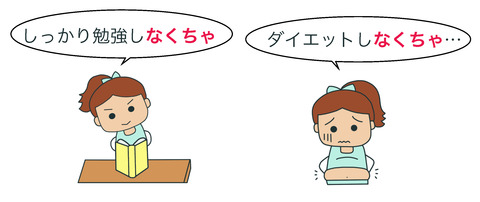
日本語文型辞典 英語版
Meaning
【なくちゃ】[N/Na でなくちゃ][A-くなくちゃ][V-なくちゃ]
なくちゃ is a casual way of saying なくては.
→
In context 2 examples
勉強しなくちゃ怒られる。
I’ll really get it if I don’t study.
早く帰らなくちゃ。
I’ve got to go home right away.
NINJAL 日本語文型データベース
Meaning
Expresses obligation, inevitability, or necessity. It can express either a general judgment based on social norms, rules, or laws, or the speaker’s personal judgment. It is also often used in a monologue about the speaker’s own actions.
This is formed by omitting 「ならない・いけない」 from 「〜なくちゃならない」, a phonetic change of 「〜なくてはならない」, or from 「〜なくちゃいけない」, a phonetic change of 「〜なくてはいけない」.
How to use it
Vない+なくちゃ
i-A: remove い + くなくちゃ (however, いい → よくなくちゃ)
na-Aでなくちゃ
Nでなくちゃ
Other
Notes
When used with a chiding tone, it is usually said by someone in a position to regulate behavior, such as a teacher or parent, to a student or child.
In context 19 examples
図書館の本、明日までに返さなくちゃ。
I have to return the library books by tomorrow.
あっ、もう5時。そろそろ帰らなくちゃ。
Oh, it’s already five. I’d better head home soon.
明日こそ妹に謝らなくちゃなあ。
I really have to apologize to my younger sister tomorrow.
また電気を消すのを忘れた。気をつけなくちゃ。
I forgot to turn off the lights again. I have to be more careful.
日本映画の勉強をしているなら、この監督の作品は見ておかなくちゃ。
If you’re studying Japanese cinema, you have to watch this director’s films.
母「もう12時だよ。明日早いんでしょ。早く寝なくちゃ」子「うん、お休みなさい」
Mother: “It’s already twelve. You have to get up early tomorrow, right? You need to go to bed soon.” Child: “Okay, good night.”
料理は、簡単でおいしくなくちゃ。そんなレシピないかな。
Cooking has to be simple and delicious. I wonder if there’s a recipe like that.
高級レストランなら、当然、サービスもよくなくちゃ。
If it’s a high-end restaurant, the service has to be good too, of course.
「海外旅行用のスーツケースならもっと大きくなくちゃ。これじゃ、荷物が全部入らないよ」
“If it’s a suitcase for an overseas trip, it needs to be bigger. This one won’t fit all my luggage.”
「将来ピアニストになるの?」「ビアニストになるには指が長くなくちゃ。手が小さい私には無理」
“Are you going to become a pianist someday?” “To become a pianist, you need long fingers. With my small hands, there’s no way.”
「主人公の優雅さを出すためには、この衣装はスカートのたけがもっと長くなくちゃ」
“To bring out the protagonist’s elegance, the skirt on this costume needs to be longer.”
何をするにも、まず自分が健康でなくちゃ。
Whatever you do, first you have to be healthy yourself.
「アナウンサーは言葉が明瞭でなくちゃ。あんなにもごもご話していちゃだめだよね」
“An announcer’s speech has to be clear. They can’t mumble like that.”
「わっ! 赤信号だよ! 運転はもっと慎重でなくちゃ」「ごめん」
“Whoa! The light is red! You have to drive more carefully.” “Sorry.”
親「優君、お隣のおじいさんと話すときの言葉はもっと丁寧じゃなくちゃ」子「わかった。気をつける」
Parent: “Yū, when you talk to the old man next door, you need to use more polite language.” Child: “Okay. I’ll be careful.”
ジャムは手作りでなくちゃ。市販のものとは味が全然違う。
Jam has to be homemade. It tastes completely different from the store-bought kind.
「靴が黒なら、ベルトも黒じゃなくちゃ。同じ色のほうがかっこいいよ」
“If the shoes are black, the belt has to be black too. It looks better when they’re the same color.”
子「友達と遊園地に行ってもいい?」親「子どもだけではだめだよ。大人と一緒でなくちゃ」
Child: “Can I go to the amusement park with my friends?” Parent: “You can’t go by yourselves. You have to go with an adult.”
子「今日は宿題してからゲームしよう」親「お、いいね。いつもそうでなくちゃ」
Child: “I’ll do my homework before playing games today.” Parent: “Oh, good. That’s how you should always be.”
Read the original source text
Meaning
義務・不可避であること、必要があることを表します。社会的常識や規則、法律などによる一般的な判断を表す場合も、話し手個人の判断を表す場合もあります。話し手が自分の行為について言う独り言でもよく使います。
「〜なくてはならない」が音声的に変化した形である「〜なくちゃならない」、または「〜なくてはいけない」が音声的に変化した形である「〜なくちゃいけない」の「ならない・いけない」を省略した形です。
How to use it
Notes
諭す意味で使う場合は、ふつう、教師や親など、行動を規制できる立場の人が、生徒・子どもなどに対して言います。