絵でわかる日本語
Usage 1
Read this source entry ↗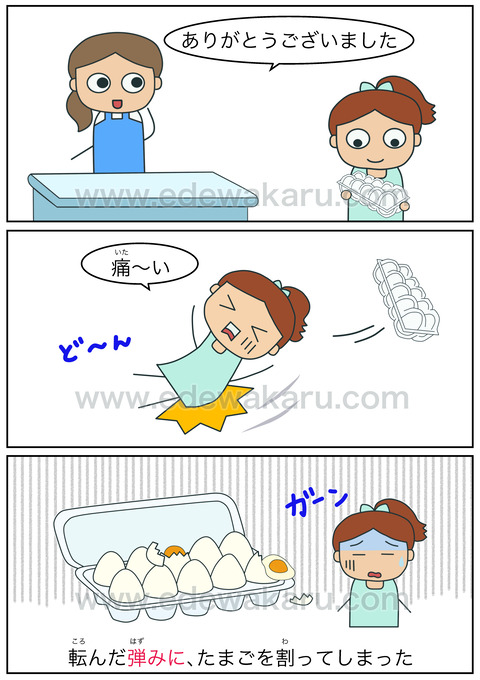
Meaning
~ happened because one did ~
~ happened as a result of doing ~
How to use it
Verb [た-form] + 弾みに・弾みで
Noun [dictionary form] + の弾みに・の弾みで
Explanation
「A弾みにB」 is a sentence pattern meaning “B happened because A happened” or “B occurred as a result of A.” B is something that happened by chance. It is used to say, “The moment A happened, B happened,” or “The moment A happened, B occurred.” The form 「〜弾みに〜てしまった」 is often used.
Learn 「〜弾みに」 together with the similar pattern 「〜拍子に」 😉
In context 5 examples
転んだ弾みに、たまごを割ってしまった
→転んだことで、たまごを割ってしまったWhen I fell, I broke the eggs. → I broke the eggs because I fell.
滑った弾みで転んでしまい、足の骨が折れてしまった
→滑った瞬間に転んでしまい、足の骨が折れてしまったI slipped and fell, and ended up breaking a bone in my foot. → The moment I slipped, I fell and broke a bone in my foot.
重いものを持ち上げた弾みに、腰を痛めてしまった
→重いものを持ち上げた瞬間に、腰を痛めてしまったWhen I lifted something heavy, I hurt my back. → The moment I lifted something heavy, I hurt my back.
急いで電車に乗ろうとした弾みで、靴が脱げてしまった
→急いで電車に乗ろうとした瞬間に、靴が脱げてしまったAs I hurried to get on the train, one of my shoes came off. → The moment I hurried to get on the train, one of my shoes came off.
友達にぶつかった弾みで、コーヒーをこぼしてしまった
→友達にぶつかったことで、コーヒーをこぼしてしまったI bumped into my friend and spilled my coffee. → I spilled my coffee because I bumped into my friend.
Read the original source text
Meaning
〜したことで〜した
〜したことで〜が起こった
How to use it
動詞[た形]+弾みに・弾みで
名詞[辞書形]+の弾みに・の弾みで
Explanation
「A弾みにB」は「AしたことでBした」「AしたことでBが起こった」という意味の文型です。「B」には偶然起こってしまったことが入り、「Aした瞬間に、Bしてしまった」「Aした瞬間に、Bが起こってしまった」と言いたい時に使われます。 「〜弾みに〜てしまった」の形がよく使われます。
「〜弾みに」に似ている文型の「〜拍子に」と一緒に覚えておきましょう😉
Usage 2
Read this source entry ↗Meaning
~ happened because one did ~
~ happened as a result of doing ~
How to use it
Verb [た-form] + 弾みに・弾みで
Noun [dictionary form] + の弾みに・の弾みで
Explanation
「A弾みにB」 is a sentence pattern meaning “B happened because A happened” or “B occurred as a result of A.” B is something that happened by chance. It is used to say, “The moment A happened, B happened,” or “The moment A happened, B occurred.” The form 「〜弾みに〜てしまった」 is often used.
Learn 「〜弾みに」 together with the similar pattern 「〜拍子に」 😉
In context 5 examples
転んだ弾みに、たまごを割ってしまった
→転んだことで、たまごを割ってしまったWhen I fell, I broke the eggs. → I broke the eggs because I fell.
滑った弾みで転んでしまい、足の骨が折れてしまった
→滑った瞬間に転んでしまい、足の骨が折れてしまったI slipped and fell, and ended up breaking a bone in my foot. → The moment I slipped, I fell and broke a bone in my foot.
重いものを持ち上げた弾みに、腰を痛めてしまった
→重いものを持ち上げた瞬間に、腰を痛めてしまったWhen I lifted something heavy, I hurt my back. → The moment I lifted something heavy, I hurt my back.
急いで電車に乗ろうとした弾みで、靴が脱げてしまった
→急いで電車に乗ろうとした瞬間に、靴が脱げてしまったAs I hurried to get on the train, one of my shoes came off. → The moment I hurried to get on the train, one of my shoes came off.
友達にぶつかった弾みで、コーヒーをこぼしてしまった
→友達にぶつかったことで、コーヒーをこぼしてしまったI bumped into my friend and spilled my coffee. → I spilled my coffee because I bumped into my friend.
Read the original source text
Meaning
〜したことで〜した
〜したことで〜が起こった
How to use it
動詞[た形]+弾みに・弾みで
名詞[辞書形]+の弾みに・の弾みで
Explanation
「A弾みにB」は「AしたことでBした」「AしたことでBが起こった」という意味の文型です。「B」には偶然起こってしまったことが入り、「Aした瞬間に、Bしてしまった」「Aした瞬間に、Bが起こってしまった」と言いたい時に使われます。 「〜弾みに〜てしまった」の形がよく使われます。
「〜弾みに」に似ている文型の「〜拍子に」と一緒に覚えておきましょう😉
文法
Meaning
Because you did ~, you end up inadvertently ...
Expresses that one thing triggers another thing happening “inadvertently” or “without meaning to.”
How to use it
V (た-form) + 弾みに
V (た-form) + 拍子に
In context 5 examples
転んだ弾みに、頭を打ってしまった。
When I fell, I hit my head.
後ろから誰かに押された弾みで、靴が脱げてしまった。
I was pushed by someone from behind, and as a result my shoe came off.
重い荷物を持ち上げようとした弾みに、腰を痛めてしまった。
When I tried to lift a heavy load, I hurt my back.
何かの拍子で、突然電気が消えた。
All of a sudden, the power went out for some reason.
人とぶつかった拍子に、持っていたスマホを落としてしまった。
I bumped into someone and dropped the smartphone I was holding.
Read the original source text
Meaning
〜したことで、つい・・・
ある事柄がきっかけとなって、「つい」、「うっかり」別の事柄が起こることを表す。
How to use it
V(タ形)+ 弾みに
V(タ形)+ 拍子に
くらべてわかる日本語表現文型辞典
Meaning
An action A causes an unintended B as a result.
How to use it
AたはずみにB (AたはずみでB)
[Verb—た form] はずみに
Explanation
【Contrast 1】
“Aた勢いでB”
“Aた勢いでB” means using the force or momentum of A to do B. “AたはずみにB” means that the action A itself triggers B.
×A大に合格したはずみでもっと難しいB大を受けることにした。 — Having passed University A, I decided to take the entrance exam for the more difficult University B on the momentum of it.
○A大に合格した勢いでもっと難しいB大を受けることにした。 — Having passed University A, I decided to take the entrance exam for the more difficult University B, carried along by the momentum.
“AたところB” (Meaning 1, p. 119)
With “AたところB,” one does A expecting B. With “AたはずみにB,” B is an unintended result.
○問題の解き方を先輩に聞いたところ、すぐ教えてもらえた。 — When I asked my senior how to solve the problem, they taught me right away.
×問題の解き方を先輩に聞いたはずみに、すぐ教えてもらえた。 — When I asked my senior how to solve the problem, they taught me right away unexpectedly.
“AたとたんにB” (Meaning 1, p. 121)
In context 4 examples
ものを取ろうと手を伸ばしたはずみに机の上のお茶をこぼした。
As I reached out to grab something, I accidentally knocked over the tea on the desk.
子どもを抱き上げたはずみにぎっくり腰になってしまった。
When I picked up the child, I put my back out.
電車の中でよろけたはずみで後ろの人の足を踏んでしまった。
I stumbled on the train and accidentally stepped on the person behind me.
お辞儀をしたはずみに彼女は抱えていた書類を路上にばらまいた。
As she bowed, the documents she was carrying scattered all over the street.
Read the original source text
Meaning
Aという動作が原因で、結果として意図していなかったBを引き起こす。
How to use it
AたはずみにB(AたはずみでB)
[動詞-た形]はずみに
Explanation
【対比1】
「Aた勢いでB」
「Aた勢いでB」はAの力を利用してBという意味。「AたはずみにB」はAの動作そのものがBの誘因となる。
×A大に合格したはずみでもっと難しいB大を受けることにした。
○A大に合格した勢いでもっと難しいB大を受けることにした。
「AたところB」(意味1 P.119)
「AたところB」はBを期待してAをする。「AたはずみにB」のBは意図しない結果。
○問題の解き方を先輩に聞いたところ、すぐ教えてもらえた。
×問題の解き方を先輩に聞いたはずみに、すぐ教えてもらえた。
「AたとたんにB」(意味1 P.121)
毎日のんびり日本語教師
How to use it
Verb ta-form + 弾みに
Verb ta-form + 拍子に
Explanation
This expresses that the preceding event triggers the following event, which occurs by chance. Here, 「弾み」 and 「拍子」 mean a momentary force or a trigger.
It is usually used to describe something that happened because someone was careless or acted absentmindedly.
Phrases such as 「その弾みに」「その拍子に」 and 「何かの拍子に」 are also used.
Notes
Nothing in particular.
In context 5 examples
寝起きによろけた拍子に、足首をひねって痛めた。
I stumbled as I was getting up, twisted my ankle, and hurt it.
倒れた弾みに持っていたものをぶちまけてしまった。
When I fell, I accidentally scattered everything I was carrying.
昔のことを、ふとした拍子に思い出す。
I remember things from the past on the spur of the moment.
転んだ弾みで、頭をぶつけた。
I hit my head when I fell.
こんな人通りの多いところで駆け回っていると、何かの拍子で大惨事になりかねない。
If you run around in such a crowded place, something could trigger a major disaster.
Read the original source text
How to use it
動た形+弾みに
動た形+拍子に
Explanation
前項が引き金となって(きっかけとなって)、後項の事態が偶発的に発生することを表します。この文型における「弾み」と「拍子」は、瞬間的な勢いやきっかけを意味します。
通常は人が不注意で、あるいはうっかりして起きた現象を述べるときに用います。
「その弾みに」「その拍子に」「何かの拍子に」などの言い方もあります。
Notes
特になし