絵でわかる日本語
NINJAL 日本語文型データベース
Meaning
[1] This is used to say that one will finish something quickly, completely, or all at once. It is used when one wants to deal with something quickly before doing something else. It is also used when one feels there is nothing left weighing on one’s mind and nothing to worry about.
This is a phonetic change of “〜てしまう.”
[2] This is used to say that the speaker causes an unfortunate event, or that an event causes the speaker to feel regret.
This is a phonetic change of “〜てしまう.”
How to use it
Notes
[1] It can be used for past, present, and future events. It can also be used in forms expressing the speaker’s intention or making a request of the listener.
In context 13 examples
まだ9時だけど、疲れたからもう寝ちゃう。
It’s only nine, but I’m tired, so I’m going to bed already.
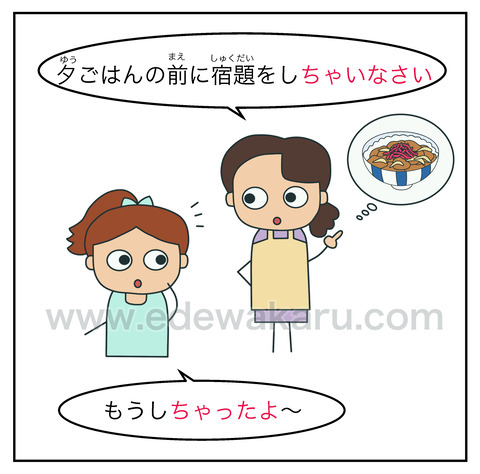
母「ジュン、ゲームの前に、さっさと宿題をしちゃいなさい」
Mother: “Jun, hurry up and finish your homework before playing games.”
「早くテーブルの上を片付けちゃいましょう。それからゆっくりデザートを食べましょう」
“Let’s clear everything off the table quickly. Then we can take our time eating dessert.”
「ねえ、こんな古い漫画本、もう捨てちゃっていいんじゃないの?」
“Hey, don’t you think it’s about time to throw away these old comic books?”
「きのうのワイン、全部飲んじゃったっけ?」
“Did we drink all of yesterday’s wine?”
「思い切って打ち明けちゃったらどう? 『好きです』って」
“Why don’t you just take the plunge and tell him, ‘I love you’?”
「この靴、いいな」「今セール中だから安いよ。買っちゃえば?」
“I like these shoes.” “They’re on sale right now, so they’re cheap. Why don’t you buy them?”
「その肉、食べないほうがいいよ。古いから食べるとおなか壊しちゃうよ」
“You’d better not eat that meat. It’s old, so it’ll upset your stomach.”
「新しい靴で旅行に行ったら、足が痛くなっちゃうかも」
“If I travel in new shoes, my feet might start hurting.”
あ、しまった。寝坊しちゃった。
Oh, no. I overslept.
「今日もお母さんに怒られちゃったよ」「何か悪いことしたの?」
“Mom got mad at me again today.” “Did you do something bad?”
雨、降ってきちゃったから、洗濯物、取り込まないと。
Oh, it’s started raining, so I have to bring in the laundry.
今日スマホ忘れちゃって、すごく困ったよ。
I forgot my phone today, and it was a real problem.
Read the original source text
Meaning
[1] あることを早く・完全に・全部終わらせると言いたいときに使います。何かをする前に早く処理したいという気持ちを表したい場合に使います。心理的に残っているものがなく、気になることがないと感じるときにも使います。
「〜てしまう」が音声的に変化した形です。
[2] 話し手自身が残念な出来事を引き起こす、または、ある出来事が話し手の残念に思う気持ちを引き起こすと言いたいときに使います。
「~てしまう」が音声的に変化した形です。
How to use it
Notes
[1] 過去のことにも、現在のことにも、未来のことにも使えます。話し手の意思や聞き手への働きかけを表す形でも使います。
Bunpro Grammar Reference
Meaning
To be not, Am not, Are not, Is not
How to use it
[な]Adjective + ちゃう(1)
Noun + ちゃう(1)
(1) やない、とちゃう
Nuance
A Kansai way to negate phrases, or ask a negative question.
Explanation
The negative form of the auxiliary verb だ in Japanese frequently appears as じゃない (an abbreviation of ではない). In 関西弁 じゃない is often replaced by ちゃう. ちゃう itself is actually just an abbreviation of 違う, a common うverb meaning 'to differ'.
ちゃう may be used directly after either nouns, or な-Adjectives, to convey 'is not (A)'.
ちゃう may also appear in the past negative form. However, as it is a set expression (and not considered an actual conjugation of 違う), it will not be conjugated like a regular う - Verb, but will become ちゃうかった.
Fun Fact
じゃない may also be replaced with やない. やない being the 関西弁 equivalent of だ, with the い-Adjective ない attached to it. Like ちゃう, やない is used after nouns, or な-Adjectives.
When conjugating in the past negative form, やない follows the regular conjugation rules of ない, becoming やなかった.
Notes
Kansai dialect
In context 16 examples
- 私は犬が好きじゃない。
私は犬が好きちゃう。I do not like dogs.
- 今のエミの彼氏ちゃう。
Isn't that Emi's boyfriend?
- このドレス綺麗ちゃう?昨日買ったの。
Don't you think this dress is cute? I bought it yesterday.
- タロウのお父さん関西人ちゃうかった?
Taro, wasn't your father from the Kansai region?
- 先生にだまされた。テスト少しも簡単ちゃうかった。
The teacher tricked us. The test was not easy at all.
- 私は寿司 が好きじゃないので、食べない。
私は寿司 が好きちゃうので、食べへん。I do not like sushi, so I don't eat it.
- りんごじゃない。
りんごちゃう。It is not an apple.
- 難しくなるんじゃない?
難しくなるんちゃう?It will probably get hard, won't it?
- その帽子は娘の帽子じゃない。
その帽子は娘の帽子ちゃう。That hat is not my daughter's hat.
- 一人だけじゃない。
一人だけちゃう。It's not just one person.
- ここは、東京じゃない、京都だよ。
ここは、東京ちゃう、京都やで。It is not Tokyo here, it is Kyoto.
- 彼女はアメリカ人じゃない?
彼女はアメリカ人ちゃう?Isn't she American?
- あれ、ミオちゃんやない?
Hey, isn't that Mio chan?
- 見て見て、これ50%(パーセント)オフやった、お得やない?
Look look, this was 50% off, don't you think that's a good deal?
- あの人はさんまさんやなかった。ただのおっちゃんやった。
That person wasn't Sanma-san. It was just a middle aged guy.
- 便利そうだったから買ったのに、全然便利やなかった。
I bought this because it looked useful, but it was not useful at all.
Read the original source text
Meaning
To be not, Am not, Are not, Is not
How to use it
[な]Adjective + ちゃう(1)
Noun + ちゃう(1)
(1)やない、とちゃう
Nuance
A Kansai way to negate phrases, or ask a negative question.
Explanation
The negative form of the auxiliary verb だ in Japanese frequently appears as じゃない (an abbreviation of ではない). In 関西弁 じゃない is often replaced by ちゃう. ちゃう itself is actually just an abbreviation of 違う, a common うverb meaning 'to differ'.
ちゃう may be used directly after either nouns, or な-Adjectives, to convey 'is not (A)'.
ちゃう may also appear in the past negative form. However, as it is a set expression (and not considered an actual conjugation of 違う), it will not be conjugated like a regular う - Verb, but will become ちゃうかった.
Fun Fact
じゃない may also be replaced with やない. やない being the 関西弁 equivalent of だ, with the い-Adjective ない attached to it. Like ちゃう, やない is used after nouns, or な-Adjectives.
When conjugating in the past negative form, やない follows the regular conjugation rules of ない, becoming やなかった.
Notes
関西弁
Nuance · 日本語
関西弁で表現を否定形にする際などネガティブな質問をする際に使われる表現。