AIUEO JLPT Grammar
Meaning
This sentence pattern expresses the speaker’s dissatisfaction or criticism of another person’s behavior, often used to emphasize the complete lack of action.
How to use it
Verb masu-stem + も + しない
In context 5 examples
彼は謝りもしないで、その場を去ってしまった。
He left without even apologizing.
何の準備もしないで、ただ行動するのはよくない。
It's no good just acting without any preparation.
彼は電話をかけ直しもしないで、無視している。
He’s ignoring it without even trying to call back.
話もしないで突然出て行った。
He left suddenly without even talking.
彼女は手伝いもしないで、見ているだけだった。
She didn’t even help; she just watched.
Read the original source text
Meaning
This sentence pattern expresses the speaker’s dissatisfaction or criticism of another person’s behavior, often used to emphasize the complete lack of action.
How to use it
動詞ます形も+しない
Explanation · 日本語
この文型は、話し手が他者の態度や行動に対して不満や非難を表すときに使う表現です。何かをまったく行わないことを強調するために用いられます。
文法
Meaning
Not do ~ at all
Expresses the speaker’s dissatisfaction.
How to use it
V (ます-stem) + もしない
In context 10 examples
「僕が悪かった」と誤っているのに、彼はこっちを見もしない。ますます腹が立って来た。
Even though I apologized, saying, "It was my fault," he won't even look at me. I'm getting more and more angry.
調べもしないで、「先生、わからない」はダメです。まずは自分で調べましょう。
You can't say, "Teacher, I don't understand," without even looking it up. First, look it up yourself.
彼はスマホばかり触って、私の話を聞きもしない。
He only plays with his smartphone and won't even listen to me.
食べもしないで、美味しいかどうかなんてわからない。
You can’t know whether it’s delicious without even trying it.
あの日の出来事は忘れもしません。
I will never forget what happened that day.
こんな結果になるなんて、思いもしなかった。
I never even imagined things would turn out this way.
プレゼントをあげたり、優しくしたりしているのに彼女は僕に振り向きもしない。
Even though I give her presents and treat her kindly, she won't even turn around to look at me.
マークさんに聞かれているなんて気づきもしなかった。
I didn't even realize Mark was asking me.
トムさんは私の部屋に入ると、何も言いもせず、勝手に冷蔵庫を開けたり、エアコンをつけたりして、ちょっとムカついた。
When Tom came into my room, he didn't say a word and just opened the refrigerator and turned on the air conditioner without asking. It annoyed me a little.
できもしないのに、「任せてください!」と言う社員は正直迷惑だ。
An employee who says, "Leave it to me!" even though they can't do it is honestly a nuisance.
Read the original source text
Meaning
全く〜しない
話し手の不満の気持ちを表す。
How to use it
V(ます形)ます + もしない
どんなときどう使う 日本語表現文型辞典
Meaning
without even
How to use it
Vます + もしない
Explanation
全然~しない
「まったく~しない」と不満の気持ちをもって言うときの言い方。
Dissatisfaction with someone who doesn't attempt to do something at all.
In context 4 examples
わたしが「さよなら」と言ったのに、あの人は振り向きもしないで行ってしまった。
Even though I said, “Goodbye,” that person left without even turning around.
調べもしないで結論を出さないでください。
Please don't draw a conclusion without even investigating.
わたしがせっかく作った料理なのに、彼は食べもしない。
Even though I went to the trouble of cooking it, he won't even eat it.
困っているときにずいぶん助けてやったのに、彼は自分がよくなったらあいさつに来もしない。
I helped him a lot when he was in trouble, but once he got back on his feet, he didn't even come by to say hello.
Read the original source text
Meaning
without even
How to use it
Vます+もしない
Explanation
全然~しない
「まったく~しない」と不満の気持ちをもって言うときの言い方。
Dissatisfaction with someone who doesn't attempt to do something at all.
絵でわかる日本語
Usage 1
Read this source entry ↗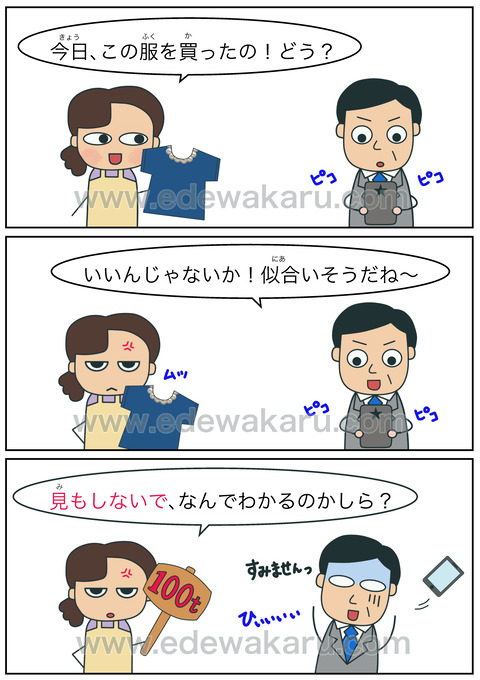
Meaning
not do ~ at all
How to use it
Verb [ます-form] + もしない
Explanation
“〜もしない” is a sentence pattern meaning “not do 〜 at all,” “not do 〜 in the least,” or “cannot do 〜.” In many cases, it is used to express the speaker’s dissatisfaction or to convey a feeling of reproach toward someone.
“〜もしない” is also often used in conversation, so be sure to learn it 😉
In context 5 examples
見もしないで、なんでわかるのかしら?
→全然見ていないのに、なんでわかるのかしら?How can you know when you haven’t even looked? → How can you know when you haven’t looked at all?
A:これ、すごくまずそうだよ…B:食べもしないで文句を言わないで!
→全く食べないで文句を言わないで〜A: This looks really awful… B: Don’t complain when you haven’t even tried it! → Don’t complain without eating any at all~
こんなことになるなんて思いもしなかった…
→こんなことになるなんて、全然思わなかったI never even imagined this would happen… → I never imagined at all that this would happen.
あの大変だった日々のことは忘れもしない
→あの大変だった日々のことは忘れられないI will never forget those difficult days. → I can’t forget those difficult days.
悪口を言っているのを聞かれていたなんて、気づきもしなかった…
→悪口を言っているのを聞かれていたなんて、全く気づかなかった…I never even realized that someone had heard me badmouthing them… → I didn’t realize at all that someone had heard me badmouthing them…
Read the original source text
Meaning
全然〜しない
How to use it
動詞[ます形]+もしない
Explanation
「〜もしない」は「全然〜しない」「全く〜しない」「〜できない」という意味の文型です。多くの場合、話し手が不満に思っていることを表したり、相手を非難する気持ちを表す時に使われます。
「〜もしない」は、会話でもよく使われますので覚えておきましょう😉
Usage 2
Read this source entry ↗Meaning
not do ~ at all
How to use it
Verb [ます-form] + もしない
Explanation
“〜もしない” is a sentence pattern meaning “not do 〜 at all,” “not do 〜 in the least,” or “cannot do 〜.” In many cases, it is used to express the speaker’s dissatisfaction or to convey a feeling of reproach toward someone.
“〜もしない” is also often used in conversation, so be sure to learn it 😉
In context 5 examples
見もしないで、なんでわかるのかしら?
→全然見ていないのに、なんでわかるのかしら?How can you know when you haven’t even looked? → How can you know when you haven’t looked at all?
A:これ、すごくまずそうだよ…B:食べもしないで文句を言わないで!
→全く食べないで文句を言わないで〜A: This looks really awful… B: Don’t complain when you haven’t even tried it! → Don’t complain without eating any at all~
こんなことになるなんて思いもしなかった…
→こんなことになるなんて、全然思わなかったI never even imagined this would happen… → I never imagined at all that this would happen.
あの大変だった日々のことは忘れもしない
→あの大変だった日々のことは忘れられないI will never forget those difficult days. → I can’t forget those difficult days.
悪口を言っているのを聞かれていたなんて、気づきもしなかった…
→悪口を言っているのを聞かれていたなんて、全く気づかなかった…I never even realized that someone had heard me badmouthing them… → I didn’t realize at all that someone had heard me badmouthing them…
Read the original source text
Meaning
全然〜しない
How to use it
動詞[ます形]+もしない
Explanation
「〜もしない」は「全然〜しない」「全く〜しない」「〜できない」という意味の文型です。多くの場合、話し手が不満に思っていることを表したり、相手を非難する気持ちを表す時に使われます。
「〜もしない」は、会話でもよく使われますので覚えておきましょう😉
日本語NET JLPT文法解説まとめ
Meaning
"Not at all ~"
Expresses the speaker's dissatisfaction.
How to use it
V (ます form) ます + もしない
Explanation
"Not at all..."
Expresses the speaker's feeling of dissatisfaction.
In context 10 examples
「僕が悪かった」と誤っているのに、彼はこっちを見もしない。ますます腹が立って来た。
Even though I apologized, saying, "It was my fault," he won't even look at me. I'm getting more and more angry.
調べもしないで、「先生、わからない」はダメです。まずは自分で調べましょう。
You can't say, "Teacher, I don't understand," without even looking it up. First, look it up yourself.
彼はスマホばかり触って、私の話を聞きもしない。
He only plays with his smartphone and won't even listen to me.
食べもしないで、美味しかどうかなんてわからない。
You can't know whether it's good without even tasting it.
あの日の出来事は忘れもしません。
I will never forget what happened that day.
こんな結果になるなんて、思いもしなかった。
I never even imagined things would turn out this way.
プレゼントをあげたり、優しくしたりしているのに彼女は僕に振り向きもしない。
Even though I give her presents and treat her kindly, she won't even turn around to look at me.
マークさんに聞かれているなんて気づきもしなかった。
I didn't even realize Mark was asking me.
トムさんは私の部屋に入ると、何も言いもせず、勝手に冷蔵庫を開けたり、エアコンをつけたりして、ちょっとムカついた。
When Tom came into my room, he didn't say a word and just opened the refrigerator and turned on the air conditioner without asking. It annoyed me a little.
できもしないのに、「任せてください!」と言う社員は正直迷惑だ。
An employee who says, "Leave it to me!" even though they can't do it is honestly a nuisance.
Read the original source text
Meaning
"全く〜しない"
話し手の不満の気持ちを表す。
How to use it
V(ます形)ます + もしない
Explanation
"Not at all..."
Expresses the speaker's feeling of dissatisfaction.
毎日のんびり日本語教師
Meaning
not do
cannot do
not necessarily do
How to use it
Verb masu-stem + もしない
する-verbs + もしない
Explanation
It attaches to the verb masu-stem and expresses meanings such as “not do” or “cannot do.”
Notes
Nothing in particular.
In context 5 examples
あの日のことは忘れもしない。(忘れられない)
I’ll never forget that day. (I can’t forget it.)
見もしないで分かるはずがない。(見ないのに)(看都不看是不会明白的)
There’s no way you can understand without even looking. (Without looking.) (You won’t understand if you don’t even look.)
話を聞きもしないでスマホをいじっている。(聞かないで)
They’re fiddling with their phone without even listening to what’s being said. (Without listening.)
ずっと隣に居たのに気付きもしなかった。(気付けなかった)
I was right beside them the whole time, but I didn’t even notice. (I couldn’t notice.)
靴を脱ぎもせず押し入ってきた。(脱がないで)
They barged in without even taking off their shoes. (Without taking them off.)
Read the original source text
Meaning
~しない
~できない
~こともない
How to use it
動ます形+もしない
サ変動詞+もしない
Explanation
動ます形に接続して、「しない」「できない」などの意味を表します。
Notes
特になし