AIUEO JLPT Grammar
Meaning
This sentence pattern is used when expressing that a certain fact or situation is not fully or partially true.
How to use it
Verb + わけではない; adjective + わけではない; な-adjective + わけではない; noun + な + わけではない; noun + の + わけではない
In context 5 examples
彼は毎日練習しているわけではない。
He doesn’t practice every day.
人生がいつもつまらないわけでもないが、退屈が多い。
Life isn't always boring, but it is often.
毎日残業するわけではない。
It’s not that I work overtime every day.
彼はいつも遅くまで働いているわけではありません。
It’s not that he always works late.
彼がいつも遅れるわけではないです。
It’s not that he is always late.
Read the original source text
Meaning
This sentence pattern is used when expressing that a certain fact or situation is not fully or partially true.
How to use it
動詞+わけではない形容詞+わけではない形容動詞な+わけではない名詞な+わけではない名詞の+わけではない
Explanation · 日本語
この文型は、ある状況や事実が完全にそうではない、または部分的にそうではないことを表すときに使われる表現です。
文法
Meaning
It cannot be said that everything is ~.
Used with the same meaning as the partial negation 「〜というものではない」.
It is also used to indirectly deny something that would naturally be expected from what was just said.
How to use it
Plain form + わけではない
For nouns, there are two possible forms: 「Nなわけではない」 and 「Nのわけではない」.
In context 13 examples
このレストランはいつも込んでいるが、値段が安いわけではない。
This restaurant is always crowded, but it’s not as if the prices are cheap.
明日は休みだが、暇なわけじゃない。
Tomorrow is a day off, but it’s not as if I’m free.
毎日、料理をするが、料理が上手なわけじゃない。
I cook every day, but it’s not as if I’m good at cooking.
たくさんお金持があっても、幸せになれるわけじゃない。
Even if you have a lot of money, that doesn’t necessarily mean you’ll be happy.
アメリカに住めば、英語がペラペラになるというわけではない。
Living in America doesn’t necessarily mean you’ll become fluent in English.
海外での勤務経験があるが、英語が流暢に話せるというわけではない。
I have work experience overseas, but that doesn’t mean I can speak English fluently.
有名な大学を卒業した人が優秀だというわけではない。
People who graduated from famous universities aren’t necessarily outstanding.
他の会社へ転職したいという君の気持ちがわからないわけではない。
It’s not that I don’t understand your desire to change jobs and go to another company.
熱があるわけではなさそうだが、今日は休んだほうがいいよ。
It doesn’t look like you have a fever, but you should take the day off.
お酒が飲めないわけではないよ。ただ弱いんだ。
It’s not that I can’t drink alcohol. I just have a low tolerance.
トムさんとは、時々話しますが、親しい関係というわけではありません。学校以外では特に交流もないですし。
I talk with Tom from time to time, but it’s not as if we’re close. We don’t really spend time together outside of school, either.
歌うのが苦手というわけじゃないが、他の人に聞かれるのが恥ずかしいので、カラオケに行ってもあまり歌わない。
It’s not that I’m bad at singing, but I’m embarrassed to have other people hear me, so I don’t sing much even when I go to karaoke.
この商品を作るのは不可能なわけではないが、時間とコストがかかりますよ。
It’s not impossible to make this product, but it will take time and money.
Read the original source text
Meaning
全部が〜とは言えない。
部分否定の「〜というものではない」と同じ意味で使われる。
また、直前のことから当然予想されることを婉曲的に否定するのにも用いられる。
How to use it
普通形 + わけではない
名詞の接続は「Nなわけではない」と「Nのわけではない」の2通りある。
Bunpro Grammar Reference
Meaning
It doesn't mean that, It is not the case, It's not like
How to use it
Verb + わけではない(1)
[い]Adjective + わけではない(1)
[な]Adjective + な + わけではない(1)
Noun + の(2) + わけではない(1)
(1)わけじゃない
(2) である
Verb + わけではありません(1)
[い]Adjective + わけではありません(1)
[な]Adjective + な + わけではありません(1)
Noun + の(2) + わけではない(1)
(1)わけじゃありません
(2) である
Nuance
A grammar point used when (A) is not the case, or not necessarily so.
Explanation
As mentioned in the 訳だ grammar point, わけ is a noun that is used for strong determination/conclusion in Japanese, in the same way that 'so' is in English. Naturally, this determination may sometimes be negative, as is the case with わけではない. ではない being the conjugated form of the auxiliary verb だ, the adverbial particle は, and the い-Adjective ない.
わけではない may be translated as 'it doesn't mean that (A)', or 'it's not the case that (A)'. Although, 'it is not necessarily so that it's (A)', or 'so it's not (A)' are closer to the actual nuance of わけ. わけではない can be used at the end of any sentence, so long as the word before わけ is in attributive form.
日本に住んでいるから日本語を話せるわけではないです。私は日本に来る前に日本語の勉強をしていました。
It is not the case that I am able to speak Japanese because I live in Japan. I studied Japanese before I came.
私の家は広いわけではないけど、小さくもない。
It is not necessarily that my house is big, but it is not small either.
仕事が大変なわけではない。忙しいだけ。
It's not that my job is difficult, it's just busy.
熱のわけではないけど、体がだるい。
It's not necessarily that I have a fever, but my body feels heavy.
As always, では may be replaced by じゃ.
あの監督は有名だけど、映画を監督して有名になったわけじゃない。
That director is famous, but he did not become popular because he directed a movie.
あなたが悪かったって言っているわけじゃない。
It's not that I am saying that you were in the wrong. (I am not strictly saying that you were in the wrong)
Fun Fact
わけだ and わけではない match the explanatory meaning of 'so' in English that often replaces words like 'because' and 'since'. However, as we will examine in more detail in the わけがない grammar point, わけ also matches the emphatic nuance of 'so', as can be seen in statements like 'it's SO not (A)'.
あなたの事が嫌いというわけではない。
It's not necessarily so that I dislike you. (But I sure don't love you)
あなたの事が嫌いというわけがない。
I so don't dislike you. (I don't dislike you at all)
In context 20 examples
- A(エー):「北海道といえば、C(シー)さんによれば一年中寒いらしい。」
B(ビー):「夏でも寒いわけではない。」A: 'Speaking of Hokkaido, according to C it is cold there all year long.' B: 'It doesn't mean it is cold even in summer.'
- あなたが悪かったって言っているわけじゃない。
It's not that I am saying that you were in the wrong. (I am not strictly saying that you were in the wrong)
- 日本に住んでいるから日本語を話せるわけではないです。私は日本に来る前に日本語の勉強をしていました。
It is not the case that I am able to speak Japanese because I live in Japan. I studied Japanese before I came.
- 熱のわけではないけど、体がだるい。
It's not necessarily that I have a fever, but my body feels heavy.
- あの監督は有名だけど、映画を監督して有名になったわけじゃない。
That director is famous, but he did not become popular because he directed a movie.
- 仕事が大変なわけではない。忙しいだけ。
It's not that my job is difficult, it's just busy.
- 私の家は広いわけではないけど、小さくもない。
It is not necessarily that my house is big, but it is not small either.
- A(エー):「天気予報によると明日は晴れるだろう。」
B(ビー):「雨が降らないわけではない。」A: 'The weather forecast calls for clear skies tomorrow.' B: 'It doesn't mean it won't rain.'
- A(エー):「また試合に負けたよ。もう我慢できない!泣いちゃいたい!」
B(ビー):「いつもうまくいくわけではない。失敗はつきものだ。」A: 'I lost a match again! I can't stand it anymore! I want to cry!' B: 'It is not the case that things will always turn out well. Failures are an unavoidable part of life.'
- A(エー):「あなたはデートを忘れていたわ!私は腹が立っているから話しかけないで!」
B(ビー):「遅くなってしまいましたが、忘れていたわけではありませんよ。」A: 'You forgot about our date! I am angry, so don't speak to me!' B: 'I may have been late, but that doesn't mean that I forgot.'
- A(エー):「B(ビー)さんは、来年結婚するつもりということだね。」
B(ビー):「まだ決まったわけではないから、内密にお願いします。」A: 'B, I heard you are going to get married next year.' B: 'It is not the case that it is set in stone, so please keep it a secret.'
- A(エー):「それは嘘だと思う。」
B(ビー):「まったくの嘘っていうわけではないけど、怪しい情報だな。」A: 'I think it is a lie.' B: 'It is not the case that it is an absolute lie, but that information is suspicious.'
- A(エー):「では、これから、僕は家の所有者ですね?この家を僕の自由にしていいんですよね?」
B(ビー):「何をしてもいいわけではないですよ。ちゃんとしたルールがあるんです。」A: 'So, from now on I am the house owner, right? I can do whatever I like with it, right?' B: 'It doesn't mean that you can just do whatever you want. There are proper rules.'
- 兄A(エー) :「B(ビー)くんは俺の古いスマホをもらいたいの?」
弟 B(ビー):「必要なわけではないけど、もらえるのなら欲しい。」Older brother, A: 'B, do you want to have my old phone?' Younger brother, B: 'It is not like I need it, but I won't say no if you give it to me.'
- A(エー):「たくさん勉強したのに、結局、試験には落ちた。」
B(ビー):「ただ、完全に落ちたわけではなくて、後日、追試をうけることができる。」A: 'Although I studied a lot, in the end I failed the exam.' B: 'But it does not mean that you failed it completely, plus you can retake it in the future.'
- A(エー):「C(シー)さんは日本に十年以上住んでる。日本語が上手だろうね。」
B(ビー):「日本に長い間住んでも、日本語を話せるわけではないよ。」A: 'C has been living in Japan for over ten years. His Japanese is probably amazing, right?' B: 'Even if he has lived in Japan for a long time it doesn't mean he can speak Japanese.'
- A(エー):「C(シー)のミスで、試合に負けたぞ。」
B(ビー):「C(シー)が完全に悪いわけではないが、多少の責任があると思う。」A: 'Because of C's mistakes we lost the match!' B: 'It is not like C is completely at fault, but I think that C shares some of the responsibility.'
- A(エー):「賞はただのペンだったよ。」
B(ビー):「だけど、あのペンはどこでも買えるわけではない。」A: 'The reward was just a pen!' B: 'Yeah, but it is not like you can just buy that pen anywhere.'
- あなたの事が嫌いというわけではない。
It's not necessarily so that I dislike you. (But I sure don't love you)
- あなたの事が嫌いというわけがない。
I so don't dislike you. (I don't dislike you at all)
DoJG 日本語文法辞典(全集)
Meaning
It does not mean that ~; I don't mean that ~; it is not that ~; it is not true that ~; it is not the case that
How to use it
(i) {V/Adjective い}informal | (という) わけではない | |
| {分かる/分かった}(という) わけではない | It does not mean that someone understands/understood something |
| {悪い/悪かった}(という) わけではない | It does not mean that someone is/was bad |
(ii) Adjective な stem | {な/だった}わけではない | |
| {駄目な/駄目だった}わけではない | It does not mean that something is/was no good |
(iii) Adjective な stem | {な/だった}というわけではない | |
| {駄目(だ)/だった}というわけではない | It does not mean that something is/was no good |
(iv) Noun | だったわけではない | |
| 失敗だったわけではない | It does not mean that something was a failure |
(v) Noun | {(だ)/だった}というわけではない | |
| {失敗(だ)/だった}というわけではない | It does not mean that something is/was a failure |
Explanation
A phrase which is used to deny what is implied in the previous or following statement.
In context 12 examples
この問題を解決するのは非常に難しい。しかし、不可能(だ)というわけではない。
It is very difficult to solve this problem. But that does not mean that it is impossible (to solve).
君の考えに反対するわけではないが、そのやり方でうまくいくだろうか。
I don't mean to oppose your idea, but I wonder if things will go well using that approach.
結果さえよければいいというわけではない。
Obtaining a good result is not enough. (literally: It is not that it is all right if just the result is good.)
私は最近あまり沢山食べないが、食欲がないわけではない。
I do not eat much these days, but it doesn't mean that I have no appetite.
この二、三年本を書いていないが、スランプというわけではない。
I haven't written a book for the last few years, but it doesn't mean that I am in a slump.
このプロジェクトは資金不足のため中止されることになった。しかし、今までしてきたことが全く無駄になるわけではない。
It's been decided that this project is going to be stopped because of a lack of funds. However, it doesn't mean that what we have done up to now is going to be a total waste.
いくら日本語が出来ないと言っても全然話せないわけではない。
Although I say that I cannot speak Japanese, it doesn't mean that I cannot speak it at all.
君の言うことが分からないわけではないが、やっぱりこの計画は止めた方がいいと思う。
I don't mean that I don't understand what you are saying, but I think you'd better give up this plan after all.
全然見込みがないわけではないが、あまり期待はしない方がいいでしょう。
I don't mean that there is no hope, but you'd better not expect too much.
あの人が嫌いだというわけではないんですが、結婚したいとは思いません。
I don't mean that I don't like him, but I do not want to marry him.
言われたことだけしていたらそれでいいというわけではない。
Doing only what you are told to do is just not enough.
A:この病人は全く助からないんですか。B:いや、そういうわけではありません。
A: Can't this patient be saved (literally: at all)? B: No, it is not that he can't be saved.
どんなときどう使う 日本語表現文型辞典
Meaning
not necessarily; not always
How to use it
[Plain form] (ナAな・ナAである / Nの・Nである) + わけではない
Explanation
全部が~とは言えない/必ず~とは言えない
1)「~わけではない」の形で、「~」の事柄を部分的に否定するときに使う言い方。 ❷ のように「からといって」とともに使うことが多い。 ❸ の「~ないわけではない」は部分的に肯定する言い方。 ❹ ❺ のように「特に~のではないが」と説明するときにも使う。
2)「Nのわけではない」は、口語では「Nなわけではない」になることもある。
1)Negates part of what precedes わけではない. Often used with からといって (just because), as in sentence ❷ . Pattern ないわけではない in sentence ❸ shows partial affirmation. Can be used to say that something isn't particularly true, as in sentences ❹ and ❺ .
2)Pattern N のわけではない can become N なわけではない in colloquial.
In context 5 examples
わたしは学生時代に勉強ばかりしていたわけではない。よく旅行もした。
I didn’t spend all my time studying when I was a student. I traveled a lot too.
自動車立国だからといって、日本人がみんな車を持っているわけではない。
Just because Japan is a car-oriented country doesn’t mean that all Japanese people own a car.
会社をやめたいという、あなたの今の気持ちもわからないわけではありません。しかし、将来のことをよく考えて……。
It’s not that I don’t understand how you feel now about wanting to quit your job. But think carefully about your future...
熱があるわけではないが、なんとなく体が疲れた感じがする。
I don’t have a fever, but somehow I feel tired.
今日の会には特に行きたいわけではないんだけど、頼まれたから出席するんです。
It’s not that I particularly want to go to today’s meeting, but I’m attending because I was asked.
Read the original source text
Meaning
not necessarily; not always
How to use it
〔普通形〕(ナAな・ナAである/Nの・Nである)+わけではない
Explanation
全部が~とは言えない/必ず~とは言えない
1)「~わけではない」の形で、「~」の事柄を部分的に否定するときに使う言い方。 ❷ のように「からといって」とともに使うことが多い。 ❸ の「~ないわけではない」は部分的に肯定する言い方。 ❹ ❺ のように「特に~のではないが」と説明するときにも使う。
2)「Nのわけではない」は、口語では「Nなわけではない」になることもある。
1)Negates part of what precedes わけではない. Often used with からといって (just because), as in sentence ❷ . Pattern ないわけではない in sentence ❸ shows partial affirmation. Can be used to say that something isn't particularly true, as in sentences ❹ and ❺ .
2)Pattern N のわけではない can become N なわけではない in colloquial.
絵でわかる日本語
Meaning
partially deny something
used when you don’t want to state something negative directly
How to use it
Verb, adjective, or noun [plain form] + わけではない
Explanation
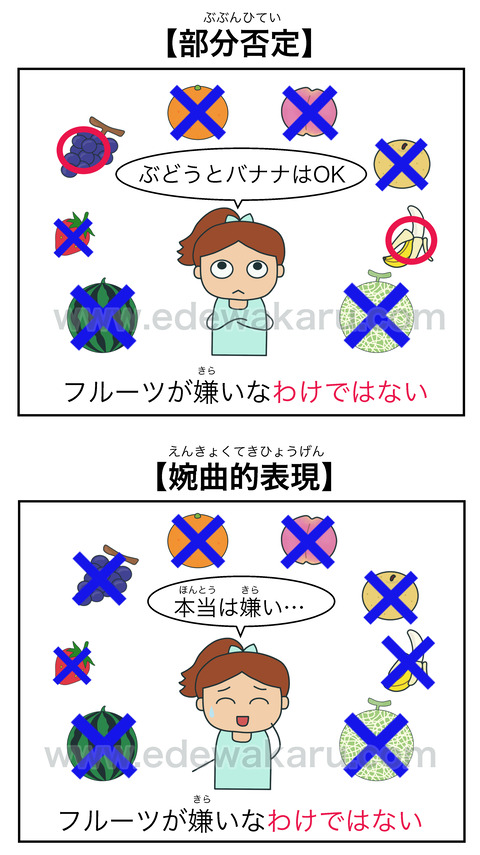
“〜わけではない” is an expression used for 【partial negation】 or 【when saying something negative indirectly】. “Indirectly” means not saying something directly, and this is a very important expression for Japanese people. 😊 Whether it is 【partial negation】 or 【indirect phrasing】 depends on the situation and context. 😀 As in the example above, sometimes it can mean either 【partial negation】 or 【indirect phrasing】. 😅
(Review: 〜によって (distinction))
[Examples of indirect phrasing]
① It’s not that I dislike
fruit.
(= I dislike fruit.)
→ A gentler expression than saying plainly, “I dislike it.”
② It’s not that today is impossible,
but… (=Today is impossible.)
→ A gentler expression than saying “Today is impossible.”
Japanese people use 【indirect expressions】 very often.
This may seem very complicated and hard to remember, but this is a very important sentence pattern that is also often used in everyday conversation, so make sure to learn it well. 😉
(Review: 〜にとって)
【The “わけ” series】
〜ないわけにはいかない
〜わけ (formal noun)
〜わけがない
〜わけがわからない (formal noun)
〜わけだ (realization)
〜わけない (formal noun)
〜わけにはいかない
In context 5 examples
フルーツが嫌いなわけではない
→フルーツが全部嫌いなのではなくて、好きなものもある【部分否定】
→フルーツは嫌いだ【はっきり「嫌い」と言わない時】It’s not that I dislike fruit. → It’s not that I dislike all fruit; there are kinds I like. [Partial negation] → I dislike fruit. [When not saying “I dislike it” directly]
英語が話せないわけではない
→英語が全然話せないのではなくて、少しは話せる【部分否定】
→英語は話せない【はっきり「話せない」と言わない時】It’s not that I can’t speak English. → It’s not that I can’t speak English at all; I can speak a little. [Partial negation] → I can’t speak English. [When not saying “I can’t speak it” directly]
図書館の本を全部読んだわけではない
→図書館の本を全部読んだのではないが、ほとんど読んだ【部分否定】
→図書館の本を全部読んだのではない【はっきりと「全部読んでいない」と言わない時】It’s not that I read all the books in the library. → I didn’t read all the books in the library, but I read most of them. [Partial negation] → I didn’t read all the books in the library. [When not saying directly, “I haven’t read them all”]
テニスができないわけではない
→テニスが全然できないのではなくて、少しはできる【部分否定】
→テニスができない【はっきり「できない」と言わない時】It’s not that I can’t play tennis. → It’s not that I can’t play tennis at all; I can play a little. [Partial negation] → I can’t play tennis. [When not saying “I can’t” directly]
A:今日、映画を見に行きませんか?B:今日は無理なわけではないんですが…
→今日は無理です【はっきり「無理」とは言わない時】A: Would you like to go see a movie today? B: It’s not that today is impossible, but… → Today won’t work for me. [When not saying “It won’t work” directly]
Read the original source text
Meaning
部分的に否定する
はっきりと否定的なことを言わない時に使う
How to use it
動詞・形容詞・名詞[普通形]+わけではない
Explanation
「〜わけではない」は【一部否定】【婉曲的(えんきょくてき)に否定的なことを言う時】に使われる表現です。「婉曲的」とははっきり言わないことで、日本人にとってはとても大切な表現です😊【一部否定】か【婉曲的に言っている】かは場面や状況によって決まります😀上の例文のように、【一部否定】【婉曲的表現】のどちらの意味にもなる場合もあります😅
(復習:〜によって(区別))
[婉曲的表現の例]
①フルーツが嫌いな
わけではない
(=フルーツは嫌いです)
→
はっきり「嫌いだ」というよりもやさしい表現
②今日は無理な
わけではないんです
が…(=今日は無理です)
→今日は「無理です」というよりもやさしい表現
日本人は【婉曲的表現】をとてもよく使います。
みなさんにとってはとても複雑で覚えにくいかもしれませんが、日常会話(にちじょうかいわ)でもよく使う、とても大切な文型ですのでしっかりと覚えておきましょう😉
(復習:〜にとって)
【「わけ」シリーズ】
〜ないわけにはいかない
〜わけ(実質名詞)
〜わけがない
〜わけがわからない(実質名詞)
〜わけだ(納得)
〜わけない(実質名詞)
〜わけにはいかない
日本語文型辞典
Meaning
Used to deny something that would naturally be inferred from the current situation or the immediately preceding remark. It is often used with expressions such as だからといって, 別に, and 特に. In ①, the fact that “the restaurant is always full” would generally lead to the conclusion that “the food is delicious,” but the speaker denies that this is so. おいしいわけではない means “the conclusion that the food is delicious is wrong.” Since this is an indirect denial compared with the direct denial “the food isn’t delicious,” it is a more tactful expression. Therefore, in situations such as ⑧, it lets one decline more indirectly than by saying “I don’t have any plans.” One can also say そういうわけではないのですが. Also, when used with words such as 全部・みんな or 全然・まったく, as in ③ and ④, it gives a partial negation, meaning “I read some of it” or “I can speak a little.”
A form combining という/って with わけではない 1. When the logic “X, therefore Y” is explicitly stated in the same sentence, as in ④’s “I don’t want to go because it’s raining,” it is more usual to use というわけではない rather than わけではない.
How to use it
…わけではない
というわけではない/ってわけではない
In context 12 examples
このレストランはいつも客がいっぱいだが、だからといって特別においしいわけではない。
This restaurant is always full, but that doesn’t mean the food is especially delicious.
私はふだんあんまり料理をしないが、料理が嫌いなわけではない。忙しくてやる暇がないだけなのだ。
I don’t cook very often, but it’s not that I dislike cooking. I’m just busy and don’t have time for it.
私の部屋は本で埋まっているが、全部を読んだわけではなく、買ってはみたものの開いたことさえないというものも多い。
My room is filled with books, but I haven’t read them all; there are many that I bought but have never even opened.
来月から英会話を習うことにした。全然話せないわけではないのだが、日頃英語をしゃべる機会がないので、いざというとき口から出てこないのだ。
I’ve decided to start taking English conversation lessons next month. It’s not that I can’t speak English at all, but I don’t get the chance to speak it in everyday life, so when I need it, the words just don’t come out.
娘の外泊をただ黙って見のがしているわけではないが、下手に注意したらかえって反発するので、どうしたものかと考えあぐねている。
It’s not that I just turn a blind eye to my daughter staying out overnight, but if I warn her clumsily, she’ll only rebel, so I’m at a loss about what to do.
弁解をするわけではありませんが、昨日は会議が長引いてどうしても抜けられなかったのです。
I’m not making excuses, but yesterday the meeting ran late and I simply couldn’t leave.
A:イギリスヘ行ってしまうんだそうですね。
B:ええ。でも別に永住するわけじゃありませんし、5年たったらまた帰ってきますよ。A: I hear you’re going to move to Britain. B: Yes. But it’s not as if I’m settling there permanently; I’ll come back again in five years.
A:今度の日曜日に映画に行きませんか。
B:日曜ですか。
A:予定があるんですか。
B:いえ、予定があるわけではないのですが、その日はうちでゆっくりしたかったので…。A: Would you like to go to a movie this Sunday? B: Sunday? A: Do you have plans? B: No, it’s not that I have plans, but I wanted to relax at home that day…
このレストランはいつも満員だが、だからといって特においしいというわけではない。
This restaurant is always full, but that doesn’t mean it’s especially delicious.
私はふだんあまり料理をしないが、料理がきらい(だ)というわけではない。忙しくてやる暇がないだけだ。
I don’t cook much, but it’s not that I dislike cooking. I’m just busy and don’t have time for it.
A:あした映画に行かない?
B:あした、か。う-ん。A:私とじゃいやだってことア。
B:いや、いや(だ)ってわけじゃないんだけど…。A: Want to go to a movie tomorrow? B: Tomorrow, huh? Hmm. A: Is it that you don’t want to go with me? B: No, it’s not that I don’t want to…
今日は学校へ行く気がしない。雨だから行きたくないというわけではない。ただ何となく今日は何もする気になれないのだ。
I don’t feel like going to school today. It’s not that I don’t want to go because it’s raining. I just don’t feel like doing anything today, for some reason.
Read the original source text
Meaning
現在の状況や直前の発言から当然導き出されることがらを否定するのに用いる。「だからといって」「別に」「特に」などとともに用いられることが多い。①では「いつも客がいっぱいだ」ということから一般的に「料理がおいしい」ことが結論として導き出されるが、それは違うのだと否定している。「おいしいわけではない」は「料理がおいしいという結論はまちがいだ」という意味で、「料理はおいしくない」という直接的な否定に比べると間接的な否定になるので、婉曲的な表現になる。従って⑧のような場合には、「予定はありませんが」と言うよりも婉曲に断りを言うことができる。「そういうわけではないのですが」とも言える。また、③④のように「全部・みんな」「全然・まったく」などの語と一緒に用いると、部分否定になり、「少しは読んだ」「少しは話せる」という意味になる。
「わけではない1」に「という/って」が結び付いた形。④の「雨だから行きたくない」のように「XY」という論理が同じ文の中に明示されている場合は「わけではない」ではなく「というわけではない」を使う方が普通。
How to use it
…わけではない
というわけではないってわけではない
日本語文型辞典 英語版
Meaning
B:ええ。でも別に永住するわけじゃありませんし、5年たったらまた帰ってきますよ。
Yes, but it’s not permanent; I’ll be back when five years have passed.
B:日曜ですか。
Sunday?
A:予定があるんですか。
Do you have plans?
B:いえ、予定があるわけではないのですが、その日はうちでゆっくりしたかったので...。
No, it’s not that I have plans but I wanted to spend that day relaxing at home....
Used to deny that which is thought to be naturally derived from what has just been said or from the current situation. It is often used together with phrases such as だからといって, 別に and 特に.
In example
(1)
, it can generally be concluded from いつも客がいっぱいだ that “the food is delicious” but this is denied as not being the case. Meaning “It is a mistake to conclude that the food is delicious,” おいしいわけではない, in comparison to the directly negative 料理はおいしくない, becomes a euphemistic, indirectly negative expression. Therefore, as in
(8)
, it can be used to make a more indirect refusal than 予定はありませんが. そういうわけではないのですが can also be said. Furthermore, as in
(3)
and
(4)
, when used with words such as 全部・みんな and 全然・まったく, it becomes a partial denial, meaning for example, “I have read a few” or “I can speak it a little.”
B:あした、か。うーん。
Tomorrow? I’m not sure....
A:私とじゃいやだってこと?
You don’t want to go with me?
B:いや、いや(だ)ってわけじゃないんだけど…。
No, no, that’s not it....
This form connects わけではない with という/って. As in the 雨だから行きたくない of example
(4)
, in cases where the logic XだからY appears explicitly within the same sentence, it is usual to use というわけではない rather than わけではない.
How to use it
1. it is not that ...; it does not mean that ...
2. it is not that ...; it is not necessarily the case that ...
In context 12 examples
このレストランはいつも客がいっぱいだが、だからといって特別においしいわけではない。
This restaurant is always full of customers but that fact doesn’t necessarily mean that the food is particularly good.
私はふだんあんまり料理をしないが、料理が嫌いなわけではない。忙しくてやる暇がないだけなのだ。
The reason I don’t often cook is not that I dislike it. It’s just that I’m busy and don’t have the time to do it.
私の部屋は本で埋まっているが、全部を読んだわけではなく、買ってはみたものの開いたことさえないというものも多い。
My room is full of books but that doesn’t mean I have read them all. There are many which I haven’t even opened since I bought them.
来月から英会話を習うことにした。全然話せないわけではないのだが、日頃英語をしゃべる機会がないので、いざというとき口から出てこないのだ。
I’ve decided to learn English conversation from next month. It’s not that I can’t speak it at all but, as I don’t have a regular chance to speak English, when it comes to the crunch it won’t come out of my mouth.
娘の外泊をただ黙って見のがしているわけではないが、下手に注意したらかえって反発するので、どうしたものかと考えあぐねている。
I don’t just silently overlook my daughter staying out overnight but clumsily caution her and, as she responds by rebelling all the more, I am at a loss as to what is to be done.
弁解をするわけではありませんが、昨日は会議が長引いてどうしても抜けられなかったのです。
It’s no excuse but yesterday’s meeting dragged on and I couldn’t escape no matter what.
A:イギリスへ行ってしまうんだそうですね。
I hear that you’re going to the UK.
A:今度の日曜日に映画に行きませんか。
Shall we go to see a movie next Sunday?
このレストランはいつも満員だが、だからといって特においしいというわけではない。
This restaurant is always full but, be that as it may, it doesn’t mean the food is especially delicious.
私はふだんあまり料理をしないが、料理がきらい(だ)というわけではない。忙しくてやる暇がないだけだ。
I don’t cook very often but it doesn’t mean I hate cooking. It’s just that I’m busy and don’t have the time to do it.
A:あした映画に行かない?
Coming to the movies tomorrow?
今日は学校へ行く気がしない。雨だから行きたくないというわけではない。ただ何となく今日は何もする気になれないのだ。
I don’t feel like going to school today. It’s not because it’s raining. It’s just that, for some reason, I don’t feel like doing anything today.
Read the original source text
Meaning
B:ええ。でも別に永住するわけじゃありませんし、5年たったらまた帰ってきますよ。
Yes, but it’s not permanent; I’ll be back when five years have passed.
B:日曜ですか。
Sunday?
A:予定があるんですか。
Do you have plans?
B:いえ、予定があるわけではないのですが、その日はうちでゆっくりしたかったので...。
No, it’s not that I have plans but I wanted to spend that day relaxing at home....
Used to deny that which is thought to be naturally derived from what has just been said or from the current situation. It is often used together with phrases such as だからといって, 別に and 特に.
In example
(1)
, it can generally be concluded from いつも客がいっぱいだ that “the food is delicious” but this is denied as not being the case. Meaning “It is a mistake to conclude that the food is delicious,” おいしいわけではない, in comparison to the directly negative 料理はおいしくない, becomes a euphemistic, indirectly negative expression. Therefore, as in
(8)
, it can be used to make a more indirect refusal than 予定はありませんが. そういうわけではないのですが can also be said. Furthermore, as in
(3)
and
(4)
, when used with words such as 全部・みんな and 全然・まったく, it becomes a partial denial, meaning for example, “I have read a few” or “I can speak it a little.”
B:あした、か。うーん。
Tomorrow? I’m not sure....
A:私とじゃいやだってこと?
You don’t want to go with me?
B:いや、いや(だ)ってわけじゃないんだけど…。
No, no, that’s not it....
This form connects わけではない with という/って. As in the 雨だから行きたくない of example
(4)
, in cases where the logic XだからY appears explicitly within the same sentence, it is usual to use というわけではない rather than わけではない.
How to use it
1. ...わけではない
2. というわけではないってわけではない
くらべてわかる日本語表現文型辞典
Meaning
Meaning 1: An expression that denies the premise that A is the case. One does not do A, but…; A is not the case, but…
Meaning 2: In the form “Aないわけではない,” means that one does A, or A does exist, but… It denies “A is not the case” and states that “A is the case.”
How to use it
Aわけではない (Aというわけではない/AわけではないがB/Aないわけではない)
Connection 1:
[Verb] わけではない
[i-adjective—plain form] わけではない
[na-adjective—な/である/だった/ではない] わけではない
[Noun—no particle] わけではない
Connection 2:
[Verb—ない-form] ないわけではない
[i-adjective—くない] わけではない
[na-adjective—ではない] わけではない
[Noun—ではない] わけではない
Explanation
【Contrast 1】
“Aない”
“Aわけではない” denies the premise that A is the case, whereas “Aない” is a simple negation.
○「お父さんお元気ですか」「それが…、病気というわけではないんですが、入院しているんです。」(入院しているが、病気という範疇には入らない状態だ) — “How is your father?” “Well… it’s not that he’s ill, but he’s in the hospital.” (He is in the hospital, but his condition does not fall into the category of illness.)
×「お父さんお元気ですか」「それが…、病気ではないんですが、入院しているんです。」 — “How is your father?” “Well… he isn’t ill, but he’s in the hospital.”
Notes
【Note 1】
・Depending on the context, the meaning changes to “not 100%” or “only a small part.”
○この問題はみんながわかるわけではない。(100%の人がわかるのではない) — Not everyone understands this problem. (It’s not the case that 100% of people understand it.)
○みんなが宝くじに当たるわけではない。(当たる人はほんのわずか一部だ) — Not everyone wins the lottery. (Only a very small number win.)
【Note 2】
・Because this is an indirect expression, it carries an implication compared with a sentence that affirms something directly.
○このテストは難しくないわけではないが、全員100点だった。 — It’s not that this test isn’t difficult, but everyone got 100 points.
○このテストは難しいが、全員100点だった。 — This test is difficult, but everyone got 100 points.
In context 8 examples
今年大学を受けるわけではないが、来年のために調べておきます。
I’m not applying to university this year, but I’ll look into it for next year.
あの人のことが好きなわけではないが、なんとなく気になる。
It’s not that I like that person, but for some reason they’re on my mind.
私は好き好んでこの仕事をしているわけではない。
I’m not doing this job because I particularly want to.
汗をかいていますが、暑いわけではないんです。
I’m sweating, but it’s not because I’m hot.
パーティーに出席しないわけではないが、気が進まない。
It’s not that I won’t attend the party, but I don’t feel like going.
勉強していないわけではない。やり方がまずいだけだ。
It’s not that I haven’t studied. I’m just using a bad method.
この料理はおいしくないというわけではないが、ちょっと辛いですね。
It’s not that this dish isn’t tasty, but it is a little spicy.
君の気持ちもわからないわけではないが、私は承知できない。
It’s not that I don’t understand how you feel, but I can’t agree to it.
Read the original source text
Meaning
意味1:Aだという前提を否定する表現。Aはしないが、Aはないけれども。
意味2:「Aないわけではない」の形で。Aはするけれども、Aはあるけれども。「Aない」ということを否定し「Aだ」ということを述べている。
How to use it
Aわけではない(Aというわけではない/AわけではないがB/Aないわけではない)
接続1:
[動詞]わけではない
[イ形-普]わけではない
[ナ形-な/である/だった/ではない]わけではない
[名詞-∅]わけではない
接続2:
[動詞-ない形]ないわけではない
[イ形-くない]わけではない
[ナ形-ではない]わけではない
[名詞-ではない]わけではない
Explanation
【対比1】
「Aない」
「Aわけではない」はAという前提を否定する表現だが、「Aない」は単純な否定。
○「お父さんお元気ですか」「それが…、病気というわけではないんですが、入院しているんです。」(入院しているが、病気という範疇には入らない状態だ)
×「お父さんお元気ですか」「それが…、病気ではないんですが、入院しているんです。」
Notes
【注意1】
・意味が文脈によって「100%ではない」「ほんの一部だ」と変わる。
○この問題はみんながわかるわけではない。(100%の人がわかるのではない)
○みんなが宝くじに当たるわけではない。(当たる人はほんのわずか一部だ)
【注意2】
・婉曲表現なので、はっきり肯定する文に比べて含みを持つ。
○このテストは難しくないわけではないが、全員100点だった。
○このテストは難しいが、全員100点だった。
日本語NET JLPT文法解説まとめ
Meaning
It cannot be said that everything is ...
It is used with the same meaning as 「〜というものではない」, which expresses partial negation.
It is also used to indirectly deny something that would naturally be expected from what was just said.
Related article 【JLPT N2】Grammar and Examples: 〜というものではない 2018.5.8 Sentence pattern: 〜というものではない It cannot always be said that ... It is used with the same meaning as 「〜わけではない」, which expresses partial negation. “not necessarily / not always” Plain form + というものではない Na-adjective・Noun + というものではない N2 (adsbygoogle = window.adsbygo...
How to use it
Plain form + わけではない
Affirmative | Negative
V: 行くわけではない | 行かないわけではない
I-adjective: 安いわけではない | 安くないわけではない
Na-adjective: 嫌いなわけではない | 嫌いじゃないわけではない
Noun: 風邪なわけではない | 風邪じゃないわけではない
Nouns can be connected in two ways: 「Nなわけではない」 and 「Nのわけではない」.
Explanation
It is not that ~ / not necessarily / not always
Used to express partial negation, Also used to euphemistically deny what could naturally be expected from what is mentioned just before.)
In context 13 examples
このレストランはいつも込んでいるが、値段が安いわけではない。
This restaurant is always crowded, but it’s not as if the prices are cheap.
明日は休みだが、暇なわけじゃない。
Tomorrow is a day off, but it’s not as if I’m free.
毎日、料理をするが、料理が上手なわけじゃない。
I cook every day, but it’s not as if I’m good at cooking.
たくさんお金持があっても、幸せになれるわけじゃない。
Even if you have a lot of money, that doesn’t necessarily mean you’ll be happy.
アメリカに住めば、英語がペラペラになるというわけではない。
Living in America doesn’t necessarily mean you’ll become fluent in English.
海外での勤務経験があるが、英語が流暢に話せるというわけではない。
I have work experience overseas, but that doesn’t mean I can speak English fluently.
有名な大学を卒業した人が優秀だというわけではない。
People who graduated from famous universities aren’t necessarily outstanding.
他の会社へ転職したいという君の気持ちがわからないわけではない。
It’s not that I don’t understand your desire to change jobs and go to another company.
熱があるわけではなさそうだが、今日は休んだほうがいいよ。
It doesn’t look like you have a fever, but you should take the day off.
お酒が飲めないわけではないよ。ただ弱いんだ。
It’s not that I can’t drink alcohol. I just have a low tolerance.
トムさんとは、時々話しますが、親しい関係というわけではありません。学校以外では特に交流もないですし。
I talk with Tom from time to time, but it’s not as if we’re close. We don’t really spend time together outside of school, either.
歌うのが苦手というわけじゃないが、他の人に聞かれるのが恥ずかしいので、カラオケに行ってもあまり歌わない。
It’s not that I’m bad at singing, but I’m embarrassed to have other people hear me, so I don’t sing much even when I go to karaoke.
この商品を作るのは不可能なわけではないが、時間とコストがかかりますよ。
It’s not impossible to make this product, but it will take time and money.
Read the original source text
Meaning
全部が〜とは言えない。
部分否定の「〜というものではない」と同じ意味で使われる。
また、直前のことから当然予想されることを婉曲的に否定するのにも用いられる。
関連記事【JLPT N2】文法・例文:〜というものではない2018.5.8文型:〜というものではない いつも〜とは言えない。 部分否定の「〜わけではない」と同じ意味で使われる。 "not necessarily / not always" 普通形 + というものではない Na・Nだ + というものではない N2 (adsbygoogle = window.adsbygo...
How to use it
普通形 + わけではない
肯定(affirmative)否定(negative)V行くわけではない行かないわけではないイA安いわけではない安くないわけではないナA嫌いなわけではない嫌いじゃないわけではないN風邪なわけではない風邪じゃないわけではない名詞の接続は「Nなわけではない」と「Nのわけではない」の2通りある。
Explanation
It is not that ~ / not necessarily / not always
Used to express partial negation, Also used to euphemistically deny what could naturally be expected from what is mentioned just before.)
毎日のんびり日本語教師
How to use it
Verb plain form + (という)わけではない
い-adjective plain form + (という)わけではない
な-adjective stem + な/である/という + わけではない
Noun + な/である/という + わけではない
Explanation
Expresses negation.
However, it is not a complete negation, and implies that there are some exceptions or aspects that can be accepted. For that reason, the preceding or following clause may use a word expressing contrast, such as “however,” “~だが,” or “だからといって,” and refer to such an aspect.
In spoken language, it is ~わけじゃない.
Notes
The わけ series
In context 8 examples
今日あることが明日も必ずあるわけではない。(今天有的事明天不一定也有。)
Just because something is true today doesn’t mean it will necessarily be true tomorrow.
太っているわけではないが、痩せているわけでもない。
It’s not that I’m fat, but I’m not thin either.
眠くないわけではないが寝られない。(虽然不是不困但是睡不着。)
It’s not that I’m not sleepy, but I can’t sleep.
マスクをしているからといって、絶対に感染しないというわけではない。
Just because you’re wearing a mask doesn’t mean you absolutely won’t get infected.
犬は喋れるわけじゃないが、人と心を通わせることができる。
Dogs can’t talk, but they can communicate with people heart to heart.
旅行好きというわけじゃないけど、一人でドライブして遠くに行くのは好きだ。
It’s not that I’m a travel lover, but I do like going on long solo drives.
負の感情を抱くことが悪いというわけではないが、それを口に出したら悪口になって人をより傷つけてしまう。
It’s not that having negative feelings is bad, but if you say them out loud, they become insults and end up hurting people even more.
激痛というわけじゃないが、横腹が少し痛くて気になる。
It’s not excruciating pain, but my side hurts a little and it’s bothering me.
Read the original source text
How to use it
動詞普通形+(という)わけではない
い形容詞普通形+(という)わけではない
な形容詞語幹+な/である/という+わけではない
名詞+な/である/という+わけではない
Explanation
否定を表します。
ただし完全な否定ではなく、一部例外の存在や許容できる部分があることを暗示します。そのため前件、後件には「しかし」「~だが」「だからといって」等の逆接を表す語を用い、その一部に言及する内容が来ることがあります。
話し言葉は「~わけじゃない」です。
Notes
「わけ」シリーズ
IMABI
わけではない, わけがない, わけにはいかない
Read this IMABI lesson ↗Explanation
わけではない, わけがない, わけにはいかない
In the previous lesson, we learned all about the phrase わけだ and its relation with similar phrases. What we did not do is cover what happens when we use this in the negative, of which there are three patterns to choose from:
わけではない
わけがない
わけにはいかない
わけではない
わけではない is, simply put, the basic negation of わけだ. Therefore, it may be used in all five usages mentioned in the previous lesson. As such, context will be necessary to show whether it used in negating reason, cause/effect, acknowledge, or (re)stating fact. It is simply translated as “it is not that…” However, despite showing negation, it can be viewed as not being a 100% denial.
1. 絶対ぜったいに反対はんたい(だ)というわけではないんですが、もうすこし考かんがえてみたいんです。
It’s not that I’m absolutely against it, but I would like to think about it a little more.
2. 「僕ぼくは何なんとも言いえないんですけれど、根本ねもとさんも賛成さんせいなんでしょうか」「いや、うちもその意見いけんには全面的ぜんめんてきに賛成さんせい(だ)というわけじゃありません」
“I can’t really say anything, but are you too in support of it, Mr. Nemoto?” ”No, it’s not that I’m wholeheartedly in support of the opinion either.”
3. 彼氏かれしの考かんがえてることがすべて分わかるわけじゃないが、おおよそは分わかるよ。
It’s not that I understand everything my boyfriend is thinking, but I generally do.
4. 「ベジタリアンということは、肉にくや魚さかなは全然食ぜんぜんたべないということですか。」「いろいろなベジタリアンがいますが、私わたしの場合ばあいは、全然ぜんぜん食たべないというわけではありません。魚さかなは食たべることがありますから。つまり、魚菜食主義者ぎょさいしょくしゅぎしゃなんです。ペスクタリアンとも言いいますよ。」
“Is being a vegetarian not eating any meat or fish?” “There are many kinds of vegetarians, but as for myself, it’s not that I don’t completely eat (meat). That’s because I eat fish. In other words, I follow pescaterianism. You can also call me a pescatarian.”
5. お酒さけはあまり飲のみませんが、飲のめないわけじゃないですよ。
I don’t really drink alcohol, but it’s not that I can’t drink it.
6. 全すべてが私わたしの責任せきにん(だ)というわけではありません。
That doesn’t mean it’s entirely my fault.
7. そこまで本気ほんきで英語えいごを勉強べんきょうしたいわけではない。
It’s not that I want to seriously study English to that extent.
8. 梅雨つゆの頃ころはよく降ふりますが、毎日降まいにちふるわけではありません。
In the rainy season it frequently rains, but it’s not the case that it rains every day.
9. 死しぬ気きでやっても本当ほんとうに死しぬわけじゃないよ。
Even if you did it with the will to die, it’s not that you will really die.
10. まだ結婚けっこんしていないですが、結婚けっこんしたくないわけでもないんです。
I’m not married yet, but it’s not that I don’t want to get married.
11. ホタテのこういうことを知しりたかったわけじゃないのよ。
It’s not the case at all that I wanted to know this about scallops.
12. 「この患者かんじゃは全然助ぜんぜんたすからないんですか。」「いいえ、全然助ぜんぜんたすからないというわけではありませんが、難むずかしいでしょう。」
“Can this patient not be saved?” “No, well it’s not the case that he can’t be helped at all, but it’ll be difficult.”
13. 恋こいを知しらないわけじゃないし、逃にげてるわけでもない。
It’s not that I don’t know love, and it’s also not even that I’m running away.
14.「智君さとしくんのこと、好すきじゃないの?」「好すきじゃないってわけじゃないけど…」
“Do you not like Satoshi?” “It’s not that I don’t like him, but…”
15. 悪わるいことをしたわけじゃない。
It’s not that I did something bad.
わけがない
わけがない is used when you are negating the commonsense reasoning behind something being right/correct/impossible. In its own way, it is very similar to phrases ありえない and 信じられない. It can be translated as “there’s no way that…”
16. ビッグフートが存在そんざいするわけがない。
There’s no way that Big Foot exists.
17. 六月ろくがつに雪ゆきが降ふるわけがない。
There’s no way that it will/can snow in June.
18. ペンギンは絶滅ぜつめつするわけがないでしょう。
Surely there’s no way that penguins will go extinct.
19. 偶然ぐうぜんなわけがないでしょう。
Surely there’s no way it was a coincidence.
20. 英語えいごはおろか、中国語ちゅうごくごも学まなべるわけないでしょう。
English is one thing, but there’s no way that I could learn Chinese, no?
21. 黙だまって見送みおくることなど出来できるわけがないでしょう。
There’s no way I can just stay silent and see (him) off, you know.
22. 皆みんなに信用しんようされるわけがないでしょう。
There’s definitely no way that (he) would be trusted by everyone, you know.
23. 退院たいいんして1いち日にちも過すぎていないんだから、旅行りょこうに行いけるわけなんてないよ。
It hasn’t even been a day since (he) left the hospital, so there’s absolutely no way he’d go traveling.
24. 稚魚ちぎょはたとえば小ちいさい池いけだったら、全部駆除ぜんぶくじょできるのかもしれないけど、琵琶湖びわこみたいなところでは完全かんぜんに駆除くじょできるわけがないでしょう。
If say it were a small pond, you could exterminate all the juvenile fish, but if it were a large place like Lake Biwa, there’s no way that you could possibly completely exterminate them.
25. いくら頭あたまがいい人ひとでも、一年間いちねんかんで広東語かんとんごがマスターできるわけがありません。
No matter how smart someone is, there’s no way one could master Cantonese in year.
わけにはいかない
When stating that an action is not reasonable/proper for obvious reasons and cannot be done as an effect, you use わけにはいかない. It can be translated as “there’s no way…can…/…cannot afford to…”
26. まだまだ終了報告出しゅうりょうほうこくだしてないから、帰かえるわけにはいかないだろう。
I still haven’t done the end of the day report, so there’s no way I can go home.
27. 曖昧あいまいな態度たいどを取とるわけにはいきません。
You cannot afford to take a vague attitude.
28. 風邪かぜを引ひいてしまったんですが、今日きょうは大事だいじな会議かいぎがあるので、休やすむわけにはいきません。
I caught a cold, but because I have an important meeting today, I can’t afford to take the day off.
29. 車くるまで来きちゃったから、お酒飲さけのむわけにはいかん。
I accidentally came by car, so there’s no way I can drink.
30. 彼氏かれしが作つくった料理りょうりは辛からすぎても、食たべないわけにはいかない。
Even if my boyfriend’s cooking is too spicy, there’s no way I can just not eat it.
31. 休やすみだからといって、勉強べんきょうしないわけではない。
I can’t afford to not be studying just because we’re on holiday.
32. 義父母ぎふぼが訪たずねてくるから、掃除そうじしないわけにはいかないですね。
My in-laws are coming to visit, so I can’t afford not to clean.
33. 山口やまぐちさんも一緒いっしょに来こてくださるわけにはいきませんか。
Is there no way that you can’t come with us, Mr. Yamaguchi?
34. 冬ふゆだからって、毎日髪まいにちかみを洗あらわないわけにはいかない。
I can’t afford to not wash my hair every day just because it’s winter.
35. 日本語教育にほんごきょういくは理想りそうばかり言いっても現実げんじつを無視むしするわけにはいきません。
Even if Japanese education only speaks of ideals, we can’t afford to ignore reality.
36. 負まけるわけにはいかないよ。
I can’t afford to lose!
37. 疲つかれたからってやめるわけにはいかない。
You can’t afford to quit just because you got tired.
38. そうかといって、信しんじるわけにはいかない。
Even so, you can’t afford to believe (that).
39. 「明日あすまで待まっていただけないでしょうか」「ええ、でも、急いそいでいるので、長ながい間待あいだまつわけにはいかないんです」”Could you wait until tomorrow?” “Yes, but, since I’m in a hurry, I can’t afford to wait long.”
40. 断ことわるわけにはいかないので、命令めいれいに従したがおう。
I cannot afford to refuse, and so I’ll follow the order.
In context 40 examples
絶対ぜったいに反対はんたい(だ)というわけではないんですが、もうすこし考かんがえてみたいんです。
It’s not that I’m absolutely against it, but I would like to think about it a little more.
「僕ぼくは何なんとも言いえないんですけれど、根本ねもとさんも賛成さんせいなんでしょうか」「いや、うちもその意見いけんには全面的ぜんめんてきに賛成さんせい(だ)というわけじゃありません」
“I can’t really say anything, but are you too in support of it, Mr. Nemoto?” ”No, it’s not that I’m wholeheartedly in support of the opinion either.”
彼氏かれしの考かんがえてることがすべて分わかるわけじゃないが、おおよそは分わかるよ。
It’s not that I understand everything my boyfriend is thinking, but I generally do.
「ベジタリアンということは、肉にくや魚さかなは全然食ぜんぜんたべないということですか。」「いろいろなベジタリアンがいますが、私わたしの場合ばあいは、全然ぜんぜん食たべないというわけではありません。魚さかなは食たべることがありますから。つまり、魚菜食主義者ぎょさいしょくしゅぎしゃなんです。ペスクタリアンとも言いいますよ。」
“Is being a vegetarian not eating any meat or fish?” “There are many kinds of vegetarians, but as for myself, it’s not that I don’t completely eat (meat). That’s because I eat fish. In other words, I follow pescaterianism. You can also call me a pescatarian.”
お酒さけはあまり飲のみませんが、飲のめないわけじゃないですよ。
I don’t really drink alcohol, but it’s not that I can’t drink it.
全すべてが私わたしの責任せきにん(だ)というわけではありません。
That doesn’t mean it’s entirely my fault.
そこまで本気ほんきで英語えいごを勉強べんきょうしたいわけではない。
It’s not that I want to seriously study English to that extent.
梅雨つゆの頃ころはよく降ふりますが、毎日降まいにちふるわけではありません。
In the rainy season it frequently rains, but it’s not the case that it rains every day.
死しぬ気きでやっても本当ほんとうに死しぬわけじゃないよ。
Even if you did it with the will to die, it’s not that you will really die.
まだ結婚けっこんしていないですが、結婚けっこんしたくないわけでもないんです。
I’m not married yet, but it’s not that I don’t want to get married.
ホタテのこういうことを知しりたかったわけじゃないのよ。
It’s not the case at all that I wanted to know this about scallops.
「この患者かんじゃは全然助ぜんぜんたすからないんですか。」「いいえ、全然助ぜんぜんたすからないというわけではありませんが、難むずかしいでしょう。」
“Can this patient not be saved?” “No, well it’s not the case that he can’t be helped at all, but it’ll be difficult.”
恋こいを知しらないわけじゃないし、逃にげてるわけでもない。
It’s not that I don’t know love, and it’s also not even that I’m running away.
「智君さとしくんのこと、好すきじゃないの?」「好すきじゃないってわけじゃないけど…」
“Do you not like Satoshi?” “It’s not that I don’t like him, but…”
悪わるいことをしたわけじゃない。
It’s not that I did something bad.
ビッグフートが存在そんざいするわけがない。
There’s no way that Big Foot exists.
六月ろくがつに雪ゆきが降ふるわけがない。
There’s no way that it will/can snow in June.
ペンギンは絶滅ぜつめつするわけがないでしょう。
Surely there’s no way that penguins will go extinct.
偶然ぐうぜんなわけがないでしょう。
Surely there’s no way it was a coincidence.
英語えいごはおろか、中国語ちゅうごくごも学まなべるわけないでしょう。
English is one thing, but there’s no way that I could learn Chinese, no?
黙だまって見送みおくることなど出来できるわけがないでしょう。
There’s no way I can just stay silent and see (him) off, you know.
皆みんなに信用しんようされるわけがないでしょう。
There’s definitely no way that (he) would be trusted by everyone, you know.
退院たいいんして1いち日にちも過すぎていないんだから、旅行りょこうに行いけるわけなんてないよ。
It hasn’t even been a day since (he) left the hospital, so there’s absolutely no way he’d go traveling.
稚魚ちぎょはたとえば小ちいさい池いけだったら、全部駆除ぜんぶくじょできるのかもしれないけど、琵琶湖びわこみたいなところでは完全かんぜんに駆除くじょできるわけがないでしょう。
If say it were a small pond, you could exterminate all the juvenile fish, but if it were a large place like Lake Biwa, there’s no way that you could possibly completely exterminate them.
いくら頭あたまがいい人ひとでも、一年間いちねんかんで広東語かんとんごがマスターできるわけがありません。
No matter how smart someone is, there’s no way one could master Cantonese in year.
まだまだ終了報告出しゅうりょうほうこくだしてないから、帰かえるわけにはいかないだろう。
I still haven’t done the end of the day report, so there’s no way I can go home.
曖昧あいまいな態度たいどを取とるわけにはいきません。
You cannot afford to take a vague attitude.
風邪かぜを引ひいてしまったんですが、今日きょうは大事だいじな会議かいぎがあるので、休やすむわけにはいきません。
I caught a cold, but because I have an important meeting today, I can’t afford to take the day off.
車くるまで来きちゃったから、お酒飲さけのむわけにはいかん。
I accidentally came by car, so there’s no way I can drink.
彼氏かれしが作つくった料理りょうりは辛からすぎても、食たべないわけにはいかない。
Even if my boyfriend’s cooking is too spicy, there’s no way I can just not eat it.
休やすみだからといって、勉強べんきょうしないわけではない。
I can’t afford to not be studying just because we’re on holiday.
義父母ぎふぼが訪たずねてくるから、掃除そうじしないわけにはいかないですね。
My in-laws are coming to visit, so I can’t afford not to clean.
山口やまぐちさんも一緒いっしょに来こてくださるわけにはいきませんか。
Is there no way that you can’t come with us, Mr. Yamaguchi?
冬ふゆだからって、毎日髪まいにちかみを洗あらわないわけにはいかない。
I can’t afford to not wash my hair every day just because it’s winter.
日本語教育にほんごきょういくは理想りそうばかり言いっても現実げんじつを無視むしするわけにはいきません。
Even if Japanese education only speaks of ideals, we can’t afford to ignore reality.
負まけるわけにはいかないよ。
I can’t afford to lose!
疲つかれたからってやめるわけにはいかない。
You can’t afford to quit just because you got tired.
そうかといって、信しんじるわけにはいかない。
Even so, you can’t afford to believe (that).
「明日あすまで待まっていただけないでしょうか」「ええ、でも、急いそいでいるので、長ながい間待あいだまつわけにはいかないんです」”Could you wait until tomorrow?” “Yes, but, since I’m in a hurry, I can’t afford to wait long.”
I cannot afford to refuse, and so I’ll follow the order.
断ことわるわけにはいかないので、命令めいれいに従したがおう。
I cannot afford to refuse, and so I’ll follow the order.