文法
Meaning
① 〜 had an effect / thanks to 〜
② 〜 was worthwhile
Used when you want to say that although something was difficult or painful, doing it brought an effect or achievement and led to a good result.
How to use it
V (dictionary form / た-form) + かいがあって
V (ます-stem) + がいがある
Nの + あげく ※N is the N of a する verb
Notes
① When speaking, the が in “〜かいがあって” is often omitted.
② The negative form can also be “〜かいがなく,” but “〜かいもなく” is more commonly used.
In context 12 examples
毎日シャドーイングをしたかいがあって、発音が上手になった。
Thanks to shadowing every day, my pronunciation improved.
毎日鏡の前で練習したかいがあって、プレゼンは大成功だった。
Thanks to practicing in front of the mirror every day, the presentation was a great success.
2時間も並んだかいがあって、日本一美味しいと評判の高いラーメンを食べることができた。
It was worth waiting in line for two whole hours: I was able to eat ramen reputed to be the best in Japan.
20kgもダイエットに成功したのだから、高いお金を払ったかいがあったと思う。
Since I successfully lost as much as 20 kg, I think it was worth paying so much money.
苦労したかいがあって、第一志望の大学に合格できた。
Thanks to all my hard work, I was able to get into my first-choice university.
彼はいつも面白い反応をしてくれるので、イジリがいがある。
He always gives funny reactions, so he’s fun to tease.
ジェシカさんは真面目だし、予習・復習をきちんとしてくるから教えがいがある。
Jessica is diligent and always comes prepared, having done her review and preview, so she’s rewarding to teach.
今の仕事は忙しいが、やりがいがある。
My current job is busy, but it’s rewarding.
努力のかいもなく、N1の試験に合格できなかった。
Despite all my efforts, I couldn’t pass the N1 exam.
遠くから時間とお金をかけて来たかいもなく、店は閉まっていて名物料理が食べられなかった。
Despite traveling from far away and spending time and money to get there, the shop was closed and I couldn’t eat its specialty dish.
父は手術のかいもなく、亡くなってしまった。
Despite the surgery, my father passed away.
夜11時まで残業したかいもなく、納期を守れず謝ることになった。
Despite working overtime until 11 p.m., I couldn’t meet the deadline and had to apologize.
Read the original source text
Meaning
①〜の効果があって / 〜のおかげで
②〜の価値があって
大変だった、辛かったが〜したことで効果や成果が得られて、いい結果になったと言いたい時に使う。
How to use it
V(辞書形 / タ形) + かいがあって
V(ます形)ます + がいがある
Nの + あげく ※Nはする動詞のN
Notes
①話す時は「〜かいがあって」の「が」が脱落することが多い。
②否定の形は「〜かいがなく」でもいいが「〜かいもなく」を使うことが多い。
絵でわかる日本語
Meaning
〜having had an effect from doing 〜
〜having achieved results from doing 〜
How to use it
Verb [た-form・ている-form] + かいあって
Noun [dictionary form] + のかいあって
Explanation
“〜かいあって” is a grammar pattern meaning “having had an effect from doing 〜” or “having achieved results from doing 〜.” It is used when you want to say that doing something difficult or painful produced a good effect or result 😊 When used with a noun, it becomes “〜のかいあって.”
[Examples]
Thanks to my efforts, I passed N1.
Thanks to my training, I was able to win.
The meaning is the same even when “が” is inserted, as in “〜かいがあって” 😀
[Examples]
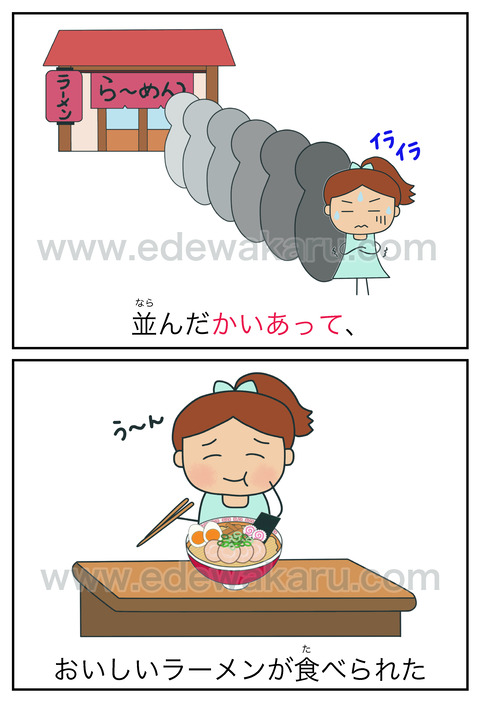
Thanks to having waited in line for two hours, I was able to eat delicious ramen.
Thanks to having waited in line for two hours, I was able to eat delicious ramen.
There is also the usage “〜かいがある” 😮
[Examples]
This ramen is delicious. It was worth waiting in line for two hours.
I passed N1! All my hard work paid off!!
“〜かいがある” is written with the kanji “〜甲斐がある,” so learners at an advanced level may want to remember it 😊
[Additional explanation]
Remember that the negative form of “〜かいあって” is “〜かいもなく.” Also, the negative form of “〜かいがある” is “〜かいがない” 😉
[Examples]
Despite my efforts, I didn’t pass N1.
I couldn’t pass N1… My efforts were in vain…
Remember that “〜かいあって” must always be followed by the た-form 😀
In context 3 examples
並んだかいあって、おいしいラーメンが食べられた
→並んだ効果があって、おいしいラーメンが食べられたThanks to having waited in line, I was able to eat delicious ramen. →As a result of waiting in line, I was able to eat delicious ramen.
努力したかいあって、N1に合格した
→努力した成果があって、N1に合格したThanks to my efforts, I passed N1. →As a result of my efforts, I passed N1.
毎日トレーニングしたかいあって、優勝することができた
→毎日トレーニングした効果があって、優勝することができたThanks to training every day, I was able to win. →As a result of training every day, I was able to win.
Read the original source text
Meaning
〜した効果があって〜
〜した成果があって〜
How to use it
動詞[た形・ている形]+かいあって
名詞[辞書形]+のかいあって
Explanation
「〜かいあって」は「〜した効果があって」「〜した成果があって」という意味で使われる文型です。
大変なことや、辛いことをしたら、いい効果や成果が出たと言いたい時に使います
😊名詞に使う場合は
「〜のかいあって」
になります。
[例]
努力
のかいあって、N1に合格した
トレーニング
のかいあって、優勝することができた
「〜かいがあって」というように「が」が入っていても意味は同じです
😀
[例]
2時間並んだ
かいあって、おいしいラーメンが食べられた
2時間並んだ
かいがあって、おいしいラーメンが食べられた
また、
「〜かいがある」
という使い方もあります😮
[例]
このラーメンはおいしい。2時間並んだ
かいがある
N1に合格できた!努力した
かいがあった!!
「〜かいがある」は漢字で書くと
「〜甲斐がある」
と書きますので、上級レベルの人は覚えておくといいと思います😊
【補足説明】
「〜かいあって」の否定形は「〜かいもなく」です。また、
「〜かいがある」の否定形は「〜かいがない」と覚えておきましょう
😉
[例]
努力した
かいもなく、N1に合格できなかった
N1に合格できなかった…努力した
かいがなかった
…
「〜かいあって」の後ろは必ず「た形」がくると覚えておきましょう
😀
日本語NET JLPT文法解説まとめ
Meaning
① The effect of ~ / thanks to ~
② Worthwhile
Used when you want to say that although something was difficult or painful, doing it produced an effect or achievement and led to a good result.
How to use it
V (dictionary form / ta-form) + かいがあって
V (ます-form)ます + がいがある
N from a する verb + かいがあって
Explanation
① "Thanks to / Due to the effects of"
② "It was worth"
It is used to say that although something was difficult and challenging, the efforts paid off and resulted in a good outcome.
① In speech, the が in 「〜かいがあって」 is often dropped.
② The negative form can be 「〜かいがなく」, but 「〜かいもなく」 is more commonly used.
In context 12 examples
毎日シャドーイングをしたかいがあって、発音が上手になった。
Thanks to shadowing every day, my pronunciation improved.
毎日鏡の前で練習したかいがあって、プレゼンは大成功だった。
Thanks to practicing in front of the mirror every day, the presentation was a great success.
2時間も並んだかいがあって、日本一美味しいと評判の高いラーメンを食べることができた。
It was worth waiting in line for two whole hours: I was able to eat ramen reputed to be the best in Japan.
20kgもダイエットに成功したのだから、高いお金を払ったかいがあったと思う。
Since I successfully lost as much as 20 kg, I think it was worth paying so much money.
苦労したかいがあって、第一志望の大学に合格できた。
Thanks to all my hard work, I was able to get into my first-choice university.
彼はいつも面白い反応をしてくれるので、イジリがいがある。
He always gives funny reactions, so he’s fun to tease.
ジェシカさんは真面目だし、予習・復習をきちんとしてくるから教えがいがある。
Jessica is diligent and always comes prepared, having done her review and preview, so she’s rewarding to teach.
今の仕事は忙しいが、やりがいがある。
My current job is busy, but it’s rewarding.
努力のかいもなく、N1の試験に合格できなかった。
Despite all my efforts, I couldn’t pass the N1 exam.
遠くから時間とお金をかけて来たかいもなく、店は閉まっていて名物料理が食べられなかった。
Despite traveling from far away and spending time and money to get there, the shop was closed and I couldn’t eat its specialty dish.
父は手術のかいもなく、亡くなってしまった。
Despite the surgery, my father passed away.
夜11時まで残業したかいもなく、納期を守れず謝ることになった。
Despite working overtime until 11 p.m., I couldn’t meet the deadline and had to apologize.
Read the original source text
Meaning
①〜の効果があって / 〜のおかげで
②〜の価値があって
大変だった、辛かったが〜したことで効果や成果が得られて、いい結果になったと言いたい時に使う。
How to use it
V(辞書形 / タ形) + かいがあって
V(ます形)ます + がいがある
する動詞のNの + かいがあって
Explanation
① "Thanks to / Due to the effects of"
② "It was worth"
It is used to say that although something was difficult and challenging, the efforts paid off and resulted in a good outcome.
①話す時は「〜かいがあって」の「が」が脱落することが多い。
②否定の形は「〜かいがなく」でもいいが「〜かいもなく」を使うことが多い。
IMABI
Negative Patterns
Read this IMABI lesson ↗Explanation
More Negative Patterns: ~ないことには, ~なし・なき, ~なしで(は), ~なしに(は), ~なくして(は), ~ことなく, & 甲斐もなく
This lesson will introduce you to more patterns that utilize ~ない or derivations of it.
~ないことには(~ない)
AないことにはB means “if…don’t/in not…; unless”. So, if you don’t do A, you get stuck with B. B could be positive or negative depending on the outcome that you wish to express. It can be used with verbs, adjectives, or the copula, but don’t forget how to properly use ない! This pattern must be only used in declarative sentences.
品詞 接続 例
名詞 N+でないことには 人でないことには
形容詞 Adj → く-連用形 + ないことには 高くないことには
形容動詞 Adj + でないことには 精密でないことには
動詞 Adj → 未然形 + ないことには しないことには
1. 泳がないことには、海岸に行けなくなった。
In not swimming, I became unable to go to the beach.
2. 急がないことには、間に合わなくなる。
In not hurrying, you won’t make it in time.
3. 勝たないことには、試合しあいに負ける。
If you don’t win, you lose in the tournament.
4. がんばらないことには、今度の韓国語の試験に合格できないよ。
Unless you try hard, you won’t pass this next Korean exam.
Grammar Note: Do not confuse this with …ないことには where は is simply emphatic. The phrase discussed in this section is conjunctive in nature, whereas this is not.
5. 自分に関わりのないことには口を出すなよ。
Don’t interfere in things that don’t concern you!
~なし
無なし means “without” and is after nominal phrases. If なし for some reason is placed before a noun, it becomes 無き. There is more behind this form of ない. The problem lies with how to use ~なしに(は), ~なしで(は), and ~なくして(は). These phrases show that if something were not to happen, a certain event won’t be. These phrases show necessity, and there is a negative phrase in the next clause.
6. コーヒーなしに過ごせない。
I can’t go on without coffee.
7. 涙なしに語ることができない。(書き言葉的)
I can’t tell it without tears coming.
8. 国民の理解と協力なしには実行できない。(書き言葉)
We can’t act forth without the understanding and cooperation of the citizens.
9. 政府開発援助なしではこの革新的な医学研究は続けることができない。
Without government development aid, this groundbreaking medical research can’t continue.
10. しっかりと準備することなくしては成功できぬ。 (硬い書き言葉)
Without properly preparing, you can’t succeed.
11. 先生方のご指導なくして私の大学合格は有り得ませんでした。(とても丁寧; Useful expression)
Without the guidance of my teachers, my college success wouldn’t have been possible.
12. 政治家せいじかはテレプロンプター(原稿)なしで話せない。
Politicians can’t talk without a teleprompter.
13.百害ひゃくがいあって一利いちりなし。(Set phrase/proverb)
To do no good but a lot of harm.
14. 「憲法を改正することなくして、軍事大国になれない」と考える人が増えているそうだ。
It sounds that the number of people who think that without revising the constitution, [Japan] won’t be able to become a military power is growing.
Grammar Note: Also seen as ~ずして(は), ~なくして(は) is a more old-fashioned/archaic equivalent of ~なしに(は), but it can be used in plus and or negative situations.
~なしで(は) VS ~なしに(は)
Although both present a premise X, which makes Y possible, they are slightly different.
1. ~なしで(は) is used with a noun that shows a general condition, and the listener is told that there must be X. Thus, the speaker can use this when pointing out a ban or the need for evasion.
2. ~なしに(は) can’t be used directly towards the listener to get that person working. When these expressions are interchangeable, the former shows an individual cause whereas the latter shows a more obvious situation that is deemed to be evident and necessary. Thus, it is more suited for the written language.
15. スペイン語?無理いうなや。辞書なし{で・に}は、分からんわ。(ちょっと関西弁っぽい)
Spanish? Don’t be unreasonable. I can’t understand it without a dictionary.
16. 客商売だから、ネクタイなし{〇 で・X に}は、困るんだけども。(話し言葉)
Since it’s business (client-oriented), it’d be troubling without a tie.
17. 届け出なし{〇 に・△ で}外泊するのは、キャンプの規則に違反することになります。
Sleeping outdoors is now a violation of camp rules without notification.
18. ノックなしに(は)、ドアを開けないでください。
Don’t open the door without knocking.
Grammar Note: は in the last situation would make it fit well, but the message was probably written on the door rather than spoken. Had the sentence been spoken, with ノックしないで being more common, ~なしに would exemplary demonstrate consideration to the listener.
~ないことには~ない VS ~ことなしに(は)~ない VS ~ことなく
XないことにはYない shows that for the realization of Y, X is necessary. X can be a positive or negative situation. However, ~ことなしに(は)~ない and ~ことなく can only be used with verbs whereas the former pattern is also seen with nouns and adjectives. Furthermore, these latter expressions show that “for Y to realize, X is unavoidable”. So, it’s not positive.
19a. 努力どりょく{することなしには・しないことには}、成功はできない。
19b. 成功するためには、努力を避さけていることはできない。
You cannot succeed unless you put in effort.
20. 「憲法を変え{・ることなしには・ないことには}、軍事大国になれないと考える人が増えている」といわれますが、本当かどうかよく分かりませんね。
It’s said that the number of people that think that without changing the constitution, [Japan] won’t be able to come a military power is growing, but I don’t really know if that’s true.
21. 優しい人でないことには、お金があっても、結婚できませんよ。
You can’t get married even if you have money if you’re not a nice person.
Other things to keep in mind is that both ~ことなしに(は)~ない and ~ことなく are more likely to appear in the written language; however, the former is even more 硬かたい because it has the old なし in it. You do still see ~こと(も)なく in the spoken language, though, in which it has interchangeability with 連用形+もしないで.
22a. 多少のリスクを負わないことには、ビジネスなんかできないよ。とうてい避けられないもんだから。〇
22b. 多少のリスクを負う{ことなく・ことなしに}、ビジネスなんかできないよ。とうてい避けられないもんだから。X
Without taking some risk, you can’t do business. That’s because you can’t avoid it no matter what.23. 石に躓つまづいて転ころんだ子供が{泣くこともなく・泣きもしないで}、笑顔えがおで立ち上がったなんてびっくりしたよ。
I was surprised that the kid who tripped and fell on the rocks got up with a smile without even crying.
24. しょうことなく、メザキさんと並んで、いくら行っても太くもならないし細くもならない道を、長く歩いた。
With it not being helped, I went along with Mr. Mezaki, and we walked a long ways down the road, which no matter how much you go neither widens nor thins.
From 溺レる by 川上弘美.
Phrase Note: しょうことなく = しょうことなしに = やむを得ず.
25. ためらうことなく、消防士は燃えている家に入った。
The firefighters went into the burning house without hesitation.
26. 福田社長はしょうことなしに謝罪をした。
Company President Fukuda apologized with little choice.
27. 試験に合格することなしに、この会社には入れません。
It is not possible to get into this company without passing the exam.
甲斐(かい)もなく
甲斐かい means “avail” and 甲斐かいもなく, thus, means “to no avail/in vain”. Just as in English, it is not really casual.
28. 私たちは練習れんしゅうした甲斐かいもなく負けてしまった。
We lost despite practicing.
29. わざわざフランスから出かけてきた甲斐がありました。
It was worth our while to have come all the way from France.
30. 勉強した甲斐もなく落ちてしまいました。
I ended up failing to no avail of studying.
31. 働はたらき甲斐がい
Just the value of working
32. 年甲斐としがいもなく
Unbecoming to one’s age
In context 35 examples
泳がないことには、海岸に行けなくなった。
In not swimming, I became unable to go to the beach.
急がないことには、間に合わなくなる。
In not hurrying, you won’t make it in time.
勝たないことには、試合しあいに負ける。
If you don’t win, you lose in the tournament.
がんばらないことには、今度の韓国語の試験に合格できないよ。
Unless you try hard, you won’t pass this next Korean exam.
自分に関わりのないことには口を出すなよ。
Don’t interfere in things that don’t concern you!
コーヒーなしに過ごせない。
I can’t go on without coffee.
涙なしに語ることができない。(書き言葉的)
I can’t tell it without tears coming.
国民の理解と協力なしには実行できない。(書き言葉)
We can’t act forth without the understanding and cooperation of the citizens.
政府開発援助なしではこの革新的な医学研究は続けることができない。
Without government development aid, this groundbreaking medical research can’t continue.
しっかりと準備することなくしては成功できぬ。 (硬い書き言葉)
Without properly preparing, you can’t succeed.
先生方のご指導なくして私の大学合格は有り得ませんでした。(とても丁寧; Useful expression)
Without the guidance of my teachers, my college success wouldn’t have been possible.
政治家せいじかはテレプロンプター(原稿)なしで話せない。
Politicians can’t talk without a teleprompter.
百害ひゃくがいあって一利いちりなし。(Set phrase/proverb)
To do no good but a lot of harm.
「憲法を改正することなくして、軍事大国になれない」と考える人が増えているそうだ。
It sounds that the number of people who think that without revising the constitution, [Japan] won’t be able to become a military power is growing.
~なしで(は) is used with a noun that shows a general condition, and the listener is told that there must be X. Thus, the speaker can use this when pointing out a ban or the need for evasion.
Spanish? Don’t be unreasonable. I can’t understand it without a dictionary.
~なしに(は) can’t be used directly towards the listener to get that person working. When these expressions are interchangeable, the former shows an individual cause whereas the latter shows a more obvious situation that is deemed to be evident and necessary. Thus, it is more suited for the written language.
Spanish? Don’t be unreasonable. I can’t understand it without a dictionary.
スペイン語?無理いうなや。辞書なし{で・に}は、分からんわ。(ちょっと関西弁っぽい)
Spanish? Don’t be unreasonable. I can’t understand it without a dictionary.
客商売だから、ネクタイなし{〇 で・X に}は、困るんだけども。(話し言葉)
Since it’s business (client-oriented), it’d be troubling without a tie.
届け出なし{〇 に・△ で}外泊するのは、キャンプの規則に違反することになります。
Sleeping outdoors is now a violation of camp rules without notification.
ノックなしに(は)、ドアを開けないでください。
Don’t open the door without knocking.
努力どりょく{することなしには・しないことには}、成功はできない。
You cannot succeed unless you put in effort.
成功するためには、努力を避さけていることはできない。
You cannot succeed unless you put in effort.
「憲法を変え{・ることなしには・ないことには}、軍事大国になれないと考える人が増えている」といわれますが、本当かどうかよく分かりませんね。
It’s said that the number of people that think that without changing the constitution, [Japan] won’t be able to come a military power is growing, but I don’t really know if that’s true.
優しい人でないことには、お金があっても、結婚できませんよ。
You can’t get married even if you have money if you’re not a nice person.
多少のリスクを負わないことには、ビジネスなんかできないよ。とうてい避けられないもんだから。〇
Unless you take on some risk, you can’t do business. It’s something you simply can’t avoid. 〇
多少のリスクを負う{ことなく・ことなしに}、ビジネスなんかできないよ。とうてい避けられないもんだから。X
You can’t do business without taking on some risk. It’s something you simply can’t avoid. X
しょうことなく、メザキさんと並んで、いくら行っても太くもならないし細くもならない道を、長く歩いた。
With it not being helped, I went along with Mr. Mezaki, and we walked a long ways down the road, which no matter how much you go neither widens nor thins.
ためらうことなく、消防士は燃えている家に入った。
The firefighters went into the burning house without hesitation.
福田社長はしょうことなしに謝罪をした。
Company President Fukuda apologized with little choice.
試験に合格することなしに、この会社には入れません。
It is not possible to get into this company without passing the exam.
私たちは練習れんしゅうした甲斐かいもなく負けてしまった。
We lost despite practicing.
わざわざフランスから出かけてきた甲斐がありました。
It was worth our while to have come all the way from France.
勉強した甲斐もなく落ちてしまいました。
I ended up failing to no avail of studying.
働はたらき甲斐がい
Just the value of working
年甲斐としがいもなく
Unbecoming to one’s age
Read the original source text
Explanation
More Negative Patterns: ~ないことには, ~なし・なき, ~なしで(は), ~なしに(は), ~なくして(は), ~ことなく, & 甲斐もなく
This lesson will introduce you to more patterns that utilize ~ない or derivations of it.
~ないことには(~ない)
AないことにはB means “if…don’t/in not…; unless”. So, if you don’t do A, you get stuck with B. B could be positive or negative depending on the outcome that you wish to express. It can be used with verbs, adjectives, or the copula, but don’t forget how to properly use ない! This pattern must be only used in declarative sentences.
品詞 接続 例
名詞 N+でないことには 人でないことには
形容詞 Adj → く-連用形 + ないことには 高くないことには
形容動詞 Adj + でないことには 精密でないことには
動詞 Adj → 未然形 + ないことには しないことには
1. 泳がないことには、海岸に行けなくなった。
In not swimming, I became unable to go to the beach.
2. 急がないことには、間に合わなくなる。
In not hurrying, you won’t make it in time.
3. 勝たないことには、試合しあいに負ける。
If you don’t win, you lose in the tournament.
4. がんばらないことには、今度の韓国語の試験に合格できないよ。
Unless you try hard, you won’t pass this next Korean exam.
Grammar Note: Do not confuse this with …ないことには where は is simply emphatic. The phrase discussed in this section is conjunctive in nature, whereas this is not.
5. 自分に関わりのないことには口を出すなよ。
Don’t interfere in things that don’t concern you!
~なし
無なし means “without” and is after nominal phrases. If なし for some reason is placed before a noun, it becomes 無き. There is more behind this form of ない. The problem lies with how to use ~なしに(は), ~なしで(は), and ~なくして(は). These phrases show that if something were not to happen, a certain event won’t be. These phrases show necessity, and there is a negative phrase in the next clause.
6. コーヒーなしに過ごせない。
I can’t go on without coffee.
7. 涙なしに語ることができない。(書き言葉的)
I can’t tell it without tears coming.
8. 国民の理解と協力なしには実行できない。(書き言葉)
We can’t act forth without the understanding and cooperation of the citizens.
9. 政府開発援助なしではこの革新的な医学研究は続けることができない。
Without government development aid, this groundbreaking medical research can’t continue.
10. しっかりと準備することなくしては成功できぬ。 (硬い書き言葉)
Without properly preparing, you can’t succeed.
11. 先生方のご指導なくして私の大学合格は有り得ませんでした。(とても丁寧; Useful expression)
Without the guidance of my teachers, my college success wouldn’t have been possible.
12. 政治家せいじかはテレプロンプター(原稿)なしで話せない。
Politicians can’t talk without a teleprompter.
13.百害ひゃくがいあって一利いちりなし。(Set phrase/proverb)
To do no good but a lot of harm.
14. 「憲法を改正することなくして、軍事大国になれない」と考える人が増えているそうだ。
It sounds that the number of people who think that without revising the constitution, [Japan] won’t be able to become a military power is growing.
Grammar Note: Also seen as ~ずして(は), ~なくして(は) is a more old-fashioned/archaic equivalent of ~なしに(は), but it can be used in plus and or negative situations.
~なしで(は) VS ~なしに(は)
Although both present a premise X, which makes Y possible, they are slightly different.
1. ~なしで(は) is used with a noun that shows a general condition, and the listener is told that there must be X. Thus, the speaker can use this when pointing out a ban or the need for evasion.
2. ~なしに(は) can’t be used directly towards the listener to get that person working. When these expressions are interchangeable, the former shows an individual cause whereas the latter shows a more obvious situation that is deemed to be evident and necessary. Thus, it is more suited for the written language.
15. スペイン語?無理いうなや。辞書なし{で・に}は、分からんわ。(ちょっと関西弁っぽい)
Spanish? Don’t be unreasonable. I can’t understand it without a dictionary.
16. 客商売だから、ネクタイなし{〇 で・X に}は、困るんだけども。(話し言葉)
Since it’s business (client-oriented), it’d be troubling without a tie.
17. 届け出なし{〇 に・△ で}外泊するのは、キャンプの規則に違反することになります。
Sleeping outdoors is now a violation of camp rules without notification.
18. ノックなしに(は)、ドアを開けないでください。
Don’t open the door without knocking.
Grammar Note: は in the last situation would make it fit well, but the message was probably written on the door rather than spoken. Had the sentence been spoken, with ノックしないで being more common, ~なしに would exemplary demonstrate consideration to the listener.
~ないことには~ない VS ~ことなしに(は)~ない VS ~ことなく
XないことにはYない shows that for the realization of Y, X is necessary. X can be a positive or negative situation. However, ~ことなしに(は)~ない and ~ことなく can only be used with verbs whereas the former pattern is also seen with nouns and adjectives. Furthermore, these latter expressions show that “for Y to realize, X is unavoidable”. So, it’s not positive.
19a. 努力どりょく{することなしには・しないことには}、成功はできない。
19b. 成功するためには、努力を避さけていることはできない。
You cannot succeed unless you put in effort.
20. 「憲法を変え{・ることなしには・ないことには}、軍事大国になれないと考える人が増えている」といわれますが、本当かどうかよく分かりませんね。
It’s said that the number of people that think that without changing the constitution, [Japan] won’t be able to come a military power is growing, but I don’t really know if that’s true.
21. 優しい人でないことには、お金があっても、結婚できませんよ。
You can’t get married even if you have money if you’re not a nice person.
Other things to keep in mind is that both ~ことなしに(は)~ない and ~ことなく are more likely to appear in the written language; however, the former is even more 硬かたい because it has the old なし in it. You do still see ~こと(も)なく in the spoken language, though, in which it has interchangeability with 連用形+もしないで.
22a. 多少のリスクを負わないことには、ビジネスなんかできないよ。とうてい避けられないもんだから。〇
22b. 多少のリスクを負う{ことなく・ことなしに}、ビジネスなんかできないよ。とうてい避けられないもんだから。X
Without taking some risk, you can’t do business. That’s because you can’t avoid it no matter what.23. 石に躓つまづいて転ころんだ子供が{泣くこともなく・泣きもしないで}、笑顔えがおで立ち上がったなんてびっくりしたよ。
I was surprised that the kid who tripped and fell on the rocks got up with a smile without even crying.
24. しょうことなく、メザキさんと並んで、いくら行っても太くもならないし細くもならない道を、長く歩いた。
With it not being helped, I went along with Mr. Mezaki, and we walked a long ways down the road, which no matter how much you go neither widens nor thins.
From 溺レる by 川上弘美.
Phrase Note: しょうことなく = しょうことなしに = やむを得ず.
25. ためらうことなく、消防士は燃えている家に入った。
The firefighters went into the burning house without hesitation.
26. 福田社長はしょうことなしに謝罪をした。
Company President Fukuda apologized with little choice.
27. 試験に合格することなしに、この会社には入れません。
It is not possible to get into this company without passing the exam.
甲斐(かい)もなく
甲斐かい means “avail” and 甲斐かいもなく, thus, means “to no avail/in vain”. Just as in English, it is not really casual.
28. 私たちは練習れんしゅうした甲斐かいもなく負けてしまった。
We lost despite practicing.
29. わざわざフランスから出かけてきた甲斐がありました。
It was worth our while to have come all the way from France.
30. 勉強した甲斐もなく落ちてしまいました。
I ended up failing to no avail of studying.
31. 働はたらき甲斐がい
Just the value of working
32. 年甲斐としがいもなく
Unbecoming to one’s age