絵でわかる日本語
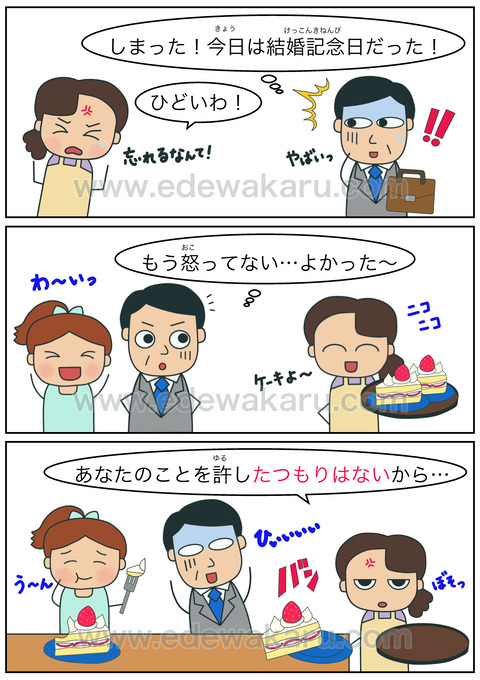
Meaning
I did not 〜
I did not mean to 〜
How to use it
Verb [た-form] + たつもりはない
Verb [た-form] + たつもりはなかった
Explanation
「Aたつもりはない」 is a sentence pattern meaning “I did not do A” or “I did not mean to do A.” It is used when denying the other person’s judgment or misunderstanding about something you did, A.
[Examples]
① I didn’t mean to forgive you, you know!
[The other person’s judgment/misunderstanding] You forgave me.
→I didn’t forgive you.
② Daughter: You’re going to buy this for me, right?
Mother: I didn’t mean to say that.
[The daughter’s judgment/misunderstanding] You’ll buy this for me.
→I didn’t say I’d buy it for you.
③ I didn’t mean to make fun of you… I’m sorry.
[The other person’s judgment/misunderstanding] They were made fun of.
→I didn’t make fun of you.
④ A: Yamada-kun was really angry!
B: What!? I didn’t mean to make him angry…
[Yamada-kun’s judgment/misunderstanding] Someone said something irritating to him.
→I didn’t mean to make him angry.
⑤ I didn’t mean to get angry, but I made her cry.
[Her judgment/misunderstanding] She was yelled at.
→I wasn’t angry.
「〜つもりではない」 is a pattern you don’t get many chances to study. Advanced learners should learn it. There are also many patterns containing 「つもり」, so review them 😉
[Sentence patterns containing 「つもり」]
In context 5 examples
あなたのことを許したつもりはないからね!
→あなたのことを許したのではないからねI didn’t mean to forgive you, you know! →I didn’t forgive you, you know!
娘:これ買ってくれるんでしょ?母:そんなことを言ったつもりはないわ
→そんなことを言ったのではないわDaughter: You’re going to buy this for me, right? Mother: I didn’t say that. →I didn’t say that.
馬鹿にしたつもりはなかったの…ごめんね
→馬鹿にしようと思ったのではないの…ごめんねI didn’t mean to make fun of you… I’m sorry. →I didn’t mean to make fun of you… I’m sorry.
A:山田くん、すごく怒ってたわよ!B:え!?怒らせたつもりはないんだけどなぁ…
→怒らせようと思ったのではないんだけどなぁ…A: Yamada-kun was really angry! B: What!? I didn’t mean to make him angry… →I didn’t mean to make him angry…
怒ったつもりはなかったが、彼女を泣かせてしまった
→怒ったのではないが、彼女を泣かせてしまったI didn’t mean to get angry, but I made her cry. →I wasn’t angry, but I made her cry.
Read the original source text
Meaning
〜したのではない
〜しようと思ったのではない
How to use it
動詞[た形]+たつもりはない
動詞[た形]+たつもりはなかった
Explanation
「Aたつもりはない」は「Aしたのではない」「Aしようと思ったのではない」という意味の文型です。自分のしたこと「A」に対する相手の判断や誤解を否定する場合に使われます。
[例]
①あなたのことを許し
たつもりはない
からね!
【相手の判断・誤解】許してくれた
→許したのではない
②娘:これ買ってくれるんでしょ?
母:そんなことを言っ
たつもりはない
わ
【娘の判断・誤解】これを買ってくれる
→「買ってあげる」とは言っていない
③馬鹿にし
たつもりはなかった
の…ごめんね
【相手の判断・誤解】馬鹿にされた
→馬鹿にしたのではない
④A:山田くん、すごく怒ってたわよ!
B:え!?怒らせ
たつもりはない
んだけどなぁ…
【山田くんの判断・誤解】ムカつくことを言われた
→怒らせようと思っていない
⑤怒っ
たつもりはなかった
が、彼女を泣かせてしまった
【彼女の判断・誤解】怒られた
→怒っていない
「〜つもりではない」は、勉強する機会がすくない文型です。上級レベルの人は覚えておくといいと思います。また、「つもり」がつく文型はたくさんありますので、復習しておきましょう😉
【「つもり」がつく文型】
毎日のんびり日本語教師
How to use it
Verb ta-form + つもりはない
Verb ta-form + つもりはなかった
Explanation
This expresses a defense or excuse in response to a misunderstanding or misinterpretation by another person caused by one’s past actions.
Notes
The 「つもり」 series
In context 8 examples
そんなこと言ったつもりはありませんよ。
I didn’t mean to say anything like that.
いじめたつもりはないと思っていても、相手がいじめられたと思っていればそれはいじめだ。
Even if you think you didn’t mean to bully someone, if they feel they were bullied, then it was bullying.
面白い事を言ったつもりはないんですが、笑ってくれて嬉しいです。
I didn’t mean to say anything funny, but I’m glad you laughed.
馬鹿にしたつもりはないのですが、そう聞こえたのなら素直に謝ります。
I didn’t mean to make fun of you, but if that’s how it sounded, I’ll apologize sincerely.
付き合ったつもりはないのに、彼はそう勘違いしていたようだ。
I didn’t think we were dating, but it seems he misunderstood.
許可したつもりはないが、どうしてもというならやりたいようにやればいい。
I didn’t mean to give you permission, but if you insist, go ahead and do as you like.
あなたを許したつもりはありません。(我不认为原谅你了。)
I don’t think I’ve forgiven you.
怒ったつもりはないので、謝られても困ります。
I didn’t mean to get angry, so I don’t know what to do with your apology.
Read the original source text
How to use it
動た形+つもりはない
動た形+つもりはなかった
Explanation
過去の行為によって引き起こされた相手の勘違いや誤解に対する・弁明を表します。
Notes
「つもり」シリーズ