日本語文型辞典
Meaning
Basic information: N/Na/A/V みたいだ
Explanation: This is used mainly in spoken language. It is also used in writing, but it is quite casual; in formal writing or situations, ようだ is used. Set expressions using ようだ are difficult to rephrase with みたいだ.
It is used to describe the state, nature, shape, or manner of an action by giving an example of something similar. It is the same as よう. To emphasize a very close resemblance, まるで/ちょうど…みたい is used. あたかも, いかにも, and さながら are formal, written expressions, so they are not used together with みたい.
a. NみたいなN
In the form N1みたいなN2, this is used to explain what kind of thing N2 is by giving an example similar to N2. It can be rephrased as NのようなN. Many learners confuse it with NらしいN, but NみたいなN merely gives an example of something similar; it does not mean N1=N2. For example, 男みたいな人 means the person looks like a man but is not actually a man. In contrast, 男らしい人 means “a very masculine person whose typically male traits stand out,” and is used of men.
b. …みたいだ
This is used to describe how the speaker perceives a state, nature, shape, or manner of an action, by giving an easy-to-understand example of something similar. It can be rephrased as …ようだ. In everyday spoken language, women often omit the sentence-final だ, as in ④. うそみたいだ means “It’s hard to believe; I’m very surprised.”
c. …みたいに
This is used to describe a state, nature, shape, or manner of an action by giving an example of something similar. Examples ⑤ and ⑥ imply “although that is not actually the case.”
d. …みたいなものだ
This means “It has not yet become so in reality, but it is almost certain to happen” or “It is in a state that can be called almost the same.” In spoken language, もんだ is often used instead of ものだ.
This expresses the speaker’s conjecture and means “I can’t state it definitively, but that’s what I think.” It is used when the speaker makes an inference based on something they personally experienced directly, such as seeing something, hearing a sound, or smelling something. In contrast, らしい is used for the speaker’s conjecture based on indirect information, such as something heard from another person, and そうだ is used when simply reporting what was heard.
Both …みたいだ and …みたいだった can often be used, but their meanings differ. As in the following example, V-たみたいだ states a conclusion the speaker has inferred at the time of speaking about something that happened in the past.
V-たみたいだった expresses that the speaker thought so at some point in the past.
Also, when describing how something appears from direct observation, for example when a cake is right in front of you, you would not say このケーキはおいしいみたいだ (“This cake seems delicious”). In that case, say このケーキはおいしそうだ (“This cake looks delicious”).
Note that そう used here is different from hearsay そう. For hearsay, the forms are おいしいそうだ and 便利だそうだ.
This is used to give examples. ① means “for example, large cities such as Tokyo and Osaka,” and ② means “for example, department stores or other large shops like department stores.” Examples ⑤–⑦ take the form of examples, but in effect can be understood as equivalent to “It was so hot this year that I really came to hate working,” “You really are such a scatterbrain,” and “He keeps doing whatever he likes, so before long no one will have anything to do with him.” In polite spoken language, …のような/ように is used.
How to use it
…みたい【Simile】
N/V みたいだ
N/A/V みたいに
Nみたいなものだ
V-たみたいなものだ
…みたいだ【Conjecture】
…みたい【Examples】
NみたいなN
Nみたいに
In context 41 examples
この薬は、チョコレートみたいな味がする。
This medicine tastes like chocolate.
竹下さんって、あの学生みたいな人でしょ?
Takeshita is the person who’s like that student, right?
いい年をして、子供みたいな服を着なV)でほしいな。
You’re old enough to know better; I wish you wouldn’t wear clothes like a child.
飛行機みたいな形の雲が浮かんでいる。
A cloud shaped like an airplane is floating by.
すごい風だ。まるで台風みたいだ。
What incredible wind! It’s just like a typhoon.
君ってまるで子供みたいだね。
You’re just like a child.
その地方の方言に慣れるまでは、まるで外国語を聞いているみたいだった。
Until I got used to the dialect of that region, it was just like listening to a foreign language.
私が合格するなんてうそみたい。
It seems unbelievable that I passed.
もう9月も半ばなのに、真夏みたしミラ暑い。
It’s already the middle of September, but it’s as hot as midsummer.
この服は、買って何年にもなるが、新品みたいにきれいだ。
I bought these clothes years ago, but they’re as clean as new.
子供みたいにすねるのはやめろよ。
Stop sulking like a child.
こんなにうまいコーヒーが、二杯100円だなんて、ただみたいに安いね。
This coffee is so good, and at 100 yen for two cups, it’s practically free.
私ばかりが悪いみたいに言わないでよ。あなただって悪いんだから。
Don’t talk as if I’m the only one at fault. You’re at fault too.
A:学校ではあまり会わないね。
B:おいおい、そんな言い方をしたら、僕が授業をさぼってばかりいるみたいに聞こえるじゃないか。A: I don’t see you much at school. B: Hey, if you put it that way, it sounds like I’m always skipping class.
僕の給料なんか、会社の儲けに比べたら、ただみたいなものさ。
Compared with the company’s profits, my salary is practically nothing.
≪野球をみながら≫こんなに点差があけば、もう勝ったみたいなものだ。
〈Watching baseball〉With a lead this big, we’ve practically already won.
A:中田さん、店、売ったんだって?
B:売ったというか、まあ、取られたみたいなものだ。借金の抵当にはいってたんだそうだよ。A: I heard you sold your shop, Mr. Nakata. B: You could say I sold it, but really, it was practically taken from me. I hear it was collateral for a debt.
誰も彼女の本名を知らないみたいだ。
It seems that no one knows her real name.
田中さんは甘いものが嫌いみたいだ。
Tanaka seems to dislike sweet things.
どうもかぜをひいたみたいだ。
I think I’ve caught a cold.
今度発売された辞書は、すごくいいみたいだよ。
The dictionary that just came out seems really good.
何か焦げているみたいだ。へんな匂いがする。
It seems something is burning. There’s a strange smell.
A:あの人証?
B:誰だろう。近所の人じゃないみたいだね。A: Who is that person? B: I wonder who. They don’t seem to be from around here.
A:試験はいつあるんだい。
B:来週みたいだよ。A: When’s the exam? B: I think it’s next week.
A:あの人会社をやめたの?
B:みたいだね。A: Did that person quit their company? B: Seems so.
A:小林さんはもうアメリカに行ったのかな?
B:ええ、きのう出発したみたいだ。A: I wonder if Kobayashi has gone to America already. B: Yes, it seems he left yesterday.
A:山本さん怒っていたでしょう?
B:うん、すごく怒ってるみたいだった。A: Yamamoto was angry, wasn’t he? B: Yes, he seemed really angry.
そのときの佐々木さんはなんだか怖くて、いつもの彼ではないみたいだった。
Sasaki seemed somehow frightening then, unlike his usual self.
(例) 山下さんは今日は来ないみたいですね(もう、時間も遅いし)。
山下さんは今日は来ないらしいですよ(直葺妾きいたわけではないがー他の人がそう言っていた)。
山下さんは今日は来ないそうです(山下さんから「行かない」という伝言があった)。(Example) Yamashita probably won’t come today (it’s already late). I hear Yamashita probably won’t come today (I didn’t hear it directly, but someone else said so). I hear Yamashita won’t come today (a message came from Yamashita saying, “I’m not going”).
(例) A:田中さんはいつ来たのかな?
B:午前中は見かけなかったから、昼から来たみたいですよ。(Example) A: I wonder when Tanaka came. B: I didn’t see him in the morning, so it seems he came in the afternoon.
(例) 昨日の夜は妙だった。誰か来たみたいだったから、ドアをあけてみたが、だれもいなかった。そんなことが何度もあった。
(Example) Last night was strange. It seemed like someone had come, so I opened the door, but no one was there. That happened several times.
(例) A:これ、新しく買ったテープレコーダーです。
(Example) A: This is the tape recorder I just bought.
(正) B:便利そうですね。
(Correct) B: It looks convenient.
(誤) B:便利みたいですね。
(Incorrect) B: It seems convenient. (For an appearance directly observed, use 便利そうですね.)
東京や大阪みたいな大都会には住みたくない。
I don’t want to live in a big city like Tokyo or Osaka.
A:三分間写真の機械って、
B:さあ、デパートみたいなところにはあるんじゃないかな。A: You know those three-minute photo booths— B: Well, I think there are some in places like department stores.
何か細くて長い棒みたいな物はありませんか。
Do you have something like a thin, long stick?
佐藤さんみたいに英語が上手になりたい。
I want to become as good at English as Mr. Sato.
今年みたいに暑いと、働くのが本当にいやになる。
When it’s as hot as it is this year, I really come to hate working.
看みたいなあわて者、見たことがないよ。
I’ve never seen such a scatterbrain!
彼みたいに勝手なことばかりしていると、そのうち誰も相手にしなくなる。
If you keep doing whatever you like, as he does, before long no one will have anything to do with you.
Read the original source text
Meaning
基本情報N/Na/A/V みたいだ説明 おもに話しことばで使う。書くときにも使われるが、かなりくだけた表現で、かたい文や改まった場面では「ようだ」が使われる。「ようだ」を使った慣用的な表現は「みたいだ」で言いかえにくい。
よく似たものを例にあげて、ものごとの状態・性質・形・動作の様子などを表す時に使う。「よう」と同じ。非常によく似ていることを強調する場合には、「まるで/ちょうど…みたい」が使われる。「あたかも」「いかにも」「さながら」は、書きことば的なかたい言い方なので、「みたい」とはいっしょに使わない。
a. NみたいなN
「N1みたいなN2」の形で、N2がどのようなものかを、N2に似ている例を挙げて説明するのに使う。「NのようなN」で言いかえることができる。「NらしいN」と混同する学習者が多いが、「NみたいなN」は、似たものを例に挙げているだけで、N1=N2ではない。例えば、「男みたいな人」という場合、その人は男のように見えるが、実際は男ではない。それに対して、「男らしい人」は「たいへん男っぽい、男の特徴がきわだった人」の意味で男性に対して使われる表現である。
b. …みたいだ
ものごとの状態・性質・形・動作の様子などについて話し手がどのように感じたかを、わかりやすいよく似たものを例にあげて述べるのに使う。「…ようだ」で言いかえることができる。日常の話しことばで女性が使う場合には④のように、文末の「だ」を省くことが多い。「うそみたいだ」は「とても信じられない、たいへん驚いた」という意味。
c. …みたいに
ものごとの状態・性質・形・動作の様子などについて、よく似たものを例にあげて述べるのに使う。⑤⑥の例は、「本当はそうでないのに」という含みがある。
d. …みたいなものだ
「まだ現実にはそうなっていないが、ほとんど確実実にそうなる」あるいは「ほとんど同じと言ってよい状態である」という意味を表す。話しことばでは「ものだ」ではなく「もんだ」が使われることが多い。
話し手の推量を表す。「はっきりと断定はできないが、そのように思う」という意味。話し手が、何かを見たとか、音を開いた、匂いをかいだなど自分自身の直接経験したことをもとに推論したことを述べる表現。これに対して、他の人から聞いた話など間接的な情報にもとづいた話し手の推量を表すときには「らしい」が使われ、聞いたことをそのまま報告する場合には「そうだ」が使われる。
「…みたいだ」と「…みたいだった」の二つはどちらも使える場合が多いが、意味は異なる。次の例のように「V-たみたいだ」は、過去に起きたことがらについて、話し手が話している時点で推量した結果を述べている。
「V-たみたいだった」は、話し手が過去のある時点でそのように思ったということを表す。
また、見たままの様態を述べる場合、例えば目の前にケーキがある時に「このケーキはおいしいみたいだ」とは言わない。この場合には「このケーキはおいしそうだ」と言う。
このときに使われる「そう」は、伝聞の「そう」とは違うので注意が必要である。伝聞の場合には「おいしいそうだ」「便利だそうだ」となる。
例をあげる場合に使う。①は、「例えば、東京や大阪などの大都会」、②は「例えば、デパートやデパートのような大きな店」という意味。⑤⑥⑦は例示の形をとっているが、実際には「今年は暑かったので、働くのが本当にいやになった」「君は本当にあわてものだ」「彼は勝手なことばかりしているから、そのうち誰も相手にしなくなる」と同じと考えてよい。丁寧な話しことばでは「…のような/ように」が用いられる。
How to use it
…みたい【比況】
N/V みたいだ
N/A/V みたいに
Nみたいなものだ
V-たみたいなものだ
…みたいだ【推量】
…みたい【例示】
NみたいなN
Nみたいに
絵でわかる日本語
Usage 1
Read this source entry ↗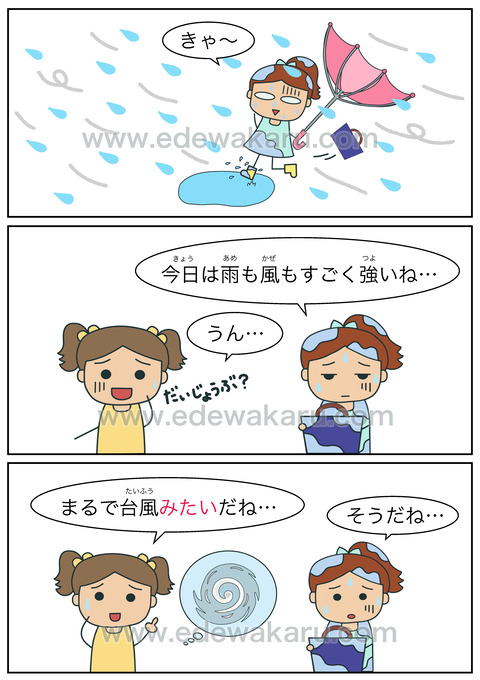
Meaning
Like ~
Actually not ~, but similar to ~
How to use it
Verb [plain form]+みたいだ
Adjective [plain form]+みたいだ
Noun [dictionary form]+みたいだ
Explanation
「〜みたいだ」 is a sentence pattern meaning “actually not ~, but similar to ~.” It is used when describing a state, shape, taste, smell, manner of an action, or degree of a state by giving an example of something similar 😊 「〜みたいだ」 is often used with 「まるで」, as in examples ① and ④.
[Examples]
① A: The rain and wind are really strong today.
B: Yeah. It’s just like a typhoon.
→ A typhoon hasn’t arrived, but the rain and wind are as strong as during a typhoon.
② This juice tastes like medicine…
→ This isn’t medicine, but it tastes similar to medicine.
③ She sings as well as a professional singer.
→ She isn’t a singer, but she sings as well as one.
④ Those two look very alike. They’re just like siblings.
→ They aren’t siblings, but they look as alike as real siblings.
⑤ Yamada cries a lot like a child.
→ Yamada is already an adult, but he cries as much as a child.
⑥ This green juice is sweet and easy to drink, like juice.
→ This green juice isn’t juice, but it’s as sweet and easy to drink as juice.
[Forms of 「〜みたい」] ①
〜みたいだ.
「〜みたいだ」 can be replaced with 「〜ようだ」 expressing [simile・metaphor]. However, when a noun comes before it, take care: 「〜みたいだ」 does not take 「の」, unlike 「noun+のようだ」 😨
[Examples]
⭕️ This juice has a taste like medicine.
⭕️ This juice has a taste like medicine.
❌ This juice has a taste like medicine.
❌ This juice has a taste like medicine.
「〜みたい」 is more colloquial than 「〜ようだ」 and is often used in conversation.
「〜ようだ」 has many meanings and is very complex 😔 To learn how to use 「〜みたい」 well, it may help to review 「〜ようだ」 carefully first 😉
(Review: 〜ようだ (simile))
(Review: 〜ようだ (sensory conjecture)) (Review: the 「〇〇 series」 list)
In context 6 examples
A:今日は雨も風もすごく強いねB:うん。まるで台風みたいだね
A: The rain and wind are really strong today. B: Yeah. It’s just like a typhoon.
このジュースは薬みたいな味がする…(復習:「味」と「におい」)(復習:〜がする)
This juice tastes like medicine… (Review: 「味」 and 「におい」) (Review: 〜がする)
彼女は歌手みたいに歌が上手だ
She sings as well as a professional singer.
あの二人はとても似ている。まるで兄弟みたいだ(復習:〜ている(いつもの状態))
Those two look very alike. They’re just like siblings. (Review: 〜ている (usual state))
山田くんは子供みたいによく泣く
Yamada cries a lot like a child.
この青汁は、ジュースみたいに甘くて飲みやすいね(復習:「緑」なのに「青」?)(復習:〜やすい)(復習:「〜やすい」と「〜にくい」を使う時に注意すること)
This green juice is sweet and easy to drink, like juice. (Review: Why 「青」 when it’s 「緑」?) (Review: 〜やすい) (Review: Points to note when using 「〜やすい」 and 「〜にくい」)
Read the original source text
Meaning
〜ようだ
実際は〜ではないが〜に似ている
How to use it
動詞[普通形]+みたいだ
形容詞[普通形]+みたいだ
名詞[辞書形]+みたいだ
Explanation
「〜みたいだ」は「実際は〜ではないが、〜に似ている」という意味を表す文型です。この文型は、何かの【状態】【形】【味】【におい】【動作の状態】【状態の程度】などを、
何か似ているものを例にあげて言う時
に使われます😊「〜みたいだ」は、例文①④のように、
「まるで〜」
と一緒によく使われます。
[例]
①A:今日は雨も風もすごく強いね
B:うん。まるで台風
みたいだ
ね
→台風は来ていないが、台風の時と同じくらい雨と風が強い
②このジュースは薬
みたいな
味がする…
→このジュースは薬ではないが、薬の味に似ている
③彼女は歌手
みたいに
歌が上手だ
→彼女は歌手ではないが、歌手と同じくらい歌が上手だ
④あの二人はとても似ている。まるで兄弟
みたいだ
→あの二人は兄弟ではないが、本当の兄弟と同じくらい似ている
⑤山田くんは子供
みたいに
よく泣く
→山田くんはもう大人なのに、子供と同じくらいよく泣く
⑥この青汁は、ジュース
みたいに
甘くて飲みやすいね
→この青汁はジュースではないが、ジュースと同じくらい甘くて飲みやすいね
[「〜みたい」の形]①
〜みたいだ。
この「〜みたいだ」は【比況・比喩】を表す「〜ようだ」にチェンジできます。しかし、
前に名詞がきた場合は「名詞+のようだ」「名詞+みたいだ」というように、「〜みたいだ」には「の」が入りませんので気をつけましょう
😨
[例]
⭕️このジュースは薬の
ような
味がする
⭕️このジュースは薬
みたいな
味がする
❌このジュースは薬
ような
味がする
❌このジュースは薬の
みたいな
味がする
「〜みたい」は「〜ようだ」より口語的で会話でよく使われます。
「〜ようだ」にはたくさん意味があり、とても複雑です😔「〜みたい」が上手に使えるように、まず「〜ようだ」をしっかりと復習しておくといいと思います😉
(復習:〜ようだ(比況))
(復習:〜ようだ(五感推量))(復習:「〇〇シリーズ」リスト)
Usage 2
Read this source entry ↗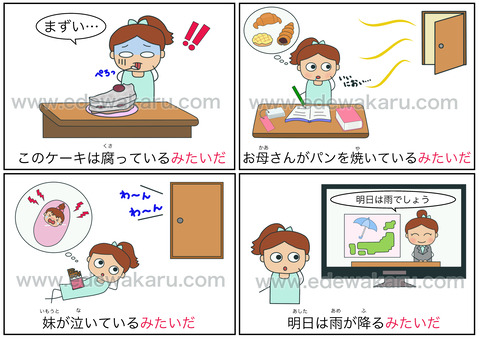
Meaning
Like ~
It feels like ~
I think probably ~
How to use it
Verb [plain form]+みたいだ
Adjective [plain form]+みたいだ
Noun [plain form]+みたいだ
In context 9 examples
このケーキは腐っているみたいだ(復習:〜ている(結果の状態))
This cake seems to be spoiled. (Review: 〜ている (resulting state))
お母さんがパンを焼いているみたいだ(復習:〜ている(進行中))
It seems Mom is baking bread. (Review: 〜ている (in progress))
妹が泣いているみたいだ
It seems my younger sister is crying.
明日は雨が降るみたいだ
It seems it will rain tomorrow.
あのラーメン屋さんは人気があるみたいだ
It seems that ramen shop is popular.
店員:今から15分間、タイムサービスでステーキが半額です!娘:お母さん、ステーキが安いみたいだよ!!!母:そうね、買いに行きましょう!(復習:タイムサービス・タイムセール)【説明】「〜みたいだ」は「〜の感じがする」という意味で使われる文型です。これは【五感推量(ごかんすいりょう)】を表す「〜ようだ」の口語的文型です。【五感推量の「〜ようだ」】とチェンジすることができます😊「〜ようだ」と同じように、【五感】を使って推量・判断している時に使われます。例文によっては、どの五感を使って判断したのかはっきりしない場合もよくあります😮(復習:〜ようだ(五感推量))(復習:〜によって(区別))[五感]視覚→「見て」判断嗅覚→「嗅いで」判断味覚 →「食べて」判断触覚→「触って」判断聴覚→「聞いて」判断[例]
Employee: For the next 15 minutes, steaks are half price as a special offer! Daughter: Mom, it seems the steaks are cheap!!! Mother: You’re right. Let’s go buy some! (Review: time service・time sale) [Explanation] 「〜みたいだ」 is a sentence pattern meaning “it feels like ~.” This is the colloquial form of 「〜ようだ」 expressing [sensory conjecture]. It can be substituted for 「〜ようだ」 expressing [sensory conjecture] 😊 As with 「〜ようだ」, it is used when making a conjecture or judgment based on the [five senses]. Depending on the example, it is often unclear which sense was used to make the judgment 😮 (Review: 〜ようだ (sensory conjecture)) (Review: 〜によって (distinction)) [Five senses] Sight → judge by “seeing” Smell → judge by “smelling” Taste → judge by “tasting” Touch → judge by “touching” Hearing → judge by “hearing” [Examples]
このケーキは腐っているみたいだ【味覚】ケーキをちょっと食べたら変な味がしたから「腐っている」と思った(復習:「味」と「におい」)(復習:〜がする)
This cake seems to be spoiled. [Taste] I tasted a little of the cake, and it tasted strange, so I thought, “It’s spoiled.” (Review: 「味」 and 「におい」) (Review: 〜がする)
お母さんがパンを焼いているみたいだ【嗅覚】パンのにおいがしたので「パンを焼いている」と思った③妹が泣いているみたいだ【聴覚】妹が泣いている声が聞こえたので「泣いている」と思った④明日は雨が降るみたいだ【視覚】ニュースを見て「明日は雨が降る」と思った【聴覚】ニュースを聞いて「明日は雨が降る」と思った⑤あのラーメン屋さんは人気があるみたいだ【視覚】ラーメン屋さんの前に人がたくさん並んでいるのを見て「人気がある」と思った【聴覚】友達に「人気があるんだよ」と聞いて「人気がある」と思った*この例文だけでは【視覚】を使ったのか【聴覚】使ったのかはわかりません
It seems Mom is baking bread. [Smell] I smelled bread, so I thought, “She’s baking bread.” ③ It seems my younger sister is crying. [Hearing] I heard my younger sister crying, so I thought, “She’s crying.” ④ It seems it will rain tomorrow. [Sight] I watched the news and thought, “It will rain tomorrow.” [Hearing] I heard the news and thought, “It will rain tomorrow.” ⑤ It seems that ramen shop is popular. [Sight] I saw lots of people lined up in front of the ramen shop and thought, “It’s popular.” [Hearing] I heard a friend say, “It’s popular,” and thought, “It’s popular.” *From this example alone, it is unclear whether [sight] or [hearing] was used.
店員:今から15分間、タイムサービスでステーキが半額です! 娘:お母さん、ステーキが安いみたいだよ!!!【聴覚】「ステーキが半額」と聞いて「安い」と思った【視覚】他のお客さんがステーキを買いに行くのを見て「安い」と思った*この例文では【聴覚】を使ったのか【視覚】使ったのかはわかりません日常会話では「〜ようだ」よりも「〜みたいだ」の方がよく使われます。とても大切な文型ですので、「〜ようだ」と一緒にしっかりと覚えておきましょう😉【関連文法】
Employee: For the next 15 minutes, steaks are half price as a special offer! Daughter: Mom, it seems the steaks are cheap!!! [Hearing] She heard that “steaks are half price” and thought they were cheap. [Seeing] She saw other customers go to buy steaks and thought they were cheap. *This example does not tell us whether [hearing] or [sight] was used. In everyday conversation, 「〜みたいだ」 is used more often than 「〜ようだ」. This is a very important sentence pattern, so learn it carefully along with 「〜ようだ」 😉 [Related grammar]
Read the original source text
Meaning
〜ようだ
〜の感じがする
たぶん〜と思う
How to use it
動詞[普通形]+みたいだ形容詞[普通形]+みたいだ名詞[普通形]+みたいだ
どんなときどう使う 日本語表現文型辞典
Usage 1
Meaning
just like
How to use it
N + みたいだS
Explanation
みたいだ〈比況〉
様子や状況を表すのに、よく似たものにたとえて言う言い方。 ❹ のように名詞以外につく例もある。
ム行みたいだ
Simile used to describe appearance or situation. Also appends to words other than nouns, as in sentence ❹ .
In context 4 examples
彼女の話し方は子どもみたいね。
The way she talks is like a child's.
あそこに見えるお城みたいな家にはどんな人が住んでいるの。
What kind of people live in that castle-like house you can see over there?
びわ湖は海みたいに大きい湖なんだよ。
Lake Biwa is a huge lake, like the sea.
今日は春が来たみたいな暖かさですね。
It's so warm today, like spring has come.
Read the original source text
Meaning
just like
How to use it
N+みたいだS
Explanation
みたいだ〈比況〉
様子や状況を表すのに、よく似たものにたとえて言う言い方。 ❹ のように名詞以外につく例もある。
ム行みたいだ
Simile used to describe appearance or situation. Also appends to words other than nouns, as in sentence ❹ .
Usage 2
Meaning
looks as if
How to use it
[plain form] (ナA / N) + みたいだS
Explanation
みたいだ〈推量〉
1)自分の感じや観察でそう推量したとき、または断定を避けて言うときに使う。「ようだ」の口語的言い方。
2)話をする人の意志的な行為の予測には使わない。
1)Conjecturing based on speaker's feelings or observations, or when avoiding firm declaration. Colloquial form of ようだ.
2)Not used for predictions about speaker's intentional actions.
In context 3 examples
わたし、なんだか風邪をひいたみたい。のどが痛いの。
I feel like I've caught a cold. My throat hurts.
あら、またバス代が値上がりするみたいよ。
Oh, it looks like bus fares are going up again.
うちの犬はボールがいちばん好きみたいだね。
It seems our dog likes balls best.
Read the original source text
Meaning
looks as if
How to use it
〔普通形〕(ナA/N)+みたいだS
Explanation
みたいだ〈推量〉
1)自分の感じや観察でそう推量したとき、または断定を避けて言うときに使う。「ようだ」の口語的言い方。
2)話をする人の意志的な行為の予測には使わない。
1)Conjecturing based on speaker's feelings or observations, or when avoiding firm declaration. Colloquial form of ようだ.
2)Not used for predictions about speaker's intentional actions.
日本語NET JLPT文法解説まとめ
Usage 1
Read this source entry ↗Meaning
“I think … / It feels like …”
An expression used to talk about what the speaker senses or surmises through the five senses.
How to use it
V (plain form) + みたいだ
い-adjective (plain form) + みたいだ
な-adjective + みたいだ
N + みたいだ
Explanation
“It seems like”
Expressions used by the speaker to convey what they have sensed and speculated using their five.
More casual than “〜ようだ,” and used when speaking with friends, family, and other people one is close to.
In context 11 examples
あそこで事故があったみたいです。
It seems there was an accident over there.
どうやら、車とバイクがぶつかったみたいです。
Apparently, a car and a motorcycle collided.
彼はお腹が空いているみたいです。
He seems to be hungry.
頭が痛いし、体も暑いし、熱があるみたいだ。
My head hurts and my body feels hot, so it seems I have a fever.
トムさんは最近、忙しいみたいだ。
Tom seems busy lately.
電源ボタンを押しても、つかないし、壊れているみたいだ。
It doesn't turn on even when I press the power button, so it seems to be broken.
二人は最近話さないし、別れたみたいだ。
The two of them haven't been talking lately, so it seems they've broken up.
トムさん、すごく嬉しそうだし、試験に合格したみたいだね。
Tom looks really happy, and it seems he passed the exam.
広場に有名人がいるみたいで、たくさん人が集まっている。
It seems there's a celebrity in the plaza, and lots of people have gathered.
あのレストランは人がたくさん並んでいるし、人気があるみたいです。
There's a long line at that restaurant, and it seems to be popular.
彼は昨日あまり寝てないみたいだ。
It seems he didn't sleep much yesterday.
Read the original source text
Meaning
"〜と思う / 〜の感じがする"
五感を使って話し手が感じたこと、推量したことを言う表現
How to use it
V(普通形) + みたいだ
イA(普通形)+ みたいだ
ナA + みたいだ
N + みたいだ
Explanation
"It seems like"
Expressions used by the speaker to convey what they have sensed and speculated using their five.
「〜ようだ 」よりもカジュアルで、友達や家族、親しい人と話す時に使う。
Usage 2
Read this source entry ↗Meaning
“It isn't actually that way, but it feels that way.”
A figurative expression that compares something to another thing. It is more casual than 「まるで〜ようだ」 and is used in conversation.
How to use it
まるで + N + みたいだ
まるで + N1 + みたいな + N2
まるで + N + みたいに + V / イA
Explanation
as if it were like / as if it were similar to
Used to like one thing to something else.
「まるで」 can also be omitted.
In context 12 examples
彼は日本人みたいに流暢な日本語を話す。
He speaks Japanese fluently, like a Japanese person.
息子はもう中学生なのに、一人で何もできないし、まるで赤ちゃんみたいだ。
My son is already in middle school, but he can't do anything by himself; he's just like a baby.
ジェームスさんは歌がすごく上手だし、歌手みたいだ。
James sings really well; he's like a professional singer.
このジュース、薬みたいな味がするよ。
This juice tastes like medicine.
二人は仲がいいし、まるで兄弟みたいだ。
The two of them are close, just like siblings.
今日は風が強くて、まるで台風みたいな天気だ。
It's windy today, and the weather is just like a typhoon.
娘さん、お人形みたいにかわいいね。
Your daughter is as cute as a doll.
まるで新品のみたいにピカピカだ。
It's sparkling like it's brand new.
このお酒、ジュースみたいで飲みやすい。
This alcohol is easy to drink, like juice.
わぁ、この石きれい。ダイヤモンドみたい。
Wow, this stone is beautiful. It's like a diamond.
マイケルさんの首は、キリンみたいに長い。
Michael's neck is as long as a giraffe's.
母は今、怒っていてと鬼みたいな顔をしている。
My mother is angry right now and has a face like a demon.
Read the original source text
Meaning
"実際はそうではないが、そのように感じる”
他の物に例える表現(比喩)。「まるで〜ようだ」よりもカジュアルで会話で使う。
How to use it
まるで + N + みたいだ
まるで + N1 + みたいな + N2
まるで + N + みたいに + V / イA
Explanation
as if it were like / as if it were similar to
Used to like one thing to something else.
「まるで」は省略して使うこともできる。
毎日のんびり日本語教師
How to use it
Verb plain form + みたいだ
い-adjective plain form + みたいだ
な-adjective stem + みたいだ
Noun + みたいだ
Explanation
There are three usages.
① Simile
「~みたいだ」 is placed at the end of a sentence. The clause following 「~みたいに」 takes a verb, and the clause following 「~みたいな」 takes a noun.
「まるで」 may also appear in the preceding part in correlation with it.
② Giving examples / listing
③ Conjecture
Indicates the speaker's subjective conjecture about something.
「どうやら」, 「どうも」, and similar words may also appear in the preceding part in correlation with it.
「みたい」 is used in spoken language. A somewhat more formal expression than 「みたい」 is 「ようだ/ように/ような」. They can be used interchangeably, but be careful, as they connect differently.
Notes
Related grammar: 「【N4 Grammar】~ようだ/ように/ような」
In context 15 examples
葬式みたいな話は聞きたくない。
I don't want to hear talk like it's a funeral.
彼の鼻はバナナみたいに長い。
His nose is long like a banana.
彼女は太陽みたいな人だ。
She is a person like the sun.
最近は子供みたいな大人が増えている。(最近像孩子一样的大人在增加。)
Lately, more and more adults who are like children are appearing.
毎日ゴミみたいな生活をしている。
I live the same kind of life as garbage every day.
兄みたいな人にはなりたくない。(我不想成为像哥哥一样的人。)
I don't want to become someone like my older brother.
あの人みたいに日本語を流暢に話せるようになりたい。
I want to become able to speak Japanese fluently like that person.
今年の誕生日も、去年みたいに盛大に祝ってほしい。(希望今年的生日也像去年一样盛大地庆祝。)
I want you to celebrate my birthday grandly this year too, like last year.
チョコレートみたいな甘い物は食べると気持ち悪くなる。
When I eat sweet things like chocolate, I feel sick.
数日前から風邪みたいな症状が続いている。
I've had cold-like symptoms for several days now.
あそこのお店はいつも行列ができていて、どうやら人気があるみたいだ。
There's always a line at that shop, so it seems to be popular.
彼は舌打ちが癖になっているみたいだ。(他好像变得爱咂嘴了。)
It seems he's developed a habit of clicking his tongue.
道が濡れてるし、雨が降ったみたいです。
The road is wet, so it seems to have rained.
あの二人は結婚したみたいだ。
It seems those two got married.
うちの猫ちゃんは私がいないと寂しいみたいだ。
It seems my kitty gets lonely when I'm not around.
Read the original source text
How to use it
動詞普通形+みたいだ
い形容詞普通形+みたいだ
な形容詞語幹+みたいだ
名詞+みたいだ
Explanation
3つの用法があります。
①比喩
「~みたいだ」は文末に置かれ、「~みたいに」の後件は動詞、「~みたいな」の後件は名詞が接続されます。
前項に「まるで」が呼応することもあります。
②例示・列挙
③推測
話し手の物事に対する主観的な推測を表します。
「どうやら」「どうも」等が前項に呼応することもあります。
「みたい」は話し言葉で用いられます。「みたい」よりもやや硬い表現に「ようだ/ように/ような」があります。お互い言い換えることはできますが、接続が異なるので注意が必要です。
Notes
関連文法「【N4文法】~ようだ/ように/ような」
日本語文型辞典 英語版
Meaning
【みたいだ】[N/Na/A/V みたいだ]A casual expression mainly used in speaking. In formal sentences or situations ようだ is used more commonly. It is unusual to replace ようだ in idiomatic expressions with みたいだ.
a. NみたいなN
When used in the form N1みたいなN2, N2 is described by giving an example of something (N1) to which it bears some resemblance.
Can be rephrased using N1のようなN
b. ...みたいだ[N/V みたいだ]
What the speaker felt about the condition, nature, form, or behavior of things is expressed by giving an easy-to-comprehend example of something which bears some resemblance to them. It can be replaced with ...ようだ. Many women omit the sentence-final だ in everyday conversation, as in example
(4)
. うそみたいだ means “(it’s) unbelievable” or “(I’m) very surprised.”
c. ...みたいに[N/A/V みたいに]
B:おいおい、そんな言い方をしたら、僕が授業をさぼってばかりいるみたいに聞こえるじゃないか。
Hey, when you talk like that, it sounds like I’m always skipping classes.
Used to show the condition, nature, form, or behavior of things by giving something similar as an example. Examples
(5)
and
(6)
imply “even though (that) is not the case....”
d. ...みたいなものだ[Nみたいなものだ][V-たみたいなものだ]
B:売ったというか、まあ、取られたみたいなものだ。借金の抵当にはいってたんだそうだよ。
Sold? Well, more like it was taken. Apparently it was used as collateral against a loan.
Means “(it) has still not actually happened but (it) is almost sure to” or “the situation is almost the same as....” In speech, もんだ is often used in place of ものだ.
B:誰だろう。近所の人じゃないみたいだね。
Hmm, I wonder. He doesn’t look like someone from around here.
B:来週みたいだよ。
It looks like next week.
B:みたいだね。
It would seem so.
B:ええ、きのう出発したみたいですよ。
Yeah, it seems she left yesterday.
B:うん、すごく怒ってるみたいだった。
Yeah, he seemed very angry.
Shows the speaker’s supposition. Means “(I) can’t be certain but (I) think it is so.” Expresses the speaker’s inference based on what they themselves have experienced, something they have seen, heard, or sensed.
In contrast to this, when expressing a supposition based on information gained indirectly, such as something heard from another person, らしい is used. When reporting something as it was heard from another, そうだ is used.
(例)山下さんは今日は来ないみたいですね(もう、時間も遅いし)。
It looks like Yamashita-san is not coming today (because the time is already late).
(例)山下さんは今日は来ないらしいですよ(直接きいたわけではないが、他の人がそう言っていた)。
It looks like Yamashita-san is not coming today (I haven’t heard this directly but somebody else was saying so).
(例)山下さんは今日は来ないそうです(山下さんから「行かない」という伝言があった)。
It looks like Yamashita-san is not coming today (I had a message from Yamashita-san saying she is not coming).
...みたいだ and ...みたいだった are both often used, but their meanings are different. As in the next example, V-たみたいだ concerns a thing which occurred in the past and shows the inferred outcome at the time of speaking.
(例)A:田中さんはいつ来たのかな?
I wonder when Tanaka-san arrived.
B:午前中は見かけなかったから、昼から来たみたいですよ。
I didn’t see him this morning and so he must have come after noon.
V-たみたいだった shows that the speaker thought something to be the case at a certain point in the past.
(例)昨日の夜は妙だった。誰か来たみたいだったから、ドアをあけてみたが、だれもいなかった。そんなことが何度もあった。
Last night was strange. Because I thought someone had come, I opened the door, but there was nobody there. That kind of thing has happened many times.
Also, when describing a situation as it is seen, for example, when there is a cake before your eyes, このケーキはおいしいみたいだ is not used. In such a case このケーキはおいしそうだ is used.
(例)A:これ、新しく買ったスマートフォンです。
This is my new smartphone.
(○)B:便利そうですね。
B:It looks handy.
(×)B:便利みたいですね。
B:It looks handy.
The そう that is used in such cases is different from the そう used to express hearsay and so care must be taken. When expressing hearsay we use おいしいそうだ(they say it is tasty) and 便利だそうだ (they say it is handy/convenient).
B:さあ、デパートみたいなところにはあるんじゃないかな。
Well, won’t they have them in places like department stores?
Used to give examples. Example
(1)
means “big cities such as Tokyo and Osaka, for example,” while
(2)
means “large shops like department stores, for example.”
Examples
(5)
,
(6)
, and
(7)
take the form of exemplifications but, in reality, they can be thought to mean the same as “because this summer was really hot, I didn’t like to work,” “you really are disorganized,” and “because he always does selfish things, eventually nobody will want anything to do with him.” In polite speech ...のような/ように is used.
How to use it
1. ...みたい〈simile〉Used to show a condition, nature, form, or behavior of things by giving something similar as an example. It is the same as よう. まるで/ちょうど...みたい can be used to emphasize extreme similarity. As あたかも, いかにも, and さながら are formal written expressions, they cannot be used with みたい.
2. Not to be confused with NらしいN, where N1=N
2. N1みたいなN2 only gives something which resembles N2 as an example and so N2 is not actually the thing denoted by N
1. For example, 男みたいな人 means that the person appears like a man but, in reality, is not a man. In contrast to this, 男らしい人 means that the person is very manly, or that masculine characteristics are prominent in that person, and it is used in reference to males.
2. ...みたいだ〈supposition, conjecture〉
3. ...みたい〈example〉[NみたいなN][Nみたいに]
In context 35 examples
この薬は、チョコレートみたいな味がする。
This medicine tastes like chocolate.
竹下さんって、あの学生みたいな人でしょ?
Takeshita-san is that guy who looks like a student, right?
いい年をして、子供みたいな服を着ないでほしいな。
At your age, I wish you wouldn’t wear such childish clothes.
飛行機みたいな形の雲が浮かんでいる。
There’s a cloud there that looks like an airplane.
すごい風だ。まるで台風みたいだ。
What a wind! It’s just like a typhoon.
君ってまるで子供みたいだね。
You’re just like a child.
その地方の方言に慣れるまでは、まるで外国語を聞いているみたいだった。
Until I got used to the dialect of that area, it was just like listening to a foreign language.
私が合格するなんてうそみたい。
That I have passed (the exam) seems unbelievable.
もう9月も半ばなのに、真夏みたいに暑い。
Even though it’s the middle of September, it’s hot like midsummer.
この服は、買って何年にもなるが、新品みたいにきれいだ。
It’s many years since I bought these clothes, but they look as good as new.
子供みたいにすねるのはやめろよ。
Stop sulking like a child.
こんなにうまいコーヒーが、一杯 100 円だなんて、ただみたいに安いね。
Having coffee this good for only 100 yen a cup—it’s so cheap it seems free.
私ばかりが悪いみたいに言わないでよ。あなただって悪いんだから。
Don’t speak as if only I was bad! You were bad, too!
A:学校ではあまり会わないね。
We don’t see you much at school.
僕の給料なんか、会社の儲けに比べたら、ただみたいなものさ。
When it comes to my salary, compared to the company’s profits, it’s like I’m working for free.
《野球をみながら》こんなに点差があけば、もう勝ったみたいなものだ。
《while watching baseball》With this kind of point spread, it’s like they’ve already won.
A:中田さん、店、売ったんだって?
Is it true that Nakata-san sold his shop?
誰も彼女の本名を知らないみたいだ。
It seems that nobody knows her real name.
田中さんは甘いものが嫌いみたいだ。
It seems that Tanaka-san dislikes sweet things.
どうもかぜをひいたみたいだ。
I might have caught a cold.
今度発売された辞書は、すごくいいみたいだよ。
The dictionary being launched now seems really good.
何か焦げているみたいだ。へんな匂いがする。
Something seems to be burning. There is a strange smell.
A:あの人誰?
Who is that?
A:試験はいつあるんだい。
When’s your exam?
A:あの人会社をやめたの?
Has that person quit the company?
A:小林さんはもうアメリカに行ったのかな?
Kobayashi-san has already gone to America, hasn’t she?
A:山本さん怒っていたでしょう?
Yamamoto-san was angry, wasn’t he?
そのときの佐々木さんはなんだか怖くて、いつもの彼ではないみたいだった。
Sasaki-san was kind of scary at that time. He didn’t seem like his usual self.
東京や大阪みたいな大都会には住みたくない。
I don’t want to live in a big city like Tokyo or Osaka.
A:三分間写真の機械って、どんなところにある?
What kind of place will have an instant photo booth?
何か細くて長い棒みたいな物はありませんか。
Do you have something long and thin like a pole?
佐藤さんみたいに英語が上手になりたい。
I want to become good at English like Sato-san.
今年みたいに暑いと、働くのが本当にいやになる。
When it’s as hot as this year, work really becomes a pain.
君みたいなあわて者、見たことがないよ。
I’ve never seen anyone as discombobulated as you.
彼みたいに勝手なことばかりしていると、そのうち誰も相手にしなくなる。
If he keeps on doing selfish things like he is now, eventually nobody will want to have anything to do with him.
文法
Usage 1
Meaning
“I think … / It feels like …”
An expression used to talk about what the speaker senses or surmises through the five senses.
How to use it
V (plain form) + みたいだ
い-adjective (plain form) + みたいだ
な-adjective + みたいだ
N + みたいだ
Notes
This is more casual than 「〜ようだ」 and is used when speaking with friends, family, and other people you are close to.
In context 11 examples
あそこで事故があったみたいです。
It seems there was an accident over there.
どうやら、車とバイクがぶつかったみたいです。
Apparently, a car and a motorcycle collided.
彼はお腹が空いているみたいです。
He seems to be hungry.
頭が痛いし、体も暑いし、熱があるみたいだ。
My head hurts and my body feels hot, so it seems I have a fever.
トムさんは最近、忙しいみたいだ。
Tom seems busy lately.
電源ボタンを押しても、つかないし、壊れているみたいだ。
It doesn't turn on even when I press the power button, so it seems to be broken.
二人は最近話さないし、別れたみたいだ。
The two of them haven't been talking lately, so it seems they've broken up.
トムさん、すごく嬉しそうだし、試験に合格したみたいだね。
Tom looks really happy, and it seems he passed the exam.
広場に有名人がいるみたいで、たくさん人が集まっている。
It seems there's a celebrity in the plaza, and lots of people have gathered.
あのレストランは人がたくさん並んでいるし、人気があるみたいです。
There's a long line at that restaurant, and it seems to be popular.
彼は昨日あまり寝てないみたいだ。
It seems he didn't sleep much yesterday.
Read the original source text
Meaning
"〜と思う / 〜の感じがする"
五感を使って話し手が感じたこと、推量したことを言う表現
How to use it
V(普通形) + みたいだ
イA(普通形)+ みたいだ
ナA + みたいだ
N + みたいだ
Notes
「〜ようだ 」よりもカジュアルで、友達や家族、親しい人と話す時に使う。
Usage 2
Meaning
“It isn't actually that way, but it feels that way.”
A figurative expression that compares something to another thing. It is more casual than 「まるで〜ようだ」 and is used in conversation.
How to use it
まるで + N + みたいだ
まるで + N1 + みたいな + N2
まるで + N + みたいに + V / イA
Notes
「まるで」 can also be omitted.
In context 12 examples
彼は日本人みたいに流暢な日本語を話す。
He speaks Japanese fluently, like a Japanese person.
息子はもう中学生なのに、一人で何もできないし、まるで赤ちゃんみたいだ。
My son is already in middle school, but he can't do anything by himself; he's just like a baby.
ジェームスさんは歌がすごく上手だし、歌手のみたいだ。
James is really good at singing, and he seems like a singer.
このジュース、薬みたいな味がするよ。
This juice tastes like medicine.
二人は仲がいいし、まるで兄弟みたいだ。
The two of them are close, just like siblings.
今日は風が強くて、まるで台風みたいな天気だ。
It's windy today, and the weather is just like a typhoon.
娘さん、お人形みたいにかわいいね。
Your daughter is as cute as a doll.
まるで新品のみたいにピカピカだ。
It's sparkling like it's brand new.
このお酒、ジュースみたいで飲みやすい。
This alcohol is easy to drink, like juice.
わぁ、この石きれい。ダイヤモンドみたい。
Wow, this stone is beautiful. It's like a diamond.
マイケルさんの首は、キリンみたいに長い。
Michael's neck is as long as a giraffe's.
母は今、怒っていてと鬼みたいな顔をしている。
My mother is angry right now and has a face like a demon.
Read the original source text
Meaning
"実際はそうではないが、そのように感じる”
他の物に例える表現(比喩)。「まるで〜ようだ」よりもカジュアルで会話で使う。
How to use it
まるで + N + みたいだ
まるで + N1 + みたいな + N2
まるで + N + みたいに + V / イA
Notes
「まるで」は省略して使うこともできる。
NINJAL 日本語文型データベース
Usage 1
Meaning
Used when the speaker wants to state a judgment or conjecture made at that point in time. It can be used even when the judgment or conjecture is not based on objective evidence. It is often used when the speaker gets that impression from their own subjective observation or intuition. It is also used to speak cautiously and avoid making a definite assertion.
At the end of a sentence, it may take the form 「~みたい。」 in casual spoken language.
How to use it
V plain form + みたいだ
i-A plain form + みたいだ
na-A plain form + みたいだ (however, 「na-Aだ」 → 「na-A + みたいだ」)
N plain form + みたいだ (however, 「Nだ」 → 「N + みたいだ」)
Notes
It is not normally used in the past or negative form.
It is not used to make judgments or conjectures about the speaker’s own intentional actions.
In context 22 examples
「ずっと向こうで花火をやっているみたいだね。ときどき夜空が明るく光る」
“It looks like there are fireworks going off way over there. The night sky lights up from time to time.”
この薬はあまり効かないみたいなので、別の薬に替えてもらいたいです。
This medicine doesn’t seem to work very well, so I’d like to switch to another one.
あ、道、間違えたみたい。さっきのところに戻ろう。
Oh, it looks like we took a wrong turn. Let’s go back to where we were before.
ここ、蚊に刺されたみたいだ。かゆい。
Oh, it looks like a mosquito bit me here. It itches.
「あの学校のサッカー部、今年は優勝できなかったみたいですよ。残念でしたね」
“It seems that the soccer team at that school didn’t win the championship this year. What a shame.”
明日の雨は相当強いみたいだなあ。出勤、大丈夫かなあ。
It looks like tomorrow’s rain will be quite heavy. I wonder if I’ll be able to get to work.
この子は動くおもちゃがほしいみたいなので、おもちゃ屋に連れて行って、自分で選ばせよう。
This child seems to want a moving toy, so let’s take them to the toy store and have them choose one themselves.
「えーっと、この計算は正しくないみたいですよ。もう一度計算してみてもらえますか」
“Um, this calculation doesn’t seem to be right. Could you try calculating it one more time?”
この映画は、ところどころ子どもには怖かったみたいです。
This movie seems to have been scary for children in some parts.
どうやら私が作った料理はあまりおいしくなかったみたいだ。みなさん、残している。
Apparently, the food I made wasn’t very tasty. Everyone is leaving some.
「あの、昨日は私、冷静じゃなかったみたいで、言い過ぎました。ごめんなさい」
“Um, I don’t think I was very calm yesterday, and I said too much. I’m sorry.”
うちの子は算数が苦手みたいです。よく間違えます。
My child seems to be bad at arithmetic. They often make mistakes.
あの人、最近あまり元気じゃないみたいで、心配です。
That person doesn’t seem very well lately, and I’m worried.
「ミーちゃん、このキャットフードは食べないね。あんまり好きじゃないみたい」
“Mi-chan, you’re not eating this cat food. It seems you don’t like it very much.”
「サッカー練習はかなり大変だったみたい。ひろし、帰ってきてすぐ寝てたよ」
“Soccer practice seems to have been really tough. Hiroshi went straight to bed as soon as he got home.”
「あの報告書でよかったのかなあ」「ええ、大丈夫だったみたいですよ。クレームはありませんでしたから」
“I wonder if that report was all right.” “Yes, it seems to have been fine. We didn’t receive any complaints.”
どうやら、あの人が店長みたいだ。話しかけてみよう。
Apparently, that person is the store manager. I’ll try talking to them.
あれ、いつの間にか外は雪みたい。
Oh, it looks like it’s snowing outside before I knew it.
今日はリサイクルゴミの日じゃないみたいだ。誰も出していない。
It seems today isn’t recycling day. No one has put anything out.
「電話、誰からだったの」「間違いだったみたい。すぐ切っちゃった」
“Who was the phone call from?” “It seems it was a wrong number. I hung up right away.”
あ、ここは行き止まりか。この道じゃなかったみたいだ。
Oh, it’s a dead end here. It seems this wasn’t the right road.
「え、美香、会社やめたの?」「そうらしいよ。なんか、思ったような仕事じゃなかったみたいで、すごく悩んでたの」
“What, Mika quit her job?” “Apparently. It seems the work wasn’t what she expected, and she was really troubled.”
Read the original source text
Meaning
話し手がその時点で判断・推量したことを言いたいときに使います。特に客観的な根拠があって判断・推量したことでなくても使えます。話し手自身の主観的観察や直感でそう感じた場合などに使うことが多いです。また、はっきり断定するのを避けて、遠慮した言い方をするときにも使います。
文末に使う場合、くだけた話し言葉では「~みたい。」という形になることもあります。
How to use it
V普通形+みたいだ
i-A普通形+みたいだ
na-A普通形+みたいだ(ただし、「na-Aだ」→「na-A+みたいだ」)
N普通形+みたいだ(ただし、「Nだ」→「N+みたいだ」)
Notes
ふつう、過去形や否定形にはしません。
話し手自身の意志的な行為の判断・推量には使いません。
Usage 2
Meaning
Used to describe the form, nature, appearance, and so on of something by comparing it to something similar, making it easier to picture.
How to use it
V plain form + みたいだ
N みたいだ
Notes
It changes forms like a na-adjective, as in 「~みたいではない・~みたいだった・~みたいで・~みたいな・~みたいに」. 「〜みたいな」 modifies the noun that follows. 「〜みたいに」 modifies the verb or adjective sentence that follows.
In context 15 examples
宝くじで1000万円当たった。まだ夢を見ているみたいだ。
I won 10 million yen in the lottery. It still feels like I’m dreaming.
飛行機が乱気流に突入したとき、まるでジェットコースターに乗っているみたいだった。
When the plane entered turbulence, it was just like riding a roller coaster.
電車に乗っていると、その音や揺れがちょうど母親のおなかの中にいるみたいで、気持ちがよくなって眠くなってしまうらしい。
Apparently, when riding a train, its sounds and rocking feel just like being inside one’s mother’s womb, making you feel so good that you get sleepy.
その男からは、何日も風呂に入っていないみたいな匂いがした。
The man smelled as if he hadn’t bathed in days.
引越してきてからもう何か月もたっているのに、まるで今日引越してきたみたいに家の中がちらかっている。
Even though it’s already been months since I moved in, the house is a mess, as if I had moved in today.
夫は子どもが生まれてから人が変わったみたいに朝早く起きるようになりました。
Since our child was born, my husband has started getting up early, as if he were a different person.
家に帰ると、うちの犬が、まるで何日も会わなかったみたいにしっぽを振って大歓迎してくれた。
When I got home, our dog wagged its tail and gave me a huge welcome, as if we hadn’t seen each other for days.
ここから見る富士山はまるで絵画みたいだ。
Mount Fuji as seen from here looks just like a painting.
「愛ちゃん、その服を着ると、アイドルみたいだね」
“Ai, you look like an idol in that outfit.”
展望台から見ると、ビルの下を走る車はまるでミニカーみたいです。
From the observation deck, the cars running below the buildings look just like toy cars.
結婚式での父の燕尾服姿は、まるで太ったペンギンみたいだった。
My father in his tailcoat at the wedding looked just like a fat penguin.
事故の現場は、まるで地獄絵図みたいで恐ろしかった。
The accident scene was terrifying, like a picture of hell.
まだ5月なのに、こちらは初夏を通り越して真夏みたいな暑さです。
It’s only May, but here it’s so hot, like midsummer after skipping early summer.
テレビゲームをしているときの父は、いつも子どもみたいにはしゃいでいます。
When my father plays video games, he always gets excited like a child.
娘は希望の大学に入れなくて、もうこの世の終わりみたいにしょんぼりしている。
My daughter couldn’t get into the university she wanted, and she’s moping as if it were the end of the world.
Read the original source text
Meaning
物事の形・性質・様子などがイメージしやすいように、よく似た何かにたとえて表現するときに使います。
How to use it
V普通形+みたいだ
Nみたいだ
Notes
「~みたいではない・~みたいだった・~みたいで・~みたいな・~みたいに」などのように、ナ形容詞と同じ形に変化します。「〜みたいな」は後にくる名詞を説明します。「〜みたいに」は後にくる動詞文、形容詞文を説明します。
IMABI
Similarity
Read this IMABI lesson ↗Explanation
Similarity: ~ようだ & ~みたいだ
Though these phrases have a common theme, their grammar and usages do vary significantly. So, please be sure to not rush through them even if you’ve seen them show up many times in your studies thus far.
~ようだ
様 is a noun that literally means “appearance”. ~ようだ is a 形容動詞 conjugating ending that comes from it, and it has many applications.
~ようだ
Overall, ~ようだ is like “like” or “seem”. よう is a noun itself, so when used after nouns, precede it with の. When after 形容動詞, use な!
1. 僕の犬は言葉が分かるようだよ。
My dog seems to understand words!
2. 爬虫類はちゅうるいのようで、実は、哺乳類ほにゅうるいだ。
It looks like a reptile but in reality is a mammal.
漢字 Note: 爬 and 哺 are rare. So, you don’t need to worry about them.
3. すこし塩辛しおからいようですね。
It’s kind of salty, don’t you think?
Word Note: 辛い is often used to mean “salty” in West Japan. The word 塩っぱい also exists. In this word, 塩 is pronounced as しょ.
4. どうも壊こわれているようだ。
Presumably, it’s broken.
5. みな元気なようです。
Everyone seems fine.
6. 彼はとても悲しんでいるようです。
He seems to be very sad.
7.何か隠かくしているようです。
He appears to be hiding something.
8. あの人を見たような気がしました。
I felt like I saw that person before.
9. ちょっと怒おこったように聞こえた。
I heard her like she was a little angry.
10. ステーキかまたはそれと同じようなものを食べる。
To eat steak or something just like it.
11. 彼は、何も言いたくないような、押おし黙だまった表情をしてる。
He’s reticent as if he doesn’t want to say anything.
12. 彼は、何も言いたくないようで、ぶすっとしてる。
He’s in a bad mood not saying anything.
13. 難しかったようです。
It looks like it was difficult.
14. 対策もなく、俎板まないたの鯉こいのようなものだ。(Idiomatic)
It’s basically a hopeless situation without a countermeasure.
まるで & ~かのようだ
~ようだ is also often paired with まるで to make “just like”, and when used with the particle か, it creates “as if”.
15. マイクさんはまるで天使のような人ですね。
Isn’t Mike just like an angel?
16. まるで人でも殺したかのように、ぼうぜんとしてる。
He’s dumbfounded as if he’s killed a person.
17. 彼の病気はまるで神様が治してくれたかのようにきれいに消えましたよ。
His sickness disappeared as if it was by God.
18. 地に膝ひざをつくかのように木が風に揺ゆれていた。
The trees swayed in the wind as if they knelled to the ground.
~よう{なら・だったら}
~よう{なら・だったら} euphemizes a supposition.
19. この治療ちりょう{手当て・処置しょち}で治らないようだったら病院に行ってくださいね。
If you don’t get better with this medical treatment, please go to the hospital, OK?
The Noun よう
The noun よう may be after the 連用形 of verbs to show appearance or method. It can also function as a nominalizer.
20. 言おう様ない (Rare) = 言い様のない
Indescribable
21. その苦しみようは見ていられない。
I can’t stand watching that miserable condition (of that man).
~みたいだ
~みたいだ is for the most part a more casual variant of よう for comparison, but since it does come from 見る (to see), it shows that something “resembles…”. It acts as a 形容動詞. So, you can see ~みたいな (adjectival) and ~みたいに (adverbial). The negative should be ~ないみたいだ. but in slang you may still see ~みたくない.
22. 兄は侍さむらいみたいな人だね。
My older brother is like a samurai.
23. 真まっ暗で雨が降ったみたいだ。
It was like rain had fallen in pitch black.
24. ガムみたいに伸びるものだ。
It’s a thing that stretches like gum.
25. もう売り切れみたい。
It looks like it’s already sold out.
26. 誰もいないみたいだが。
It seems that nobody is here, but…
27. 夢みたいな話だ。
That’s a story resembling a dream.
28. 壁かべは紙みたいに薄うすいよ。
The walls are thin like paper.
29. 味がすこし薄いみたいです。
The taste seems to slightly be weak.
Origin Note: ~みたい comes from ~みた様, which can still be seen in literature.
In context 29 examples
僕の犬は言葉が分かるようだよ。
My dog seems to understand words!
爬虫類はちゅうるいのようで、実は、哺乳類ほにゅうるいだ。
It looks like a reptile but in reality is a mammal.
すこし塩辛しおからいようですね。
It’s kind of salty, don’t you think?
どうも壊こわれているようだ。
Presumably, it’s broken.
みな元気なようです。
Everyone seems fine.
彼はとても悲しんでいるようです。
He seems to be very sad.
何か隠かくしているようです。
He appears to be hiding something.
あの人を見たような気がしました。
I felt like I saw that person before.
ちょっと怒おこったように聞こえた。
I heard her like she was a little angry.
ステーキかまたはそれと同じようなものを食べる。
To eat steak or something just like it.
彼は、何も言いたくないような、押おし黙だまった表情をしてる。
He’s reticent as if he doesn’t want to say anything.
彼は、何も言いたくないようで、ぶすっとしてる。
He’s in a bad mood not saying anything.
難しかったようです。
It looks like it was difficult.
対策もなく、俎板まないたの鯉こいのようなものだ。(Idiomatic)
It’s basically a hopeless situation without a countermeasure.
マイクさんはまるで天使のような人ですね。
Isn’t Mike just like an angel?
まるで人でも殺したかのように、ぼうぜんとしてる。
He’s dumbfounded as if he’s killed a person.
彼の病気はまるで神様が治してくれたかのようにきれいに消えましたよ。
His sickness disappeared as if it was by God.
地に膝ひざをつくかのように木が風に揺ゆれていた。
The trees swayed in the wind as if they knelled to the ground.
この治療ちりょう{手当て・処置しょち}で治らないようだったら病院に行ってくださいね。
If you don’t get better with this medical treatment, please go to the hospital, OK?
言おう様ない (Rare) = 言い様のない
Indescribable
その苦しみようは見ていられない。
I can’t stand watching that miserable condition (of that man).
兄は侍さむらいみたいな人だね。
My older brother is like a samurai.
真まっ暗で雨が降ったみたいだ。
It was like rain had fallen in pitch black.
ガムみたいに伸びるものだ。
It’s a thing that stretches like gum.
もう売り切れみたい。
It looks like it’s already sold out.
誰もいないみたいだが。
It seems that nobody is here, but…
夢みたいな話だ。
That’s a story resembling a dream.
壁かべは紙みたいに薄うすいよ。
The walls are thin like paper.
味がすこし薄いみたいです。
The taste seems to slightly be weak.