日本語文型辞典 英語版
Meaning
【をのぞいて】[Nをのぞいて(は)]
Means “with that as an exception.” It is a written expression. In speech ...をのぞけば or ...のほかは are often used.
In context 4 examples
山田さんをのぞいて、みんな来ています。
Everyone is coming except Yamada-san.
火曜日をのぞいて(は)だいたいあいています。
We are generally open apart from on Tuesdays.
その国は、真冬の一時期をのぞいて(は)だいたい温暖な気候だ。
Apart from in midwinter, that country has a generally warm climate.
全体的には、この問題を除いて、ほぼ解決したと言ってよいだろう。
On the whole, apart from this problem, I think we can say it is settled.
IMABI
Exception
Read this IMABI lesson ↗Explanation
Exception: ~をのぞいて, ~をおいて, & ~ならでは
These phrases limit things as exceptions in their own unique ways.
~のぞいて
After a noun phrase of some sort, ~除いて is used to mean “except…” and is often left in ひらがな. It is a general phrase and will differ with the emotive power of the following grammar point ~をおいて. The verb 除く can mean “to remove/exclude”, and “exclude” can also be expressed with the verb 除外じょがいする, which is of the vein of “to set aside/rule out”.
1. 一隻いっせきを除いて艦船かんせんは全部沈しずんだ。
Except for one vessel, all of the carriers sank.
2. きのう、暑かったことをのぞいて、僕らは楽しいときを過ごした。
Yesterday, except it being hot, we had a good time.
3. 私は除いてください。
Please include me out.
4. 私は報道記者と政治家を除く全ての人々が平等であると信じている。
I believe it in the equality of all people except reporters and politicians.
5. 北部をのぞいて、お天気はよかったですよ。
The weather was good except in the north.
6. わたしを除いて全ての人がそれを知っていたそ。
Except me, it seems that everyone knew about it.
7. 女性は調査対象ちょうさたいしょうから除外することになった。
It was decided that women were to be taken out of the inquiry subjects.
Variant Note: In more formal literary fashion, this can also be seen as ~のぞき.
8. 政府の規制改革会議きせいかいかくかいぎが全面的ぜんめんてきな解禁かいきんを求めている、インターネットを使った市販薬しはんやくの販売について、菅官房長官かんかんぼうちょうかんや田村厚生労働大臣たむらこうせいろうどうだいじんら関係4閣僚かくりょうは、副作用ふくさようのリスクの評価が終わっていない、ごく一部の市販薬を除き、大半たいはんを解禁する方向で調整ちょうせいを進める見通しです。
In regards to the all-round band lift of the sale of over-the-counter drugs using the internet that a government regulation reform meeting is seeking, Chief Cabinet Secretary Kan, Prime Minister Tamura of the Ministry of Health, Labor and Welfare, and four other bureaucrats in connection are forecast to further the coordination in the direction of lifting the ban in large part with exception to a small amount of over-the-counter drugs of which the evaluation of side-effect risks is not over.
From NHK on June 4, 2013.
Warning Note: Do not confuse this with the verb 覗く, which means to “to peep/take a look at” and has the same pronunciation.
~をのぞいて VS ~以外
This is very similar to ~以外. One thing to notice, though, is that ~以外 is a suffix, and as seen below, the phrase is more affirmative and somewhat more formal sounding.
9. 九州以外のどこも地震が発生した。
With exception of Kyushu, earthquakes occurred everywhere.
10. これ以外に方法はありませんよ。
There is no method other than this.
~をおいて
~をおいて means “apart from”. This phrase is used to highly evaluate something or someone. So, it’s a good thing. There is always something like ほかに…(い)ない after it. When you are generally saying “aside from”, use ~を除いて. Like ~除いて, ~をおいて is used after noun phrases.
This phrase originally showed a meaning of “without emphasizing A as something important, one treats A as being useless and throws it out/places it to the side/separates it apart/removes it. In this sense, Aをおいてほかに(い)ない becomes a double negative expression, which then makes it an extremely powerful affirmative statement of A being number one.
In Japanese it is usually the case that very powerful expressions are kept in the written language, and although this is the case for をおいて, in rather formal situations, it can be used to declare one’s top recommendation. It doesn’t necessarily have to be in formal situations; however, as the first example sentence demonstrates clearly.
Examples
11. 君をおいて適任者てきにんしゃはいないぞ!
Apart from you there’s no responsible person!
12. 頼れるのは彼女をおいてほかにない。
There is no one to rely apart from her.
13. これをおいてほかに方法はなかった。
There was no way but this.
14. それはさておき・それはさておいて
Aside from that
15. 九州と四国を除いてそこかしこで東日本大震災は多数の死者を出して大災害が発生する結果となりました。
Apart from Kyushu and Shikoku, no matter where there are many deaths and major catastrophes have occurred in the Tohoku-Kanto Earthquake Catastrophe.
~別 VS ~をおいて
The following paraphrases with 別 is used rather than ~をおいて because the situation is not one of pointing out as the best but something that should be treated separately.
16a. 震度7 は別として、釜石市には津波が押し寄せました。
16b. 震度7度の地震とは別に、津波が釜石市を襲おそった。
Apart from a 7 earthquake, Kamaishi City got flooded by a tsunami.
Word Note: The 震度 system is on a different scale than the Richter scale.
~ならでは
~ならでは is one of those instances where classical grammar holds on strong. The なら in this expression, like the particle なら comes from the 未然形 of the Classical Japanese copular verb なり. It is then followed by a classical usage of で, which is not related to the contraction of にて. In this case, it is the contraction of ~ずて, which is equivalent to ~なくて. は, here, is here for contrastive purposes. If the pattern were translated into something solely Modern Japanese, it would be equivalent to ~でなくては・~でなければ.
This pattern is used to express the brilliance/wonderfulness of something by claiming that only it is as such. In the unabbreviated state of a sentence with it, a complementing verbal/adjectival phrase follows, but this can be omitted out if that phrase is being used as an attribute by replacing it with の, giving ~ならではの, which is the more common form of the pattern.
The entire phrase, which is “AならではBない(C )” is, then, equivalent to expressions such as “AであってはじめてB” and “AだからこそB”. In the case that A is a commonplace noun, ~ならでは is of the sense of the former coming from the position of societal wisdom/common sense. However, when A is particular, it shows that only A can do C.
Examples
17. 君ならではできないことだよ!
Without you, this cannot be done!
18. それ、中国の方ならでは{できない・の}ものの考え方ですよ。
That is only a matter of thought possibly by a person from China.
19. それって、大阪弁ならでは{ありえない・の}人当たりのよさですね。
That is charm only that of Osaka Dialect, isn’t it?
20. 社長しゃちょうならではの発想はっそうですね。
This can only be a conception of the company president, isn’t it?
21. この教科書きょうかしょならではの特徴とくちょうです。
This is a characteristic only in this textbook.
22. 50年続いた老舗ならでは出せないこの味の良さ!
The goodness of this flavor that only an old shop for 50 years can offer!
23. この体験は沖縄ならではですよ。
This experience can only be in Okinawa!
Grammar Note: As you can see, another exceptional thing about ~ならでは is that it can be followed by ~です with the rest of the pattern omitted.
24. さすが一流レストランのシェフならでは{出せない・の}味ですね。
This is as expected flavor that can only be from a first rate restaurant chef.
Phrase Note: さすが, which is an adverb that shows something as something to be expected, is frequently used with ~ならでは.
In context 25 examples
一隻いっせきを除いて艦船かんせんは全部沈しずんだ。
Except for one vessel, all of the carriers sank.
きのう、暑かったことをのぞいて、僕らは楽しいときを過ごした。
Yesterday, except it being hot, we had a good time.
私は除いてください。
Please include me out.
私は報道記者と政治家を除く全ての人々が平等であると信じている。
I believe it in the equality of all people except reporters and politicians.
北部をのぞいて、お天気はよかったですよ。
The weather was good except in the north.
わたしを除いて全ての人がそれを知っていたそ。
Except me, it seems that everyone knew about it.
女性は調査対象ちょうさたいしょうから除外することになった。
It was decided that women were to be taken out of the inquiry subjects.
政府の規制改革会議きせいかいかくかいぎが全面的ぜんめんてきな解禁かいきんを求めている、インターネットを使った市販薬しはんやくの販売について、菅官房長官かんかんぼうちょうかんや田村厚生労働大臣たむらこうせいろうどうだいじんら関係4閣僚かくりょうは、副作用ふくさようのリスクの評価が終わっていない、ごく一部の市販薬を除き、大半たいはんを解禁する方向で調整ちょうせいを進める見通しです。
In regards to the all-round band lift of the sale of over-the-counter drugs using the internet that a government regulation reform meeting is seeking, Chief Cabinet Secretary Kan, Prime Minister Tamura of the Ministry of Health, Labor and Welfare, and four other bureaucrats in connection are forecast to further the coordination in the direction of lifting the ban in large part with exception to a small amount of over-the-counter drugs of which the evaluation of side-effect risks is not over.
九州以外のどこも地震が発生した。
With exception of Kyushu, earthquakes occurred everywhere.
これ以外に方法はありませんよ。
There is no method other than this.
君をおいて適任者てきにんしゃはいないぞ!
Apart from you there’s no responsible person!
頼れるのは彼女をおいてほかにない。
There is no one to rely apart from her.
これをおいてほかに方法はなかった。
There was no way but this.
それはさておき・それはさておいて
Aside from that
九州と四国を除いてそこかしこで東日本大震災は多数の死者を出して大災害が発生する結果となりました。
Apart from Kyushu and Shikoku, no matter where there are many deaths and major catastrophes have occurred in the Tohoku-Kanto Earthquake Catastrophe.
震度7 は別として、釜石市には津波が押し寄せました。
Apart from a 7 earthquake, Kamaishi City got flooded by a tsunami.
震度7度の地震とは別に、津波が釜石市を襲おそった。
Apart from a 7 earthquake, Kamaishi City got flooded by a tsunami.
君ならではできないことだよ!
Without you, this cannot be done!
それ、中国の方ならでは{できない・の}ものの考え方ですよ。
That is only a matter of thought possibly by a person from China.
それって、大阪弁ならでは{ありえない・の}人当たりのよさですね。
That is charm only that of Osaka Dialect, isn’t it?
社長しゃちょうならではの発想はっそうですね。
This can only be a conception of the company president, isn’t it?
この教科書きょうかしょならではの特徴とくちょうです。
This is a characteristic only in this textbook.
50年続いた老舗ならでは出せないこの味の良さ!
The goodness of this flavor that only an old shop for 50 years can offer!
この体験は沖縄ならではですよ。
This experience can only be in Okinawa!
さすが一流レストランのシェフならでは{出せない・の}味ですね。
This is as expected flavor that can only be from a first rate restaurant chef.
絵でわかる日本語
Usage 1
Read this source entry ↗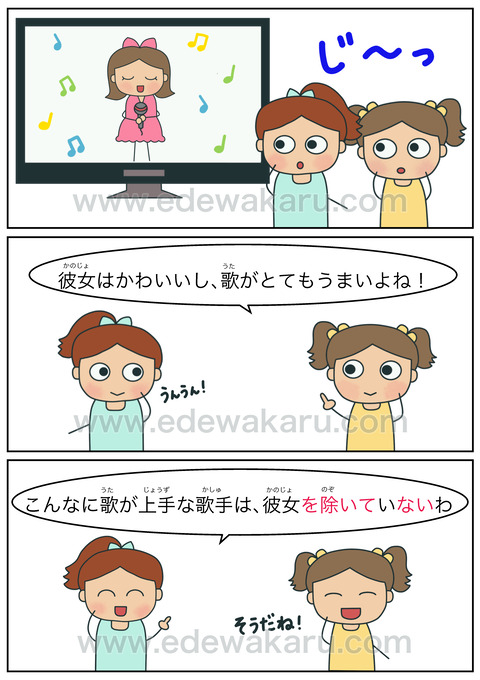
Meaning
there is no one besides ... who can ...
there is nothing suitable besides ...
How to use it
Noun [dictionary form] + を除いて〜ない
In context 5 examples
A:彼女はかわいいし、歌がとてもうまいよね!B:うん!こんなに歌が上手な歌手は、彼女を除いていないわ
→彼女以外に歌が上手に歌える人はいないA: She’s cute, and she sings really well! B: Yeah! There’s no singer who sings as well as she does. →There’s no one besides her who can sing so well.
彼を除いて、あれほど勉強ができる人はいない
→彼以外に、あれほど勉強ができる人はいないThere is no one besides him who can study as well as that.
田中さんを除いて、この仕事を任せられる人はいるまい…
→田中さん以外に、この仕事を任せられる人はいないThere’s probably no one besides Tanaka who can be entrusted with this job… →There’s no one besides Tanaka who can be entrusted with this job.
彼女:この式場を除いて、結婚式をするのに最適な場所はないわ!彼氏:そうだね。じゃあ、ここに決めよう!
→この式場以外に、結婚式をするのに最適な場所はないわ!Girlfriend: There’s no place more suitable for a wedding than this venue! Boyfriend: You’re right. Let’s choose this place! →There’s no place more suitable for a wedding than this venue!
彼女:あなたを除いて頼める人はいなかったの彼氏:ほかならぬ君のためなら何でもするさ
→あなた以外に頼める人はいなかったの【説明】「Aを除いて〜ない」は「A以外に、〜できる人はいない」「A以外にふさわしいものはない」という意味の文型です。「A」を高く評価する文型で、「 A以外に適当な[人・もの・こと]はない」「Aのほかに、同じくらいすばらしい[人・もの・こと]はない」と言いたい時に使われます。「〜を除いて、ほかに〜ない」という形もよく使われます。[例]こんなに歌が上手な歌手は、彼女を除いていないわ=こんなに歌が上手な歌手は、彼女を除いてほかにいないわ類似文型に「〜をおいて」がありますので、一緒に覚えておきましょう。【関連文型】Girlfriend: There was no one besides you I could ask. Boyfriend: For your sake, I’d do anything. →There was no one besides you I could ask. [Explanation] “Aを除いて〜ない” is a grammar pattern meaning “There is no one besides A who can ...” or “There is nothing suitable besides A.” It praises A and is used when you want to say “There is no suitable [person/thing/matter] besides A” or “There is no one/thing/matter as wonderful as A.” The form 〜を除いて、ほかに〜ない is also often used. [Example] There’s no singer who sings as well as she does. = There’s no other singer who sings as well as she does. The similar pattern 〜をおいて is also worth learning together. [Related patterns]
Read the original source text
Meaning
〜以外に〜できる人はいない
〜以外に適当なものはない
How to use it
名詞[辞書形]+を除いて〜ない
Usage 2
Read this source entry ↗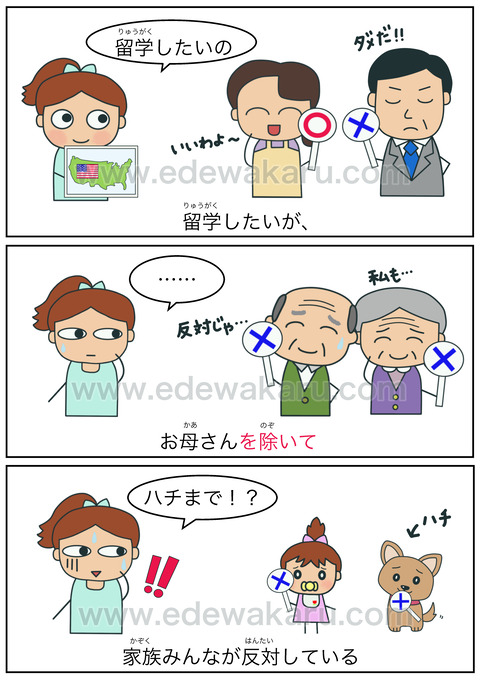
Meaning
other than ...
excluding ...
How to use it
Noun [dictionary form] + を除いて
Explanation
“Aを除いて” is a grammar pattern meaning “other than A” or “with A as an exception.” It is used to exclude A.
〜を除き is a more formal expression than 〜を除いて and can be substituted for it.
[Example]
All items are half price, except for selected items.
= All items are half price, except for selected items.
There is also the grammar pattern 〜を除いて〜ない, so let’s learn it together 😊
[Related patterns]
In context 5 examples
留学したいが、お母さんを除いて家族みんなが反対している
→お母さん以外、家族みんなが反対しているI want to study abroad, but everyone in my family except my mother is against it. →Everyone in my family other than my mother is against it.
彼は日曜日を除いて毎日働いている
→日曜日以外、毎日働いているHe works every day except Sunday. →He works every day other than Sunday.
A:全員揃った?B:山田くんを除いて、みんな来ているよ
→山田くん以外、みんな来ているよA: Is everyone here? B: Everyone except Yamada is here. →Everyone other than Yamada is here.
彼氏:予定が空いている日ってある?彼女:土曜日を除いて、いつでも空いてるよ〜
→土曜日以外、いつでも空いてるよ〜Boyfriend: Are there any days when you’re free? Girlfriend: I’m free any time except Saturday~ →I’m free any time other than Saturday~
一部商品を除いて、全ての商品が半額になっております一部商品を例外として、全ての商品が半額になっております
All items are half price except for selected items. All items are half price, with selected items as the exception.
Read the original source text
Meaning
〜以外
〜を除外して
How to use it
名詞[辞書形]+を除いて
Explanation
「Aを除いて」は「A以外」「Aは例外として」という意味の文型です。これはAを除外することを表す時に使われます。
「〜を除き」
は「〜を除いて」のかたい言い方で、チェンジすることができます。
[例]
一部商品
を除いて、全ての商品が半額になっております
=一部商品
を除き、全ての商品が半額になっております
「〜を除いて〜ない」という文型もありますので、一緒に覚えておきましょう😊
【関連文型】
日本語文型辞典
Meaning
Basic information: Nをのぞいて(は). Means “with that as an exception.” A written-style expression; in speech, “-をのぞけば” or “…のほかは” is more commonly used. Examples: ① Everyone is on board except Mr. Yamada. ② I’m generally free except on Tuesdays. ③ The country generally has a mild climate except for a short period in midwinter. ④ Overall, it would be fair to say that everything has been more or less resolved except for this problem.
Read the original source text
Meaning
基本情報Nをのぞいて(は)説明「それを例外として」という意味を表す。書きことば的で、話しことばでは「-をのぞけば」や「…のほかは」の方をよく使う。例文① 山田さんをのぞいて、みんな乗ています。② 火曜日をのぞいて(は)だいたいあいています。③ その国は、真冬の一時期をのぞいて(は)だいたい温暖な気候だ。④ 全体的には、この問題を除いて、ほぼ解決したと言ってよいだろう。
毎日のんびり日本語教師
How to use it
Noun + を除いて/を除き
Explanation
It expresses excluding some elements from a certain range.
Notes
Nothing in particular.
In context 8 examples
館内は一部を除き撮影できます。
Photography is permitted inside the building, with some exceptions.
館内では喫煙室を除き全面禁煙となっております。皆様のご理解とご協力をお願いします。
Smoking is prohibited throughout the building except in the smoking room. We ask for your understanding and cooperation.
当店では今月末まで、一部商品を除き50%OFFでお買い求めいただけます。
Until the end of this month, you can purchase items at our store at 50% off, with some exceptions.
明日は関東地方を除き、天気が崩れます。
Tomorrow, the weather will deteriorate except in the Kanto region.
一部の列車を除き、車内での飲食は原則禁止です。
As a rule, eating and drinking on board is prohibited, with some trains excepted.
ウサギは睡眠時間を除き、常に食事を行う動物です。
Rabbits are animals that eat almost constantly, except when they are sleeping.
彼を除いて、全員来ています。
Everyone has arrived except him.
休業日を除き、頂いたメールへの返信は即日行なっております。
We reply to emails we receive on the same day, except on days when we are closed.
Read the original source text
How to use it
名詞+を除いて/を除き
Explanation
ある範囲から一部の要素を除外することを表します。
Notes
特になし