絵でわかる日本語
Explanation
「決して〜ない」 is a sentence pattern used to mean “absolutely not 〜” or “no matter what happens, 〜,” emphasizing a [strong intention] or [prohibition]. It is always followed by a negative form and used in the form 「決して〜ない」.
Because it is used for emphasis, the sentence still works even without 「決して」 😮
[Examples]
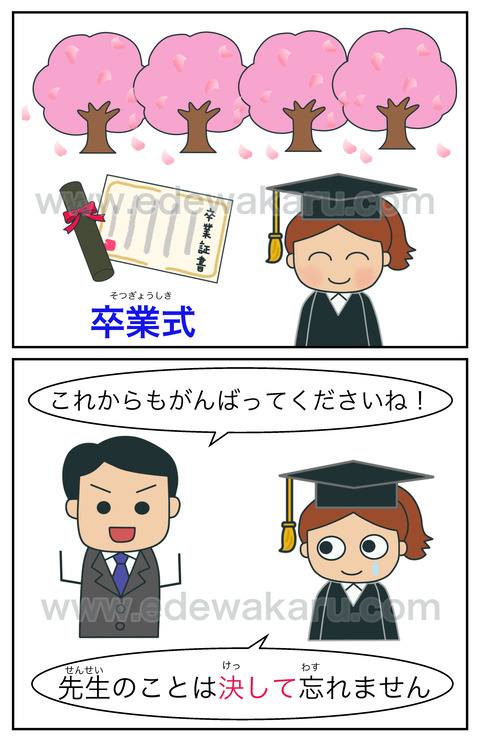
I will never forget my teacher. [Emphasizes “will not forget”]
I will not forget my teacher.
Make sure you don’t be late tomorrow! [Emphasizes “make sure you’re not late”]
Make sure you’re not late tomorrow!
*「〜ように」 is short for 「〜ようにしてください」
「決して〜ない」 is used for strong intention or prohibition, so learn some expressions it commonly appears with 😉
・決して〜ないでください
・決して〜するな
・決して〜てはいけない
・〜てはならない
・決して〜てはだめだ
・決して〜べからず
(Review: 〜べからず・〜べからざる)
Also, 「決して」 has two pronunciations, 「けっして」 and 「けして」, but the meaning is the same 😮
Different people say either 「けっして」 or 「けして」, so learn both. (Review: 〜によって (distinction))
This pattern is also used very often in conversation, so learn it well enough to use it skillfully 😊
Read the original source text
Explanation
「決して〜ない」は「絶対に〜ない」「どんなことがあっても〜」という意味で【強い意志】や【禁止】の意味を強調するために使われる文型です。後ろには必ず否定形がきて「決して〜ない」という形で使用されます。
強調の意味で使われるので「決して」がなくても文(文)は成立します
😮
[例]
先生のことは
決して
忘れません【
「忘れない」というのを強調】
先生のことは忘れません
明日は
決して
遅刻しないように!【
「遅刻しないように」というのを強調】
明日は遅刻しないように!
*「〜ように」は「〜ようにしてください」の省略形(しょうりゃくけい)
「決して〜ない」は強い意志や禁止に使われますので、一緒によく使うものをいくつか覚えておきましょう😉
・決して
〜ないでください
・決して
〜するな
・決して
〜てはいけない
・
〜てはならない
・決して
〜てはだめだ
・決して
〜べからず
(復習:〜べからず・〜べからざる)
また
「決して」は「けっして」「けして」というように2つ読み方がありますが、意味は同じです。😮
人によって「けっして」という人と「けして」という人に分かれますのでどちらも覚えておきましょう。(復習:〜によって(区別))
会話でもとてもよく使う文型ですので、うまく使えるようにしっかりと覚えておきましょう😊
Bunpro Grammar Reference
Meaning
Never, By no means
How to use it
決して + Verb[ない]
決して + [い]Adjective[ない]
決して + [な]Adjective + ではない(1)
決して + Noun + ではない(1)
(1) じゃない
Nuance
A grammar point that strongly implies that something is decisively not the case
Explanation
決して by itself is the て form of the verb 決する 'to determine'. However 決して is special in that it is considered to be a stand-alone adverb. As an adverb, it carries the meaning of 'decidedly', or 'assuredly', and is used in sentences that contain ない, in order to convey 'never (A)', 'under no circumstances (A)' or 'by no means (A)'.
Like many other adverbs in Japanese, 決して can appear at the beginning of a sentence, or directly before the word it is modifying (which will be in its ない form).
この道はものすごく危ないので、決してグループから離れないで下さい。
This road is very dangerous, so please under no circumstances leave the group.
決して痛くないとは言えないです。
By no means, can I say that it does not hurt.
この乗り物は決して危険ではないです。
This ride is by no means dangerous.
この子は決して悪い人ではないけど、時々失礼なときがある。
By no means do I think that this kid is bad, but they are rude at times.
While the translation is 'never', the literal meaning of 決して is 'decidedly not (A)', or 'assuredly not (A)', simply emphasizing the negative point within a sentence.
Caution
決して may also sometimes be paired with other structures that are not specifically negative, the primary example of this being ものか (a grammar point that we will learn about later). ものか strongly confirms a statement as being something that does not exist/will not be done.
この宝石を決して渡すものか!
There is no way I will hand over this treasure!
お前に決してお金を貸すものか!
There is no way I will lend you money!
In context 18 examples
- 嘘をついたら決してゆるさない。
I will never forgive you if you lie to me.
- この道はものすごく危ないので、決してグループから離れないで下さい。
This road is very dangerous, so please under no circumstances leave the group.
- 決して痛くないとは言えないです。
By no means, can I say that it does not hurt.
- この乗り物は決して危険ではないです。
This ride is by no means dangerous.
- この子は決して悪い人ではないけど、時々失礼なときがある。
By no means do I think that this kid is bad, but they are rude at times.
- 何があっても、決して諦めない。
I will never give up, no matter what happens.
- 彼は決して妥協しない人だ。
He is a person that never compromises.
- あの人は決して嘘をつかない。
That person never tells lies.
- あなたのことは決して忘れません。
I will never forget you.
- 決して損はさせないから、私を信用してください。
Please trust me because I will never let you lose out.
- 何を手に入れても、決して満足しない。
I will never feel satisfied no matter what I get.
- そんな決定は決して認めない!
I will never approve such a decision!
- あの人に冗談を言っても、決して笑わない。
Even if you tell a joke, he never laughs.
- 何回友達に行こうと誘われても、決して行かない。
No matter how many times my friends pressure me to go, I will never go.
- 彼は少し偏屈だが、決して悪い人ではない。
He is a bit eccentric, but he is by no means a bad person.
- トムは決して頭が悪いわけではない。単なる怠け者なだけだ。
Tom is by no means dumb, he is simply lazy.
- この宝石を決して渡すものか!
There is no way I will hand over this treasure!
- お前に決してお金を貸すものか!
There is no way I will lend you money!