日本語文型辞典
Meaning
Basic information: N/Na なら(ば); A-ければ; V-ば. Explanation
One of the inflected forms of predicates, expressing a condition. It is the most typical Japanese form for expressing conditions and has uses that partly overlap with 「たら」, 「と」, and 「なら」. When following a noun or Na adjective, 「は」 is often omitted, giving 「N/Naなら」. 「N/Naであれば」 is its formal, written-style form. The negative form 「N/Naでなければ」 is used in both writing and speech. The i-adjective 「いい」 is always used as 「よければ」, never 「いければ」. 「ば」 is often used like 「たら」, but 「ば」 tends to be used in writing and 「たら」 in speech. In casual speech, final 「consonant+eba」 may become 「consonant+ya」 (e.g. あれば⇾ありゃ, 行けば⇾行きゃ, 飲めば⇾飲みゃ, なければ⇾なけりゃ), and 「A-ければ」 may become 「A-きゃ」 (e.g. なければ⇾なきゃ).
An expression describing conditional relationships in general, rather than conditions concerning a specific person or thing. It means “if X holds, Y will always hold.” It expresses logical, lawlike, or causal relationships that hold constantly regardless of time, and the sentence always ends with the dictionary form. It is used not to discuss personal experiences or individual one-time events, but to say “when X holds, Y naturally follows,” “this generally happens,” or “this is essential by nature.”
The subject is often omitted, but when it is stated, the expression takes up an entire class of things, as in 「人はだれでも」 or 「Nというものは」, and makes a statement about it. As in ⑥ and ⑦, 「ものだ」, meaning that something has this nature, often accompanies it at the end of a sentence. It is also often used in proverbs and maxims, as in ⑨–⑪.
For a particular person or thing, expresses repeated actions or habits: “whenever X occurs, Y occurs,” or “whenever one does X, one always does Y.” The difference from 1【general condition】 is that 【general condition】 describes something that holds regardless of time for an unspecified subject and always uses the dictionary form at the end, whereas this use can take either the dictionary form or the ta form. It is used to describe the habits or repeated actions of a specific subject.
a. …ば…V-る
The dictionary form of an action verb is used at the end of the sentence to express a specific subject's current habit or repeated action.
b. …ば…V-た
Expresses a specific subject's past habit—“used to / always did that in the past” or “if they did that, this always happened”—or something that invariably held in a particular past situation. As in ① and ②, it may be accompanied by 「V-たものだ」, which expresses reminiscence.
The pattern 「…ば…V-た」 also has use 4【counterfactual】, which describes something contrary to fact. The difference from 【repetition/habit】 is that the latter describes an event that actually occurred. The past-fact use is also found with 「たら」, but 「ば」 describes actions repeated in the past or situations that always held under certain conditions, while 「たら」 usually describes an event that happened only once in the past.
(Example 1) describes an event repeated in the past: “If/whenever I drank two beers, I got drunk.” (Example 2) describes a one-time past event: “I happened to drink two beers, and then I got drunk.”
For a specific thing or person, expresses the relationship “if X holds, Y holds.” X may or may not have been realized already, but Y always describes something not yet realized.
Unlike 1【general condition】, which describes things in general and always uses the conclusive dictionary form at the end, 【hypothetical condition】 applies 【general condition】 to a specific, individual situation and states it prospectively. Sentence endings such as 「だろう」 and 「かもしれない」 can be added.
Y uses expressions that describe unrealized matters, or expressions of “expression/influence,” such as intentions or commands.
a. …ば+unrealized matter
For a specific person or thing, means “if X holds, then Y will naturally hold.” Y describes an unrealized matter, and the sentence often ends with an expression of conjecture or prediction, such as 「だろう」, 「にちがいない」, 「はずだ」, 「かもしれない」, or 「思う」.
①–③ assume an unrealized X and conjecture what Y should hold in such a case. ④–⑥ describe a situation where X has already been realized, and express “if this situation holds, then Y will naturally hold.”
When the speaker is fairly certain that Y will hold, the sentence may also end in the predicate's present conclusive form, as follows.
「ば」 is often used to say that X is a necessary and sufficient condition for Y. ⑧ uses the form 「Xさえ…ばY」 to mean “X alone is sufficient for Y to hold”; ⑨ states what one should do to achieve a desired result; ⑩ means “if you drink that much, of course you'll feel sick.”
All of these implicitly include 【general condition】, “if X, then Y always,” and apply it to a specific case. For example, ⑩ applies the general condition “anyone will feel sick if they drink too much” to a particular person, saying “if you drink that much, naturally you'll feel sick too.”
b. …ば+intention/wish
Used in forms such as 「Xば…しよう/したい」 when Y expresses an intention or wish. There are restrictions on the predicates used for X. As a general tendency, there is no problem when the predicate for X expresses a state, but it is often unnatural when followed by a verb expressing an action or change.
①–⑤ use state predicates such as i-adjectives, 「ある」, and 「V-ない」, so 「ば」 can be used without a problem. ⑥–⑩ express actions or changes in X, but 「ば」 can still be used. ⑥ describes a situation where the listener and speaker perform the same action. ⑦ and ⑧ are expressions used to make a promise by offering the other person an exchange: “if you do X, I'll do Y in your place.” ⑨ and ⑩ mean, respectively, “I'm not sure whether you'll finish reading / you might not finish reading, but if you do,” and “if it happens to rain.” These expressions are used when the speaker doubts whether X will certainly occur or considers the possibility that it may not. In cases such as ⑥–⑩, 「ば」 can be used even when X expresses an action or change. By contrast, 「ば」 cannot be used to describe a sequence of future planned actions in chronological order. For example, if ⑨ means “I'll read the next book after I finish this one,” 「ば」 cannot be used; 「たら」 must be used instead.
c. …ば+directive
This is when an expression of “influence,” such as a command, prohibition, permission, invitation, or request, follows 「ば」, requiring the listener to act. In general, when the sentence ends with a directive expression, verbs expressing actions or changes are difficult to use for X, and the restrictions are even stronger than with an intention or wish for Y.
「ば」 can be used after state predicates such as 「V-たい」, 「V-ない」, and 「ある」; all examples ①–⑥ are of this kind. ⑦ is an example where 「ば」 can follow a verb expressing change: the change verb 「終わる」 is followed by a request. It means “you might not finish, but if you do manage to finish,” with the speaker doubting or feeling negatively about the possibility of finishing. 「ば」 can sometimes be used in such cases.
In general, however, 「ば」 cannot be used when X expresses an action or change and, after that action or change occurs, the listener is instructed to perform or prohibited from performing the next action. 「たら」 must be used instead.
d. …ば+question
In the form 「XばYか」, expresses a question requiring an answer from the listener. ①–③ are yes/no questions; ④–⑥ are questions with an interrogative word such as “how” or “where.” In the latter cases, 「ば」 is often used to ask about the means or method X for achieving a good result Y, in the form 「どうすればYか」. By contrast, 「たら」 is more natural when asking what action to take if X occurs; using 「ば」 is often unnatural.
e. interrogative word+V-ば…のか
A rhetorical expression in which an interrogative word such as 「何/どれだけ/どんなに」 is followed by a verb in the ba form. It means “no matter how much one does something, things do not readily go as desired” and expresses frustration or despair about the situation. Sentence endings such as 「のか/のだ/のだろう(か)」 are used. 「V-ば」 can be paraphrased as 「V-たら」.
An expression that states something contrary to fact before or after it, then describes what would (have) happened if circumstances had been different. It is used for things that have already happened, or when it is clear that they cannot happen. If a desired state of affairs fails to materialize, it conveys regret or disappointment. Conversely, when a bad situation has been avoided, it expresses relief that it did not happen. Whether a sentence is 【counterfactual】 often cannot be distinguished from its form alone, but the following patterns are commonly used for counterfactual conditional sentences. 「ば」 in this use can always be replaced with 「たら」.
a. …ば…のに/…のだが
A counterfactual conditional sentence in the form 「XばYのに/のだが/のだけれど」. The predicate for Y may be in the dictionary form or ta form. ① and ② are examples of the former, expressing a wish for things to be different from the current situation or lamenting the current situation. ③ is an example of the latter: it assumes circumstances contrary to past facts and says that a different result would have followed. ④ is in the form 「V-ていればV-ている」 and assumes that, regarding something already realized, the present situation would not be as it is if circumstances were different. As in ①–③, sentence-final 「のに」, 「のだが」, or 「のだけれど」 makes it clear that a sentence is counterfactual, but these may be absent, as in ④.
b. …ば…だろう/…はずだ
Conjectures about what might have happened if circumstances had been different. Sentence endings use expressions of prediction or conjecture, such as 「だろう」, 「はずだ」, 「かもしれない」, 「にちがいない」, and 「と思う」.
As in ①–⑤, when these follow a predicate in the ta form, they indicate that past facts were different from what is stated; when they follow the dictionary form, as in ⑥, they indicate that the current situation is different from what is stated.
c. …ば…ところだ(った)
The sentence ending takes forms such as 「V-るところだった」, 「V-ていたところだ」, or 「V-ていたところだった」.
「…ばV-るところだ」 is a way of assuming an unrealized event Y that would likely occur if circumstances differed from X. ① is an example: it means “I'm not actually young, so I can't go, but I feel like going that much.”
「…ばV-ていたところだ」 describes something that could have happened in the past, meaning “if circumstances had been different, that would have happened.” ② is an example.
「…ばV-るところだった」 in ③ and ④ is used when an event that would have occurred if circumstances differed was avoided just before it happened. It is used in situations where one might say, “I'm glad we avoided a bad result.”
「忘れていたところだった」 in ⑤ can also be said as 「忘れているところだった」, but the former describes the situation at a past point in time, “I managed not to forget,” while the latter describes the current situation, “I am managing not to forget.”
⇾ところだ2
d. …ば V-た/V-ていた
The sentence ends with a verb in the ta form and expresses something contrary to fact. Used to assume, about a past matter, something that did not actually happen or a state that was different from reality, and to say what would have held in that case. For example, ② means “If I had come earlier, I would have made it, but I actually came late and didn't make it.”
Counterfactual conditional sentences usually include sentence-final expressions such as 「のに/のだが/のだけれど」, 「だろう/かもしれない/はずだ/にちがいない/と思う」, or 「ところだ(った)」, as in A–c above, but some patterns, such as d, do not. Pay particular attention when the sentence ends in the ta form, because sentences using 「ば」 and 「たら」 may have different meanings.
(Example 1) means an event that actually happened: “I pressed the button. Then it exploded.” By contrast, (Example 2) is counterfactual: “If I had pressed the button, it would have exploded, but I didn't press it, so it didn't explode.”
Used in the form 「XばY」 to mean that Y was newly realized when X occurred. 「たら」 and 「と」 are normally used for this meaning; 「ば」 is limited to somewhat old-fashioned literary expressions, such as those in poetry or novels. When it is used in speech, it is usually in the form 「V-てみれば」, expressing a feeling of understanding upon learning a fact, as in “that makes sense” or “that's only natural after all.”
①–③ can be paraphrased with 「たら」, but when 「たら」 is used, the meaning is “after doing something, I realized something.” For example, if ① is paraphrased with 「たら」 as 「会ってみたら、うわさほどのことはなかったよ」, it means “I met them and found out they weren't as remarkable as the rumors said.” When simply stating something newly discovered in this way, 「たら」 or 「と」 is normally used; 「ば」 is often unnatural.
When the same person performs a second action just once, immediately after the first action, 「ば」 and 「たら」 cannot be used; 「と」 must be used instead.
The same verb or adjective is repeated. Used to bring up contrasting matters and say that either way the result is the same. For example, ① means “A car is convenient if you have one, but you can get by without one better than you might think”; ② means “Whether it's hot or cold, he complains”; ③ means “Money is troublesome whether you have it or not”; ④ means “You worry about children when they're small, and you worry about them even after they grow up.” In ④, the second 「大きく」 can be omitted, giving 「大きくなればなったで」. 「…たら…で」 is a similar expression.
Used to limit in advance the range of conditions under which the following statement is made, or to give advance notice or a qualification. This is a somewhat fixed idiomatic expression. In most cases, it can be paraphrased with 「たら」.
a. …ば+request/suggestion
A set expression used to make a request, suggestion, or proposal to the listener, showing consideration for their convenience and feelings. It means “if this doesn't conflict with your convenience or wishes,” and is a polite expression showing the speaker's reserve: if it is inconvenient or they are not inclined, they do not necessarily have to agree.
b. …ば【viewpoint】
Follows verbs expressing speech, thought, or comparison, such as 「言う」, 「思う」, or 「比べる」, to introduce and explain in advance the viewpoint or standpoint from which the following statement or judgment is made. ① and ② can be paraphrased as “to speak frankly / frankly speaking / if I may be frank”; ③ as “compared with / when compared”; and ④ as “when I think about it.” The latter is used to look back on what has happened with emotion, meaning “thinking back on it now,” and cannot be paraphrased with the te form, 「たら」, or 「と」. Many such expressions have become fairly fixed idioms; others include 「はっきり言えば」, 「極端に言えば」, 「からみれば」, and 「からすれば」.
Pronounced with rising intonation, it is used to encourage the listener to take some action. Ending a sentence with 「V-ば」 alone often gives a dismissive impression, as though the matter is of no importance to the speaker. It can be paraphrased as 「V-たら」 or 「V-たらどう」. Used in casual speech.
Used to emphasize by listing similar matters in parallel, as in ①–③, or to indicate that there are various possibilities by listing contrasting matters, as in ④ and ⑤. These examples can be paraphrased with 「-し」, as in 「潜も飲むしたばこも吸う」. Also, as in 「動物の好きな人がいれば嫌いな人もいる」, 「が」 may be used with the first 「も」.
⇾おもえば
⇾かとおもえば
⇾からいう1
⇾からする1
⇾からみる1
⇾さえ2
⇾ってば
⇾といえば
⇾とすれば1
⇾とすれば2
⇾となれば
⇾ともなれば
⇾なら1
⇾なら2
⇾なら3
⇾にいわせれば
⇾にしてみれば
⇾ほど4b
⇾も4d
⇾も10
How to use it
…ば【general condition】
…ば N/Na だ
…ばA-い
…ばV-る
…ぱ【repetition/habit】
…ば【hypothetical condition】
…ば【counterfactual】
…ぱ【established condition】
…ば…で
A-ければA-いで
V-ばV-たで
…ぱ【preface】
V-ば【suggestion】
…も…ば…も
10 おもえば
11 …かとおもえば
12 …からいえば
13 …からすれば
14 …からみれば
15 さえ…ば
16 ってば
17 …といえば
18 …とすれば
19 …となれば
20 …ともなれば
21 …ならば
22 …にいわせれば
23 …にしてみれば
24 …ば…ほど
25 …も…ば
…も…あれば…もある
In context 120 examples
春が来れば花が咲く。
When spring comes, flowers bloom.
10を2で割れば5になる。
If you divide 10 by 2, you get 5.
台風が近づけば気圧が下がる。
When a typhoon approaches, the atmospheric pressure drops.
年をとれば身体が弱くなる。
As you get older, your body grows weaker.
経済状態が悪化すれば犯罪が増加する。
When economic conditions worsen, crime increases.
人間というものは、余分な金を持ち歩けばつい使いたくなるものだ。
People naturally want to spend extra money if they carry it around.
信じていれば夢はかなうものだ。
If you believe, dreams come true.
だれでもほめられればうれしい。
Everyone is happy to be praised.
風がふけば桶屋がもうかる。
If the wind blows, the tub maker profits.
犬が西向きゃ尾は東。
If a dog faces west, its tail faces east.
終わりよければすべてよし。
All's well that ends well.
祖母は天気がよければ毎朝近所を散歩します。
My grandmother takes a walk around the neighborhood every morning if the weather is nice.
彼は暇さえあればいつもテレビを見ている。
Whenever he had free time, he was always watching TV.
父は私の顔を見れば「勉強しろ」と言う。
Whenever my father sees my face, he says, “Study!”
愛犬のポチは主人の姿を見ればとんでくる。
Whenever Pochi, our beloved dog, sees his master, he comes running.
子供のころは、天気がよければ、よく母とこの河原を散歩したものだ。
When I was a child, if the weather was nice, I often used to take a walk along this riverbank with my mother.
学生のころは暇さえあればお洒を飲んで友達と語り明かしたものだ。
When I was a student, whenever I had free time, I'd drink sake and talk the night away with my friends.
父は東京へ行けば必ずお土産を買ってきてくれた。
Whenever my father went to Tokyo, he always brought me back a souvenir.
20年ほど前には、街から少し離れれば、いくらでも自然が残っていた。
About twenty years ago, if you went a little way out of town, there was plenty of nature left.
(例) 1。ビールを2本飲めば酔っぱらいました。
2。ビールを2本飲んだら酔っぱらいました。(Example) 1. I got drunk if I drank two beers. 2. I got drunk when I drank two beers.
(例) 【一般条件】食事を減らせば誰でもやせる。
【仮定条件】食事を減らせばあなたもやせるだろう。(Example) 【general condition】Anyone will lose weight if they reduce their food intake. 【hypothetical condition】You'll probably lose weight too if you reduce your food intake.
もし私が彼の立場なら、やっぱり同じように考えるだろう。
If I were in his position, I would probably think the same way.
もし天気が悪ければ、試合は中止になるかもしれない。
If the weather is bad, the match might be canceled.
手術をすれば助かるでしょう。
If you have surgery, you'll probably be saved.
こんなに安ければ、きっとたくさん売れると思う。
If it's this cheap, I think it'll surely sell a lot.
それだけ成績がよければ、どの大学にでも入学できるはずです。
With grades that good, you should be able to get into any university.
ふだん物静かな夫がめずらしく、一時間も説教していた。あれだけ叱られれば、息子も少しは反省するにちがいない。
My usually quiet husband unusually lectured him for a whole hour. If our son has been scolded that much, he must be reflecting at least a little.
応募人数が多ければ抽選になります。
If there are many applicants, there will be a lottery.
うっかりミスさえしなければ必ず合格できますよ。
If you avoid careless mistakes, you can definitely pass.
食事の量を減らして運動をすれば、2、3キロぐらいはすぐ減りますよ。
If you reduce the amount you eat and exercise, you'll quickly lose about two or three kilos.
A:気分が悪くなってきたよ。
B:それだけ飲めば、気分も悪くなるよ。A: I'm starting to feel sick. B: If you drink that much, of course you'll feel sick.
安ければ買うつもりです。
I'll buy it if it's cheap.
A:こんどの日曜日、天気がよければハイキングに行こうよ。
B:いいね。すこしぐらい天気が悪くても行こうよ。A: If the weather is nice this coming Sunday, let's go hiking. B: Sounds good. Let's go even if the weather is a little bad.
A:なにか飲む?
B:そうだな、ビールがあれば飲みたいな。A: Want something to drink? B: Let's see… If there's beer, I'd like some.
レポートを提出しなければ、合格点はあげません。
If you don't submit your report, I won't give you a passing grade.
田中さんが行かなければ、私も行かない。
If Mr. Tanaka doesn't go, I won't go either.
田中さんが行けば、私も行く。
If Mr. Tanaka goes, I'll go too.
掃除を手伝ってくれればおこづかいをあげる。
If you help me clean, I'll give you some pocket money.
お電話くださればお迎えに上がります。
If you call me, I'll come pick you up.
もし、今学期中にこの本を読み終われば、次にこの本を読みます。
If I finish reading this book during this semester, I'll read this book next.
もし雨が降れば中止しよう。
If it rains, let's cancel.
(誤) この本を読めば次にこの本を読みます。
(Incorrect) If I read this book, I'll read this book next.
(正) この本を読んだら次にこの本を読みます。
(Correct) When I finish reading this book, I'll read this book next.
そう思いたければ勝手に思え。
If that's what you want to think, go ahead and think it.
やりたくなければやるな。
If you don't want to do it, don't.
宿題をすませなければ遊びに行ってはいけない。
If you haven't finished your homework, you can't go out to play.
飲みたくなければ飲まなくてもいい。
If you don't want to drink, you don't have to.
お時間があれば、もう少しゆっくりしていってくださいよ。
If you have time, please stay a little longer.
明日、天気がよければ海に行きませんか。
If the weather is nice tomorrow, would you like to go to the beach?
7時までに仕事が終われば、来てください。
Please come if you finish work by seven.
(誤) 駅に着けば迎えに来てください。
(Incorrect) If you arrive at the station, please come pick me up.
(正) 駅に着いたら迎えに来てください。
(Correct) When you arrive at the station, please come pick me up.
(誤) お酒を飲めば運転するな。
(Incorrect) If you drink alcohol, don't drive.
(正) お酒を飲んだら運転するな。
(Correct) Once you drink alcohol, don't drive.
A:学生ならば、料金は安くなりますか。
B:大人料金の2割引になります。A: If I'm a student, will the fare be cheaper? B: You'll get 20 percent off the adult fare.
この病気は手術をすれば治りますか。
Can this illness be cured if I have surgery?
あやまれば許してくれるでしょうか。
If I apologize, do you think they'll forgive me?
A:どうすれば機嫌を直してくれるかしら。
B:何か贈り物をして丁寧にあやまるのが一番ね。A: What should I do to get her in a better mood? B: The best thing is to give her a present and apologize sincerely.
A:どのぐらい入院すればよくなるでしょうか。
B:2週間ぐらいですね。A: How long do I need to be hospitalized to get better? B: About two weeks.
A:どこに行けばその本を見つけることができるでしょうか。
B:神田の古本屋を探せば、一冊ぐらいはあるかもしれませんね。A: Where should I go to find that book? B: If you look in the secondhand bookstores in Kanda, they might have a copy.
(誤) 雨が降ればどうしますか。
(Incorrect) If it rains, what will you do?
(正) 雨が降ったらどうしますか。
(Correct) What will you do if it rains?
いったいどういうふうに説明すれば分かってもらえるのか。
Just how should I explain it so that they'll understand?
何年勉強すればあんなに上手に英語がしゃべれるようになるのだろう。
How many years would you have to study to become able to speak English that well?
どれだけ待てば、手紙は来るのか。
How long must I wait for the letter to arrive?
人間、一体何度同じ過ちを繰り返せば、気がすむのであろうか。
Just how many times must people repeat the same mistake before they're satisfied?
宿題がなければ夏休みはもっと楽しいのに。(残念なことに宿題がある。)
Summer vacation would be much more fun if there were no homework. (Unfortunately, there is homework.)
お金があれば買うんだけどなあ。(お金が無いから買えない。)
I would buy it if I had money. (I can't buy it because I don't have money.)
お金があれば買えたんだが。(お金がなかったので買えなかった。)
I could have bought it if I'd had money. (I couldn't buy it because I didn't have money.)
A:試験うまくいった?
B:うまくいっていれば、こんな不機嫌な顔はしていないさ。(試験に失敗したから、こんな不機嫌な顔をしている)A: Did the exam go well? B: If it had gone well, I wouldn't have such a sour look on my face. (I have such a sour look because I failed the exam.)
地震の起こるのがあと1時間遅ければ被害はずっと大きかっただろう。
If the earthquake had happened an hour later, the damage would have been much worse.
気をつけていれば、あんな事故は起きなかったはずだ。
If we'd been careful, that accident shouldn't have happened.
発見がもう少し遅ければ助からなかったかもしれない。
If the discovery had been a little later, they might not have been saved.
あの時すぐに手術をしていれば、助かったにちがいない。
If they had operated immediately then, he would certainly have been saved.
彼が止めに入らなければ、ひどい喧嘩になっていたと思う。
If he hadn't stepped in to stop us, I think it would have turned into a terrible fight.
あの時、あの飛行機こ乗っていれば、私は今ここにいないはずだ。
If I had been on that plane then, I wouldn't be here now.
もう少し若ければ、私が自分で行くところだ。
If I were a little younger, I would go myself.
あのとき、あの飛行機に乗っていれば私も事故に巻き込まれていたところだ。
If I had been on that plane then, I would have been caught up in the accident too.
今日の授業は突然休講になったらしい。田中が電話をしてくれなければ、もう少しで学校に行くところだった。
Apparently today's class was suddenly canceled. If Tanaka hadn't called me, I would almost have gone to school.
電車がもう少し早く来ていれば大惨事になるところだった。
If the train had come a little earlier, there would have been a major disaster.
注意していただかなければ忘れていたところでした。
If you hadn't pointed it out to me, I would have forgotten.
安ければ買った。
If it had been cheap, I would have bought it.
もっと早く来れば間に合った。
If I had come earlier, I would have made it.
手当てが早ければ、彼は助かっていた。
If treatment had been given sooner, he would have survived.
きちんとした説明があれば、私も反対しなかった。
If there had been a proper explanation, I wouldn't have objected either.
(例) 1。ボタンを押したら爆発した。
2。ボタンを押せば爆発した。(Example) 1. When I pressed the button, it exploded. 2. If I pressed the button, it exploded.
彼は変わり者だという評判だったが、会ってみれば、うわさほどのことはなかった。
He had a reputation for being eccentric, but when I met him, he wasn't as remarkable as the rumors suggested.
言われてみればそれももっともな気がする。
Now that you mention it, that does seem reasonable.
始める前は心配だったが、すべてが終わってみれば、それほど大したことではなかったと思う。
I was worried before starting, but now that everything is over, I think it wasn't such a big deal.
(誤) 昨日、台所で変な音がするので泥棒かと思って行ってみれば、弟がラーメンを作っていた。
(Incorrect) Yesterday, I heard a strange sound in the kitchen and thought it might be a burglar, so when I went to look, my younger brother was making ramen.
(正) 昨日、台所で変な音がするので泥棒かと思って{行ってみたら/行ってみると}、弟がラーメンを作っていた。
(Correct) Yesterday, I heard a strange sound in the kitchen and thought it might be a burglar, so when I went to look, my younger brother was making ramen.
(誤) 朝起きれば、雨が降っていた。
(Incorrect) When I woke up in the morning, it was raining.
(正) 朝{起きたら/起きると}、雨が降っていた。
(Correct) When I woke up in the morning, it was raining.
(誤) 次郎は家に{帰れば/帰ったら}、テレビを見た。
(Incorrect) When Jiro got home, he watched TV.
(正) 次郎は家に帰ると、テレビを見た。
(Correct) Jiro got home and watched TV.
自動車がないとさぞ不便だろうと思っていたが、なければないでやっていけるものだ。
I thought it would surely be inconvenient without a car, but you can manage without one.
父は暑さに弱い。それでは冬が好きかというとそうではない。寒ければ寒いで文句ばかり言っている。
My father is sensitive to heat. You might think that means he likes winter, but it isn't so. When it's cold, he just complains.
金などというものは、無ければ困るが、あればあったでやっかいなものだ。
Money is troublesome: you need it when you don't have any, but it's troublesome when you do have it.
子供が小さい間は、病気をしないだろうかちゃんと育つだろうかと心配ばかりしていたが、大きくなれば大きくなったで、受験やら就職やら心配の種はなくならない。
When the children were small, I worried constantly about whether they would get sick or grow up properly. But after they grow up, there are still things to worry about, such as entrance exams and finding a job.
もし、お差し支えなければ、ご住所とお名前をお聞かせください。
If it's not inconvenient for you, please tell me your address and name.
A:今日の説明会はもう終わったんでしょうか。
B:はい、3時に終了いたしました。よろしければ、来週の火曜にも説明会がございますが。A: Has today's information session already ended? B: Yes, it concluded at three. If you'd like, there will also be an information session next Tuesday.
よろしければ、もう一杯いかがですか。
If you'd like, would you care for another cup?
A:本当に行くのかい。
B:うん。でも正直言えば、本当は行きたくないんだ。A: Are you really going? B: Yeah. But to be honest, I really don't want to go.
50年前と比べれば、日本人もずいぶん背が高くなったと言える。
Compared with 50 years ago, one could say that Japanese people have grown considerably taller.
今は円高なので、国内旅行よりも海外旅行の方が安くつくらしい。考えてみればおかしな話だ。
Since the yen is strong now, traveling abroad apparently costs less than traveling within Japan. When you think about it, that's strange.
思えば、事業が成功するまでのこの10年は長い年月だった。
Looking back, these ten years until the business succeeded were a long time.
≪服売り場で≫
A:これなんかどうかなあ。
B:着てみれば?≪At the clothing department≫ A: I wonder what you think of something like this. B: Why don't you try it on?
A:ゆうべから、すごく頭が痛いんだ。
B:そんなに痛いの?会社休めば?A: My head has been hurting terribly since last night. B: Does it hurt that much? Why don't you take the day off work?
A:あ、これ間違ってる。
B:教えてあげれば?A: Oh, this is wrong. B: Why don't you tell them?
彼は心臓が悪いくせに酒も飲めばたばこも吸う。
Even though his heart is bad, he drinks and smokes, too.
彼は器用な男で料理もできれば裁縫もできる。
He's a skillful man: he can cook, and he can sew, too.
勲章なんかもらっても、うれしくもなければ、名誉だとも思わない。
Even if I received a medal, I wouldn't be happy, nor would I think it an honor.
動物が好きな人もいれば、嫌いな人もいる。
Some people like animals, while others dislike them.
人の一生にはいい時もあれば悪い時もある。
There are good times and bad times in a person's life.
お父さんってば、早く来てよ。
Dad, come on, hurry up and get here!
絶対に私が正しいんだってば。
I'm telling you, I'm absolutely right.
考えれば考えるほど分からなくなる。
The more I think about it, the less I understand.
食べれば食べるほど太る。
The more you eat, the fatter you get.
その部品なら 1000 円も出せば買えるよ。
You can buy that part for as little as 1,000 yen.
こんな作業は5分もあれば終わる。
A task like this will be done in just five minutes.
Read the original source text
Meaning
基本情報N/Na なら(ば)A-ければV-ば説明述語の活用形のひとつで、条件を表す。日本語の条件を表す一番典型的な形式で「たら」「と」「なら」と部分的に重なる用法をもつ。説明名詞、ナ形容詞に続く場合は、「は」が省略され「N/Naなら」となることが多い。「N/Naであれば」はそのかたい書きことば的な言い方。否定形の「N/Naでなければ」は、書きことばでも話しことばでも使われる。イ形容詞の「いい」は「いければ」ではなく必ず「よければ」の形で用いられる。「ば」は「たら」と同じように使われることが多いが、書きことばでは「ば」、話しことばでは「たら」が使われる傾向がある。くだけた話しことばでは、語尾の「子音+eba」が「子音+ya」(例:あれば⇾ありゃ、行けば⇾行きゃ、飲めば⇾飲みゃ、なければ⇾なけりゃ)となったり、「A-ければ」が「A-きゃ」(例:なければ⇾なきゃ)となることがある。
特定の個人やものごとではなく、ものごと一般についての条件関係を述べる表現で、「Xが成立すれば必ずYが成立する」という意味を表す。特定の時間にかかわらず恒常的に成り立つ論理的、法則的な関係や因果関係を表し、文末はいつも辞書形が用いられる。個人的な経験や個別的な一回きりの出来事を問題にするのではなく、「Xが成立した場合には、当然Yになる」「一般的にそうなる」「本質的にそうだ」という場合に使われる。
主語は示されないことが多いが、示される場合は「人はだれでも」「Nというものは」のように、ある種類に属するもの全体が取り上げられ、それについて述べる表現になる。⑥⑦のように、文末に本来そのような性質をもっているという意味の「ものだ」を伴うことも多い。⑨~⑪のように、ことわざや格言などにもよく使われる。
ある特定の人物や事物について、「Xが成立するとその度にYが成立する」「Xを行うと決まってYを行う」という繰り返し行われる動作や習慣を表す。1の【一般条件】との違いは、【一般条件】は、不特定の主語について時間を超越して成り立つことがらを述べるもので、文末には必ず辞書形が使われるのに対し、この用法は辞書形だけでなくタ形も用いることができる点である。特定の主語の習慣や反復動作を述べるような場合に使われる。
a. …ば…V-る
文末に動作を表す動詞の辞書形が用いられ、特定の主語の現在の習慣や反復的動作を表す。
b. …ば…V-た
「過去にはいつも/必ずそうした」「そうすれば必ずそうだった」といった特定の主語の過去の習慣や、過去の特定の状況で必ず成立したことがらなどを表す。①②のように回想を表す「V-たものだ」を伴うこともある。
「…ば…V-た」の文型としては、事実に反したことがらを述べる4の【反事実】の用法があるが、これと【反復・習慣】の用法の違いは、後者は実際に成立した事実を述べるものだという点である。なお、過去の事実を述べる用法は「たら」にもあるが、「ば」が過去に繰り返し行われた行動や一定の条件の下でいつも成立した状況を表すのに対して、「たら」は普通、過去に一回だけ成立した出来事を表す。
(例1)は「2本飲めば必ず/いつも酔っぱらった」という、過去に繰り返し起こった出来事を表すのに対し、(例2)は「たまたま2本飲んだら酔っぱらった」という、過去に一度起こった出来事を表す。
特定の事物・人物について「Xが成り立てばYが成り立つ」という関係を表す。Xは未実現の場合と、すでに実現している場合があるが、Yは常に未実現のことがらを表す。
1の【一般条件】がものごと一般について述べるもので、文末には必ず言い切りの辞書形を用いるのに対し、【仮定条件】は【一般条件】を特定の個別的なことがらに当てはめて予潮的に述べる場合の用法で、文末に「だろう」「かもしれない」などを付けることができる。
Yには未実現のことがらを述べ立てる表現や、意志や命令などの「表出・働きかけ」の表現が用いられる。
a. …ば+未実現のことがら
特定の人物や事物について「Xが成り立てば当然Yが成り立つだろう」という意味を表す。Yは未実現のことがらを表し、文末には「だろう」「にちがいない」「はずだ」「かもしれない」や「思う」など、推量や予測の表現を伴うことが多い。
①~③は、未実現のXを仮定して、そのような場合に成り立つはずのYを推測する言い方。④~⑥は、Xがすでに実現していることがらを表す場合で、「このような状況が成立しているのであれば、当然Yが成り立つだろう」という表現。
話し手がYの成立についてかなり確信をもっているような場合には、次のように、文末が述語の現在言い切り形で終わる場合もある。
「ば」は、XがYを成立させるための必要十分条件であるということを言う場合によく用いられる。⑧は、「Xさえ…ばY」の形で「Yが成立するためにはXが成立すれば十分だ」という意味の表現であり、⑨は、どうすれば望んでいる結果が得られるかを述べる表現、⑩は「そんなに飲めば気分が悪くなるのも当然だ」という意味の表現である。
これらはいずれも「Xならば必ずY」という【一般条件】を裏にもち、それを特定の場合にも当てはめて述べるのに用いられる。⑩の例で言えば、「だれでも飲み過ぎれば気分が悪くなる」という【一般条件】を、特定の相手に対して当てはめ「あなたもそれだけ飲めば気分が悪くなるのも当然だ」と言っているのである。
b. …ば+意志・希望
「Xば…しよう/したい」のような形で、Yが意志や希望を表す場合で、Xに用いられる述語には制約がある。一般的傾向としては、Xの述語が状態性の場合は問題がないが、動作や変化を表す動詞に続く場合は不自然になることが多い。
①~⑤はイ形容詞や「ある」や「V-ない」など、状態性の述語が使われているため、「ば」は問題なく使用できる。⑥~⑩はXが動作・変化を表す場合だが、「ば」が使用できる場合である。⑥は、聞き手と話し手が同じ動作を表すような場合であり、⑦⑧は、「あなたがXを行えば私は代わりにYを行う」といった意味の、相手に交換条件を出して約束する場合の表現である。⑨⑩は、それぞれ「読み終わるかどうかはっきりわからないが/読み終わらないかもしれないが、もし読み終わったら」「仮に雨が降った場合は」という意味を表すもので、Xのことがらが確実に成立するかどうかに疑いをもっていたり、成立しない場合を考慮にいれて述べる場合の表現である。⑥~⑩のような場合は、Xが動作・変化を表すものでも「ば」の使用が可能となる。これに対して、未来の行動予定について、動作の順番を時間的な経過にそって表すような場合には「ば」は使えない。例えば⑨が「この本を読み終わってから次の本を読もう」という意味で使われる場合には「ば」を用いることができず、代わりに「たら」を使わなければならない。
c. …ば+働きかけ
「ば」の後に「命令・禁止・許可・勧誘・依頼」など、聞き手に行動を行うことを要求する「働きかけ」の表現が続いたもの。一般に文末が「働きかけ」の表現の場合は、Xに動作・変化を表す動詞は使いにくく、Yが「意志・希望」の表現の場合よりもさらに強い制約を受ける。
「ば」が使用可能なのは「V-たい」「V-ない」「ある」などの状態性の述語に続く場合で、①~⑥はすべてそのような例である。⑦は、変化を表す動詞に「ば」の使用が可能な例で、「終わる」という変化の動詞に依頼表現が続いている。「終わらないかもしれないが、仮に終わらせることができた場合」という意味で、終わる可能性に対して話し手は疑いや否定的な気持ちをもっている。このような場合には「ば」が使用できることがある。
だが、一般的には、Xが動作や変化を表し、その動作・変化が起こった後に、次の動作を行うよう指示したりそれを禁止したりする場合には「ば」は使えず、代わりに「たら」を使わなければならない。
d. …ば+問いかけ
「XばYか」の形で、聞き手に答えを要求する問いかけを表す。①~③は、「はい」「いいえ」を問う疑問文、④~⑥は、「どう」「どこ」などの疑問詞を伴う疑問文の例である。後者の場合、「ば」は、「どうすればYか」の形で、よい結果Yを得るための手段・方法Xを問うような場合によく用いられる。これに対して、Xが成立した場合にどのような行動をとるかを問う場合は「たら」を使うのが自然で、「ば」を使うと不自然になることが多い。
e. 疑問詞+V-ば…のか
「何/どれだけ/どんなに」などの疑問詞に動詞のバ形が続く反語的表現。「いくら…してもなかなか思い通りにならない」という意味で、状況に対するいらだちや絶望的な気持ちを表す。文末には「のか/のだ/のだろう(か)」などが用いられる。「V-ば」は「V-たら」でも言いかえ可能。
前後に事実と反対のことがらを述べて、もし事情が反対ならば実現する(した)はずのことを述べる表現。すでに実現してしまっていることがらについて言う場合と、実現が不可能なことが明らかなような場合に使う。望ましい事態が実現しない場合は後悔や残念な気持ちを伴う。反対に悪い事態が避けられたような場合は「そうならなくてよかった」という安堵の気持ちを表す。【反事実】かどうかは形では区別できない場合が多いが、以下のような文型は反事実条件文でよく使われるものである。この用法の「ば」はいずれの場合も「たら」で言いかえることができる。
a. …ば…のに/…のだが
「XばYのに/のだが/のだけれど」の形の反事実条件文。Yの述語は辞書形の場合と夕形の場合がある。①②が前者の例で、現状と違うことを望んだり、現状を嘆いたりする場合の表現。③は後者の例で、過去の事実とは異なる事態を仮定して、その場合には違った結果になっていたということを述べるもの。④は「V-ていればV-ている」の形のもので、すでに実現していることがらについて、事情が異なれば現状のようであるはずがないと仮定して述べる表現。①~③のように文末に「のに」「のだが」「のだけれど」などが付けば反事実条件文であることがはっきりするが、④のようにそれが示されない場合もある。
b. …ば…だろう/…はずだ
事情が異なればあり得たはずのことがらを推測して述べるもの。文末には「だろう・はずだ・かもしれない・にちがいない・と思う」など予測・推測を表す表現が使われる。
①~⑤のように、これらが述語のタ形を受ける場合は、過去の事実がそれと異なることを表し、⑥のように辞書形を受ける場合は、現状がそれと異なることを表す。
c. …ば…ところだ(った)
文末は「V-るところだった」「V一ていたところだ」「V-ていたところだった」などの形になる。
「…ばV-るところだ」は、事情がXと異なれば実現しそうな未実現のことがらYを仮定する言い方。①がその例で「実際には若くないので行けないが、そうしたいぐらいの気持ちだ」という意味を表す。
「…ばV-ていたところだ」は「事情が異なればそうした/なったはずだ」と、過去にあり得た状況を述べる表現で、②がその例。
③④の「…ばV-るところだった」は、事情が異なれば起こっていたはずの出来事が、その直前で避けられたような場合に使う。「悪い結果を避けることができてよかった」というような場合に用いる。
⑤の「忘れていたところだった」は「忘れているところだった」と言うこともできるが、前者は「忘れずにすんだ」という過去の時点での状況を表し、後者は「忘れずにすんでいる」という現時点での状況を表す。
⇾ところだ2
d. …ば V-た/V-ていた
文末が動詞のタ形をとって、事実に反することがらを表す。過去のことがらについて、実際にはしなかったことや実際とは違った状態を仮定して、その場合に成立していたことがらを言う場合に使う。②の例で言えば「もっと早く来れば間に合ったのだが、実際には遅く来たので間に合わなかった」という意味。
普通、反事実条件文は、上のA~cのように文末に「のに/のだが/のだけれど」や「だろう/かもしれない/はずだ/にちがいない/と思う」「ところだ(った)」などを伴うことが多いが、dのようにそれがない文型もある。特に文末がタ形で終わる場合は、「ば」を用いた文と「たら」を用いた文は異なる意味を表すことがあるので注意が必要である。
(例1)は「ボタンを押した。すると爆発した」という実際に起こった出来事の意味になるのに対し(例2)は「ボタンを押せば爆発したが実際には押さなかったので爆発しなかった」という反事実条件文の意味になる。
「XばY」という形で、Xが成立した場面でYを新たに認識したという意味を表す場合に用いる。この用法には、「たら」と「と」を使うのが普通で、「ば」が使われるのは、詩歌や小説など、やや古めかしい文学的な表現に限られる。話しことばで使われる場合は、たいてい「V-てみれば」の形で使われ、事実を知って「それももっともだ」「やっぱりそれが当然だ」と納得するような気持ちを表す。
①~③は「たら」で言いかえられるが、「たら」を使った場合は、「あることをした結果、あることに気がついた」という意味になる。例えば、①を「たら」で言いかえ「会ってみたら、うわさほどのことはなかったよ」のように言うと「会ってみた結果、うわさとは違うことが分かった」という意味になる。このように新たに分かったことがらをそのまま述べるような場合は、「たら」か「と」を使うのが普通で、「ば」を使うと不自然になることが多い。
次のように同じ人物が前の動作に連続して後の動作を一度だけ行うような場合は「ば」と「たら」は使えず、「と」を使わなければならない。
同じ動詞や形容詞を繰り返して使う。対照的なことがらを取り上げて、どちらにしても同じだという場合に使う。例えば、①は「自動車はあれば便利だが、なくても思ったほどは困らない」②は「又は暑くても寒くても、文句を言っている」③は「金はあってもなくても困る」、④は「子供は小さい間もきくなってからも心配なものだ」という意味になる。④は2度目の「大きく」を省略して「大きくなればなったで」とも言える。「…たら…で」は類義表現。
後に続く発言がどのような条件でなされるものなのか、前もってその範囲を限定したり、予告や注釈を行う場合に用いる。ある程度固定化の進んだ慣用的な表現。たいていの場合「たら」で言いかえが可能。
a. …ば+依頼・勧め
聞き手に依頼や勧め・提案をする場合に用いられる慣用的な表現で、相手の都合や気持ちに対する配慮を表す。「あなたの都合や意向に反するものでなければ」という意味で、もし都合が悪かったり、その気がない場合は必ずしもそれに応じなくてもいいという話し手の遠慮を表す丁寧な表現である。
b. …ば【観点】
「言う」「思う」「比べる」など、発言や思考、比較を表す動詞を受けて、後に続く発言や判断がどのような観点・立場からなされているのか、前もって予告し、説明する言い方。①②は「正直言って/言うと/言ったら」「比べて/比べると/比べたら」、③は「考えてみると/みたら」と言いかえることができる。④は「改めて思えば」の意味で、これまでのことを感慨をこめて振り返る場合に使われる言い方だが、テ形や「たら」「と」での言いかえは不可能。ある程度固定化が進んだ慣用表現が多く、この他にも「はっきり言えば」「極端に言えば」「からみれば」「からすれば」などがある。
上昇調のイントネーションで発音され、聞き手にある行動をするように勧める時に使う。「V-ば」だけで終わる言い方をすると、話し手にとってはどうでもいいことであるという、投げやりな感じがすることが多い。「V-たら」「V-たらどう」で言いかえ可能。くだけた話しことばで使う。
①~③のように類似したことがらを並列的に並べて強調する場合や、④⑤のように対照的なことがらを並ベて、いろいろな場合があることを表す場合に使う。これらの例文は「潜も飲むしたばこも吸う」のように「-し」を使った表現に言いかえることができる。また、「動物の好きな人がいれば嫌いな人もいる」のように、初めの「も」に「が」が使われることもある。
⇾おもえば
⇾かとおもえば
⇾からいう1
⇾からする1
⇾からみる1
⇾さえ2
⇾ってば
⇾といえば
⇾とすれば1
⇾とすれば2
⇾となれば
⇾ともなれば
⇾なら1
⇾なら2
⇾なら3
⇾にいわせれば
⇾にしてみれば
⇾ほど4b
⇾も4d
⇾も10
How to use it
…ば【一般条件】
…ば N/Na だ
…ばA-い
…ばV-る
…ぱ【反復・習慣】
…ば【仮定条件】
…ば【反事実】
…ぱ【確定条件】
…ば…で
A-ければA-いで
V-ばV-たで
…ぱ【前置き】
V-ば【勧め】
…も…ば…も
10 おもえば
11 …かとおもえば
12 …からいえば
13 …からすれば
14 …からみれば
15 さえ…ば
16 ってば
17 …といえば
18 …とすれば
19 …となれば
20 …ともなれば
21 …ならば
22 …にいわせれば
23 …にしてみれば
24 …ば…ほど
25 …も…ば
…も…あれば…もある
IMABI
The Conditionals
Read this IMABI lesson ↗Explanation
Conditionals I: The Particles と, なら(ば), たら, & ば
Creating an “if” statement in Japanese is not easy. This lesson will showcase to you three of the most common grammar points in Japanese to make conditional phrases. By no means, though, does this mean you will be able to master them completely by reading this lesson. The differences between these patterns are highly contextual, and it will still take a lot of practice to get the hang of them. So, by all means, please take your time as you read through this lesson.
The Conjunctive Particle と
The conjunctive と can be described as being in the part of the construction of the following constructs. For all of these constructs, the particle follows the non-past tense of a verb.
When X happens, Y will happen. For example, “when you turn, there will be a bank.”
When X happens, Y happens. For example, “when I opened the door, snow came in.”
When/if…, then… (Certain)
So, “when X happens, Y happens.” Y is predictable or an unavoidable fact. This is not an “if” statement. Even when it is translated with the word “if”, Y is still something that is certain. So, this means that this pattern is not correct for requests, judgments, etc. These sorts of things don’t have a 100% degree of certainty, and they can be easily refuted.
1. 四月になると、桜さくらが咲さく。
When it becomes April, cherry blossoms will blossom.
2. 先生だと、きっと年上としうえなんじゃないですか。
If he’s a teacher, surely he has to be older, right?
3.病院びょういんに行くと藤原さんがいました。
When I went to the hospital, Mr. Fujiwara was there.
4. 今出かけないと遅おくれるよ。
If you don’t depart now, you’ll be late.
5. 窓まどを開あけると、牛が見えます。
When you open the window, you can see cows.
6. 日が昇のぼると、明るくなります。
When the sun rises, it becomes bright.
7. 日が沈しずむと、暗くなります。
When the sun sets, it becomes dark.
8. 昆布こんぶや何かで出汁だしを取るといい。
It would be good to gather soup stock withkombu or something.
9. 3に2を足たすと、5になります。
When we add 2 to 3, we get 5.
10. 雪が降ふり始めると、動物どうぶつたちは冬眠とうみんを始める。
When it begins to snow, the animals begin hibernation.
11. ワカメやヒジキを食べると髪が生える。
Your hair grows when you eat wakame and hijiki.
12. ♪さかなさかなさかな~魚を食べると~♪あたまあたまあたま~頭がよくなる~♪
Fish, fish, fish, when you eat fish, your brain gets smart, your brain gets smart, your brain gets smart.
Practice (1): Translate the following. You may use a dictionary.
1. If you warm ice, it melts.
2. 部屋に入るとカーテンを開けた。
3. ボーイフレンドと京都に行きました。
4. ドアを開けると、犬がいた。窓まどを開けると、鳥がいた。そして、ゴミ箱ばこを開けると、ねずみがいた。
Practice (8): Translate the following. You may use a dictionary.
1. If you warm ice, it melts.
2. 部屋へやに入るとカーテンを開あけた。
3. ボーイフレンドと京都に行きました。
4. ドアを開けると、犬がいた。窓まどを開けると、鳥がいた。そして、ゴミ箱ばこを開けると、ねずみがいた。
The Conjunctive Particle なら(ば)
なら may show advice. It can show things that would be realistic if something were to ever be the case. なら is called the contextual conditional because it is equivalent to “if you are talking about…, then…“. Overall, なら(ば) is used to give suggestions, speculation, or requests.
13. 中国に行くなら、万里ばんりの長城ちょうじょうを見みてください。
If you are going to China, please see the Great Wall.
14. カメラを買いたいなら、秋葉原に行った方がいいです。
If you want to buy a camera, it’s best to go to Akihabara.
15. 郵便局ゆうびんきょくに行くなら、60円の切手きってを5枚買ってきてください。
If you are going to the post office, please buy five 60 yen stamps.
16. いいえ、売り切れましたが、自由席じゆうせきならあります。
No, they are sold out, but we have unreserved seats.
17. どうしてもというなら仕方しかたがない。
If you must, you have no choice.
18. それなら話は早い。
That makes it easy.
19. 仕事を終えたのなら、帰かえっていいよ。
You may leave provided/providing that you finished your work.
20. 知っているんなら、教えてください。
Providing that you know, please tell me.
Grammar Note: なら expresses the speaker’s supposition or defines the basis of the statement. There is no required temporal ordering of the two situations presented. So, it can’t be used to show a consequence in the past or condition for the future.
Nuance Note: のなら is stronger and enforces a confirmation of the content of the condition.
Usage Note: なら can also be used as a conjunction at the front of a sentence in broken down speech for それなら.
Practice (2): Translate the following.
1. 韓国かんこくに行くなら(ば)、飛行機ひこうきの方がよいです。
2. みなが行くなら、私も行きます。
3. 電車がないなら、歩くまでだ。
4. 大阪おおさかに行くなら、新幹線しんかんせんがいいですよ。
5. その話なら何度なんども聞いているよ。
The Conjunctive Particle たら
1. Shows an unrealized event being hypothesized, not completely certain. It’s often preceded by もし. In a temporal condition, the next action is to happen after the action with たら. So, something happens once certain conditions are met.
21. 会議かいぎが終わったら、電話でんわしますね。
I’ll call you once the meeting ends, OK?
22. 金持かねもちになったら、城しろを買う!
If I were rich, I’d so buy a castle!
23. もし雨が降らなかったら、行きましょう。
If it doesn’t rain, let’s go.
24. 雨が(降り)やんだら、どこかに行くと決めた。
After it finished raining, we decided to go somewhere.
25. 日本に行けたらいいなあ。
It would be nice if I could go to Japan.
26. もし地球ちきゅうに引力いんりょくがなかったら、空中くうちゅうに浮ういているでしょう。
If there wasn’t gravity on earth, you would probably be floating in the air.
27. 地震じしんが収おさまったら、正しい情報じょうほうを聞いてください。
Once an earthquake subsides, get accurate information.
2. When you do X, Y happens. The latter part is typically unexpected.
28. ドアを開けたら、加藤かとうさんが立っていました。
When I opened the door, Mr. Kato was standing there.
29. 本を読んであげたら、弟が喜よろこびました。
When I read the book for my younger brother, he was very happy.
30. 休んだら、元気になった。
When I rested, I got better.
31. 銀行に行ったら、友人ゆうじんに会いました。
When I went to the bank, I saw a friend.
3. Shows an obvious conditional. This is a generic condition. This means that something is almost always followed by some situation. This “almost always” diction suggests that it is not as certain as と.
32. この会社かいしゃの社員しゃいんだったら、あの大学だいがくで割引わりびきがもらえる。
If you are an employee of this company, you can get a discount at that college.
33. 人を殺ころしたら、死刑しけいになります。
If you kill a person, you’ll get the death penalty.
34. 風邪かぜを引いたら、くしゃみが出でます。
If we catch a cold, we sneeze.
4. (の)だったら emphasizes a topic because of the condition of someone else.
35. やりたくないんだったらやめてくれ。(Vulgar)
If you don’t want to do it, stop!
36. お父さんだったら部屋にいるよ。
If you’re talking about dad, he’s in the room.
たら may be たらば in formal situations. In hypothetical situations, もし(も) is almost always added. Unlike と or なら, たら may be in a hypothetical yet unrealistic gesture. It’s also the most common conditional because of its wide usage. However, it’s often avoided in formal writing.
The Adverb もし
We saw that in the first usage of たら, もし was always present. もし is related to hypothetical events. If you looked in a Japanese dictionary, you would find a definition similar to the following.
37. ある事態じたいを仮定かていして述のべることを表あらわす。
It shows an event of hypothesizing and stating a certain condition.
When a clause with たら is used to show a hypothetical condition–where it may or may not happen–it is usually used with もし. もし is also used with counter-factual hypothetical statements where the event is extremely unrealistic. Even here, もし simply adds more uncertainty.
38. 毎日すしが食べられたら、私は幸せでしょう。
If I could eat sushi every day, I would be very happy.
39. もし雨が降れば私は家にいます。
If it rains tomorrow, I will stay at home.
40. もし私があなただったらすこし待つでしょう。
If I were you, I’d wait a while.
41. もし君が僕の立場たちばだったら、どうしますか?
Suppose you were in my place, what would you do?
The Conjunctive Particle ば
ば creates the provisional conditional form with the 仮定形. Never confuse this with the potential form (可能形) .
Part of SpeechExample仮定形+~ば
一段動詞食べるtabere–食べれば
五段動詞歌うutae–歌えば
サ変するsure–すれば
カ変来るkure–来れば
形容詞新しいatarashikere–新しければ
形容動詞簡単kantan.nara–
kantan.deare–簡単なら (ば)
簡単であれば
であるであるdeare–であれば
だだnara–なら(ば)
Conjugation Note: Do not confuse the potential form (可能形) with the 仮定形. All potential forms conjugate as 一段 verbs – e.g. 買えば (if… buys) vs. 買えれば (if.. can buy).
ば indicates that the previous stated condition’s establishment is the condition for the latter stated condition to occur. The subjects of both clauses should not show volition. So, although the subject may be the same in both clauses, the resultant outcome should be natural in such instance.
This particle is perfect for showing desired result, so it would sound unnatural if the latter clause had some negative/undesired result specifically stated. This, then, does not mean “negative words” used in making suggestions/commands are then ungrammatical because you are soliciting a desired outcome.
ば may also show the cue for a latter stated recognition or judgment.
42. ほかに意見がなければ、これで終わりましょう。
If you don’t have any other opinions, let’s end here.
43. まあ、無理むり{なら・であれば}、月曜日までに出してください。
Well, if it’s impossibility, turn it in by Monday.
Like たら, it can show generic, temporal, and hypothetical conditions, but it is more forceful and places emphasis on the future aspect. The main clause should not suggest with an action in the following manner.
44a. 京都へ来たら、ぜひ連絡してください。〇
44b. 京都へ来れば、ぜひ連絡してください。X
Once you come to Kyoto, please contact me.
The suggestion is to do something once the condition of reaching Kyoto is met. Both conditionals can be followed by expressions reflecting the will of the speaker, but phrases with ば tend to be stronger and directed more specifically on something.
45. 押おせば、開ひらきます。
It will open once you push it.
46. 冬になれば、雪が降る。
When it becomes winter, snow will fall.
Grammar Note: たら has a sequence requirement, but this “once” nuance of ば focuses on the conditional as the instigator for the latter to occur.
47. 都合がよければ、一緒いっしょに大阪に行きませんか。
How about going to Osaka together if it’s convenient with you?
48. 自信じしんがあれば半なかば成功せいこうしたも同然どうぜんだ。(Proverb)
Confidence is half the battle.
49. 見上げれば、星ほしが宙ちゅうをうねり、闇やみが覆おおっている。
If you look up, the stars are projected in the air, and the dark is spreading.
50. あれだけ勉強すれば、合格ごうかくするのも当然とうぜんです。
If you’ll study to that extent, passing is only natural.
51. 酒も飲めば、タバコも吸う。
If you drink sake, you also smoke.
52. 歌手かしゅになりたいのであれば、楽器がっきの弾ひき方かたも習ならった方ほうがよいのです。
If it is the case that you wish to become a singer, it is best that you also learn how to play an instrument.
Pronunciation Note: Do not pronounce 楽器 as がき because 餓鬼 = brat. So, be careful.
Practice (3): Translate the following.
1. 高ければ、買わない方がいいですよ。
2. 僕の家に来ればどう?
3. 犬と話せれば、楽しいでしょう。
4. 勉強すれば、Aがもらえますよ。
5. 安ければ、買った方がいいと思います。
Proverb Note: 一犬虚いっけんきょに吠ほゆれば万犬実ばんけんじつを云いう。This proverb means that “if a single dog barks a lie, ten thousand dogs will then speak it as the truth”. This is meant to show that once a rumor spreads, it will eventually be taken as the truth. 吠ゆれば is the Classical Japanese form 吠えれば, and in proverbs such as this, old forms of grammar are common.
Slang Note: ~ば may be turned into ~や in slang. Generally, this is seen when れ precedes ば, and then the combination becomes りゃ. For instance, どうすりゃいいの? However, you can still say things like どう言いやいいんだよ. Of course, this would be very casual and slang and is rather 乱暴.
Keys
Practice (1):
1. 氷を温あたためると、溶とける。
2. When I entered the room, I opened the curtains.
3. I went to Kyoto with my boyfriend.
4. When I opened the door, there was a dog. When I opened the window, there was a bird. And, when I opened the trash can, there was a rat.
Practice (2):
1. If you are going to Korea, it is best to go by plane.
2. If everyone’s going, I’ll go too.
3. If there’s not a train, you just got to walk.
4. If you are going to Osaka, the bullet train is good.
5. If it’s that you’re talking about, I’ve heard it numerous times.
Practice (3):
1. It’s best not to buy it if it’s expensive.
2. How about coming to my house?
3. It would probably be fun if you could talk to dogs.
4. You’ll be able to receive an A if you study.
5. If it’s cheap, I think that it’s best to buy it.
In context 71 examples
四月になると、桜さくらが咲さく。
When it becomes April, cherry blossoms will blossom.
先生だと、きっと年上としうえなんじゃないですか。
If he’s a teacher, surely he has to be older, right?
病院びょういんに行くと藤原さんがいました。
When I went to the hospital, Mr. Fujiwara was there.
今出かけないと遅おくれるよ。
If you don’t depart now, you’ll be late.
窓まどを開あけると、牛が見えます。
When you open the window, you can see cows.
日が昇のぼると、明るくなります。
When the sun rises, it becomes bright.
日が沈しずむと、暗くなります。
When the sun sets, it becomes dark.
昆布こんぶや何かで出汁だしを取るといい。
It would be good to gather soup stock withkombu or something.
3に2を足たすと、5になります。
When we add 2 to 3, we get 5.
雪が降ふり始めると、動物どうぶつたちは冬眠とうみんを始める。
When it begins to snow, the animals begin hibernation.
ワカメやヒジキを食べると髪が生える。
Your hair grows when you eat wakame and hijiki.
♪さかなさかなさかな~魚を食べると~♪あたまあたまあたま~頭がよくなる~♪
Fish, fish, fish, when you eat fish, your brain gets smart, your brain gets smart, your brain gets smart.
部屋に入るとカーテンを開けた。
Practice (8): Translate the following. You may use a dictionary.
ボーイフレンドと京都に行きました。
Practice (8): Translate the following. You may use a dictionary.
ドアを開けると、犬がいた。窓まどを開けると、鳥がいた。そして、ゴミ箱ばこを開けると、ねずみがいた。
Practice (8): Translate the following. You may use a dictionary.
部屋へやに入るとカーテンを開あけた。
When I entered the room, I opened the curtains.
中国に行くなら、万里ばんりの長城ちょうじょうを見みてください。
If you are going to China, please see the Great Wall.
カメラを買いたいなら、秋葉原に行った方がいいです。
If you want to buy a camera, it’s best to go to Akihabara.
郵便局ゆうびんきょくに行くなら、60円の切手きってを5枚買ってきてください。
If you are going to the post office, please buy five 60 yen stamps.
いいえ、売り切れましたが、自由席じゆうせきならあります。
No, they are sold out, but we have unreserved seats.
どうしてもというなら仕方しかたがない。
If you must, you have no choice.
それなら話は早い。
That makes it easy.
仕事を終えたのなら、帰かえっていいよ。
You may leave provided/providing that you finished your work.
知っているんなら、教えてください。
Providing that you know, please tell me.
韓国かんこくに行くなら(ば)、飛行機ひこうきの方がよいです。
If you go to Korea, it would be better to go by plane.
みなが行くなら、私も行きます。
If everyone goes, I’ll go too.
電車がないなら、歩くまでだ。
If there’s no train, I’ll just walk.
大阪おおさかに行くなら、新幹線しんかんせんがいいですよ。
If you’re going to Osaka, the Shinkansen is a good choice.
その話なら何度なんども聞いているよ。
I’ve heard that story many times.
Shows an unrealized event being hypothesized, not completely certain. It’s often preceded by もし. In a temporal condition, the next action is to happen after the action with たら. So, something happens once certain conditions are met.
I’ll call you once the meeting ends, OK?
会議かいぎが終わったら、電話でんわしますね。
I’ll call you once the meeting ends, OK?
金持かねもちになったら、城しろを買う!
If I were rich, I’d so buy a castle!
もし雨が降らなかったら、行きましょう。
If it doesn’t rain, let’s go.
雨が(降り)やんだら、どこかに行くと決めた。
After it finished raining, we decided to go somewhere.
日本に行けたらいいなあ。
It would be nice if I could go to Japan.
もし地球ちきゅうに引力いんりょくがなかったら、空中くうちゅうに浮ういているでしょう。
If there wasn’t gravity on earth, you would probably be floating in the air.
地震じしんが収おさまったら、正しい情報じょうほうを聞いてください。
Once an earthquake subsides, get accurate information.
ドアを開けたら、加藤かとうさんが立っていました。
When I opened the door, Mr. Kato was standing there.
本を読んであげたら、弟が喜よろこびました。
When I read the book for my younger brother, he was very happy.
休んだら、元気になった。
When I rested, I got better.
銀行に行ったら、友人ゆうじんに会いました。
When I went to the bank, I saw a friend.
Shows an obvious conditional. This is a generic condition. This means that something is almost always followed by some situation. This “almost always” diction suggests that it is not as certain as と.
If you are an employee of this company, you can get a discount at that college.
この会社かいしゃの社員しゃいんだったら、あの大学だいがくで割引わりびきがもらえる。
If you are an employee of this company, you can get a discount at that college.
人を殺ころしたら、死刑しけいになります。
If you kill a person, you’ll get the death penalty.
風邪かぜを引いたら、くしゃみが出でます。
If we catch a cold, we sneeze.
(の)だったら emphasizes a topic because of the condition of someone else.
If you don’t want to do it, stop!
やりたくないんだったらやめてくれ。(Vulgar)
If you don’t want to do it, stop!
お父さんだったら部屋にいるよ。
If you’re talking about dad, he’s in the room.
ある事態じたいを仮定かていして述のべることを表あらわす。
It shows an event of hypothesizing and stating a certain condition.
毎日すしが食べられたら、私は幸せでしょう。
If I could eat sushi every day, I would be very happy.
もし雨が降れば私は家にいます。
If it rains tomorrow, I will stay at home.
もし私があなただったらすこし待つでしょう。
If I were you, I’d wait a while.
もし君が僕の立場たちばだったら、どうしますか?
Suppose you were in my place, what would you do?
ほかに意見がなければ、これで終わりましょう。
If you don’t have any other opinions, let’s end here.
まあ、無理むり{なら・であれば}、月曜日までに出してください。
Well, if it’s impossibility, turn it in by Monday.
京都へ来たら、ぜひ連絡してください。〇
Once you come to Kyoto, please contact me.
京都へ来れば、ぜひ連絡してください。X
Once you come to Kyoto, please contact me.
押おせば、開ひらきます。
It will open once you push it.
冬になれば、雪が降る。
When it becomes winter, snow will fall.
都合がよければ、一緒いっしょに大阪に行きませんか。
How about going to Osaka together if it’s convenient with you?
自信じしんがあれば半なかば成功せいこうしたも同然どうぜんだ。(Proverb)
Confidence is half the battle.
見上げれば、星ほしが宙ちゅうをうねり、闇やみが覆おおっている。
If you look up, the stars are projected in the air, and the dark is spreading.
あれだけ勉強すれば、合格ごうかくするのも当然とうぜんです。
If you’ll study to that extent, passing is only natural.
酒も飲めば、タバコも吸う。
If you drink sake, you also smoke.
歌手かしゅになりたいのであれば、楽器がっきの弾ひき方かたも習ならった方ほうがよいのです。
If it is the case that you wish to become a singer, it is best that you also learn how to play an instrument.
高ければ、買わない方がいいですよ。
If it’s expensive, you’d better not buy it.
僕の家に来ればどう?
Why don’t you come to my house?
犬と話せれば、楽しいでしょう。
If we could talk with dogs, it would be fun.
勉強すれば、Aがもらえますよ。
If you study, you’ll get an A.
安ければ、買った方がいいと思います。
If it’s cheap, I think you should buy it.
氷を温あたためると、溶とける。
2. When I entered the room, I opened the curtains.
Read the original source text
Explanation
Conditionals I: The Particles と, なら(ば), たら, & ば
Creating an “if” statement in Japanese is not easy. This lesson will showcase to you three of the most common grammar points in Japanese to make conditional phrases. By no means, though, does this mean you will be able to master them completely by reading this lesson. The differences between these patterns are highly contextual, and it will still take a lot of practice to get the hang of them. So, by all means, please take your time as you read through this lesson.
The Conjunctive Particle と
The conjunctive と can be described as being in the part of the construction of the following constructs. For all of these constructs, the particle follows the non-past tense of a verb.
When X happens, Y will happen. For example, “when you turn, there will be a bank.”
When X happens, Y happens. For example, “when I opened the door, snow came in.”
When/if…, then… (Certain)
So, “when X happens, Y happens.” Y is predictable or an unavoidable fact. This is not an “if” statement. Even when it is translated with the word “if”, Y is still something that is certain. So, this means that this pattern is not correct for requests, judgments, etc. These sorts of things don’t have a 100% degree of certainty, and they can be easily refuted.
1. 四月になると、桜さくらが咲さく。
When it becomes April, cherry blossoms will blossom.
2. 先生だと、きっと年上としうえなんじゃないですか。
If he’s a teacher, surely he has to be older, right?
3.病院びょういんに行くと藤原さんがいました。
When I went to the hospital, Mr. Fujiwara was there.
4. 今出かけないと遅おくれるよ。
If you don’t depart now, you’ll be late.
5. 窓まどを開あけると、牛が見えます。
When you open the window, you can see cows.
6. 日が昇のぼると、明るくなります。
When the sun rises, it becomes bright.
7. 日が沈しずむと、暗くなります。
When the sun sets, it becomes dark.
8. 昆布こんぶや何かで出汁だしを取るといい。
It would be good to gather soup stock withkombu or something.
9. 3に2を足たすと、5になります。
When we add 2 to 3, we get 5.
10. 雪が降ふり始めると、動物どうぶつたちは冬眠とうみんを始める。
When it begins to snow, the animals begin hibernation.
11. ワカメやヒジキを食べると髪が生える。
Your hair grows when you eat wakame and hijiki.
12. ♪さかなさかなさかな~魚を食べると~♪あたまあたまあたま~頭がよくなる~♪
Fish, fish, fish, when you eat fish, your brain gets smart, your brain gets smart, your brain gets smart.
Practice (1): Translate the following. You may use a dictionary.
1. If you warm ice, it melts.
2. 部屋に入るとカーテンを開けた。
3. ボーイフレンドと京都に行きました。
4. ドアを開けると、犬がいた。窓まどを開けると、鳥がいた。そして、ゴミ箱ばこを開けると、ねずみがいた。
Practice (8): Translate the following. You may use a dictionary.
1. If you warm ice, it melts.
2. 部屋へやに入るとカーテンを開あけた。
3. ボーイフレンドと京都に行きました。
4. ドアを開けると、犬がいた。窓まどを開けると、鳥がいた。そして、ゴミ箱ばこを開けると、ねずみがいた。
The Conjunctive Particle なら(ば)
なら may show advice. It can show things that would be realistic if something were to ever be the case. なら is called the contextual conditional because it is equivalent to “if you are talking about…, then…“. Overall, なら(ば) is used to give suggestions, speculation, or requests.
13. 中国に行くなら、万里ばんりの長城ちょうじょうを見みてください。
If you are going to China, please see the Great Wall.
14. カメラを買いたいなら、秋葉原に行った方がいいです。
If you want to buy a camera, it’s best to go to Akihabara.
15. 郵便局ゆうびんきょくに行くなら、60円の切手きってを5枚買ってきてください。
If you are going to the post office, please buy five 60 yen stamps.
16. いいえ、売り切れましたが、自由席じゆうせきならあります。
No, they are sold out, but we have unreserved seats.
17. どうしてもというなら仕方しかたがない。
If you must, you have no choice.
18. それなら話は早い。
That makes it easy.
19. 仕事を終えたのなら、帰かえっていいよ。
You may leave provided/providing that you finished your work.
20. 知っているんなら、教えてください。
Providing that you know, please tell me.
Grammar Note: なら expresses the speaker’s supposition or defines the basis of the statement. There is no required temporal ordering of the two situations presented. So, it can’t be used to show a consequence in the past or condition for the future.
Nuance Note: のなら is stronger and enforces a confirmation of the content of the condition.
Usage Note: なら can also be used as a conjunction at the front of a sentence in broken down speech for それなら.
Practice (2): Translate the following.
1. 韓国かんこくに行くなら(ば)、飛行機ひこうきの方がよいです。
2. みなが行くなら、私も行きます。
3. 電車がないなら、歩くまでだ。
4. 大阪おおさかに行くなら、新幹線しんかんせんがいいですよ。
5. その話なら何度なんども聞いているよ。
The Conjunctive Particle たら
1. Shows an unrealized event being hypothesized, not completely certain. It’s often preceded by もし. In a temporal condition, the next action is to happen after the action with たら. So, something happens once certain conditions are met.
21. 会議かいぎが終わったら、電話でんわしますね。
I’ll call you once the meeting ends, OK?
22. 金持かねもちになったら、城しろを買う!
If I were rich, I’d so buy a castle!
23. もし雨が降らなかったら、行きましょう。
If it doesn’t rain, let’s go.
24. 雨が(降り)やんだら、どこかに行くと決めた。
After it finished raining, we decided to go somewhere.
25. 日本に行けたらいいなあ。
It would be nice if I could go to Japan.
26. もし地球ちきゅうに引力いんりょくがなかったら、空中くうちゅうに浮ういているでしょう。
If there wasn’t gravity on earth, you would probably be floating in the air.
27. 地震じしんが収おさまったら、正しい情報じょうほうを聞いてください。
Once an earthquake subsides, get accurate information.
2. When you do X, Y happens. The latter part is typically unexpected.
28. ドアを開けたら、加藤かとうさんが立っていました。
When I opened the door, Mr. Kato was standing there.
29. 本を読んであげたら、弟が喜よろこびました。
When I read the book for my younger brother, he was very happy.
30. 休んだら、元気になった。
When I rested, I got better.
31. 銀行に行ったら、友人ゆうじんに会いました。
When I went to the bank, I saw a friend.
3. Shows an obvious conditional. This is a generic condition. This means that something is almost always followed by some situation. This “almost always” diction suggests that it is not as certain as と.
32. この会社かいしゃの社員しゃいんだったら、あの大学だいがくで割引わりびきがもらえる。
If you are an employee of this company, you can get a discount at that college.
33. 人を殺ころしたら、死刑しけいになります。
If you kill a person, you’ll get the death penalty.
34. 風邪かぜを引いたら、くしゃみが出でます。
If we catch a cold, we sneeze.
4. (の)だったら emphasizes a topic because of the condition of someone else.
35. やりたくないんだったらやめてくれ。(Vulgar)
If you don’t want to do it, stop!
36. お父さんだったら部屋にいるよ。
If you’re talking about dad, he’s in the room.
たら may be たらば in formal situations. In hypothetical situations, もし(も) is almost always added. Unlike と or なら, たら may be in a hypothetical yet unrealistic gesture. It’s also the most common conditional because of its wide usage. However, it’s often avoided in formal writing.
The Adverb もし
We saw that in the first usage of たら, もし was always present. もし is related to hypothetical events. If you looked in a Japanese dictionary, you would find a definition similar to the following.
37. ある事態じたいを仮定かていして述のべることを表あらわす。
It shows an event of hypothesizing and stating a certain condition.
When a clause with たら is used to show a hypothetical condition–where it may or may not happen–it is usually used with もし. もし is also used with counter-factual hypothetical statements where the event is extremely unrealistic. Even here, もし simply adds more uncertainty.
38. 毎日すしが食べられたら、私は幸せでしょう。
If I could eat sushi every day, I would be very happy.
39. もし雨が降れば私は家にいます。
If it rains tomorrow, I will stay at home.
40. もし私があなただったらすこし待つでしょう。
If I were you, I’d wait a while.
41. もし君が僕の立場たちばだったら、どうしますか?
Suppose you were in my place, what would you do?
The Conjunctive Particle ば
ば creates the provisional conditional form with the 仮定形. Never confuse this with the potential form (可能形) .
Part of SpeechExample仮定形+~ば
一段動詞食べるtabere–食べれば
五段動詞歌うutae–歌えば
サ変するsure–すれば
カ変来るkure–来れば
形容詞新しいatarashikere–新しければ
形容動詞簡単kantan.nara–
kantan.deare–簡単なら (ば)
簡単であれば
であるであるdeare–であれば
だだnara–なら(ば)
Conjugation Note: Do not confuse the potential form (可能形) with the 仮定形. All potential forms conjugate as 一段 verbs – e.g. 買えば (if… buys) vs. 買えれば (if.. can buy).
ば indicates that the previous stated condition’s establishment is the condition for the latter stated condition to occur. The subjects of both clauses should not show volition. So, although the subject may be the same in both clauses, the resultant outcome should be natural in such instance.
This particle is perfect for showing desired result, so it would sound unnatural if the latter clause had some negative/undesired result specifically stated. This, then, does not mean “negative words” used in making suggestions/commands are then ungrammatical because you are soliciting a desired outcome.
ば may also show the cue for a latter stated recognition or judgment.
42. ほかに意見がなければ、これで終わりましょう。
If you don’t have any other opinions, let’s end here.
43. まあ、無理むり{なら・であれば}、月曜日までに出してください。
Well, if it’s impossibility, turn it in by Monday.
Like たら, it can show generic, temporal, and hypothetical conditions, but it is more forceful and places emphasis on the future aspect. The main clause should not suggest with an action in the following manner.
44a. 京都へ来たら、ぜひ連絡してください。〇
44b. 京都へ来れば、ぜひ連絡してください。X
Once you come to Kyoto, please contact me.
The suggestion is to do something once the condition of reaching Kyoto is met. Both conditionals can be followed by expressions reflecting the will of the speaker, but phrases with ば tend to be stronger and directed more specifically on something.
45. 押おせば、開ひらきます。
It will open once you push it.
46. 冬になれば、雪が降る。
When it becomes winter, snow will fall.
Grammar Note: たら has a sequence requirement, but this “once” nuance of ば focuses on the conditional as the instigator for the latter to occur.
47. 都合がよければ、一緒いっしょに大阪に行きませんか。
How about going to Osaka together if it’s convenient with you?
48. 自信じしんがあれば半なかば成功せいこうしたも同然どうぜんだ。(Proverb)
Confidence is half the battle.
49. 見上げれば、星ほしが宙ちゅうをうねり、闇やみが覆おおっている。
If you look up, the stars are projected in the air, and the dark is spreading.
50. あれだけ勉強すれば、合格ごうかくするのも当然とうぜんです。
If you’ll study to that extent, passing is only natural.
51. 酒も飲めば、タバコも吸う。
If you drink sake, you also smoke.
52. 歌手かしゅになりたいのであれば、楽器がっきの弾ひき方かたも習ならった方ほうがよいのです。
If it is the case that you wish to become a singer, it is best that you also learn how to play an instrument.
Pronunciation Note: Do not pronounce 楽器 as がき because 餓鬼 = brat. So, be careful.
Practice (3): Translate the following.
1. 高ければ、買わない方がいいですよ。
2. 僕の家に来ればどう?
3. 犬と話せれば、楽しいでしょう。
4. 勉強すれば、Aがもらえますよ。
5. 安ければ、買った方がいいと思います。
Proverb Note: 一犬虚いっけんきょに吠ほゆれば万犬実ばんけんじつを云いう。This proverb means that “if a single dog barks a lie, ten thousand dogs will then speak it as the truth”. This is meant to show that once a rumor spreads, it will eventually be taken as the truth. 吠ゆれば is the Classical Japanese form 吠えれば, and in proverbs such as this, old forms of grammar are common.
Slang Note: ~ば may be turned into ~や in slang. Generally, this is seen when れ precedes ば, and then the combination becomes りゃ. For instance, どうすりゃいいの? However, you can still say things like どう言いやいいんだよ. Of course, this would be very casual and slang and is rather 乱暴.
Keys
Practice (1):
1. 氷を温あたためると、溶とける。
2. When I entered the room, I opened the curtains.
3. I went to Kyoto with my boyfriend.
4. When I opened the door, there was a dog. When I opened the window, there was a bird. And, when I opened the trash can, there was a rat.
Practice (2):
1. If you are going to Korea, it is best to go by plane.
2. If everyone’s going, I’ll go too.
3. If there’s not a train, you just got to walk.
4. If you are going to Osaka, the bullet train is good.
5. If it’s that you’re talking about, I’ve heard it numerous times.
Practice (3):
1. It’s best not to buy it if it’s expensive.
2. How about coming to my house?
3. It would probably be fun if you could talk to dogs.
4. You’ll be able to receive an A if you study.
5. If it’s cheap, I think that it’s best to buy it.
Conditional Phrases
Read this IMABI lesson ↗Explanation
Conditional Phrases
Now that you have learned about the conditional particles, it’s time for you to learn about all the different phrases you can make with them. Now, this lesson won’t be totally exhaustive in its coverage on these phrases. So, you will still learn more in the future.
たら Phrases
~としたら
~としたら is like “if it happens that”. Notice that it can follow verbs in the non-past or past tense, but this decision has to be solely made on the circumstances.
1. もしたくさんの遺産いさんがあったとしたらどのように使うのですか?
Say if it so happened that you had a lot of inheritance, how would you use it?
2. 仮に、お金が一億円あるとしたら、何に使いますか。
If you were to have 100 million yen for instance, what would you use it for?
~たらいい? ~たらどう?
There are many ways to make suggestions, some of which are made with たら. These phrases may show noninterference, light commands, and suggestions–“how about?”. In plain speech it’s more common to drop か in a question in order to not sound curt/rude.
3. 他たの人と話したらどうですか。
How about talking to other people?
4. もし来なかったらどうしよう?
What shall we do if he doesn’t come?
5. どうやって償つぐないをしたらいいのでしょうか。
How can I make it up to you?
6. 先生もお使いになってみたらいかがですか。(Very polite/formal)
Sensei, how about you try using this?
7. どうしたらいいですか。
What shall/should I do?
8. どうしたらいいと思いますか。
What do you think I should do?
9. 何で行ったらどうですか。
How do I get there?
Grammar Note: This 何で is read as なにで, and it refers to the means by which you are going. As this is also expressed by the word “how” do not be confused.
10. どこでチケットを買ったらいいですか。
Where should I buy a ticket?
In casual speech, the final part after the conditional is often dropped. When this is done, the sentence ends with a rising intonation.
11. 先生に聞いてみたら?
How about you ask the teacher?
~てはどう and its variants can also be used to mean “how about (you)?”.
12. この本を読んでみてはどうですか。
How about you read this book.
13. この薬を飲んでみてはいかがでしょう。
Why don’t you take this medicine?
Conditional…だけ
With a conditional, だけ can express “the more, the…”. Some patterns include したら…しただけ, …しただけ, …したらそれだけ, and ~ば…だけ”. At this point, just recognize what role だけ plays.
14. 希望きぼうした会社かいしゃに就職しゅうしょくしたら就職したぶん(だけ)気苦労きぐろうも増ふえるでしょう。
Just by getting a job at your dream company, anxiety will also surely increase.
Word Note: 希望する and 望のぞむ both mean “to hope”, but they’re not used like the English word. They are mainly literary, but when spoken they show sincere desire, beseeching, etc. 希望する is more like “to desire”. If wanted to say, “I hope it’s cold tomorrow”, you’d say something like明日寒あすさむいといいね. In short, these words are too serious to be used in more practical settings.
15. (時間じかんが)十分じゅっぷん(だけ)あれば、仕上しあげられるけど、もう零時れいじになったから床とこに就ついた方がいいです。
If I just had ten minutes, I would be able to finish it. But, because it’s already midnight, it’s best to go to bed.
でもしたら・でもしようものなら
でもしたら or でもしようものなら–“(even) if you were”. This pattern attaches to the 連用形 of a verb.
16. 遅おくれでもしたら大変たいへんですよ。
It would be awful even if you were just late.
17. でも突つっ切きる時に万まんが一いち子供を轢ひきでもしたら大変である。
But, if by chance when I break across, it would be awful if I were to run over a kid.
From 雨天炎天―ギリシャ・トルコ辺境紀行 by 村上春樹.
Conditional…(た)で
There are three conditional patterns in which で acts as a conjunctive particle. Unlike the case particle, this classification means that it is to follow something that acts as a clause. This is completely different than just following a noun phrase.
These phrases below that utilize this odd で show an effect on something due to a conditional. So, there is some causality implied. So, if something happens, there is a certain effect. This use of で can surface as any of the following patterns. The table is followed by example sentences.
With なら 名詞・形容動詞+なら+形容動詞+で 広大なら広大で
With たら 連用形+たら+た+で 引っ越したら引っ越したで
安かったら安かったで
With ば 動詞: 已然形+ば+連用形+た+で
形容詞: 已然形+ば+終止形+で
形容動詞: 已然形+ば+語根+で
名詞: であれば+ 名詞 + で あればあったで
広ければ広いで
難解であれば難解で
暇であれば暇で
Say we note this pattern as A + Conditional +A + B. While you adequately assess the establishment of A, you lead into a situation B that is not foreseen.
18. 休んだら休んだで、たくさんやることがある。
From having taken a break, I have a lot of stuff to do.
19. 一段落したらしたで、次の難問が待っている。
Just from following down one step, the next difficult problem awaits.
20. お金というものはあったらあったで無駄に使ってしまうものだ。
Money is something that when you have it, you end up wasting it.
21. 部屋が広ければ広いで掃除機なんか結構時間がかかります。
The bigger the room gets, the more time it takes to do stuff like vacuuming.
In all four of these examples, because of the event transpiring before で, there is an effect from it that leads to the result stated after で. This pattern tends to get used a lot more when the past tense precedes で.
Because this pattern doesn’t get used extremely frequently, judgments may vary on exact instances of it. This is because it should be used within the explanation provided above. If you are told that you are using it incorrectly, you should use ほど instead of で. This does not mean で → ほど in most cases. Nor does this mean that these different patterns are the same by any means. It’s just that if you use this pattern incorrectly, it more than likely should be ほど.
一段落いちだんらくしたらしたで、次の難問なんもんが待っている。
Just from following down one step, the next difficult problem awaits.
ば Phrases
~ばいい
~ばいい is like “it would be good”. In the past tense, ~ばよかった, the perspective changes to first person to show a feeling of regret or criticism at something not happening. In question form it is essentially the same thing as ~たらいいですか。
22. あの家を買えばいいんです。
It would be good for you to buy that house.
23. 私がすればよかったんですが。
It would have been good if I had done it.
24. 時間があればよかった。
It would have been nice if there were time.
25. もっと早く来ればよかった。
It would have been nice if you had come earlier.
~{から・と・に}すれば
~からすれば, ~とすれば, and ~にすれば show a particular position. There isn’t really any significant differences between them, although judging from the translations below, you can get a sense of slight nuance differences based on the particle used.
26. 彼にすれば悪意あくいから出た行為こういだったのでしょう。
Considering it’s him, the action was probably out of malice thought.
27. 彼女の顔つきからすれば、本当に美しいですよね。
Starting with her looks, she’s really pretty, isn’t she!
In context 27 examples
もしたくさんの遺産いさんがあったとしたらどのように使うのですか?
Say if it so happened that you had a lot of inheritance, how would you use it?
仮に、お金が一億円あるとしたら、何に使いますか。
If you were to have 100 million yen for instance, what would you use it for?
他たの人と話したらどうですか。
How about talking to other people?
もし来なかったらどうしよう?
What shall we do if he doesn’t come?
どうやって償つぐないをしたらいいのでしょうか。
How can I make it up to you?
先生もお使いになってみたらいかがですか。(Very polite/formal)
Sensei, how about you try using this?
どうしたらいいですか。
What shall/should I do?
どうしたらいいと思いますか。
What do you think I should do?
何で行ったらどうですか。
How do I get there?
どこでチケットを買ったらいいですか。
Where should I buy a ticket?
先生に聞いてみたら?
How about you ask the teacher?
この本を読んでみてはどうですか。
How about you read this book.
この薬を飲んでみてはいかがでしょう。
Why don’t you take this medicine?
希望きぼうした会社かいしゃに就職しゅうしょくしたら就職したぶん(だけ)気苦労きぐろうも増ふえるでしょう。
Just by getting a job at your dream company, anxiety will also surely increase.
(時間じかんが)十分じゅっぷん(だけ)あれば、仕上しあげられるけど、もう零時れいじになったから床とこに就ついた方がいいです。
If I just had ten minutes, I would be able to finish it. But, because it’s already midnight, it’s best to go to bed.
遅おくれでもしたら大変たいへんですよ。
It would be awful even if you were just late.
でも突つっ切きる時に万まんが一いち子供を轢ひきでもしたら大変である。
But, if by chance when I break across, it would be awful if I were to run over a kid.
休んだら休んだで、たくさんやることがある。
From having taken a break, I have a lot of stuff to do.
一段落したらしたで、次の難問が待っている。
Just from following down one step, the next difficult problem awaits.
お金というものはあったらあったで無駄に使ってしまうものだ。
Money is something that when you have it, you end up wasting it.
部屋が広ければ広いで掃除機なんか結構時間がかかります。
The bigger the room gets, the more time it takes to do stuff like vacuuming.
あの家を買えばいいんです。
It would be good for you to buy that house.
私がすればよかったんですが。
It would have been good if I had done it.
時間があればよかった。
It would have been nice if there were time.
もっと早く来ればよかった。
It would have been nice if you had come earlier.
彼にすれば悪意あくいから出た行為こういだったのでしょう。
Considering it’s him, the action was probably out of malice thought.
彼女の顔つきからすれば、本当に美しいですよね。
Starting with her looks, she’s really pretty, isn’t she!
The Particle ば
Read this IMABI lesson ↗Explanation
第028課: The Particle ば
In Classical Japanese, the function of the particle ば1 is deduced by what conjugational base it follows, with the 未然形 and 已然形 coming into play. In both cases, the particle ば functions as a conjunctive particle, with its meaning heavily influenced by the core function of the respective base.
After the 未然形
While the use of the conjunctive particle ば after the 未然形 is no longer productive in Modern Japanese, a handful of grammatical structures (e.g. ~とあらば = “if the need arises”), along with occasional set phrases (急がば回れ = “slow and steady wins the race”), do preserve this archaism.
1. いつわりのなき世なりせばいか許人の事の葉うれしからまし。
If this were a world without falsehood, how pleasing would people’s words (like yours) be!
From the 『古今和歌集』.
2. 若し急とみの事有らば、この袋の口を解きたまへ。
If there is an emergency, undo the mouth of this bag.
From the 『古事記』.
3. 盛りにならば、容貌かたちも限りなくよく、髪もいみじく長くなりなむ。
If I reach my prime, my looks will be without comparison, and my hair will become very long.
From the 『更級日記』.
4. 徳をつかんと思はば、すべからく、まづその心づかひを修行しゆぎやうすべし。
If you intend to obtain virtue, you ought to definitely first discipline the heart.
From the 『徒然草』.
5. 君為 手力労 織在衣服斜 春去 何色 摺者吉
君がため手力たぢから疲れ織りたる衣ぞ春さらばいかなる色に摺すりてば好よけ2む。
This is a kimono that I’ve threaded by my hands for you. In spring, what color shall we dye it in?
From the 『万葉集』。
Extant Examples
6. 笑わば笑え。
If you are to laugh, laugh!
7. 死なば諸共
If we are to die, (may we die) together.
8. 遠慮会釈もあらばこそ
Indeed, not even with the thought of consideration for the others…
After the 已然形
When after the 已然形, the conjunctive particle ば indicates causation3, translating more or less as “since/when.”
9. 命長ければ、辱多し。
When you’re life is long/if you live long, you have a lot of shame.
From the 『徒然草』.
10. 老いぬればさらぬ別れのありといへばいよいよ見まくほしき君かな。
Since they say when we grow old an unavoidable parting awaits, I want to see you all the more!
From the 『伊勢物語』.
11. はべる所の焼け侍りにければ
Since the place where I was ended up burning
From the 『枕草子』.
Etymologically speaking, the particle ば is likely the voiced rendition of the particle は, although when the two particles ultimately became recognized as separate morphemes in the minds of speakers would still be up in the air. ↩︎
よけ is what an ancient く-stem 未然形 would have looked like for adjectives. The conditional here would be translated with the particle たら today. This kind of usage where the conditional and temporal usage to be discussed seem to be mixed would eventually lead them to become one by the 室町時代. ↩︎
This notion of causality is still a fundamental premise to how the conditional particle ば functions in Modern Japanese, a combination of its former 未然形・已然形-split functionality. ↩︎
In context 11 examples
いつわりのなき世なりせばいか許人の事の葉うれしからまし。
If this were a world without falsehood, how pleasing would people’s words (like yours) be!
若し急とみの事有らば、この袋の口を解きたまへ。
If there is an emergency, undo the mouth of this bag.
盛りにならば、容貌かたちも限りなくよく、髪もいみじく長くなりなむ。
If I reach my prime, my looks will be without comparison, and my hair will become very long.
徳をつかんと思はば、すべからく、まづその心づかひを修行しゆぎやうすべし。
If you intend to obtain virtue, you ought to definitely first discipline the heart.
君為 手力労 織在衣服斜 春去 何色 摺者吉
君為 手力労 織在衣服斜 春去 何色 摺者吉
笑わば笑え。
If you are to laugh, laugh!
死なば諸共
If we are to die, (may we die) together.
遠慮会釈もあらばこそ
Indeed, not even with the thought of consideration for the others…
命長ければ、辱多し。
When you’re life is long/if you live long, you have a lot of shame.
老いぬればさらぬ別れのありといへばいよいよ見まくほしき君かな。
Since they say when we grow old an unavoidable parting awaits, I want to see you all the more!
はべる所の焼け侍りにければ
Since the place where I was ended up burning
Read the original source text
Explanation
第028課: The Particle ば
In Classical Japanese, the function of the particle ば1 is deduced by what conjugational base it follows, with the 未然形 and 已然形 coming into play. In both cases, the particle ば functions as a conjunctive particle, with its meaning heavily influenced by the core function of the respective base.
After the 未然形
While the use of the conjunctive particle ば after the 未然形 is no longer productive in Modern Japanese, a handful of grammatical structures (e.g. ~とあらば = “if the need arises”), along with occasional set phrases (急がば回れ = “slow and steady wins the race”), do preserve this archaism.
1. いつわりのなき世なりせばいか許人の事の葉うれしからまし。
If this were a world without falsehood, how pleasing would people’s words (like yours) be!
From the 『古今和歌集』.
2. 若し急とみの事有らば、この袋の口を解きたまへ。
If there is an emergency, undo the mouth of this bag.
From the 『古事記』.
3. 盛りにならば、容貌かたちも限りなくよく、髪もいみじく長くなりなむ。
If I reach my prime, my looks will be without comparison, and my hair will become very long.
From the 『更級日記』.
4. 徳をつかんと思はば、すべからく、まづその心づかひを修行しゆぎやうすべし。
If you intend to obtain virtue, you ought to definitely first discipline the heart.
From the 『徒然草』.
5. 君為 手力労 織在衣服斜 春去 何色 摺者吉
君がため手力たぢから疲れ織りたる衣ぞ春さらばいかなる色に摺すりてば好よけ2む。
This is a kimono that I’ve threaded by my hands for you. In spring, what color shall we dye it in?
From the 『万葉集』。
Extant Examples
6. 笑わば笑え。
If you are to laugh, laugh!
7. 死なば諸共
If we are to die, (may we die) together.
8. 遠慮会釈もあらばこそ
Indeed, not even with the thought of consideration for the others…
After the 已然形
When after the 已然形, the conjunctive particle ば indicates causation3, translating more or less as “since/when.”
9. 命長ければ、辱多し。
When you’re life is long/if you live long, you have a lot of shame.
From the 『徒然草』.
10. 老いぬればさらぬ別れのありといへばいよいよ見まくほしき君かな。
Since they say when we grow old an unavoidable parting awaits, I want to see you all the more!
From the 『伊勢物語』.
11. はべる所の焼け侍りにければ
Since the place where I was ended up burning
From the 『枕草子』.
Etymologically speaking, the particle ば is likely the voiced rendition of the particle は, although when the two particles ultimately became recognized as separate morphemes in the minds of speakers would still be up in the air. ↩︎
よけ is what an ancient く-stem 未然形 would have looked like for adjectives. The conditional here would be translated with the particle たら today. This kind of usage where the conditional and temporal usage to be discussed seem to be mixed would eventually lead them to become one by the 室町時代. ↩︎
This notion of causality is still a fundamental premise to how the conditional particle ば functions in Modern Japanese, a combination of its former 未然形・已然形-split functionality. ↩︎
AIUEO JLPT Grammar
Usage 1
Meaning
This sentence pattern lists two things and demonstrates the shared traits or actions of a person or object, presenting items in parallel that complement each other. It can be used for both positive and negative content.
How to use it
Noun + も + verb ba-form + noun + も; noun + も + adjective ba-form + noun + も; noun + も + na-adjective + なら + noun + も; noun + も + noun + なら + noun + も
In context 5 examples
彼は勉強もできれば、スポーツも得意だ。
He is good at studying, and he is also good at sports.
このレストランは料理も美味しければ、サービスも素晴らしい。
This restaurant not only has delicious food but also offers excellent service.
彼はお金もなければ、時間もない。
He has neither money nor time.
彼は頭も良ければ、性格も良い。
He is both smart and has a good personality.
彼女は英語もできれば、数学もできる。
She is good at English and math.
Read the original source text
Meaning
This sentence pattern lists two things and demonstrates the shared traits or actions of a person or object, presenting items in parallel that complement each other. It can be used for both positive and negative content.
How to use it
名詞も+動詞ば形+名詞も名詞も+形容詞ば形+名詞も名詞も+形容動詞なら+名詞も名詞も+名詞なら+名詞も
Explanation · 日本語
この文型は、二つの事柄を挙げて、同じ人や物に関する性質や行動を示し、前後に並列した項目が相互に補完し合う形で述べられる表現です。肯定的な内容にも否定的な内容にも使うことができます。
Usage 2
Meaning
「ば」is a conjunction used to express a condition, indicating that a result or situation will occur if the condition is met. It is used when expressing actions or results that occur under specific conditions.
How to use it
Verb in ば-form; adjective in ば-form; noun + で + あれば; adjectival noun + で + あれば
In context 5 examples
薬を飲めば、すぐに治ります。
If you take the medicine, you will get better soon.
練習すれば、上手になります。
If you practice, you will get better.
アップデートすれば、この問題は解決します。
If you update, this problem will be solved.
お金があれば、新しい家を買いたいです。
If I have money, I want to buy a new house.
時間があれば、友達に会いたいです。
If I have time, I want to meet my friends.
Read the original source text
Meaning
「ば」is a conjunction used to express a condition, indicating that a result or situation will occur if the condition is met. It is used when expressing actions or results that occur under specific conditions.
How to use it
動詞ば形形容詞ば形名詞で+あれば形容動詞で+あれば
Explanation · 日本語
「ば」は、仮定や条件を表す接続助詞で、ある条件が満たされると、それに続いて起こる結果や状況を表現します。特定の条件で成立する行動や結果を示したいときに使われます。
文法
Usage 1
Meaning
There are ~ as well, and there are ~ too.
How to use it
Nも + V (ば-form) / イAければ / ナAなら / Nなら + Nも
In context 7 examples
本を読むのが好きな人もいれば、嫌いな人もいます。
Some people like reading books, while others don't.
どこかへ旅行に行きたいけど、時間もなければ、お金もない。
I'd like to travel somewhere, but I have neither time nor money.
人生は楽しいこともあれば、苦しいこともある。
Life has its fun times and its hard times.
マンゴーには甘いものもあれば、酸っぱいものもある。
Some mangoes are sweet, while others are sour.
ジェシカさんは性格もよければ、頭もいい。
Jessica has a good personality and is smart too.
田中さんは英語もできれば、中国語もできる。
Mr. Tanaka can speak English and Chinese too.
私はタバコも吸わなければ、お酒も飲まない。
I neither smoke nor drink alcohol.
Read the original source text
Meaning
〜も・・・し、それから〜も・・・。
How to use it
Nも + V(バ形)/ イAければ / ナAなら / Nなら + Nも
Usage 2
Meaning
XばY: Indicates that Y occurs when the condition X is met.
How to use it
V (ば-form)
い-adjective + ければ / い-adjective + なければ
な-adjective + ならば / な-adjective + でなければ
N + ならば / N + でなければ
Notes
① Can be used for both conditions that are likely to be realized and those that are unlikely.
② The following clause often describes a good result.
③ A slightly stiff expression, characteristic of written language.
④ Often used in proverbs. (Example: 三人よれば、文殊の知恵。)
In context 13 examples
春になれば、桜が咲きます。
When spring comes, the cherry blossoms will bloom.
100万円当たれば、車を買います。
If I win 1,000,000 yen, I'll buy a car.
次の電車に乗れば、間に合います。
If I take the next train, I'll make it in time.
トムさんに聞けば、なんでも教えてくれますよ。
If you ask Tom, he'll teach you anything.
毎日練習すれば、日本語が上手になりますよ。
If you practice every day, you'll get better at Japanese.
この道を行けば、問題ないだろう。
If you take this road, you should be fine.
機会があれば、行ってみたいです。
If I get the chance, I'd like to go.
仕事が早く終われば、飲み会に参加できます。
If I finish work early, I can join the drinking party.
もし明日、雨が降れば、試合は中止です。
If it rains tomorrow, the game will be canceled.
あと3,000円安ければ、買います。
If it were 3,000 yen cheaper, I'd buy it.
試験で70点以上取れば、合格です。
If you score 70 points or higher on the exam, you pass.
歳を取れば、体力は衰えるものだ。
As you get older, your physical strength naturally declines.
ちりも積もれば山となる。
Even dust, when piled up, becomes a mountain.
Read the original source text
Meaning
XばY:Xという条件が成立すると、Yが起こることを表す。
How to use it
V(ba form)
イA + ければ / イA + なければ
ナA + ならば / ナA + でなければ
N + ならば / N +でなければ
Notes
① 実現性の高い条件、低い条件、どちらの場合でも使える。
② 後件には良い結果が来ることが多い。
③ 少し硬い表現で書き言葉的。
④ ことわざで使われることが多い。(例:三人よれば、文殊の知恵。)
Bunpro Grammar Reference
Usage 1
Meaning
…And…, Both ... and ..., ... And ... as well
How to use it
Noun (A)も + Verb[ば]+ Noun (B)も
Noun (A)も + [い]Adjective[ば]+ Noun (B)も
Noun (A)も + [な]Adjective + なら + Noun (B)も
Noun (A)も + Noun + なら + Noun (B)も
Nuance
A hypothetical expression that points out that in addition to the surprising (A), the surprising (B) is also true.
Explanation
も~ば~も is a construction in Japanese which presents aspects of something to which both (A) and (B) are true. も will be connected to a noun, before the hypothetical marking particle ば will appear following a verb, い-Adjective, な-Adjective, or noun. In the case of nouns and な-Adjectives, なら or ならば will be used.
In this way, も~ば~も just highlights that 'If (A) is true, then so is (B)'. This usually just emphasizes that (A) and (B) are things that go together hand-in-hand, with one trait or characteristic always existing if the other does. Standard translations include 'both (A) and (B) are (C)', or 'the trait of (C), is in (A) and (B) as well'.
お父さんはイタリア語も出来れば、スペイン語も話せる。
My father can speak Italian and Spanish.
日本の冬は湿度も低ければ、温度も低いから外で火を使う時は気をつけないといけない。
Winter in Japan is cold and dry, so you have to be careful when using fire outside.
このギターの音も好きなら柄も好きなので、一生手放したくありません。
I like the sound and the design of this guitar, so I never want to let it go.
マルチ商法の話を聞くたびに、騙す方も騙す方なら、騙される方も騙される方だといつも思う。
Whenever I hear about pyramid schemes, I always think that if the scammers are scammers, then the scammed are scammed. (I always think that the scammers and the scammed are both at fault.)
Caution
With も~ば~も, both traits will be things that share some sort of mutual connection. This means that both (A) and (B) will either be positive, neutral, or negative, but rarely a mixture of either one. Despite this, (A) and (B) can occasionally be contrastive, such as with 'to like', and 'to hate'.
あの居酒屋のスタッフの態度もよければ、値段も高いから人気がある。
The attitude of the staff at that izakaya is good and it is expensive, which is why they are so popular. (Unnatural Japanese)
In context 17 examples
- 彼女は地位もなければお金もない。
She has neither status nor money.
- お父さんはイタリア語も出来れば、スペイン語も話せる。
My father can speak Italian and Spanish.
- マルチ商法の話を聞くたびに、騙す方も騙す方なら、騙される方も騙される方だといつも思う。
Whenever I hear about pyramid schemes, I always think that if the scammers are scammers, then the scammed are scammed. (I always think that the scammers and the scammed are both at fault.)
- 日本の冬は湿度も低ければ、温度も低いから外で火を使う時は気をつけないといけない。
Winter in Japan is cold and dry, so you have to be careful when using fire outside.
- このギターの音も好きなら柄も好きなので、一生手放したくありません。
I like the sound and the design of this guitar, so I never want to let it go.
- あの人は、実力もあれば、努力もする。
That person has capabilities and puts forth effort.
- 彼は撮影もできれば、ナレーションもできる。
He can do photography and also narration.
- 「うまくいっている」という実感もなければ、兆候もない。
There is not any feeling of 'it is going well,' nor is there any indication.
- 総理大臣は、経済も見直せれば、人権問題も解決できます。
The Prime Minister can reform the economy and resolve human rights issues.
- あの曲芸師は、茶碗も回せれば、座布団も回せる。
That acrobat can spin a tea cup and spin a cushion.
- あの子は、算数もできなければ国語もできないから、将来が不安です。
That child cannot do math, and cannot do Japanese, so I am anxious about their future.
- 彼は、スポーツも上手にできれば、仕事も効率よくできる。
He can play sports well and does his job efficiently.
- あのバスは、指定席もなければ予約もできないから、行ってみないと乗れるか分からない。
Since that bus does not have assigned seating and you cannot reserve a seat, if you do not go and check, you won't know if you can ride or not.
- あの候補者は、地盤もなければ知名度もないから、たぶん受からないと思います。
Since that candidate does not have a base and does not have popularity, I think perhaps he will not win.
- 人は皆、短所もあれば弱さもある。だからこそ、助け合って生きるのです。
Everyone has disadvantages and weaknesses. For that reason, live to help each other.
- 彼は、習字もできれば、ピアノだって弾けるし、スポーツも万能だ。
He can write well, as well as play the piano, and he is versatile in sports.
- あの居酒屋のスタッフの態度もよければ、値段も高いから人気がある。
The attitude of the staff at that izakaya is good and it is expensive, which is why they are so popular. (Unnatural Japanese)
Usage 2
Meaning
If… then, (Conditional)
How to use it
[い]Adjective[い̶]+ ければ
[な]Adjective + なら(ば)
Noun + なら(ば)
Verbs:
[る1]Verb → 見る̶ + れば
[る5]Verb → 座る̶ + れば
[う]Verb → 歌う̶ + えば
[く]Verb → 歩く̶ + けば
[す]Verb → 話す̶ + せば
[つ]Verb → 打つ̶ + てば
[ぬ]Verb → 死ぬ̶ + ねば
[ぶ]Verb → 飛ぶ̶ + べば
[む]Verb → 休む̶ + めば
[ぐ]Verb → 泳ぐ̶ + げば
Exceptions:
する → すれば
くる → くれば
Negative Forms:
Verb[な̶い̶]+ なければ
[い]Adjective[な̶い̶]+ なければ
[な]Adjective + で + なければ
Noun + で + なければ
Nuance
A grammar point that expresses hypothetical situations and their potential, sometimes expected outcomes.
Explanation
There are several different ways to express 'if' in Japanese. One of these is through using the conjunction particle ば. ば presents hypothetical situations (possibilities), and pairs with verbs using an う to え sound-change conjugation method on the terminal (last) kana. Let's examine this with a few verbs first.
仕事を辞めれば自由時間が増えるけど、お金が無くなる。
If I quit work, I will have more free time, but I will have no money.
雨が止めば、今日も釣りに行くつもりです。
If it stops raining, I intend to go fishing today also.
そこの信号で右に曲がれば病院に着きます。
If you turn right at the light just there, you will get to the hospital.
店に電話をすれば、すぐに予約ができるよ。
If you call the store, you will be able to make a reservation immediately.
あいつがくればパーティーが楽しくなると思う。
If he comes to the party, I think it will be more fun.
As we can see with these verbs, the final kana will change to an え sound, from its original う (る to れ, う to え, く to け, す to せ, etc.) before adding ば. It is important to practice these, to not get them mixed up with verbs that use れる, and られる. Unlike with these verbs, the base form of する and くる will not change when using ば.
To conjugate い-Adjectives with ば, the い will be replaced with けれ, one of the standard い-Adjective conjugation forms. After this, just add ば.
頭が痛ければ、薬を飲んで寝た方がいい。
If your head hurts, it would be better if you take some medicine and then sleep.
ラーメン屋のチャーハンが不味ければ、そこのラーメンも不味いだろう。
If a ramen shop's fried rice tastes bad, then the ramen probably tastes bad too, right?
For な-Adjectives, and nouns, なら (another standard conjugation form of these words) will be added, before attaching ば.
刺身が嫌いならば 、寿司も嫌いでしょう。
If you do not like sashimi, then you probably don't like sushi either, right?
バイクならば、バイク専用の駐輪場に止めてください。
If it's a motorcycle, please park it in the designated bike parking lot.
In the negative form (using ない), both the auxiliary verb ない, and the い-Adjective ない will conjugate in the same way. Simply replace い with けれ, and then add ば.
私が作ったクッキーを食べたくなければ、捨ててもいいよ。
If you don't want to eat the cookie that I made, you can throw it away.
カレーが辛くなければ、いっぱい食べれる。
If the curry isn't spicy, I can eat a lot of it.
トラックの運転手でなければ、この仕事の辛さが分からない。
If you aren't a truck driver, then you wouldn't understand the hardships of this job.
Fun Fact
The なら in ならば is often used by itself to mean 'if', and is an abbreviation of the classical auxiliary verb なり 'to be'. In its hypothesis form, なり will become ならば. However, なり is very irregularly used by itself in modern Japanese, with なら, and ならば being far more common.
Caution
So that you do not mix up the conjugation rules for ば, and passive verbs, remember that the last kana of the verb will change to an あ sound, before adding れる with passive verbs. However, this change is to an え sound with ば.
運動をすれば痩せるよ。
If you exercise, you will lose weight.
夜遅くに電話をされると迷惑です。
It is very inconsiderate of you to call this late at night.
In context 26 examples
- ヘルメットを被らなければ、バイクに乗れない。
If (you) do not wear a helmet, then (you) cannot ride a motorbike.
- 店に電話をすれば、すぐに予約ができるよ。
If you call the store, you will be able to make a reservation immediately.
- 雨が止めば、今日も釣りに行くつもりです。
If it stops raining, I intend to go fishing today also.
- そこの信号で右に曲がれば病院に着きます。
If you turn right at the light just there, you will get to the hospital.
- ラーメン屋のチャーハンが不味ければ、そこのラーメンも不味いだろう。
If a ramen shop's fried rice tastes bad, then the ramen probably tastes bad too, right?
- 刺身が嫌いならば 、寿司も嫌いでしょう。
If you do not like sashimi, then you probably don't like sushi either, right?
- あいつがくればパーティーが楽しくなると思う。
If he comes to the party, I think it will be more fun.
- 頭が痛ければ、薬を飲んで寝た方がいい。
If your head hurts, it would be better if you take some medicine and then sleep.
- 私が作ったクッキーを食べたくなければ、捨ててもいいよ。
If you don't want to eat the cookie that I made, you can throw it away.
- トラックの運転手でなければ、この仕事の辛さが分からない。
If you aren't a truck driver, then you wouldn't understand the hardships of this job.
- 仕事を辞めれば自由時間が増えるけど、お金が無くなる。
If I quit work, I will have more free time, but I will have no money.
- バイクならば、バイク専用の駐輪場に止めてください。
If it's a motorcycle, please park it in the designated bike parking lot.
- カレーが辛くなければ、いっぱい食べれる。
If the curry isn't spicy, I can eat a lot of it.
- スマホがあれば、財布はいらない。
If one has a smartphone, they don't need a wallet.
- 毎日サッカーの練習に行けば、プロのサッカー選手になれる。
If you go to soccer practice every day, then you can become a professional soccer player.
- 今週の金曜日までに出来なければ、来週末に終わらせなくてはいけない。
If (you) cannot do it by this Friday, then (you) have to finish it next weekend.
- 展覧会に行けば、色々なことを学べる。
If (you) go to an exhibit, then (you) can learn a variety of things.
- 天気予報を見れば、明日の天気が分かるだろう。
If (you) look at the weather forecast, then (you) will know tomorrow's weather (yeah?).
- 地図をよく見れば迷子にならないから、よく見てね。
Since you won't get lost if you look at the map well, please look properly.
- そのコーヒーを好きでなければ、この飲み物も絶対好きじゃないでしょう。
If you do not like that coffee, then you most certainly will not like this drink.
- この本を読めば、日本の文化が分かる。
If you read this book, then you will understand Japan's culture.
- 丁寧に話せば、面接がうまく行くと思うよ。
If you speak politely, then I think that your interview will go well.
- LED(エルイーディー)を使えば、電気代が大分減ります。
If you use LEDs, then your electric bill will go down greatly.
- 毎日運動をして、プロテインを飲めば、筋肉が増えると思う。
If you exercise every day and if you drink protein shakes, then you will gain muscle.
- 運動をすれば痩せるよ。
If you exercise, you will lose weight.
- 夜遅くに電話をされると迷惑です。
It is very inconsiderate of you to call this late at night.
日本語NET JLPT文法解説まとめ
Usage 1
Read this source entry ↗Meaning
There are ~ as well, and there are ~ too.
How to use it
Nも + V (ば-form) / イAければ / ナAなら / Nなら + Nも
In context 7 examples
本を読むのが好きな人もいれば、嫌いな人もいます。
Some people like reading books, while others don't.
どこかへ旅行に行きたいけど、時間もなければ、お金もない。
I'd like to travel somewhere, but I have neither time nor money.
人生は楽しいこともあれば、苦しいこともある。
Life has its fun times and its hard times.
マンゴーには甘いものもあれば、酸っぱいものもある。
Some mangoes are sweet, while others are sour.
ジェシカさんは性格もよければ、頭もいい。
Jessica has a good personality and is smart too.
田中さんは英語もできれば、中国語もできる。
Mr. Tanaka can speak English and Chinese too.
私はタバコも吸わなければ、お酒も飲まない。
I neither smoke nor drink alcohol.
Read the original source text
Meaning
〜も・・・し、それから〜も・・・。
How to use it
Nも + V(バ形)/ イAければ / ナAなら / Nなら + Nも
Usage 2
Read this source entry ↗Meaning
XばY: Indicates that Y occurs when the condition X is met.
How to use it
V (ば-form)
い-adjective + ければ / い-adjective + なければ
な-adjective + ならば / な-adjective + でなければ
N + ならば / N + でなければ
Explanation
"If X, then Y"
If condition X is met, then Y will happen.
① Can be used for both highly likely and unlikely conditions.
② The result in the following clause is often favorable.
③ A slightly formal expression, more characteristic of written language.
④ Often used in proverbs. (Example: "San nin yoreba, Monju no chie.")
In context 13 examples
春になれば、桜が咲きます。
When spring comes, the cherry blossoms will bloom.
100万円当たれば、車を買います。
If I win 1,000,000 yen, I'll buy a car.
次の電車に乗れば、間に合います。
If I take the next train, I'll make it in time.
トムさんに聞けば、なんでも教えてくれますよ。
If you ask Tom, he'll teach you anything.
毎日練習すれば、日本語が上手になりますよ。
If you practice every day, you'll get better at Japanese.
この道を行けば、問題ないだろう。
If you take this road, you should be fine.
機会があれば、行ってみたいです。
If I get the chance, I'd like to go.
仕事が早く終われば、飲み会に参加できます。
If I finish work early, I can join the drinking party.
もし明日、雨が降れば、試合は中止です。
If it rains tomorrow, the game will be canceled.
あと3,000円安ければ、買います。
If it were 3,000 yen cheaper, I'd buy it.
試験で70点以上取れば、合格です。
If you score 70 points or higher on the exam, you pass.
歳を取れば、体力は衰えるものだ。
As you get older, your physical strength naturally declines.
ちりも積もれば山となる。
Even dust, when piled up, becomes a mountain.
Read the original source text
Meaning
XばY:Xという条件が成立すると、Yが起こることを表す。
How to use it
V(ba form)
イA + ければ / イA + なければ
ナA + ならば / ナA + でなければ
N + ならば / N +でなければ
Explanation
"if X then Y"
If condition X is met, then Y will happen.
① 実現性の高い条件、低い条件、どちらの場合でも使える。
② 後件には良い結果が来ることが多い。
③ 少し硬い表現で書き言葉的。
④ ことわざで使われることが多い。(例:三人よれば、文殊の知恵。)
① Usable in both high-feasibility and low-feasibility conditions.
② Often results in favorable outcomes in the consequent.
③ Written in a slightly formal tone, more characteristic of written language.
④ Frequently used in proverbs. (Example: "San nin yoreba, Monju no chie.")
NINJAL 日本語文型データベース
Usage 1
Meaning
This is used when you want to say that even though the situation is a certain way, things have not turned out as you imagined.
When the condition represented by “〜” is a favorable one, an unfavorable situation or state follows, expressing surprise or disappointment.
When the condition represented by “〜” is an unfavorable one, the meaning is that things are the same in any situation or state, regardless of that condition, so it is not a big problem.
How to use it
Notes
The same word comes before and after “〜ば.”
In context 8 examples
お金があればあったで生じる苦労もある。
Having money brings its own hardships.
早く就職したかったが、就職すれば就職したで悩みがつきない。
I wanted to find a job quickly, but once you get a job, that brings its own worries.
子どもがずっとほしかったが、子どもが生まれれば生まれたで自分の時間がなくなってしまった。
I had always wanted children, but once a child is born, that brings its own consequence: I ended up with no time for myself.
自分の子どもの成長が楽しみだったが、大きくなればなったで学費の心配が出てきた。
I looked forward to watching my child grow up, but once they got older, that brought its own concern: I began worrying about tuition.
パソコンをセールで思わず買ってしまったが、安ければ安いですぐに壊れてしまった。
I bought a computer on sale on impulse, but cheap things have their own drawbacks: it broke right away.
暑いのは苦手だが、寒ければ寒いで布団から出られない。
I can’t stand hot weather, but when it’s cold, that brings its own problem: I can’t get out of bed.
新しい職場は家から近くなったが、近ければ近いで仕事も頼まれ、残業が増えてしまった。
My new workplace is closer to home, but being close has its own downside: I get asked to do work and end up working more overtime.
この仕事は新人にはあまり担当させたくないが、ベテランだと経験が深ければ深いで融通が利かないこともある。
I don’t really want to assign this work to newcomers, but when it comes to veterans, their deep experience can have its own drawback: they can be inflexible.
Read the original source text
Meaning
状況が~であっても、想像した通りになっていないと言いたいにときに使います。
「〜」という条件が好ましい条件の場合、後には好ましくない状況や状態が続いて、意外な気持ちや残念な気持ちを表します。
「〜」という条件が好ましくない条件の場合、その条件に関係なくどんな状況や状態でも同じなので、大した問題ではないという意味を表します。
How to use it
Notes
「〜ば」の前と後には同じ言葉がきます。
Usage 2
Meaning
This is a way of speaking used to place two similar or contrasting things side by side and emphasize that both are the case, or that neither is the case.
These are the forms used with verbs and i-adjectives, and with the negative forms of na-adjectives and nouns.
How to use it
Notes
The two things expressed in the sentence may sometimes belong to different parts of speech.
「Nも」 may not appear in the sentence.
In context 24 examples
人生にはいい時もあれば悪い時もある。
In life, there are good times and bad times.
祖父はご飯もよく食べれば、運動もよくしている。健康そのものだ。
My grandfather eats well and exercises regularly too. He is the picture of health.
私は今、お金もなければ時間もない。旅行には出られない。
Right now, I have neither money nor time. I can't go on a trip.
私は小学生のころ、本も読まなければテレビもあまり見なかった。
When I was in elementary school, I neither read books nor watched much TV.
このサプリメントは、以前は入手するのに苦労したが、今ではコンビニでも買えれば、ネットでも安く購入できる。
This supplement used to be hard to get, but now you can buy it at convenience stores and purchase it cheaply online too.
SNSでは、多くの人が相手の言葉を深く考えもしなければ、相手の状況を慮りもしない。
On social media, many people neither think carefully about what others say nor consider their circumstances.
この制服はデザインもよければ着心地もいいので気に入っている。
I like this uniform because the design is good and it's comfortable to wear.
この植物は、寒さにも強ければ、乾燥にも耐える。初心者が育てるのにはぴったりだ。
This plant is resistant to cold and can withstand dryness. It's perfect for beginners to grow.
父はこのところ血圧も高くなければコレステロール値も悪くないらしい。安心した。
Apparently, my father's blood pressure hasn't been high lately, and his cholesterol level isn't bad either. What a relief.
この靴はきつくもなければゆるくもない。私の足にぴったりだ。
These shoes are neither tight nor loose. They fit my feet perfectly.
このピアノ練習曲は特に難しくもなければ易しすぎでもない。今の私が練習するのにちょうど合っている。
This piano etude is neither particularly difficult nor too easy. It's just right for me to practice at my current level.
私のように、表現力も豊かでなければ発想も乏しい人間に、いい小説など書けるわけがない。
Someone like me, who has neither a rich expressive ability nor much imagination, could never write a good novel.
あの人は真面目でもなければ、包容力もない。リーダーとして適任とは言えない。
That person is neither serious nor understanding. You can't say they are suited to be a leader.
うちの子は、性格も特に活発でなければ、服装も目立たない。おとなしい子だ。
Our child is not particularly lively in temperament, and their clothes don't stand out either. They're a quiet child.
この地域は、農業も盛んでなければ、工業も発展していないが、観光地として成功している。
Neither agriculture is thriving nor industry is developed in this region, yet it has succeeded as a tourist destination.
キャンプは、必ずしも安全でもなければ、衛生的でもない。
Camping is not necessarily safe, nor is it hygienic.
私の家は郊外にあるが、幹線道路に近いため、閑静でもなければ、のどかでもない。
My home is in the suburbs, but because it's close to a major road, it's neither quiet nor peaceful.
私の部屋は、きれいでもなければ、広くもない。
My room is neither clean nor spacious.
あの人の作品は独創的でもなければ、普遍的なテーマもない。
That person's work is neither original nor does it have a universal theme.
ここは一流ホテルのレストランなのに、味も一流でなければサービスもひどい。
Although this is a restaurant in a first-class hotel, neither is the food first-rate nor is the service any good.
うちの家具は日本製のものが少ない。ベッドも日本製でなければ、テーブルも日本製ではない。
We have few pieces of furniture that are made in Japan. Neither the bed nor the table is Japanese-made.
祖父が遺した骨董品を鑑定してもらったが、この絵も本物でなければ、この皿も偽物だそうだ。
I had the antiques my grandfather left appraised, and apparently this painting is not genuine, and this plate is a fake either.
ここは公園でもなければ、犬の遊び場でもありませんよ。
This is neither a park nor a place for dogs to play.
この曲を作った人は、作曲家でもなければ、演奏家でもないそうです。
Apparently, the person who composed this piece is neither a composer nor a performer.
Read the original source text
Meaning
類似した事柄や対立する事柄を2つ並べて、そのどちらでもあること、または、そのどちらでもないことを強調するときの言い方です。
動詞、イ形容詞と、ナ形容詞の否定、名詞の否定の場合の形です。
How to use it
Notes
2つの事柄を表す文には異なる品詞がくる場合もあります。
「Nも」が文中に現れないこともあります。
Usage 3
Meaning
Used when suggesting that the listener do ~. It may also be used to advise that “it’s not good not to do ~.”
How to use it
Vば
Notes
Because 「〜ば」 carries the meaning “just doing ~ is enough,” it can sound dismissive, as if the speaker is displeased that the other person is not doing 「~」 or is asking for something besides 「~」.
In context 5 examples
「このジャケット、どうかな」「いいね。着てみれば?」
“What do you think of this jacket?” “Looks good. Why don’t you try it on?”
「ね、今から直ちゃんと会うんだ。美紀ちゃんも来れば?」「行く行く!」
“Hey, I’m going to meet Nao now. Miki, why don’t you come too?” “Sure, I’m coming!”
「あ、このサラダ、まだ残ってるよ。全部食べちゃえば?」
“Oh, there’s still some of this salad left. Why don’t you just eat all of it?”
「え、まだ飲むの? 明日も仕事なんだから、もうやめておけば?」
“What, you’re still drinking? You have work tomorrow, so why don’t you call it a night?”
「何なの? 黙ってないで、言いたいことがあるなら言えば?」
“What is it? Don’t just keep quiet—if you have something to say, why don’t you say it?”
Read the original source text
Meaning
聞き手が~することを提案するときに使います。「~しないのはよくない」と忠告する意味で使うこともあります。
How to use it
Vば
Notes
「〜ば」は「~だけで十分だ」という意味を含むため、相手が「~」しようとしないことや「~」以外を求めることを、話し手が不愉快に思っているような、突き放した感じを与える場合があります。
DoJG 日本語文法辞典(全集)
Meaning
If
How to use it
(i) Group 1 verbs | Vconditional ば | |
| 話せば | If someone talks |
(ii) Group 2 verbs | Vstem れば | |
| 食べれば | If someone eats |
(iii) Irregular verbs | 来る→来れば | If someone comes |
| する→すれば | If someone does |
(iv) Adjective い | Adjective い stem ければ | |
| 高ければ | If something is expensive |
(v) Adjective な | Adjective な stem {なら (ば)/ であれば} | |
| {静かなら (ば)/ 静かであれば} | If something is quiet |
(vi) Noun+copula | Noun {なら (ば)/ であれば} | |
| {先生なら (ば)/ 先生であれば} | If someone is a teacher |
Explanation
A conjunction which indicates that the preceding clause expresses a conditional.
In context 7 examples
この薬を飲めばよくなる・なります。
If you take this medicine, you'll get well.
これは松本先生に聞けば分かります。
You'll understand it if you ask Professor Matsumoto.
その町は車で行けば三十分で行ける。
You can get to that town in thirty minutes if you go by car.
安ければ買います。
I'll buy it if it's cheap./I would buy it if were cheap.
時間があれば京都へも行きたい。
If I have time, I want to go to Kyoto too./If I had time, I would want to go to Kyoto, too.
見たければ見なさい。
If you want to see it, see it.
出来ればこれもやってください。
Please do this, too, if you can.
絵でわかる日本語
Usage 1
Read this source entry ↗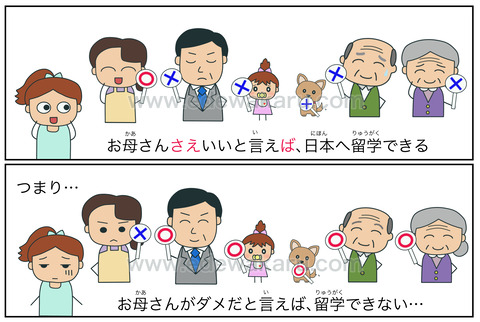
Meaning
(In the form “Aさえ〜ば”)
If A happens, that alone is enough
If A happens, nothing else is necessary
If A happens, there is no problem
If A is OK, everything is OK
How to use it
Verb [ます-form] + さえすれば
い-adjective [drop い] + くさえあれば
な-adjective [drop な] + でさえあれば
Noun [dictionary form] + さえ〜ば
Explanation
“Aさえ〜ば” is a sentence pattern meaning “If A is achieved, that is enough,” “If there is A, there is no problem,” or “If there is A, nothing else is needed.”
It means “If A is OK, everything is OK,” and emphasizes that “If A is no good, everything is no good.”
😮
[Example]
① If Mom says it’s OK, I can study abroad in Japan.
→ Even if Dad, Grandpa, Grandma, or my younger sister says it’s no good, it’s OK as long as Mom says yes.
→ Even if Dad, Grandpa, Grandma, or my younger sister says yes, it’s no good if Mom says no.
Also, the way this pattern connects to anything other than nouns is very complicated, so be sure to learn it well. 😨
[Verbs]
食べる→食べさえすれば
食べている→食べていさえすれば/食べてさえいれば
勉強する→勉強しさえすれば/勉強さえすれば
[い-adjectives]
おいしい→おいしくさえあれば
[な-adjectives]
きれいな→きれいでさえあれば
[For advanced learners]
“〜さえ〜ば” is one sentence pattern, so you cannot change “さえ” to “すら.” 😯
[Example]
⭕️ If Mom says it’s OK, I can study abroad in Japan.
❌ If even Mom says it’s OK, I can study abroad in Japan.
This is an N3 pattern, but its connections are very complicated, so do your best to learn them. 😊
In context 4 examples
お母さんさえいいと言えば、日本に留学できる
→お母さんがいいと言ったら、日本に留学することができるIf Mom says it’s OK, I can study abroad in Japan. → If Mom says it’s OK, I’ll be able to study in Japan.
ゲームさえできれば、それで十分だ
→ゲームができたら、他には何もできなくてもOKだIf I can play games, that’s enough. → If I can play games, it’s OK even if I can’t do anything else.
連絡さえすれば、休んでもいいですよ
→連絡をすれば、休んでも問題はないですよYou can take the day off as long as you let me know. → If you contact me, it’s no problem for you to take the day off.
お金さえあれば幸せだなんて、うそだ(復習:〜なんて)
→お金があれば幸せだなんて、うそだIt’s a lie that you’ll be happy as long as you have money. (Review: 〜なんて) → It’s a lie that you’ll be happy if you have money.
Read the original source text
Meaning
(「Aさえ〜ば」の形で)
Aが実現すればそれで十分だ
Aが実現すれば、他のことは必要ではない
Aが実現すれば、問題はない
AがOKなら、全部OK
How to use it
動詞[ます形]+さえすれば
い形容詞[ーい]+くさえあれば
な形容詞[ーな]+でさえあれば
名詞[辞書形]+さえ〜ば
Explanation
「Aさえ〜ば」は「Aが実現すれば、十分だ」「Aがあれば問題ない」「Aがあれば他は必要ではない」という意味を表す文型です。
「AがOKなら、全部OK」という意味を表す文型で、「Aがダメなら、全部ダメだ」という意味を強調します
😮
[例]
①お母さん
さえ
いいと言え
ば、日本に留学できる
→お父さん・おじいちゃん・おばあちゃん・妹がダメと言っても、お母さんがいいと言えばOK
→お父さん・おじいちゃん・おばあちゃん・妹がいいと言っても、お母さんがダメと言えばダメ
また、この文型は、
名詞以外の接続がとても複雑です
ので、しっかりと覚えておきましょう😨
[動詞]
食べる→食べ
さえすれば
食べている→食べ
ていさえすれば
/食べ
てさえいれば
勉強する→勉強し
さえすれば
/勉強
さえすれば
[い形容詞]
おいしい→おいし
くさえあれば
[な形容詞]
きれいな→きれい
でさえあれば
【上級レベルの人へ】
「〜さえ〜ば」は1つの文型ですので、「さえ」を「すら」にチェンジすることができません😯
[例]
⭕️お母さん
さえ
いいと言え
ば、日本へ留学できる
❌お母さん
すら
いいと言え
ば、日本へ留学できる
N3の文型ですが、接続がとても複雑ですのでがんばって覚えてくださいね😊
Usage 2
Read this source entry ↗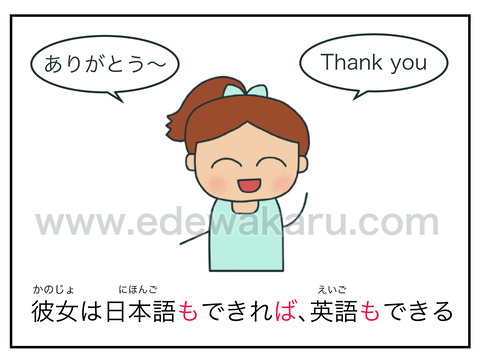
Meaning
Both … and …
How to use it
Noun [dictionary form] + も + verb・adjective [ば-form] + noun [dictionary form] + も
Explanation
「〜も〜ば〜も〜」is used with the same meaning as「〜も〜し〜も〜」. The most basic use is to list 「good thing + good thing」or「bad thing + bad thing」as in examples ①② 😊 As in examples ③④, when using the negative form, it becomes 「〜も〜なければ〜も〜ない」. Also, as in example ⑤, it can be used to list contrasting things, such as 「好き」and「嫌い」, so remember that 😀
【Summary of usage】
・「good thing + good thing」or「bad thing + bad thing」(examples ①②)
・Negative form: 「〜も〜なければ〜も〜ない」(examples ③④)
・Can also be used for contrasting things (such as “like/dislike,” “difficult/easy,” “good/bad”) (example ⑤)
Many people find the ば-form difficult and may feel this pattern is hard to use, but in conversation 「〜も〜し〜も〜」is more commonly used 😉
In context 5 examples
彼女は日本語もできれば、英語もできる【いいこと+いいこと】
→彼女は日本語もできるし、英語もできるShe can speak Japanese, and she can speak English too. 【good thing + good thing】 →She can speak Japanese, and she can speak English too.
このレストランは値段も高ければ、サービスも悪い【悪いこと+悪いこと】
→このレストランは値段も高いし、サービスも悪いThis restaurant is expensive, and the service is bad too. 【bad thing + bad thing】 →This restaurant is expensive, and the service is bad too.
旅行に行きたいが、お金もなければ時間もない【否定形+否定形】
→旅行に行きたいが、お金もないし、時間もないI want to travel, but I have no money and no time. 【negative + negative】 →I want to travel, but I have no money and no time.
彼はお酒も飲まなければ、たばこも吸わない 【否定形+否定形】
→彼はお酒も飲まないし、たばこも吸わないHe neither drinks alcohol nor smokes. 【negative + negative】 →He neither drinks alcohol nor smokes.
犬が好きな人もいれば、嫌いな人もいる【対照的なこと(好き・嫌い)】
→犬が好きな人もいるし、嫌いな人もいるSome people like dogs, while others dislike them. 【contrasting things (like/dislike)】 →Some people like dogs, while others dislike them.
Read the original source text
Meaning
〜も〜し、〜も〜
How to use it
名詞[辞書形]+も+動詞・形容詞[ば形]+名詞[辞書形]+も
Explanation
「〜も〜ば〜も〜」は「〜も〜し〜も〜」と同じ意味で使用されます。1番基本的な使い方は①②のように
「いいこと+いいこと」「悪いこと+悪いこと」を並べて使う
ものですね😊例文③④のように、
否定形を使う場合は「〜も〜なければ〜も〜ない」
となります。また、例文⑤の
「好き」と「嫌い」のように対照的(たいしょうてき)なことを並べて使用する場合
もありますので覚えておきましょう😀
【使い方まとめ】
・
「いいこと+いいこと」「悪いこと+悪いこと」
(例文①②)
・否定形は
「〜も〜なければ〜も〜ない」
(例文③④)
・
対照的なことにも使う
(「好き・嫌い」「難しい・簡単」「いい・悪い」など)(例文⑤)
「ば形」は苦手な人も多く、使いにくく感じるかもしれませんが、会話では「〜も〜し〜も〜」の方がよく使われます😉
Usage 3
Read this source entry ↗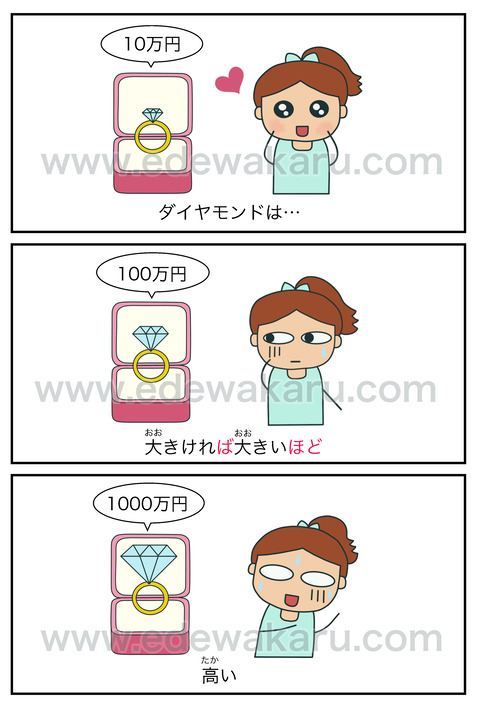
Meaning
In proportion to 〜, further 〜
If 〜, then further 〜
How to use it
Verb or い-adjective [ば-form] + verb or い-adjective [dictionary form] + ほど
な-adjective [であれば form] + な-adjective [〜な or 〜である] + ほど
Noun [であれば form] + noun [〜である] + ほど
Explanation
“AばBほど” is a sentence pattern expressing proportional change or a change in degree, as in “If A, then B also changes in proportion to it.”
[Example]
The bigger a diamond is, the more expensive it is.
In this example, the meaning is that when the size changes, the price also changes in proportion to it: “As a diamond gets bigger, its price also goes up.” 😀
[Additional explanation]
At the N2 level, “〜ば” in “〜ば〜ほど” may be omitted. 😨
[Examples]
① The bigger a diamond is, the more expensive it is.
② The more you study, the better your Japanese gets.
Also, with な-adjectives, forms such as “〜であれば〜なほど,” “〜であれば〜であるほど,” and “〜であればあるほど” can be used. 😮
[Examples]
The easier the test is, the better.
The easier the test is, the better.
The easier the test is, the better.
The easier the test is, the better.
The easier the test is, the better.
There are several forms for な-adjectives, but I think “〜であればあるほど” is used most often. 😀 If you have trouble with the ば-form, review it. 😉
In context 4 examples
ダイヤモンドは大きければ大きいほど高い
→ダイヤモンドは大きさに比例して、(大きくなると)更に高くなるThe bigger a diamond is, the more expensive it is. → In proportion to its size, a diamond becomes even more expensive as it gets bigger.
勉強すれば勉強するほど日本語が上手になる
→勉強するとそれに比例して、更に日本語が上手になるThe more you study, the better your Japanese gets. → As you study, your Japanese gets even better in proportion.
私は、食べれば食べるほど太っちゃうの…(復習:〜ちゃう・〜じゃう)
→私は、食べるとそれに比例して、更に太っちゃうのThe more I eat, the fatter I get... (Review: 〜ちゃう・〜じゃう) → As I eat, I get even fatter in proportion.
テストは簡単であれば、簡単であるほどいい
→テストは簡単だったら更にいいThe easier the test is, the better. → If the test were easy, that would be even better.
Read the original source text
Meaning
〜に比例して、更に〜
〜だったら、更に〜
How to use it
動詞・い形容詞[ば形]+動詞・い形容詞[辞書形]+ほど
な形容詞[であれば形]+な形容詞[ーな・ーである]+ほど
名詞[であれば形]+名詞[ーである]+ほど
Explanation
「AばBほど」は「Aだったら、それに比例してBも〜」というように、【比例変化】【程度の変化】を表す文型です。
[例]
ダイヤモンドは大きけれ
ば
大きい
ほど
高い
この例文では、
「ダイヤモンドは大きさが変わると、それに比例して値段も高くなる」
というように、【大きさ】が変化すると【値段】も比例して変わるという意味を表しています😀
【補足説明】
「〜ば〜ほど」はN2にレベルになると「〜ば」が省略されることがあります😨
[例]
①ダイヤモンドは(大きければ)大きい
ほど
高い
②(勉強すれば)勉強する
ほど
日本語が上手になる
また、「な形容詞」は
「〜であれば〜なほど」「〜であれば〜であるほど」「〜であればあるほど」
などを使うことができます😮
[例]
テストは簡単
であれば
簡単な
ほど
いい
テストは簡単
であれば
簡単
であるほど
いい
テストは(簡単であれば)簡単な
ほど
いい
テストは(簡単であれば)簡単
であるほど
いい
テストは簡単
であればあるほど
いい
「な形容詞」はいくつかの形がありますが、
「〜であればあるほど」が一番よく使われると思います
😀「ば形」が苦手な人は復習をしておいてくださいね😉
どんなときどう使う 日本語表現文型辞典
Usage 1
Meaning
if
How to use it
Vば / i-adjective ければ / na-adjective or Noun なら(ば)
Explanation
ば〈条件〉
巻末の活用表参照1)「ば・なら(ば)」は仮定条件を表す。動詞とイ形容詞には「ば」を使い、ナ形容詞と名詞の肯定形には「なら」を使う。「なら」は❼のように「ならば」の形で使うこともある。
2)「ば」の動詞が状態性の動詞(ある・いる・できる)以外の場合は、後の文には話す人の意志・依頼などを表す文は使わない。
◆ × もし熱が出れば、この薬を飲んでください。→○もし熱が出たら、この薬を飲んでください。
3)しかし「~」が状態性の言葉(動詞の「あれば・いれば」、動詞の否定形「食べなければ」、形容詞「安ければ」など)の場合にはこの制限はなくなる。
1)Pattern ば・なら(ば) is a conditional. Verbs and イ-adjectives take ~ばナ-adjec-tives and affirmatives of nouns take なら. As in sentence ❼, なら can be used interchangeably with ならば.
2)When ~ば verb is not verb of state (ある, いる, できる), second clause does not include speaker's volition or requests.
In context 7 examples
よく読めば、わかります。
If you read it carefully, you’ll understand.
この本はむずかしいことが書いてあるから、よく読まなければ、わからないよ。
This book has difficult things written in it, so if you don’t read it carefully, you won’t understand.
明日、天気がよければテニスをしますが、よくなければうちでDVDでも見ます。
If the weather is good tomorrow, I’ll play tennis, but if it isn’t, I’ll watch a DVD or something at home.
このDVD、とてもよかったよ。もし見たければ、貸してあげるよ。
This DVD was really good. If you want to watch it, I’ll lend it to you.
あさって、休みでしょう。もしひまなら、映画を見に行きませんか。
The day after tomorrow is a day off, right? If you’re free, would you like to go see a movie?
部屋が静かでなければ、わたしは勉強できません。
If the room isn’t quiet, I can’t study.
もしその人がいい人ならば、いっしょに仕事をしたい。
If that person is a good person, I’d like to work with them.
Read the original source text
Meaning
if
How to use it
Vば/イAければ/ナNなら(ば)/Nなら(ば)
Explanation
ば〈条件〉
巻末の活用表参照1)「ば・なら(ば)」は仮定条件を表す。動詞とイ形容詞には「ば」を使い、ナ形容詞と名詞の肯定形には「なら」を使う。「なら」は❼のように「ならば」の形で使うこともある。
2)「ば」の動詞が状態性の動詞(ある・いる・できる)以外の場合は、後の文には話す人の意志・依頼などを表す文は使わない。
◆ × もし熱が出れば、この薬を飲んでください。→○もし熱が出たら、この薬を飲んでください。
3)しかし「~」が状態性の言葉(動詞の「あれば・いれば」、動詞の否定形「食べなければ」、形容詞「安ければ」など)の場合にはこの制限はなくなる。
1)Pattern ば・なら(ば) is a conditional. Verbs and イ-adjectives take ~ばナ-adjec-tives and affirmatives of nouns take なら. As in sentence ❼, なら can be used interchangeably with ならば.
2)When ~ば verb is not verb of state (ある, いる, できる), second clause does not include speaker's volition or requests.
Usage 2
Meaning
the more…the more; the less…the less
How to use it
Vば + Vる / i-adjective ければ + i-adjective い / na-adjective なら + na-adjective な + ほど
Explanation
ば~ほど
~すれば…になり、もっと~すればもっと…になる
1)「一方の程度が変われば、それとともに他方も変わる」と言いたいときの表現。ナ形容詞の場合は「~なら~なほど」となる。
2) ❺ のように、普通予想することと反対の結果となる場合にも使う。
1)As degree of one thing changes, so does another. ナ-adjectives become ~なら~なほど.
2)Also used for results contrary to what is usually expected, as in sentence ❺ .
In context 5 examples
山は登れば登るほど、気温が低くなる。
The higher you climb the mountain, the lower the temperature gets.
お礼の手紙を出すのは早ければ早いほどいい。
The sooner you send a thank-you letter, the better.
毎日使う道具の使い方は簡単なら簡単なほどいい。
The simpler the way to use a tool you use every day, the better.
このABC社で仕事をするには、外国語が上手なら上手なほどいい。
When working at ABC Company, the better you are at foreign languages, the better.
あの人の話は聞けば聞くほどわからなくなる。
The more I listen to that person’s story, the less I understand.
Read the original source text
Meaning
the more…the more; the less…the less
How to use it
Vば+Vる/イAければ+イAい/ナAなら+ナAな+ほど
Explanation
ば~ほど
~すれば…になり、もっと~すればもっと…になる
1)「一方の程度が変われば、それとともに他方も変わる」と言いたいときの表現。ナ形容詞の場合は「~なら~なほど」となる。
2) ❺ のように、普通予想することと反対の結果となる場合にも使う。
1)As degree of one thing changes, so does another. ナ-adjectives become ~なら~なほど.
2)Also used for results contrary to what is usually expected, as in sentence ❺ .
Usage 3
Meaning
would have
How to use it
Vば / i-adjective ければ / na-adjective なら(ば) / Noun なら(ば) + ~(のに)
Explanation
ば~(のに)〈反実仮想〉
B:それで遅れたんですか。山崎さんといっしょに来ればよかったのに。
1)「~ば、…のに/けれど」の形で、「~ば」で事実とは違うことを仮想して、「…」で実現しなかったことなどについて、残念な気持ちやよかったという気持ちなどを述べる。
2)ナ形容詞と名詞では「なら(ば)」となる。
3)文末は「よかった・のに・けれど」などの表現が多い。
1)Speaker imagines some event contrary to fact before ば~のに/けれど, then expresses after pattern feelings of regret or gladness that event was not realized.
2)With ナ-adjectives and nouns becomes なら(ば).
3)Often sentence endings take よかった (good), のに (would have been), or けれど (but).
In context 3 examples
A:ごめんなさい。きのうは、会議の場所を間違えて、遅くなったんです。
A: I’m sorry. Yesterday, I went to the wrong meeting place and was late.
試合のとき、山田君がもっと元気なら勝てたのに。
If Yamada had been more energetic during the game, we could have won.
店できれいなセーターを見た。もっと安ければ買ったんだけれど……。
I saw a beautiful sweater at the store. If it had been cheaper, I would have bought it…
Read the original source text
Meaning
would have
How to use it
Vば/イAければ/ナAなら(ば)/ Nなら(ば)+~(のに)
Explanation
ば~(のに)〈反実仮想〉
B:それで遅れたんですか。山崎さんといっしょに来ればよかったのに。
1)「~ば、…のに/けれど」の形で、「~ば」で事実とは違うことを仮想して、「…」で実現しなかったことなどについて、残念な気持ちやよかったという気持ちなどを述べる。
2)ナ形容詞と名詞では「なら(ば)」となる。
3)文末は「よかった・のに・けれど」などの表現が多い。
1)Speaker imagines some event contrary to fact before ば~のに/けれど, then expresses after pattern feelings of regret or gladness that event was not realized.
2)With ナ-adjectives and nouns becomes なら(ば).
3)Often sentence endings take よかった (good), のに (would have been), or けれど (but).
日本語文型辞典 英語版
Meaning
【ば】[N/Na なら(ば)][A-ければ][V-ば]ば is a conjugation form for predicates and indicates a condition. It is the most typical marker for conditional clauses in Japanese, and its usage overlaps partially with that of たら, と, and なら.
When this conditional follows a noun or a na-adjective, ば is often dropped and the form N/Naなら is used. N/Naであれば is a formal, written expression for N/Naなら. The negative form N/Naでなければ is used in both written and spoken Japanese. The i-adjective いい always takes the form よければ, not いければ.
ば is usually used the same way as たら. However, ば tends to be used more in written Japanese, while たら is used more in spoken Japanese. In casual spoken language, sometimes the combination of “consonant + eba” at the end of a word changes to “consonant + ya” (e.g. あれば→ありゃ, 行けば→行きゃ, 飲めば→飲みゃ, なければ→なけりゃ), and the combination A-ければ may change to A-きゃ (e.g. なければ→なきゃ).
Used to state a conditional relation regarding a general state of affairs, not a specific person or thing. Means “when X happens, Y also happens, without exception.” Expresses logical or rule-based relations or cause-and-effect relations that are not situated at a particular point in time but always hold true. The dictionary form is always used at the end of the sentence. Not used to talk about a personal experience or one particular event. Used to say that “when X is realized, Y is the natural consequence,” “such-and-such generally happens,” or “something is intrinsically such-and-such.”
When this expression is used, the subject is often omitted. When the subject appears, it is one that refers to some kind of group as a whole, such as 人はだれでも (everyone/all people) or Nというものは (N in general). This use of the ba-form is often followed at the end of the sentence by ものだ, which indicates that the thing in question intrinsically has a certain nature, as exemplified in
(6)
and
(7)
. Often used in proverbs and maxims as well, as in
(9)
-
(11)
.
a. ...ば... V-る
This usage of the ba-form has the dictionary form of an action verb at the end of the sentence. Expresses a current habit or a repeated action of a definite subject.
b. ...ば... V-た
This usage of the ba-form expresses a past habit of a definite subject, or a state/event that always took place under some particular circumstances in the past. Means “someone used to do/always did...in the past,” “if someone did A, then B was always the case.” Sometimes used with V-たものだ, which indicates recollection, as shown in
(1)
and
(2)
.
In the pattern ...ば...V-た, the ba-form can also indicate a state or event contrary to the actual situation, as in
(4)
. The difference between counter-factual ば and repetitive/habitual ば is that the latter states a fact that has actually been realized.
Like ば, たら can also be used to state a past fact. However, while ば expresses an action that was repeated in the past or a situation that was always realized under certain conditions, たら usually expresses a past event that took place one time only.
(例1)ビールを2本飲めば酔っぱらいました。
Whenever I drank two bottles of beer, I got drunk.
(例2)ビールを2本飲んだら酔っぱらいました。
When I drank two bottles of beer, I got drunk.
(1)
above means “when I drank two bottles, I always/without exception got drunk.” This expresses an event that was repeated in the past. In contrast,
(2)
means “when I happened to drink two bottles, I got drunk” and expresses a past event that occurred once.
The generic conditional ば described in Usage 1 is used to talk about things or events in general and is always accompanied by the dictionary form of a predicate at the end of the sentence. On the other hand, the hypothetical conditional ば is used to apply a general condition to a particular situation and state a prediction. It can be combined with expressions such as だろう and かもしれない at the end of the sentence.
(例)〈一般条件〉食事を減らせば誰でもやせる。
〈generic condition〉If you reduce your food intake at meals, anyone can lose weight.
(例)〈仮定条件〉食事を減らせばあなたもやせるだろう。
〈not-yet-realized condition〉If you reduce your food intake at meals, you too will lose weight.
The slot for Y in this pattern may be filled by a statement describing an unrealized situation, an expression of intention or command, or some other expression that reveals the speaker’s thoughts/feelings or his/her desire to exert an influence on someone.
a. ...ば+未実現のことがら
Used with respect to a specific person or thing and means “if X happens, of course Y will also happen.” Y refers to an unrealized situation or event and is often combined with an expression of supposition or prediction at the end of the sentence, such as だろう, にちがいない, はずだ, かもしれない, or 思う.
In
(1)
-
(3)
, the speaker assumes X, which has not (yet) been realized, and makes supposition Y, which is something that should happen under condition X.
(4)
-
(6)
are cases in which X has already been realized. Here the ba-form expresses the notion that “if a situation like this has actually occurred, then Y should naturally occur as well.”
When the speaker is quite certain that Y will be realized, the non-past declarative form of a predicate can be used at the end of the sentence, as shown below.
B:それだけ飲めば、気分も悪くなるよ。
If you’ve drunk that much, you will feel bad.
ば is often used to say that X is a necessary and sufficient condition for the realization of Y. In
(8)
, it takes the pattern Xさえ...ばY and expresses the meaning “in order to realize Y, it is sufficient to realize X.” In
(9)
, it is used to state what must be done in order to obtain a desired result, and in
(10)
it means “when you’ve drunk so much, it’s no surprise that you feel bad.”
All of these are ultimately examples of the generic condition “if X, then definitely Y” being applied to specific cases. For instance, in
(10)
, the generic condition “anyone who drinks too much will start to feel bad” is applied to a particular addressee’s case, in order to convey the message “if you too drink so much, it’s only natural that you feel sick.”
b. ...ば+意志・希望
B:いいね。すこしぐらい天気が悪くても行こうよ。
Sounds good. Even if the weather isn’t quite perfect, let’s go.
B:そうだな、ビールがあれば飲みたいな。
Well, if you have beer, I’d like some.
ば is used in the pattern Xば...しよう/したい, where Y expresses the speaker’s intention or desire, and the range of predicates that can appear in X is restricted. The general tendency is that there is no difficulty if the predicate in X is stative, but use of a verb that expresses an action or change of state often sounds unnatural.
(1)
-
(5)
contain stative predicates, including i-adjectives, ある, and V-ない, so ば can be used with no problem. In
(6)
-
(10)
, X expresses an action or change of state, but it is still possible to use ば. This has to do with the fact that
(6)
expresses the same action on the part of both the listener and the speaker, and
(7)
and
(8)
, which mean “if you do X, I will do Y in return,” are cases of the speaker making a promise to the listener in exchange for something. The ば clause in
(9)
means “I don’t know whether I can finish reading it or not, but.../I may not be able to finish reading it, but if I can...,” and the one in
(10)
means “supposing it were to rain.” These expressions are used when the speaker has doubts about whether or not X will definitely occur, or when s/he takes into account the possibility that X will not occur.
So, in cases like
(6)
-
(10)
, ば can be used even though X expresses an action or change of state. However, when X expresses a future plan which involves a sequence of actions that progress over time, ば cannot be used. For example, if
(9)
is intended to mean “after I finish reading this book, then I’ll read the next,” たら must be used instead of ば.
(×)この本を読めば次にこの本を読みます。
If I read this book, I’ll read that book next.
(○)この本を読んだら次にこの本を読みます。
After I read this book, I’ll read that book next.
c. ...ば+働きかけ
ば is followed by an expression that requires the listener to perform an action, such as a command, prohibition, permission, invitation, or request. In general, when an “exertion-of-influence” expression like one of these appears at the end of the sentence, it is unlikely that an action or change-of-state verb can be used in X, and the range of verbs that can be used is even more restricted than when Y is an expression of intention or desire.
ば can be used when it is followed by a stative predicate such as V-たい, Vない, or ある, as is the case in examples
(1)
-
(6)
. In
(7)
, the change-of-state verb 終わる is used with ば and followed by an expression of request. This sentence conveys the meaning “you might not finish, but supposing you are able to...” and indicates that the speaker has doubts or a negative feeling about the possibility that the listener will finish. In cases like this, ば may sometimes be used.
However, in general, when X expresses an action or change, and the speaker instructs the listener to perform a second action (after the first action/change has taken place) or prohibits that action, ば cannot be used. たら should be used instead.
(×)駅に着けば迎えに来てください。
If you arrive at the station, please come to pick me up.
(○)駅に着いたら迎えに来てください。
When you arrive at the station, please come to pick me up.
(×)お酒を飲めば運転するな。
If you drink, don’t drive.
(○)お酒を飲んだら運転するな。
When you drink, don’t drive.
d. ...ば+問いかけ
B:大人料金の2割引になります。
It will be twenty percent off the adult price.
B:何か贈り物をして丁寧にあやまるのが一番ね。
The best thing you can do is give him some kind of gift and apologize politely.
B:2週間ぐらいですね。
About two weeks.
B:神田の古本屋を探せば、一冊ぐらいはあるかもしれませんね。
If you go to the used bookstores in Kanda, you may be able to find a copy.
The pattern XばYか expresses a question seeking an answer from the listener.
(1)
-
(3)
are yes-no interrogative sentences, and
(4)
-
(6)
are interrogative sentences with question words such as どう (how) and どこ (where). In the latter case, ば is often used in the form どうすればYか, to ask about the means or method X that can be used in order to achieve the good result Y. On the other hand, when the speaker is asking what to do when X has occurred, it is more natural to use たら, and using ば often results in an unnatural or anomalous expression.
(×)雨が降ればどうしますか。
What will you do if it rains?
(○)雨が降ったらどうしますか。
What will you do if it rains?
e. 疑問詞+V-ば...のか
This is a rhetorical expression that consists of a question word such as 何 (what), どれだけ (how much), or どんなに (how/however) followed by the ba-form of a verb. It means “no matter how much I do..., things don’t go the way I want them to,” and it expresses the speaker’s sense of exasperation or desperation regarding a certain situation. Expressions like のか, のだ, and のだろう(か) are used at the end of the sentence. V-ば can be replaced by V-たら.
When this pattern is used to say that a desired situation has not been realized, it conveys a feeling of regret or disappointment. On the other hand, when it is used to say that an undesirable situation has been avoided, it implies the speaker’s feeling of relief, as in “it’s a good thing such-and-such didn’t happen.”
In many cases, it is impossible to distinguish a counter-factual use from a factual one on the basis of form alone. However, the patterns below are often used in counter-factual conditional sentences. Also, this usage of ば can always be substituted with たら.
a. ...ば ...のに/...のだが
B:うまくいっていれば、こんな不機嫌な顔はしていないさ。(試験に失敗したから、こんな不機嫌な顔をしている。)
If it had gone well, I wouldn’t look this crabby. (Because I failed the exam, I look this crabby.)
The pattern XばYのに/のだが/のだけれど is a counter-factual conditional sentence. The predicate in Y takes either the dictionary form or the ta-form.
(1)
and
(2)
are examples of the former. These express that the speaker desires something that is different from the present situation, regrets this situation, etc. In
(3)
the speaker uses the ta-form to hypothesize a past situation that is different from what actually happened and to state that, if the hypothetical situation had been realized, the result would have been different.
(4)
illustrates the pattern V-ていればV-ている, which is used to state a hypothesis, with regard to a situation that has already been realized, that if things had been different the present situation would not have arisen.
As shown in
(1)
-
(3)
, when an expression like のに, のだが, or のだけれど appears at the end of the sentence, it is clear that the sentence is a counter-factual conditional. However, such expressions are not always used, as seen in
(4)
.
b. ...ば ...だろう/...はずだ
Used to speculate about a situation or event that could have happened, if things had been different. An expression of prediction or conjecture, such as だろう, はずだ, かもしれない, にちがいない, or と思う, is used at the end of the sentence.
When the expression of prediction or conjecture is preceded by the ta-form of a predicate, as in
(1)
-
(5)
, it means that the actual past situation differs from the one expressed by the predicate. When the dictionary form is used, as in
(6)
, it means that the present situation differs from the one expressed by the predicate.
c. ...ば...ところだ(った)
In this pattern, ば is followed at the end of the sentence by an expression like V-るところだった, V-ていたところだ, or V-ていたところだった.
...ばV-るところだ is used to hypothesize an unrealized situation or event Y, which would likely be realized if the situation were different from X.
(1)
is such an example; it means “I’m not actually young so I can’t go, but I am almost inclined to do so.”
...ばV-ていたところだ means “if the situation had been different, I would have done such-and-such/such-and-such would have happened.” Expresses a potential situation in the past, as exemplified in
(2)
.
...ばV-るところだった, shown in
(3)
and
(4)
, is used when an event that would have happened under different circumstances was avoided just before it takes place. Used when the speaker feels relieved that it was possible to avoid an unfavorable outcome.
忘れていたところだった in
(5)
can be rephrased as 忘れているところだった. However, the former expresses a past situation, with the sense of “I managed not to forget,” while the latter expresses a present situation, with the sense of “I’ve managed to remember.”
→
【ところだ】2d. ...ば V-た/V-ていた
In this pattern, ば takes the ta-form of a verb at the end of the sentence and expresses a counter-factual situation or event. Used with respect to a past situation, to hypothesize an action that was not actually performed or a state that differs from reality, and to express a situation or event that would have occurred under the hypothetical circumstances.
(2)
, for instance, means “if I had come earlier, I would have been in time; however, since I actually came late, I was not in time.”
In general, counter-factual conditional sentences often end with expressions like のに/のだが/のだけれど, or だろう/かもしれない/はずだ/にちがいない/と思う, or ところだ(った), as shown in patterns (a)-(c) above. However, there are cases in which no such expression is used, as shown in this pattern (d). Note that when the ta-form is used in sentence-final position, in particular, conditional sentences with ば and たら may express different meanings.
(例1)ボタンを押したら爆発した。
When I pressed the button, it exploded.
(例2)ボタンを押せば爆発した。
If I had pressed the button, it would have exploded.
Example 1, which means “I pressed the button. Then it exploded,” expresses an event that actually took place. On the other hand, example 2 is a counter-factual conditional sentence that means “If I had pressed the button, it would have exploded, but I didn’t actually press the button, so it didn’t explode.”
The pattern XばY is used to express that the speaker realized Y at the time X occurred. For this usage, たら and と are more usual, and the use of ば is restricted to somewhat old-fashioned literary expressions such as those found in poetry and novels. When this pattern is used in spoken Japanese, it usually takes the form V-てみれば and expresses the speaker’s understanding or acceptance after learning the truth about something, with the sense of “that is quite right” or “of course, it stands to reason.”
In
(1)
-
(3)
, ば can be replaced by たら, but when たら is used, it means “as a result of taking such-and-such an action, I realized something.” For example, when ば in
(1)
is replaced by たら to say 会ってみたら、うわさほどのことはなかったよ, the たら sentence means “as a result of meeting him, I found out that he was not as (strange) as was rumored.” Thus, when a speaker is describing a new realization just the way it happened, s/he usually uses たら or と; if ば is used, it often sounds unnatural.
(×)昨日、台所で変な音がするので泥棒かと思って行ってみれば、弟がラーメンを作っていた。
Yesterday I heard a strange noise in the kitchen so I thought it might be a thief, but if I went to see, my brother was making raamen noodle soup.
(○)昨日、台所で変な音がするので泥棒かと思って{行ってみたら/行ってみると}、弟がラーメンを作っていた。
Yesterday I heard a strange noise in the kitchen so I thought it might be a thief, but when I went to see, my brother was making raamen noodle soup.
(×)朝起きれば、雨が降っていた。
If I got up in the morning, it was raining.
(○)朝{起きたら/起きると}、雨が降っていた。
When I got up in the morning, it was raining.
When talking about one person who performs two actions in succession, one time only, と should be used, not ば or たら. See the example below.
(×)次郎は家に{帰れば/帰ったら}、テレビを見た。
If Jiro came home, he watched TV.
(○)次郎は家に帰ると、テレビを見た。
When Jiro came home, he watched TV.
The same verb or adjective is repeated in this pattern, which is used to say that situations that should contrast with each other are essentially the same. For instance,
(1)
means “if I had a car, it would be convenient, but even without a car, I don’t have as much trouble as I’d expected,”
(2)
means “My father complains, regardless of whether it is hot or cold,”
(3)
means “Money is always troublesome, whether you have it or not,” and
(4)
means “Children make us worry while they’re small and also after they’ve grown up.” In
(4)
, it is possible to omit the second use of 大きく and say 大きくなればなったで instead. ...たら...で is a synonymous expression.
a. ...ば+request, recommendation
B:はい、3時に終了いたしました。よろしければ、来週の火曜にも説明会がございますが。
Yes, it was over at three. If it’s convenient for you, there will be another briefing next Tuesday.
The expressions above in ba-form are idiomatic expressions used to make requests, recommendations, or suggestions. They show the speaker’s consideration for the listener’s situation or feelings. They mean “as long as it is not contrary to your convenience or intentions.” These are polite expressions that convey the speaker’s reservation—that is, the attitude that it is not necessary for the listener to act on the request, suggestion, etc., if it is inconvenient for him/her or if s/he does not want to do it.
b. ...ば〈viewpoint〉
B:うん。でも正直言えば、本当は行きたくないんだ。
Yeah. But to be honest, I really don’t want to.
Verbs of utterance, thought, or comparison, such as 言う (say/speak), 思う (think), and 比べる (compare), are used in the ba-form to give advance warning or explanation of the perspective or standpoint from which the statement or judgment that follows will be made.
The ba-form expressions in
(1)
and
(2)
can be rephrased as 正直言って/言うと/言ったら and 比べて/比べると/比べたら, respectively.
(3)
can be rephrased as 考えてみると/みたら. The expression 思えば in
(4)
, which means “when I think about it once again,” is used to take an emotional look back at the past. It cannot be rephrased with the te-form, たら, or と.
As noted above, this usage of the ba-form consists mostly of idiomatic expressions that are rather fixed. Additional examples include はっきり言えば (frankly speaking/to put it bluntly), 極端に言えば (to put it in extreme terms), からみれば (from the viewpoint of), からすれば (from the standpoint of), and so on.
A:これなんかどうかなあ。
What about this one?
B:着てみれば。
Why don’t you try it on?
B:そんなに痛いの? 会社休めば。
That bad, huh? Why don’t you take a day off?
B:教えてあげれば。
Why don’t you tell him?
V-ば is pronounced with rising intonation and used to suggest that the listener take a particular action. When the speaker ends a sentence with V-ば, it often sounds like s/he is unconcerned or has only passing interest in the matter at hand. Can be substituted with V-たらor V-たらどう. Used in casual spoken Japanese.
This pattern is used to list similar items for emphasis, as shown in
(1)
-
(3)
, or to list contrasting items in order to express that there is a variety of cases, as shown in
(4)
and
(5)
. These examples can be paraphrased using ...し, as in 酒も飲むしたばこも吸う (he drinks and moreover he smokes). Also, the first instance of も can be changed to が, as in 動物の好きな人がいれば嫌いな人もいる (some people like animals, but others don’t).
1
1
1
1
1
1
1
1
1
2
1
→
1
1
【とすれば1】、
1
2
2
【なら1】、
【なら2】、
2
2
2
→
【ほど】4b
2
→
【も】4d
2
【も】10
How to use it
1. ...ば〈generic condition〉[...ば N/Na だ][...ば A-い][...ば V-る]
2. ...ば〈repetition, habit〉Used with respect to a particular person or thing and expresses a habit or an action that is repeated. Means “every time X happens, Y happens too,” “whenever X is done, Y is invariably done as well.” The difference between this usage and the generic conditional described in 1 is that the generic conditional, which describes a situation that has an indefinite subject and transcends time, is always used with the dictionary form of a predicate at the end of the sentence, whereas the repetitive/habitual conditional can be used with not only the dictionary form but also the ta-form. This conditional is used to describe a habit or a repeated action of a definite subject.
3. ...ば〈not-yet-realized condition〉Expresses the relation “if X happens, Y will happen,” with respect to a particular thing or person. X can be something that either has or has not been realized, but Y is always something that has not yet been realized.
4. ...ば〈counter-factual〉A statement of something contrary to fact comes before ば, and after ば comes a description of something that should (have) happen(ed) if the situation were the opposite. Used to talk about an undesirable situation that has already been realized, or about a situation that is obviously impossible to realize.
5. ...ば〈already-realized condition〉
6. ...ば...で[A-ければ A-いで][V-ば V-たで]
7. ...ば〈introductory utterance〉This pattern is used to indicate in advance the conditions under which the following statement will be made, or to give advance warning or explanation of something. It includes idiomatic expressions that are rather fixed. In most cases, ば can be replaced by たら.
8. V-ば〈suggestion, recommendation〉
9. ...も...ば...も
0. おもえば→
1. ...かとおもえば→
2. ...からいえば→
3. ...からすれば→
4. ...からみれば→
5. さえ...ば→
6. ってば
7. ...といえば→
8. ...とすれば→
9. ...となれば→
0. ...ともなれば→
1. ...ならば→
2. ...にいわせれば→
3. ...にしてみれば→
4. ...ば...ほど
5. ...も...ば
6. ...も...あれば...もある→
In context 103 examples
春が来れば花が咲く。
When spring comes, flowers bloom.
10 を2で割れば5になる。
When you divide ten by two, you get five.
台風が近づけば気圧が下がる。
When a typhoon approaches, the atmospheric pressure drops.
年をとれば身体が弱くなる。
People get weaker with age.
経済状態が悪化すれば犯罪が増加する。
When the economy deteriorates, the crime rate increases.
人間というものは、余分な金を持ち歩けばつい使いたくなるものだ。
If people carry around extra money, they will want to spend it.
信じていれば夢はかなうものだ。
If you believe in your dream, it will come true.
だれでもほめられればうれしい。
Everyone is happy when praised.
風がふけば桶屋がもうかる。
Bliss often falls into the hands of an unexpected person. (lit. “If the wind blows, the bucket-maker profits.”)
犬が西向きゃ尾は東。
If a dog faces west, its tail will point east. (used to emphasize that something is obvious or a matter of course)
終りよければすべてよし。
All’s well that ends well.
祖母は天気がよければ毎朝近所を散歩します。
My grandmother takes a walk in the neighborhood every morning, if the weather is nice.
彼は暇さえあればいつもテレビを見ている。
Whenever he has time, he always watches television.
父は私の顔を見れば「勉強しろ」と言う。
Whenever my father sees me, he says “Go study!”
愛犬のポチは主人の姿を見ればとんでくる。
My pet dog, Pochi, always runs to me (= his master) when he sees me.
子供のころは、天気がよければ、よく母とこの河原を散歩したものだ。
When I was a child, I often used to take walks with my mother along this riverbed, if the weather was nice.
学生のころは暇さえあればお酒を飲んで友達と語り明かしたものだ。
When I was a college student, whenever I had time I used to drink and talk with my friends all night long.
父は東京へ行けば必ずお土産を買ってきてくれた。
My father used to buy me a souvenir every time he went to Tokyo.
20 年ほど前には、街から少し離れれば、いくらでも自然が残っていた。
Twenty years ago, if you went just a little way out of the city, there were still plenty of places where the natural environment remained untouched.
もし私が彼の立場なら、やっぱり同じように考えるだろう。
If I were in his shoes, I would think the same.
もし天気が悪ければ、試合は中止になるかもしれない。
If the weather is bad, the match may be canceled.
手術をすれば助かるでしょう。
If you have surgery, you will probably recover.
こんなに安ければ、きっとたくさん売れると思う。
If it is this inexpensive, I’m sure it will sell well.
それだけ成績がよければ、どの大学にでも入学できるはずです。
If your grades are that good, you should be able to get into any university.
ふだん物静かな夫がめずらしく、一時間も説教していた。あれだけ叱られれば、息子も少しは反省するにちがいない。
Surprisingly, my usually quiet husband lectured our son for a whole hour. Having been given such a talking-to, surely our son will reflect on his conduct at least a little.
応募人数が多ければ抽選になります。
If there is a large number of applicants, the selection will be made by lottery.
うっかりミスさえしなければ必ず合格できますよ。
If you just don’t make any careless mistakes, you will definitely pass.
食事の量を減らして運動をすれば、2、3キロぐらいはすぐ減りますよ。
If you reduce your food intake and get some exercise, you will soon lose two or three kilograms.
A:気分が悪くなってきたよ。
I’m starting to feel sick.
安ければ買うつもりです。
If it is inexpensive, I intend to buy it.
A:こんどの日曜日、天気がよければハイキングに行こうよ。
If the weather is nice, let’s go hiking next Sunday.
A:なにか飲む?
Do you want something to drink?
レポートを提出しなければ、合格点はあげません。
If you don’t submit a paper, I won’t give you a passing grade.
田中さんが行かなければ、私も行かない。
If Tanaka-san isn’t going, I won’t go either.
田中さんが行けば、私も行く。
If Tanaka-san is going, I’ll go too.
掃除を手伝ってくれればおこづかいをあげる。
If you help me with the cleaning, I’ll give you some spending money.
お電話くださればお迎えに上がります。
If you telephone me, I will come to meet you.
もし、今学期中にこの本を読み終われば、次にこの本を読みます。
If I can finish reading this book this term, I’ll read that book next.
もし雨が降れば中止しよう。
If it rains, let’s cancel it.
そう思いたければ勝手に思え。
If that’s what you want to think, go right ahead!
やりたくなければやるな。
Don’t do it if you don’t want to.
宿題をすませなければ遊びに行ってはいけない。
Unless you finish your homework, you can’t go out to play.
飲みたくなければ飲まなくてもいい。
If you don’t want to drink, you don’t have to.
お時間があれば、もう少しゆっくりしていってくださいよ。
If you have time, please stay for a little while longer.
明日、天気がよければ海に行きませんか。
If the weather is nice tomorrow, shall we go to the beach?
7時までに仕事が終われば、来てください。
If you’re finished work by seven, please come.
A:学生ならば、料金は安くなりますか。
If you’re a student, is the charge lower?
この病気は手術をすれば治りますか。
Will this illness be cured if I have an operation?
あやまれば許してくれるでしょうか。
If I apologize, will she forgive me?
A:どうすれば機嫌を直してくれるかしら。
What can I do to restore his good humor?
A:どのぐらい入院すればよくなるでしょうか。
How long will I have to stay in the hospital to recover?
A:どこに行けばその本を見つけることができるでしょうか。
I wonder where I can go to find that book.
いったいどういうふうに説明すれば分かってもらえるのか。
How in the world should I explain it, to make him understand?
何年勉強すればあんなに上手に英語がしゃべれるようになるのだろう。
I wonder how many years I should study English in order to be able to speak as fluently as that.
どれだけ待てば、手紙は来るのか。
How long should I wait for the letter to come?
人間、一体何度同じ過ちを繰り返せば、気がすむのであろうか。
How many times do human beings have to repeat the same mistake until they are satisfied?
宿題がなければ夏休みはもっと楽しいのに。(残念なことに宿題がある。)
If there were no assignments, my summer holiday would be more enjoyable. (Unfortunately, I do have assignments.)
お金があれば買うんだけどなあ。(お金が無いから買えない。)
If I had the money, I would buy it. (Because I don’t have the money, I can’t buy it.)
お金があれば買えたんだが。(お金がなかったので買えなかった。)
If I had had the money, I could have bought it. (Because I didn’t have the money, I couldn’t buy it.)
A:試験うまくいった?
Did your exam go well?
地震の起こるのがあと1時間遅ければ被害はずっと大きかっただろう。
If the earthquake had happened one hour later, the damage would have been far more extensive.
気をつけていれば、あんな事故は起きなかったはずだ。
If she’d been more careful, an accident like that wouldn’t have happened.
発見がもう少し遅ければ助からなかったかもしれない。
If he had been found a little later, he might not have been saved.
あの時すぐに手術をしていれば、助かったにちがいない。
If she had had an operation right away at that time, she would certainly have recovered.
彼が止めに入らなければ、ひどい喧嘩になっていたと思う。
I think it would have turned into a terrible fight, if he had not stepped in to stop it.
あの時、あの飛行機に乗っていれば、私は今ここにいないはずだ。
If I had taken that flight then, I would not be here now.
もう少し若ければ、私が自分で行くところだ。
If I were a little younger, I would be ready to go myself.
あのとき、あの飛行機に乗っていれば私も事故に巻き込まれていたところだ。
If I had taken that flight then, I would have been caught up in the accident too.
今日の授業は突然休講になったらしい。田中が電話をしてくれなければ、もう少しで学校に行くところだった。
Apparently today’s class was canceled without notice. If Tanaka hadn’t called me, I would have been on my way to school in a little while.
電車がもう少し早く来ていれば大惨事になるところだった。
If the train had arrived a little earlier, it would have been a terrible disaster.
注意していただかなければ忘れていたところでした。
If you hadn’t reminded me, I would have forgotten.
安ければ買った。
If it had been inexpensive, I would have bought it.
もっと早く来れば間に合った。
If I had come earlier, I would have been in time.
手当てが早ければ、彼は助かっていた。
If he had been treated sooner, he would have been saved.
きちんとした説明があれば、私も反対しなかった。
If a proper explanation had been given, I wouldn’t have objected either.
彼は変わり者だという評判だったが、会ってみれば、うわさほどのことはなかった。
He had the reputation of being quite a strange character, but when I met him, he was not half as strange as was rumored.
言われてみればそれももっともな気がする。
Now that you say so, I think that’s a good point too.
始める前は心配だったが、すべてが終わってみれば、それほど大したことではなかったと思う。
I was worried before I started, but now that it’s all over, I don’t think it was such a big deal.
自動車がないとさぞ不便だろうと思っていたが、なければないでやっていけるものだ。
I thought it would be very inconvenient to live without a car, but I can actually manage without one.
父は暑さに弱い。それでは冬が好きかというとそうではない。寒ければ寒いで文句ばかり言っている。
My father can’t take the heat. But that doesn’t mean he likes winter. Once it gets cold, he does nothing but complain about it.
金などというものは、無ければ困るが、あればあったでやっかいなものだ。
Money is something that is trouble if you don’t have any, but a nuisance if you do have some.
子供が小さい間は、病気をしないだろうかちゃんと育つだろうかと心配ばかりしていたが、大きくなれば大きくなったで、受験やら就職やら心配の種はなくならない。
When my children were little, I fretted over whether they would get sick or grow up the right way. Now that they’re getting older, there is no end to worries about entrance exams and job-hunting and so forth.
もし、お差し支えなければ、ご住所とお名前をお聞かせください。
If you wouldn’t mind, please tell me your name and address.
A:今日の説明会はもう終わったんでしょうか。
Has today’s briefing already finished?
よろしければ、もう一杯いかがですか。
If it suits you, would you care for another glass?
A:本当に行くのかい。
Are you really going?
50 年前と比べれば、日本人もずいぶん背が高くなったと言える。
Compared with fifty years ago, we can say that Japanese people too have gotten quite a bit taller.
今は円高なので、国内旅行よりも海外旅行の方が安くつくらしい。考えてみればおかしな話だ。
I’ve heard that because the yen is strong now, traveling abroad is less expensive than traveling in Japan. If you think about it, that’s really strange.
思えば、事業が成功するまでのこの 10 年は長い年月だった。
Looking back, these past ten years—until the project succeeded—were really long ones.
《服売り場で》
《at a clothing store》
A:ゆうべから、すごく頭が痛いんだ。
I’ve had a terrible headache since yesterday evening.
A:あ、これ間違ってる。
Oh, this is wrong.
彼は心臓が悪いくせに酒も飲めばたばこも吸う。
Even though he has a bad heart, he not only drinks but also smokes.
彼は器用な男で料理もできれば裁縫もできる。
He is good with his hands, and he not only cooks but also sews.
勲章なんかもらっても、うれしくもなければ、名誉だとも思わない。
Even if I were given a medal, I wouldn’t feel pleased or honored.
動物が好きな人もいれば、嫌いな人もいる。
Some people like animals, but some don’t.
人の一生にはいい時もあれば悪い時もある。
We have both good and bad times in our lives.
お父さんってば、早く来てよ。
Oh Dad, hurry up and come!
絶対に私が正しいんだってば。
I’m telling you, I’m definitely right!
考えれば考えるほど分からなくなる。
The more I think, the more confused I get.
食べれば食べるほど太る。
The more I eat, the more I gain weight.
その部品なら 1000 円も出せば買えるよ。
You can buy this part for only 1,000 yen.
こんな作業は5分もあれば終わる。
It would take only five minutes to finish a job like this.