絵でわかる日本語
Usage 1
Read this source entry ↗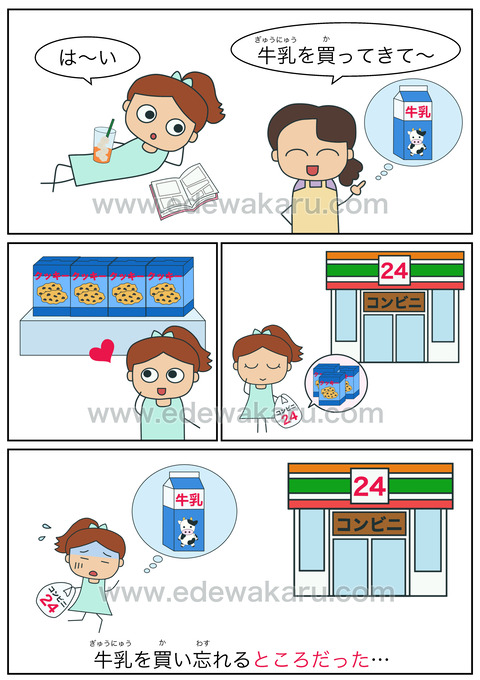
Meaning
I almost did ~.
How to use it
Verb [dictionary form] + ところだった
Verb [ない-form] + ところだった
Explanation
「〜ところだった」 is a sentence pattern meaning “I almost did ~” or “I was almost going to have a bad outcome.” It is used when you want to say, “I didn’t actually do it, but I almost did” or “Something bad was about to happen, but it didn’t.” Remember the expressions commonly used with it.
[Commonly used expressions]
・
もう少しで
〜ところだった
・
あと少しで
〜ところだった
・
危うく
〜ところだった, etc.
「〜ところだった」 also has a use meaning “I almost ended up in a good situation…,” so learn that as well 😀
In context 6 examples
牛乳を買い忘れるところだった…
→もう少しで、牛乳を買い忘れていた(でも忘れなかった)I almost forgot to buy milk… →I was just about to forget to buy milk (but I didn’t forget).
もう少しで事故に遭うところだった
→もう少しで、事故に遭っていた(でも遭わなかった)I almost got into an accident. →I was just about to get into an accident (but I didn’t).
二度寝をしてしまい、テストに間に合わないところだった
→もう少しで、テストに間に合わなかった(でも間に合った)I overslept after going back to sleep, and I almost didn’t make it to the test. →I was just about to not make it to the test (but I did make it).
テストに名前を書くのを忘れるところだった
→もう少しで書くのを忘れていた(でも忘れなかった)I almost forgot to write my name on the test. →I was just about to forget to write it (but I didn’t forget).
危うく犯人にされるところだった
→もう少しで犯人にされていた(でもされなかった)I was almost made out to be the culprit. →I was just about to be made out to be the culprit (but I wasn’t).
こっそりゲームをしているところを見つかるところだった
→もう少しで見つかっていた(でも見つからなかった)I almost got caught while secretly playing a game. →I was just about to get caught (but I wasn’t).
Read the original source text
Meaning
もう少しで〜していた
How to use it
動詞[辞書形]+ところだった
動詞[ない形]+ところだった
Explanation
「〜ところだった」は「もう少しで〜していた」「もう少しで悪い結果になっていた」という意味を表す文型です。これは「
実際には〜しなかったが、もう少しで〜だった」「悪いことが、もう少しで起こりそうだったが起こらなかった」
言いたい時に使われる文型です。よく一緒に使われる表現を覚えておきましょう。
[一緒によく使う表現]
・
もう少しで
〜ところだった
・
あと少しで
〜ところだった
・
危うく
〜ところだった など
「〜ところだった」には「あと少しでいい状況になったのに…」という意味を表す用法もありますので、一緒に覚えておきましょう😀
Usage 2
Read this source entry ↗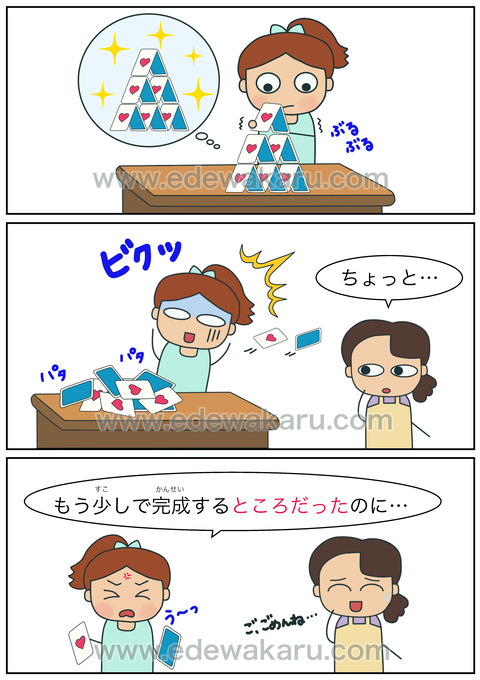
Meaning
I almost managed to ~
I might have been able to ~ if only…
It was just about to happen.
How to use it
Verb [dictionary form] + ところだった
Verb [dictionary form] + ところだった
Explanation
「Aところだった」 is a sentence pattern meaning “I might have been able to do A if only…” or “I almost did A.” A is a good situation or state. It is used when you want to say, “I almost ended up in a good situation, but didn’t.” In many cases, the form 「〜ところだったのに」 is used.
[Examples]
① If only it had been a little longer, it would have been finished
ところだった
のに…
[Good situation]
The tower gets completed
→It might have been finished soon, but it wasn’t.
② Mother: Go do a little shopping for me!
Daughter: I was just about to finish my homework
ところだった
のに…
[Good situation]
The homework gets finished
→I was just about to finish my homework, but didn’t.
③ If I had been ten seconds earlier, I would have caught the train
ところだった
[Good situation]
Catch the train
→I might have caught the train if only I’d been a little earlier, but I didn’t.
④ I was just about to finish building the dominoes
ところだった
のに, but my friend knocked them down.
[Good situation]
The dominoes get completed
→I was just about to finish, but couldn’t.
「〜ところだった」 also has a use meaning “was on the verge of a bad outcome,” so learn that as well 😊
In context 4 examples
もう少しで完成するところだったのに…
I was just about to finish…
母:ちょっと買い物に行ってきて〜!娘:もうちょっとで宿題が終わるところだったのに…
Mother: Go do a little shopping for me! Daughter: I was just about to finish my homework…
あと10秒早かったら、電車に間に合うところだった
If I had been ten seconds earlier, I would have caught the train.
もう少しでドミノができ上がるところだったのに、友達に倒された
I was just about to finish building the dominoes, but my friend knocked them down.
Read the original source text
Meaning
もう少しで〜できたのに
もう少しで〜できたかもしれないのに
〜直前だったのに
How to use it
動詞[辞書形]+ところだった
動詞[辞書形]+ところだった
Explanation
「Aところだった」は「もう少しで、Aできたかもしれないのに」「もう少しでAできたのに」という意味を表す文型です。「A」には【いい状況】や【いい状態】が入り、
「もう少しで【いい状況】になったかもしれないのに、【いい状況】ならなかった」
と言いたい時に使います。多く場合、「〜ところだったのに」の形が使われます。
[例]
①もう少しで完成する
ところだった
のに…
【いい状況】
タワーが完成する
→もう少しで完成できたかもしれないのに、完成しなかった
②母:ちょっと買い物に行ってきて〜!
娘:もうちょっとで宿題が終わる
ところだった
のに…
【いい状況】
宿題が終わる
→もうちょっとで宿題が終わったのに、終わらなかった
③あと10秒早かったら、電車に間に合う
ところだった
【いい状況】
電車に間に合う
→もう少しで電車に間に合ったかもしれないのに、間に合わなかった
④もう少しでドミノができ上がる
ところだった
のに、友達に倒された
【いい状況】
ドミノができ上がる
→もう少しでできたのに、できなかった
「〜ところだった」には「悪い結果になる直前」という意味を表す用法もありますので、一緒に覚えておきましょう😊
日本語NET JLPT文法解説まとめ
Meaning
“It almost became ~. / It might have ended up as ~.”
Used when saying that something did not actually happen, but seemed likely to.
How to use it
V(dictionary form / ない-form) + ところだった
Explanation
"nearly ended up / almost / was about to happen"
This is used to describe something that almost happened but didn't actually happen."
Read the original source text
Meaning
"もう少しで~になる可能性があった。/ ~という結果になったかもしれない。"
実際にはなっていないが、そうなりそうであったことを言う時に使う。
How to use it
V(辞書形 / ナイ形) + ところだった
Explanation
"nearly ended up / almost / was about to happen"
This is used to describe something that almost happened but didn't actually happen."
毎日のんびり日本語教師
How to use it
Verb dictionary form + ところだった
Verb た-form + ところだった
Explanation
Expresses that a situation which would have occurred under different conditions was avoided before it happened.
It is used with 「もう少し」 or 「危うく(あやうく)」.
Notes
The 「ところ」 series
In context 8 examples
教えてくれなかったらまた忘れるところだった。
If you hadn’t told me, I would have forgotten again.
もう少しブレーキを踏むのが遅れていたら死んでいたところだった。
If I’d been even a little later hitting the brakes, I would have died.
対処が遅れていたら、あやうくまた犠牲者が出るところだった。
If the response had been delayed, there would almost have been another casualty.
目覚まし設定し忘れて、あやうく寝過ごすところだった。
I forgot to set my alarm and nearly overslept.
道に迷って帰って来れなくなるところだった。
I nearly got lost and couldn’t make it back.
前の車が不審な挙動をしていて、危うく事故に巻き込まれるところだった。
The car in front of me was acting suspiciously, and I nearly got caught up in an accident.
天気が良くてのんびり歩いていたら、もう少しで電車に乗り遅れるところだった。
The weather was nice, and I was walking leisurely, so I almost missed the train.
途中で気づいたから良かったものの、もう少しで騙されてお金をむしり取られるところだった。
It’s a good thing I realized partway through; I almost got conned out of my money.
Read the original source text
How to use it
動辞形+ところだった
動た形+ところだった
Explanation
条件が異なれば発生していたであろう事態を、発生する前に回避することができたことを表します。
「もう少しで」や「危うく(あやうく)」などと呼応します。
Notes
「ところ」シリーズ
AIUEO JLPT Grammar
Meaning
This sentence pattern shows that something almost happened, but in the end, it did not occur, used when a crisis or failure is avoided, or when something failed to happen but was very close.
How to use it
Verb dictionary form + ところだった
In context 5 examples
もう少しで電車に乗り遅れるところだった。
I almost missed the train.
寝坊してしまって、遅刻するところだった。
I overslept and almost arrived late.
危うく財布を忘れるところだったが、途中で気が付いた。
I nearly forgot my wallet, but then I realized it halfway through.
危なくパスポートを家に置いていくところだった。
I almost left my passport at home.
大雨で道が滑りやすく、転ぶところだった。
The road was slippery from the rain, and I almost fell.
Read the original source text
Meaning
This sentence pattern shows that something almost happened, but in the end, it did not occur, used when a crisis or failure is avoided, or when something failed to happen but was very close.
How to use it
動詞辞書形+ところだった
Explanation · 日本語
この文型は、ある出来事や状況がもう少しで起こりそうだったが、実際には起こらなかったことを表す表現で、危機や失敗を回避した場合や、惜しくも実現しなかったことを述べるときに使用されます。
文法
Meaning
There was a chance something would almost happen. / It might have resulted in ~.
Used when something did not actually happen, but seemed likely to.
How to use it
V (dictionary form / ない-form) + ところだった
In context 6 examples
車を運転してると、突然猫が飛び出してきて、もう少しでひいてしまうところでした。
While I was driving, a cat suddenly darted out, and I nearly ran it over.
あと10秒遅かったら、電車に乗り遅れるところだった。
If I’d been ten seconds later, I would have missed the train.
イタズラしすぎたせいで、もう少しで彼を怒らせるところでした。
Because I played too many pranks, I nearly made him angry.
家を出るのが、あと5分遅れていたら、遅刻するところでした。
If I’d left the house five minutes later, I would have been late.
トムさんが言ってくれなかったら、うっかり忘れるところでした。
If Tom hadn’t told me, I would have accidentally forgotten.
気がつくのが遅かったら、大惨事になるところでした。
If I’d noticed any later, it would have become a major disaster.
Read the original source text
Meaning
もう少しで~になる可能性があった。/ ~という結果になったかもしれない。
実際にはなっていないが、そうなりそうであったことを言う時に使う。
How to use it
V(辞書形 / ナイ形) + ところだった
NINJAL 日本語文型データベース
Meaning
Used when you want to say that something was about to happen but didn’t at the last moment, or that you were about to do something but didn’t.
It often expresses relief that a bad situation caused by carelessness or the like was avoided. Also, 「〜のに」 may follow 「ところだった」 to express regret that things did not turn out well.
How to use it
Vるところだった/Vないところだった
Notes
“〜” is often a verb that does not express an intentional action, such as 「忘れる、間違える」 (forget, make a mistake).
In context 5 examples
うっかり大事な書類を捨ててしまうところだった。気づいてよかった。
I almost threw away an important document by mistake. Good thing I noticed.
ホームを間違えてしまって、危うく電車に乗り遅れるところでした。
I got the platform wrong and nearly missed the train.
このスイーツは1日10食限定で、私が注文したのが最後の一つだった。少し注文が遅かったら、食べられないところだった。
This dessert is limited to ten servings a day, and the one I ordered was the last one. If I’d ordered a little later, I wouldn’t have been able to eat it.
運行中の新幹線の台車に亀裂が見つかった。一歩間違えれば、大事故が避けられないところだった。
A crack was found in the bogie of a Shinkansen in service. If one thing had gone wrong, a major accident would have been unavoidable.
もう少しで試合に勝てるところだったのに、ミスが重なって一気に逆転された。
We were just about to win the match, but a string of mistakes turned things around in an instant.
Read the original source text
Meaning
〜という事態になりそうだったが、直前でそうならなかった、または~という行為をしそうだったが、そうしなかったと言いたいときに使います。
不注意などによる悪い状況が避けられたことに対する安堵感を表すことが多いです。また、「ところだった」の後に「〜のに」を使って、いい状況にならなかったことに対する残念な気持ちを表すこともあります。
How to use it
Vるところだった/Vないところだった
Notes
「〜」には、「忘れる、間違える」など、意志的な行為を表さない動詞がくることが多いです。
Bunpro Grammar Reference
Usage 1
Meaning
Almost, Nearly, About to, On the verge of
How to use it
Verb[る]+ ところだった
Verb[ない]+ ところだった
Verb[る]+ ところでした
Verb[ない]+ ところでした
Nuance
A construction indicating the place or situation in which (A) was about to, or on the verge of happening.
Explanation
As explained in the ところ grammar point, ところ is a noun that is often used to highlight the situation within which a verb is 'about to' happen (when that verb appears in its non-past form). However when followed by だった, it emphasizes that the thing that was 'about to' happen never actually eventuated (or that another more important event happened at that moment). This can be translated as 'to almost (A)', or 'to be on the verge of (A)'.
やばい、大事な書類を捨てるところだった。
Oh shoot, I was just about to throw away an important document.
毒キノコを食べるところだったが、キノコに詳しい友達が止めてくれた。
I was about to eat a poisonous mushroom, but a friend that is very knowledgeable about mushrooms stopped me.
The verb that ところ is paired with may also be seen grouped with the auxiliary verb ない. In this case, it implies that something was 'about not' to happen (but then did).
この電車に間に合ってよかった。もう少しで待ち合わせ時間に間に合わないところだった。
I am so glad that we made this train. I was about to be late for the meet up.
現金が足りなくて家賃が払えないところだった。
I was about to not be able to pay my rent because I didn't have cash.
In context 16 examples
- もう少しで船からおちるところだった。
I nearly fell off the ship (had I been a little closer to the edge).
- やばい、大事な書類を捨てるところだった。
Oh shoot, I was just about to throw away an important document.
- 毒キノコを食べるところだったが、キノコに詳しい友達が止めてくれた。
I was about to eat a poisonous mushroom, but a friend that is very knowledgeable about mushrooms stopped me.
- この電車に間に合ってよかった。もう少しで待ち合わせ時間に間に合わないところだった。
I am so glad that we made this train. I was about to be late for the meet up.
- 現金が足りなくて家賃が払えないところだった。
I was about to not be able to pay my rent because I didn't have cash.
- ちょうど電車が発車するところだった。
It was right when the train was about to depart.
- 危うく遅刻するところだった。
I was on the verge of being late.
- もう少しで事故が起こるところだった。
I nearly had an accident.
- 好きな声優に会えないところだった。
I almost didn't meet my favorite voice actress.
- 彼女に誤解されるところだった。
She was on the verge of misunderstanding me.
- 今高速に乗るところだったのに...
Aw, I was just about to get on the highway....
- 眠りに入るところだったのに、電話で起こされた。
I was just about to go to sleep, but was woken up by a phone call.
- もう少しで遅刻するところだったが、ギリギリ間に合いました。
I was on the verge of being late, but I made it just in time.
- 店は閉店するところだったが、売ってくれました。
The shop was just about to close, but they were kind enough to sell it to me.
- 電車に傘を忘れるところだったが、隣の人が教えてくれた。
I was on the verge of forgetting my umbrella on the train, when the person next to me reminded me about it.
- 発見が遅れたら、危うく死ぬところだった。
I would have been on the verge of dying had they not found me sooner.
Usage 2
Meaning
Was just about to do something, Was in the middle of...
How to use it
Verb[る] + ところだった
Verb[る] + ところでした
Nuance
A structure expressing that something was in, or about to be in the position or situation of (A).
Explanation
When combined with the dictionary form of verbs, ところだった will indicate that something was about to happen, and will regularly be translated as 'was just about to do (A)', or 'was in the middle of (A)'. In many cases, ところだった will indicate either a positive or negative result that came about from 'not doing (A)'.
As this grammar pattern is a combination of ところ 'place', and the past tense of だ, だった; it will put emphasis of 'having been in the place or situation of (A)', before something happened that caused the expected result to change.
危なかった。危うくあの人をひくところだった。
That was close. I was about to run over that person.
起きるのが3分遅かったら、遅刻するところだった。
I was about to be late if I had woken up three minutes later.
In cases where a positive result was narrowly missed out on, のに will often appear directly after ところだった. This can be interpreted as 'despite almost doing (A), (B)'.
今から家を出るところだったのに、いきなり雨が降ってきたから雨が止むまで待つ。
I was just about to leave the house, but it suddenly started raining, so I'm going to wait until the rain stops.
もうすぐ犯人が自白するところだったのに、お前が余計なことを言うから...。
The killer was just about to confess, but you went off on a tangent...
In context 16 examples
- 絵の具をつけてしまうところだった。
I was just about to apply the paint.
- 危なかった。危うくあの人をひくところだった。
That was close. I was about to run over that person.
- 起きるのが3分遅かったら、遅刻するところだった。
I was about to be late if I had woken up three minutes later.
- 今から家を出るところだったのに、いきなり雨が降ってきたから雨が止むまで待つ。
I was just about to leave the house, but it suddenly started raining, so I'm going to wait until the rain stops.
- もうすぐ犯人が自白するところだったのに、お前が余計なことを言うから...。
The killer was just about to confess, but you went off on a tangent...
- 危うく期限が切れてしまうところだった。
I was just about to narrowly miss the deadline.
- 今から関西弁を教わるところだったのに。
I was just about to be taught the Kansai dialect.
- 出掛けるところだったが、雨が降ってきたのでやめました。
I was just about to go out, but because it started raining, I stopped.
- 捕まえた犯人を危うく逃すところだった。
The captured criminal was just about to barely escape.
- 悪友と付き合って、寿命を縮めるところでした。
I got involved with bad friends and nearly shortened my lifespan. (was just about to)
- お風呂に入っているところだったから、電話に出られませんでした。
Since I was in the middle of taking a bath, I couldn't answer the phone.
- あんな人だって知らなかったら、危うく付き合うところだった。
I was just about to go out with that person, if I didn't know who they were.
- 今作るところだったけど、「夕飯はいらない」と連絡が入った。
I was just about to make it, but I got a message saying, 'I don't need dinner.'
- 携帯の電池がなくなるところだったが、なんとか間に合った。
The battery on my phone was just about to die, but I somehow managed to make it in time.
- やっと慣れてきたところだったのに、仕事を辞めなければいけなくなった。
Despite just about getting used to it, I had to quit my job.
- お湯の温度を調整しているところだったのに、ブレーカーが落ちてしまった。
Just as I was in the middle of adjusting the hot water temperature, the breaker unfortunately tripped.
Read the original source text
Meaning
Was just about to do something, Was in the middle of...
How to use it
Verb[る] + ところだった
Verb[る] + ところでした
Nuance
A structure expressing that something was in, or about to be in the position or situation of (A).
Explanation
When combined with the dictionary form of verbs, ところだった will indicate that something was about to happen, and will regularly be translated as 'was just about to do (A)', or 'was in the middle of (A)'. In many cases, ところだった will indicate either a positive or negative result that came about from 'not doing (A)'.
As this grammar pattern is a combination of ところ 'place', and the past tense of だ, だった; it will put emphasis of 'having been in the place or situation of (A)', before something happened that caused the expected result to change.
危なかった。危うくあの人をひくところだった。
That was close. I was about to run over that person.
起きるのが3分遅かったら、遅刻するところだった。
I was about to be late if I had woken up three minutes later.
In cases where a positive result was narrowly missed out on, のに will often appear directly after ところだった. This can be interpreted as 'despite almost doing (A), (B)'.
今から家を出るところだったのに、いきなり雨が降ってきたから雨が止むまで待つ。
I was just about to leave the house, but it suddenly started raining, so I'm going to wait until the rain stops.
もうすぐ犯人が自白するところだったのに、お前が余計なことを言うから...。
The killer was just about to confess, but you went off on a tangent...
Nuance · 日本語
あるものが(A)にいた、又は(A)という状況に巻き込まれる寸前だったということを表す表現。
Explanation · 日本語
動詞の辞書形と組み合わされた「ところだった」は「もう少しで (A) しそうだった」や「(A) の途中だった」のような意味を表す文型です。多くの場合、「ところだった」は (A) をしなかったことによって生じた良い結果や悪い結果を表します。
この文型は、場所を意味する名詞の「ところ」と「だ」の過去形「だった」を組み合わせて、「(A) の場所や状況にいたこと」を強調します。そして、その時点で起こるはずだったことが、予想外の出来事によって変わった時に使われます。
危なかった。危うくあの人をひくところだった。
That was close. I was about to run over that person.
起きるのが3分遅かったら、遅刻するところだった。
I was about to be late if I had woken up three minutes later.
あと少しで良い結果を得られそうだったがそれを逃してしまったという場合、「ところだった」の直後に「のに」を使うことがあります。これは「あと少しで (A) だったが、(B) という悪い結果になってしまった」という意味で使われます。
今から家を出るところだったのに、いきなり雨が降ってきたから雨が止むまで待つ。
I was just about to leave the house, but it suddenly started raining, so I'm going to wait until the rain stops.
もうすぐ犯人が自白するところだったのに、お前が余計なことを言うから...。
The killer was just about to confess, but you went off on a tangent...
どんなときどう使う 日本語表現文型辞典
Meaning
nearly ended up
How to use it
Vる・Vない+ところだった
Explanation
もう少しで~のような結果になりそうだった
「~のような結果になりそうだったが、実際にはならなかった」と言いたいときに使う。悪い結果になる直前だったことを言う場合が多く、「もう少しで・危なく(危うく)」などの副詞とよくいっしょに使う。
Some result nearly occurred, but did not actually. In many cases is used to indicate state just prior to adverse result, and is often used with adverbs もう少しで, 危なく or 危うく.
In context 4 examples
誤解がもとで、危うく大切な親友を失うところだった。
Because of a misunderstanding, I very nearly lost a dear friend.
考えごとをしながら歩いていたので、もう少しで横道から出てきた自転車にぶつかるところだった。
I was walking while lost in thought, and I nearly collided with a bicycle that came out of a side street.
切符売り場に来るのがもう少し遅かったら、映画の予約券が買えないところだった。
If I had come to the ticket counter a little later, I would have been unable to buy an advance ticket for the movie.
200メートルの平泳ぎの競泳でもう少しで1位になるところだったのに、タッチの差で2位だった。
I came very close to taking first place in the 200-meter breaststroke race, but I finished second by a touch.
Read the original source text
Meaning
nearly ended up
How to use it
Vる・Vない+ところだった
Explanation
もう少しで~のような結果になりそうだった
「~のような結果になりそうだったが、実際にはならなかった」と言いたいときに使う。悪い結果になる直前だったことを言う場合が多く、「もう少しで・危なく(危うく)」などの副詞とよくいっしょに使う。
Some result nearly occurred, but did not actually. In many cases is used to indicate state just prior to adverse result, and is often used with adverbs もう少しで, 危なく or 危うく.