DoJG 日本語文法辞典(全集)
Meaning
Only; just; mere
How to use it
(i) たかが | Nounだ | |
| たかが子供だ | Someone is only a child |
(ii) たかが | {Noun/Number(+Counter)} (くらい){と/で} | |
| たかがレポート(くらい)と | Thinking/saying that it’s only a report |
| たかがレポート(くらい)で | Over just a report |
| たかが二人(くらい)と | Thinking/saying that (there are only) two people |
| たかが二人(くらい)で | With just two people |
(iii) たかが~ | {V/Adjectiveい}informal くらい (のこと)で | |
| たかが英語が{できる/できた}くらい (のこと)で | Just because someone can/could speak English; just for (things like) being able to speak English |
| たかが成績{悪い/悪かった}くらい (のこと)で | Just because someone’s performance is/was poor; just for (things like) someone’s poor performance |
(iv) たかが~ | Adjectiveなstem{な/だった} くらい (のこと)で | |
| たかが料理が下手{な/だった} くらい (のこと)で | Just because someone is/was bad a cooking; just for (something like) being a poor cook |
Explanation
A noun modifier used when the speaker thinks little of the referent of the modified noun or noun phrase.
In context 13 examples
たかが子供の言ったことだ。そんなに深刻に考えることはない。
It's just something a child told you. You don't have to take it so seriously.
たかが漫画(くらい)と馬鹿にしてはいけない。
You shouldn't make light of it saying it's just a cartoon.
たかが車の故障(くらい)でそんなに大騒ぎする必要はない。
You don't need to make such a big fuss over a little car trouble.
たかが無断で自転車を借りたくらい(のこと)でそんなに怒らなくてもいいでしょう。
You don't have to get so mad at me just for borrowing your bicycle without asking.
人間一人の知恵などたかが知れている。
One person's wisdom doesn't amount to much.
たかが喫煙じゃないか。どうしてそんなに犯罪者のように言われなきゃならないんだ。
It's only smoking. Why do they have to talk about us as if we were criminals?
たかがノートくらいと言われるかもしれませんが、僕にとってはとても大事なものなんです。
You may say it's just a notebook, but to me it's very important.
たかが10万円で何ができると言うのですか。
What do you expect us to do with only 100,000 yen?
たかがアパート探しくらいで君に面倒をかけたくない。
I don't want to bother you with just apartment hunting.
たかが転んだくらいで救急車を呼ぶなんて大げさだ。
It is overreacting to call an ambulance just for falling down.
公共事業によって景気が回復する領域などたかが知れている。
There's hardly any area in which the economy can be improved through public projects.
たかが椅子。しかし、これによって仕事の能率が大きく左右されるし健康にも影響する。
It's just (a matter of) a chair. But it can affect your productivity at work and influence your health.
たかが風邪、されど風邪。
It's just a cold, but it is a cold.
日本語文型辞典
Meaning
Used with a noun preceded by 「たかが」 to express the feeling that it is being judged as trivial. It is followed by an expression of judgment such as 「ばからしい」 or 「気にするな」. Often used in the forms 「たかがNのために」 or 「たかがNのことで」.
Means “for such a small thing.” Used to say that there is no need to do something or worry about something for that reason.
How to use it
たかがN
たかが…ぐらいで
たかが N/A/V ぐらいで
たかが N/Na なぐらいで
In context 9 examples
かしこいと言ってもたかが子どもだ。言うことに、いちいち腹を立ててはいけないよ。
Even if they are clever, they’re only children. You shouldn’t get angry at every single thing they say.
たかが皿1枚に10万円も払うのはばかげている。
It’s ridiculous to pay as much as 100,000 yen for just one plate.
たかが証明書一枚のために朝から二時間も待たされるなんて、ひどく能率の悪い役所だ。
This is a terribly inefficient government office, making people wait two hours from the morning just for a single certificate.
たかが1泊の旅行のためにどうしてそんな大きなカバンがいるのよ。
Why do you need such a big bag for just a one-night trip?
A:ぼく、この服いやだ。
B:たかが服のことでなんだ。気に入らないなら家にいなさい。A: I don’t like these clothes. B: What’s the big deal over just clothes? If you don’t like them, stay home.
たかが風邪ぐらいで学校を休まなくてもよい。
You don’t need to miss school over just a cold.
たかが試験に失敗したぐらいでくよくよすることはない。
There’s no need to get depressed over failing just one exam.
たかが絵画展に入選したぐらいでこんなに祝っていただくのはなんだか恥ずかしいです。
I feel a little embarrassed that you’re celebrating me so much just because my work was selected for an art exhibition.
たかが旅さきの安いおみやげぐらいで、そんなにお礼をいっていただくと困ります。
I’m embarrassed when you thank me so much just for a cheap souvenir from a trip.
Read the original source text
Meaning
「たかが」の付く名詞にたいして、たいしたことではないと低く評価する気持ちを表す。「ばからしい」「気にするな」などの価値判断の表現が続く。「たかがNのために」「たかがNのことで」という形で使われることが多い。
「こんなに小さいことのために」という意味。「そのことのために…する必要はない、気にしないでよい」と言うときに使う。
How to use it
たかがN
たかが…ぐらいで
たかが N/A/V ぐらいで
たかが N/Na なぐらいで
絵でわかる日本語
Usage 2
Read this source entry ↗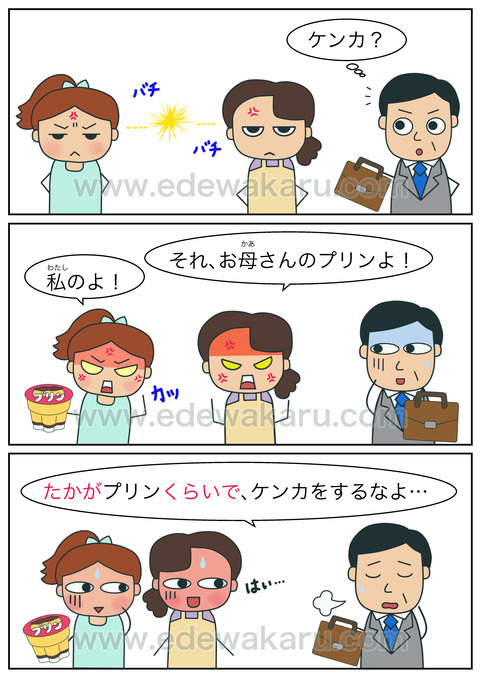
Meaning
for something as small as 〜
How to use it
たかが + verb/adjective/noun [plain form] + くらいで
Explanation
「たかがAくらいで」 is a sentence pattern meaning “for something as small as A.” 「A」 can be something small or something that is not a major problem. It is used to say that there is no need to do something because of A, or to tell someone not to do something because of A.
[Examples]
① Don’t fight over something as small as pudding…
[Something small] pudding
→Don’t fight over something as small as pudding…
② Don’t give up just because you failed an exam once!!
[Something that is not a major problem] failing an exam once
→Don’t give up just because you failed once.
③ There’s no need to go to the hospital for an injury this minor.
[Something that is not a major problem] a minor injury
→There’s no need to go to the hospital for such a minor injury.
④ You don’t have to cry just because you lost a game, do you?
[Something small] losing a game
→You don’t have to cry just because you lost a game, do you?
⑤ Wife: Why don’t you take the day off work?
Husband: I can’t take the day off work just because I caught a cold…
[Something that is not a major problem] catching a cold
→I can’t take the day off work just because I caught a cold…
The 「くらい」 in 「たかがAくらいで」 is 「くらい」 expressing [disregard], so review it 😀
[Related patterns]
In context 1 examples
妻:今日は会社を休んだら?夫:たかがかぜをひいたくらいで、会社を休むわけにはいかないよ…
Wife: Why don’t you take the day off work today? Husband: I can’t take the day off work just because I caught a cold…
Read the original source text
Meaning
〜のような、小さなことのために
How to use it
たかが+動詞・形容詞・名詞[普通形]+くらいで
Explanation
「たかがAくらいで」は「Aのような、小さなことのために〜」という意味の文型です。「A」には
「小さなこと」
や
「大きな問題ではないこと」
などが入り、「Aのために〜する必要がない」「Aのために〜するな」と言いたい時に使われます。
[例]
①
たかが
プリン
くらいで、ケンカをするなよ…
【小さなこと】プリン
→プリンのような小さなことで、ケンカをするなよ…
②
たかが
1回試験に失敗した
くらいで、あきらめちゃだめだよ!!
【大きな問題ではないこと】1回試験に失敗した
→1回失敗しただけで、あきらめちゃだめだよ
③
たかが
これ
くらいの
ケガ
で、病院に行くことはないさ
【大きな問題ではないこと】小さなケガ
→こんな小さなケガのために、病院に行くことはないさ
④
たかが
ゲームで負けた
くらいで、泣かなくてもいいでしょ?
【小さなこと】ゲームで負けた
→ゲームで負けただけで、泣かなくてもいいでしょ?
⑤妻:今日は会社を休んだら?
夫:
たかが
かぜをひいた
くらいで、会社を休むわけにはいかないよ…
【大きな問題ではないこと】かぜをひいた
→かぜをひいただけで、会社を休むわけにはいかないよ…
「たかがAくらいで」の「くらい」は、[軽視]を表す「くらい」ですので、復習をしておきましょう😀
【関連文型】
毎日のんびり日本語教師
Usage 1
Read this source entry ↗How to use it
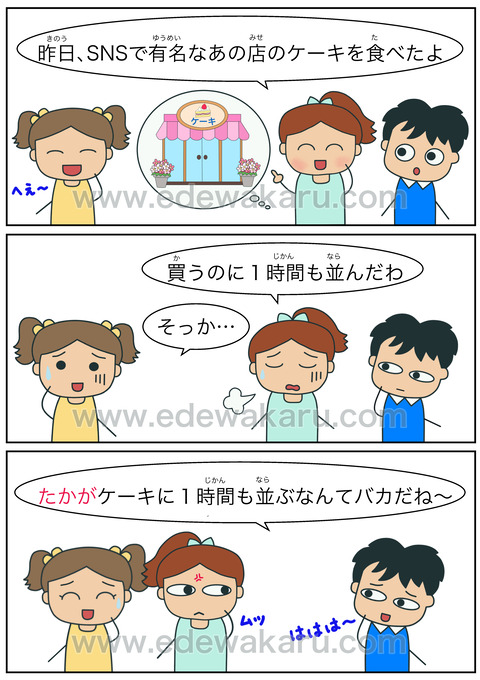
たかが + noun
Explanation
A noun follows, expressing a feeling of looking down on or dismissing the subject.
The kanji used is “高が.” Here, “高” indicates degree.
There is also the expression using the same word twice:
“たかが~、されど~ (although …, still …)”
For example, “たかが子供、されど子供” means something like “You shouldn't look down on someone just because they're a child,” and expresses high regard for children.
There is also the idiom:
“高が知れている (it's nothing special).”
Since the extent of it is known, this expression dismisses something as not amounting to much.
A related expression is:
“高をくくる (to underestimate / to consider not worth worrying about).”
This describes underestimating something by assuming it is not much to worry about.
Notes
Related grammar: “【N0 Grammar】たかが~くらいで/たかが~ぐらいで”
In context 2 examples
井戸の底から見える景色などたかが知れている。(仅仅能从井底可以看到的景色。)
The view you can see from the bottom of a well is limited. (The view one can see from the bottom of a well.)
有能な人間は失敗から学ぶから有能なのである。成功から学ぶものなどたかが知れている。
Capable people are capable because they learn from failure. There is only so much one can learn from success.
Read the original source text
How to use it
たかが+名詞
Explanation
後項に名詞を接続して、対象に対して馬鹿にしたり、軽視したりする気持ちを表します。
漢字は「高が」を用います。この「高」とは程度を表します。
同じ単語を2度使って
「たかが~、されど~(虽然…但是…)」
という言い方もあります。
例えば「たかが子供、されど子供」は、「子供だからといって馬鹿にしてはいけない」というような意味となり、子供に対する高い評価を表します。
また、
「高が知れている(没有什么了不起的)」
という慣用表現もあります。
その程度が分かっているので、大したことはないという対象を軽視する表現です。
これと関連した表現に
「高をくくる(不放在眼里/认为不值一顾)」
もあります。
こちらは対象の程度について大したことはないと見くびることを表します。
Notes
関連文法「【N0文法】たかが~くらいで/たかが~ぐらいで」
Usage 2
Read this source entry ↗How to use it
たかが + noun + ぐらいで
たかが + い-adjective plain form + ぐらいで
たかが + な-adjective stem + な/である + ぐらいで
たかが + verb plain form + ぐらいで
Explanation
“たかが” expresses a feeling of looking down on or dismissing the subject.
It brings up something trivial and insignificant, and the following part takes a pattern meaning that there is no need to do something because of it, or that one need not do it.
Notes
Related grammar: “【N0 Grammar】たかが~”
There is no difference between “くらい” and “ぐらい”; they mean the same thing whichever one is used.
The “くらい/ぐらい” series
In context 1 examples
次の試合もすぐ控えているんだから、たかが1敗したくらいで悲しむのはまだ早い。
The next game is coming up soon too, so it's too early to be sad over just one loss.
Read the original source text
How to use it
たかが+名詞+ぐらいで
たかが+い形容詞普通形+ぐらいで
たかが+な形容詞語幹+な/である+ぐらいで
たかが+動詞普通形+ぐらいで
Explanation
「たかが」は対象を馬鹿にしたり、軽視したりする気持ちを表します。
取るに足らないような些細なことを取り上げ、後項ではその為に~する必要ない、~しなくてもいいというような文型を取ります。
Notes
関連文法「【N0文法】たかが~」
「くらい」と「ぐらい」に違いはありません。どちらを使っても意味は同じです。
「くらい/ぐらい」シリーズ
日本語文型辞典 英語版
Meaning
B:たかが服のことでなんだ。気に入らないなら家にいなさい。
They’re just clothes—why are you making such a fuss? If you don’t like them, stay at home.
Expresses a low evaluation of the noun to which it is attached, in the sense that that thing is not special or of little importance. Followed by expressions of value judgment, such as ばからしい (foolish, silly) or 気にするな (Don’t worry about it). Often used in the forms たかがNのために and たかがNのことで.
Means “for/because of such a small thing.” Used to say “there’s no need to do...because of X” or “there’s no need to worry about X.”
How to use it
1. たかがN
2. たかが...ぐらいで[たかが N/A/V ぐらいで][たかが N/Na なぐらいで]
In context 9 examples
かしこいと言ってもたかが子どもだ。言うことに、いちいち腹を立ててはいけないよ。
He may be clever, but he’s only a child. You shouldn’t get annoyed by every little thing he says.
たかが皿1枚に 10 万円も払うのはばかげている。
It’s crazy to pay 100,000 yen for just one single plate.
たかが証明書一枚のために朝から2時間も待たされるなんて、ひどく能率の悪い役所だ。
I’ve had to wait two whole hours this morning to get just one certificate. What a horribly inefficient government office this is.
たかが1泊の旅行のためにどうしてそんな大きなカバンがいるのよ。
Why do you need such a large bag for just an overnight trip?
A:ぼく、この服いやだ。
I don’t like this outfit.
たかが風邪ぐらいで学校を休まなくてもよい。
There is no need to take a day off school simply because you have a cold.
たかが試験に失敗したぐらいでくよくよすることはない。
There is no need to brood just because you failed an exam.
たかが絵画展に入選したぐらいでこんなに祝っていただくのはなんだか恥ずかしいです。
I feel somewhat embarrassed to be given such a big celebration simply for having my painting selected for an exhibition.
たかが旅さきの安いおみやげぐらいで、そんなにお礼をいっていただくと困ります。
You needn’t thank me so much for just a cheap souvenir from my trip.
Read the original source text
Meaning
B:たかが服のことでなんだ。気に入らないなら家にいなさい。
They’re just clothes—why are you making such a fuss? If you don’t like them, stay at home.
Expresses a low evaluation of the noun to which it is attached, in the sense that that thing is not special or of little importance. Followed by expressions of value judgment, such as ばからしい (foolish, silly) or 気にするな (Don’t worry about it). Often used in the forms たかがNのために and たかがNのことで.
Means “for/because of such a small thing.” Used to say “there’s no need to do...because of X” or “there’s no need to worry about X.”
How to use it
1. たかがN
2. たかが...ぐらいで[たかが N/A/V ぐらいで][たかが N/Na なぐらいで]
AIUEO JLPT Grammar
Meaning
This sentence pattern emphasizes that something is trivial or insignificant, suggesting no need for an exaggerated reaction or excessive worry. It is often used to downplay a situation or reassure others.
In context 5 examples
たかが風邪くらいで、そんなに心配しなくてもいいよ。
It’s just a cold, no need to worry so much.
たかが5分遅れたくらいで、そんなに怒らなくてもいいだろう。
You don’t have to be so angry just because I was 5 minutes late.
たかがそんな失敗で、人生が終わるわけじゃない。
Failing that exam isn’t the end of the world.
たかがゲームだ。気にするな。
It's just a game. Don't worry about it.
たかが道を間違えたくらいで、大した問題じゃないよ。
It’s just a wrong turn, it’s no big deal.