AIUEO JLPT Grammar
Meaning
This sentence pattern emphasizes something being expressed intensely or an action seeming imminent. It is often used as an exaggerated expression in written or literary language rather than in everyday conversation. The verb form connects without auxiliary verbs, but for “する,” it changes to 「せんばかり」.
How to use it
Verb nai-form ん + ばかり(に・の・だ)
In context 5 examples
彼は涙があふれんばかりに、感謝の言葉を述べた。
He expressed his gratitude, almost on the verge of tears.
彼女は飛び上がらんばかりに喜んだ。
She was so happy that she almost jumped for joy.
彼女は今にも崩れ落ちんばかりだ。
She looks on the verge of collapse.
彼は今にも殴りかからんばかりの勢いで、相手をにらんだ。
He glared at the other person with such intensity, as if he was about to punch him.
犬は今にも飛びかからんばかりの姿勢でこちらを見ていた。
The dog was staring at us, as if it was about to jump on us at any moment.
Read the original source text
Meaning
This sentence pattern emphasizes something being expressed intensely or an action seeming imminent. It is often used as an exaggerated expression in written or literary language rather than in everyday conversation. The verb form connects without auxiliary verbs, but for “する,” it changes to 「せんばかり」.
How to use it
動詞ない形ん+ばかり (+にorのorだ)
Explanation · 日本語
この文型は、何かが非常に強く表現されている様子や、今にもその動作が起こりそうであることを強調するときに使われます。誇張した表現として使われることが多く、日常会話よりもやや書き言葉や文学的な表現で使われます。動詞のない形に接続しますが、「する」は「せんばかり」となります。
DoJG 日本語文法辞典(全集)
Meaning
As if ~ were about to ~; almost
How to use it
(i) Vnegative | んばかりに | Exception: する→せんばかりに |
| 泣かんばかりに | As if someone were about to cry |
| 発狂せんばかりに | As if someone were about to go mad |
(ii) Vnegative | んばかりのNoun | |
| 心臓が張り裂けんばかりの痛み | Heartbreaking pain (literally: pain that felt as if the heart were about to break) |
(iii) Vnegative | んばかり{だ/だった} | |
| 家屋は倒れんばかり{だ/だった} | It is/was as if the houses were about to collapse |
Explanation
んばかり(に)An adverbial phrase that is used when a situation looks as if someone were about to do something or as if something were about to occur literally or figuratively.
In context 13 examples
犬は噛みつかんばかりに僕に向かってほえた。
The dog barked at me as if it were about to bite.
どの演奏も若さと情熱あふれんばかりに満ちていた。
Every performance was filled with an overwhelming amount of youth and passion (literally: as if youth and passion were about to overflow).
時折、木の枝も折れんばかりの強風が吹いていた。
Occasionally the wind was blowing so hard it seemed the tree branches would break.
驚いて腰を抜かさんばかりだった。
I was so frightened that it seemed I was about to lose the use of my legs (literally: to lose my lower back).
その選手がシュートを決めた時、夜空に鳴り響く雷鳴をかき消さんばかりに、大歓声が競技場にとどろいた。
When the player scored a goal, a big shout of jubilation reverberated throughout the arena, as though it would muffle the rumble of thunder in the night sky.
樹高10メートルの梢から地面に届かんばかりに垂れ下がっている様子は、まさに流れ落ちる桜花の滝にふさわしい。
The way in which the cherry blossoms are hanging from the top of the branch of the 10-meter tree, as if they were about to touch the ground, is just worthy of being called a cherry blossom waterfall.
「風の谷のナウシカ」を娘さんに薦められて見たお父さんは、涙を流さんばかりに感激した。
The father was so deeply moved by ""Nausicaa of the Valley of the Wind,"" which his daughter recommended he watch, that he almost cried.
演奏が終わるか終わらないかのうちに、この曲を知っているのは自分だと言わんばかりに拍手をする人もいます。
Some people begin applauding just as a performance is coming to an end as if they were showing (literally: saying) how well they know the piece.
彼に別れたいと言われた時には、私は胸が張り裂けんばかりに苦しかった。
When he told me he wanted to break up, it was so painful I thought my chest would burst.
彼の死を聞いた時、彼女は気も狂わぬばかりに泣き叫んだ。
When she heard the news of his death, she screamed as if she were crazy.
上司から叱りつけられた山崎は土下座せぬばかりに平身低頭して謝った。
When his boss told him off, Yamazaki apologized, bowing to the ground as if he were about to get down on his hands and knees.
彼女はいつもこぼれんばかりの笑みをたたえている。
She is always smiling as if her smiles would overflow.
引っ越しの時あまり重いものを持ったので、腕が肩から抜けんばかりだった。
During the move I carried such heavy stuff that it felt as if my arms were about to fall out of their sockets (literally: come out from the shoulders).
絵でわかる日本語
Meaning
As if about to 〜 at any moment
How to use it
Verb [ない-form] + んばかり
Explanation
「〜んばかり」 is a sentence pattern meaning “as if about to 〜 at any moment.” It is used to describe a [manner], [degree], and so on. It is also used to mean “The action is not actually happening, but the situation is such that it seems about to happen.” 😊 Its form changes according to the word that follows. 😮 Remember it as:
「〜ばかりに = as if 〜ing」「〜んばかりの = as if about to 〜」「〜んばかりだ = seems about to 〜」
(Review: about to 〜 at any moment)
(Review: 〜そうだ (possibility))
(Review: 〜そうだ (appearance))
(Review: 〜そうだ (someone else’s action))
(Review: 〜によって (distinction))
[How to use 「〜んばかり」]
・〜んばかりに + verb/adjective
= as if about to 〜
・〜んばかりの + noun
= as if about to 〜
・〜んばかりだ。
= seems about to 〜.
Also, as in Example ③, when it is used with 「〜する」, it becomes 「〜せんばかり」. 😊
[Examples]
⭕️ hot enough to seem about to burn someone
❌ hot enough to seem about to burn someone
「〜んばかり」 is a formal expression, so in most cases it is used in writing. People taking N1 should learn it thoroughly for the test. 😉
(Review: 〜として)
(Review: 〜ために (purpose))
[“ばかり” patterns]
〜たばかり
〜てばかりいる・〜てばかりだ
〜てばかりはいられない・〜てばかりもいられない
〜と言わんばかりに・〜とばかりに
〜とばかり思っていた
〜とばかりは言えない
〜ばかり (quantity word + ばかり)
〜ばかりだ
〜ばかりだ (preparations complete)
〜ばかりで
〜ばかりでなく〜も
〜ばかりに
〜ばかりの (figurative)
〜ばかりは
〜んばかり
In context 5 examples
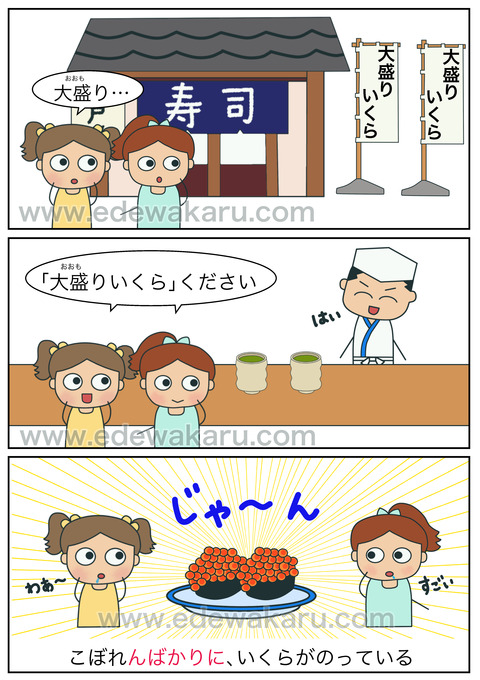
こぼれんばかりに、いくらがのっている
→今にもこぼれそうなくらい、いくらがのっているThe salmon roe is piled on so high it looks like it could spill at any moment. → There is so much salmon roe on it that it looks like it could spill at any moment.
彼女は泣き出さんばかりの顔をしていた
→彼女は今にも泣き出しそうな顔をしていたShe had a face as if she were about to burst into tears. → She had a face as if she were about to burst into tears at any moment.
あのコーヒーは、やけどせんばかりの熱さだった
→あのコーヒーは、今にもやけどをしてしまいそうなくらいの熱さだったThat coffee was so hot it seemed it could burn someone at any moment. → That coffee was so hot it seemed someone could get burned at any moment.
そのニュースを聞いた時は、胸が張り裂けんばかりの気持ちだった
→今にも胸が張り裂けそうな気持ちだった(復習:胸が張り裂ける)When I heard that news, I felt as if my heart were about to burst. → I felt as if my heart were about to burst at any moment. (Review: 胸が張り裂ける)
ちょっと食べすぎた…お腹がはち切れんばかりだ
→今にもお腹がはち切れそうだ*「はち切れる」とは「中身がいっぱいになって裂ける」という意味です😊(復習:〜すぎる)I ate a little too much… My stomach feels like it’s about to burst. → My stomach feels like it’s about to burst at any moment. *「はち切れる」 means “to split open because it is full.” 😊 (Review: 〜すぎる)
Read the original source text
Meaning
今にも〜しそうだ
How to use it
動詞[ない形]+んばかり
Explanation
「〜んばかり」は「今にも〜そう」という意味を表す文型です。この文型は【様子】【程度】などを表す場合に使います。また
「実際は〜していないが、〜しそうな状態だ」
という場合にも使われます😊後ろにくる語によって、形が変わります😮
「〜ばかりに=〜そうに」「〜んばかりの=〜そうな」「〜んばかりだ=〜そうだ」
と覚えておきましょう。
(復習:今にも〜そう)
(復習:〜そうだ(可能性))
(復習:〜そうだ(様態))
(復習:〜そうだ(第三者の行為))
(復習:〜によって(区別))
[「〜んばかり」の使い方]
・〜んばかりに+動詞・形容詞
=〜そうに
・〜んばかりの+名詞
=〜そうな
・〜んばかりだ。
=〜そうだ。
また、例文③のように「〜する」に使う場合は「〜せんばかり」になります😊
[例]
⭕️やけどせ
んばかり
の熱さ
❌やけどし
んばかり
の熱さ
「〜んばかり」はかたい言い方ですので、ほとんどの場合は
書き言葉
として使われます。N1を受ける人はテストのためにしっかりと覚えておきましょう😉
(復習:〜として)
(復習:〜ために(目的))
【「ばかり」シリーズ】
〜たばかり
〜てばかりいる・〜てばかりだ
〜てばかりはいられない・〜てばかりもいられない
〜と言わんばかりに・〜とばかりに
〜とばかり思っていた
〜とばかりは言えない
〜ばかり(数量詞+ばかり)
〜ばかりだ
〜ばかりだ(準備完了)
〜ばかりで
〜ばかりでなく〜も
〜ばかりに
〜ばかりの(比喩)
〜ばかりは
〜んばかり