AIUEO JLPT Grammar
Meaning
This sentence pattern is used to express how a person or organization feels about something or how they have influenced something, highlighting that something has special meaning or value.
How to use it
Noun に + とって
In context 5 examples
私にとって、この仕事は大きな挑戦です。
For me, this job is a big challenge.
この発見は、科学の発展にとって重要な一歩です。
This discovery is an important step for the advancement of science.
彼にとって、それは単なる仕事の一部に過ぎないが、私にとっては人生の大きな転機だ。
To him, it’s just part of his job, but to me, it’s a major turning point in my life.
健康は、誰にとっても大切なものです。
Health is important to everyone.
この問題は教師にとっては簡単だが、生徒にとっては難しいかもしれない。
This problem may be easy for teachers but difficult for students.
Read the original source text
Meaning
This sentence pattern is used to express how a person or organization feels about something or how they have influenced something, highlighting that something has special meaning or value.
How to use it
名詞に+とって
Explanation · 日本語
この文型は、名詞に接続して使われ、その名詞が指す人物や団体がある事物や状況に対してどのように感じられたか、または影響を与えたかを表す表現で、何かが特別な意味や価値を持つことを強調します。
DoJG 日本語文法辞典(全集)
Meaning
To; for
How to use it
Noun | にとって | |
| 私にとって | To/for me |
Explanation
From the standpoint of; so far as someone (or something) is concerned.
In context 8 examples
これは我々にとって無視出来ない問題だ。
For us this is a problem which cannot be ignored.
この大学で教えられることは私にとって極めて名誉なことです。
Being able to teach at this university is a big honour for me.
町の人々にとってこの工場の閉鎖は死活問題だ。
For people in this town, the shutdown of this plant is a matter of life and death.
今日は私達にとって忘れられない日になるでしょう。
Today will be an unforgettable day for us.
今度のアメリカの輸入政策は日本企業にとって大きな打撃になる。
America's policy on imports this time will be a big blow to Japanese companies.
今回の合併は我が社にとってあまり益はない。
There is little benefit for us (literally: for our company) in this merger.
ここは君にとって一番安全な場所だ。
This is the safest place for you.
今村さんは私にとって遠い親戚に当たる。
Mr. Imamura is a remote relative of mine.
Read the original source text
Meaning
To; for
How to use it
Noun | にとって | |
| 私にとって | To/for me |
Explanation
From the standpoint of; so far as someone (or something) is concerned.
どんなときどう使う 日本語表現文型辞典
Meaning
for; from the point of view of
How to use it
N + にとって
Explanation
~の立場から考えると
1)主として人物を表す名詞につながり、いろいろな考えや感じ方がある中で、その人の立場で考えるとどうであるか、その人にはどう感じられるかを言いたいときに使う。
2)後には評価・価値判断を表す文(主に形容詞文)が続くことが多い。
1)Mainly appends to nouns describing people; describes how someone in this position thinks of many ideas or inter-pretations.
2)Often phrases (mainly adjectival phrases) expressing evaluation or value judgments follow.
In context 4 examples
現代人にとって、ごみをどう処理するかは大きな問題です。
For people today, how to dispose of garbage is a major problem.
これは普通の絵かもしれないが、わたしにとっては大切な思い出のものだ。
This may be an ordinary picture, but to me it is a precious memento.
石油は現代の工業にとってなくてはならない原料である。
Oil is an indispensable raw material for modern industry.
うちの家族にとって、この犬はもうペット以上の存在なのです。
For my family, this dog is already more than just a pet.
Read the original source text
Meaning
for; from the point of view of
How to use it
N+にとって
Explanation
~の立場から考えると
1)主として人物を表す名詞につながり、いろいろな考えや感じ方がある中で、その人の立場で考えるとどうであるか、その人にはどう感じられるかを言いたいときに使う。
2)後には評価・価値判断を表す文(主に形容詞文)が続くことが多い。
1)Mainly appends to nouns describing people; describes how someone in this position thinks of many ideas or inter-pretations.
2)Often phrases (mainly adjectival phrases) expressing evaluation or value judgments follow.
絵でわかる日本語
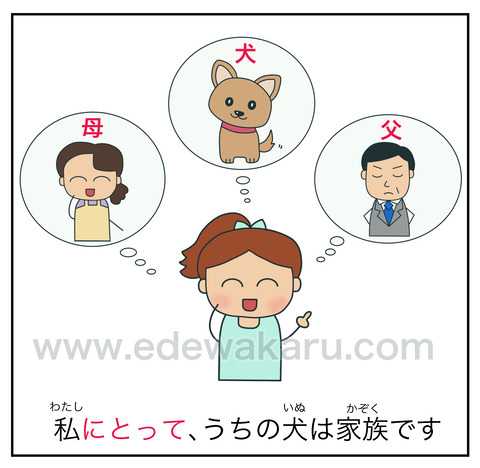
Meaning
Speaking from the position of 〜
From the perspective of 〜
Judging from the standpoint of 〜
How to use it
Noun [dictionary form] + にとって
Noun [dictionary form] + にとっての + noun
Explanation
“〜にとって” is a sentence pattern meaning “speaking from the position of 〜.” The subject is a person, organization, group, or the like, and it is used when you want to say “considering it from that position, it is 〜.” 😊
When “は” is added, as in “〜にとっては,” it expresses emphasis or contrast. 😮
[Examples]
Our dog is family to me (I don’t know how it is for other people). [Emphasis]
Our dog is family to me, but a pet to my father. [Contrast]
For him, this grammar is easy, but for me, it is difficult. [Contrast]
[Be careful]
Expressions such as “賛成” (agree) and “反対” (oppose) cannot follow it, so be careful. 😨
❌ As for going on a trip, it is in favor to me.
⭕️ I am in favor of going on a trip.
[For those who want to learn more]
The polite form of “〜にとって” is “〜にとりまして.” Its colloquial form is “〜にとっちゃ.” 😊
There are many patterns similar to “〜にとって,” so make sure to distinguish and learn them one by one. 😉
[Similar patterns]
In context 3 examples
私にとってうちの犬は家族です
→私の視点から言えば、うちの犬は家族ですTo me, our dog is family. → From my perspective, our dog is family.
彼にとって、この文法は簡単すぎます
→彼の立場に立って言えば、この文法は簡単すぎますFor him, this grammar is too easy. → Speaking from his position, this grammar is too easy.
日本社会にとって、少子化は大きな問題だ
→日本社会という視点から見れば、少子化は大きな問題だFor Japanese society, the declining birthrate is a major problem. → From the perspective of Japanese society, the declining birthrate is a major problem.
Read the original source text
Meaning
〜の立場に立って言えば
〜の視点から言えば
〜の立場から見れば
How to use it
名詞[辞書形]+にとって
名詞[辞書形]+にとっての+名詞
Explanation
「〜にとって」は「〜の立場に立って言えば」という意味を表す文型です。主語には「
人」や「団体・組織」「グループ」がきて、「その立場で考えると〜だ」と言いたい時に使われます
😊
「〜にとっては」と「は」が入ると【強調】や【対比】の意味を表します
😮
[例]
うちの犬は、私
にとっては
家族です(他の人にとってはどうかわからない)
【強調】
うちの犬は、私
にとっては
家族ですが、父
にとっては
ペットです
【対比】
彼
にとっては、この文法は簡単ですが、私
にとっては
難しいです
【対比】
【注意しましょう】
後ろに「賛成」「反対」などは使えませんので気をつけて下さい
😨
❌旅行に行くのは、私
にとって
賛成です
⭕️私は、旅行に行くのに賛成です
【余裕のある人へ】
「〜にとって」の丁寧な言い方は
「〜にとりまして」
です。また、口語形は
「〜にとっちゃ」
です😊
「〜にとって」は似ている文型がたくさんありますので、1つずつしっかりと区別して覚えておきましょう😉
【類似文型】
日本語文型辞典
Meaning
Basic information
Nにとって
Usually follows nouns referring to people or organizations and means “from that person’s/organization’s point of view.” Rarely, as in ③, it follows a noun referring to a thing and means “considering it from that point of view.” It is followed by expressions indicating possibility or impossibility, or evaluative expressions such as 「むずかしい」, 「有り難い」, and 「深刻だ」. Expressions that state an attitude, such as 「賛成」, 「反対」, and 「感謝する」, cannot be used.
Examples
① For him, a repair like this is nothing.
② Inflation is a serious problem for people living on pensions.
③ Repeated natural disasters dealt a major blow to the nation’s reconstruction.
④ For me, laid up in bed, my friend’s encouragement was more appreciated than anything.
Example (incorrect) That proposal is opposition for me.
Example (correct) I am opposed to that proposal.
Read the original source text
Meaning
基本情報Nにとって説明多くは人や組織を表す名詞を受けて、「その立場からみれば」という意味を表す。まれに③のようにものごとを表す名詞を受けて「その点から考えると」の意を表すこともある。後ろには可能・不可能を表す表現や「むずかしい」「有り薙い」「深刻だ」など、評価を表す表現が続く。「賛成」「反対」「感謝する」などの態度表明にかかわる表現は用いることができない。例文① 彼にとってこんな修理は何でもないことです。② 年金生活者にとってはインフレは深刻な問題である。③ 度重なる自然災害が国家の再建にとって大きな痛手となった。④ 病床の私にとっては、友人の励ましがなによりも有り難いものだった。例文(誤) その案は私にとって反対です。例文(正) 私はその案に反対です。
日本語文型辞典 英語版
Meaning
【にとって】[Nにとって]
With a noun mostly expressing a person or an organization, expresses the meaning of “from the point of view.” May express the meaning of “considering that aspect” when it is preceded by a noun expressing a thing, state or an event, as shown in
(3)
. Followed by some expression to show (in)ability or the speaker’s evaluation, such as むずかしい(difficult), 有り難い(grateful), or 深刻だ(serious). Cannot be followed by an expression to show the speaker’s attitude, such as 賛成, 反対 or 感謝する.
(×)その案は私にとって反対です。
For me, I disagree with the plan.
(○)私はその案に反対です。
I disagree with the plan.
In context 4 examples
彼にとってこんな修理は何でもないことです。
For him, such repairs are nothing.
年金生活者にとってはインフレが深刻な問題である。
For pensioners, inflation is a serious problem.
度重なる自然災害が国家の再建にとって大きな痛手となった。
The succession of natural disasters became a huge obstacle to reconstructing the country.
病床の私にとっては、友人の励ましがなによりも有り難いものだった。
When I was sick in bed, I appreciated the encouragement of my friends more than anything.
くらべてわかる日本語表現文型辞典
Meaning
From A’s standpoint, X is B.
How to use it
(X is) AにとってB (AにとってもB / AにとってはB)
[Noun – ∅] にとって
Explanation
【Contrast 1】
“AにしてもB” (Meaning 4, p. 237)
“AにしてもB” means B applies in A’s case too, whereas “(X is) AにとってもB” means that from A’s standpoint or perspective, X is B.
○私にしても休みは取りたい。 — I want to take time off too.
×私にとっても休みはとりたい。 — I too want to take time off from my point of view.
○来てくださってありがとう。私にとっても楽しいひとときでした。 — Thank you for coming. It was an enjoyable time for me too.
×来てくださってありがとう。私にしても楽しいひとときでした。 — Thank you for coming. It was an enjoyable time for me too.
In context 4 examples
美しい自然は人間にとって、かけがえのないものです。
Beautiful nature is irreplaceable to human beings.
若いころに苦労するのは、君の将来にとって、役立つはずだ。
Struggling when you are young should be useful for your future.
梅雨の長雨も草花にとっては、恵みの雨だ。
Even the long rains of the rainy season are a blessing for plants and flowers.
産地直送は生産者にとっても、消費者にとっても、便利なシステムだ。
Direct shipment from the producer is a convenient system for both producers and consumers.
Read the original source text
Meaning
Aの立場から考えてみるとXはB。
How to use it
(Xは)AにとってB(AにとってもB/AにとってはB)
[名詞-∅]にとって
Explanation
【対比1】
「AにしてもB」(意味4 P.237)
「AにしてもB」は、Aの場合もBを表し、「(Xは)AにとってもB」は、Aの立場、観点からはXはBを表す。
○私にしても休みは取りたい。
×私にとっても休みはとりたい。
○来てくださってありがとう。私にとっても楽しいひとときでした。
×来てくださってありがとう。私にしても楽しいひとときでした。
毎日のんびり日本語教師
How to use it
Noun + にとって(は)
Noun + にとっての + noun
Explanation
This sentence pattern is attached to nouns such as people, organizations, and groups to state a judgment, impression, evaluation, or the like from their point of view.
Notes
Nothing in particular.
In context 8 examples
女の子一人という環境は私にとって不安で心配。
Being the only girl in that environment makes me feel anxious and worried.
彼氏や彼女がいるのと自分にとって一生大切にしたい人がいるのとでは全く違う。
Having a boyfriend or girlfriend is completely different from having someone you want to cherish for the rest of your life.
失敗した時こそ、私たちにとって本当の学びが始まる。
It is precisely when we fail that true learning begins for us.
今年が皆様にとって素晴らしい一年であることを祈念いたします。
I sincerely hope this year will be a wonderful one for all of you.
これは私にとって特別な映画です。
This is a special movie for me.
社会人にとっての24時間はあまりにも短い。
Twenty-four hours is far too short for working adults.
こんなことをしているのは私にとってもあなたにとっても時間の無駄です。
Doing something like this is a waste of time for both you and me.
彼の2歩は私にとっての3歩。
His two steps are like three steps for me.
Read the original source text
How to use it
名詞+にとって(は)
名詞+にとっての+名詞
Explanation
人や組織、集団などの名詞につき、それらの立場から見た判断や感想、評価などを述べる文型です。
Notes
特になし
NINJAL 日本語文型データベース
Meaning
Used when you want to say what something is like when considered from the position or viewpoint of “~,” or how it feels to “~,” amid the variety of opinions and impressions people have.
In formal speeches or documents, it may also take the form “〜にとりまして.”
How to use it
Nにとって
Notes
“~” is usually followed by a word referring to an entity capable of making judgments, such as a person or organization. “〜にとって” is often followed by a clause expressing an evaluation or value judgment.
In context 6 examples
私にとって1970年は、文学賞を受賞し、作家としてデビューした忘れられない年です。
For me, 1970 is an unforgettable year: I received a literary award and made my debut as a writer.
この度の合同企画は、両社にとってきわめて有意義なものと確信しております。
We are convinced that this joint project is extremely meaningful for both companies.
ボランティア活動というのは、支援を受ける側だけでなく活動する側にとっても喜びになるものだと思う。
I think volunteer work brings joy not only to those receiving support, but also to those doing the work.
外国からの観光客の減少は、観光業に従事する我々にとっては大問題だ。
The decline in tourists from abroad is a major problem for those of us working in the tourism industry.
一般論に振り回されず、自分にとっての正解を見つける努力をしたほうがいい。
Rather than being swayed by general opinions, you should make an effort to find what is right for you.
本日多くのご来賓の方々、保護者の皆様をお迎えし、入学式を盛大に挙行できますことは、私どもにとりまして、非常に大きな喜びでございます。
It is a great joy for us to welcome so many distinguished guests and parents today and to hold this entrance ceremony in grand style.
Read the original source text
Meaning
人によっていろいろな考えや感想がある中で、~の立場・視点で考えるとどうか、~にはどう感じられるかを言いたいときに使います。
改まったスピーチや文書などでは「〜にとりまして」の形になることもあります。
How to use it
Nにとって
Notes
「~」にはふつう、人や組織など、判断ができる主体を表す言葉がきます。「〜にとって」の後には、評価・価値判断などを表す文がくることが多いです。
IMABI
Standpoint: として(は) VS にとって(は)
Read this IMABI lesson ↗Explanation
Standpoint: として(は) VS にとって(は)
This lesson is about relatively similar speech modals that concern describing standpoint or point of view. Although their English translations cause great confusion to learners, don’t let this beat you.
~として(は)
1. The first uses of ~として that we will study are after nominal phrases. This is something really important to keep in mind because other usages of this will go after other things. So, don’t get things confused in your mind.
The first thing that として is most known for is when it shows “qualification/title”. In other words, it functions like the as in “to carry out one’s duty as an officer”. It can also be used to show what you have something as. This is somewhat causative in nature, but in this sense it is closer to utility. So, just as you can say, “to use a sharp stick as a knife”, you can say 鋭い枝をナイフとして使う. Notice, though, that “as” in English can be used in many more situations than what has just been defined for として.
“(Aは)B としては” is typically just a contrastive usage of として, but it can have nuances more similar to “among” in the sense of ~の場合には. It could also emphasis a side of judgment. For instance, if you were to say 私としては, you are emphasizing your side of opinion.
Particle Note: When used to modify another noun phrase, which is possible as well in English, you must use ~としての.
1. ジョン万次郎まんじろうは、日本人として始めて、アメリカで教育を受けた。
Jon Manjiro was the first person as a Japanese to receive an education in America.
2. 石炭を燃料として使う。
To use coal as fuel.
3. 私一己としては
For my own part/personally
4. 私としては、彼の意見に反対です。
As for me, I don’t agree with his opinion.
5. 最高傑作として作る。X → 最高傑作を作る。
To create as a masterpiece.
6. 最高傑作としての条件 〇
Conditions as a best work masterpiece
7. くそあいつは教師としても無能だぞ。(Vulgar)
That guy is also incompetent as a teacher.
Usage Note: This usage is deemed to be case.
2. Shows complete negation with a word showing unit.
8. 僕は、一日として彼女のことを思わない日はない。
There’s not even a single day that I don’t think about her.
9. 一人として賛成しません。
Not one person can agree.
Usage Note: This usage is deemed to be adverbial.
3. After the 終止形 it means “in assuming that” or “with the reason of”.
10. 話は後でするとして、まず食事にしましょう。
Let’s leave talking for later and eat first.
Usage Note: This usage is deemed to be conjunctive.
Grammar Note: として is a grammaticalized object that should be studied separately from とする. Though its usages derive from it, it has become its own grammar point in its own right. Thus, it should be differentiated from a として from とする used at the end of a dependent clause, in which て would still have a conjunctive function. The として is also not the same as the として found in the 連用形 of タル形容動詞.
11. 堂堂としている。
It’s magnificent. (Grand; impressive)
12. われわれはその実験の結果を基礎として、学会雑誌に発表することになりました。
We had the results of that experiment as our basis and published (the results) in a scientific journal.
In Relation to ~とする
Up to now, there have been several mentions of ~とする. How exactly does this fit with this section? Furthermore, how are you supposed to know what you’re looking at? “AをBとする” is “to make/have A be B” a certain way where と shows the content/substance of a result. ~とする can mean “to presume; to think that; etc.
13. その結果を基礎としている。
To be having the results as the basis.
14. 業としている。
To be pursuing a vocation.
15. 石炭を燃料とする。
To have coal be (used as) fuel.
16. 今は配慮を必要としている。
We need forethought now.
17. 一時として目が離せないよ。
My eyes can leave a single moment.
18. 長官として発言する。
To speak as a general.
19. 初めて会う人やよく知らない人には敬語を使うのが礼儀だとされていますよ。
It is deemed proper etiquette to use Keigo towards people such as those you first meet or don’t know well.
20. 人を殺すのが犯罪(だ)とされていない者はいるのか。
Is there a person that doesn’t deem killing a person a crime?
~としても
~としても is after nominal phrases to mean “even the position of…” or “even if…were to…”.
21. 私としても、この事柄は重要ではないとよく分かります。
As for me, too, I understand well that this matter is not important.
22. 新車を買うとしても、今度もやっぱ(り)黒いのにしよう。
Even if we were to buy a new vehicle, let’s surely get the black one this time.
23. 行けるとしても、少し遅れてしまうかも。
Even if we were able to go, we would end up being a little late.
24. 生まれ変わったとしても、またそんなことをするのか。
Even if I were born again, would such a thing happen again?
~にとって
~にとって, equivalent to “(の立場・たちば)からみて”, means “to/for” and shows someone’s perspective on something. ~にとって may be with は to make a slightly contrasting image or with の attributively. It may be ~にとりまして in polite speech and ~にとっちゃ(あ) in slang.
25. 彼にとっちゃその方がええんだよ。(砕けた)
For him, that way’s better.
26. 初心者にとってはあのクラスは難しい。
That class is difficult to beginners.
27. 人間にとっての事柄ことがら
A circumstance to humans
28. 韓国語を知っている人にとって、日本語は難しくないはずです。
For people who know Korean, Japanese isn’t supposed to be difficult.
29. 核爆弾かくばくだんは世界平和にとっての重大な脅威きょういです。
Nuclear weapons are great threats to world peace.
~として VS ~にとって
Many students often overextend the usages of these two speech modals. Common mistakes include confusing these patterns with topicalization and “although phrases”. As a quick exercise, consider the following sentences and what you should do to fix them.
30a. 彼女は学生として、学校へ行かず、遊んでばかりいるよ。X
30b. 外国人として大変なのは食べ物だと思います。X
30c. 僕にとってその色はあんまり好きじゃない。X
Hopefully you found something wrong with these sentences. The first order of business is to where these speech modals literally come from. ~として comes from the case particle と + the verb する; ~にとって comes from the case particle に + the verb 取る. Once put together, they mark their own unique case function. Thus, some people often call them “compound case particles”.
“Noun + ~として” and “Noun + ~にとって” both show position/point of view, but in the case of the former, it is often used to state an action that one does/did as qualification and/or from a position/standpoint. This may sound confusing, but consider the following.
31. クラスの代表として委員会に出席しました。(Qualification/position)
I attended the committee meeting as the class representative.
32. あなたの医者として、食事の量を減らすよう忠告します。
As your doctor, I advise you to decrease the amount you eat.
On the other hand, ~にとって shows an evaluation or value judgment from the/a standpoint (of someone).
33. 私にとりまして、出張は大変思い出深かったです。
For me, the business trip was very profoundly memorable.
Usage Note: ~にとりまして is normally used when talking to someone much older than you. So, the above sentence would most likely be 私にとって、出張は大変思い出深かったです.
34. これは私にとって忘れられない思い出です。
This is a memory to me that I can’t forget.
35. これはあたしにとってとっても大切なものなんだわ。(Feminine; Emphatic)
This is something very important to me.
With は
は is added to them when raising a circumstance as the topic, emphasis, or show a contrast.
36. 私としては、その考えには賛成いたしかねます。
As for me, I can’t agree to that idea.
37. あんたにとっちゃ朝飯前かもしれんが、俺にとっちゃ大変な仕事なんだよ。(砕けた)
To you it may be trivial, but to me it’s a big job.
Contrast
38. 人{として・にとって]大切なことは何か。
With ~として, the sentence suggests that what’s being important should be done by people whereas ~にとって simply states what’s so, or in this case simply stating a question.
39.
Aさん: A銀行がB銀行と合併がっぺいするそうですよ。
Bさん: へえ。でも、A銀行{としては・にとっては}、そう悪いことではないんじゃないですか。
Aさん: でも、B銀行としては黙って見ているわけにはいかないんじゃないですか。
40.
Aさん: 文部省もんぶしょうとしてはどう考えていますか。
Bさん: 文部省としましては、今回の処置しょちはやむを得ないものと考えております。(謙譲語)
Exercise: Translate the last two passages!
These patterns also differ greatly in what kinds of sentences they’re used in.
~として
Circumstance There is a sentence that shows that something happens, and the sentence after shows an opinion or stance concerning it.
Opinion Used to present one’s opinion and then show an opposite position.
41. 市から感謝状と記念品をいただきました。これは我が家の家宝として大切にしたいです。
I received a letter of thanks and mementos from the city. I would like to treat this as a family treasure in our home.
42. 義務教育の段階で外国語を教えた方がいい。外国語が話せるのは社会人として絶対に必要な教育である。
Foreign language should be taught at the level of mandatory education. Being able to speak a foreign language is absolutely necessary education for a person of society.
~にとって
~にとって~の/ことは~だ/である A very emphatic derivative of the basic form.
In topic sentence After introducing the topic, a concrete explanation follows.
43. 今僕にとって唯一の楽しみになっているのは日本語の勉強です。
What has now become my sole enjoyment is my Japanese studies.
44. 昔の人々の生活にとって、お寺は欠かせないものだった。
The temple was a necessary thing to the lives of the ancient.
Words Used with Them
1. XとしてY
Words that follow Y:
Verbs that describe action: 言う、許す、行動する.
Verbs/adjectives that describe condition: 恥ずかしい、有名だ、知られている.
45. 彼は弁護士としては無能です。
He is no good as a lawyer.
2. XにとってY
Words that follow Y:
Potential expressions: 可能だ、忘れられない.
Adjectives of evaluation: 大切だ、難しい、大変だ.
Adjective + Noun
46. 世界の経済にとって、金融きんゆうを引き締しめるのは好このましくない事態だ。
For the world economy, tightening the money market is not a desirable situation.
In context 50 examples
The first uses of ~として that we will study are after nominal phrases. This is something really important to keep in mind because other usages of this will go after other things. So, don’t get things confused in your mind.
The first uses of ~として that we will study follow nominal phrases. This is important to keep in mind because other uses of this expression follow other things. So, don’t get them mixed up.
ジョン万次郎まんじろうは、日本人として始めて、アメリカで教育を受けた。
Jon Manjiro was the first person as a Japanese to receive an education in America.
石炭を燃料として使う。
To use coal as fuel.
私一己としては
For my own part/personally
私としては、彼の意見に反対です。
As for me, I don’t agree with his opinion.
最高傑作として作る。X → 最高傑作を作る。
To create as a masterpiece.
最高傑作としての条件 〇
Conditions as a best work masterpiece
くそあいつは教師としても無能だぞ。(Vulgar)
That guy is also incompetent as a teacher.
僕は、一日として彼女のことを思わない日はない。
There’s not even a single day that I don’t think about her.
一人として賛成しません。
Not one person can agree.
After the 終止形 it means “in assuming that” or “with the reason of”.
Let’s leave talking for later and eat first.
話は後でするとして、まず食事にしましょう。
Let’s leave talking for later and eat first.
堂堂としている。
It’s magnificent. (Grand; impressive)
われわれはその実験の結果を基礎として、学会雑誌に発表することになりました。
We had the results of that experiment as our basis and published (the results) in a scientific journal.
その結果を基礎としている。
To be having the results as the basis.
業としている。
To be pursuing a vocation.
石炭を燃料とする。
To have coal be (used as) fuel.
今は配慮を必要としている。
We need forethought now.
一時として目が離せないよ。
My eyes can leave a single moment.
長官として発言する。
To speak as a general.
初めて会う人やよく知らない人には敬語を使うのが礼儀だとされていますよ。
It is deemed proper etiquette to use Keigo towards people such as those you first meet or don’t know well.
人を殺すのが犯罪(だ)とされていない者はいるのか。
Is there a person that doesn’t deem killing a person a crime?
私としても、この事柄は重要ではないとよく分かります。
As for me, too, I understand well that this matter is not important.
新車を買うとしても、今度もやっぱ(り)黒いのにしよう。
Even if we were to buy a new vehicle, let’s surely get the black one this time.
行けるとしても、少し遅れてしまうかも。
Even if we were able to go, we would end up being a little late.
生まれ変わったとしても、またそんなことをするのか。
Even if I were born again, would such a thing happen again?
彼にとっちゃその方がええんだよ。(砕けた)
For him, that way’s better.
初心者にとってはあのクラスは難しい。
That class is difficult to beginners.
人間にとっての事柄ことがら
A circumstance to humans
韓国語を知っている人にとって、日本語は難しくないはずです。
For people who know Korean, Japanese isn’t supposed to be difficult.
核爆弾かくばくだんは世界平和にとっての重大な脅威きょういです。
Nuclear weapons are great threats to world peace.
彼女は学生として、学校へ行かず、遊んでばかりいるよ。X
As a student, she doesn’t go to school and just keeps playing. X
外国人として大変なのは食べ物だと思います。X
As a foreigner, I think the difficult thing is food. X
僕にとってその色はあんまり好きじゃない。X
For me, I don’t like that color very much. X
クラスの代表として委員会に出席しました。(Qualification/position)
I attended the committee meeting as the class representative.
あなたの医者として、食事の量を減らすよう忠告します。
As your doctor, I advise you to decrease the amount you eat.
私にとりまして、出張は大変思い出深かったです。
For me, the business trip was very profoundly memorable.
これは私にとって忘れられない思い出です。
This is a memory to me that I can’t forget.
これはあたしにとってとっても大切なものなんだわ。(Feminine; Emphatic)
This is something very important to me.
私としては、その考えには賛成いたしかねます。
As for me, I can’t agree to that idea.
あんたにとっちゃ朝飯前かもしれんが、俺にとっちゃ大変な仕事なんだよ。(砕けた)
To you it may be trivial, but to me it’s a big job.
人{として・にとって]大切なことは何か。
What is important for a person?
市から感謝状と記念品をいただきました。これは我が家の家宝として大切にしたいです。
I received a letter of thanks and mementos from the city. I would like to treat this as a family treasure in our home.
義務教育の段階で外国語を教えた方がいい。外国語が話せるのは社会人として絶対に必要な教育である。
Foreign language should be taught at the level of mandatory education. Being able to speak a foreign language is absolutely necessary education for a person of society.
今僕にとって唯一の楽しみになっているのは日本語の勉強です。
What has now become my sole enjoyment is my Japanese studies.
昔の人々の生活にとって、お寺は欠かせないものだった。
The temple was a necessary thing to the lives of the ancient.
XとしてY
Words that follow Y:
彼は弁護士としては無能です。
He is no good as a lawyer.
XにとってY
Words that follow Y:
世界の経済にとって、金融きんゆうを引き締しめるのは好このましくない事態だ。
For the world economy, tightening the money market is not a desirable situation.
Read the original source text
Explanation
Standpoint: として(は) VS にとって(は)
This lesson is about relatively similar speech modals that concern describing standpoint or point of view. Although their English translations cause great confusion to learners, don’t let this beat you.
~として(は)
1. The first uses of ~として that we will study are after nominal phrases. This is something really important to keep in mind because other usages of this will go after other things. So, don’t get things confused in your mind.
The first thing that として is most known for is when it shows “qualification/title”. In other words, it functions like the as in “to carry out one’s duty as an officer”. It can also be used to show what you have something as. This is somewhat causative in nature, but in this sense it is closer to utility. So, just as you can say, “to use a sharp stick as a knife”, you can say 鋭い枝をナイフとして使う. Notice, though, that “as” in English can be used in many more situations than what has just been defined for として.
“(Aは)B としては” is typically just a contrastive usage of として, but it can have nuances more similar to “among” in the sense of ~の場合には. It could also emphasis a side of judgment. For instance, if you were to say 私としては, you are emphasizing your side of opinion.
Particle Note: When used to modify another noun phrase, which is possible as well in English, you must use ~としての.
1. ジョン万次郎まんじろうは、日本人として始めて、アメリカで教育を受けた。
Jon Manjiro was the first person as a Japanese to receive an education in America.
2. 石炭を燃料として使う。
To use coal as fuel.
3. 私一己としては
For my own part/personally
4. 私としては、彼の意見に反対です。
As for me, I don’t agree with his opinion.
5. 最高傑作として作る。X → 最高傑作を作る。
To create as a masterpiece.
6. 最高傑作としての条件 〇
Conditions as a best work masterpiece
7. くそあいつは教師としても無能だぞ。(Vulgar)
That guy is also incompetent as a teacher.
Usage Note: This usage is deemed to be case.
2. Shows complete negation with a word showing unit.
8. 僕は、一日として彼女のことを思わない日はない。
There’s not even a single day that I don’t think about her.
9. 一人として賛成しません。
Not one person can agree.
Usage Note: This usage is deemed to be adverbial.
3. After the 終止形 it means “in assuming that” or “with the reason of”.
10. 話は後でするとして、まず食事にしましょう。
Let’s leave talking for later and eat first.
Usage Note: This usage is deemed to be conjunctive.
Grammar Note: として is a grammaticalized object that should be studied separately from とする. Though its usages derive from it, it has become its own grammar point in its own right. Thus, it should be differentiated from a として from とする used at the end of a dependent clause, in which て would still have a conjunctive function. The として is also not the same as the として found in the 連用形 of タル形容動詞.
11. 堂堂としている。
It’s magnificent. (Grand; impressive)
12. われわれはその実験の結果を基礎として、学会雑誌に発表することになりました。
We had the results of that experiment as our basis and published (the results) in a scientific journal.
In Relation to ~とする
Up to now, there have been several mentions of ~とする. How exactly does this fit with this section? Furthermore, how are you supposed to know what you’re looking at? “AをBとする” is “to make/have A be B” a certain way where と shows the content/substance of a result. ~とする can mean “to presume; to think that; etc.
13. その結果を基礎としている。
To be having the results as the basis.
14. 業としている。
To be pursuing a vocation.
15. 石炭を燃料とする。
To have coal be (used as) fuel.
16. 今は配慮を必要としている。
We need forethought now.
17. 一時として目が離せないよ。
My eyes can leave a single moment.
18. 長官として発言する。
To speak as a general.
19. 初めて会う人やよく知らない人には敬語を使うのが礼儀だとされていますよ。
It is deemed proper etiquette to use Keigo towards people such as those you first meet or don’t know well.
20. 人を殺すのが犯罪(だ)とされていない者はいるのか。
Is there a person that doesn’t deem killing a person a crime?
~としても
~としても is after nominal phrases to mean “even the position of…” or “even if…were to…”.
21. 私としても、この事柄は重要ではないとよく分かります。
As for me, too, I understand well that this matter is not important.
22. 新車を買うとしても、今度もやっぱ(り)黒いのにしよう。
Even if we were to buy a new vehicle, let’s surely get the black one this time.
23. 行けるとしても、少し遅れてしまうかも。
Even if we were able to go, we would end up being a little late.
24. 生まれ変わったとしても、またそんなことをするのか。
Even if I were born again, would such a thing happen again?
~にとって
~にとって, equivalent to “(の立場・たちば)からみて”, means “to/for” and shows someone’s perspective on something. ~にとって may be with は to make a slightly contrasting image or with の attributively. It may be ~にとりまして in polite speech and ~にとっちゃ(あ) in slang.
25. 彼にとっちゃその方がええんだよ。(砕けた)
For him, that way’s better.
26. 初心者にとってはあのクラスは難しい。
That class is difficult to beginners.
27. 人間にとっての事柄ことがら
A circumstance to humans
28. 韓国語を知っている人にとって、日本語は難しくないはずです。
For people who know Korean, Japanese isn’t supposed to be difficult.
29. 核爆弾かくばくだんは世界平和にとっての重大な脅威きょういです。
Nuclear weapons are great threats to world peace.
~として VS ~にとって
Many students often overextend the usages of these two speech modals. Common mistakes include confusing these patterns with topicalization and “although phrases”. As a quick exercise, consider the following sentences and what you should do to fix them.
30a. 彼女は学生として、学校へ行かず、遊んでばかりいるよ。X
30b. 外国人として大変なのは食べ物だと思います。X
30c. 僕にとってその色はあんまり好きじゃない。X
Hopefully you found something wrong with these sentences. The first order of business is to where these speech modals literally come from. ~として comes from the case particle と + the verb する; ~にとって comes from the case particle に + the verb 取る. Once put together, they mark their own unique case function. Thus, some people often call them “compound case particles”.
“Noun + ~として” and “Noun + ~にとって” both show position/point of view, but in the case of the former, it is often used to state an action that one does/did as qualification and/or from a position/standpoint. This may sound confusing, but consider the following.
31. クラスの代表として委員会に出席しました。(Qualification/position)
I attended the committee meeting as the class representative.
32. あなたの医者として、食事の量を減らすよう忠告します。
As your doctor, I advise you to decrease the amount you eat.
On the other hand, ~にとって shows an evaluation or value judgment from the/a standpoint (of someone).
33. 私にとりまして、出張は大変思い出深かったです。
For me, the business trip was very profoundly memorable.
Usage Note: ~にとりまして is normally used when talking to someone much older than you. So, the above sentence would most likely be 私にとって、出張は大変思い出深かったです.
34. これは私にとって忘れられない思い出です。
This is a memory to me that I can’t forget.
35. これはあたしにとってとっても大切なものなんだわ。(Feminine; Emphatic)
This is something very important to me.
With は
は is added to them when raising a circumstance as the topic, emphasis, or show a contrast.
36. 私としては、その考えには賛成いたしかねます。
As for me, I can’t agree to that idea.
37. あんたにとっちゃ朝飯前かもしれんが、俺にとっちゃ大変な仕事なんだよ。(砕けた)
To you it may be trivial, but to me it’s a big job.
Contrast
38. 人{として・にとって]大切なことは何か。
With ~として, the sentence suggests that what’s being important should be done by people whereas ~にとって simply states what’s so, or in this case simply stating a question.
39.
Aさん: A銀行がB銀行と合併がっぺいするそうですよ。
Bさん: へえ。でも、A銀行{としては・にとっては}、そう悪いことではないんじゃないですか。
Aさん: でも、B銀行としては黙って見ているわけにはいかないんじゃないですか。
40.
Aさん: 文部省もんぶしょうとしてはどう考えていますか。
Bさん: 文部省としましては、今回の処置しょちはやむを得ないものと考えております。(謙譲語)
Exercise: Translate the last two passages!
These patterns also differ greatly in what kinds of sentences they’re used in.
~として
Circumstance There is a sentence that shows that something happens, and the sentence after shows an opinion or stance concerning it.
Opinion Used to present one’s opinion and then show an opposite position.
41. 市から感謝状と記念品をいただきました。これは我が家の家宝として大切にしたいです。
I received a letter of thanks and mementos from the city. I would like to treat this as a family treasure in our home.
42. 義務教育の段階で外国語を教えた方がいい。外国語が話せるのは社会人として絶対に必要な教育である。
Foreign language should be taught at the level of mandatory education. Being able to speak a foreign language is absolutely necessary education for a person of society.
~にとって
~にとって~の/ことは~だ/である A very emphatic derivative of the basic form.
In topic sentence After introducing the topic, a concrete explanation follows.
43. 今僕にとって唯一の楽しみになっているのは日本語の勉強です。
What has now become my sole enjoyment is my Japanese studies.
44. 昔の人々の生活にとって、お寺は欠かせないものだった。
The temple was a necessary thing to the lives of the ancient.
Words Used with Them
1. XとしてY
Words that follow Y:
Verbs that describe action: 言う、許す、行動する.
Verbs/adjectives that describe condition: 恥ずかしい、有名だ、知られている.
45. 彼は弁護士としては無能です。
He is no good as a lawyer.
2. XにとってY
Words that follow Y:
Potential expressions: 可能だ、忘れられない.
Adjectives of evaluation: 大切だ、難しい、大変だ.
Adjective + Noun
46. 世界の経済にとって、金融きんゆうを引き締しめるのは好このましくない事態だ。
For the world economy, tightening the money market is not a desirable situation.
文法
Meaning
from the standpoint of ...; from ...’s perspective
How to use it
N + にとって (N is mainly a noun referring to a person, organization, etc.)
Notes
・A judgment or evaluation follows.
・The expression 「〜とっては」 is also used.
・A polite form is 「〜にとりまして」.
In context 15 examples
私たちにとって、ララ(猫の名前)は家族と同じだ。
For us, Lara (the cat’s name) is just like family.
私にとって、漢字の勉強はとても楽しい。
For me, studying kanji is a lot of fun.
私にとって、一番大切なものはお金だ。
For me, the most important thing is money.
現代人にとって、スマホは生活の一部である。
For people today, smartphones are a part of everyday life.
外国人にとって、日本人の名前はかなり覚えにくいようだ。
Japanese names seem quite difficult for foreigners to remember.
あなたにとって、理想の人とはどんな人ですか。
For you, what kind of person is ideal?
芸能人にとって、歯は命と言われています。
They say that teeth are a performer’s life.
スポーツ選手にとって、健康管理はとても重要です。
Health management is very important for athletes.
私にとって、この子は宝のようなものです。
To me, this child is like a treasure.
誰にとっても大切なのは健康です。
Health is important to everyone.
彼にとって、一番大切なものはお金のようです。
For him, money seems to be the most important thing.
日本人にとって、米とみそは欠かせないものだ。
For Japanese people, rice and miso are indispensable.
今回の失敗はクライアントにとっては、重大な問題ではなかったようだ。
This failure does not seem to have been a serious problem for the client.
君の意見など、私にとってはどうでもいいことだ。
Your opinions and the like are of no consequence to me.
体にとって一番重要なものは、水でしょう。
Water is probably the most important thing for the body.
Read the original source text
Meaning
〜の立場から考えると / 〜の視点で言うと
How to use it
N + にとって(Nは主に人や組織などを表す名詞)
Notes
・判断や評価の内容が後ろに続く。
・「〜とっては」という言い方もある。
・丁寧な言い方は「〜にとりまして」。
日本語NET JLPT文法解説まとめ
Meaning
from the standpoint of ...; from ...’s perspective
How to use it
N + にとって (N is mainly a noun referring to a person, organization, etc.)
Explanation
From the standpoint of 〜. Preceded by content with judgement or evaluation.
・It is followed by content expressing a judgment or evaluation.
・The expression “〜とっては” is also used.
・The polite form is “〜にとりまして.”
In context 17 examples
私たちにとって、ララ(猫の名前)は家族と同じだ。
For us, Lara (the cat’s name) is just like family.
私にとって、漢字の勉強はとても楽しい。
For me, studying kanji is a lot of fun.
私にとって、一番大切なものはお金だ。
For me, the most important thing is money.
現代人にとって、スマホは生活の一部である。
For people today, smartphones are a part of everyday life.
外国人にとって、日本人の名前はかなり覚えにくいようだ。
Japanese names seem quite difficult for foreigners to remember.
あなたにとって、理想の人とはどんな人ですか。
For you, what kind of person is ideal?
芸能人にとって、歯は命と言われています。
They say that teeth are a performer’s life.
スポーツ選手にとって、健康管理はとても重要です。
Health management is very important for athletes.
私にとって、この子は宝のようなものです。
To me, this child is like a treasure.
誰にとっても大切なのは健康です。
Health is important to everyone.
彼にとって、一番大切なものはお金のようです。
For him, money seems to be the most important thing.
日本人にとって、米とみそは欠かせないものだ。
For Japanese people, rice and miso are indispensable.
今回の失敗はクライアントにとっては、重大な問題ではなかったようだ。
This failure does not seem to have been a serious problem for the client.
君の意見など、私にとってはどうでもいいことだ。
Your opinions and the like are of no consequence to me.
体にとって一番重要なものは、水でしょう。
Water is probably the most important thing for the body.
日本で働きたいと思っている外国人にとって、こちらのサイトが役に立つと思います。
I think this site will be useful for foreigners who want to work in Japan.
一人暮らしの学生にとって、インスタントラーメンは欠かせないもの1つだ。
For students living alone, instant ramen is one of the essentials.
Read the original source text
Meaning
〜の立場から考えると / 〜の視点で言うと
How to use it
N + にとって(Nは主に人や組織などを表す名詞)
Explanation
From the standpoint of 〜. Preceded by content with judgement or evaluation.
・判断や評価の内容が後ろに続く。
・「〜とっては」という言い方もある。
・丁寧な言い方は「〜にとりまして」。