くらべてわかる日本語表現文型辞典
Meaning
Meaning 1: If one assumes that the preceding clause does not come to pass, one readily states that it will be A. This expresses the speaker's feeling that A is no big deal.
Meaning 2: There is no deep significance to the fact that A happened. It is simply that A (was done).
Meaning 3: Everything that needed to be done has already been done, and the only thing left is to do A.
How to use it
Aまでだ (Aまでのことだ)
Connection 1:
[Verb—dictionary form] までだ
[Verb—ない form] ないまでだ
Connection 2:
[Verb—た form] までだ
[i-adjective—かった] までだ
Connection 3:
[Verb—dictionary form] までだ
Explanation
[Contrast 3]
“Aだけだ”
“Aまでだ” is not used in negative sentences, but “Aだけだ” is.
○やるべきことはすべてやった。後はつまらないミスをしないだけだ。 — I have done everything that needed to be done. All that's left is to avoid making a silly mistake.
×やるべきことはすべてやった。後はつまらないミスをしないまでだ。 — I have done everything that needed to be done. All that's left is to avoid making a silly mistakeまでだ.
“Aばかり” (Meaning 3, p. 274)
“Aばかり” carries the nuance of waiting for the situation to become A, while “Aまでだ” focuses on there being nothing else left to do besides A.
○掃除もすみ、あとは客が来るばかりだ。 — The cleaning is finished, and all that's left is for the guests to arrive.
×掃除もすみ、あとは客が来るまでだ。 — The cleaning is finished, and all that's left is for the guests to arriveまでだ.
○苦しい勉強に耐えてきた。あとは全力を出し切るまでだ。 — I have endured grueling study. All that's left is to give it everything I've got.
×苦しい勉強に耐えてきた。あとは全力を出し切るばかりだ。 — I have endured grueling study. All that's left is to give it everything I've gotばかり.
In context 12 examples
間に合わないときはあきらめるまでだ。
If we can't make it in time, all we can do is give up.
向こうが来ないのなら、こっちから出向くまでのことだ。
If they aren't coming, we'll just go over there ourselves.
借金を返していただけないのでしたら、裁判に訴えるまでです。
If you cannot repay the debt, we will have no choice but to take you to court.
要求が受け入れられなければ、合併の計画が白紙に戻るまでのことだ。
If our demands aren't accepted, then the merger plan will simply go back to square one.
終電がなくなったから、歩いて帰ってきたまでだよ。
The last train had gone, so I simply walked home.
なぜ怒られるんだ。言われたことをしたまでじゃないか。
Why are you angry? I only did what I was told, didn't I?
あの時はたまたま運が悪かったまでさ。次に頑張ればいい。
We were just unlucky that time. We can try harder next time.
大学に入学したといっても、エスカレーター式の大学に入ったまでで、たいしたことはない。
Even though I got into university, it was only an escalator-system university, so it's nothing special.
ここまで頑張ったんだから、あとは結果を待つまでだ。
We've come this far, so all that's left is to wait for the results.
出来るだけの説明はした。あとは先方のよい返事を待つまでだ。
I've explained as much as I can. All that's left is to wait for a favorable reply from them.
教えることは全部教えた。あとは彼の力に期待するまでだ。
I've taught him everything there is to teach. All that's left is to trust in his abilities.
俺たちは厳しい練習に耐えてきた。その力を発揮するまでだ。
We've endured tough training. All that's left is to show what we can do.
Read the original source text
Meaning
意味1:前件が成立しないと仮定したら、Aになるとあっさり表明する。話し手にとっては、Aは大したことはないという気持ちを表す。
意味2:Aという事実に深い意味はない。ただ、A(をした)だけのことだ。
意味3:すでにやるべきことはやり尽くし、あとはAをするだけの状態だ。
How to use it
Aまでだ(Aまでのことだ)
接続1:
[動詞-る形]までだ
[動詞-ない形]ないまでだ
接続2:
[動詞-た形]までだ
[イ形-かった]までだ
接続3:
[動詞-る形]までだ
Explanation
【対比3】
「Aだけだ」
「Aまでだ」は否定文にはつかないが、「Aだけだ」はつく。
○やるべきことはすべてやった。後はつまらないミスをしないだけだ。
×やるべきことはすべてやった。後はつまらないミスをしないまでだ。
「Aばかり」(意味3 P.274)
「Aばかり」はAという状態になるのを待っているというニュアンスだが、「Aまでだ」はA以外にもうすべきことは何もないという部分に視点がある。
○掃除もすみ、あとは客が来るばかりだ。
×掃除もすみ、あとは客が来るまでだ。
○苦しい勉強に耐えてきた。あとは全力を出し切るまでだ。
×苦しい勉強に耐えてきた。あとは全力を出し切るばかりだ。
絵でわかる日本語
Meaning
(If ~ doesn’t work,) I’ll just do ~
(If ~ doesn’t work,) I can just do ~, so it’s no problem
How to use it
Verb [dictionary form] + までだ
Verb [dictionary form] + までのことだ
Explanation
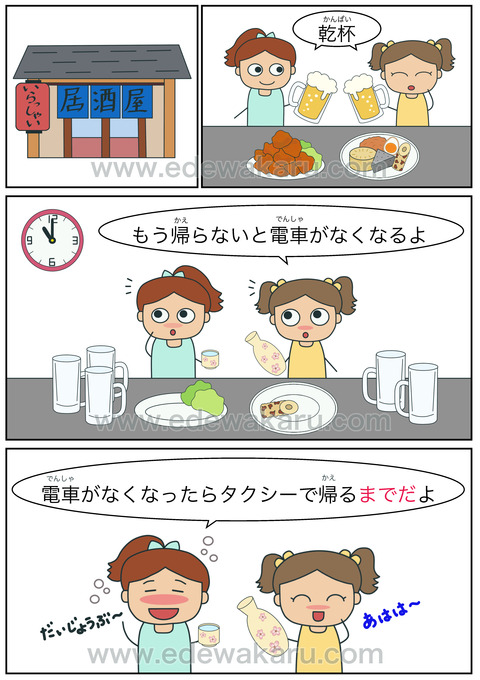
“〜までだ・〜までのことだ” is a sentence pattern meaning “just do ~.” It means “there’s no other way, so I’ll just do ~,” and is used when you want to say, “If ~ doesn’t work, I can just do ~, so there’s no problem,” or “I’ll just do ~, so it’ll be fine.” “〜までのことだ” emphasizes “〜までだ,” so the two can be used interchangeably 😉
[Example]
If the trains stop running, I’ll just go home by taxi.
=If the trains stop running, I’ll just go home by taxi.
A conditional sentence comes before “〜までだ,” so remember that forms like “〜だったら〜までだ” and “〜なら〜までだ” are often used 😀
[Patterns containing “まで”]
〜たまでだ・〜たまでのことだ
〜たらそれまでだ・〜ばそれまでだ
〜ないまでも
〜に至るまで
〜までして
〜までだ・〜までのことだ(V辞+までだ)
〜までに
〜までになる
〜までもない
In context 5 examples
電車がなくなったら、タクシーで帰るまでだ
→電車がなくなったら、タクシーで帰ればいいから大丈夫だIf the trains stop running, I’ll just go home by taxi. →If the trains stop running, I can just go home by taxi, so it’ll be fine.
お金が足りなかったら、お母さんに借りるまでだ
→お金が足りなかったら、お母さんに借りるだけだから問題ない(復習:貸す・借りる)(復習:貸す・借りる(練習))If I don’t have enough money, I’ll just borrow some from my mother. →If I don’t have enough money, I can just borrow some from my mother, so it’s no problem. (Review: lend/borrow) (Review: lend/borrow [practice])
不合格だったら、来年またチャレンジするまでだ
→不合格だったら、来年またチャレンジするだけだIf I fail, I’ll just try again next year. →If I fail, I’ll just try again next year.
手伝ってくれないんだったら、一人でやるまでだ
→手伝ってくれないんだったら、一人でやるだけだから問題ないIf you won’t help me, I’ll just do it alone. →If you won’t help me, I can just do it alone, so it’s no problem.
ホテルが見つからなかったら、カラオケでオールするまでだ
→ホテルが見つからなかったら、カラオケでオールするだけだから大丈夫だ(復習:オール)If I can’t find a hotel, I’ll just stay up all night at karaoke. →If I can’t find a hotel, I’ll just stay up all night at karaoke, so it’ll be fine. (Review: stay up all night)
Read the original source text
Meaning
(〜がだめなら)〜するだけだ
(〜がだめなら)〜すればいいから、問題ない
How to use it
動詞[辞書形]+までだ
動詞[辞書形]+までのことだ
Explanation
「〜までだ・〜までのことだ」は「〜するだけだ」という意味を表す文型です。これは「他の方法がないので〜するだけだ」という意味で、
「〜がだめなら〜すればいいから問題ない」「〜するだけだから大丈夫だ」
と言いたい時に使われます。
「〜までのことだ」は「〜までだ」を強調した言い方です
のでチェンジすることができます😉
[例]
電車がなくなったら、タクシーで帰る
までだ
=電車がなくなったら、タクシーで帰る
までのことだ
「〜までだ・〜までのことだ」は前には条件文(じょうけんぶん)がきますので、
「〜だったら〜までだ」「〜なら〜までだ」
の形がよく使われると覚えておきましょう😀
【「まで」がつく文型】
〜たまでだ・〜たまでのことだ
〜たらそれまでだ・〜ばそれまでだ
〜ないまでも
〜に至るまで
〜までして
〜までだ・〜までのことだ(V辞+までだ)
〜までに
〜までになる
〜までもない
どんなときどう使う 日本語表現文型辞典
Usage 1
Meaning
(not serious) merely; simply
How to use it
Vた + までだ
Explanation
までだ〈軽い気持ち〉
~しただけなのだ
母:何度電話しても、あなたがいないから、ちょっと気になったまでよ。
B:いいえ、故郷のものなので懐かしくてつい買い込んだまでのことなんです。
「ただそれだけの事情や理由で、特別な意図はない」と言い訳をしたいときの言い方。
Speaker does not have special intent when doing something, but merely has insignificant circumstances or reasons.
In context 3 examples
娘:もしもし、あら、お母さん、どうしたの。こんなに遅く電話なんかして。
Daughter: Hello? Oh, Mom, what's wrong? Calling me this late.
A:まあ、たくさんのお買い物ですね。何か特別なことでもあるんですか。
A: Oh, that's a lot of shopping. Is there some special occasion?
わたしの言葉に特別な意味はない。ただ、彼を慰めようと思って言ったまでだ。
There was no special meaning to what I said. I only said it because I wanted to comfort him.
Read the original source text
Meaning
(not serious) merely; simply
How to use it
Vた+までだ
Explanation
までだ〈軽い気持ち〉
~しただけなのだ
母:何度電話しても、あなたがいないから、ちょっと気になったまでよ。
B:いいえ、故郷のものなので懐かしくてつい買い込んだまでのことなんです。
「ただそれだけの事情や理由で、特別な意図はない」と言い訳をしたいときの言い方。
Speaker does not have special intent when doing something, but merely has insignificant circumstances or reasons.
Usage 2
Meaning
(resignation) just have to
How to use it
Vる + までだ
Explanation
までだ〈覚悟〉
ほかに方法がないから~する覚悟がある
「ほかに適当な方法がないから、最後の手段として~する」という話者の覚悟・決意を表す。 ❸ のように「までのことだ」という形もある。
Speaker's resignation or resolve that there are no other appropriate alternatives so must try some last resort. As in sentence ❸ , can become までのことだ.
In context 3 examples
この台風で家までの交通機関がストップしてしまったら、歩いて帰るまでだ。
If the transportation home stops running because of this typhoon, I'll just walk home.
これだけがんばってもどうしてもうまくいかなかったときは、あきらめるまでだ。
If it still doesn't work out no matter how hard I try, I'll just give up.
彼女がどうしてもお金を返さないと言うのなら、しかたがない。強行手段を取るまでのことだ。
If she insists that she absolutely won't pay back the money, there's no helping it. I'll just have to resort to forceful measures.
Read the original source text
Meaning
(resignation) just have to
How to use it
Vる+までだ
Explanation
までだ〈覚悟〉
ほかに方法がないから~する覚悟がある
「ほかに適当な方法がないから、最後の手段として~する」という話者の覚悟・決意を表す。 ❸ のように「までのことだ」という形もある。
Speaker's resignation or resolve that there are no other appropriate alternatives so must try some last resort. As in sentence ❸ , can become までのことだ.
日本語NET JLPT文法解説まとめ
Meaning
Since there is no other way, one will just have to ~.
How to use it
V (dictionary form) + までだ / までのことだ
これ / それ + までだ
Explanation
If it comes to that, I'll just...
① A conditional sentence comes in the preceding clause.
② 「これまでだ / それまでだ」 means that, since there is no other way, it's the end.
In context 2 examples
これ以上安くできないのなら、他に安い値段で製造してくれる会社を探すまでのことです。
If they can't make it any cheaper, we'll just have to look for another company that can manufacture it at a lower price.
泊まるホテルが見つからなかったら、漫画喫茶を利用するまでだ。
If I can't find a hotel to stay at, I'll just use a manga café.
Read the original source text
Meaning
他に手段がないので〜するだけだ。
How to use it
V(辞書形)+ までだ / までのことだ
これ / それ + までだ
Explanation
If it comes to that, I'll just...
①前件には条件文が来る。
②「これまでだ/それまでだ」は他に手段がないので、終わりだという意味。
毎日のんびり日本語教師
How to use it
Verb た-form + までだ
Verb た-form + までのことだ
Explanation
Explains the purpose or reason for an action, expressing that the action or purpose is nothing more or less than that.
It has the same meaning as 「ただ~しただけだ」 (I merely did ~).
「~までのことだ」 is an emphatic form of 「~までだ」.
Notes
Related grammar: “【N1 Grammar】~ばそれまでだ/~たらそれまでだ”
In context 8 examples
私は事実を述べたまでのことだ。(我只是叙述事实而已。)
I merely stated the facts. (我只是叙述事实而已。)
このままじゃ失敗するから、見ていられなくなってアドバイスしたまでだ。
I only gave advice because I couldn’t bear to watch you fail if things continued this way.
聞かれたから答えたまでだ。
I merely answered because I was asked.
撤回はいたしません。自分の意見を言ったまでです。
I will not retract it. I merely stated my opinion.
失敗して悔しいが、自分の努力が足りなかったまでのことだ。
It’s frustrating to fail, but it’s simply that I didn’t put in enough effort.
佐藤は監督の指示に従ったまでのこと。責任は監督にある。
Sato merely followed the coach’s instructions. The responsibility lies with the coach.
感謝なんて要りません。私にできることをしたまでのことです。
There’s no need to thank me. I only did what I could.
私は事実を述べたまでのことです。用法② 決心
I merely stated the facts. Usage ②: determination
Read the original source text
How to use it
動た形+までだ
動た形+までのことだ
Explanation
行為の目的や原因についてし、その行為や目的がそれ以上でも以下でもないことを表します。
「ただ~しただけだ」と意味は同じです。
「~までのことだ」は「~までだ」の強調した言い方です。
Notes
関連文法「【N1文法】~ばそれまでだ/~たらそれまでだ」
AIUEO JLPT Grammar
Meaning
This sentence pattern emphasizes that a particular matter is simply a fact or exists without deeper meaning. It is used to convey actions or results that carry no additional significance and is often seen in contexts of excuses or minor explanations.
How to use it
Verb dictionary form + までだ; verb ta-form + までだ; verb dictionary form + までの + ことだ; verb ta-form + までの + ことだ
In context 5 examples
バスがないなら、歩いて帰るまでだ。
If there’s no bus, I’ll just walk home.
失敗しても、またやり直すまでのことだ。
If I fail, I’ll just try again.
誰も助けてくれないなら、一人でやるまでです。
If no one helps me, I’ll just do it by myself.
提案が通らないなら、別の方法を考えるまでのことだ。
If the proposal doesn’t go through, I’ll just think of another way.
お金がなくなったら、節約するまでのことでしょう。
If I run out of money, I’ll just save more.
Read the original source text
Meaning
This sentence pattern emphasizes that a particular matter is simply a fact or exists without deeper meaning. It is used to convey actions or results that carry no additional significance and is often seen in contexts of excuses or minor explanations.
How to use it
動詞辞書形+までだ動詞た形+までだ動詞辞書形+までの+ことだ動詞た形+までの+ことだ
Explanation · 日本語
この文型は、ある事柄を単なる事実として強調したり、何かがそれだけであることを示したりする表現です。行動や結果がそれ以上の意味を持たないことを伝えたいときに使われます。あまり大したことではないときや、言い訳や説明をしている場合にも使用されます。
文法
Meaning
Since there is no other way, one will just have to ~.
How to use it
V (dictionary form) + までだ / までのことだ
これ / それ + までだ
Notes
① The preceding clause takes a conditional form.
② 「これまでだ / それまでだ」 means that there is no other way and it is the end.
In context 6 examples
お金を返してくれないなら、警察に連絡するまでだ。
If you won’t pay me back, I’ll just contact the police.
これだけ練習したんだから、あとは当日に全力を出すまでだ。
Since I’ve practiced this much, all that’s left is to give it my all on the day.
誰も手伝ってくれないのなら、自分一人でやるまでのことです。
If no one will help me, I’ll just do it by myself.
ビザが更新できないのであれば、国へ帰るまでのことです。
If I can’t renew my visa, I’ll just go back to my country.
これ以上安くできないのなら、他に安い値段で製造してくれる会社を探すまでのことです。
If they can't make it any cheaper, we'll just have to look for another company that can manufacture it at a lower price.
泊まるホテルが見つからなかったら、漫画喫茶を利用するまでだ。
If I can't find a hotel to stay at, I'll just use a manga café.
Read the original source text
Meaning
他に手段がないので〜するだけだ。
How to use it
V(辞書形)+ までだ / までのことだ
これ / それ + までだ
Notes
①前件には条件文が来る。
②「これまでだ/それまでだ」は他に手段がないので、終わりだという意味。
NINJAL 日本語文型データベース
Meaning
[1] Used when you want to say that you are prepared to do 〜 if there is no other way, and that it is not a big problem.
[2] Used when you want to say that you did nothing more than simply 〜, without any particular deeper meaning. It is used when the speaker feels they may have made something seem more meaningful than it was and wants to tell the other person that there was no ulterior motive or special reason. It is also used to modestly say that one’s action was not important, out of consideration for the other person.
How to use it
Vるまでだ
Vたまでだ
Notes
[1] Do not use the past or negative form.
「〜」 takes verbs expressing intentional actions.
The subject is usually first person, but is often left unstated. In a sentence advising the listener, the listener may be the subject.
It is often used together with a sentence describing the situation or a conditional expression such as 「~たら、〜ば、〜場合」.
[2] Do not use the past or negative form.
「~」 takes verbs expressing intentional actions.
In context 10 examples
あ、最終バスはもう行ってしまったのか。まあいいや。バスがなければ、歩いて帰るまでだ。
Oh, the last bus has already left? Well, never mind. If there’s no bus, I’ll just walk home.
父「そんなに気を落とすな。来年の大会出場を目指して、明日からまた頑張るまでだよ」
Father: “Don’t get so down. We’ll just aim to compete in next year’s tournament and start working hard again tomorrow.”
彼女に勇気を出して告白してみよう。だめだったら、いさぎよく諦めるまでだ。
I’ll work up the courage and confess my feelings to her. If it doesn’t work out, I’ll just accept it and give up.
介護が必要な妻のための休みが取れないなら、会社を辞めるまでだ。
If I can’t get time off to care for my wife, I’ll just quit my job.
人生は長い。今年国家試験に不合格だったら来年また受けるまでだと思えばいい。
Life is long. You can just think, “If I fail the national exam this year, I’ll take it again next year.”
「怒ってないよ。ただ、メッセージの返事が遅くなった理由を聞いたまでだよ」
“I’m not angry. I just asked why you took so long to reply to my message.”
私はただあなたの意見に賛成できないと言ったまでで、悪気は全くありませんよ。
I only said that I couldn’t agree with your opinion; I had no ill intentions at all.
この作品の正直な感想を聞かせてくれと言われたから、思ったことを言ったまでだ。それなのに怒るなんて。
You asked me to give you my honest impression of this work, so I just said what I thought. And yet you’re getting angry.
「あなたの命を助けてくれたのはお医者さんです。私はただ救急車を呼んだまでですから、そんなに大したことはしていません」
“The doctor is the one who saved your life. I only called the ambulance, so I didn’t do anything particularly significant.”
落とし主「財布を拾ってくださった方へのお礼はどうすればいいですか」警官「拾った方は、『落ちていた財布を拾って届けたまでなので、お礼はいらない』って言ってましたよ」
Wallet owner: “How should I thank the person who picked up my wallet?” Police officer: “The person who found it said, ‘I only picked up the wallet that had been dropped and turned it in, so there’s no need to thank me.’”
Read the original source text
Meaning
[1] 他に方法がなければ~する覚悟を持っているし、それは大した問題ではないと言いたいときに使います。
[2] 特に深い意味はなく、ただ~しただけだと言いたいときに使います。もっと意味のあることのように思わせてしまったと話し手が考えている状況で、他意はない、特別な理由はない、と相手に伝えたいときに使います。また、相手への配慮から、自分の行為は重要なものではないと謙遜して言う場合にも使います。
How to use it
Vるまでだ
Vたまでだ
Notes
[1] 過去形や否定形にはしません。
「〜」には意志的な行為を表す動詞がきます。
主語はふつう一人称ですが、文中に表さないことが多いです。聞き手に忠告する文では聞き手を主語にする場合もあります。
状況を表す文や「~たら、〜ば、〜場合」など条件を表す表現をよく一緒に使います。
[2] 過去形や否定形にはしません。
「~」には、意志的な行為を表す動詞がきます。