絵でわかる日本語
Meaning
among ~
How to use it
Noun [dictionary form] + のうち
Explanation
“Nのうち” means “among ~” and is used to limit a range.
It is used with meanings such as “within ~” and “from among ~.” 😀 “N” often takes the form [number + counter], as in “◯個” or “◯つ,” but the form “〇〇と〇〇と〇〇のうち〜” is also often used. 😊
[Example]
Choose whichever you want to eat from among the cake,
ice cream,
and cream puffs.
→ Choose whichever you want to eat from among the cake, ice cream, and cream puffs.
(Review: “氷” and “アイス”)
(Review: cream puffs)
(Review: 〜の)
There aren’t many opportunities to study “〜のうち,” so learn it today 😉
In context 3 examples
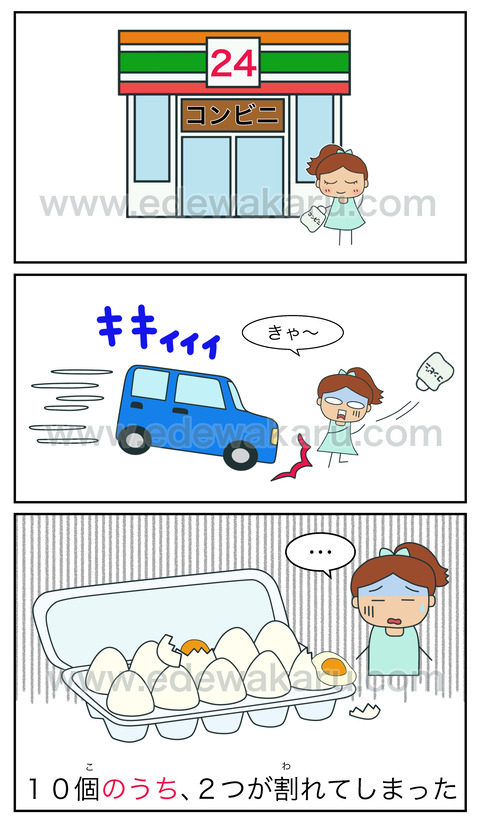
10個のうち、2つが割れてしまった
→10個ある中の、2つが割れてしまったTwo out of the ten broke. → Two among the ten that there were broke.
3つのうちで好きなのはどれですか?
→3つの中で好きなのはどれですか?Which of the three do you like? → Which do you like among the three?
買ってきた5冊の本のうち、3冊は日本語の本で、2冊は英語の本だ
→買ってきた5冊の本の中の3冊は日本語の本で、2冊は英語の本だOf the five books I bought, three are Japanese books and two are English books. → Of the five books I bought, three are Japanese books and two are English books.
Read the original source text
Meaning
〜の中
How to use it
名詞[辞書形]+のうち
Explanation
「Nのうち」は「〜の中」という意味で、範囲を限定することに使われます。
「〜の中で」「〜の中から」
などの意味で使用されます😀「N」には「◯個」「◯つ」のように
【◯+数量詞】
の形が使われることが多いですが、
「〇〇と〇〇と〇〇のうち〜」
という形もよく使われます😊
[例]
ケーキ、
アイス、
シュークリームのうち
から、食べたいのを選んでね
→ケーキ、アイス、シュークリームの中から、食べたいのを選んでね
(復習:「氷」と「アイス」)
(復習:シュークリーム)
(復習:〜の)
「〜のうち」は勉強する機会があまりありませんので、今日覚えてしまいましょう😉
日本語文型辞典
Meaning
a. Nのうち
Used to limit a range. As in ①–③, when indicating that something is selected from within that range, it can be rephrased as Nのなか. Also, as in ③, multiple nouns can be listed in the form N1とN2と…のうち.
b. …うちにはいらない
Means “does not fall within that range; is not enough to be considered part of that group.”
a. …うちに
Used with an expression indicating that something continues for a period of time; means “while that state continues” or “within that time.” 今 in ⑥ does not refer to an instant, but to a span of time that lasts “until some change occurs in the current situation.”
b. V-ている/V-る うちに
Means “while … is happening.” It is followed by an expression indicating the occurrence of an event or a change. The form V-ている is used more often, but V-るうちに is also used.
c. V-ないうちに
Means “while the state of not doing … continues.” As in ③ and ④, if it is known that the state will eventually change, it can be rephrased as V-る前に (“before …”).
d. V-るかV-ないうちに
The same verb is repeated to mean “when very little time has passed since something began.”
e. …うちは
Means “while a certain state continues without changing.” It is often used when comparing with the state after it ends.
f. …うちが
When followed by words such as 花だ, 勝負だ, いい, or 幸せだ, it means “the period while a certain state continues without changing is good, important, or precious.”
g. そのうち
⇾そのうち
How to use it
うち [range]
Nのうちにはいらない
A-いうちにはいらない
Vうちにはいらない
うち [time]
Nのうちに
Naなうちに
A-いうちに
Nのうちは
Naなうちは
A-いうちは
V-る/V-ている うちは
V-ない うちは
Nのうちが
Naなうちが
A-いうちが
V-る/V-ている うちが
V-ていない うちが
In context 34 examples
この三曲のうちでどれが一番気に入りましたか。
Which of these three pieces did you like best?
三つのうちから好きなものを選びなさい。
Choose whichever you like from the three.
バッハとモーツァルトとベートーベンのうちで、一番人気があるのはやはりモーツァルトだそうだ。
Of Bach, Mozart, and Beethoven, Mozart is apparently the most popular, as one would expect.
昨日買ったCDのうち、2枚はインドネシアのポップスで、3枚はカリブの音楽だ。
Of the CDs I bought yesterday, two are Indonesian pop and three are Caribbean music.
通勤の行き帰りに駅まで歩くだけでは、運動するうちに入らない。
Just walking to and from the station on your commute doesn't count as exercising.
5分やそこら漢字の練習をしたって、それではやったうちに入らない。
Even if you practice kanji for five minutes or so, that doesn't count as having practiced.
ラーメンを作るのが得意だなんて、そんなの料理のうちに入らないよ。
Saying you're good at making ramen doesn't count as cooking.
彼はきびしい教師だと評判だが、宿題を忘れた生徒を廊下に立たせるぐらいなら、特にきびしいうちには入らないと思う。
He's reputed to be a strict teacher, but I don't think making students who forgot their homework stand in the hallway is especially strict.
朝のうちに宿題をすませよう。
Let's finish our homework in the morning.
朝のすずしいうちにジョギングに行った。
I went jogging while it was still cool in the morning.
ここ数日のうちには何とかします。
I'll take care of it somehow within the next few days.
ひまわりは留守のうちにかなり大きくなっていた。
The sunflowers had grown quite a lot while I was away.
父親が元気なうちに、一度一緒に温泉にでも行こうと思う。
While my father is still healthy, I think I'll go to a hot spring with him sometime.
電車が出るまでまだ少し時間があるから、今のうちに駅弁を買っておいたらどう?
There's still a little time before the train leaves, so why don't you buy a station bento while you can?
彼女は話しているうちに顔が真っ赤になった。
As she was talking, her face turned bright red.
手紙を書いているうちに、ふと彼が今日こっちに来ると言っていたことを思いだした。
While I was writing a letter, I suddenly remembered that he had said he was coming here today.
読み進むうちに次第に物語にのめり込んで言った。
As I read on, I gradually became engrossed in the story.
知らないうちに隣は引っ越していた。
Without my realizing it, the neighbors had moved away.
あれから10分もしないうちにまたいたずら電話がかかってきた。
Another prank call came in less than ten minutes later.
暗くならないうちに買い物に行ってこよう。
Let's go shopping before it gets dark.
お母さんが帰ってこないうちに急いでプレゼントを隠した。
I hurriedly hid the present before Mom came home.
夕食に手をつけるかつけないうちに、ポケットベルで呼び出された。
I had barely started eating dinner when I was summoned by pager.
朝まだ目がさめるかさめないうちに、友達が迎えにきた。
My friend came to pick me up early in the morning, before I was even fully awake.
その手紙の最初の一行を読むか読まないうちに、もう何が書いてあるのかだいたい分かってしまった。
Before I had even read the first line of the letter, I already had a pretty good idea of what it said.
明るいうちはこのあたりはにぎやかだが、夜になると人通りもなくなり、一人で歩くのは危ない。
This area is lively while it's still light, but at night there are no people around, and it's dangerous to walk alone.
記憶力が衰えないうちは、何とか新しい外国語も勉強できるだろう。
As long as my memory doesn't deteriorate, I should be able to manage to study a new foreign language too.
息子が大学生のうちは私も生きがいがあったが、就職して家から出て行ってしまってからは毎日がむなしい。
While my son was a university student, I had something to live for too, but ever since he got a job and moved out, every day has felt empty.
父は働いているうちは若々しかったが、退職したとたんに老け込んでしまった。
My father stayed youthful while he was working, but as soon as he retired, he suddenly grew old.
体が健康なうちは健康のありがたさに気づかないが、病気になってはじめてそれが分かる。
As long as you are healthy, you don't realize how precious good health is; you understand it only when you become ill.
若いですねと言ってもらえるうちが花だ。
The time when people still tell you that you look young is the best.
天体写真は雲が出ていないうちが勝負だ。
For astrophotography, it's all about taking the pictures while there are no clouds.
どんなに苦労が多くつらい毎日でも、生きているうちが幸せなのであって、死んでしまったら元も子もない。
No matter how full of hardships and painful each day may be, being alive is what makes you happy; once you die, you lose everything.
いくら福祉施設が充実しても、やっぱり人生は体が丈夫なうちが楽しい。
No matter how well-equipped welfare facilities may be, life is still more enjoyable while your body is strong.
人生、若いうちが花だ。
Life is at its best when you're young.
Read the original source text
Meaning
a. Nのうち
範囲を限定するのに用いる。①~③のように、その範囲の中から何かを選ぶことを表す場合には「Nのなか」に言いかえられる。また、③のように、複数の名詞を並べて「N1とN2と…のうち」と言う場合もある。
b. …うちにはいらない
「その範囲には入らない、そのグループの中に入るとみなすには不十分だ」という意味を表す。
a. …うちに
ある期間続くことを表す表現と共に用いられて、「その状態が続く間に」「その時間以内に」という意味を表す。⑥の「今」は瞬間的な時点ではなく、「今の事態に何らかの変化が起こるまでの間」という一定の長さを持った時間を表している。
b. V-ている/V-る うちに
「…している間に」という意味を表す。後ろには、出来事の生起や変化を表す表現が続く。「V-ている」の形の方が多く用いられるが、「V-るうちに」が使われることもある。
c. V-ないうちに
「…しない状態が続いている間に」という意味を表す。③④のようにその状態がいずれ変化することがわかっている場合は、「V-る前に」と言いかえられる。
d. V-るかV-ないうちに
同じ動詞を繰り返して用いて、「なにかをし始めてまだほとんど時間がたっていない時に」という意味を表す。
e. …うちは
「ある状態が変わらないでまだ続いている間」という意味を表す。それが終わってからの状態と比較する場合に用いることが多い。
f. …うちが
後に「花だ/勝負だ/いい/幸せだ」などの言葉を伴って、「ある状態が続いていて変わらない間がよい、大切だ、大事だ」という意味を表す。
g. そのうち
⇾そのうち
How to use it
うち【範囲】
Nのうちにはいらない
A-いうちにはいらない
Vうちにはいらない
うち【時間】
Nのうちに
Naなうちに
A-いうちに
Nのうちは
Naなうちは
A-いうちは
V-る/V-ている うちは
V-ない うちは
Nのうちが
Naなうちが
A-いうちが
V-る/V-ている うちが
V-ていない うちが
日本語文型辞典 英語版
Meaning
Nのうち is used to delimit a range. It can be replaced by Nのなか, as in
(1)
-
(3)
, when someone is choosing something within that range. In some cases, N1とN2と...のうち is used to list a series of nouns, as in
(3)
.
b. ...うちにはいらない[Nのうちにはいらない][A-いうちにはいらない][Vうちにはいらない]
Means “such-and-such is not included in a certain range, cannot be regarded as belonging to a certain group because it is insufficient.”
うちに is used with expressions that indicate duration over an interval of time and means “while that state continues” or “within that period of time.” 今, in
(6)
, indicates not a point in time but “a length of time until a change takes place in the present situation.”
b. V-ている/V-る うちに
Means “while one is …ing.” Followed by an expression indicating the occurrence of an event or a change. V-ている is used more than V-る, but the pattern V-るうちに is sometimes used.
c. V-ないうちに
Means “while the state of something not having happened continues.” When the speaker knows that the state will change later on, as in
(3)
and
(4)
, V-る前に can be used instead.
d. V-るか V-ないうちに
In this pattern, the same verb is repeated and the meaning is “when I’d started doing something but almost no time had yet elapsed.”
e. ...うちは[Nのうちは][Na なうちは][A-いうちは][V-る/V-ている うちは][V-ない うちは]
Means “while a certain state continues without change.” Often used to compare this state with another that will arise (or has arisen) after the first one ends (or has ended).
f. ...うちが[Nのうちが][Na なうちが][A-いうちが][V-る/V-ている うちが][V-てない うちが]
When うちが is followed by words like 花だ, 勝負だ, いい, or 幸せだ, it means “the time that a certain state continues without change is good, valuable, or important.”
g. そのうち→
How to use it
1. うち〈limit〉a. Nのうち
2. うち〈time〉a. ...うちに[Nのうちに][Na なうちに][A-いうちに]
In context 34 examples
この三曲のうちでどれが一番気に入りましたか。
Of these three songs, which one did you like best?
三つのうちから好きなものを選びなさい。
Choose the one you like out of these three.
バッハとモーツァルトとベートーベンのうちで、一番人気があるのはやはりモーツァルトだそうだ。
I heard that, as might be expected, among Bach, Mozart, and Beethoven, the most popular composer is Mozart.
昨日買ったCDのうち、2枚はインドネシアのポップスで、3枚はカリブの音楽だ。
Of the CDs I bought yesterday, two are Indonesian pop music and three are Caribbean music.
通勤の行き帰りに駅まで歩くだけでは、運動するうちに入らない。
Just walking to the station on the way to and from the office is not exercise.
5分やそこら漢字の練習をしたって、それではやったうちに入らない。
Doing kanji drills for five minutes or so doesn’t really count as practice.
ラーメンを作るのが得意だなんて、そんなの料理のうちに入らないよ。
You said you’re good at making raamen(Chinese noodles), but that doesn’t count as cooking.
彼はきびしい教師だと評判だが、宿題を忘れた生徒を廊下に立たせるぐらいなら、特にきびしいうちには入らないと思う。
Everyone says he’s a strict teacher, but if all he does is make students who forgot their homework stand in the hallway, I don’t think that makes him so strict.
朝のうちに宿題をすませよう。
Let’s finish our homework during the morning.
朝のすずしいうちにジョギングに行った。
I went jogging in the morning while it was still cool.
ここ数日のうちには何とかします。
I’ll do something about it within the next few days.
ひまわりは留守のうちにかなり大きくなっていた。
The sunflowers grew very big while I was away.
父親が元気なうちに、一度一緒に温泉にでも行こうと思う。
I think I’ll go to a hot spring with my father once while he is still in good health.
電車が出るまでまだ少し時間があるから、今のうちに駅弁を買っておいたらどう?
Since we still have a little time before the train leaves, shall we buy some box lunches now?
彼女は話しているうちに顔が真っ赤になった。
She turned red while she was speaking.
手紙を書いているうちに、ふと彼が今日こっちに来ると言っていたことを思いだした。
As I was writing a letter, suddenly I remembered that he said he was coming here today.
読み進むうちに次第に物語にのめり込んでいった。
I gradually became more and more absorbed in the story as I went on reading it.
知らないうちに隣は引っ越していた。
My neighbor had moved away before I noticed.
あれから10分もしないうちにまたいたずら電話がかかってきた。
I received another crank call again within ten minutes after the first one.
暗くならないうちに買い物に行ってこよう。
I’ll go shopping before it gets dark.
お母さんが帰ってこないうちに急いでプレゼントを隠した。
I hid the present quickly before my mother came home.
夕食に手をつけるかつけないうちに、ポケットベルで呼び出された。
Just as I had started to eat dinner, I was paged.
朝まだ目がさめるかさめないうちに、友達が迎えにきた。
My friend came to pick me up in the morning when I was just waking up.
その手紙の最初の一行を読むか読まないうちに、もう何が書いてあるのかだいたい分かってしまった。
I already knew more or less what was written in the letter even before I’d finished reading the first line.
明るいうちはこのあたりはにぎやかだが、夜になると人通りもなくなり、一人で歩くのは危ない。
It’s busy around here while it’s light, but after dark when there are few people on the street, it’s dangerous to walk around alone.
記憶力が衰えないうちは、何とか新しい外国語も勉強できるだろう。
I’m sure I can learn a new foreign language somehow or other, before my memory starts to go.
息子が大学生のうちは私も生きがいがあったが、就職して家から出て行ってしまってからは毎日がむなしい。
I had something to live for while my son was a university student, but after he left home to begin working, I have been feeling empty every day.
父は働いているうちは若々しかったが、退職したとたんに老け込んでしまった。
My father was young and vibrant while he was working, but as soon as he retired, he suddenly aged.
体が健康なうちは健康のありがたさに気づかないが、病気になってはじめてそれが分かる。
We don’t appreciate the value of our health while we still have it, it’s only after we get sick that we start to appreciate it.
若いですねと言ってもらえるうちが花だ。
The best time in life is when people tell you how young you are.
天体写真は雲が出ていないうちが勝負だ。
It’s crucial to take photographs of the night sky while there aren’t any clouds.
どんなに苦労が多くつらい毎日でも、生きているうちが幸せなのであって、死んでしまったら元も子もない。
No matter how hard and painful every day might be, to be alive is to be happy. If we die, that’s the end of everything.
いくら福祉施設が充実しても、やっぱり人生は体が丈夫なうちが楽しい。
No matter how much social welfare institutions improve, I think life is only enjoyable as long as we are in good health.
人生、若いうちが花だ。
Youth is the best time of life.
Read the original source text
Meaning
Nのうち is used to delimit a range. It can be replaced by Nのなか, as in
(1)
-
(3)
, when someone is choosing something within that range. In some cases, N1とN2と...のうち is used to list a series of nouns, as in
(3)
.
b. ...うちにはいらない[Nのうちにはいらない][A-いうちにはいらない][Vうちにはいらない]
Means “such-and-such is not included in a certain range, cannot be regarded as belonging to a certain group because it is insufficient.”
うちに is used with expressions that indicate duration over an interval of time and means “while that state continues” or “within that period of time.” 今, in
(6)
, indicates not a point in time but “a length of time until a change takes place in the present situation.”
b. V-ている/V-る うちに
Means “while one is …ing.” Followed by an expression indicating the occurrence of an event or a change. V-ている is used more than V-る, but the pattern V-るうちに is sometimes used.
c. V-ないうちに
Means “while the state of something not having happened continues.” When the speaker knows that the state will change later on, as in
(3)
and
(4)
, V-る前に can be used instead.
d. V-るか V-ないうちに
In this pattern, the same verb is repeated and the meaning is “when I’d started doing something but almost no time had yet elapsed.”
e. ...うちは[Nのうちは][Na なうちは][A-いうちは][V-る/V-ている うちは][V-ない うちは]
Means “while a certain state continues without change.” Often used to compare this state with another that will arise (or has arisen) after the first one ends (or has ended).
f. ...うちが[Nのうちが][Na なうちが][A-いうちが][V-る/V-ている うちが][V-てない うちが]
When うちが is followed by words like 花だ, 勝負だ, いい, or 幸せだ, it means “the time that a certain state continues without change is good, valuable, or important.”
g. そのうち→
How to use it
1. うち〈limit〉a. Nのうち
2. うち〈time〉a. ...うちに[Nのうちに][Na なうちに][A-いうちに]
IMABI
While II: ~うち
Read this IMABI lesson ↗Explanation
While II: うち
As with so many nouns which denote a point/domain of space, the noun うち, whose primary meaning is to mean “interior,” may function as a temporal noun for the function of “while” but with a catch: ~うち specifically denotes that before the timeline of V1 runs out of time, V2 is undertaken, and not only that, by V2 being undertaken, V1‘s timeline will have (likely) ended.
The Spatial 内(うち)
The primary meaning of うち in a spatial sense is indicating “within” a certain domain. When that domain is compartmented off, it may translate as “interior/inside,” and when extrapolated onto groups of people or situations, it may also translate as “among” or “amidst.”
Orthography Note: Unlike the temporal meaning of ~うち which is typically written in kana, the spatial meanings are normally represented by the use of its kanji spelled 内.
Though 内 is rather synonymous with 中 (inside/middle) when it means “interior,” 内 tends to be used more often in metaphoric contexts in modern usage. When indicating “inward,” we find 内 interchangeable with 内側, but 中 would have to be interpreted as towards “the center” in a sense of directionality.
1. あのドアは内に向かって開きます。
That door opens inward.
2. 内側から鍵がかかってしまった。
It was locked from the inside.
3. 内に秘めた力を解き放て!
Release the power hidden within!
4. 賞味期限って、 暗黙のうち1に未開封、が条件ですか?
Is (the thing) being “unopened” an unspoken condition to a use-by date?
5. 百人残ったうちの一人が犯人だ。
One of these remaining 100 people is the criminal.
6. 五つのうちから一つ選んでください。
Please choose one from these five.
7. これも仕事のうちですよ。
This is also a part of the job.
8. 運も実力のうち。
Luck is also a part of your skills.
9. 近いうちに連絡します。
I’ll contact you before long.
10. 町の大半が一瞬のうちに消えた。
The majority of the town disappeared in an instant.
内 may also indicate the place in which one belongs, and this can be interpreted in various ways, including “one’s home/household,” “one’s inner circle (including “team,” “club,” “workplace,” etc.,” “one’s family,” or even, “one’s spouse.” For the meanings of “one’s home/household/spouse,” it may be alternatively written in kanji as 家.
11. うちと鹿島だけ日曜試合なんだけど、なんでだろう?
Only our (team) and Kashima are on Sunday matches, but why, though?
12. うちの会社にはフランス人のスタッフがいます。
There is a French staff member in the company I work at.
13. 家じゅうで山へ行くんです。
(We)’re going to the mountains as a family.
14. 家に相談します。
I’ll discuss (it) with my spouse.
These meanings have even led うち to develop into a first person pronoun in casual, familial speech. Although associated more so with female speakers in some regions, it has largely become gender neutral in recent decades.
15. ウチと付き合ってくれない?
Would you go out with me?
The Temporal ~うち
The spatial meanings of うち help build an image of a circle, and the matter being discussed is within that circle. When used temporarily, we see that the main clause must always be performed within the “circle” a.k.a time frame that うち creates.
The closest equivalent to the temporal ~うち is ~間, and while both translate as “while” and appear with the same variety of predicates – verbal, adjectival, noun – the specific difference in meaning of the former results in unique differences in how particles, tense, and aspect function with it.
Just like in our previous discussion on ~間に, the dependent clause which precedes ~うちに will be referenced as V1. Also, “V” may be substituted with other predicates provided the time frame implied is still logical. The main clause which follows ~うちに will be denoted as V2, which is also not restricted to verbs alone. Because the use of the negative in V1 has a major impact on how ~うちに is interpreted, that will be denoted as V1neg.
Both ~うちに and ~間に involve V2 realizing within the time frame of V1. While V2 occurs within the time frame of V1 with ~間に and can last however long in that interval, V2 must be completed before V1‘s time frame expires with ~うちに. It is implied that by V2 not realizing in that deadline set by V1 that a negative consequence is to be expected.
16. 若わかい(うちに 〇・間に X}英語を勉強した方ほうがいいよ。
It’s best that you study English while you’re young.
The consequence of not learning English while one is young is that doing so will be far harder. It is also worth noting that learning English before “being young” is illogical, and that logic is extended to the pattern itself. Meaning, V1 and V2 cannot be flipped and still be valid. Relating this back to the spatial meaning of うち, V2 is within the circle, not the circle itself.
One must also not misconstrue the fact that 若い間に itself is a possible phrase, but it is ungrammatical in Ex. 16 due to the time limit set by the speaker for V2 to occur. When such a time limit set on V2 is so intrinsic to achieving a favorable outcome, ~うちに cannot be replaced by ~間に.
17. スープがまだ熱い{うちに 〇・間に X}飲むのが好きです。
I like eating my soup while it’s still hot.
18. 警察けいさつが来ないうちに、逃にげるから、心配しんぱいないよ。(Casual)
I’ll run away before the police come, so no worries.
In Ex. 18, the main point is escaping while V1neg is still valid, which is synonymous with saying before V1pos realizes. As the principle of V2 being completed in the time limit set by V1 still applies when it is rendered in the negative as V1neg, and so long as the time frame is sufficient yet critical to completing V2, the stakes implied prevent ~ない間に from being possible, though as we saw in the previous lesson, the structure is valid when outcome is not such a contingency.
19. 妻つまが帰ってこない{うちに・間に}、部屋を片かたづけました。
I cleaned up the room in the time my wife wasn’t home yet.
Using ~うちに in Ex. 19 would suggest not cleaning the room before your wife comes home would result in punishment, whereas by using ~ない間に, the agent just so happened to complete V2 while V1 was the case.
The dynamic of a time limit that has to be met is fueled by there being a willful agent committing V2. When this volition is taken out of the equation entirely, interchangeability between ~うちに and ~間に is heightened.
20. 知らない{間に・うちに}、眠ねむってしまっていた。
I had been asleep [without even knowing it/before I knew it].
With ~間, we learned that the timelines of V1 and V2 are on parallel paths, but because ~うちに is always visualized as a “circle” within the time domain of V1, に is almost never dropped, as it is に which anchors the time frame of V1 as a point of reference. Another difference is that while 間 may be interpreted as “interval” in a broader sense—capable of being paired with various other case particles which indicate direction like から (from) and まで (to)—this is not possible with ~うちに.
Using ~うちに with まで is ungrammatical, largely because it would be redundant but also contradictory to the time limit set by まで. The purpose of まで would be to indicate that the time frame of V2 must be contained within the time limit set for V1, and the use of ~間(に・には・は)can be viewed as highlighting that time frame.
21. 家に帰るまでの{間(に)〇・うちに X}、雨が降ってきてしまった。
I was caught in the rain during the time it took to get home.
~うちに w/ Instantaneous Verbs
When ~うちに is paired with an instantaneous verb, the time limit enforced on V1 results in the “before” interpretation that is exhibited when paired with V1neg, but with a slight twist, the action – though syntactically treated as being “instantaneous” – is reinterpreted as still following on a timeline of its own. Here, we find considerable interchangeability between ~うちに and ~間に with their difference in nuance maintained.
22. 自宅へ帰る{間に・うちに}、手を見て電車に傘かさを忘れてきたのに気づいた。
[While going home/before getting home], I (happened to) look at my hand and noticed that I had gotten so far having left my umbrella in the train.
Restrictions on Non-Past
Though the non-past tense is seen out of necessity with instantaneous verbs, with non-instantaneous verbs, ~うちに is generally paired with the progressive tense (~ている). The reasoning for why the non-past is not used with ~うちに is: if even after the realization/completion of V2 there is the potential that V1 continues for some time, ~間に may be used because V2 just happens to occur within V1‘s not so long timeline; however, ~うちに cannot be used because it implies that V1 will have stopped upon V2 realizing, but the feasibility of having met such a deadline with consequences on the line is not felt via the use of the non-past tense. By using the progressive tense with V1, we know that it must still be ongoing while V2 gets the chance to be completed.
23a. 彼氏かれしが晩ご飯はんの支度したくをする間に、宿題を全部済ぜんぶすませてしまった。 〇
23b. 彼氏が晩ご飯の支度をするうちに、宿題を全部済ませてしまった。X
I finished all of my homework while my boyfriend prepared dinner.
Conversely, if there is the potential that V1 stops due to V2 realizing (coming to fruition), ~うちに becomes grammatical with the non-past tense. Meanwhile, ~間に becomes ungrammatical due to having a broader time frame conflicting with the notion of abruptly stopping due to V2 realizing. Remember that ~間に captures the beginning and end of V1.
Consider the notion of drinking shots over the course of an evening. In Ex. 24, V1 marked by ~うちに necessitates the consequence stated in V2, and we know from the use of ~ていた in V2 that this is a recurring scenario. Meaning, V1 is very much a snapshot of time, but that is just enough time to get red in the face from a shot. The logical association between the act and the consequence allows for the use of the non-past tense, and the intermittent nature of V1 helps constitute a timeline similar to what we see formed with instantaneous verbs.
24. 酒をごくごくと飲む{うちに 〇・間に X}、また顔が真っ赤になっていた。
My face had gotten completely red again as I was gulping down the alcohol.
Now, let’s posit that V2 realizes but there is a chance that V1 continues or may come to a halt, the non-past may be seen with ~うちに, and interchangeability between it and ~間に is heightened. By using ~間に, it is implied that V1 did not just halt because of V2 realizing. Even if V1 is halted for now, it may potentially be resumed down the road. By using ~うちに, it would sound as though V1 were halted because of the realization of V2.
The use of non-verbal predicates are the most likely realization of this because of how the states (as opposed to actions) that they describe are impervious to change and are not necessarily maintained by an agent (doer), but when V2 is put into the equation, that situation/state might change.
25. 暖かい{うちに・間に}、ちょっと散歩さんぽに出かけます。
I’ll go out for a little walk while it’s warm.
26. その新聞は、夜の{うちに・間に}、配くばられてくるんですね。
That’s because the newspaper is delivered during the night.
27. メールを書く{うちに・間に}、パッケージが届くのを思い出したんだ。
I remembered that my package would arrive while I was writing an e-mail.
In Ex. 27, the spur of one’s memory could cause V1 to be postponed, making V1 sound intermittent like is the case in Ex. 24 and befitting of ~うちに’s use. If, however, V2 were just a floating memory in the course of V1, that would fall best under ~間に’s domain. We can also assume that because of the need of V2 to be fulfillable within the span of V1, that V1 in Ex. 27 must be occurring within a snippet of time, for V1 itself may be paused (=stopped).
~ている+{間に・うちに}
When the progressive aspect ~ている is invoked with both ~間に and ~うちに, the timeline of V1 with which V2 must be completed by is considerably long in duration, which is also a reflection of aspect—how the clauses behave over time.
28. 赤ちゃんが寝ている{うちに・間に}、新聞を読むよ。
I’ll read the newspaper while the baby is sleeping.
29. 彼氏が晩ご飯の支度をしている{うちに・間に}、宿題を全部済ませてしまった。
I finished all of my homework while my boyfriend was preparing dinner.
~ないうちに
First, consider the following examples.
30. {まだ覚えている・忘れない}うちに宿題をします。
I’ll do my homework {while I remember/before I forget}.
31. {涼すずしい・暑あつくならない}うちに、夏休みの宿題をしてしまいました。
I completed all of my summer break homework {while it was cool/before it got hot}.
32. {明るい・暗くならない}うちに帰りなさい。(Stern)
Come home {while it’s light/before it gets dark}.
~ないうちに shows that V2 is realized before V1neg were to realize in the affirmative. You can reword ~ないうちに with V1pos ~間に, granted that V1pos is the antonym of V1neg that is used with ~ないうちに. This interchangeability necessitates that viewing the situation from the opposite angle is possible. So, in the case of Ex. 32, getting home in time before it is dark is fine, in the same sense that getting home is being done when the sun is still up. When V1neg does finally occur in the affirmative, V2 ought to have been completed. Note, though, that ~ないうちに inherently implies a misfortune if V2 does not occur by the time V1neg does happen to realize. This implication does not occur with statements made with ~間に.
~ないうちに can be the only correct version of a sentence. For instance, in Exs. 33 and 34, see how the opposite isn’t possible with either うち or 間. Shots are preventative, so it’s logical that ~ないうちに makes sense.
33. 病気にならないうちに、予防注射よぼうちゅうしゃをしておいた方がいいですよ。〇
It’s best that you get immunizations in advance before you get ill.
34. 丈夫じょうぶな{うち・間}に、予防注射をしておいた方がいいですよ。X
It’s best that you get immunizations in advance while you’re sturdy.
35. 蚊かが{入らない 〇・出ている X}うちに、蚊帳かやを吊つった。
I hanged up the mosquito net {before 〇/while X} the mosquitoes got in.
Remember, when you can visualize a beginning and end point, ~ない間に can be used, but all of the facts leading up to now hold.
36. 誰だれもいない{うちに・間に}、机を片付かたづけた。
While there was no one, I fixed up the desks.
~ないうちに vs ~前に
With “V1neg+うちに+V2“, V2 is a positive situation which brings about a positive outcome so long as it happens. In the event V1neg does occur, that outcome is, likewise, unfavorable. This nuancing does not apply to ~まえに.
37. 走っていたが、家に{着かないうちに・着くまえに ?}、雨に降られてしまった。
I was running, but I got hit by the rain before I could get home.
38. 妻が{起きないうちに・起きるまえに}、家を出た。
I left the house before my wife woke up.
39. 雨が降ふ{る前に・らないうちに}、帰りましょう。
Let’s go home before it rains.
~間は vs ~うちは
One situation in which the particle に may be seen omitted from ~うちに is when it is topicalized with は for the purpose of highlighting the circumstance in which V2 is completed. Here, the difference between ~間は and ~うちは lies with whether V2 is still completed and not ongoing once V1 ends.
40. 彼氏が晩ご飯の支度する{あいだは・うちは}、宿題をしていた。
I was doing my homework while my boyfriend was preparing dinner (but not at other times).
41a. 授業のあいだは、ずっと居眠いねむりしていた。 〇
41b. 授業のうちは、ずっと居眠りしていた。X
I napped all through class.
42. コーヒーって若いうちはあまり飲まないほうがいいんですか。
Is it best to not drink a lot of coffee while you’re young?
~うちが
Although any instance of ~うちが can theoretically be rephrased out of a sentence, its existence ought not be ignored. Here, we find that the main clause is NEVER an action that must be completed by the end of the dependent clause, but it is still a state that MUST remain true for as long as the dependent clause is true.
43. 何といっても、若いうちが花だよ。
No matter what they say, youth is the flower of life.
44. お酒は、ほろ酔よいのうちが最高さいこうだと言われる。
It’s said that alcohol is the best while tipsy.
参照
『日本語類義表現使い分け辞典』 pgs 206-209 by 泉原省二.
In the phrase 暗黙のうち, うち denotes the situation in which an action is performed. For this meaning, it may also be spelled in kanji as 裡. ↩︎
In context 46 examples
あのドアは内に向かって開きます。
That door opens inward.
内側から鍵がかかってしまった。
It was locked from the inside.
内に秘めた力を解き放て!
Release the power hidden within!
賞味期限って、 暗黙のうち1に未開封、が条件ですか?
Is (the thing) being “unopened” an unspoken condition to a use-by date?
百人残ったうちの一人が犯人だ。
One of these remaining 100 people is the criminal.
五つのうちから一つ選んでください。
Please choose one from these five.
これも仕事のうちですよ。
This is also a part of the job.
運も実力のうち。
Luck is also a part of your skills.
近いうちに連絡します。
I’ll contact you before long.
町の大半が一瞬のうちに消えた。
The majority of the town disappeared in an instant.
うちと鹿島だけ日曜試合なんだけど、なんでだろう?
Only our (team) and Kashima are on Sunday matches, but why, though?
うちの会社にはフランス人のスタッフがいます。
There is a French staff member in the company I work at.
家じゅうで山へ行くんです。
(We)’re going to the mountains as a family.
家に相談します。
I’ll discuss (it) with my spouse.
ウチと付き合ってくれない?
Would you go out with me?
若わかい(うちに 〇・間に X}英語を勉強した方ほうがいいよ。
It’s best that you study English while you’re young.
スープがまだ熱い{うちに 〇・間に X}飲むのが好きです。
I like eating my soup while it’s still hot.
警察けいさつが来ないうちに、逃にげるから、心配しんぱいないよ。(Casual)
I’ll run away before the police come, so no worries.
妻つまが帰ってこない{うちに・間に}、部屋を片かたづけました。
I cleaned up the room in the time my wife wasn’t home yet.
知らない{間に・うちに}、眠ねむってしまっていた。
I had been asleep [without even knowing it/before I knew it].
家に帰るまでの{間(に)〇・うちに X}、雨が降ってきてしまった。
I was caught in the rain during the time it took to get home.
自宅へ帰る{間に・うちに}、手を見て電車に傘かさを忘れてきたのに気づいた。
[While going home/before getting home], I (happened to) look at my hand and noticed that I had gotten so far having left my umbrella in the train.
彼氏かれしが晩ご飯はんの支度したくをする間に、宿題を全部済ぜんぶすませてしまった。 〇
I finished all of my homework while my boyfriend prepared dinner.
彼氏が晩ご飯の支度をするうちに、宿題を全部済ませてしまった。X
I finished all of my homework while my boyfriend prepared dinner.
酒をごくごくと飲む{うちに 〇・間に X}、また顔が真っ赤になっていた。
My face had gotten completely red again as I was gulping down the alcohol.
暖かい{うちに・間に}、ちょっと散歩さんぽに出かけます。
I’ll go out for a little walk while it’s warm.
その新聞は、夜の{うちに・間に}、配くばられてくるんですね。
That’s because the newspaper is delivered during the night.
メールを書く{うちに・間に}、パッケージが届くのを思い出したんだ。
I remembered that my package would arrive while I was writing an e-mail.
赤ちゃんが寝ている{うちに・間に}、新聞を読むよ。
I’ll read the newspaper while the baby is sleeping.
彼氏が晩ご飯の支度をしている{うちに・間に}、宿題を全部済ませてしまった。
I finished all of my homework while my boyfriend was preparing dinner.
{まだ覚えている・忘れない}うちに宿題をします。
I’ll do my homework {while I remember/before I forget}.
{涼すずしい・暑あつくならない}うちに、夏休みの宿題をしてしまいました。
I completed all of my summer break homework {while it was cool/before it got hot}.
{明るい・暗くならない}うちに帰りなさい。(Stern)
Come home {while it’s light/before it gets dark}.
病気にならないうちに、予防注射よぼうちゅうしゃをしておいた方がいいですよ。〇
It’s best that you get immunizations in advance before you get ill.
丈夫じょうぶな{うち・間}に、予防注射をしておいた方がいいですよ。X
It’s best that you get immunizations in advance while you’re sturdy.
蚊かが{入らない 〇・出ている X}うちに、蚊帳かやを吊つった。
I hanged up the mosquito net {before 〇/while X} the mosquitoes got in.
誰だれもいない{うちに・間に}、机を片付かたづけた。
While there was no one, I fixed up the desks.
走っていたが、家に{着かないうちに・着くまえに ?}、雨に降られてしまった。
I was running, but I got hit by the rain before I could get home.
妻が{起きないうちに・起きるまえに}、家を出た。
I left the house before my wife woke up.
雨が降ふ{る前に・らないうちに}、帰りましょう。
Let’s go home before it rains.
彼氏が晩ご飯の支度する{あいだは・うちは}、宿題をしていた。
I was doing my homework while my boyfriend was preparing dinner (but not at other times).
授業のあいだは、ずっと居眠いねむりしていた。 〇
I napped all through class.
授業のうちは、ずっと居眠りしていた。X
I napped all through class.
コーヒーって若いうちはあまり飲まないほうがいいんですか。
Is it best to not drink a lot of coffee while you’re young?
何といっても、若いうちが花だよ。
No matter what they say, youth is the flower of life.
お酒は、ほろ酔よいのうちが最高さいこうだと言われる。
It’s said that alcohol is the best while tipsy.