文法
Meaning
“Assuming that 〜 / If 〜 were actually to happen”
How to use it
V (plain form) + としたら
い-adjective (plain form) + としたら
な-adjective (plain form) + としたら
N (plain form) + としたら
Notes
An expression of judgment, conjecture, or a question comes afterward.
In context 15 examples
もし、ここに100万円あったとしたら、何に使いますか。
If there were one million yen here, what would you spend it on?
車で行くとしたら、何時間かかるんでしょうか。
If we were to go by car, how many hours would it take?
旅行するとしたら、夏休みがいいですね。
If we were to travel, summer vacation would be good.
パソコンを買うとしたら、やっぱりMacを買いたいです。
If I were to buy a computer, I'd want to get a Mac, as expected.
その話が本当だとしたら、彼が犯人ということになるね。
If that story is true, then that would mean he's the culprit.
来れるとしたら、何時ぐらいになりそうですか。
If you can come, around what time do you think you'll be able to make it?
中国に行くとしたら、どこがおすすめですか。
If you were to go to China, where would you recommend?
もし、どこでもドアがあったとしたら、どこへ行きたいですか。
If there were a Anywhere Door, where would you want to go?
もし、1つだけ願いが叶うとしたら、どんなお願いごとをしますか。
If just one wish could come true, what would you wish for?
もし、明日死ぬとしたら、今日何する?
If you were going to die tomorrow, what would you do today?
三泊四日で韓国に行くとしたら、どこがおすすめ?
If you were going to South Korea for four days and three nights, where would you recommend?
もし彼の話が本当だとしたら、大変なことですよ。
If what he says is true, it would be a serious matter.
毎日が日曜日だとしたら、何したい?
If every day were Sunday, what would you want to do?
お金がたくさんあって、一生働く必要がないとしたら、毎日何する?
If you had lots of money and didn't need to work for the rest of your life, what would you do every day?
もし生まれ変われるとしたら、男と女どっちがいい?
If you could be reborn, would you rather be a man or a woman?
Read the original source text
Meaning
〜と仮定したら / もし〜が実際に起こったと仮定したら
How to use it
V(普通形)+ としたら
イA(普通形) + としたら
ナA(普通形) + としたら
N(普通形) + としたら
Notes
後ろには判断や推量、疑問を表す表現が来る。
Bunpro Grammar Reference
Usage 1
Meaning
If it were the case that, Assuming that...
How to use it
Verb + としたら(1)
[い]Adjective + としたら(1)
[な]Adjective + (だ) + としたら(1)
Noun + (だ) + としたら(1)
(1) とすると、とすれば
Nuance
A structure that goes off the assumption that (A) were true, and then expresses some hypothetical result.
Explanation
When partnered with several of the assumption based expressions that are used in Japanese, the case marking particle と may be used to show a hypothesis about a certain result. This is one of the result highlighting uses of と. Structures that may be seen are as follows:
(A) としたら (B) - When (A) is the result, (B).
(A) とすれば (B) - If the result is (A), (B).
(A) とすると (B) - A result of (A) will be (B).
Although these nuances are slightly different, realistically they are used in almost exactly the same way, to express a possible (undetermined) result. This can be translated to 'assuming that (A)', or 'if it were the case that (A)'.
To use these expressions, simply attach と and your chosen variation of したら to the end of any verb/い-Adjective, or noun/な-Adjective followed by だ.
来週出かけるとしたらどこに行きたい?
If we were to go out next week, where would you want to go?
歯が痛いとすれば、虫歯かもしれません。
If your tooth hurts, you might have a cavity.
この壁が真っ直ぐだとすると、こっちの壁は斜めっていうこと?
Assuming that this wall here is straight, does that mean that this one here is slanted?
通勤手段が車だとしたら、交通費は出ません。
Assuming that your mode of transportation is your car, transportation will not be compensated.
In context 16 examples
- 付き合うとしたら、田中さんと山田さんどっちがいい?
If you were to date Tanaka or Yamada, who would you choose?
- 来週出かけるとしたらどこに行きたい?
If we were to go out next week, where would you want to go?
- 歯が痛いとすれば、虫歯かもしれません。
If your tooth hurts, you might have a cavity.
- この壁が真っ直ぐだとすると、こっちの壁は斜めっていうこと?
Assuming that this wall here is straight, does that mean that this one here is slanted?
- 通勤手段が車だとしたら、交通費は出ません。
Assuming that your mode of transportation is your car, transportation will not be compensated.
- 無料だとすれば、人が大勢来る。
If we suppose it was free, lots of people would come.
- 留学に行くとすると、論文が必要。
Assuming that you study abroad, an essay is necessary.
- 買い物に行かないとしたら、晩御飯はどうする?
Assuming that I don't go shopping, what will be done about dinner?
- もし会えるとしたら、明日か明後日だね。
Assuming that we can meet, it will be either tomorrow or the day after.
- 突然、終わってしまうとすれば、君はどうするの?
Assuming it suddenly ended, what would you do?
- それが原因だとすれば、修理できると思うよ。
Assuming that is the cause, I think you can fix it.
- 明日の試合に勝ったとすれば、決勝に進める。
If I win tomorrow's match, I would advance to the finals.
- 今年受からなかったとしたら、来年の受験はどうするつもりなの?
Supposing you didn't pass the entrance exam this year, what do you intend to do next year?
- もし勉強しなかったとしたら、明日のテストは悲惨なことになるかなぁ?
Assuming that I hadn't studied, I wonder if it would mean that tomorrow's test would be a disaster?
- 今日中に結論が出ないとすれば、明日の発表に間に合いませんよ。
Assuming that you don't reach a conclusion by today, you won't make it in time for tomorrow's presentation.
- 私の記憶が間違いないとすれば、あの角を曲がった辺りにスーパーがあるはずです。
Assuming that my memory is correct, there should be a supermarket around that corner.
Usage 2
Meaning
Tried to ~ but ~, Was about to ~ but ~, Was going to ~ but ~
How to use it
Verb[おう] + としたが(1) + Result
Verb[おう] + としたら + Result
(1) けれども、けれど、けど
Nuance
A phrase which indicates that someone had the will or intent to do (A), but was unable to complete the action for some reason.
Explanation
As mentioned in our ようとする lesson, when combined with the auxiliary verb う (or よう), とする carries the meaning of 'to try to do (A)', or 'to be about to do (A)'. The case marking particle と in this expression highlights a 'result'.
However, the addition of structures like the conjunction particles が, or たら, to the past tense of する will indicate that something interrupted (A), and therefore it was unable to be completed. In these cases, the translation becomes 'to have tried to do (A), but (B)', 'was about to (A), but (B), or 'was on the verge of (A), but (B)'.
クライアントに電話を掛けようとしたが、夜遅かったので朝まで待つことにした。
I was going to make a phone call to our client, but it was late at night so I decided to wait until morning.
池で泳ごうとしたら、警察に止められた。
I was stopped by the police when I was about to swim in the lake.
逃げようとしたけど、捕まったら大変なことになるから逃げなかった。
I was about to run away, but if I got caught, it would have become a bigger deal, so I didn't.
う and よう mark volition (the express intent to do something), while とする adds the nuance that the express intent has been decided, and all that remains is to 'do' the action. Due to this, when something interrupts a ようとする verb, it strongly suggests that (B) is/was highly unanticipated.
In context 15 examples
- 兎の世話をしようとしたが逃げられた。
I was going to take care of the rabbit but it ran away.
- クライアントに電話を掛けようとしたが、夜遅かったので朝まで待つことにした。
I was going to make a phone call to our client, but it was late at night so I decided to wait until morning.
- 池で泳ごうとしたら、警察に止められた。
I was stopped by the police when I was about to swim in the lake.
- 逃げようとしたけど、捕まったら大変なことになるから逃げなかった。
I was about to run away, but if I got caught, it would have become a bigger deal, so I didn't.
- 彼は徹夜しようとしたけれど寝てしまった。
He tried to pull an all-nighter, but fell asleep.
- 説得しようとしたが、失敗した。
I tried to persuade him, but I failed.
- お弁当を食べようとしたが、箸が入っていなかった。
I was about to eat my bento, but there were no chopsticks inside.
- 私は彼女の手伝いをしようとしたが、断られた。
I tried to help her, but was rejected.
- 勉強しようとしたが、あまりにも疲れていたのでやめました。
I tried to study, but I was too tired and I gave up.
- 謝罪しようとしたけれど、受け入れてもらえませんでした。
I tried to apologize, but they didn't accept my apology.
- 出かけようとしたけれど、あまりにも天気が悪いのでやめました。
I was about to go out, but I ended up changing my mind because the weather wasn't looking too great.
- 質問をしようとしたが、機嫌が悪そうだったのでやめました。
I was about to ask a question, but she looked like she was in a bad mood, so I thought I better not.
- 家に帰ってすぐ宿題を済ませようとしたが、難しくてできなかった。
I was going to finish my homework as soon as I got home, but I couldn't do it because it was too hard.
- 僕と彼は同時にジャンプしようとしたけれど、失敗した。
He and I both tried to jump at the same time, but messed up.
- 犯人は逃げようとしたが、すぐに警察が犯人を取り押さえた。
The criminal tried to run, but the police subdued him.
どんなときどう使う 日本語表現文型辞典
Meaning
if judged that
How to use it
〔plain form〕+としたら
Explanation
~と仮定したら
1)「今はそのような状況にはないが、その状況を仮定したら」「不明なことを、そうだと仮定したら」という意味で使う。
2)同様の表現に「とすれば・とすると」がある。
2)Similar expressions are とすれば and とすると.
1)Signifies that something is not true now, but if the speaker supposed such a situation or something uncertain to be true, then there could be a certain result.
In context 3 examples
もし、ここに100万円あったとしたら、何に使いますか。
If you had one million yen here, what would you spend it on?
この名簿が正しいとしたら、まだ来ていない人が二人いる。
If this list is correct, there are two people who haven’t arrived yet.
わたしの言葉が彼を傷つけたのだとしたら、本当に申し訳ないことをしたと思う。
If my words hurt him, I feel I did something truly regrettable.
Read the original source text
Meaning
if judged that
How to use it
〔普通形〕+としたら
Explanation
~と仮定したら
1)「今はそのような状況にはないが、その状況を仮定したら」「不明なことを、そうだと仮定したら」という意味で使う。
2)同様の表現に「とすれば・とすると」がある。
2)Similar expressions are とすれば and とすると.
1)Signifies that something is not true now, but if the speaker supposed such a situation or something uncertain to be true, then there could be a certain result.
絵でわかる日本語
Meaning
If 〜 were to happen
If one were to consider 〜 a fact
If one were to suppose 〜
How to use it
Verb, adjective, or noun [plain form] + としたら
Explanation
“〜としたら” is a sentence pattern expressing a supposition, meaning “if 〜 were true” or “if 〜 were to happen.”
What follows it is the speaker’s intention or wish. 😊 As in example ③, it is also used to talk about things that would not actually happen, for the fun of the conversation. 😁
[Examples]
A: This is impossible, but if you were to get 100 million yen, what would you want to do? (Review: 〜得る・〜得ない)
B: I’d like to travel around the world!
C: I’d like to buy a house~
A: If you could get anything, what would you want?
B: I want a diamond worth 1 million yen!
C: I want a car!!
This pattern is also used a lot in conversation, so it would be good to learn it. 😀
In context 4 examples
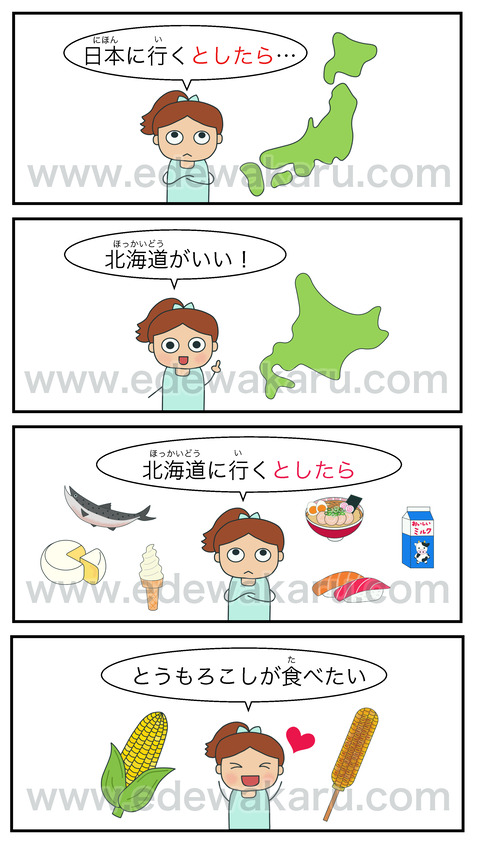
日本に行くとしたら、北海道がいい
→もし日本に行くことが実現するんだったら、北海道がいいIf I were to go to Japan, Hokkaido would be good. → If going to Japan were to happen, I’d choose Hokkaido.
北海道に行くとしたら、とうもろこしが食べたい
→もし北海道に行くことが実現するんだったら、とうもろこしが食べたいIf I were to go to Hokkaido, I’d like to eat corn. → If going to Hokkaido were to happen, I’d like to eat corn.
もし1億円もらったとしたら、何に使いますか?
→もし1億円もらったと仮定したら、何に使いますか?If you were to receive 100 million yen, what would you spend it on? → If you were to suppose you received 100 million yen, what would you spend it on?
東京まで車で行くとしたら、何時間かかるの?
→東京まで車で行く場合は何時間かかるの?If we were to drive to Tokyo, how many hours would it take? → If we go to Tokyo by car, how many hours would it take?
Read the original source text
Meaning
もし〜が実現する場合は
もし〜が事実だと考えれば
〜と仮定したら
How to use it
動詞・形容詞・名詞[普通形]+としたら
Explanation
「〜としたら」は仮定を表す文型で、「もし〜が事実なら」「もし〜が実現するのなら」という意味を表します。
後ろには話者の意志や願望がきます😊例文③のように、実際には起こらないようなことに使って会話を楽しんだりもします😁
[例]
A:あり得ないことだけど、もし1億円もらっ
としたら
何がしたい?(復習:〜得る・〜得ない)
B :世界1周旅行(せかいいっしゅうりょこう)に行きたい!
C:私は家を買いたいな〜
A:もし何でももらえる
としたら
何が欲しい?
B:100万円のダイヤモンドが欲しい!
C:私は車が欲しい!!
この文型は会話でもとてもよく使うので覚えておくといいと思います😀
日本語文型辞典
Meaning
Formed by adding 「したら」 to the particle 「と」. It follows a clause and means “if one considers it to be true,” “if one considers it to be realized or to exist,” or “in light of this fact or current situation.” It sets up a hypothetical condition of “if one considers it that way,” and in most cases it cannot be replaced by 「たら」 alone.
Means “if we assume it to be true” or “if it were to be realized or exist.” The second half is followed by an expression of the speaker's intention, judgment, or evaluation. It may be accompanied by 「仮に/もし」. When followed by an expression of intention or evaluation, 「としたら」 can be used, but 「とすると」 and 「とすれば」 sound unnatural.
Based on the current situation or information from another person, means “if we take this current situation or fact into account.” Often used in the form 「…のだとしたら」. 「かりに/もし」 cannot be used in this sense.
Follows the preceding sentence or another person's remark and means “if we take that fact or situation into account” or “if that is true.”
How to use it
…としたら【hypothetical condition】
N/Na だとしたら
A/V としたら
…としたら【established condition】
N/Na(なの)だとしたら
A/V (の)だとしたら
(そう)だとしたら
In context 11 examples
家を建てるとしたら、大きい家がいい。
If I were to build a house, I'd want a big one.
もし1億円の宝くじがあたったとしたら、家を買おう。
If I won 100 million yen in the lottery, I'd buy a house.
仮にあなたが言っていることが本当だとしたら、彼は私に嘘をついていることになる。
If what you say is true, that would mean he is lying to me.
いらっしゃるとしたら何時ごろになりますか。
If you're coming, about what time will it be?
責任があるとしたら、私ではなくあなたの方です。
If anyone is responsible, it's you, not me.
(誤) 宝くじがあたった{とすると/とすれば}家を買おう。
(Incorrect) If I won the lottery, I would buy a house. {とすると/とすれば}
これだけ待っても来ないのだとしたら、今日はもう来ないでしょう。
If they still haven't come after all this waiting, they probably aren't coming today.
A:私はそのことを誰にも話していません。
B:あなたが話してないのだとしたら、一体誰がもらしたのだろう。A: I haven't told anyone about that. B: If you didn't tell anyone, then who on earth let it slip?
A:寝台車は全て満席だって。
B:だとしたら、普通の座席に座って行くしかないわね。A: They say all the sleeping-car seats are booked. B: If that's the case, I guess we'll have to ride in regular seats.
A:会議は1時間遅れの開始になったそうですよ。
B:そうだとしたら、こんなに急いでくるんじゃなかった。A: I hear the meeting is starting an hour late. B: If that's so, we shouldn't have hurried over like this.
台風の上陸と満潮の時刻が重なるらしい。だとしたら、沿岸では厳重な警戒が必要になる。
Apparently the typhoon is due to make landfall at the same time as high tide. If that's the case, the coast will need to be on high alert.
Read the original source text
Meaning
基本情報説明助詞「と」に「したら」がついたもの。「それが事実だと考えた場合」「実現・存在すると考えた場合」「このような事実・現状をふまえると」のような意味を表す。「そのように考えた場合」という想定上の条件設定を行うもので、ほとんどの場合、単独の「たら」では置きかえられない。
「仮にそれが事実だと考えれば/それが実現・存在するような場合は」という意味を表す。後半には話し手の意志、判断や評価の表現が続く。「仮に/もし」を伴うこともある。後に意志や評価を表す表現が続く場合は「としたら」は使えるが、「とすると」「とすれば」は不自然である。
現状や相手からの情報に基づき、「このような現状・事実をふまえれば」といった意味を表す。「…のだとしたら」の形で使われることが多い。この用法では「かりに/もし」は使えない。
前の文や相手の発言を受けて、「そのような事実/状況をふまえれば」「それが事実なら」という意味を表す。
How to use it
…としたら【仮定条件】
N/Na だとしたら
A/V としたら
…としたら【確定条件】
N/Na(なの)だとしたら
A/V (の)だとしたら
(そう)だとしたら
日本語文型辞典 英語版
Meaning
【としたら】Formed by attaching the particle と to したら. Means something like “supposing that is true,” “supposing that such-and-such exists/occurs,” or “based on this fact/the present state of affairs.” Used to establish the conditions for the supposition “if one were to think such-and-such.” Can hardly ever be replaced by たら alone.
Means “supposing we assume that such-and-such is a fact,” or “in the event that such-and-such occurs or exists.” としたら is followed by an expression of the speaker’s intention, judgment, or evaluation. Sometimes accompanied by 仮に (supposing that.../granting, for the sake of argument, that...) or もし (if/provided that...). としたら can be followed by expressions of intention or evaluation; in such cases, とすると and とすれば are not natural.
(×)宝くじがあたった{とすると/とすれば}家を買おう。
{When/If} I’d win the lottery, then I’ll buy a house.
B:あなたが話してないのだとしたら、一体誰がもらしたのだろう。
If you haven’t said anything, then who in the world let it slip?
Expresses a supposition based on the present situation or information received from another person. Means “if we consider a situation/fact like this.” Often used in the form ...のだとしたら. This usage cannot be combined with the expressions 仮に or もし (see above) .
B:だとしたら、普通の座席に座って行くしかないわね。
If that’s so, then we have no other choice but to go and sit in the regular seats.
B:そうだとしたら、こんなに急いでくるんじゃなかった。
If that’s true, then we didn't have to hurry as much as we did to get here.
Refers to the preceding sentence or an utterance made by the addressee and means “if we take that fact/situation into consideration” or “if that is a fact.”
How to use it
1. ...としたら〈not-yet-realized condition〉[N/Na だとしたら][A/V としたら]
2. ...としたら〈already-realized condition〉[N/Na (なの)だとしたら][A/V (の)だとしたら]
3. (そう)だとしたら
In context 10 examples
家を建てるとしたら、大きい家がいい。
If you’re going to build a house, a big one is best.
もし1億円の宝くじがあたったとしたら、家を買おう。
If I were to win a hundred million yen in the lottery, I’d buy a house.
仮にあなたが言っていることが本当だとしたら、彼は私に嘘をついていることになる。
Supposing that what you say is true, that would mean he’s lying to me.
いらっしゃるとしたら何時ごろになりますか。
If you were to come, what time do you think it might be?
責任があるとしたら、私ではなくあなたの方です。
If someone is responsible for this, it’s not me but you.
これだけ待っても来ないのだとしたら、今日はもう来ないでしょう。
If she hasn’t come after we’ve waited this long, then she probably isn’t going to come at all today.
A:私はそのことを誰にも話していません。
I haven’t said anything about that to anyone.
A:寝台車は全て満席だって。
They say all the sleeper cars are full.
A:会議は1時間遅れの開始になったそうですよ。
I heard that the meeting is going to start about an hour late.
台風の上陸と満潮の時刻が重なるらしい。だとしたら、沿岸では厳重な警戒が必要になる。
It looks like the typhoon will hit at the same time as high tide. If that's the case, coastal areas will have to be on close alert.
くらべてわかる日本語表現文型辞典
Meaning
Meaning 1: If one assumes A, then B.
Meaning 2: Given some information A, one can conclude B on that basis.
Meaning 3: In the form 「A ようとしたら B」. One acts intending to do A, but encounters an unexpected situation B.
How to use it
A としたら B (A とすれば B)
Connection 1, 2:
[Verb] としたら
[i-adjective — plain form] としたら
[na-adjective — だ/である/だった/ではない] としたら
[Noun — ∅/ではない/だ/だった] としたら
Connection 3:
[Verb — volitional form] としたら
Explanation
【Contrast 1】
「A たら B」
「A たら B」has various meanings, but it cannot be substituted when the sentence describes a result of doing A that becomes B.
○この問題は先生に聞いたらすぐわかったよ。
×この問題は先生に聞いたとしたら、すぐわかったよ。
However, even when B is in the past tense, they can be substituted if it is a supposition rather than a result.
○彼が大統領になっていたら、また共産主義に逆戻りしていただろう。
○彼が大統領になっていたとしたら、また共産主義に逆戻りしていただろう。
In context 12 examples
彼が来るとしたら、何時ごろに来るかな?
If he comes, I wonder around what time he’ll arrive.
こっちが北だとすれば、南はあっちだ。
If this is north, then south is over there.
火星に生物がいるとすれば、どんな姿をしているのだろう。
If there are living things on Mars, I wonder what they look like.
彼が買うとしたら、きっとイタリア製のスーツだろう
If he were to buy one, it would surely be an Italian suit.
「私の兄はひつじ年よ。」「ひつじ年としたら、昭和42年生まれね。」
“My brother was born in the Year of the Sheep.” “If he was born in the Year of the Sheep, then he was born in 1967.”
「このマンションは3000万円らしいよ。」
「ここが3000万円だとしたら、あそこは5000万円ぐらいするだろう。」“I hear this apartment building costs 30 million yen.” “If this one costs 30 million yen, that one must cost about 50 million.”
君が10時の新幹線に乗るとしたら、東京に着くのは1時まえだな。
If you take the 10 o’clock bullet train, you’ll get to Tokyo before one.
この記事の通りだとすれば、彼のとった行動はおかしい。
If this article is accurate, his actions were strange.
帰ろうとしたら、事故で電車が不通になっていた。
When I was about to head home, the trains had stopped running because of an accident.
ごはんを炊こうとしたら、米が一粒もなかった。
When I went to cook rice, there wasn’t a single grain of rice.
コンピュータを開こうとしたら、画面が真っ白になってしまい、開けなかった。
When I tried to open the computer, the screen went completely white and I couldn’t open it.
コップを机の上に置こうとしたら、手がすべり、落としてしまった。
As I was about to put the cup on the desk, my hand slipped and I dropped it.
Read the original source text
Meaning
意味1:Aと仮定した場合B。
意味2:ある情報Aを受けて、それを基にすればBだと考えられる。
意味3:「AようとしたらB」の形で。Aをするつもりで行動したら、予想外の事態Bに直面した。
How to use it
AとしたらB(AとすればB)
接続1,2:
[動詞]としたら
[イ形-普]としたら
[ナ形-だ/である/だった/ではない]としたら
[名詞-∅/ではない/だ/だった]としたら
接続3:
[動詞-意向形]としたら
Explanation
【対比1】
「AたらB」
「AたらB」には色々な意味があるが、Aをした結果がBになるような文は置き換えられない。
○この問題は先生に聞いたらすぐわかったよ。
×この問題は先生に聞いたとしたら、すぐわかったよ。
しかし、Bが過去文でも、結果ではなく、仮定の場合は置き換え可能。
○彼が大統領になっていたら、また共産主義に逆戻りしていただろう。
○彼が大統領になっていたとしたら、また共産主義に逆戻りしていただろう。
日本語NET JLPT文法解説まとめ
Meaning
“Assuming that 〜 / If 〜 were actually to happen”
How to use it
V (plain form) + としたら
い-adjective (plain form) + としたら
な-adjective (plain form) + としたら
N (plain form) + としたら
Explanation
"If we assume that 〜 / If 〜 were to actually happen"
Subjunctive condition.
An expression of judgment, conjecture, or a question follows.
In context 16 examples
もし、ここに100万円あったとしたら、何に使いますか。
If there were one million yen here, what would you spend it on?
車で行くとしたら、何時間かかるんでしょうか。
If we were to go by car, how many hours would it take?
旅行するとしたら、夏休みがいいですね。
If we were to travel, summer vacation would be good.
パソコンを買うとしたら、やっぱりMacを買いたいです。
If I were to buy a computer, I'd want to get a Mac, as expected.
その話が本当だとしたら、彼が犯人ということになるね。
If that story is true, then that would mean he's the culprit.
来れるとしたら、何時ぐらいになりそうですか。
If you can come, around what time do you think you'll be able to make it?
中国に行くとしたら、どこがおすすめですか。
If you were to go to China, where would you recommend?
もし、どこでもドアがあったとしたら、どこへ行きたいですか。
If there were a Anywhere Door, where would you want to go?
もし、1つだけ願いが叶うとしたら、どんなお願いごとをしますか。
If just one wish could come true, what would you wish for?
もし、明日死ぬとしたら、今日何する?
If you were going to die tomorrow, what would you do today?
三泊四日で韓国に行くとしたら、どこがおすすめ?
If you were going to South Korea for four days and three nights, where would you recommend?
もし彼の話が本当だとしたら、大変なことですよ。
If what he says is true, it would be a serious matter.
毎日が日曜日だとしたら、何したい?
If every day were Sunday, what would you want to do?
お金がたくさんあって、一生働く必要がないとしたら、毎日何する?
If you had lots of money and didn't need to work for the rest of your life, what would you do every day?
もし生まれ変われるとしたら、男と女どっちがいい?
If you could be reborn, would you rather be a man or a woman?
世界中の国の言葉を話せるとしたら、どこで暮らしたい?
If you could speak the languages of every country in the world, where would you want to live?
Read the original source text
Meaning
〜と仮定したら / もし〜が実際に起こったと仮定したら
How to use it
V(普通形)+ としたら
イA(普通形) + としたら
ナA(普通形) + としたら
N(普通形) + としたら
Explanation
"If we assume that 〜 / If 〜 were to actually happen"
Subjunctive condition.
後ろには判断や推量、疑問を表す表現が来る。
毎日のんびり日本語教師
How to use it
Verb plain form + (の) + としたら / とすると / とすれば
い-adjective plain form + (の) + としたら / とすると / とすれば
な-adjective + (なの) + だ + としたら / とすると / とすれば
Noun + (なの) + だ + としたら / とすると / とすれば
Explanation
There are hypothetical-condition and established-condition usages.
It can also be used as “~とする。” or “~とします。” Example (5).
Notes
Nothing in particular.
In context 8 examples
明日地球が滅びるとしたら何する?
What would you do if the Earth were to end tomorrow?
旅行に行くとしたらどこに行きたい?
If you were going on a trip, where would you want to go?
「もしあなたがこれまでに泣いたことがないとしたら、あなたの目は美しいはずがないわ。」(Sophia Loren)(“如果你从来没有哭过,你的眼睛就不会美丽。”(Sophia Loren))
“If you had never cried, your eyes could not be beautiful.” (Sophia Loren)
悩みがないとすると、それはたぶん幸せなことなんだと思う。
If you have no worries, I think that’s probably a happy thing.
どちらか一人しか救えないとします。あなたは親と恋人どちらを選ぶ?
Let’s say you can save only one of them. Which would you choose, your parent or your romantic partner?
顔面上の下って言われた。嘘じゃないとすれば素直に嬉しい。
I was told I’m at the bottom of the scale for looks. If that’s not a lie, I’m honestly happy.
こんなに練習してもできないとしたら、才能がないと言わざるを得ない。
If you can’t do it even after practicing this much, there’s no choice but to say you have no talent.
このまま学費が払えないとしたら退学するしかない。
If I can’t pay tuition like this, I’ll have no choice but to drop out.
Read the original source text
How to use it
動詞普通形+(の)+としたら/とすると/とすれば
イ形容詞普通形+(の)+としたら/とすると/とすれば
ナ形容詞+(なの)+だ+としたら/とすると/とすれば
名詞+(なの)+だ+としたら/とすると/とすれば
Explanation
仮定条件と確定条件の用法があります。
「~とする。」や「~とします。」でも使えます。例(5)。
Notes
特になし
NINJAL 日本語文型データベース
Meaning
[1] Used to state the speaker’s judgment, evaluation, or intention on the assumption that something is the case. The main point is the speaker’s judgment, evaluation, or intention.
[2] Used to state the speaker’s judgment, evaluation, or intention while acknowledging the current situation. The main point is the speaker’s judgment, evaluation, or intention.
How to use it
V plain form + としたら
i-A plain form + としたら
na-A plain form + としたら
N plain form + としたら
Other forms
Notes
[1] What follows “〜としたら” is a sentence expressing the speaker’s judgment, evaluation, intention, hope, and so on.
[2] The “〜” takes information from the context or obtained from the other person. What follows “〜としたら” is a sentence expressing the speaker’s judgment, evaluation, intention, hope, and so on.
In context 39 examples
もし生まれ変わることができるとしたら、私は男ではなくて女に生まれたい。
If I could be reborn, I’d want to be born a woman rather than a man.
もしも1か月休みがもらえるとしたら、どこか遠い外国の片田舎で山や川を眺めてのんびり過ごしたい。
If I could get a month off, I’d like to spend it relaxing somewhere in the countryside of a faraway foreign country, looking at the mountains and rivers.
私の書いた宛先が間違っていないとしたら、手紙はもう先方に届いているはずですが……。返事がないなんておかしいですね。
If I got the address right, the letter should have reached the recipient by now… It’s strange that there’s been no reply.
宝くじで100万円あたったとしたら、どんなことに使いたいですか。
If you won a million yen in the lottery, what would you like to spend it on?
仮に司法試験に2回連続して合格できなかったとしたら、私は弁護士になるのをあきらめるつもりだ。
If I failed to pass the bar exam twice in a row, I would give up on becoming a lawyer.
もしあなたの仕事が将来AIにとって代わられる可能性が高いとしたら、どうしますか。
If there were a high chance that AI would replace your job in the future, what would you do?
仮に今より7万円月収が少ないとしたら、生活のやりくりはかなり大変になるだろう。
If my monthly income were 70,000 yen less than it is now, it would be quite difficult to manage my living expenses.
店の経営状態が厳しくなってきたが、もし、好転がたやすくないとしたら、経営を立て直すにはどんな方法があるだろうか。
The store’s financial situation has become difficult, but if a turnaround isn’t easy, what could we do to get the business back on track?
健康診断で指摘されたこと、近々精密検査を受けてみよう。でも、検査結果が万一想像以上に悪かったとしたら困ったことになるなあ。
I should get a detailed examination soon for the things flagged in my health checkup. But if the results are much worse than I imagine, that’ll be a problem.
昨日の飲み会で村田君はつまらなそうだった。飲み会が楽しくなかったとしたら、何が原因だろうか。
Murata seemed bored at yesterday’s get-together. If he didn’t enjoy it, I wonder what the reason was.
みんなに日程の希望を聞いてみないといけないが、来週のどこかで集まれる日があるだろうか。もしも来週が無理だとしたら、来月かなあ。
We need to ask everyone which dates work for them, but is there a day next week when we can all get together? If next week won’t work, maybe next month.
正確な計量器は正当な取引きの前提である。もし使われている計量器が正確でないとしたら正しい取引きができず、問題が生じる。
Accurate measuring instruments are essential for fair transactions. If the instruments being used aren’t accurate, fair transactions can’t be carried out, and problems will arise.
松山先生に対する挨拶はあれでよかったのだろうか。もし言い方が失礼だったとしたら、本当に恥ずかしい。
I wonder if that was an appropriate greeting to Professor Matsuyama. If my wording was rude, I’d be truly embarrassed.
もし母の人生が幸せではなかったとしたら、それはたぶん僕のせいだ。僕は何度も警察に捕まって母に心配のかけ通しだったのだから。
If my mother’s life wasn’t happy, it was probably my fault. I was arrested by the police many times and kept causing her worry.
地図に載っているこの寺まで、もしもきつい山道だとしたら、子どもは歩けないだろうなあ。
If the route to this temple shown on the map is a steep mountain path, the children probably won’t be able to walk it.
先日の選挙で議員の不正行為があったといううわさがある。万が一事実だとしたら、大変なニュースになるだろう。
There’s a rumor that a lawmaker acted improperly in the recent election. If it turns out to be true, it’ll become huge news.
白石さんの話がもし嘘じゃないとしたら、ユミはもう結婚して子どももいるはずだ。
If what Ms. Shiraishi said isn’t a lie, Yumi must already be married and have children.
患者の急変の原因が、万一医師による薬の処方ミスだったとしたら、病院側は法的責任を問われるだろう。
If the cause of the patient’s sudden deterioration turns out to be a doctor’s mistake in prescribing medication, the hospital will likely be held legally responsible.
「さっきのクイズの答え、私は自信がある。もし正解じゃなかったとしたら、出題者の方が間違っているよ」
“I’m sure about the answer to the quiz just now. If it wasn’t correct, then the person who wrote the question must be wrong.”
明日、天気予報のとおり雪が降るのだとしたら、早めに家を出たほうがいいな。
If it snows tomorrow as the forecast says, we should leave home early.
来年はエベレストに登る予定で、今トレーニング中なんです。登るとしたら6月ごろになります。
I’m planning to climb Everest next year, and I’m training now. If I do climb it, it’ll be around June.
「スポーツはほとんどやってないんですが……」「そうですか。スポーツをやってないとしたら、何か他の方法で筋力を鍛える方法を考えないと」
“I hardly do any sports…” “I see. If you don’t do sports, we’ll have to think of another way to build your muscle strength.”
「最近兄が、10年ぶりにロシアから帰国してきたんですよ」「そうですか。10年も住んでいたとしたら、ロシア語はもうぺらぺらでしょうね」
“My older brother recently came back from Russia for the first time in ten years.” “I see. If he lived there for ten years, he must be fluent in Russian by now.”
「え? 会社辞めたの? 3か月も前に? 3か月も仕事がなかったとしたら、生活費に困ったでしょう」
“What? You quit your job? Three months ago? If you’ve been out of work for three months, you must have had trouble covering your living expenses.”
「なんだか熱があるみたい。のども痛いし」「熱があってのども痛いとしたら、風邪じゃないの?」
“I think I have a fever. And my throat hurts.” “If you have a fever and a sore throat, isn’t it a cold?”
登山コースは2つある。Aコースは険しい所もあって中級者向き、Bコースはなだらかで初級者向きだけど時間がかかる。うーん、Bコースの方が険しくないとしたら遠回りでもこちらの道を行くべきかな。
There are two hiking routes. Route A has some steep sections and is for intermediate hikers; Route B is gentler and for beginners, but takes longer. Hmm, if Route B isn’t steep, maybe we should take this path even though it’s a detour.
「試験、難しい問題はなかったよ。ちゃんと答えられたと思う」「そうか。易しかったとしたら、きっと合格だろうね」
“There weren’t any difficult questions on the exam. I think I answered them properly.” “I see. If it was easy, you’ll surely pass.”
「え? 旅行費用の計算、間違っていましたか。正しくなかったとしたら、どこで間違えたんだろう」
“What? Was I wrong in calculating the travel expenses? If it wasn’t correct, I wonder where I went wrong.”
あ、この店、今日は定休日か。この店がだめだとしたら、他に行くところがないな。
Oh, this place is closed today. If this place is out, there’s nowhere else to go.
友達は週20時間アルバイトをしているが、無理じゃないと言っている。それほど大変じゃないとしたら、私もぜひそのぐらいやりたい。
My friend works 20 hours a week at a part-time job, but says it isn’t too much. If it’s not that hard, I’d definitely like to work about that much too.
リーさんは子どもの頃、学校が大嫌いだったそうだ。そんなに学校が嫌いだったとしたら、今、どうして教師になりたいなんて思うんだろう。
I hear Lee really hated school as a child. If he hated school that much, why does he want to become a teacher now?
「今日はいろいろお話ができてよかったですよ。また来てくださいね」「ご迷惑じゃなかったとしたら私もうれしいです。またお邪魔したいです」
“I’m glad we got to talk about all kinds of things today. Please come again.” “If I wasn’t a bother, I’m glad too. I’d like to visit again.”
「F社のエアコンとN社のエアコンは性能がだいたい同じですよね。同じような性能だとしたら、どうして値段がこんなに違うのでしょうか」
“F Company’s air conditioners and N Company’s air conditioners have about the same performance, right? If they perform similarly, why are their prices so different?”
「食事代、合計9440円だったよ」「9440円だとしたら、4人で割り勘にすると、えーと……」
“The meal came to 9,440 yen in total.” “If it’s 9,440 yen, split among four of us, let’s see…”
「天気予報では明日は曇りか。雨じゃないとしたらハイキングぐらいはできそうだね」
“The forecast says it’ll be cloudy tomorrow. If it doesn’t rain, we should at least be able to go hiking.”
松本さんは若いころ陸上競技の選手だったそうだ。選手だったとしたらトレーニング方法もご存じだろう。陸上部のコーチを引き受けてくれないだろうか。
I hear Mr. Matsumoto was a track and field athlete when he was young. If he was an athlete, he probably knows training methods too. I wonder if he’d agree to coach the track team.
この選択問題の答えは、bじゃなかったみたいだ。でも、bじゃなかったとしたら、一体どれなんだろう。
It looks like the answer to this multiple-choice question wasn’t b. But if it wasn’t b, then which one was it?
このオンライン講演会は、有料だそうだ。参加費を払わなければならないとしたら、私は参加しない。
I hear this online lecture is paid. If I have to pay an attendance fee, I won’t participate.
最近、自分の気持ちをきちんと伝えられない人が多いという。そうだとしたら、教育の現場でもっとコミュニケーション能力を鍛えるトレーニングをすべきだ。
They say many people these days can’t clearly communicate how they feel. If that’s the case, we should do more training at schools to improve communication skills.
Read the original source text
Meaning
[1] ~と仮定した場合の話し手の判断・評価・意志を述べるときに使います。言いたいことの中心は話し手の判断・評価・意志にあります。
[2] 〜という現状を認めた場合の話し手の判断・評価・意志を述べるときに使います。言いたいことの中心は話し手の判断・評価・意志にあります。
How to use it
V普通形+としたら
i-A普通形+としたら
na-A普通形+としたら
N普通形+としたら
その他
Notes
[1] 「~としたら」の後には、話し手の判断・評価・意志・希望などを表す文がきます。
[2] 「〜」には文脈や相手から得た情報がきます。「〜としたら」の後には、話し手の判断・評価・意志・希望などを表す文がきます。
IMABI
The Supplementary Verb する
Read this IMABI lesson ↗Explanation
The Supplementary Verb する
Essentially all material in this lesson should be review. What this lesson will try to do is showcase the various usages of the supplementary verb する, which by now you should be accustomed to seeing and using.
With Bound Particles
Bound particles are often placed after a base and followed by the supplementary verb する. For example, the particles は, も, and や may follow the 連用形 and are then followed by する to greatly emphasize the verb.
1. 彼女は褒めこそすれ、非難したことはない。
She does speaks highly (of others), but she never criticizes.
2. 聞きもしないで批評すんな。
Don’t criticize without listening.
3. 彼女は日本語が話せはするが、うまくはないね。
She can speak Japanese, but she’s not good.
4. 責めやしないのはいつまでも最良の決定です。
Not blaming (others) is the best decision no matter what.
5. 彼は顔の前で両手を広げ、それからぱたんとあわせる。「世の中にはいっぱい納屋があって、それらがみんな僕に焼かれるのを待っているような気がするんです。海辺にぽつんと建った納屋やら、たんぼのまん中に建った納屋やら・・・・・・とにかく、いろんな納屋です。十五分もあれば綺麗きれいに燃えつきちゃうんです。まるでそもそもの最初からそんなもの存在もしなかったみたいにね。誰も悲しみやしません。ただ―消えちゃうんです。ぷつん﹅﹅﹅ってね」
He spread out his hands in front of his face, clapped them together with a bang and then said, ”There are a lot of barns in this world, and I feel like waiting for them all to burn. Whether it is the barn standing up all alone on the seashore, the barn built in the middle of a field, just a wide variety of barns. Given fifteen minutes, one can burn down completely quite nicely. It’s as if from the very beginning like those barns had no existence. No one is saddened by this. They just disappear, with a snap.”
From 納屋を焼く by 村上春樹.
Grammar Note: Notice how は may contract in the construction ”連用形+はする”.
In Honorifics
する is a very important verb in humble speech. It is seen after the stems of verbs to show first person action.
6. ご案内します。
I will guide you.
7. ご奉納します。
I will offer (this).
8. お待ちします。
I will wait.
With the Particles たり and など
The auxiliary verb ~たり attaches to the 連用形 to primarily show back and forth action and must always be used with する. In the same fashion, など may also list actions by following the 連体形 of a verb.
9. 休日に雑誌を読むなどして過ごすのは本当につまらない。
To spend the holidays doing stuff like reading magazines is really boring.
10. 彼は泣いたり笑ったりばかりしている男だ。
He’s only a guy that cries and laughs.
11. 遊んだり働いたりしているというのが若さの意味だ。
The meaning of youth is to play and work.
12. 彼女は掃除をするなどして暮らしていた。
She lived on doing things such as cleaning.
With the Volitional Form
With the auxiliary verbs ~う, ~よう, and ~まい + と it shows volition in trying to (not) do something. Of course, the first two auxiliaries are positive and the last is negative.
13. 嘘をつこうとしたが、つけなかった。
I tried to lie, but I couldn’t.
14. 負けるまいとする。
To try not to lose.
15. 彼は歌おうとしたが、うまくなかった。
He tried to sing, but it wasn’t good.
~ようにする
This usage is translated as “to try…”. This is to try to do something for the long run, unlike above. Furthermore, the よう in this pattern is from 様: it’s not the volitional ending. The volitional ending ~よう came from a sound change when the original volitional contracted from む → ん and then → う. With some verb classes, this resulted in the birth of ~よう, most certainly because of pronunciation ease.
16. できるだけ野菜を食べるようにする。
I’ll try to eat vegetables as much as possible.
17. もう二度と会わないようにした。
I tried to not see him a second time.
18. 遅れないようにしてください。
Please try not be late.
~ことにする
In this speech pattern the speaker shows what he or she decided with his or her own will. Remember that this pattern can also be seen as ~こととする, which is deemed to be more punctual and formal.
19. 私は酒を飲むのをやめることとしました。
I have decided to quit drinking liquor.
20. 東京に引っ越すことにした。
I have decided to move to Tokyo.
21. たばこをやめることにしましたよ。
I’ve decided to quit smoking!
~としたことが
Being equivalent to ~ともあろうものが, it shows dismay and regret for someone’s abnormal misbehavior.
22. 彼女としたことが、大変なことを言ってしまった。
Of all people, she accidentally said something that bad!
~と[すると・したら・すれば]
~と[すると・したら・すれば] means “if there were.” The slightly different nuances of the conditional patterns still apply.
23. 十時に出たとすればもう着いているだろう?
If we had left at 10 o’ clock, wouldn’t we already have arrived?
24. 四次元よじげんの世界せかいがあるとすれば、どのようなものだと思いますか。
What do you think of what kind of a world it would be if we assumed that there was a 4 dimensional world?
25. 仮に戦争が起ったとしたら、何千、何百万の人々の命が失われるだろう。
Supposed that war broke out, tens, hundreds of millions of lives would be lost.
26. 温泉に行くとしたら、どこがいいのでしょうか。
If we were to go to a hot spring, where would be good?
27. 雨だとすると、中止だろう。
If there’s rain, it’ll probably be postponed.
28. 大地震が起こるとすると、どうすればいいのか。
If there were to be a big earthquake, what would we do?
29. 大学とすれば、抗議こうぎしないといけない。
Assuming it’s the university, we must protest.
In context 29 examples
彼女は褒めこそすれ、非難したことはない。
She does speaks highly (of others), but she never criticizes.
聞きもしないで批評すんな。
Don’t criticize without listening.
彼女は日本語が話せはするが、うまくはないね。
She can speak Japanese, but she’s not good.
責めやしないのはいつまでも最良の決定です。
Not blaming (others) is the best decision no matter what.
彼は顔の前で両手を広げ、それからぱたんとあわせる。「世の中にはいっぱい納屋があって、それらがみんな僕に焼かれるのを待っているような気がするんです。海辺にぽつんと建った納屋やら、たんぼのまん中に建った納屋やら・・・・・・とにかく、いろんな納屋です。十五分もあれば綺麗きれいに燃えつきちゃうんです。まるでそもそもの最初からそんなもの存在もしなかったみたいにね。誰も悲しみやしません。ただ―消えちゃうんです。ぷつん﹅﹅﹅ってね」
He spread out his hands in front of his face, clapped them together with a bang and then said, ”There are a lot of barns in this world, and I feel like waiting for them all to burn. Whether it is the barn standing up all alone on the seashore, the barn built in the middle of a field, just a wide variety of barns. Given fifteen minutes, one can burn down completely quite nicely. It’s as if from the very beginning like those barns had no existence. No one is saddened by this. They just disappear, with a snap.”
ご案内します。
I will guide you.
ご奉納します。
I will offer (this).
お待ちします。
I will wait.
休日に雑誌を読むなどして過ごすのは本当につまらない。
To spend the holidays doing stuff like reading magazines is really boring.
彼は泣いたり笑ったりばかりしている男だ。
He’s only a guy that cries and laughs.
遊んだり働いたりしているというのが若さの意味だ。
The meaning of youth is to play and work.
彼女は掃除をするなどして暮らしていた。
She lived on doing things such as cleaning.
嘘をつこうとしたが、つけなかった。
I tried to lie, but I couldn’t.
負けるまいとする。
To try not to lose.
彼は歌おうとしたが、うまくなかった。
He tried to sing, but it wasn’t good.
できるだけ野菜を食べるようにする。
I’ll try to eat vegetables as much as possible.
もう二度と会わないようにした。
I tried to not see him a second time.
遅れないようにしてください。
Please try not be late.
私は酒を飲むのをやめることとしました。
I have decided to quit drinking liquor.
東京に引っ越すことにした。
I have decided to move to Tokyo.
たばこをやめることにしましたよ。
I’ve decided to quit smoking!
彼女としたことが、大変なことを言ってしまった。
Of all people, she accidentally said something that bad!
十時に出たとすればもう着いているだろう?
If we had left at 10 o’ clock, wouldn’t we already have arrived?
四次元よじげんの世界せかいがあるとすれば、どのようなものだと思いますか。
What do you think of what kind of a world it would be if we assumed that there was a 4 dimensional world?
仮に戦争が起ったとしたら、何千、何百万の人々の命が失われるだろう。
Supposed that war broke out, tens, hundreds of millions of lives would be lost.
温泉に行くとしたら、どこがいいのでしょうか。
If we were to go to a hot spring, where would be good?
雨だとすると、中止だろう。
If there’s rain, it’ll probably be postponed.
大地震が起こるとすると、どうすればいいのか。
If there were to be a big earthquake, what would we do?
大学とすれば、抗議こうぎしないといけない。
Assuming it’s the university, we must protest.