絵でわかる日本語
Meaning
~ happened because one did ~
~ happened as a result of doing ~
How to use it
Verb [た-form] + 拍子に
Verb [た-form] + 拍子で
Explanation
「A拍子にB」 is a sentence pattern meaning “B happened because A happened” or “B occurred as a result of A.” B is something that happened by chance. It is used to say, “The moment A happened, B happened,” or “The moment A happened, B occurred.” It is often used when something happens because of carelessness, or when something bad happens because someone wasn’t paying attention.
Let’s review the similar pattern 「〜た弾みに・〜た弾みで」 😉
【Related articles】
In context 5 examples
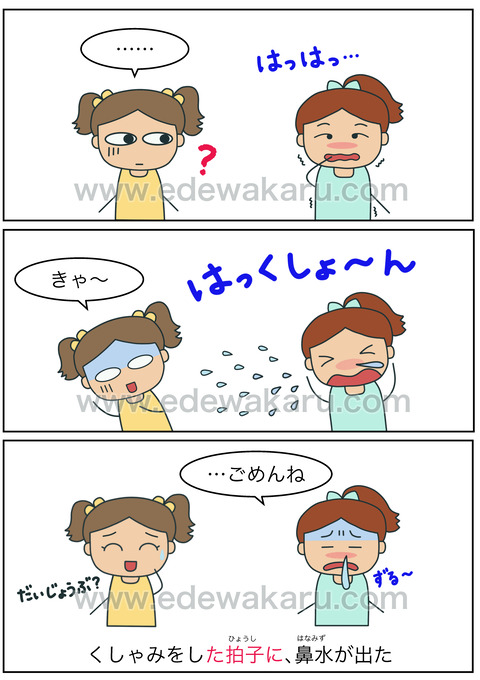
くしゃみをした拍子に鼻水が出た
→くしゃみをした瞬間に、鼻水が出たThe moment I sneezed, my nose started running. → The moment I sneezed, my nose started running.
転んだ拍子に頭を打ってしまった
→転んだことで、頭を打ってしまったI hit my head when I fell. → I hit my head because I fell.
つまずいた拍子に、お皿を落として割ってしまった
→つまずいたことで、お皿を落として割ってしまったI stumbled, and in doing so dropped and broke a plate. → I dropped and broke a plate because I stumbled.
ぶつかった拍子に転んでしまった
→ぶつかって転んでしまったI fell when I bumped into something. → I bumped into something and fell.
言いたいことを忘れてしまっても、何かの拍子に思い出すこともある
→何か別のことをした瞬間に思い出すこともあるEven if you forget what you wanted to say, sometimes you remember it when something happens to jog your memory. → Sometimes you remember it the moment you do something else.
Read the original source text
Meaning
〜たことで〜した
〜たことで〜が起こった
How to use it
動詞[た形]+拍子に
動詞[た形]+拍子で
Explanation
「A拍子にB」は「AしたことでBした」「AしたことでBが起こった」という意味の文型です。「B」には偶然起こってしまったことが入り、「Aした瞬間に、Bしてしまった」「Aした瞬間に、Bが起こった」と言いたい時に使われます。 不注意だったことが原因で何かが起こってしまった時や、うっかりしていたために何かよくないことが発生した時によく使われます。
似ている文型に「〜た弾みに・〜た弾みで」がありますので、復習しておきましょう😉
【関連記事】
文法
Meaning
Because you did ~, you end up inadvertently ...
Expresses that one thing triggers another thing happening “inadvertently” or “without meaning to.”
How to use it
V (た-form) + 弾みに
V (た-form) + 拍子に
In context 5 examples
転んだ弾みに、頭を打ってしまった。
When I fell, I hit my head.
後ろから誰かに押された弾みで、靴が脱げてしまった。
I was pushed by someone from behind, and as a result my shoe came off.
重い荷物を持ち上げようとした弾みに、腰を痛めてしまった。
When I tried to lift a heavy load, I hurt my back.
何かの拍子で、突然電気が消えた。
All of a sudden, the power went out for some reason.
人とぶつかった拍子に、持っていたスマホを落としてしまった。
I bumped into someone and dropped the smartphone I was holding.
Read the original source text
Meaning
〜したことで、つい・・・
ある事柄がきっかけとなって、「つい」、「うっかり」別の事柄が起こることを表す。
How to use it
V(タ形)+ 弾みに
V(タ形)+ 拍子に
くらべてわかる日本語表現文型辞典
Meaning
An action A causes an unintended B as a result.
How to use it
AたはずみにB (AたはずみでB)
[Verb—た form] はずみに
Explanation
【Contrast 1】
“Aた勢いでB”
“Aた勢いでB” means using the force or momentum of A to do B. “AたはずみにB” means that the action A itself triggers B.
×A大に合格したはずみでもっと難しいB大を受けることにした。 — Having passed University A, I decided to take the entrance exam for the more difficult University B on the momentum of it.
○A大に合格した勢いでもっと難しいB大を受けることにした。 — Having passed University A, I decided to take the entrance exam for the more difficult University B, carried along by the momentum.
“AたところB” (Meaning 1, p. 119)
With “AたところB,” one does A expecting B. With “AたはずみにB,” B is an unintended result.
○問題の解き方を先輩に聞いたところ、すぐ教えてもらえた。 — When I asked my senior how to solve the problem, they taught me right away.
×問題の解き方を先輩に聞いたはずみに、すぐ教えてもらえた。 — When I asked my senior how to solve the problem, they taught me right away unexpectedly.
“AたとたんにB” (Meaning 1, p. 121)
In context 4 examples
ものを取ろうと手を伸ばしたはずみに机の上のお茶をこぼした。
As I reached out to grab something, I accidentally knocked over the tea on the desk.
子どもを抱き上げたはずみにぎっくり腰になってしまった。
When I picked up the child, I put my back out.
電車の中でよろけたはずみで後ろの人の足を踏んでしまった。
I stumbled on the train and accidentally stepped on the person behind me.
お辞儀をしたはずみに彼女は抱えていた書類を路上にばらまいた。
As she bowed, the documents she was carrying scattered all over the street.
Read the original source text
Meaning
Aという動作が原因で、結果として意図していなかったBを引き起こす。
How to use it
AたはずみにB(AたはずみでB)
[動詞-た形]はずみに
Explanation
【対比1】
「Aた勢いでB」
「Aた勢いでB」はAの力を利用してBという意味。「AたはずみにB」はAの動作そのものがBの誘因となる。
×A大に合格したはずみでもっと難しいB大を受けることにした。
○A大に合格した勢いでもっと難しいB大を受けることにした。
「AたところB」(意味1 P.119)
「AたところB」はBを期待してAをする。「AたはずみにB」のBは意図しない結果。
○問題の解き方を先輩に聞いたところ、すぐ教えてもらえた。
×問題の解き方を先輩に聞いたはずみに、すぐ教えてもらえた。
「AたとたんにB」(意味1 P.121)