AIUEO JLPT Grammar
Meaning
This sentence pattern expresses a sense of disappointment or light criticism about someone else’s actions or choices.
How to use it
Verb ば-form + よかったのに; verb た-form たら + よかったのに; verb ない-form + なければ + よかったのに; verb ない-form + なかったら + よかったのに
In context 5 examples
もっと早く言えばよかったのに。
It would be better if you said it earlier.
この本を読めばよかったのに。テストに出たんだよ。
You should have read this book. It was on the test.
あんなことを言わなければよかったのに。彼を怒らせちゃったね。
You shouldn’t have said that. You’ve made him angry.
早く教えてくれたらよかったのに。もう間に合わないよ。
You should have told me earlier. Now it’s too late.
あんなに怒鳴らなければよかったのに。
You shouldn’t have yelled so much.
Read the original source text
Meaning
This sentence pattern expresses a sense of disappointment or light criticism about someone else’s actions or choices.
How to use it
動詞ば形+よかったのに動詞た形たら+よかったのに動詞ない形+なければ+よかったのに動詞ない形+なかったら+よかったのに
Explanation · 日本語
この文型は、他人の行動や選択についての残念な気持ちや、軽い非難を表すときに使われる表現です。
絵でわかる日本語
Meaning
You should have done〜… what a shame
How to use it
Verb [ば-form] + ばよかったのに
Verb [た-form] + たらよかったのに
Explanation
“〜ばよかったのに” is used when you want to say, “You should have done〜; it’s too bad you didn’t.” Use it when you want to express regret or blame toward someone, as in “You should have done〜…” 😮
“〜ばよかったのに” can be changed to “〜たらよかったのに.”
(Review: 〜がる・〜がっている①)
(Review: 〜がる・〜がっている②)
(Review: 〜がる・〜がっている③)
[Example]
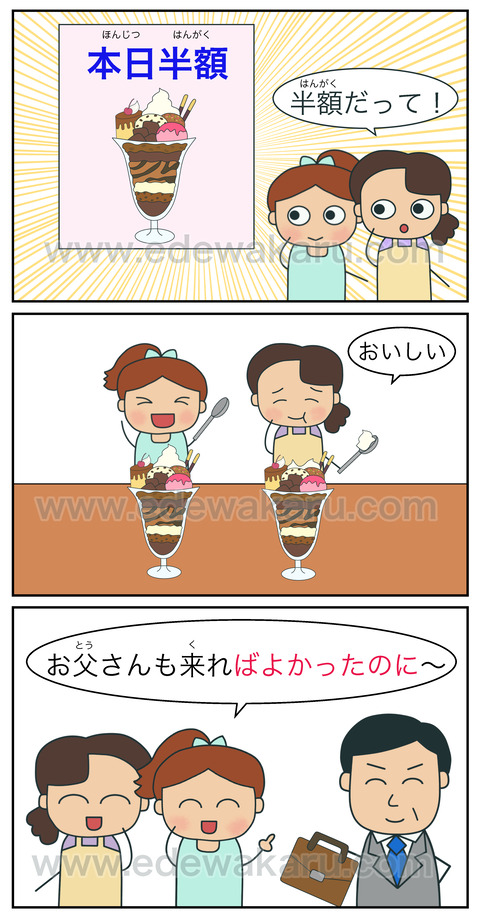
Dad should have come too.
= Dad should have come too.
Remember: “〜ばよかった・〜たらよかった” is used about oneself, while “〜ばよかったのに・〜たらよかったのに” is used about something the other person did 😉
(Review: 〜ばよかった・〜たらよかった)
In context 4 examples
お父さんも来ればよかったのに
→お父さんも来たほうがよかったのに残念ね…Dad should have come too. →It’s too bad Dad didn’t come too…
嫌いなんだったら、言えばよかったのに…
→嫌いなんだったら、言ったほうがよかったのに、なんで言わなかったの?(復習:なんで?)If you didn’t like it, you should have said so… →If you didn’t like it, you should have said so. Why didn’t you? (Review: なんで?).
知ってたなら教えてくれればよかったのに
→知ってたなら教えてくれたほうがよかったのに、どうして教えてくれなかったの?If you knew, you should have told me. →If you knew, you should have told me. Why didn’t you?
セール中だったんだから、買えばよかったのに
→セール中だったんだから買うべきだったのに、なぜ買わなかったの?(復習:〜中)Since it was on sale, you should have bought it. →Since it was on sale, you should have bought it. Why didn’t you? (Review: 〜中).
Read the original source text
Meaning
〜したほうがよかったのに…残念だね
How to use it
動詞[ば形]+ばよかったのに
動詞[た形]+たらよかったのに
Explanation
「〜ばよかったのに」は「〜したほうがよかったのに、(〜しなくて)残念だね」と言いたい時に使う文型です。
相手に対して「〜したほうがよかったのに…」と
残念がったり、非難する気持ちを表したい場合に使用します
😮
「〜ばよかったのに」は「〜たらよかったのに」にチェンジすることができます。
(復習:〜がる・〜がっている①)
(復習:〜がる・〜がっている②)
(復習:〜がる・〜がっている③)
[例]
お父さんも来れ
ばよかったのに
=お父さんも来
たらよかったのに
「〜ばよかった・〜たらよかった」は自分に対して使いますが、「〜ばよかったのに・〜たらよかったのに」は相手がしたことに使うと覚えておきましょう😉
(復習:〜ばよかった・〜たらよかった)