絵でわかる日本語
Usage 1
Read this source entry ↗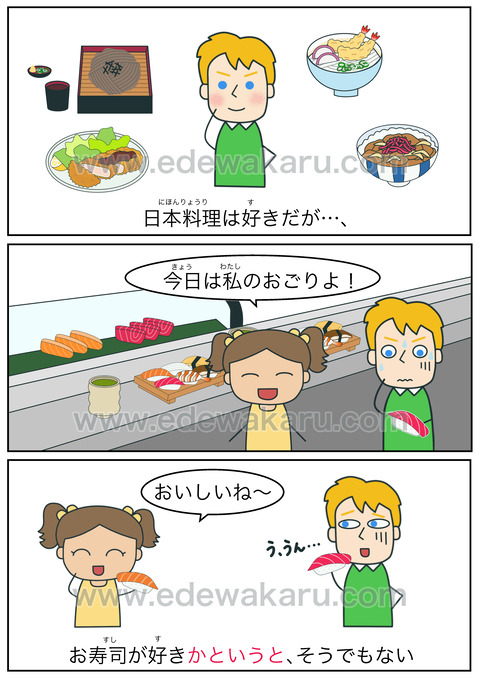
Meaning
In reality, ~ is not the case
Actually, ~ is not the case
How to use it
Verb, adjective, or noun [plain form] + かというと〜ない
Verb, adjective, or noun [plain form] + かといえば〜ない
Explanation
「Aかというと〜ない」 is a sentence pattern meaning “In reality, A is not the case” or “Actually, A is not the case.” It is used to say, “You might naturally think A because of ~, but in reality A is not the case,” or “People tend to think A, but actually it isn’t so.”
[Examples]
① I like Japanese food, but it’s not as if I like sushi.
→ It would be natural to think that I like sushi too because I like Japanese food, but I don’t like sushi.
② If you give your girlfriend an expensive present, it doesn’t necessarily mean she’ll be happy.
→ You might normally think she’d be happy if you gave her an expensive gift, but that isn’t always the case.
③ It doesn’t necessarily seem that rich people are happy.
→ People tend to think rich people are happy, but in reality that doesn’t seem to be the case.
④ It’s not necessarily true that anyone can become a singer if they sing well.
→ People normally think that if you sing well, you can become a singer, but that is not necessarily the case.
⑤ Work is very demanding, but it’s not that I want to quit.
→ People tend to think that when work is demanding, you want to quit, but that’s not the case.
「〜かというと〜ない」 is often used with 「〜とは限らない」, 「〜わけではない」, and 「〜というものではない」, so learn them together 😉
【Related patterns】
In context 5 examples
日本料理は好きだが、寿司が好きかというと、そうでもない
I like Japanese food, but it’s not as if I like sushi.
高いものをプレゼントしたら彼女が喜ぶかというと、そうではないこともある
If you give your girlfriend an expensive present, it doesn’t necessarily mean she’ll be happy.
お金持ちが幸せかというと、そういうわけでもなさそうだ
It doesn’t necessarily seem that rich people are happy.
歌がうまければ誰でも歌手になれるかというと、そうとは限らない
It’s not necessarily true that anyone can become a singer if they sing well.
仕事はとても大変だが、辞めたいかというと、そんなことはない
Work is very demanding, but it’s not that I want to quit.
Read the original source text
Meaning
実際は〜ではない
実は〜ではない
How to use it
動詞・形容詞・名詞[普通形]+かというと〜ない
動詞・形容詞・名詞[普通形]+かといえば〜ない
Explanation
「Aかというと〜ない」は「実際はAではない」「実はAではない」という意味の文型です。「〜だからAだと思うのが当然だが、実際はAではない」「普通に考えるとAだと思われがちだが、実はAではない」と言いたい時に使われます。
[例]
①日本料理が好きだが、寿司が好き
かというと、そうでもない
→日本料理が好きだから、お寿司も好きだと思われるのが当然だが、お寿司は好きではない
②高いものをプレゼントしたら彼女が喜ぶ
かというと、そうではないこともある
→高いものをプレゼントしたら彼女が喜ぶと思うのが普通だが、そうではないこともある
③お金持ちが幸せ
かというと、そういうわけでもなさそうだ
→普通に考えるとお金持ちは幸せだと思われがちだが、実際はそうではない
④歌がうまければ誰でも歌手になれる
かというと、そうとは限らない
→歌がうまければ歌手になれると思うのが普通だが、そうとは限らない
⑤仕事はとても大変だが、辞めたい
かというと、そんなことはない
→仕事が大変だと辞めたいと思っていると思われがちだが、そんなことはない
「〜かというと〜ない」は「〜とは限らない」「〜わけではない」「〜というものではない」などとよく使われますので、一緒に覚えておきましょう😉
【関連文型】
Usage 2
Read this source entry ↗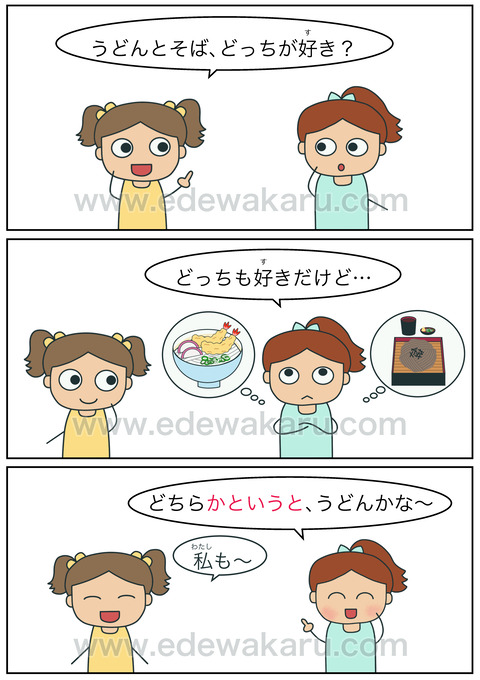
Meaning
To explain why ~
How to use it
Question word + かというと
Question word + かといえば
Explanation
「Aかというと」 is a sentence pattern meaning “to explain why A” or “to explain A.” A contains a question word. When giving a reason with expressions such as 「なぜかというと」 or 「どうしてかというと」, patterns such as 「〜からだ」 and 「〜ためだ」 are often used.
[Examples]
① A: Which do you like better, udon or soba?
B: I like both, but if I had to say which, I guess udon.
→ If I explain which one I like better, I’d say udon.
② She speaks English fluently. The reason is that she studied abroad in the United States.
→ To explain why, it’s because she studied abroad in the United States.
③ I don’t really like Yamada. The reason is that he’s very stingy.
→ To explain why, it’s because he’s very stingy.
④ I didn’t like studying when I was in elementary school. As for when I started liking it, that was when I became a high school student.
→ To explain when I started liking it, it was when I became a high school student.
⑤ I can’t stand natto. The reason is that it smells really bad.
→ To explain why, it’s because it smells really bad.
⑥ Teacher: Why are you studying Japanese?
Student: The reason is that I love Japanese anime.
→ To explain why, it’s because I love Japanese anime.
There is also the pattern 「〜かというと〜ない」, so learn it at the same time 😉
【Related patterns】
In context 6 examples
A: うどんとそば、どっちが好き?B:どっちも好きだけど、どちらかというと、うどんかな
A: Which do you like better, udon or soba? B: I like both, but if I had to say which, I guess udon.
彼女は英語がペラペラだ。どうしてかというと、アメリカに留学していたからだ
She speaks English fluently. The reason is that she studied abroad in the United States.
私はあまり山田くんが好きではない。なぜかというと、とてもケチだからだ
I don’t really like Yamada. The reason is that he’s very stingy.
小学生の頃は勉強が嫌いだった。いつ好きになったかというと、高校生になった時だ
I didn’t like studying when I was in elementary school. As for when I started liking it, that was when I became a high school student.
納豆が苦手だ。なぜかというと、とてもくさいからだ
I can’t stand natto. The reason is that it smells really bad.
先生:なぜ日本語を勉強していますか?学生:なぜかというと、日本のアニメが大好きだからです
Teacher: Why are you studying Japanese? Student: The reason is that I love Japanese anime.
Read the original source text
Meaning
〜かを説明すると
How to use it
疑問詞+かというと
疑問詞+かといえば
Explanation
「Aかというと」は「Aかを説明すると」「Aについて説明すると」という意味の文型です。「A」には疑問詞が入ります。「なぜかというと」「どうしてかというと」のように理由を言う場合は、「〜からだ」「〜ためだ」などの文型がよく使われます。
[例]
①A: うどんとそば、どっちが好き?
B:どっちも好きだけど、どちら
かというと、うどんかな
→どちらが好きかを説明すると、うどんだと思う
②彼女は英語がペラペラだ。どうして
かというと、アメリカに留学していたからだ
→どうしてかを説明すると、アメリカに留学していたからだ
③私はあまり山田くんが好きではない。なぜ
かというと、とてもケチだからだ
→なぜかを説明すると、とてもケチだからだ
④小学生の頃は勉強が嫌いだった。いつ好きになった
かというと、高校生になった時だ
→いつ好きになったかを説明すると、高校生になった時だ
⑤納豆が苦手だ。なぜ
かというと、とてもくさいからだ
→なぜかを説明すると、とてもくさいからだ
⑥先生:なぜ日本語を勉強していますか?
学生:なぜ
かというと、日本のアニメが大好きだからです
→なぜかを説明すると、日本のアニメが好きだからです
「〜かというと〜ない」という文型もありますので、一緒に覚えておきましょう😉
【関連文型】