くらべてわかる日本語表現文型辞典
Meaning
X is A and nothing other than A. An emphatic expression stating that X is A.
How to use it
(X is) nothing other than A (nothing other than because of A)
[Verb - te iru] (+ kara) ni hoka naranai
[Noun - ∅] ni hoka naranai
Explanation
【Contrast 1】
“A ni suginai” (Meaning 1, p. 241)
“(X wa) A ni suginai” includes the speaker’s feeling that it is trivial, of no value, or insignificant that X is A.
○たとえ世間が認めなくても、彼の行いは立派な行為にほかならない。 — Even if society does not recognize it, his conduct is nothing other than a fine deed.
×たとえ世間が認めなくても、彼の行いは立派な行為にすぎない。 — Even if society does not recognize it, his conduct is merely a fine deed.
○たとえ人気があっても、ルパンは犯罪者にほかならない。 — Even if he is popular, Lupin is nothing other than a criminal.
○たとえ人気があっても、ルパンは犯罪者にすぎない。 — Even if he is popular, Lupin is merely a criminal.
In context 4 examples
合格できたのは、努力の結果にほかならない。
The fact that I was able to pass is nothing other than the result of hard work.
親が厳しいのは子どもを愛しているからにほかならない。
The reason my parents are strict is nothing other than that they love their child.
恐がらなくてもいい。「たたり」なんて、迷信にほかならない。
You don’t have to be afraid. A “curse” is nothing more than a superstition.
世界の安全と平和は日本の安全と平和にほかならない。
The safety and peace of the world are nothing other than the safety and peace of Japan.
Read the original source text
Meaning
XはAであって、A以外のものではない。XはAであるということの強調表現。
How to use it
(Xは)Aにほかならない(Aからにほかならない)
[動詞-ている](+から)にほかならない
[名詞-∅]にほかならない
Explanation
【対比1】
「Aにすぎない」(意味1 P.241)
「(Xは)Aにすぎない」にはXがAであることに対する話し手のつまらない・価値がない・少ないなどの気持ちが含まれている。
○たとえ世間が認めなくても、彼の行いは立派な行為にほかならない。
×たとえ世間が認めなくても、彼の行いは立派な行為にすぎない。
○たとえ人気があっても、ルパンは犯罪者にほかならない。
○たとえ人気があっても、ルパンは犯罪者にすぎない。
DoJG 日本語文法辞典(全集)
Meaning
Be nothing but ~; be simply ~
How to use it
(i) (Nounは)Noun | にほかならない | |
| (彼の話は)冗談にほかならない | His talk is nothing but a joke |
(ii) ~のは~から | にほかならない | |
| 働くのはお金が欲しいからにほかならない | The reason that we work is simply because we want money |
(iii) ~は~こと | にほかならない | |
| 読書は著者と対話することにほかならない | Reading is nothing but a dialogue with the author |
Explanation
A phrase that is used to indicate that an action/state mentioned in the topic phrase or clause is nothing but something.
In context 12 examples
あの人の言葉は美辞麗句にほかならない。
His words are nothing but flowery words.
日本語を勉強しているのは将来日本で仕事をしたいからにほかならない。
The reason that I am studying Japanese is simply because I want to work in Japan in the future.
外国語学習はほかの国の人の考え方を学ぶことにほかならない。
Foreign language learning is nothing but learning about the ways people in other countries think.
モーツァルトの音楽は天使の声にほかならない。
Mozart's music is nothing but an angel's voice.
結婚は人生の墓場にほかならない。
Marriage is nothing but a graveyard of life.
彼の言動は自己宣伝にほかならない。
His speech and behaviour are nothing but self-advertisement.
親が子供を厳しくしつけるのは子供を愛しているからにほかならない。
The reason why parents discipline their children strictly is simply because they love their children.
彼女が僕に寄って来るのは僕を利用したいからにほかならない。
The reason why she comes close to me is simply because she wants to use me.
私の日本語がこれほど上達したのは大学の時の日本語の先生のおかげにほかならない。
The reason why my Japanese made such progress is simply because of my college Japanese instructor.
この大学の学生の質がいいのは選抜が厳しいからにほかならない。
The reason why the student quality of this college is so good is simply because the selection is tough.
核兵器の使用は人類の破滅を招くことにほかならない。
The use of nuclear weapons invites nothing but (literally: is nothing but to invite) the annihilation of humanity.
ほかならない君のためだから、やってあげよう。
It's for you of all people, so I'll do it.
絵でわかる日本語
Usage 1
Read this source entry ↗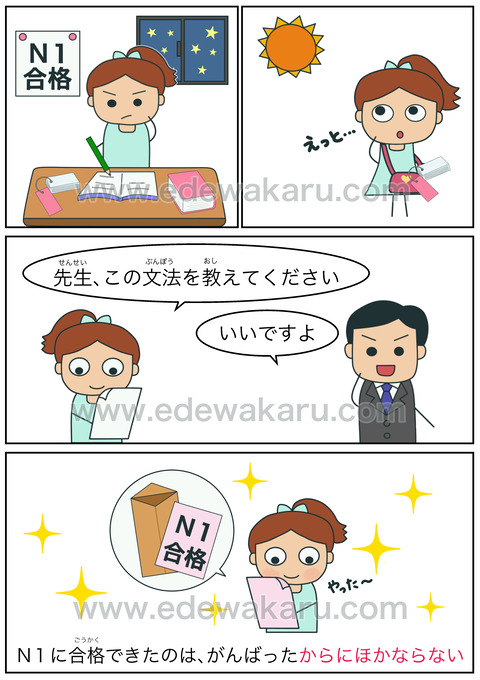
Meaning
It is precisely because ...
It is definitely because ...
How to use it
Verb, adjective, or noun [plain form] + からにほかならない
Explanation
“〜からにほかならない” is a grammar pattern meaning “It is precisely because ...” or “It is definitely because ...” It is often used in the form 〜のは〜からにほかならない, emphatically asserting a cause or reason.
Let’s also review 〜にほかならない, meaning “there is no other reason than that” 😊
In context 5 examples
N1に合格できたのは、がんばったからにほかならない
→合格できたのは、がんばったからだThe reason I passed N1 is precisely that I worked hard. →I passed because I worked hard.
不合格だったのは、遊んでばかりいたからにほかならない
→不合格だったのは、絶対に遊んでばかりいたからだThe reason I failed was definitely that I did nothing but play. →The reason I failed was definitely that I did nothing but play.
子供に厳しくするのは、子供が大切だからにほかならない
→子供に厳しくするのは、子供が大切だからだThe reason I’m strict with my children is precisely that they are important to me. →The reason I’m strict with my children is that they are important to me.
日本に来たのは、日本語を勉強したかったからにほかならない
→日本に来たのは、正に日本語を勉強したかったからだThe reason I came to Japan is precisely that I wanted to study Japanese. →I came to Japan precisely because I wanted to study Japanese.
成功したのは、みんなの協力があったからにほかならない
→正にみんなの協力があったからだOur success was precisely because everyone cooperated. →It was precisely because everyone cooperated.
Read the original source text
Meaning
正に〜からだ
絶対に〜からだ
How to use it
動詞・形容詞・名詞[普通形]+からにほかならない
Explanation
「〜からにほかならない」は「正に〜からだ」「絶対に〜からだ」という意味の文型です。多くの場合
「〜のは〜からにほかならない」
の形が使われ、原因・理由を断定する気持ちを強調します。
「それ以外にない」という意味の「〜にほかならない」も復習しておきましょう😊
Usage 2
Read this source entry ↗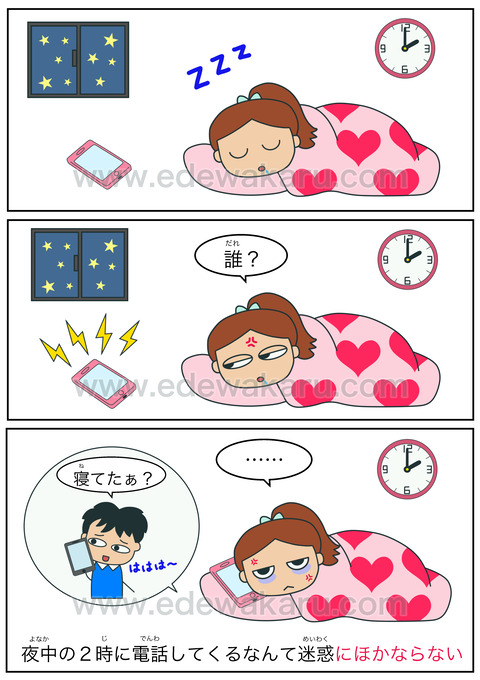
Meaning
It is definitely ...
There is nothing other than ...
How to use it
Noun [dictionary form] + にほかならない
Explanation
“〜にほかならない” is a grammar pattern meaning “It is definitely ...,” “It is precisely ...,” or “It really is ...” It is used to strongly assert that something is absolutely nothing other than ... When written in kanji, 〜にほかならない is written 〜に他ならない.
There is also the form 〜からにほかならない, so let’s learn that together 😊
In context 5 examples
夜中の2時に電話してくるなんて迷惑にほかならない
→夜中の2時でに電話してくるなんて本当に迷惑だCalling at two in the morning is nothing but a nuisance. →Calling at two in the morning is really a nuisance.
N1合格は努力した結果にほかならない
→N1に合格したのは、正に努力した結果だPassing N1 is nothing other than the result of hard work. →Passing N1 is precisely the result of hard work.
0点だったのは、勉強不足にほかならない
→0点だったのは、絶対に勉強不足だったからだThe reason I got zero points was definitely that I hadn’t studied enough. →I got zero points because I definitely hadn’t studied enough.
お店のものを盗むことは犯罪にほかならない
→お店のものを盗むことは、正に犯罪だStealing things from a store is nothing other than a crime. →Stealing things from a store is precisely a crime.
彼氏:君と出会ったのは、運命にほかならないよ彼女:ええ。私たちは赤い糸で結ばれているのよ
→君と出会ったのは、正に運命だBoyfriend: Meeting you was nothing other than fate. Girlfriend: Yes. We’re connected by the red thread of fate. →Meeting you was precisely fate.
Read the original source text
Meaning
絶対に〜だ
〜以外にない
How to use it
名詞[辞書形]+にほかならない
Explanation
「〜にほかならない」は「絶対に〜だ」「正に〜だ」「本当に〜だ」という意味の文型です。この文型は「絶対に〜以外のものではない」と強く断定する気持ちを表す時に使われます。「〜にほかならない」は漢字で書くと
「〜に他ならない」
になります。
「〜にほかならない」には「〜からにほかならない」という形もありますので、一緒に覚えておきましょう😊
どんなときどう使う 日本語表現文型辞典
Meaning
nothing other than
How to use it
N + にほかならないW
Explanation
~だ/~以外のものではない
「絶対に~だ・~以外のものではない」と断定したいときの言い方。評論文などに使われる書き言葉。
Definitive opinion. Written form used in critiques and other essays.
In context 3 examples
文化とは国民の日々の暮らし方にほかならない。
Culture is nothing other than the everyday way of life of a nation’s people.
山川さんが東京で暮らすようになってもふるさとの方言を話し続けたのは、ふるさとへの深い愛着の表れにほかならない。
The fact that Mr. Yamakawa continued speaking his hometown dialect even after he began living in Tokyo is nothing other than an expression of his deep attachment to his hometown.
彼が厳しい態度を示すのは、子どもの将来のことを心配するからにほかならない。
The only reason he takes such a strict attitude is that he worries about the children’s future.
Read the original source text
Meaning
nothing other than
How to use it
N+にほかならないW
Explanation
~だ/~以外のものではない
「絶対に~だ・~以外のものではない」と断定したいときの言い方。評論文などに使われる書き言葉。
Definitive opinion. Written form used in critiques and other essays.
日本語NET JLPT文法解説まとめ
Meaning
Nothing other than ~ / absolutely ~
How to use it
N + にほかならない
ほかならぬ + N
Explanation
nothing other than ~ / absolutely ~ / definitely ~
・Written language
・An expression for making a definitive statement
・written language
・Expressions for making definitive statements
In context 12 examples
緊急時に一番大切なことは、まず落ち着くことにほかならない。
The most important thing in an emergency is nothing other than to stay calm first.
親が子供に厳しくするのは、子供の将来のことを心配するからにほかならない。
The only reason parents are strict with their children is that they worry about their children’s future.
就労ビザなしで外国で働くのは、犯罪にほかならない。
Working in a foreign country without a work visa is nothing other than a crime.
彼が試験に落ちたのは、単に勉強不足にほかならない。
The only reason he failed the exam is simply that he didn’t study enough.
彼がN1に合格できたのは、努力の結果にほかならない。
The fact that he passed N1 is nothing other than the result of his hard work.
自分からやると言ったのに、途中でやめてしまうのは無責任にほかならない。
You said you’d do it of your own accord, so quitting halfway through is nothing short of irresponsible.
今回の商談がうまくいったのは、上司のサポートがあったからにほかならない。
The only reason this business negotiation went well was that we had our supervisor’s support.
彼らが日本へ行くのは、お金を稼ぎたいからにほかならない。
The only reason they are going to Japan is that they want to earn money.
予定より早く完成できたのは、みんなの協力があったからにほかならない。
The only reason we finished ahead of schedule was that everyone cooperated.
彼が芸能人になれたのも、俳優だった父のコネにほかならない。
The reason he was able to become an entertainer was nothing other than his actor father’s connections.
言語はコミュニケーションの手段にほかならない。
Language is nothing other than a means of communication.
僕がここまでやってこられたのも、家族や友人、恋人の支えがあったからにほかなりません。
The only reason I’ve made it this far is that my family, friends, and partner supported me.
Read the original source text
Meaning
〜以外のものではない / 絶対に〜だ
How to use it
N + にほかならない
ほかならぬ + N
Explanation
nothing other than ~ / absolutely ~ / definitely ~
・書き言葉
・断定したい時の言い方
・written language
・Expressions for making definitive statements
毎日のんびり日本語教師
How to use it
Noun + にほかならない
ほかならぬ + noun
Explanation
An expression of assertion and emphasis.
Indicates that it is precisely that, with no other possibilities.
Notes
Nothing in particular.
In context 6 examples
人として最も大事なのは、心の強さにほかならない。
The most important thing in being a person is nothing other than strength of heart.
人生は運命にほかならない。
Life is nothing other than fate.
したくないことはしないというのは、わがままに他ならない。
Not doing what you don’t want to do is nothing but selfishness.
不幸なのは他人のせいではなく、自分が悪いからに他ならない。
One’s unhappiness is not someone else’s fault; it is solely because one is at fault.
こんな結果になってしまったのは感情的に物事を進めてきたからに他ならない。
The only reason things ended up like this is that we have been handling matters emotionally.
逃げ出すことは、責任を放棄することに他ならない。(逃跑无非是逃脱责任。)
Running away is nothing other than abandoning responsibility. (Running away is nothing more than shirking responsibility.)
Read the original source text
How to use it
名詞+にほかならない
ほかならぬ+名詞
Explanation
断定、強調の表現です。
他の選択肢はなく、まさにそれであることを表します。
Notes
特になし
日本語文型辞典 英語版
Meaning
Used to assert something and expresses the meaning of “there is nothing more than something” or “it is the very something.”
Used to assert that the reason or cause of some event is nothing more than that, or that is the very reason.
How to use it
1. Nにほかならない
2. ...にほかならない[...から/...ため にほかならない]
In context 5 examples
この会を成功のうちに終わらせることが出来ましたのは、皆様がたのご協力のたまものに他なりません。
It was entirely your cooperation that has resulted in a successful conclusion to the meeting.
年を取るというのは、すなわち経験を積むということに他ならない。
Aging is nothing other than collecting more experiences.
父が肺ガンになったのは、あの工場で長年働いたために他ならない。
My father’s lung cancer is entirely due to the fact that he worked at that factory for many years.
彼が私を憎むのは、私の業績をねたんでいるからに他ならない。
The reason he hates me is entirely because he is jealous of my accomplishments.
この仕事にこんなにも打ち込むことができたのは、家族が支えていてくれたからに他ならない。
I could throw myself into my work only because I was supported by my family.
Read the original source text
Meaning
Used to assert something and expresses the meaning of “there is nothing more than something” or “it is the very something.”
Used to assert that the reason or cause of some event is nothing more than that, or that is the very reason.
How to use it
1. Nにほかならない
2. ...にほかならない[...から/...ため にほかならない]
AIUEO JLPT Grammar
Meaning
This sentence pattern emphasizes that a certain matter is the exact one, not something else. It is used when the speaker confidently concludes something.
How to use it
Noun に + ほか + ならない
In context 5 examples
彼の失敗は、準備不足にほかならない。
His failure is nothing but a result of inadequate preparation.
その決断は、彼女の信念の強さを示すものにほかならない。
That decision is nothing other than a demonstration of her strong convictions.
このプロジェクトが成功したのは、チーム全員の協力のおかげにほかならない。
The success of this project is nothing but the result of the entire team’s cooperation.
彼の成功は、才能と努力の賜物にほかならないです。
His success is nothing but the result of talent and hard work.
この事件の原因は、管理の甘さにほかなりません。
The cause of this incident is nothing other than poor management.
Read the original source text
Meaning
This sentence pattern emphasizes that a certain matter is the exact one, not something else. It is used when the speaker confidently concludes something.
How to use it
名詞に+ほか+ならない
Explanation · 日本語
この文型は、ある事柄が他ではなく、まさにそれであることを強調する表現です。話し手が強い確信を持って結論を述べるときに使用されます。
文法
Meaning
Nothing other than ~ / absolutely ~
How to use it
N + にほかならない
ほかならぬ + N
Notes
・Written language
・An expression used when you want to make a firm assertion
In context 12 examples
緊急時に一番大切なことは、まず落ち着くことにほかならない。
The most important thing in an emergency is nothing other than to stay calm first.
親が子供に厳しくするのは、子供の将来のことを心配するからにほかならない。
The only reason parents are strict with their children is that they worry about their children’s future.
就労ビザなしで外国で働くのは、犯罪にほかならない。
Working in a foreign country without a work visa is nothing other than a crime.
彼が試験に落ちたのは、単に勉強不足にほかならない。
The only reason he failed the exam is simply that he didn’t study enough.
彼がN1に合格にできたのは、努力の結果にほかならない。
The only reason he was able to pass N1 was the result of his hard work.
自分からやると言ったのに、途中でやめてしまうのは無責任にほかならない。
You said you’d do it of your own accord, so quitting halfway through is nothing short of irresponsible.
今回の商談がうまくいったのは、上司のサポートがあったからにほかならない。
The only reason this business negotiation went well was that we had our supervisor’s support.
彼らが日本へ行くのは、お金を稼ぎたいからにほかならない。
The only reason they are going to Japan is that they want to earn money.
予定より早く完成できたのは、みんなの協力があったからにほかならない。
The only reason we finished ahead of schedule was that everyone cooperated.
彼が芸能人になれたのも、俳優だった父のコネにほかならない。
The reason he was able to become an entertainer was nothing other than his actor father’s connections.
言語はコミュニケーションの手段にほかならない。
Language is nothing other than a means of communication.
僕がここまでやってこられたのも、家族や友人、恋人の支えがあったからにほかなりません。
The only reason I’ve made it this far is that my family, friends, and partner supported me.
Read the original source text
Meaning
〜以外のものではない / 絶対に〜だ
How to use it
N + にほかならない
ほかならぬ + N
Notes
・書き言葉
・断定したい時の言い方
Bunpro Grammar Reference
Meaning
Nothing but, None other than, Simply
How to use it
Noun + にほかならない(1)
(1) にほかならぬ
Noun + にほかなりません
Nuance
A construction expressing that (A) is nothing but (A), and can become no other. Simply (A).
Explanation
に他ならない is a grammar pattern used with nouns to indicate that something is 'definitely (A)', or 'nothing but (A)'. Other common translations are 'none other than (A)', or 'simply (A)'.
This expression is often used to emphasize statements, reasons, or causes.
かすみさんがみんなに好かれるのはお人よしだからに他ならない。
The reason why Kasumi-san is liked by everyone is simply because she is a good person.
こんな夜遅くに訪問してくるなんて迷惑に他ならない。
Visiting me at such a late time is nothing but a nuisance.
Being a combination of the noun 他 'other' and the negated form of the う-Verb なる 'to become'. This phrase literally just states that (A) will not become anything other than what it is, as the given definition is already the most accurate.
Caution
In formal situations, particularly formal writing, に他ならぬ may also sometimes be seen.
A(エー)チームがこの大会で優勝できたのは岡村コーチのおかげにほかならぬ。
The reason why team A was able to win this tournament is simply because of coach Okamura.
我が社の商品が人気なのは広告が印象的だからにほかならぬ。
The reason our company's products are popular is simply because our advertisements leave a lasting impression.
In context 16 examples
- 第一にすべきは人命にほかなりません。
The first priority is nothing other than human life.
- かすみさんがみんなに好かれるのはお人よしだからに他ならない。
The reason why Kasumi-san is liked by everyone is simply because she is a good person.
- こんな夜遅くに訪問してくるなんて迷惑に他ならない。
Visiting me at such a late time is nothing but a nuisance.
- 三位という結果は彼の実力にほかならない。
Getting (the result of) 3rd was simply due to his skill.
- 結局「笑い」というのは好き嫌いにほかならない。
In the end, 'laughing' is simply up to your likes and dislikes. (好き嫌い = noun)
- 彼があの番組に出たのは、宣伝にほかならない。
Him going on that show was simply for publicity.
- 通常の事故の原因はスピード違反にほかならない。
The common cause of the accidents is simply people going too fast.
- 人の話を聞かないのは、彼の短所にほかなりません。
His weak point is simply not listening to other people's conversations.
- 今回の成績は、地味な努力の積み重ねによるものにほかならない。
This result is nothing but the accumulation of calm, collected effort.
- 何事においても大切なのは、素質と努力にほかならない。
With anything and everything, the most important thing is none other than one's qualities and effort.
- この会社がここまで成長したのは、彼との出会いがあったからにほかならない。
Being able to get this far at this company is thanks to none other than meeting him.
- わが社の今年度の多大な利益は顧客のおかげにほかなりません。
Our company's tremendous profit for this fiscal year is thanks to none other than our customers.
- タイタニック号の沈没は低品質なリベットに因ったものにほかならない。
The sinking of the Titanic was caused by nothing but low quality rivets.
- 学校校長の生徒に対した演説:
「みなさんの未来に責任を持つのは誰でしょうか。それはみなさん自身にほかならないのです。」School director's speech to students: 'Who is responsible for your future? That is none other than yourself.'
- A(エー)チームがこの大会で優勝できたのは岡村コーチのおかげにほかならぬ。
The reason why team A was able to win this tournament is simply because of coach Okamura.
- 我が社の商品が人気なのは広告が印象的だからにほかならぬ。
The reason our company's products are popular is simply because our advertisements leave a lasting impression.
Read the original source text
Meaning
Nothing but, None other than, Simply
How to use it
Noun + にほかならない(1)
(1) にほかならぬ
Noun + にほかなりません
Nuance
A construction expressing that (A) is nothing but (A), and can become no other. Simply (A).
Explanation
に他ならない is a grammar pattern used with nouns to indicate that something is 'definitely (A)', or 'nothing but (A)'. Other common translations are 'none other than (A)', or 'simply (A)'.
This expression is often used to emphasize statements, reasons, or causes.
かすみさんがみんなに好かれるのはお人よしだからに他ならない。
The reason why Kasumi-san is liked by everyone is simply because she is a good person.
こんな夜遅くに訪問してくるなんて迷惑に他ならない。
Visiting me at such a late time is nothing but a nuisance.
Being a combination of the noun 他 'other' and the negated form of the う-Verb なる 'to become'. This phrase literally just states that (A) will not become anything other than what it is, as the given definition is already the most accurate.
Caution
In formal situations, particularly formal writing, に他ならぬ may also sometimes be seen.
A(エー)チームがこの大会で優勝できたのは岡村コーチのおかげにほかならぬ。
The reason why team A was able to win this tournament is simply because of coach Okamura.
我が社の商品が人気なのは広告が印象的だからにほかならぬ。
The reason our company's products are popular is simply because our advertisements leave a lasting impression.
Nuance · 日本語
(A)は(A)でしかなく、それ以外のものにはなれないということを表す表現。単純に(A)でしかない。
Explanation · 日本語
「に他ならない」は名詞と一緒に使われ、何かが「まさしく (A) である」や「(A) 以外では決してない」ことを表す文型です。「絶対に (A) だ」や「ただ (A) だ」と言い換えることもできます。
この表現は、何かを強く主張したり、理由や原因を断定したりするときによく使われます。
かすみさんがみんなに好かれるのはお人よしだからに他ならない。
The reason why Kasumi-san is liked by everyone is simply because she is a good person.
こんな夜遅くに訪問してくるなんて迷惑に他ならない。
Visiting me at such a late time is nothing but a nuisance.
「に他ならない」は名詞の「他」と五段動詞の「なる」の否定形の組み合わせから成り立っています。そのため、文字通りの意味としては「(A) はその他の物にならない」となりますが、この文字通りの意味は先に述べた実際に使われている意味とも重なっています。
注意点
フォーマルな場面、特に正式な文書では、「に他ならぬ」が使われることもあります。
A(エー)チームがこの大会で優勝できたのは岡村コーチのおかげにほかならぬ。
The reason why team A was able to win this tournament is simply because of coach Okamura.
我が社の商品が人気なのは広告が印象的だからにほかならぬ。
The reason our company's products are popular is simply because our advertisements leave a lasting impression.
NINJAL 日本語文型データベース
Meaning
It expresses the speaker’s decisive interpretation that something is precisely ~.
How to use it
Nにほかならない
Other
Notes
In polite speech, 「〜にほかなりません」 is more commonly used than 「〜にほかならないです」.
It is often used in the present tense.
In context 7 examples
人間は自然界の一部にほかならない。
Human beings are nothing other than a part of the natural world.
結婚するということは、他人と二人で暮らし始めるという現実にほかならないのだ。
Getting married is nothing other than the reality of beginning to live together with another person.
部長「今回の売り上げ目標の達成は、皆さんのご尽力のたまものにほかなりません」
Department manager: “Achieving this sales target is entirely thanks to all your hard work.”
校長「この国の将来を担うのは君たち若者にほかなりません」
Principal: “You young people are the ones who will shape the future of this country.”
雅代は娘が生んだその赤ん坊を見てすぐ、その子は、自分の血を分けた孫にほかならないと実感した。
As soon as Masayo saw the baby her daughter had given birth to, she realized that the child was none other than her own flesh-and-blood grandchild.
勉強をするのは自分自身のためにほかならない。他人のためではないのだ。
Studying is for your own sake and nothing else. It isn’t for anyone else.
彼女が身を引いたのは、彼を深く愛していたからにほかならなかった。
The only reason she stepped aside was that she loved him deeply.
Read the original source text
Meaning
ある事柄がまさしく〜だという話し手の断定的な解釈を表します。
How to use it
Nにほかならない
その他
Notes
丁寧体で使うときは、「〜にほかならないです」より「〜にほかなりません」のほうをよく使います。
現在形で使うことが多いです。
日本語文型辞典
Meaning
Used to state decisively that “there is nothing else” or “it is precisely that.”
Used to state decisively that the reason or cause something happened is nothing other than that very thing, and precisely for that reason.
How to use it
Nにほかならない
…にほかならない …から/…ため にほかならない
In context 5 examples
この会を成功のうちに終わらせることが出来ましたのは、皆様がたのご協力のたまものに他なりません。
We were able to bring this gathering to a successful close precisely thanks to everyone’s cooperation.
年を取るというのは、すなわち経験を積むということに他ならない。
Growing older is, in other words, nothing other than gaining experience.
父が肺ガンになったのは、あの工場で長年働いたために他ならない。
The only reason my father developed lung cancer was that he had worked at that factory for many years.
彼が私を憎むのは、私の業績をねたんでいるからに他ならない。
The only reason he hates me is that he envies my achievements.
この仕事にこんなにも打ち込むことができたのは、家族が支えていてくれたからに他ならない。
The only reason I was able to devote myself so much to this work was that my family supported me.
Read the original source text
Meaning
「それ以外にない」「まさにそのものである」と断定的に述べる場合に用いる。
あることがらが起こった理由や原因がそのこと以外にない、まさにそのためであると断定的に述べるのに用いられる。
How to use it
Nにほかならない
…にほかならない …から/…ため にほかならない