DoJG 日本語文法辞典(全集)
Usage 1
Meaning
But; however; only; the only thing is that ~
How to use it
(i) ただ | One+Counter (のNoun) | |
| ただ一人の息子 | The only son |
| ただ一発で | With only one shot |
(ii) ただ | One+CounterもVerbal(negative) | |
| ただ一日も休んだことがない | Have not taken even one day off |
(iii) ただ | Nounだけ(Particle) | |
| Nounだけ(Particle) 単語だけ(を)覚える | Remember only words |
| Nounだけ(Particle) 力だけで解決する | Solve something only with force |
(iv) ただ | Verbal(という)だけ(だ) | |
| ただ読んだ(という)だけ(だ) | Someone just read it; that’s all |
| ただ安い(という)だけ(だ) | Something is just cheap; that’s all |
| ただ{静かな/静かだという}だけ(だ) | Something is just quiet; that’s all |
| ただ大学教授(だ)(という)だけ(だ) | Someone is just a college professor; that’s all |
Explanation
A conjunction that introduces a supplementary remark.
In context 7 examples
この辺りは駅にもスーパーにも近くて便利だ。ただ環境があまりよくない。
This area is close to both the station and a supermarket, so it's convenient, but the environment is not very good.
とてもいいコンピュータだと思います。ただ値段が問題ですね。
I think this is a very good computer. But, the price is a problem.
彼はいい人だ{が/けど}、ただちょっと考えが浅いところが気になる。
He is a nice person, only I'm concerned that he is a little shallow.
この故障は直せないことはないと思います。ただ時間がかかると思います。
It's not impossible to repair this problem, only I think it'll take time.
とても静かでいいうちだ。ただ近くに店がないので買い物は不便だ。
It is a very quiet and nice house, only there are no shops nearby, so it's inconvenient for shopping.
このデジカメ優れた機能をたくさん持っている。ただユーザーインターフェースが悪くて使いにくいのが難点だ。
This digital camera has many outstanding functions. However, the problem is that it's hard to use because the user interface is bad.
たいていのことは私がいなくても他の者が代わりにやってくれるが、ただこの仕事は他の者に頼むわけにはいかない。
For most things, if I'm not available others can do it for me; however, as far as this job is concerned, I cannot ask someone else to do it for me.
Usage 2
Meaning
Only; just; simply; that's all
How to use it
(i) ただ | One+Counter (のNoun) | |
| ただ一人の息子 | The only son |
| ただ一発で | With only one shot |
(ii) ただ | One+CounterもVerbal(negative) | |
| ただ一日も休んだことがない | Have not taken even one day off |
(iii) ただ | Nounだけ(Particle) | |
| Nounだけ(Particle) 単語だけ(を)覚える | Remember only words |
| Nounだけ(Particle) 力だけで解決する | Solve something only with force |
(iv) ただ | Verbal(という)だけ(だ) | |
| ただ読んだ(という)だけ(だ) | Someone just read it; that’s all |
| ただ安い(という)だけ(だ) | Something is just cheap; that’s all |
| ただ{静かな/静かだという}だけ(だ) | Something is just quiet; that’s all |
| ただ大学教授(だ)(という)だけ(だ) | Someone is just a college professor; that’s all |
Explanation
An adverb which emphasizes the idea of "only".
In context 12 examples
彼のただ一つの欠点は時間にルーズだということだ。
His only (one) defect is that he is not punctual (literally: he is slack about time).
彼女はただの一度も手紙をくれなかった。
She didn't write me even once (literally: only once).
彼はただ弁護士だけが頼りだ。
He has no one else to rely on but his lawyer.
彼女とはただお茶を飲んで話をした(という)だけだ。
I just talked with her over a cup of tea; that's all.
彼はただ一人でやってきた。
He came over alone.
私達が困っていた時、助けてくれた者はただの一人もいなかった。
Not a single person helped us when we were in trouble.
ただそれだけのことで彼を首にしたんでか。
Did you fire him only for that reason?
ただ言われたことだけをやっていても進歩はない。
There will be no progress if you do only what you are told to do.
私はただ頼まれたことをしているだけだ。
I am just doing what I was asked to do; that's all.
あの男はただ真面目だというだけだ。
He is just serious; he has no other merit.
別に大した意味はないんですが、ただちょっと聞いてみたかったんです。
It doesn't have any special meaning, but I just wanted to ask.
ただ人の言うことを鵜呑みにしていては面白い発想は生まれない。
If you simply swallow what other people say, you won't come up with any interesting ideas.
日本語文型辞典
Meaning
Indicates a limitation, meaning that there is nothing else. Often used with だけ, のみ, ばかり, and the like. Means “just that.” In ②, it means “just apologize.” As in ⑤ and ⑥, when indicating a small quantity, it can be rephrased with たった or ほんの.
Used when adding to something stated earlier, or when giving other conditions, exceptions, and the like. Conversational. In writing, ただし is used.
How to use it
ただ [limitation]
…ただ
In context 11 examples
その絵はただ古いだけであまり値打がない。
That painting is merely old and isn’t worth much.
悪いのはこちらの方だから、ただひたすら謝るほかはない。
We’re the ones at fault, so all we can do is apologize sincerely.
部下はただ命令に従うのみだ。
Subordinates have only to obey orders.
ただご無事をお祈りするばかりでございます。
I can only pray for your safety.
ただ一度会っただけなのにあの人が忘れられない。
Although I met that person just once, I can’t forget them.
これまで学校をただの1日も休んだことはない。
I haven’t missed even a single day of school so far.
外はただ一面の雪であった。
Outside, there was nothing but snow stretching everywhere.
おもしろい計画だね。ただ金がかかりそうだ。
That’s an interesting plan. It does look like it’ll cost money, though.
A:この椅子はずいぶんしっかりした作りですね。
B:ええ、ただ少し重いのでお年寄りにはちょっと不便かもしれません。A: This chair is very sturdily made. B: Yes, though it’s a little heavy, so it might be somewhat inconvenient for elderly people.
あいつは悪いやつだ。ただ家族にはやさしいようだが。
He’s a bad guy. Though he does seem to be kind to his family.
A:お母さん、アメリカに留学する話。賛成してくれるでしょ?
B:私はいいんだけど、ただね、お父さんがどういうかと思って…。A: Mom, you’ll approve of my plan to study in America, right? B: I’m fine with it, but I wonder what your father will say…
Read the original source text
Meaning
それ以外はないという限定を表す。「だけ」「のみ」「ばかり」などとともに使うことが多い。「それだけ」の意。②は「謝るだけだ」という意味。⑤⑥のように数量の少なさを表すときは「たった」「ほんの」で言いかえられる。
前に述べたことを補ったり、そのほかの条件、例外などを述べるときに使う。話しことば。書きことばでは「ただし」を用いる。
How to use it
ただ【限定】
…ただ
絵でわかる日本語
Meaning
Only...; nothing but...
There is no choice but to...
How to use it
ただ + verb, い-adjective, or noun [dictionary form] + のみ
ただ + な-adjective
Explanation
“ただ〜のみ” is a sentence pattern meaning “only...” or “there is no choice but to....” It is a formal way of saying “ただ〜だけだ,” and emphasizes that “there is no other option” or “there is only one thing that must be done.” “ただ” can be omitted. With a verb formed with する, both “〜するのみ” and “〜あるのみ” are used.
[Example]
If you want to get better at English, all you can do is practice.
= If you want to get better at English, there is nothing to do but practice.
“ただ〜のみ” is a formal expression, but those taking the N1 exam should remember it. 😊
In context 5 examples
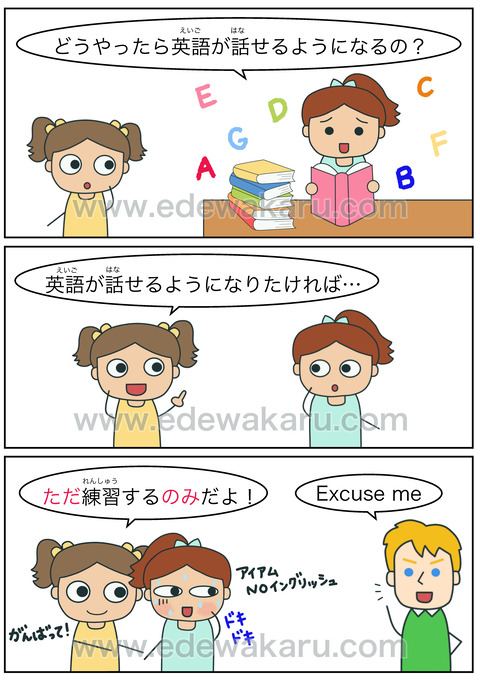
英語が話せるようになりたければ、ただ練習するのみだよ!
→話せるようになりたければ、練習するしかないよ!If you want to be able to speak English, all you can do is practice!
A:明日の運動会、楽しみだね!B:うん。雨が降らないことをただ願うのみだよ〜→雨が降らないことをただ願うだけだよ〜
A: I’m looking forward to tomorrow’s sports day! B: Yeah. All I can do is hope it doesn’t rain. → All I can do is hope it doesn’t rain.
やれることはやった。あとはただ結果を待つのみだ
→あとはただ結果を待つだけだI’ve done what I can. All that’s left is to wait for the results. → All that’s left is just to wait for the results.
部長を怒らせたくなければ、ただ我慢するのみだ…
→ただ我慢するしかない…If you don’t want to make the department manager angry, all you can do is put up with it... → There’s nothing to do but put up with it...
A:彼女にふられたんだ…B:彼女のことなんて忘れて、ただ仕事に集中するのみだよ
→ただ仕事に集中するだけだよA: She dumped me... B: Just forget about her and focus on your work. → Just focus on your work.
Read the original source text
Meaning
ただ〜だけだ
〜するしかない
How to use it
ただ+動詞・い形容詞・名詞[辞書形]+のみ
ただ+な形容詞
Explanation
「ただ〜のみ」は「ただ〜だけ」「〜するしかない」という意味の文型です。これは「ただ〜だけだ」のかたい言い方で、「〜以外にない」「しなければいけないことは1つしかない」ということを強調します。「ただ」は省略することができます。[する動詞]を使う場合は「〜するのみ」 だけでなく「〜あるのみ」という形もあります。
[例]
英語が上手になりたいなら、
ただ
練習
するのみ
だ
=英語が上手になりたいなら、
ただ
練習
ある
のみ
だ
「ただ〜のみ」はかたい言い方ですが、N1を受ける人は覚えておきましょう😊
どんなときどう使う 日本語表現文型辞典
Meaning
the only thing that…
How to use it
ただ + N / 〔Plain form〕 (ナAである / Nである) + のみW
Explanation
ただ~のみ
ただ~だけ
「ただ~だけ」と限定するときの表現。硬い書き言葉。
Sets limits on something. Very formal written expression.
In context 4 examples
マラソン当日の天気、選手にとってはただそれのみが心配だ。
For the runners, the only thing they worry about is the weather on the day of the marathon.
戦争直後、人々はただ生きるのみでせいいっぱいだった。
Immediately after the war, people had all they could do just to survive.
ただ厳しいのみではいい教育とは言えない。
Being strict alone does not make for a good education.
今はもう過去を振り返るな。ただ前進あるのみ。
Don't look back on the past anymore. All that's left is to move forward.
Read the original source text
Meaning
the only thing that…
How to use it
ただ+N/〔普通形〕(ナAである/Nである)+のみW
Explanation
ただ~のみ
ただ~だけ
「ただ~だけ」と限定するときの表現。硬い書き言葉。
Sets limits on something. Very formal written expression.
毎日のんびり日本語教師
How to use it
(ただ +) action noun + あるのみだ
(ただ +) verb dictionary form + のみ
(ただ +) noun (+ particle) + のみ
Explanation
This is an expression of limitation. It indicates that there is only one thing to do.
It can be rephrased as 「~するしかない」, but while 「~しかない」 carries the speaker’s pessimistic nuance, 「~あるのみだ」 expresses the speaker’s strong, positive resolve.
「ただ」 may also appear in the preceding phrase.
「のみ」 is somewhat formal, so 「だけ」 is easier to use in conversation.
Notes
Related grammar: 「【N3文法】~しかない」
In context 17 examples
何事も練習あるのみ。
All things require practice.
成功するためにはひたすら努力あるのみ。
To succeed, all you can do is keep making an all-out effort.
今は耐え時。我慢あるのみだ。(现在是忍耐的时候。忍着就是了。)
Now is the time to endure. All we can do is hold on.
私が相手。つまりお前は死あるのみ。
I’m your opponent. In other words, all that awaits you is death.
先ずは行動あるのみ。結果は後からついてくる。
First, all you can do is take action. The results will follow later.
今は辛抱あるのみ。(现在只有忍耐。)
For now, all we can do is endure.
日々鍛錬あるのみ。
All we can do is train day after day.
自分には何もできない。ただ嵐が過ぎ去るのを待つのみだ。
There’s nothing I can do. I can only wait for the storm to pass.
他人の評価など関係ない。ただ突っ走るのみ。
Other people’s opinions don’t matter. All I can do is charge ahead.
神とは、ただ想像のなかにのみ存在する。
God exists only in the imagination.
幸福とはただ遠方からのみ見えるものだ。
Happiness is something visible only from afar.
今はただ祈るのみ。
For now, all we can do is pray.
連日の大雨。ただ家に引きこもるのみ。
It’s been pouring rain for days. All I can do is stay holed up at home.
考えているヒマはない。ただ動くのみだ。
There’s no time to think. All I can do is act.
老兵はただ死にゆくのみ。
The old soldier can only go on to die.
人間は呼吸をして生きるだけ。人間に許された生き方はこの一択のみ。
Humans simply live by breathing. This is the only way of life allowed to humans.
頭痛のみで熱は全くない。
Only a headache; no fever at all.
Read the original source text
How to use it
(ただ+)動作性の名詞+あるのみだ
(ただ+)動辞形+のみ
(ただ+)名詞(+助詞)+のみ
Explanation
限定の文法です。すべきことは一つしかないことを表します。
「~するしかない」に言い換えることができますが、「~しかない」は話者の悲観的なニュアンスが含まれるのに対し、「~あるのみだ」は話者の積極的な強い意志を表します。
前件に「ただ」が呼応することもあります。
「のみ」はやや硬めの表現なので、会話では「だけ」が使いやすいです。
Notes
関連文法「【N3文法】~しかない」
日本語文型辞典 英語版
Meaning
Expresses a limitation, in the sense that there is nothing except such-and-such. Often used in combination with だけ, のみ or ばかり. Means “only such-and-such.” Example
(2)
means “only to apologize.” When ただ expresses the scarcity of an amount, as in
(5)
and
(6)
, it can be replaced by たった or ほんの.
B:ええ、ただ少し重いのでお年寄りにはちょっと不便かもしれません。
Yes, but it’s a little heavy, so it might be a bit hard for elderly people to use.
B:私はいいんだけど、ただね、お父さんがどういうかと思って…。
It’s fine with me, but you know, I wonder what your father will say....
Used to supplement a preceding statement or to describe additional conditions or exceptions. Spoken language. In written language, ただしis used.
How to use it
1. ただ〈limit, restriction〉
2. ...ただ
In context 11 examples
その絵はただ古いだけであまり値打がない。
That painting is just old; it doesn’t have much value.
悪いのはこちらの方だから、ただひたすら謝るほかはない。
It’s our fault, so all we can do is to keep apologizing.
部下はただ命令に従うのみだ。
The only thing subordinates can do is to obey orders.
ただご無事をお祈りするばかりでございます。
I can only but pray that you are all right.
ただ一度会っただけなのにあの人が忘れられない。
I’ve only met him once, and yet I can’t forget him.
これまで学校をただの1日も休んだことはない。
Until now I haven’t missed even one day of school.
外はただ一面の雪であった。
Outside everything was covered in a blanket of snow.
おもしろい計画だね。ただ金がかかりそうだ。
It’s an interesting plan. But it will probably cost a lot.
A:このイスはずいぶんしっかりした作りですね。
This chair is very solidly built, isn’t it?
あいつは悪いやつだ。ただ家族にはやさしいようだが。
He’s not a good guy. But apparently he’s nice to his family.
A:お母さん、アメリカに留学する話。賛成してくれるでしょ?
Mom, about studying abroad in America.... You’d agree to that, wouldn’t you?
Read the original source text
Meaning
Expresses a limitation, in the sense that there is nothing except such-and-such. Often used in combination with だけ, のみ or ばかり. Means “only such-and-such.” Example
(2)
means “only to apologize.” When ただ expresses the scarcity of an amount, as in
(5)
and
(6)
, it can be replaced by たった or ほんの.
B:ええ、ただ少し重いのでお年寄りにはちょっと不便かもしれません。
Yes, but it’s a little heavy, so it might be a bit hard for elderly people to use.
B:私はいいんだけど、ただね、お父さんがどういうかと思って…。
It’s fine with me, but you know, I wonder what your father will say....
Used to supplement a preceding statement or to describe additional conditions or exceptions. Spoken language. In written language, ただしis used.
How to use it
1. ただ〈limit, restriction〉
2. ...ただ
文法
Meaning
Nothing but ~. An expression that limits something, saying that there is nothing beyond it.
How to use it
ただ + V (dictionary form) + のみ
ただ + い-adjective い + のみ
ただ + な-adjective である + のみ
ただ + N + のみ
※With する-verbs, in addition to 「〜するのみ」, the expression 「〜あるのみ」 is also used.
Notes
① A formal expression used in writing.
② 「ただ」 may be omitted.
In context 6 examples
今はただみんなの無事を祈るのみです。
All we can do now is pray that everyone is safe.
ただ今は無くなった方のご冥福を祈るのみです。
For now, all I can do is pray for the repose of the souls of those who have passed away.
昨日の失敗は一旦忘れて、ただ次の仕事に専念するのみだ。
Put yesterday’s failure aside for now and just focus on the next job.
明日は楽しみにしていた遠足なので、雨が降らないことを祈るのみです。
Tomorrow is the field trip I’ve been looking forward to, so all I can do is pray that it doesn’t rain.
やれることはやったので、後はただ結果を待つのみだ。
I’ve done all I can, so now all that’s left is to wait for the results.
過去のことは振り返らず、ただ前進あるのみだ。
Don’t dwell on the past; just keep moving forward.
Read the original source text
Meaning
ただ〜だけそれ以外にはないと限定して言う表現。
How to use it
ただ + V(辞書形) + のみ
ただ + イAい + のみ
ただ + ナである + のみ
ただ + N + のみ
※する動詞は「〜するのみ」の他に「〜あるのみ」という言い方もある。
Notes
①硬い表現で書き言葉
②「ただ」は省略可
Bunpro Grammar Reference
Meaning
Nothing but, Should, Have to, Only, All that remains,
How to use it
(ただ) + Verb[る]+ のみ + (だ(1))
(ただ) + [する]Verb + ある(2) + のみ + (だ(1))
(1) である
(2) する
(ただ) + Verb[る]+ のみ + (です(1))
(ただ) + [する]Verb + ある(2) + のみ + (です(1))
(1) であります
(2) する
Nuance
An expression used when there is merely just one action remaining.
Explanation
ただ~のみ is an expression that is commonly interpreted as ‘(A) is all that is required’, or ‘(A) is all that remains’. It is a combination of the neologism ただ ‘merely’, and the adverbial particle のみ ‘just’ or ‘only’. のみ itself has the same meanings and uses as both だけ and ばかり, but is slightly more formal.
Frequently, (A) will be a verb that indicates movement, continuation, or hope. This highlights that one has already done everything that is possible, and all that is left to do is hope for a good result, or that one is already doing all that is necessary, and all that remains is to continue.
私たちにはもう何もできない。ただ医者を信じて待つのみだ。
There is nothing we can do anymore. What we can do is nothing but trust the doctor and wait.
僕にできることはただ祈るのみです。
I can do nothing but pray.
将来日本の大手企業に勤めたいので、ただ勉強あるのみだ。
Since I want to work in a big Japanese company in the future, I have no choice but to study.
When する-Verbs are used with this expression, occasionally it will be replaced by ある. This puts more focus on the existence of the action, rather than the action itself. The replacement of する with ある is primarily literary.
In context 14 examples
- A(エー):「どうやれば作家になる夢を実現することができるのでしょう?」
B(ビー):「やっぱりなにごとも練習あるのみだな。」A: 'How can I achieve my dream of becoming a writer?' B: 'In the end, It all rests on practice.'
- 私たちにはもう何もできない。ただ医者を信じて待つのみだ。
There is nothing we can do anymore. What we can do is nothing but trust the doctor and wait.
- 僕にできることはただ祈るのみです。
I can do nothing but pray.
- 将来日本の大手企業に勤めたいので、ただ勉強あるのみだ。
Since I want to work in a big Japanese company in the future, I have no choice but to study.
- 「できるだけのことをした。あとは降伏するのみだ。」
'We have done all we can. All that remains is to surrender.'
- 人生には後悔する暇なんてありません。ただ前進あるのみです。
There is no time for something like regrets in life. We have only to move forward.
- テストを受けた後、ただ結果を待つのみだ。
'After taking the test, all that remains is to wait for the results.'
- 「このような状況ではただ前に進んで迎えに行くのみであります。」
'In a situation like this, there is no choice but to keep moving forward.'
- 今戦わなければ死あるのみだ!
Nothing but death remains for us if we don't fight now!
- 世界をより良くするためには行動あるのみだ。
To make the world a better place, we have no choice but to take action.
- 新聞記者:「アスリートはストレスの多い生活をしているでしょう?」
インタビューされたスポーツマン:「アスリートにとってはスポーツ競技の結果がすべてです。不安もありますが、やるべきことは練習あるのみです。」Newspaper reporter: 'Athletes live a very stressful life, don't they?' Interviewed sportsman: 'For athletes, everything depends on the results of the sports competition. There is anxiety too, but what we have to do we have no choice but to exercise.'
- 週末は仕事の事は考えずに走るのみだね。
On weekends I just run, without thinking about work.
- 癖を直すためには、我慢あるのみだ。
To cure bad habits, we have no choice but to endure.
- たとえ自分の進む道が難しくなることがあっても、我々は従うのみだ。
Even if it happens that our path will get harder, we have no choice but to follow it.
日本語NET JLPT文法解説まとめ
Meaning
"just ~ / nothing but ~"
An expression that limits something by saying there is nothing else.
How to use it
ただ + V(dictionary form) + のみ
ただ + イAい + のみ
ただ + ナである + のみ
ただ + N + のみ
※For suru verbs, 「〜あるのみ」 is also used in addition to 「〜するのみ」.
Explanation
"only"
An expression that limits by saying there is no other option.
① A formal expression used in written language.
② 「ただ」 may be omitted.
In context 6 examples
今はただみんなの無事を祈るのみです。
All we can do now is pray that everyone is safe.
今ただは無くなった方のご冥福を祈るのみです。
For now, all I can do is pray for the repose of the soul of the person who passed away.
昨日の失敗は一旦忘れて、ただ次の仕事に専念するのみだ。
Put yesterday’s failure aside for now and just focus on the next job.
明日は楽しみにしていた遠足なので、雨が降らないことを祈るのみです。
Tomorrow is the field trip I’ve been looking forward to, so all I can do is pray that it doesn’t rain.
やれることはやったので、後はただ結果を待つのみだ。
I’ve done all I can, so now all that’s left is to wait for the results.
過去のことは振り返らず、ただ前進あるのみだ。
Don’t dwell on the past; just keep moving forward.
Read the original source text
Meaning
"ただ〜だけ"
それ以外にはないと限定して言う表現。
How to use it
ただ + V(辞書形) + のみ
ただ + イAい + のみ
ただ + ナである + のみ
ただ + N + のみ
※する動詞は「〜するのみ」の他に「〜あるのみ」という言い方もある。
Explanation
"only"
An expression that limits by saying there is no other option.
①硬い表現で書き言葉
②「ただ」は省略可