AIUEO JLPT Grammar
Meaning
「〜以上は」is used to express strong determination, obligation, or an inevitable result based on certain conditions or situations. It is often used in formal contexts and has a meaning similar to「〜からには」.
How to use it
Verb + 以上 (+ は); adjective + 以上 (+ は); na-adjective + な + 以上 (+ は)
In context 5 examples
約束した以上、守るべきです。
Now that you’ve made a promise, you should keep it.
会議で決定した以上は、計画を進めるしかありません。
Since it was decided in the meeting, we have no choice but to proceed with the plan.
試合に出場する以上は、全力を尽くすべきだ。
Since you’re competing, you should give it your all.
もうここまで来た以上、後戻りはできない。
Now that we’ve come this far, there’s no turning back.
もう決めた以上、後悔せずに前進します。
Since I’ve already decided, I will move forward without regrets.
Read the original source text
Meaning
「〜以上は」is used to express strong determination, obligation, or an inevitable result based on certain conditions or situations. It is often used in formal contexts and has a meaning similar to「〜からには」.
How to use it
動詞+以上 (+は)形容詞+以上 (+は)形容動詞な+以上 (+は)
Explanation · 日本語
「〜以上は」は、ある条件や状況を前提として、それに基づいた強い決意や義務、または当然の結果を述べるときに使われる表現です。「〜からには」と同様の意味を持ち、特にフォーマルな場面で使われることが多いです。
DoJG 日本語文法辞典(全集)
Meaning
Since; now that; once; if ~ at all; as long as; so long as
How to use it
(i) Vinformal | 以上(は) | |
| 先生である以上は | As long as someone is a teacher |
Explanation
以上(は)A conjunction indicating the speaker/writer's feeling that there should be a very strong logical/natural connection between wht precedes the conjunction and what follows it.
In context 8 examples
日本に来た以上(は)、日本語をしっかり勉強したい。
Since I came to Japan, I would like to study Japanese hard.
学生である以上(は)、勉強すべきだ。
So long as you are a student, you should study.
日本語を始めた以上、よく話せて、聞けて、読めて、書けるようになるまで頑張ります。
Now that I have begun to study Japanese, I will hang in there until I can speak and understand what I hear, and read and write well.
新車を買う以上は、出来るだけ燃費のいいのを買いたいです。
If I buy a new car at all, I would like to buy one with good gas mileage.
親である以上、子供の教育に関心があるのは当然でしょう。
If you are any sort of parent, you should be interested in your child's education.
貰った以上は、あなたが何と言おうと、私の物です。
Now that you have given this to me, it is mine, no matter what you say.
体をよく動かしている以上は、人間の体は衰えないらしい。
So long as you are very active, your body seems to stay strong.
人と約束した以上は、それを守らなければならない。
Once you have made a promise to someone, you have to keep it.
どんなときどう使う 日本語表現文型辞典
Meaning
so long as
How to use it
〔plain form〕(ナAである/Nである)+以上(は)
Explanation
いじょう(は)
~のだから
「~以上、…」の形で、「~のだから、当然…」と話す人の判断・決意・勧めなどを言うときの表現。「…」には話す人の判断や意向を表した言い方、または相手へ働きかける言い方・勧め・禁止などがよく使われる。
Speaker's judgment, decisions, or recommendation ("since…then naturally…"). Phrases expressing the speaker's judgment and volition, or appeal to the listener, recommendations, or prohibitions often follow 以上 (は).
In context 3 examples
約束した以上、守るべきだと思う。
Since I made a promise, I think I should keep it.
この学校に入学した以上は、校則は守らなければならない。
Once you have enrolled in this school, you must follow the school rules.
学生である以上、勉強を第一にしなさい。
As long as you are a student, put your studies first.
Read the original source text
Meaning
so long as
How to use it
〔普通形〕(ナAである/Nである)+以上(は)
Explanation
いじょう(は)
~のだから
「~以上、…」の形で、「~のだから、当然…」と話す人の判断・決意・勧めなどを言うときの表現。「…」には話す人の判断や意向を表した言い方、または相手へ働きかける言い方・勧め・禁止などがよく使われる。
Speaker's judgment, decisions, or recommendation ("since…then naturally…"). Phrases expressing the speaker's judgment and volition, or appeal to the listener, recommendations, or prohibitions often follow 以上 (は).
絵でわかる日本語
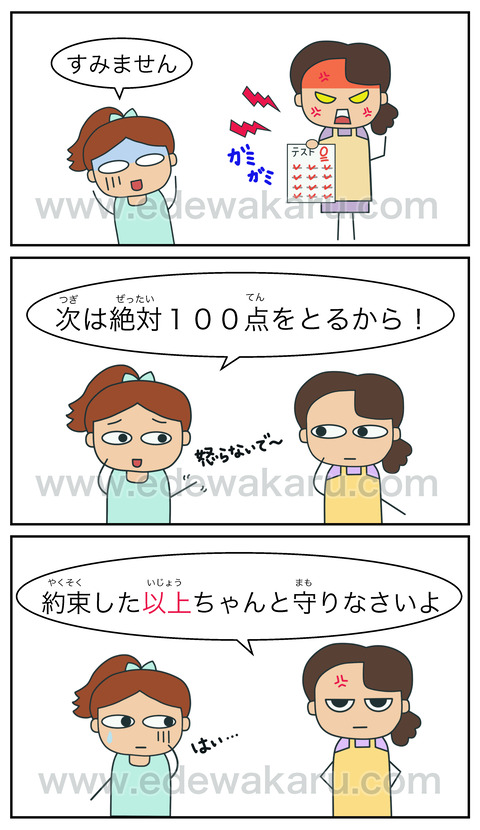
Meaning
because 〜, naturally 〜
because 〜, certainly 〜
How to use it
Verb, adjective, or noun [plain form] + 以上
Explanation
“〜以上” is a sentence pattern meaning “because 〜, naturally 〜” or “because 〜, certainly 〜.” It’s a good idea to learn a few patterns commonly used with it. 😊
[Expressions often used with “〜以上”]
・〜以上〜なければいけない
・〜以上〜べきだ
・〜以上〜つもりだ
・〜以上〜はずだ
・〜以上〜に違いない
etc.
Also, “〜以上” can be said as “〜以上は.”
[Example]
Since you made a promise, you have to keep it properly.
= Since you made a promise, you have to keep it properly.
Learn similar sentence patterns together. 😊
【Related sentence patterns】
In context 4 examples
約束した以上、ちゃんと守りなさいよ!
→約束したんだから、必ず守りなさいよ!Since you made a promise, you have to keep it properly! → Since you made a promise, you have to keep it, no matter what!
N1を受ける以上、しっかり勉強するべきだ
→N1を受けるのだから、当然しっかり勉強するべきだSince you’re taking N1, you should study hard, of course. → Since you’re taking N1, you naturally should study hard.
留学する以上、ペラペラになれるようにしよう
→留学するのだから、必ずペラペラになれるようにしようSince you’re studying abroad, let’s make sure you become fluent. → Since you’re studying abroad, let’s make sure you can become fluent.
やると決めた以上、最後までがんばらなきゃ
→やると決めたのだから、当然最後までがんばらなきゃSince you decided to do it, you have to keep trying until the end. → Since you decided to do it, naturally you have to keep trying until the end.
Read the original source text
Meaning
〜だから、当然〜
〜だから、必ず〜
How to use it
動詞・形容詞・名詞[普通形]+以上
Explanation
「〜以上」は「〜だから、当然〜」「〜だから、必ず〜」という意味を表す文型です。
一緒によく使う文型をいくつか覚えておくといいと思います😊
[「〜以上」と一緒によく使う表現]
・〜以上〜
なければいけない
・〜以上〜
べきだ
・〜以上〜
つもりだ
・〜以上〜
はずだ
・〜以上〜
に違いない
など
また、
「〜以上」は「〜以上は」ということもできます
[例]
約束した
以上、ちゃんと守りなさいよ
=約束した
以上は、ちゃんと守りなさいよ
似ている文型を一緒に覚えておきましょう😊
【関連文型】
日本語文型辞典
Meaning
Indicates a number that includes that number and any greater number.
a. …いじょうのN
Means “something at a higher level than the thing indicated by the noun or verb.” In examples ①–③, something that was the upper limit goes beyond it; in examples ④–⑥, it means that something is at the upper limit and will not go beyond it.
b. …いじょうに
Attaches to a noun or verb and means “more than …” or “to an even greater extent than …, which is already quite considerable.”
a. これいじょう+修飾句+Nは…ない
Usually used with 「これ/それ/あれ」 to indicate that the thing referred to is the greatest in degree: “the most ….”
b. これいじょう…ば
Besides 「これいじょう」, 「それいじょう」 and 「あれいじょう」 are also used; 「と/たら/なら/ても」 may also be used instead of 「ば」. Means “if/even if it were to be at a higher level than the present state.” It often implies “even though the level is already quite high as it is.”
c. これいじょうV-て
Usually attaches to 「これ/それ/あれ」 and means “do … more than at present.” Often followed by expressions such as “what will happen,” “what should we do,” “what should we do about it,” or “what will it become,” to mean “doing that would be pointless; there's nothing to be done.”
d. これいじょう…は+否定的表現
Usually attaches to 「これ/それ/あれ」 and is followed by a negative expression such as “cannot,” “difficult,” “cannot endure,” or “let's stop.” It means that the present state is already at the highest degree and cannot go any further.
Attaches to a verb denoting an action that involves some responsibility or resolve and means “in a situation where one does/has done that.” It is followed by an expression of resolve, recommendation, or obligation to accept the consequences and take responsibility.
a. いじょう(の)+数量詞/N
Used when listing a number of items and then bringing the list to a close.
b. いじょう
Means “that is all that needs to be said” or “the end.” Often used in administrative documents, lists, and similar writing.
How to use it
数量詞+いじょう
いじょう の/に
N/V いじょうのN
N/V いじょうに
これ/それ/あれ いじょう
Vいじょう(は)
いじょう
In context 44 examples
体重が45キロ以上なら献血できる。
You can donate blood if you weigh 45 kilograms or more.
65才以上の人は入場料がただになる。
Admission is free for people aged 65 and over.
夏休みの間に食文化に関する本を3冊以上読んでレポートを書きなさい。
Read at least three books about food culture during summer vacation and write a report.
自分の能力以上の仕事を与えられるのは悪いことではない。
Being given work beyond your ability is not a bad thing.
その薬は期待以上の効果をもたらした。
The medicine produced results that exceeded expectations.
彼はみんなが期待している以上の働きをきっとしてくれる人だ。
He is the kind of person who will surely do more than everyone expects of him.
これ以上のことは今はお話しできません。
I can't tell you anything more than this right now.
落ち込んでいる友達に対して、私には慰めの言葉をかける以上のことは何もしてあげられない。
There's nothing more I can do for my depressed friend than offer words of comfort.
新しく入ったアルバイトの学生は、命令された以上のことをやろうとしないのでほとんど役に立たない。
The new part-time student is almost no help because they won't do anything beyond what they're told.
あの人は噂以上におっちょこちょいだ。
That person is even more scatterbrained than the rumors say.
試験の点は想像以上に悪かった。
The exam score was worse than I imagined.
彼女はタイの人なのに、日本人以上に日本の歴史について詳しい。
Although she is Thai, she knows more about Japanese history than the Japanese do.
そのレストランはみんなが言う以上にサービスも味も申し分なかった。
The restaurant's service and food were beyond reproach, even more so than everyone had said.
彼は思っていた以上に神経が細やかでよく気の付く人だった。
He was more sensitive and attentive than I had thought.
ほかの人が練習する以上にやっているつもりなのに、全然ピアノが上達しないのはどういうわけだろう。
I feel like I'm practicing even more than other people, so why am I making no progress at all on the piano?
これ以上わかりやすいテキストは、今のところない。
There is currently no textbook easier to understand than this one.
あれ以上くだらない映画もめったにない。
There are few movies more pointless than that one.
あの人以上に賢い人は日本中探してもいないだろう。
There probably isn't anyone in all of Japan smarter than that person.
これ以上水かさが増すと大変なことになる。
If the water rises any further, it will become a serious problem.
これ以上雨が降らなければ、畑の作物は全滅するだろう。
If it doesn't rain any more, the crops in the fields will probably be completely wiped out.
それ以上努力してもおそらく何の成果もあがらないと思うよ。
I don't think any results will come of working any harder than that.
あんな忙しい生活をこれ以上続けたら、きっと彼は体をこわしてしまうだろう。
If he continues this busy lifestyle any longer, he'll surely ruin his health.
明日の講演が今日の以上につまらないのなら、行くだけ時間の無駄だ。
If tomorrow's lecture is any more boring than today's, going would just be a waste of time.
今以上にいろいろ工夫して料理を作っても、誰もほめてくれなければつまらない。
It's no fun to put even more thought into cooking than I do now if no one praises me.
それ以上頑張ってどうなると言うのだ。
What do you think you'll accomplish by trying any harder than that?
彼女、あんなに細いのに、あれ以上ダイエットしてどうするんだろう。
She's already so thin; what on earth would she do by dieting any more?
あなた、これ以上お金をためて、いったい何に使おうって言うのよ。
You've saved this much money already; what on earth are you planning to use even more of it for?
お互いこれ以上争うのはやめましょうよ。
Let's stop fighting with each other any more.
もうこれ以上今のような忙しい生活には耐えられない。
I can't endure this busy lifestyle any longer.
さすが田中さんだ。ほかの人にはあれ以上の発明はちょっとできないだろう。
That's Tanaka for you. It's hard to imagine anyone else coming up with an invention better than that one.
雪もひどくなってきたし、もうこれ以上先へ進むのは危険だ。ここであきらめて下山しよう。
The snow is getting heavier, and it's dangerous to go any farther. Let's give up here and head down the mountain.
A:もっと安くなりませんか。
B:もうこれ以上は勘弁してくださいよ。これでももうほとんどうちの方はもうけがないくらいなんですから。A: Can't you make it cheaper? B: Please don't ask me to go any lower. Even at this price, we hardly make any profit.
絶対にできると言ってしまった以上、どんな失敗も許されない。
Now that I've said it's absolutely possible, no failure will be tolerated.
全員一致で選ばれてクラブの部長になる以上、みんなの信頼を裏切るようなことだけはしたくない。
Since I've been unanimously chosen to be club president, I don't want to do anything that would betray everyone's trust.
大学をやめる以上、学歴に頼らないで生きていける力を自分で身につけなければならない。
If I'm going to leave university, I have to develop the ability to make a living without relying on my academic credentials.
こういうことになってしまった以上、私が責任を取って辞めるしか解決策はないだろう。
Now that things have come to this, the only solution is probably for me to take responsibility and resign.
私に通訳がちゃんとつとまるかどうかわかりませんが、お引き受けした以上は精一杯の努力はするつもりです。
I don't know whether I can manage the interpreting properly, but since I've accepted, I intend to do my very best.
田中、木村、山本、吉田、以上の4人はあとで私のところに来なさい。
Tanaka, Kimura, Yamamoto, and Yoshida—you four, come to my office later.
東京、大阪、京都、神戸、福岡、札幌、以上6つの都市が今回の調査対象となります。
Tokyo, Osaka, Kyoto, Kobe, Fukuoka, and Sapporo—these six cities are the subjects of this survey.
自分の長所、短所、自慢できること、今一番関心のあること、将来の夢、以上5点をはっきりさせて自己紹介文を書いてください。
Clearly identify these five points—your strengths, weaknesses, what you are proud of, what interests you most right now, and your dreams for the future—and write a self-introduction.
植物をむやみに採らないこと、火の後始末に気を付けること、トイレはきれいに使うこと、以上のことを必ず守ってキャンプしてください。
When camping, be sure to follow these rules: don't pick plants indiscriminately, make sure fires are properly put out, and keep the toilets clean.
発音はきれいか、言語表現は適切か、内容は興味を感じさせるか、訴えたいことははっきり伝わってくるか、以上のような点がスピーチの審査の時におもにポイントとなる。
The main points considered when judging a speech are whether the pronunciation is clear, the language is appropriate, the content is interesting, and the speaker's message comes across clearly.
作業が終わり次第、必ず報告に来ること。以上。
Be sure to come report as soon as the work is finished. That is all.
次の品物を記念品として贈呈します。置き時計一つ、木製本棚二つ、百科事典全20巻一式。以上です。
The following items will be presented as commemorative gifts: one mantel clock, two wooden bookcases, and one complete set of 20 volumes of an encyclopedia. That is all.
Read the original source text
Meaning
その数を含めてそれより多い数を表す。
a. …いじょうのN
「名詞や動詞が表すものごとより程度の高いものごと」という意味を表す。そのことが上限であったのがそれ以上になるという場合①~③や、そのことが上限なのでそれより上には行かないという場合④~⑥がある。
b. …いじょうに
名詞や動詞に接続して、「…よりもっと」「…もかなりの程度だが、それよりもさらに」という意味を表す。
a. これいじょう+修飾句+Nは…ない
おもに「これ/それ/あれ」に付き、それによって指し示されているものが最も程度が高いという意味を表す。「一番…だ」。
b. これいじょう…ば
「これいじょう」のほかに「それいじょう」「あれいじょう」、または「ば」のかわりに「と/たら/なら/ても」も用いる。「今の状態よりもっと高い程度であったら/であっても」という意味。「今でさえかなり高い程度であるのに」という意味が含まれることが多い。
c. これいじょうV-て
おもに「これ/それ/あれ」に接続し、「今の状態よりもっと…する」という意味を表す。後ろに「どうなるのか/どうするのか/何をするのか/何になるのか」などを伴って、「そんなことをしても無意味だ、しかたがない」という意味を表すことが多い。
d. これいじょう…は+否定的表現
おもに「これ/それ/あれ」に接続し、後ろに「できない/難しい/耐えられない/やめよう」などの否定的内容を表す表現を伴って、今の状態が最高の程度で、それより上の程度に進むことはできないという意味を表す。
なんらかの責任や覚悟を伴う行為を表す動詞に付いて、「それをする/したという状況では」という意味を表す。後ろにはそれに伴う覚悟をし、責任を持たなければならないという決意・勧告・義務などの表現が続く。
a. いじょう(の)+数量詞/N
いくつかの項目を並べあげ、それらを声とめる場合に用いる。
b. いじょう
「これで言うべきことはすべてだ」「終わり」の意味。事務的な書類や目録などの文書で使われることが多い。
How to use it
数量詞+いじょう
いじょう の/に
N/V いじょうのN
N/V いじょうに
これ/それ/あれ いじょう
Vいじょう(は)
いじょう
くらべてわかる日本語表現文型辞典
Meaning
Meaning 1: B expresses a general principle or the speaker’s intention, as in “If A, then naturally B.”
Meaning 2: In the state, status, or position of A, B should naturally be the case; B is to be expected.
Meaning 3: In the form “Aない以上B.” If the state of not-A continues, then the state B continues as well.
How to use it
A以上B (A以上はB / Aない以上B)
Connection 1:
[Verb] 以上
[i-adjective—い / くない] 以上
[na-adjective—な / である / ではない] 以上
[Noun—である / ではない] 以上
Connection 2:
[Verb—る form / ている] 以上
[Noun—である] 以上
Connection 3:
[Verb—ない form] ない以上
Explanation
【Contrast 1】
“AてまえB” (meaning 1, p. 147)
“AうえはB” (meaning 1, p. 39)
“AからにはB” (meaning 1, p. 69)
They can be used in nearly the same way, but the nuances differ. “A以上” is also used to state rules or what is expected in principle, whereas “Aからには” conveys the speaker’s feelings or determination.
○酒を飲んだ以上、運転してはいけない。 — Since you have drunk alcohol, you must not drive.
○酒を飲んだからには、運転はさせられない。 — Since you have drunk alcohol, I can’t let you drive.
【Contrasts 2 and 3】
“AからにはB” (meanings 1 and 2, pp. 69–70)
It can be used in place of “AからにはB,” but “AからにはB” conveys a stronger personal feeling, so it may be inappropriate depending on the person being addressed or the situation.
○お客様、チケットをお持ちでない以上、ご入場していただくわけにはまいりません。 — Customer, since you do not have a ticket, we cannot let you enter.
×お客様、チケットをお持ちでないからには、ご入場していただくわけにはまいりません。 — Customer, since you do not have a ticket using からには, we cannot let you enter.
【Contrasts 1–3】
“AかぎりB” (meaning 1, p. 51)
Notes
【Note 1】
・Whether “る form + 以上” or “た form + 以上” is used depends on whether the speaker makes the decision before or after the action. The following clause expresses a claim or intention, with forms such as “~なければならない” (must), “~当たり前だ” (it is only natural), “~当然だ” (it is only to be expected), “~べきだ” (should), “~つもりだ” (intend to), or “~ようと思う” (plan to).
In context 12 examples
引き受ける以上、責任をもって行うつもりだ。
Since I’m taking this on, I intend to do it responsibly.
留学した以上、言葉だけでなくその国の文化も学ぶつもりだ。
Since I have studied abroad, I intend to learn not only the language but also that country’s culture.
防犯に対する住民の不安が大きい以上、対策が必要だ。
Since residents are very concerned about crime prevention, measures are necessary.
機械が相手である以上、故障は避けられない。
Since we are dealing with a machine, breakdowns are unavoidable.
こんな生活を続けている以上、あなたの病状はよくならないでしょう。
As long as you continue living like this, your condition probably won’t improve.
日本人である以上、正しい日本語が話せるのは当然のことだ。
Since you are Japanese, it is only natural that you can speak correct Japanese.
医者である以上、常に患者の生命を第一に考えなければならない。
As a doctor, you must always put the lives of your patients first.
夫婦である以上、お互いに助け合うべきだ。
Since you are married, you should help each other.
社長の承諾が得られない以上、計画を進めることはできない。
Since we cannot get the president’s approval, we cannot proceed with the plan.
雨が降らない以上、給水制限は仕方のないことだ。
Since it isn’t raining, water restrictions can’t be helped.
大学や専門学校に進学しない以上、学生ビザでは滞在できない。
Since you are not going on to a university or vocational school, you cannot stay on a student visa.
彼のほうから謝ってこない以上、許すつもりはありません。
Unless he apologizes of his own accord, I have no intention of forgiving him.
Read the original source text
Meaning
意味1:Aだったら当然Bと、Bで一般論や話し手の意思を表す。
意味2:Aという状態・身分・立場の場合、当然Bとなるべきだ、はずだ。
意味3:「Aない以上B」の形で。Aない状態が続くのなら、Bの状態も続く。
How to use it
A以上B(A以上はB/Aない以上B)
接続1:
[動詞]以上
[イ形-い/くない]以上
[ナ形-な/である/ではない]以上
[名詞-である/ではない]以上
接続2:
[動詞-る形/ている]以上
[名詞-である]以上
接続3:
[動詞-ない形]ない以上
Explanation
【対比1】
「AてまえB」(意味1 P.147)
「AうえはB」(意味1 P.39)
「AからにはB」(意味1 P.69)
ほぼ言い換え可能だが、ニュアンスは違う。「A以上」は規則や建前を述べるのにも使うのに対し、「Aからには」には話し手の感情や意気込みが感じられる。
○酒を飲んだ以上、運転してはいけない。
○酒を飲んだからには、運転はさせられない。
【対比2,3】
「AからにはB」(意味1,2 P.69,70)
「AからにはB」との置き換えは可能であるが、「AからにはB」は個人的な気持ちが強く感じられるので、相手や場面によっては相応しくない。
○お客様、チケットをお持ちでない以上、ご入場していただくわけにはまいりません。
×お客様、チケットをお持ちでないからには、ご入場していただくわけにはまいりません。
【対比1~3】
「AかぎりB」(意味1 P.51)
Notes
【注意1】
・「ル形以上」か「タ形以上」かは、話し手の決断する前か後かによる。後文は「~なければならない」「~当たり前だ」「~当然だ」「~べきだ」や、「~つもりだ」「~ようと思う」など、主張や意志を表す文。
毎日のんびり日本語教師
How to use it
Noun + である以上(は)
Verb plain form + 以上(は)/上は
Verb ta-form + 上は
i-adjective plain form + 以上(は)
na-adjective plain form + である/な + 以上(は)
Explanation
This pattern expresses the speaker’s strong will, sense of duty, or resolve.
The preceding part describes an event that has already occurred, and the following part states what should be done under that circumstance.
Notes
The 「上」 series
In context 9 examples
本当に好きな以上は仕方ない。
Since I truly love them, there’s nothing I can do about it.
給料を貰ってる以上は一生懸命やるのみ。
Since I’m getting paid, I have to work hard.
選ばれた以上、文句も言っていられない。
Now that I’ve been chosen, I can’t complain.
結局人類が人類である以上差別からは逃れられない。
As long as humanity is human, it ultimately cannot escape discrimination.
FWである以上、まずはゴールを意識しないとダメ。
As a forward, I have to focus on scoring goals first.
試験勉強は一切してないが、会場に来た以上は全力を出そうと思う。
I haven’t studied at all for the exam, but now that I’ve come to the venue, I’m going to do my best.
証拠が無い以上は無罪だと考えるべきだ。
As long as there is no evidence, we should consider them innocent.
タイムマシンが無い以上は、歴史の教科書に書かれている憶測が正しいか確認できない。
Without a time machine, we can’t check whether the speculation written in history textbooks is correct.
この仕事を引き受けた以上は責任をもってやり遂げる。
Now that I’ve taken on this job, I’ll see it through responsibly.
Read the original source text
How to use it
名詞+である以上(は)
動詞普通形+以上(は)/上は
動た形+上は
い形普通形+以上(は)
な形普通形+である/な+以上(は)
Explanation
話者の強い意志や義務感、決意を表す文型です。
前件では既に発生した出来事を述べ、その状況下においてやるべき事柄を後件で述べます。
Notes
「上」シリーズ
NINJAL 日本語文型データベース
Meaning
Used when you want to say that something is naturally the case because of a situation such as “〜.”
How to use it
V plain form + 以上
i-A plain form + 以上
na-A plain form + 以上 (however, “na-Aだ” → “na-Aな+以上・na-Aである+以上”)
N plain form + 以上 (however, “Nだ” → “Nである+以上”)
Notes
“〜” takes a sentence that describes a situation requiring some kind of responsibility or resolve. After “〜以上,” a sentence expressing the speaker’s judgment, resolve, recommendation, or the like follows.
In context 17 examples
内容に問題がある以上、この本を出版することはできない。
Since there are problems with the content, this book cannot be published.
現状では、私生活を犠牲にしなければ管理職に就けない以上、昇進を望まない人が多くいることは責められない。
Given that, under current conditions, one cannot take a managerial position without sacrificing one’s private life, it is understandable that many people do not want a promotion.
どんなに難しい仕事でも、引き受けた以上、完成させなければならない。
No matter how difficult the job, once you have accepted it, you must complete it.
話し始めた以上、途中でやめないで最後まで話してもらいたい。
Now that you have started speaking, I want you to continue to the end without stopping partway through.
予算が厳しい以上、できるだけ経費を削減したいと思っている。
Since the budget is tight, I would like to reduce expenses as much as possible.
医師「手術後の経過がよくない以上、退院を許可することはできませんよ」
Doctor: “Since your recovery after surgery has not been good, I cannot approve your discharge.”
彼の言い分が正しかった以上、疑ったことを謝らなければ。
Since what he said was correct, I have to apologize for doubting him.
投票率が高くなかった以上、選挙結果に民意が正しく反映されているとは言いにくい。
Since voter turnout was not high, it is hard to say that the election results accurately reflect the public’s wishes.
今後も少子高齢化の進行が確実な以上、公的なサービスは縮小せざるを得ないだろう。
Since the progression of the declining birthrate and aging population is certain to continue, public services will probably have to be cut back.
犯罪を犯した証拠が明白である以上、彼が犯人であると考えるほかない。
Since the evidence that he committed a crime is clear, there is no choice but to consider him the culprit.
自分の日常生活で英語が必要でない以上、必死に英語を勉強する必要はないと考える人もいる。
Some people think that if English is not necessary in their everyday lives, there is no need to study it intensively.
取り扱い上の注意喚起が不十分だった以上、今回の事故についてはメーカーの責任が問われるだろう。
Since the warnings about precautions for handling the product were insufficient, the manufacturer will likely be held responsible for this accident.
警備が厳重ではなかった以上、倉庫内に不審者が侵入する可能性は常にあったと言える。
Since security was not tight, it can be said that there was always a possibility of suspicious people entering the warehouse.
会員である以上、会則に従ってもらわないと困ります。
Since you are a member, you must follow the membership rules.
人間は神や仏ではない以上、いつも正しい道を選択できるとは限らない。
Since human beings are neither gods nor Buddhas, they cannot always choose the right path.
教師「最終試験に不合格だった以上、君は卒業できないよ」
Teacher: “Since you failed the final exam, you cannot graduate.”
「誓って真実だ」と言っていたことさえ真実でなかった以上、あなたのことは何も信用できない。
Since even what you said was the truth under oath was not true, I cannot trust anything about you.
Read the original source text
Meaning
〜という状況なので、あることが当然だと言いたいときに使います。
How to use it
V普通形+以上
i-A普通形+以上
na-A普通形+以上(ただし、「na-Aだ」→「na-Aな+以上・na-Aである+以上」)
N普通形+以上(ただし、「Nだ」→「Nである+以上」)
Notes
「〜」には、何らかの責任や覚悟が必要になる状況を表す文がきます。「〜以上」の後には、話し手の判断・決意・勧告などを表す文がきます。
IMABI
以 Adverbial Nouns
Read this IMABI lesson ↗Explanation
以 Adverbial Nouns
This lesson is about a handful of important phrases which start with the character 以. Adverbial nouns can follow other nouns without particles and can easily just be used as adverbs and after the て形.
以外 以内 以降 以後
以前 以来 以上 以下
以遠 以往 以東 以北
以南 以西
以外
1. Attached to a nominal phrase meaning “except”.
1. 九州と四国以外で地震が発生した。
With exception of Kyushu and Shikoku, earthquakes had occurred everywhere.
2. これ以外に方法はありませんよ。
There is no method other than this.
3. 従業員以外の方の入室は{お断ことわりします・禁きんじられています}。
Entrance except for employees is prohibited.
2. 以外の何なにものでもない means “… is entirely…”.
4. 愚痴ぐち以外の何ものでもない。
It is complete stupidity.
5. 好奇心こうきしん以外の何ものでもありませんね。
It’s entirely curiosity isn’t it?
3. ”Apart from”.
6a. 城壁じょうへき以外の地へは踏ふみ込めないなら、大砲たいほうを撃うつがよい。(Bookish)
6b. 城壁以外から踏み込めないなら、大砲を撃つ(の)がよい。(More natural)
If you cannot break in apart from the wall, it would be good to fire the cannon.
以内
The opposite of 以外, 以内 means “inside of/within”.
7a.境界線きょうかいせん以内に止まる。
7b. 境界線の中で止まる。(More natural)
To stop within the boundary line.
8. 二百字以内で纏まとめられるのか。(Harsh)
Can you summarize it within 200 characters?
9. 6時間以内に着くはずです。
It is supposed to arrive within 6 hours.
以降
以降 means “thereafter”.
10. 20世紀以降、日本は新技術において進んでいます。
From the 20th century thereafter, Japan has been advancing in new technology.
11. 面会人は午後10時以降本病院に留まることはできません。
Visitors can not remain in the hospital on and after 10 p.m.
12. 8時以降は店を閉じています。
We will close the shop after 8 o’ clock.
以後
Following after nouns and the て形 of a verb, 以後 means “thereafter/since then”. 以後 is quite objective while 以降 is not. 以後 may also mean “from now on”.
13a. 以後、十分気をつけます。
13b. 以後はもっと注意します。
I’ll be more careful from now on.
14. その店舗は7時{以後は・以降は・から}開店しています。
The shop will be open after 7 o’ clock.
15. 彼女は先々週せんせんしゅう風邪を引いて、以後ずっと寝込んでいます。
She caught a cold two weeks ago and has been in bed ever since.
16. それ以後ずっと
Ever after
17a. 退職以後たいしょくいごは悠々自適ゆうゆうじてき。
17b. 退職後は悠々自適。(More natural)
After retirement is leisure with dignity.
以前
The opposite of 以降, 以前 means “before” or “ago”.
18. 以前どこかであなたに出会ったことがあります。
I believe I’ve seen you somewhere before.
19. 4人とも以前は旧「Enron」に勤めていた。
All four formerly worked at Enron.
20. 以前よりずっとよく見えます。
It looks much better than it was before.
21. 以前ほど魚を食べていない。
We’re eating not as much fish.
22. 俺は以前にもまして勉強しようと決めたのだよ。
I decided to study harder still more than ever before.
以来
以来 means “from/since”. In a slightly old fashioned sense, it may mean “henceforth”. It is used when the situation is continuing action or state since a certain point in time. Other situations are taken care of by ~てから. Also, this phrase is interchangeable with the even more less frequently used ~てこのかた.
23a. 以来君と旅行するのはご免めんだ。(Original from text; old-fashioned)
23b. 今後、君と旅行するのはご免だ。(More natural)
I decline from traveling with you henceforth.
From 漱石そうせき.
24a. 以来、気をつけたまえ。(Old-fashioned)
24b. 以後、気をつけたまえ。(Slightly old-fashioned; Masculine)
From henceforth, be careful.
25. 彼は大学を出て以来会社に勤めています。
He has been working at the company since he left college.
26a. 子供の頃ころ以来知っている。
26b. 子供の頃から知っている。(More natural)
To know since childhood.
27. 佐伯に関しては、このマンションに越して以来、何の音沙汰もなかったから、徐々に緊張が解け始めているが、拳銃のことは、日を追うに連れて祥子の心に重くのしかかってきていた。
In regards to Sahaku, there hadn’t been any news since moving into this apartment, so Sachiko’s tensions gradually began to wind down, but as for the handgun, as she pursued the days, it came to press heavily on her heart.
From 冷たい誘惑 by 乃南アサ.
Word Note: 音沙汰 literally has “sound” and “incident” in it. Although 沙汰 in this case is used to mean “update”, the word is most likely used here to continue a not so favorable tone in regards to 佐伯. Here are some more phrases with 沙汰.
警察沙汰 Police case 取り沙汰 Idle talk 裁判沙汰 Litigation
表沙汰 Creating publicity 色恋沙汰 Love affair 狂気の沙汰 Madness
以上
1. “More than”.
28. このグループには12歳以上の子供が含ふくまれている。
Children twelve and over are included in this group.
29. iPadは400ドル以上する。
The iPad costs 400 dollars and over.
30. 3ヶ月以上大阪に滞在たいざいするつもりだ。
I plan to stay in Osaka for over three months.
31. 予想以上
Beyond expectation
32. 期待以上でした。
It exceeded our hopes.
33. これ以上の面倒めんどうには耐たえられない。
I can’t take it anymore.
2. Above-mentioned; foregoing; herein-before.
34. 以上の説明でご理解を頂いただきたい。
I would like to receive some understanding with the above explanation.
35. 以上は方法を説明したものだ。
The above-mentioned explains how to do it.
3. That is the end; the end; this is all.
36. 以上で私の報告は終わります。
Let me finish my report with this.
37a. 死亡者3千名、行方不明者1万5千名、以上1万8千名。
37b. 死亡者3千名、行方不明者1万5千名、計1万8千名。
Fatalities 3000 people, missing people 15,000 people, and 18,000 people in total.
4. Following the 連体形 of a verb, it means “seeing that”, “over”, or “since”.
38. 前回の売り上げ以上の成績を上げる。
To raise improvements over the previous sales.
39. 昨年以上に売り上げは伸のばせない。
We can’t boost our sales above as they were last year.
40. (私を)信頼できない以上、犬の世話をさせるべきじゃない。
Since you don’t trust me, you should not let me take care of your dog.
以下
以下 means “below(-mentioned)/following”.
41. 以下次号。
To be continued.
42. 結果は以下の通り。
The results are as follows.
43a. 氷点以下となったため、寒さで体温の下がる低体温症で亡くなった方もいました。(Rare)
43b. 氷点下となりましたから、寒さで体温の下がる低体温症で亡くなった方もいました。
Because it has become below freezing, there are those that have died from hypothermia due to loss of body temperature from the cold.
44. 小数点以下を切り捨てる。
To round off the figures below/after the decimal point.
45. 社長以下八名が出席しました。
With the president, eight people in total were present.
以遠 & 以往
以遠 means “beyond” and 以往 means “hereafter/formerly”.
46. この電車は大阪以遠は各駅停車となります。
This train stops at Osaka and all stations beyond.
47a. 終戦以往百年。(Literary; old-fashioned)
47b. 終戦後百年。(Natural)
47c. 終戦以来百年。(Natural)
100 years hereafter the war.
以東、以北、以南、以西
These words, 以東, 以北, 以南, and 以西 mean “east of”, “north of”, “south of”, and “west of” respectively. However, the area is everything below. So, consider that when you use these words.
48. 東京以東
East of Tokyo
49. 東京の東は千葉県です。
To the east of Tokyo is Chiba Prefecture.
50. ミシシッピ川以西はグレート・プレーンズです。
West of the Mississippi River are the Great Plains.
51a. 東京以北には福島第一原発発電所があります。X
51b. 東京の北には福島第一原発発電所があります。〇
51c. 福島第一原発発電所は東京の北です。〇
North of Tokyo is the Fukushima Number One Nuclear Electric Power Plant.
52a. 仙台以南は東京です。X
52b. 仙台の南に東京はあります。〇
52c. 東京は仙台の南です。〇
South of Sendai is Tokyo.
In context 69 examples
九州と四国以外で地震が発生した。
With exception of Kyushu and Shikoku, earthquakes had occurred everywhere.
これ以外に方法はありませんよ。
There is no method other than this.
従業員以外の方の入室は{お断ことわりします・禁きんじられています}。
Entrance except for employees is prohibited.
以外の何なにものでもない means “… is entirely…”.
It is complete stupidity.
愚痴ぐち以外の何ものでもない。
It is complete stupidity.
好奇心こうきしん以外の何ものでもありませんね。
It’s entirely curiosity isn’t it?
城壁じょうへき以外の地へは踏ふみ込めないなら、大砲たいほうを撃うつがよい。(Bookish)
If you cannot break in apart from the wall, it would be good to fire the cannon.
城壁以外から踏み込めないなら、大砲を撃つ(の)がよい。(More natural)
If you cannot break in apart from the wall, it would be good to fire the cannon.
境界線きょうかいせん以内に止まる。
To stop within the boundary line.
境界線の中で止まる。(More natural)
To stop within the boundary line.
二百字以内で纏まとめられるのか。(Harsh)
Can you summarize it within 200 characters?
6時間以内に着くはずです。
It is supposed to arrive within 6 hours.
20世紀以降、日本は新技術において進んでいます。
From the 20th century thereafter, Japan has been advancing in new technology.
面会人は午後10時以降本病院に留まることはできません。
Visitors can not remain in the hospital on and after 10 p.m.
8時以降は店を閉じています。
We will close the shop after 8 o’ clock.
以後、十分気をつけます。
I’ll be more careful from now on.
以後はもっと注意します。
I’ll be more careful from now on.
その店舗は7時{以後は・以降は・から}開店しています。
The shop will be open after 7 o’ clock.
彼女は先々週せんせんしゅう風邪を引いて、以後ずっと寝込んでいます。
She caught a cold two weeks ago and has been in bed ever since.
それ以後ずっと
Ever after
退職以後たいしょくいごは悠々自適ゆうゆうじてき。
After retirement is leisure with dignity.
退職後は悠々自適。(More natural)
After retirement is leisure with dignity.
以前どこかであなたに出会ったことがあります。
I believe I’ve seen you somewhere before.
4人とも以前は旧「Enron」に勤めていた。
All four formerly worked at Enron.
以前よりずっとよく見えます。
It looks much better than it was before.
以前ほど魚を食べていない。
We’re eating not as much fish.
俺は以前にもまして勉強しようと決めたのだよ。
I decided to study harder still more than ever before.
以来君と旅行するのはご免めんだ。(Original from text; old-fashioned)
I decline from traveling with you henceforth.
今後、君と旅行するのはご免だ。(More natural)
I decline from traveling with you henceforth.
以来、気をつけたまえ。(Old-fashioned)
From henceforth, be careful.
以後、気をつけたまえ。(Slightly old-fashioned; Masculine)
From henceforth, be careful.
彼は大学を出て以来会社に勤めています。
He has been working at the company since he left college.
子供の頃ころ以来知っている。
To know since childhood.
子供の頃から知っている。(More natural)
To know since childhood.
佐伯に関しては、このマンションに越して以来、何の音沙汰もなかったから、徐々に緊張が解け始めているが、拳銃のことは、日を追うに連れて祥子の心に重くのしかかってきていた。
In regards to Sahaku, there hadn’t been any news since moving into this apartment, so Sachiko’s tensions gradually began to wind down, but as for the handgun, as she pursued the days, it came to press heavily on her heart.
このグループには12歳以上の子供が含ふくまれている。
Children twelve and over are included in this group.
iPadは400ドル以上する。
The iPad costs 400 dollars and over.
3ヶ月以上大阪に滞在たいざいするつもりだ。
I plan to stay in Osaka for over three months.
予想以上
Beyond expectation
期待以上でした。
It exceeded our hopes.
これ以上の面倒めんどうには耐たえられない。
I can’t take it anymore.
以上の説明でご理解を頂いただきたい。
I would like to receive some understanding with the above explanation.
以上は方法を説明したものだ。
The above-mentioned explains how to do it.
以上で私の報告は終わります。
Let me finish my report with this.
死亡者3千名、行方不明者1万5千名、以上1万8千名。
Fatalities 3000 people, missing people 15,000 people, and 18,000 people in total.
死亡者3千名、行方不明者1万5千名、計1万8千名。
Fatalities 3000 people, missing people 15,000 people, and 18,000 people in total.
Following the 連体形 of a verb, it means “seeing that”, “over”, or “since”.
To raise improvements over the previous sales.
前回の売り上げ以上の成績を上げる。
To raise improvements over the previous sales.
昨年以上に売り上げは伸のばせない。
We can’t boost our sales above as they were last year.
(私を)信頼できない以上、犬の世話をさせるべきじゃない。
Since you don’t trust me, you should not let me take care of your dog.
以下次号。
To be continued.
結果は以下の通り。
The results are as follows.
氷点以下となったため、寒さで体温の下がる低体温症で亡くなった方もいました。(Rare)
Because it has become below freezing, there are those that have died from hypothermia due to loss of body temperature from the cold.
氷点下となりましたから、寒さで体温の下がる低体温症で亡くなった方もいました。
Because it has become below freezing, there are those that have died from hypothermia due to loss of body temperature from the cold.
小数点以下を切り捨てる。
To round off the figures below/after the decimal point.
社長以下八名が出席しました。
With the president, eight people in total were present.
この電車は大阪以遠は各駅停車となります。
This train stops at Osaka and all stations beyond.
終戦以往百年。(Literary; old-fashioned)
100 years hereafter the war.
終戦後百年。(Natural)
100 years hereafter the war.
終戦以来百年。(Natural)
100 years hereafter the war.
東京以東
East of Tokyo
東京の東は千葉県です。
To the east of Tokyo is Chiba Prefecture.
ミシシッピ川以西はグレート・プレーンズです。
West of the Mississippi River are the Great Plains.
東京以北には福島第一原発発電所があります。X
North of Tokyo is the Fukushima Number One Nuclear Electric Power Plant.
東京の北には福島第一原発発電所があります。〇
North of Tokyo is the Fukushima Number One Nuclear Electric Power Plant.
福島第一原発発電所は東京の北です。〇
North of Tokyo is the Fukushima Number One Nuclear Electric Power Plant.
仙台以南は東京です。X
South of Sendai is Tokyo.
仙台の南に東京はあります。〇
South of Sendai is Tokyo.
東京は仙台の南です。〇
South of Sendai is Tokyo.
Bunpro Grammar Reference
Usage 1
Meaning
More than (or equal to), Over・(and) above, Any more・Greater, Exceeding
How to use it
Noun + Amount + 以上
それ(1) + 以上
(1) これ、あれ
Nuance
A phrase which expresses that (A) is the minimum amount, for which something is greater than or exceeds.
Explanation
In order to mark something as 'equal to, or more than (A)', 以上 will be used. This is simply a combination of the kanji 以 which means 'by means of', and 上 'above'. This expression may also be translated as 'greater than (A)', or 'exceeding (A)'.
To use 以上, attach it to the amount that you want to highlight as the 'minimum' amount.
七十歳以上の人は運転をしない方がいい。
It would be better if people over the age of 70 didn't drive.
コンサートには500人以上のファンが集まった。
More than 500 fans gathered at the concert.
以上 is also regularly used as a statement that translates roughly as 'the end', or 'that's it', and is a very common way to say that something has finished.
え~っと、ビッグマックのセットとクォーターパウンダーの単品とナゲットの30ピースを下さい。以上です。
Uhhh, Can I have a Big Mac meal, a quarter pounder, and 30 nuggets? That's all.
Although saying 'the end' would sound a bit rude in English in this situation, it is completely natural in Japanese, and literally means 'the above (list of things I said) is all'.
In context 15 examples
- その時に100人以上も参加した。
At that time, more than 100 people attended.
- コンサートには500人以上のファンが集まった。
More than 500 fans gathered at the concert.
- え~っと、ビッグマックのセットとクォーターパウンダーの単品とナゲットの30ピースを下さい。以上です。
Uhhh, Can I have a Big Mac meal, a quarter pounder, and 30 nuggets? That's all.
- 七十歳以上の人は運転をしない方がいい。
It would be better if people over the age of 70 didn't drive.
- 六歳以上。
Ages 6 and over. (and older)
- これ以上はもう聞きたくない。
I don't want to listen to this any more (than this).
- これ以上運動をしたくない。
I don't want to exercise more than this.
- それ以上私のお金を使わないで。
Please don't use any more of my money over that amount.
- それ以上運ぶのは、腰に悪いよ。
Carrying any more than that, it's bad for your back.
- これ以上走れません。吐きそうです。
I can't run any more than this, I might puke.
- 去年300日以上トレーニングが出来た。
Last year, I worked out more than 300 days.
- カタカナを全部覚えたけど、二週間以上かかりました。
I memorized all of the katakana, but it took over two weeks. (more than)
- 明日までに漢字100個以上覚えなくてはならない。
I have to memorize over 100 kanji by tomorrow. (more than)
- 普通は1日に50人以上がこのホテルに泊まる。
Usually over 50 people stay at this hotel a day. (more than)
- 私の誕生日パーティーに20人以上の友達が来た。
More than 20 friends came to my birthday party.
Read the original source text
Meaning
More than (or equal to), Over・(and) above, Any more・Greater, Exceeding
How to use it
Noun + Amount + 以上
それ(1) + 以上
(1) これ、あれ
Nuance
A phrase which expresses that (A) is the minimum amount, for which something is greater than or exceeds.
Explanation
In order to mark something as 'equal to, or more than (A)', 以上 will be used. This is simply a combination of the kanji 以 which means 'by means of', and 上 'above'. This expression may also be translated as 'greater than (A)', or 'exceeding (A)'.
To use 以上, attach it to the amount that you want to highlight as the 'minimum' amount.
七十歳以上の人は運転をしない方がいい。
It would be better if people over the age of 70 didn't drive.
コンサートには500人以上のファンが集まった。
More than 500 fans gathered at the concert.
以上 is also regularly used as a statement that translates roughly as 'the end', or 'that's it', and is a very common way to say that something has finished.
え~っと、ビッグマックのセットとクォーターパウンダーの単品とナゲットの30ピースを下さい。以上です。
Uhhh, Can I have a Big Mac meal, a quarter pounder, and 30 nuggets? That's all.
Although saying 'the end' would sound a bit rude in English in this situation, it is completely natural in Japanese, and literally means 'the above (list of things I said) is all'.
Nuance · 日本語
(A)が最低限で、それより大きい、又はそれを超えることを表現するフレーズ。
Usage 2
Meaning
Since, Now that, As long as, If
How to use it
Verb + 以上(は)
[い]Adjective + 以上(は)
[な]Adjective + である + 以上(は)
Noun + である + 以上(は)
Nuance
A formal expression stating that upon or above the situation of (A), (B) must or should be considered.
Explanation
When combined with the adverbial particle は, 以上 is frequently translated as 'since (A), (B)', 'now that (A), (B)', or 'as long as (A), (B)'. This is a formal structure that is rarely found in daily speech.
This construction may be used with verbs and い-Adjectives in their standard forms, and な-Adjectives or nouns followed by である以上は.
猫を飼うと決めた以上は、最後まで責任を持って育てないといけないと思います。
Now that I have decided to keep a cat, I think that I have the responsibility to raise it until the end.
体調が悪い以上は、会社に来ないでください。
As long as you are sick, please don't come into work.
有名である以上は、テレビではもちろん、SNSでも発言に気をつけなければいけません。
As long as you are famous, you will have to watch what you say, not only on television, but also on social networks.
この地域の住民である以上は、この地域のルールをしっかりと守ってもらわないと困ります。
As long as you are a resident of this community, we need you to properly follow the rules of this community.
As with many other grammar points, the particle is often dropped, leaving 以上 by itself.
キャプテンに選ばれた以上、結果を残すために精一杯頑張ります!
Now that I have been chosen as captain, I will do my best to achieve results!
どんなに気を付けていても、人間である以上、ミスは防げないよ。
No matter how careful you are, as long as you're human, you can't avoid making mistakes.
Due to である以上は often presenting something which is being acted upon, the (B) part of sentences that include this grammar structure will frequently include the resolutions or intentions of the speaker, and can be thought of as either obvious or necessary once considering (A). This usually appears in the form of べきだ, つもりだ, はずだ, たい, ほうがいい, and similar patterns.
Fun-fact
Despite the standard translations, the literal meaning of 'above and beyond (A), (B)' is also a good way to remember this grammar pattern, as it basically highlights that anything 'past', 'beyond', or 'above' (A) is what needs to be considered.
In context 18 examples
- 試験を受ける以上、休むことはできない。
As long as I am taking the exam, I can't rest.
- 体調が悪い以上は、会社に来ないでください。
As long as you are sick, please don't come into work.
- 猫を飼うと決めた以上は、最後まで責任を持って育てないといけないと思います。
Now that I have decided to keep a cat, I think that I have the responsibility to raise it until the end.
- この地域の住民である以上は、この地域のルールをしっかりと守ってもらわないと困ります。
As long as you are a resident of this community, we need you to properly follow the rules of this community.
- 有名である以上は、テレビではもちろん、SNSでも発言に気をつけなければいけません。
As long as you are famous, you will have to watch what you say, not only on television, but also on social networks.
- キャプテンに選ばれた以上、結果を残すために精一杯頑張ります!
Now that I have been chosen as captain, I will do my best to achieve results!
- どんなに気を付けていても、人間である以上、ミスは防げないよ。
No matter how careful you are, as long as you're human, you can't avoid making mistakes.
- 親である以上は子育てを頑張るべきだ。
Since you are a parent, you should do your best to raise your child.
- 日本に来た以上、真剣に日本語の勉強をしたいと思います。
Now that I have come to Japan, I think I want to study Japanese seriously.
- 都心に住んでいる以上、渋滞は避けられない。
Now that I am living in the city center, I can't avoid the traffic.
- この条件で引き受けた以上、文句は言えない。
Now that I have agreed to these terms, I can't complain.
- この日程で作業する以上、残業するしかありません。
Now that I am working this schedule, I have no choice but to do overtime.
- 反対が過半数である以上、この案は考え直すしかない。
Now that the opposition is the majority, there is no choice but to rethink this plan.
- うちの会社に入社した以上は、ちゃんとした仕事をしてもらわないと困ります。
Now that you have joined our company, there will be trouble if we don't receive adequate work from you.
- 芸能人である以上、謝罪会見を開くしかない。
Now that he is an entertainer, he has no choice but to hold an apology interview.
- 勝手に分解した以上、ちゃんと元に戻す責任がある。
Now that I have arbitrarily taken it apart, I have the responsibility to put it back together properly.
- 一定の結果を出していない以上、あなたを解任するしかありません。
Now that you aren't showing consistent results, we have no choice but to dismiss you.
- これだけの実力がある以上、期待されるのは当然のことです。
Now that I have this much ability, it is only natural that others would expect more from me.