AIUEO JLPT Grammar
Meaning
「〜づらい」 connects to the masu-stem of verbs to describe actions that are difficult or inconvenient to perform, either physically or psychologically.
How to use it
Verb masu-form + づらい
In context 5 examples
この靴は歩きづらい。
These shoes are hard to walk in.
彼女には本当のことを言いづらいです。
It’s hard to tell her the truth.
このペンは書きづらい。
This pen is difficult to write with.
彼の話は信じづらい。
It’s hard to believe what he says.
風が強くて、外は歩きづらかった。
It’s hard to walk outside because of the strong wind.
Read the original source text
Meaning
「〜づらい」 connects to the masu-stem of verbs to describe actions that are difficult or inconvenient to perform, either physically or psychologically.
How to use it
動詞ます形+づらい
Explanation · 日本語
「〜づらい」は、動詞ます形に接続して、ある行動をすることが難しい、またはしにくいことを表す形容詞です。物理的・心理的に難しさや不便さを感じる場合に使われます。
文法
Meaning
〜is difficult to do
How to use it
V (ます-form) + づらい
Notes
It has a meaning similar to 「〜にくい」, but because it comes from the kanji 「~辛い」, it is used when something feels like a mental or physical burden. Therefore, you cannot use verbs associated with natural phenomena, as in the following example.
Example: この紙袋、丈夫で破れづらいよ。
In context 6 examples
このハンバーガー、大きすぎるし、形が崩れやすいし、食べづらいね。
This hamburger is too big, its shape falls apart easily, and it's hard to eat.
12月で会社を辞めようと思っているんだけど、何だか言いづらいなぁ。
I'm thinking of quitting my job in December, but somehow it's hard to bring it up.
昨日買った靴、デザインは気に入ってるんだけど、ちょっと歩きづらいのがね・・・。
I like the design of the shoes I bought yesterday, but they're a little hard to walk in...
最近のスマホって、いろんな機能がついていて、僕には使いづらいなぁ。
Smartphones these days have all kinds of features, so they're hard for me to use.
新聞の文字って小さいから読みづらいよ。
The print in newspapers is small, so it's hard to read.
さっき始まったセールの影響で、ウェブサイトにアクセスしづらくなってる。
Because of the sale that started a little while ago, it's become hard to access the website.
Read the original source text
Meaning
〜するのが難しい
How to use it
V(ます形)+ づらい
Notes
「〜にくい」と似た意味を持つが、「~辛い」という漢字から来ていることから「精神的、肉体的に負担に思う」という時に使う。よって、以下のように自然現象と関連する動詞を使うことはできない。
例:この紙袋、丈夫で破れづらいよ。
Bunpro Grammar Reference
Meaning
Hard to, Tough to, Painful to, Difficult to
How to use it
Verb[stem]+ づらい
Nuance
A suffix used to indicate that something is difficult or tough to do due to psychological, emotional, or physical reasons.
Explanation
Like にくい, づらい is an い-Adjective that attaches to the ます stem of verbs to express that something is 'difficult to do'. The main difference is that づらい expresses a psychological, emotional, or physical burden on the person performing the action. It carries a nuance of 'unbearable' or 'painful to do'.
まだ完全に治ってないから、歩きづらい。
I haven't fully recovered yet, so it is hard to walk.
この車のハンドルは重いから、運転しづらい。
The steering wheel of this car is heavy, so it is hard to drive.
Fun Fact
づらい comes from the い-adjective 辛い 'painful', or 'tough'. This reflects how a verb used with づらい will be painful or uncomfortable for the person performing it.
職場の人たちと仲が悪いから、ちょっと辛い。
I don't get along with the people at work, so it is a little tough.
In context 18 examples
- カップが小さいので、飲みづらいです。
The cup is small, so it's tough to drink from.
- 答えづらい事を聞かれた。
I was asked something that was tough to answer.
- タピオカが大きすぎて吸いづらい。
The tapioca is too big so it's tough to suck.
- 彼氏:「ちょっと聞きづらいんだけど・・・。」
彼女:「うん。なに?」Boyfriend: 'It's a little tough to ask, but...' Girlfriend: 'Yeah? What is it?'
- その結果になるとは考えづらいな。
It's tough to think that would be the result.
- 昨日学校を休んだから、行きづらい。
I was absent from school yesterday, so it's tough to go (today).
- 母:「ケーキが可愛すぎて、ろうそくを刺しづらいわ。」
娘:「ほんとに!」Mom: 'The cake is too cute, so it's tough to stick the candles in.' Daughter: 'I know!'
- ユリ:「シンヤと付き合ったよ!」
アキ:「私も好きだったから、喜びづらいよ。」Yuri: I'm going out with Shinya!' Aki: 'I liked him too, so it's tough to be happy for you.'
- この服は着づらい。
These clothes are tough to wear.
- 道が狭くて走りづらい。
The road is narrow and tough to run on.
- 後ろの席からは見えづらい。
It's tough to see from the back seat.
- 歯が痛くて喋りづらいです。
My tooth hurts so it's tough to talk.
- 日本語は、単語が多くて覚えづらい。
Japanese has a lot of words so it's tough to memorize.
- 言いづらいことも、何でも話せる関係です。
We have a relationship where we can talk about anything, even things that are tough to say.
- 妹:「あのスニーカーまだ乾いてないの?」
姉:「そう。乾きづらいのよね。」Younger sister: 'That sneaker isn't dry yet?' Older sister: 'Yeah. It's tough to dry.'
- 職場の人たちと仲が悪いから、ちょっと辛い。
I don't get along with the people at work, so it is a little tough.
- まだ完全に治ってないから、歩きづらい。
I haven't fully recovered yet, so it is hard to walk.
- この車のハンドルは重いから、運転しづらい。
The steering wheel of this car is heavy, so it is hard to drive.
Read the original source text
Meaning
Hard to, Tough to, Painful to, Difficult to
How to use it
Verb[stem]+ づらい
Nuance
A suffix used to indicate that something is difficult or tough to do due to psychological, emotional, or physical reasons.
Explanation
Like にくい, づらい is an い-Adjective that attaches to the ます stem of verbs to express that something is 'difficult to do'. The main difference is that づらい expresses a psychological, emotional, or physical burden on the person performing the action. It carries a nuance of 'unbearable' or 'painful to do'.
まだ完全に治ってないから、歩きづらい。
I haven't fully recovered yet, so it is hard to walk.
この車のハンドルは重いから、運転しづらい。
The steering wheel of this car is heavy, so it is hard to drive.
Fun Fact
づらい comes from the い-adjective 辛い 'painful', or 'tough'. This reflects how a verb used with づらい will be painful or uncomfortable for the person performing it.
職場の人たちと仲が悪いから、ちょっと辛い。
I don't get along with the people at work, so it is a little tough.
Nuance · 日本語
心理的、感情的、物理的理由で何かをするのが難しいことを指す際に使われる接尾辞。
絵でわかる日本語
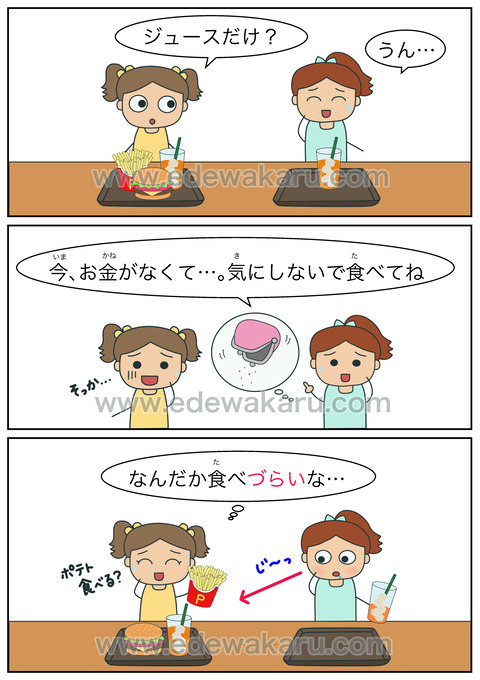
Meaning
(For psychological or physical reasons) it is difficult to ~
How to use it
Verb [ます-form] + づらい
Explanation
“〜づらい” is a sentence pattern meaning “it is difficult to ~.” It often carries the sense that there is a [psychological or physical reason] making it difficult to do something, as in “it is difficult to ~ for psychological reasons” or “it is difficult to ~ for physical reasons.”
[Examples]
なんだか食べ
づらい
な…
[Psychological reason]
Because my friend isn’t eating.
目が悪くなったので、小さい字が読み
づらい
[Physical reason]
My eyesight has gotten worse.
新しいスマホは大きすぎて使い
づらい
[Physical reason]
My hands are small.
The smartphone feels heavy.
スイーツが苦手だって言い
づらい
な…
[Psychological reason]
Because she made them with so much effort.
手が痛いので、字が書き
づらい
[Physical reason]
My hand hurts.
Since “〜づらい” means “it is difficult to do ~,” take care that it can only be used with [volitional verbs]. 😨 When you want to describe the property of something, as in “it does not easily become ~,” use “〜にくい.” 😉
(Review: 〜にくい)
[Examples]
⭕️小さい字が読み
づらい
→“読む” is a volitional verb.
❌このメガネは壊れ
づらい
⭕️このメガネは壊れ
にくい
→“壊れる” is a non-volitional verb.
“〜づらい” is one of the patterns you don’t get many chances to study, but it is often used. In most cases it is written in hiragana, but remember that its kanji spelling is “〜辛い.” 😀
In context 5 examples
なんだか食べづらいな…(復習:なんだか)
Somehow, it’s hard to eat… (Review: なんだか)
目が悪くなったので、小さい字が読みづらい
Because my eyesight has gotten worse, it’s hard to read small print.
新しいスマホは大きすぎて使いづらい
The new smartphone is too big and hard to use.
彼女がケーキをくれたけど、スイーツが苦手だって言いづらいな…(復習:「スイーツ」と「デザート」)(復習:〜って(引用))
She gave me a cake, but it’s hard to tell her that I don’t like sweets… (Review: “スイーツ” and “デザート”) (Review: 〜って (quotation))
手が痛いので、字が書きづらい
My hand hurts, so it’s hard to write.
Read the original source text
Meaning
(心理的・肉体的理由で)〜するのが難しい
How to use it
動詞[ます形]+づらい
Explanation
「〜づらい」は「〜するのが難しい」という意味を表す文型です。この文型は「心理的理由(しんりてきりゆう)があって〜するのが難しい」「肉体的理由(にくたいてきりゆう)で〜するのが難しい」というように【心理的・肉体的なこと】が原因となっているという意味が入る場合が多いです。
[例]
なんだか食べ
づらい
な…
【心理的理由】
友達は食べていないから
目が悪くなったので、小さい字が読み
づらい
【肉体的理由】
目が悪くなった
新しいスマホは大きすぎて使い
づらい
【肉体的理由】
自分の手が小さい
スマホが重いと感じる
スイーツが苦手だって言い
づらい
な…
【心理的理由】
彼女が一生懸命(いっしょうけんめい)作ってくれたから
手が痛いので、字が書き
づらい
【肉体的理由】
手が痛い
「〜づらい」は「〜するのが難しい」という意味ですから【意志動詞】にしか使うことができませんので注意しましょう😨
「簡単に〜の状態にならない」というように、物の性質を表したい時は「〜にくい」を使いましょう
😉
(復習:〜にくい)
[例]
⭕️小さい字が読み
づらい
→「読む」は意志動詞
❌このメガネは壊れ
づらい
⭕️このメガネは壊れ
にくい
→「壊れる」は無意志動詞
「〜づらい」は勉強する機会があまりない文型の1つですが、よく使われます。ほとんどの場合、ひらがなで書かれますが、漢字で書くと
「〜辛い」
と書くと覚えておきましょう😀
NINJAL 日本語文型データベース
Meaning
Expresses the feeling that doing 〜 is difficult and troublesome.
How to use it
Notes
It is often used with verbs expressing conscious actions, such as 「歩く・話す」 (walk, speak).
It changes form like an i-adjective, as in 「〜づらくない・〜づらかった・〜づらくて」.
In context 5 examples
買ったばかりの靴のサイズが合わなくて、歩きづらい。
The shoes I just bought don’t fit, so they’re hard to walk in.
バイトを辞めることを仲間には話しづらい。
It’s hard to tell my coworkers that I’m quitting my part-time job.
学生「先生、ここからは黒板の字が見えづらいです」
Student: “Teacher, it’s hard to see the writing on the blackboard from here.”
「この教科書、分かりづらくない?」「うん、文字ばかりで理解しにくいよね」
“Isn’t this textbook hard to understand?” “Yeah, it’s hard to get because it’s all text, isn’t it?”
現代は情報化社会だ。パソコンが苦手な人間には、生きづらい世の中だ。
We live in an information society today. It’s a hard world to live in for people who aren’t good with computers.
Read the original source text
Meaning
~するのが難しくて困るという気持ちを表します。
How to use it
Notes
「歩く・話す」など意識的な行為を表す動詞に使うことが多いです。
「〜づらくない・〜づらかった・〜づらくて」などのように、イ形容詞と同じ形に変化します。
IMABI
Difficult II: ~がたい & ~づらい
Read this IMABI lesson ↗Explanation
Difficult II: ~がたい & ~づらい
In this second installation on how to express difficulty, we will be looking at two additional supplementary adjectival endings which attach to the 連用形 of verbs. These endings are ~がたい and ~づらい. Both are synonymous with ~にくい but have their own specialized nuances. Despite their role of expressing difficulty, neither of these endings are particularly hard to grasp.
~がたい
The ending ~がたい attaches to the 連用形 to a semantically restricted set of verbs to indicate an action that is difficult not because of lack of ability but out of some sort of strong emotional hindrance. It is most frequently used with verbs related to acceptance belief, thought, and understanding.
~がたい is most appropriate in 書き言葉, or in a tone that is similar in nature. It is also used more so in set phrases, which was hinted by how it’s semantically restricted to only some verbs.
When written in kanji, it shares the same kanji as ~にくい. However, because ~にくい is overwhelmingly written in kana, whenever you do see ~難い, it is usually read as がたい unless the use of ~にくい would be more natural.
Verb Class +がたい
一段 Verbs 避けがたい
五段 Verbs 許しがたい
する しがたい
Etymology Note: This ending derives from the Classical Japanese adjective 難(かた)し. This ending is also responsible for the creation of ありがとう. In fact, ありがたい literally means “difficult to have,” and from that meaning the sense of “to be welcome” came about.
1. 今回の話すらも本当かどうか信じがたい。
It’s even hard to believe whether or not this current talk (of his) is true or not.
2. オレオレ詐欺は息子に成り済まして老人からお金を奪う許しがたい犯罪だ。
Phone scams involving making someone believe that they’re that person’s son is an inexcusable crime which steals money from the elderly.
3. 自分がOLであるという現状は耐え難い屈辱だ。
My current state as an OL is an unbearable disgrace.
4. 意見が分かれることは民主的な話し合いをしていれば避けがたいことだ。
When having a democratic discussion, having opinions become divided is unavoidable.
5. その光景は筆舌に尽くしがたいほど凄惨なものだった。
The scene was gruesome beyond description.
6. 2011年3月11日に東日本大震災という想像しがたい災害が起こりました。
On March 11, 2011, the Great East Japan Earthquake, a disaster hard to even believe, occurred.
7. 自衛隊のイラクへの派遣の違憲性を認めた判決は、改憲を目論む自民党にとっては認めがたい判決であろうが、 現「平和憲法」があればこその判決であると、思います。
The verdict that recognized the unconstitutionality of the Defense Force’s deployment to Iraq may very well be a verdict that’s hard to accept from the Liberal Democratic Party, whose aim is to revise the constitution, but I believe that such a verdict is all thanks to the current “constitution of peace” that we have today.
8. これは誰がどう考えても納得しがたい解釈じゃないか。
This interpretation is something that no one would ever accept no matter how you look at it.
9. 銭湯には捨てがたい魅力がある。
Public baths have a charm that’s hard to get rid of.
10. 彼は、叱れば実際に自分の言動を反省するという得がたい人材だ。
He’s the kind of hard-to-come-by human resource who actually reflects on his behavior when you reprimand him.
~づらい
Seldom written in kanji as ~辛い, ~づらい indicates an action that is emotionally straining to go about doing. The degree of “emotional strain” can vary from agony to just being burdensome. Although it can be used to express personal physical difficulty, it always places emphasis on the emotional burden that comes along with said struggle.
For comparison, 言いにくい, 言いがたい, 言いづらい are each possible, but the ‘difficult’ situation they describe are not the same. In the case of 言いにくい, the speaker is most likely referring to a situation that’s hard to pinpoint. 言いがたい, on the other hand, is a situation that the speaker has a strong urge not to discuss. 言いづらい, is similar to 言いがたい, but implies that the topic is rather painful for them to mention.
Unlike ~がたい, so long as the act being described can be conceptualized in a way that it is ‘difficult’ to the speaker or agent in an emotional way, using ~づらい can still be grammatical. However, if the verb purely describes physical difficulty, it is just as ungrammatical to use ~づらい as it would be to use ~がたい. For instance, 滑りづらい is not correct. To say, “hard to slide on,” you would need to say 滑りにくい.
In recent years, however, a decent percentage of speakers have been using ~づらい in a broader sense that makes it sound like a more refined alternative to ~にくい. As to whether the grammatical limitations of past generations will hold as an effect of this speech register restructuring, only time will tell.
Orthography Note: It is generally accepted that ~ずらい is an improper spelling of this ending and should be avoided in formal writing.
Verb Class 連用形+づらい
一段 Verbs 見づらい
五段 Verbs死にづらい
する しづらい
来る 来(き)づらい
Etymology Note: The reason for why ~づらい describes mental woe is because it derives from the adjective 辛(つら)い, which itself describes situations that are emotionally trying.
11. お前が葬儀に来なかったのは多分来づらかったからだろうと思っていた。
I had thought that the reason why you didn’t come to the funeral was probably because coming was too hard for you to handle.
12. なんか好きなんだけどちょっと話しづらくて…
I sort of like (him), but it’s a little tough to talk about it……
13. 相手に悪気はないのはわかるんだけど、感情の起伏が激しすぎて、一緒に仕事がやりづらい。
I know that the person doesn’t mean anything negative about it, but their emotional ups-and-downs are too extreme, and it’s hard to work together with them.
14. 相続のたびにお金とられるんじゃ、死にづらくてたまんねーよな。
You just can’t help being anxious about dying when your money is gonna be taken during inheritance.
15. 昨日買った長靴だけど、ちょっと歩きづらいよ。
So, about these high boots that I bought yesterday, they’re a bit tough to walk in.
16. ここのハンバーガーだが、本当においしいんだけど、大きすぎるし、形が崩れやすいし、食べづらいよね。
The burgers here are really delicious, but they’re too big and fall apart easily, and are hard to eat, huh.
17. また緊急事態宣言が出て、生活しづらくなるもんね。
It’ll be hard to make a livelihood now that another state of emergency is being declared.
18. 「いまび」はUIがスマホに対応しておらず、使いづらい。
“IMABI” is difficult to use because its UI is not optimized for smart phones.
19. いつから日本はこんなに生きづらくなったのか。
Since when did Japan become so difficult to live in like this?
20. あまり一般的でない言い回しなので、伝わりづらいかもしれません。
Since it’s not a common expression, it might be hard for its meaning to get across properly.
Sentence Note: Although Ex. 20 does not describe mental woes, the speaker is trying to explain how the text they’re proofreading may cause readers to rack their brains too much to understand. This, though, in a way, is a form of strain.
In context 20 examples
今回の話すらも本当かどうか信じがたい。
It’s even hard to believe whether or not this current talk (of his) is true or not.
オレオレ詐欺は息子に成り済まして老人からお金を奪う許しがたい犯罪だ。
Phone scams involving making someone believe that they’re that person’s son is an inexcusable crime which steals money from the elderly.
自分がOLであるという現状は耐え難い屈辱だ。
My current state as an OL is an unbearable disgrace.
意見が分かれることは民主的な話し合いをしていれば避けがたいことだ。
When having a democratic discussion, having opinions become divided is unavoidable.
その光景は筆舌に尽くしがたいほど凄惨なものだった。
The scene was gruesome beyond description.
2011年3月11日に東日本大震災という想像しがたい災害が起こりました。
On March 11, 2011, the Great East Japan Earthquake, a disaster hard to even believe, occurred.
自衛隊のイラクへの派遣の違憲性を認めた判決は、改憲を目論む自民党にとっては認めがたい判決であろうが、 現「平和憲法」があればこその判決であると、思います。
The verdict that recognized the unconstitutionality of the Defense Force’s deployment to Iraq may very well be a verdict that’s hard to accept from the Liberal Democratic Party, whose aim is to revise the constitution, but I believe that such a verdict is all thanks to the current “constitution of peace” that we have today.
これは誰がどう考えても納得しがたい解釈じゃないか。
This interpretation is something that no one would ever accept no matter how you look at it.
銭湯には捨てがたい魅力がある。
Public baths have a charm that’s hard to get rid of.
彼は、叱れば実際に自分の言動を反省するという得がたい人材だ。
He’s the kind of hard-to-come-by human resource who actually reflects on his behavior when you reprimand him.
お前が葬儀に来なかったのは多分来づらかったからだろうと思っていた。
I had thought that the reason why you didn’t come to the funeral was probably because coming was too hard for you to handle.
なんか好きなんだけどちょっと話しづらくて…
I sort of like (him), but it’s a little tough to talk about it……
相手に悪気はないのはわかるんだけど、感情の起伏が激しすぎて、一緒に仕事がやりづらい。
I know that the person doesn’t mean anything negative about it, but their emotional ups-and-downs are too extreme, and it’s hard to work together with them.
相続のたびにお金とられるんじゃ、死にづらくてたまんねーよな。
You just can’t help being anxious about dying when your money is gonna be taken during inheritance.
昨日買った長靴だけど、ちょっと歩きづらいよ。
So, about these high boots that I bought yesterday, they’re a bit tough to walk in.
ここのハンバーガーだが、本当においしいんだけど、大きすぎるし、形が崩れやすいし、食べづらいよね。
The burgers here are really delicious, but they’re too big and fall apart easily, and are hard to eat, huh.
また緊急事態宣言が出て、生活しづらくなるもんね。
It’ll be hard to make a livelihood now that another state of emergency is being declared.
「いまび」はUIがスマホに対応しておらず、使いづらい。
“IMABI” is difficult to use because its UI is not optimized for smart phones.
いつから日本はこんなに生きづらくなったのか。
Since when did Japan become so difficult to live in like this?
あまり一般的でない言い回しなので、伝わりづらいかもしれません。
Since it’s not a common expression, it might be hard for its meaning to get across properly.