AIUEO JLPT Grammar
Usage 1
Meaning
「ては」is used with the verb’s te-form and has three main uses:1.Condition: It indicates that when a certain action or situation is fulfilled, a result will occur.2.Repetition: It indicates that the same action or situation will happen repeatedly.3.Evaluation: It is used to express evaluations or impressions about an action or situation.
How to use it
Verb て-form + ては
In context 5 examples
こんなに雨が降っては、外出できない。
If it rains this much, we can’t go out.
彼は本を読んではメモを取っている。
He keeps reading books and taking notes.
そんなに食べては太るよ。
If you eat that much, you’ll gain weight.
こんなに遅くまで起きていては、体に悪いよ。
If you stay up this late, it’s bad for your health.
子どもは不安で母親を呼んでは泣き、呼んでは泣きを繰り返した。
The child was anxious and kept calling out to his mother, crying, and calling out again and again.
Read the original source text
Meaning
「ては」is used with the verb’s te-form and has three main uses:1.Condition: It indicates that when a certain action or situation is fulfilled, a result will occur.2.Repetition: It indicates that the same action or situation will happen repeatedly.3.Evaluation: It is used to express evaluations or impressions about an action or situation.
How to use it
動詞て形+ては
Explanation · 日本語
「ては」は、動詞て形に接続して使われ、主な用法には以下の三つがあります:1.条件:ある行動や状況が成立すると、それに伴って結果が生じることを示します。2.繰り返し:同じ動作や状況が繰り返されることを表します。3.評価:ある行動や状況についての評価や感想を述べるときに使われます。
Usage 2
Meaning
This sentence pattern describes repeated actions or events, emphasizing situations where two actions or occurrences alternate repeatedly.
How to use it
Verb te form ては + verb te form ては
In context 5 examples
読んでは忘れ、読んでは忘れ、全然覚えられない。
I keep reading and forgetting, reading and forgetting, and can’t remember anything.
食べては寝て、食べては寝て、すっかり太ってしまった。
I keep eating and sleeping, eating and sleeping, and now I’ve gotten fat.
書いては消し、書いては消し、結局何も進まなかった。
I kept writing and erasing, writing and erasing, and in the end, made no progress.
彼は買っては捨て、物を大切にしない。
He keeps buying and throwing away, never valuing anything.
飲んでは食べ、飲んでは食べ、お腹がいっぱいだ。
I drink and eat, eat and drink, and now I'm full.
Read the original source text
Meaning
This sentence pattern describes repeated actions or events, emphasizing situations where two actions or occurrences alternate repeatedly.
How to use it
動詞て形ては+動詞て形ては
Explanation · 日本語
この文型は、ある行動や出来事が繰り返されることを表す表現で、二つの動作や出来事が交互に何度も繰り返されることを強調する場合に使われます。
Bunpro Grammar Reference
Usage 1
Meaning
If, With, Since, Because
How to use it
Verb[て]+ は(1)
[い]Adjective[て]+ は
[な]Adjective + では(2)
Noun + では(2)
(1) Verb[て̶] + ちゃ
(2) じゃ
Nuance
A casual, hypothetical phrase showing that if the negatively evaluated (A) happens or exists, the negative (B) will also happen.
Explanation
When the particles て and は are combined, they form a regular composite structure that is used primarily to highlight repeating actions, or to make assessments or judgments about potential situations. In this grammar structure, we will be looking at the nuance that is used with potential situations. This may be interpreted simply as 'if (A), (B)', 'when (A), (B)', or 'because of (A), (B)'.
At times when used as 'if', ては will generally express some sort of negative expectation or comment.
Depending on what ては appears after, では may be used instead. This is the case when following nouns, な-Adjectives, or verbs that require で to be used instead of て when conjugating.
そのように力を入れて回してはネジがだめになってしまいますよ。
If you turn it with such force, you're going to ruin the screw.
そんなに長くては鞄に入らないので、半分に折ってください。
It won't fit in my bag if it's that long, so please fold it in half.
私は掃除が苦手なので、そんな几帳面では私と住むことはできないでしょう。
I don't like cleaning, so if you are that well-organized, you probably won't be able to live with me. (You probably won't enjoy living with me)
そんな貧乏くさい格好ではあのレストランには入れないよ。
If you have such a poor-looking outfit, they won't let you into that restaurant.
As with many other structures that use ては or では, it will often be shortened to じゃ or ちゃ.
リーダーがあの人じゃ嫌です。どうしてもあの人じゃないといけないなら私を別のチームに入れてください。
If that person is the leader, screw that. If there is really no other way than making that person the leader, then please put me on a different team.
ご飯を全部食べなくちゃ大きくなれないよ。
If you don't eat all your food, you won't grow.
In context 18 examples
- 無理に引っぱっては壊れてしまいますよ!
If you pull it forcibly, it will break!
- そんなに長くては鞄に入らないので、半分に折ってください。
It won't fit in my bag if it's that long, so please fold it in half.
- そのように力を入れて回してはネジがだめになってしまいますよ。
If you turn it with such force, you're going to ruin the screw.
- ご飯を全部食べなくちゃ大きくなれないよ。
If you don't eat all your food, you won't grow.
- 私は掃除が苦手なので、そんな几帳面では私と住むことはできないでしょう。
I don't like cleaning, so if you are that well-organized, you probably won't be able to live with me. (You probably won't enjoy living with me)
- そんな貧乏くさい格好ではあのレストランには入れないよ。
If you have such a poor-looking outfit, they won't let you into that restaurant.
- リーダーがあの人じゃ嫌です。どうしてもあの人じゃないといけないなら私を別のチームに入れてください。
If that person is the leader, screw that. If there is really no other way than making that person the leader, then please put me on a different team.
- 寝る前にそんなコーヒーを飲んでは寝られない。
If you drink coffee before going to bed, you won't be able to sleep a wink.
- こんなに塩辛くては売り物にならないよ。
If it is this salty, it will not sell.
- そんな服装ではあの店には入れてもらえないよ。
With those clothes, you won't be able to enter that shop.
- そのような給与では、あの工場で働くには無理がある。
It is not worth working in that factory if that is what you will be paid.
- ピザのパン生地がどろどろになるよ、水があまりに多くては。。。
The pizza dough will get all gooey if there is too much water…
- 今シーズンの結果次第では、引退もあると思いますよ。
With this season's results, I think that (he) will retire.
- このような間違いを何回もしていては、夏休みの課題はやりきれない。
If you continue to make mistakes like these, you won't be able to finish the summer assignment.
- あの先生じゃ、無理。去年、生徒全員が試験に落ちたんだ。
If it is that teacher, it will be impossible. Last year all the students failed the exam.
- ガソリンがこんなに高くては、車で通勤できないだろうね。自転車などを使うしかない。
If gasoline is expensive, I won't be able to come to work by car. I will have to use a bike or something.
- ポーランドの悪天候のため、オウムを解放しては、必ず死んでしまうでしょう。
As a consequence of the poor Polish climate, if you set a parrot free, it would certainly die.
- そのような振る舞いでは、周囲はあなたを「馬鹿な人」と評価し、誰もあなたに対して真面目に相手をしないでしょう。
With behavior like that, you will be labeled a fool by those around you and no one will treat you seriously.
Usage 2
Meaning
Repeating action, If, Since
How to use it
Verb[て](A) + は + Verb[て](B) + は
Verb[て](A) + は + Verb[て](A) + は
Nuance
A hypothetical structure indicating that the general repetition of (A) and (B) will lead to (C). May highlight either positive or negative results.
Explanation
Another structure making use of the combined て and は particles is ては~ては. This grammar pattern highlights that the actions of (A) and (B) are continuously being repeated and can be interpreted as 'doing (A) and (B) repeatedly'. The (A) and (B) actions will often be things that contrast each other in some respect, such as starting and stopping, walking and running, going forwards and then backwards, etc.
ては~ては will be used with verbs in the て-form, so will occasionally appear as では.
ここ最近は食べては寝て、食べては寝ての繰り返しだから太ってきた。
Recently I've been eating and sleeping, eating and sleeping, so I've gained some weight.
仕事ではミスしては怒られ、怒られてはミスをする。毎日この繰り返しだから仕事を辞めようと思う。
At work, I make a mistake and get yelled at, get yelled at and make a mistake. This repeats every day so I'm thinking of quitting my job.
The abbreviated versions of ちゃ and じゃ may also be seen with the grammar point, but it may be considered unnatural if the same abbreviation is not used both times. This is mainly due to the level of formality being required to stay the same within sentences.
運動しないで食っちゃ寝食っちゃ寝ばかりしていると牛になるよ!
If you eat and sleep, eat and sleep without exercising, you are going to turn into a cow!
薬を飲んじゃ吐いて、飲んじゃ吐いてを何回も繰り返したから喉が痛い。
My throat hurts because I've taken medicine and thrown up, then taken it and thrown up over and over.
Caution
ては may sometimes appear only once, without any change to the meaning of repetition. This is usually when there is some indication in the rest of the sentence that the action is something that is being repeated over and over.
5キロを休憩なしで走れるようになるには、疲れるまで1キロ走っては休憩しての繰り返しを1ヶ月間毎日続けることが必要です。
To be able to run 5 kilometers without taking a break, you need to run for a kilometer, then take a break, and repeat that process everyday for a month.
In context 17 examples
- 田舎者:「働いては寝て、働いては寝てばかりだ。このような人生はダメだ。」
Countryman: 'I only work and sleep, work and sleep (repeatedly)… This is not the good life.'
- ここ最近は食べては寝て、食べては寝ての繰り返しだから太ってきた。
Recently I've been eating and sleeping, eating and sleeping, so I've gained some weight.
- 仕事ではミスしては怒られ、怒られてはミスをする。毎日この繰り返しだから仕事を辞めようと思う。
At work, I make a mistake and get yelled at, get yelled at and make a mistake. This repeats every day so I'm thinking of quitting my job.
- 運動しないで食っちゃ寝食っちゃ寝ばかりしていると牛になるよ!
If you eat and sleep, eat and sleep without exercising, you are going to turn into a cow!
- 薬を飲んじゃ吐いて、飲んじゃ吐いてを何回も繰り返したから喉が痛い。
My throat hurts because I've taken medicine and thrown up, then taken it and thrown up over and over.
- あくびをしてはフリスクを食べ、あくびをしてはフリスクを食べ、何とか起きていられた。
By yawning and eating a mint, yawning and eating a mint, I was somehow able to wake up.
- 曖昧なことを言ってははぐらかし、嘘をついては逃げようとし、あの人はどうしようもない。
That person is a lost cause, saying ambiguous things and lying and trying to run.
- 酒を飲んでは暴れ、暴れては物を壊す。彼は酒癖が悪い。
Drinking alcohol and acting violently, raging and breaking things. He is a bad drunk.
- 受け取っては誰かに渡し、渡されては受け取るというだけの仕事です。
The job is just taking stuff and handing it off to others, taking and handing off.
- 威張っては人を見下し、怒鳴っては人を脅すという最低の上司だ。
Being proud and looking down on people, screaming at and threatening people. (He) is what you call a horrible boss.
- 最近、インターネット接続が悪い。接続しては切断して、接続しては、切断して。(を繰り返すことは)イライラさせられる。
Recently, my internet connection is terrible. It connects and disconnects, connects and disconnects (repeatedly)… It is driving me nuts.
- ある研究によると、一番の勉強方法は20〜40分勉強しては休憩してを繰り返すことです。
According to some research, the best way to learn is to study for about 20-40 minutes, rest and repeat.
- データを圧縮しては送信し、圧縮しては送信しを繰り返し、やっとすべて送れました。
After compressing and sending, compressing and sending, I was finally able to send it all.
- 嫌がられてはやり方を変え、嫌がられてはやり方を変え、を繰り返して人との付き合い方を学ぶ。
Being disliked, changing your methods, being disliked and changing your methods over and over you learn how to get along with people.
- 歩いては走り、走っては歩き、(を繰り返すことは)、ジョギングしてみたいけれど体力に不安な人にとって、いいトレーニング方法です。
Walking and running, running and walking (repeatedly) is a great method of training for people who want to try jogging, but are worried about endurance.
- 納得のいく写真が撮れず、写しては消し、写しては消しを繰り返している。
Without taking a photo I am pleased with, I repeatedly take a photo, erase it, take another and erase it.
- 5キロを休憩なしで走れるようになるには、疲れるまで1キロ走っては休憩しての繰り返しを1ヶ月間毎日続けることが必要です。
To be able to run 5 kilometers without taking a break, you need to run for a kilometer, then take a break, and repeat that process everyday for a month.
DoJG 日本語文法辞典(全集)
Meaning
If; when; because
How to use it
(i) Verb | ては | |
| 食べては | When/if one eats; to eat |
(ii) Adjective(い/な) | ては | |
| 大きくては | When/if something/someone is big |
| 不便では | When/if something is inconvenient |
(iii) Noun | では | |
| 病気では(頼めない) | If someone is ill (I can’t ask him to do something) |
| あの先生では(話にならない) | That teacher (would be out of the question) |
Explanation
A conjunction which presents an action/state as a topic about which a negative comment is given.
In context 10 examples
そんなに勉強しては、体を壊しますよ。
If you study that hard, you will ruin your health.
こんなに寒くては外出できません。
We cannot go out in this cold weather (literally: when it is this cold).
仕事がそんなに嫌いでは困りますね。
It's too bad that you hate your work that much.
そんなに遊んでいては、試験に失敗しますよ。
If you are fooling around like that, you will fail the examination.
あの男が来ては邪魔になる。
If he comes he will get in our way.
こんなに働かされては、病気になってしまうよ。
If I'm forced to work like this, I will end up by becoming ill.
こんなに部屋が汚くては、お客さんが見えた時に恥ずかしい。
Because the room is messy like this, I feel ashamed when I have a guest.
人が皆個人主義的では、国はやっていけない。
If everybody is individualistic, a country cannot get along well.
こんなに忙しくては、新聞も読めない。
When one is this busy, one cannot read even the newspaper.
あんな女性がデートの相手では、彼は小さくなっているだろう。
If a woman like her is his date, he must feel intimidated.
どんなときどう使う 日本語表現文型辞典
Meaning
alternately did…and…
How to use it
Vては
Explanation
何度も~して、~して
「VてはV」の形で二つの動作を繰り返し行う様子を表す。 ❸ の「VてはV、VてはV」のように2回繰り返して反復性を強調する使い方もある。 ❹ の「ちゃ」は口語。
In pattern VてはV, two actions are performed alternately. Also has usage of Vては V, Vては V to emphasize repetitiveness by stating action twice, as in sentence ❸ . Phrase ちゃ in sentence ❹ is colloquial.
In context 4 examples
夫はさっきから味を見てはなべの中をかき回している。どんな料理ができるのだろうか。
My husband has been tasting the food and stirring the pot for a while now. I wonder what kind of dish he’ll make.
正月は食べては寝、飲んでは寝の日を過ごしていた。
During New Year’s, I spent my days eating and sleeping, drinking and sleeping.
山田さんはパソコンのキーボードをたたいては考え、たたいては考えています。
Mr. Yamada keeps tapping at the computer keyboard, then thinking, then tapping and thinking again.
石田さんは報告書を課長に出しちゃ直されてるよ。
Ishida submits the report to the section chief, only to have it corrected.
Read the original source text
Meaning
alternately did…and…
How to use it
Vては
Explanation
何度も~して、~して
「VてはV」の形で二つの動作を繰り返し行う様子を表す。 ❸ の「VてはV、VてはV」のように2回繰り返して反復性を強調する使い方もある。 ❹ の「ちゃ」は口語。
In pattern VてはV, two actions are performed alternately. Also has usage of Vては V, Vては V to emphasize repetitiveness by stating action twice, as in sentence ❸ . Phrase ちゃ in sentence ❹ is colloquial.
絵でわかる日本語
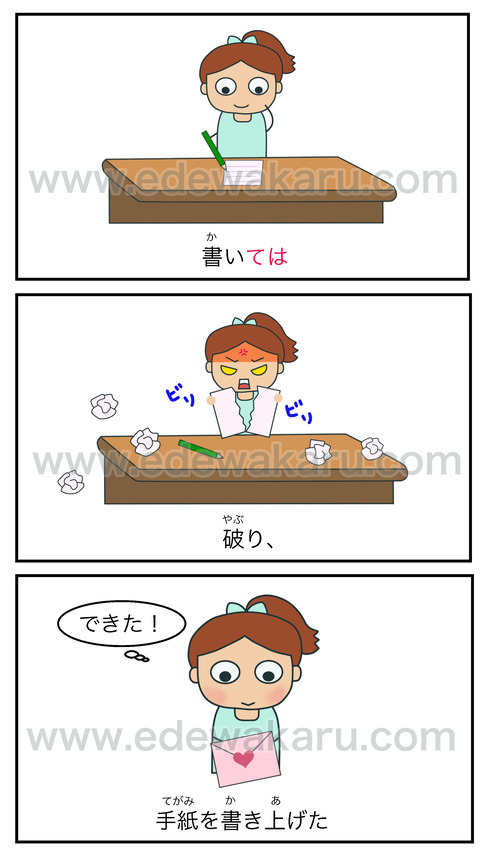
Meaning
Expresses repeated actions.
How to use it
Verb [て-form] + は〜
Explanation
“〜ては〜” is a sentence pattern that expresses repeated actions. As in examples ① and ②, it can express something that was simply repeated, or, as in example ③, something that is repeated habitually. 😊 Also, when you want to emphasize that an action is repeated many times, you can repeat the form twice as “〜ては〜、〜ては〜.” 😀
[Example]
書い
ては
破り、書い
ては
破り手紙を書き上げた
You can also replace the verb in the second instance. 😮
[Example]
書い
ては
破り、破っ
ては
書いて手紙を書き上げた
This is a pattern you don’t get many chances to study, so be sure to learn it well. 😉
In context 3 examples
書いては破り、手紙を書き上げた
→書いて破ってを繰り返し、手紙を書き上げたI wrote and tore it up over and over, then finished the letter. →I repeated writing and tearing it up, and finished the letter.
連休中(れんきゅうちゅう)は食べては寝ていたので太ってしまった
→連休中は食べて寝てを繰り返していたので太ってしまったDuring the long holiday, I kept eating and sleeping, so I gained weight. →I kept alternating between eating and sleeping during the long holiday, so I gained weight.
彼は飲んではケンカする
→彼は飲んだらいつもケンカするHe drinks and then gets into fights. →Whenever he drinks, he gets into fights.
Read the original source text
Meaning
動作の反復を表す
How to use it
動詞[て形]+は〜
Explanation
「〜ては〜」は繰り返して行われる動作を表す文型です。例文①②のように、
ただ繰り返されたことを表す場合
や例文③のように
習慣的に繰り返されることを表す場合
もあります😊また、動作が何度も繰り返されることを強調したい場合は「〜ては〜、〜ては〜」と2回繰り返す形も使用されます😀
[例]
書い
ては
破り、書い
ては
破り手紙を書き上げた
また、
2回目の動詞を入れ替えて使うこともできます
😮
[例]
書い
ては
破り、破っ
ては
書いて手紙を書き上げた
勉強する機会が少ない文型ですのでしっかりと覚えておきましょう😉
日本語文型辞典
Meaning
Basic information: N/Na では, A-くては, V-ては. This is formed by combining the predicate’s te-form with “は.” With nouns and na-adjectives, it follows the te-form of “だ” as “では,” though “であっては” is also sometimes used in written language. In spoken language it often becomes “ちゃ” or “じゃ.”
When followed at the end of the sentence by an expression of negative evaluation, it means that the condition indicated by “...ては” would lead to an undesirable result. It is often used to say that the situation should be avoided.
a. ...ては
Usually followed by an expression with negative content, meaning that this condition is a problem or that one must not do such a thing.
b. V-ていては
An expression often used for advice. It points out a bad aspect of the other person and tells them to change their behavior.
c. Vのでは
“のでは” follows a verb and means “in such a situation.” The latter part states what would result from such a situation or the speaker’s impression. In spoken language, “Vんでは” and “Vんじゃ” are often used.
d. V-る/V-ない ようでは
Used with negative expressions such as “困る,” “いけない,” and “無理だ,” it means “it would be a problem if things are like this.” It is often used to criticize or blame someone. Depending on the context, it can also be used to scold the listener directly.
⇾ようだ24
Follows a verb and expresses the repeated occurrence of an action or phenomenon.
a. V-てはV
Expresses an action repeated after a certain interval. ⑤ is accompanied by “たものだ” and recalls an action repeated in the past.
b. V-てはV, V-てはV
Two verbs are used twice in the same order to express repeated actions or phenomena. As in ④, the order may also be reversed, in the form “V1てはV2、V2てはV1.”
How to use it
...ては【condition】
V-ては【repetition】
In context 26 examples
この仕事に時給500円では人がみつかりません。
At 500 yen an hour, we won’t find anyone for this job.
先方の態度がそんなにあやふやでは将来が心配だ。
If the other party’s attitude is so vague, I’m worried about the future.
コーチがそんなにきびしくては、だれもついてきませんよ。
If the coach is that strict, no one will follow you.
そんなに大きな声を出しては魚が逃げてしまう。
If you make that much noise, the fish will get away.
そのことを彼女に言ってはかわいそうだ。
It would be cruel to tell her that.
そんなにテレビばかり見ていては目が悪くなってしまうよ。
If you keep watching nothing but TV like that, you’ll ruin your eyes.
そんなにたばこばかり吸っていては、体に障りますよ。
If you keep smoking so much, it’ll harm your health.
そんなに先生に頼っていては、進歩しませんよ。
If you keep relying on the teacher like that, you won’t make any progress.
そんなに遠くから通勤していらっしゃるのでは大変ですね。
It must be tough commuting from so far away.
年間200万円もかかるのではとてもその大学には行けない。
If it costs as much as two million yen a year, there’s no way I can attend that university.
A:山下さん子供が5人いるんですって。
B:5人もいるのでは、毎日大騒ぎだろうな。A: I hear Ms. Yamashita has five children. B: With that many, it must be chaos every day.
そんなふうに頭ごなしに否定されたのでは議論にならないじゃないですか。
If you just flatly reject it like that, we can’t have a discussion, can we?
最初の日から、仕事に遅刻するようでは困る。
It would be a problem if you were late for work from the very first day.
この程度の練習にまいるようでは、もうやめたほうがいい。
If this level of practice wears you out, you’d better quit.
そんなささいなことで傷ついて泣くようではこれから先が思いやられる。
If you get hurt and cry over such a trivial thing, I dread what lies ahead.
こんな簡単な文書も書けないようでは、店長の仕事はつとまらない。
If you can’t even write a simple document like this, you won’t be able to do a store manager’s job.
こんな短い距離も歩けないようでは夏の登山はとても無理だ。
If you can’t even walk this short distance, a summer mountain hike is out of the question.
家計が苦しいので、母はお金の計算をしてはため息をついている。
Money is tight, so my mother keeps calculating the household expenses and sighing.
子供は二、三歩歩いては立ち止まって、母親の来るのを待っている。
The child walks two or three steps, then stops, waiting for their mother to come.
その女性は誰かを待っているらしく、1ページ読んでは顔をあげて窓の外を見ている。
The woman seems to be waiting for someone; she reads a page, then looks up and gazes out the window.
一行書いては考え込むので、執筆はなかなかはかどらない。
He writes one line and then gets lost in thought, so the writing is making little progress.
学生の頃は、小説を読んでは仲間と議論したものだ。
When I was a student, I used to read novels and discuss them with my friends.
害いては消し、書いては消し、やっと手紙を書き上げた。
I wrote and erased, wrote and erased, and finally finished the letter.
作ってはこわし、作ってはこわし、を何度もやりなおして、ようやく満足できるつぽができあがった。
After making it and breaking it, over and over again, I finally completed a pot I was satisfied with.
降ってはやみ、降ってはやみの天気が続いている。
The on-and-off rain has continued.
食べては寝、寝ては食べるという生活をしている。
I live a life of eating and sleeping, sleeping and eating.
Read the original source text
Meaning
基本情報N/Na ではA-くてはV-ては説明述語のテ形と「は」の組合わさったもの。名詞、ナ形容詞の場合は「だ」のテ形を受けて「では」となるが、書きことばでは「であっては」が使われることもある。話しことばでは「ちゃ」「じゃ」となろことが多い。
文末にマイナス評価の内容を表す表現を伴って、「…ては」で示された条件のもとでは望ましくない結果となるという意味を表す。その事態を避けるべきだということが言いたい場合に使うことが多い。
a. …ては
普通、否定的な内容を表す表現が続き、この条件では困るとか、このようなことをしてはいけないという意味を表す。
b. V-ていては
忠告によく使われる表現。相手の悪い点を取り上げて、態度をあらためるように言うときに使う。
c. Vのでは
動詞に「のでは」が続き、「そのような状況では」という意味を表す。後半には、そのような状況から起こることがらや話し手の感想が述べられる。話しことばでは、「Vんでは」「Vんじゃ」が使われることが多い。
d. V-る/V-ない ようでは
「困る」「いけない」「無理だ」のような否定的な意味の表現とともに使って、「こんな様子では困る」という意味を表す。人を批判したり非難したりする場合に用いることが多い。文脈によっては、相手を直接叱責するのにも使う。
⇾ようだ24
動詞を受けて、動作、現象が繰り返し起こることを表す。
a. V-てはV
一定の時間をおいて繰り返される動作を表す。⑤は「たものだ」を伴し)、過去に反復された行為についての回想を表す。
b. V-てはV、V-てはV
二つの動詞が同じ順序で2回繰り返されて使われ、動作や現象が反復して起こることを表す。④のように、前後が入れ代わり「VlてはV2、V2てはVl」の形が使われることもある。
How to use it
…ては【条件】
V-ては【反復】
日本語文型辞典 英語版
Meaning
【ては】[N/Na では][A-くては][V-ては]A combination of the te-form of a predicate plus は. When used with nouns or na-adjectives, it takes the te-form of だ and becomes では, but in written language であっては can also be used. In spoken language, this form is often reduced to ちゃ or じゃ.
a. ...ては
Generally followed by a negative comment. Indicates that a certain condition is problematic or should be avoided.
b. V-ていては
Expresses a warning or piece of advice. Used to point out a problem someone has and to encourage a different course of action.
c. Vのでは
B:5人もいるのでは、毎日大騒ぎだろうな。
With five children, it’s probably bedlam every day!
When のでは follows a verb, the meaning is “with that sort of situation.” The last part of the sentence then states the outcome of such a situation, or the speaker’s reaction or opinion. In spoken language, Vんでは and Vんじゃ are often used.
d. V-る/V-ない ようでは
Used with expressions that convey a negative meaning, such as 困る (troublesome), いけない (wrong), and 無理だ (impossible). Means “this sort of situation is problematic.” Often used to disparage or criticize another person. In some contexts, may be used to scold or reprove someone directly.
→
4
a. V-てはV
Expresses an action repeated after a certain time. In
(5)
, it is used together with たものだ and expresses the recollection of a formerly repeated action.
b. V-てはV、V-てはV
Two verbs are used twice in the same order to indicate that an action or phenomenon is repeated. As in
(4)
, the order may be switched to create the form V1-てはV2、V2-てはV1.
How to use it
1. ...ては〈condition〉Accompanied at the end of the sentence by an expression conveying some kind of negative evaluation. Means that the condition indicated by ...ては will result in an undesirable outcome. Often used when recommending that such an outcome be avoided.
2. V-ては〈repetition〉Attaches to a verb and expresses repetition of an action or phenomenon.
In context 26 examples
この仕事に時給 500 円では人がみつかりません。
You won’t find anyone to do this job for 500 yen an hour.
先方の態度がそんなにあやふやでは将来が心配だ。
That kind of shilly-shallying attitude on their part really makes me worried about the future.
コーチがそんなにきびしくては、だれもついてきませんよ。
If the coach is that strict, no one will go along with him.
そんなに大きな声を出しては魚が逃げてしまう。
That loud a voice will scare all the fish away.
そのことを彼女に言ってはかわいそうだ。
Telling her that would be really mean.
そんなにテレビばかり見ていては目が悪くなってしまうよ。
Watching that much TV will hurt your eyesight.
そんなにたばこばかり吸っていては、体に障りますよ。
That kind of constant smoking will ruin your health.
そんなに先生に頼っていては、進歩しませんよ。
You’ll never make any progress if you just depend on your teacher all the time.
そんなに遠くから通勤していらっしゃるのでは大変ですね。
It must be hard for you to commute from so far away.
年間 200 万円もかかるのではとてもその大学には行けない。
If it costs two million yen a year, you certainly can’t go to that university.
A:山下さん子供が5人いるんですって。
I heard Yamashita-san has five children.
そんなふうに頭ごなしに否定されたのでは議論にならないじゃないですか。
With that kind of flat-out rejection, the discussion doesn’t go anywhere, does it.
最初の日から、仕事に遅刻するようでは困る。
His coming to work late from the very first day is a real problem for us.
この程度の練習に参るようでは、もうやめたほうがいい。
If just this much practice is too much for you, you’d better quit.
そんなささいなことで傷ついて泣くようではこれから先が思いやられる。
If such a little thing hurt her and made her cry, what’s going to happen in the future?
こんな簡単な文書も書けないようでは、店長の仕事はつとまらない。
He’s not fit to be shop manager if he can’t write something this easy.
こんな短い距離も歩けないようでは夏の登山はとても無理だ。
If he can’t walk that short a distance, then the summer mountain-climbing trip is completely out of the question.
家計が苦しいので、母はお金の計算をしてはため息をついている。
Funds were severely limited, and Mother let out sigh after sigh as she worked on the household budget.
子供は二、三歩歩いては立ち止まって、母親の来るのを待っている。
The little child stopped every two or three steps and waited for her mother.
その女性は誰かを待っているらしく、1ページ読んでは顔をあげて窓の外を見ている。
The woman reading the book appears to be waiting for someone, and she lifts her head every page or so to look out the window.
一行書いては考え込むので、執筆はなかなかはかどらない。
He pauses to think after every line, so his writing is making little progress.
学生の頃は、小説を読んでは仲間と議論したものだ。
When I was a student, I used to read novels and then discuss them with my friends.
書いては消し、書いては消し、やっと手紙を書き上げた。
After countless writings and erasures, he finally finished the letter.
作ってはこわし、作ってはこわし、を何度もやりなおして、ようやく満足できるつぼができあがった。
Again and again he made it, only to break it and start over, and at last he completed the pot to his satisfaction.
降ってはやみ、降ってはやみの天気が続いている。
The weather continues with rain off and on.
食べては寝、寝ては食べるという生活をしている。
His life is nothing but eating and sleeping, sleeping and eating.
IMABI
~ては
Read this IMABI lesson ↗Explanation
~ては
In this lesson, we will learn about the grammar point ~ては, which is a combination of the conjunctive particle て and the bound particle は, used here in its contrastive role. Firstly, as a very brief reminder, below is a quick summation of how to conjugate with ~ては. Because this grammar pattern only concerns verbs, we’ll only need to worry about when~ては may become ~では. This occurs for Godan verbs which end in ぐ・ぶ・む・ぬ.
Ichidan Verb 食べる + ては → 食べては
Godan Verb 立つ + ては →
死ぬ + ては → 立っては
死んでは
する する + ては → しては
くる くる + ては → きては
だ だ + ては → では
Curriculum Note: This lesson does not cover how the contrastive は can go after the gerund use of the particle て as seen in phrases like ~について, ~に関して, ~に対して, etc. This is to be discussed later in IMABI.
The Usages of ~ては
Usage 1: Trouble Causing Hypotheticals
The first usage of ~ては we will look at is how it is used to express situations that bring about anxiety, misgivings, uneasiness, fear, and/or inconvenience.
1. 学校がっこうの体育たいいくの運動うんどうで喘息発作ぜんそくほっさが出でては困こまります。
I’m troubled with asthma attacks happening due to exercise at school in gymnastics.
2. 老人ろうじんに見みられては困こまります。
I’m embarrassed when I’m looked at by old people.
3. 誤解ごかいがあっては困こまりますので。
Since it’d be worrisome if there is a misunderstanding.
4. 傷きずが残のこっては大変たいへんだ。
Things will be difficult if there are any wounds/nicks.
5. 鹿しかにやられては元もとも子こもないので、森林しんりんの周囲しゅういを電気柵でんきさくで囲かこっています。
Since it’d all be for naught if it were ruined by deer, we have the surroundings of the forest enclosed in an electric fence.
~ては(いけない・ならない・だめ)
We have actually already learned about this usage of ~ては when we learned about “must” and “must not” conditional phrases. As review, we will go over the basic combinations for these conditional phrases once more.
【Must Not】
・~てはいけない: This is used to tell someone he/she mustn’t do something. It isn’t simply used just to forcibly prohibit things. It could simply imply that the act in question is not favorable and that it will not be approved of by the speaker. This pattern is not typically used towards those who are higher in social status.
・~てはならない: This is used to prohibit something with a sense of duty and responsibility. Whereas the phrase above is most frequently used to prohibit and/or disapprove of the action(s) of individuals, this phrase is most frequently used to objectively state things that ought not be allowed by society at large. Because of this, it is frequently used in law and other important, official documents.
・~てはだめだ: This phrase is a more colloquial, softer variant of ~てはいけない.
6. お盆ぼんに土つちを掘ほってはいけない。
One mustn’t dig up dirt during the Festival of the Dead.
7. 私わたしたちが責任せきにんを放棄ほうきしてはならない。
We must not abdicate our responsibility.
8. 動物どうぶつを殺ころしてはだめなのはなぜなんだろう。
Why is it that it’s bad to kill animals?
9. 見みた目めで判断はんだんしてはいけません。
One mustn’t judge based on appearance.
10. もう二度にどと戦争せんそうを起おこしてはなりません。
We mustn’t start a war ever again.
【Must】
・~なくてはいけない: The use of this pattern indicates that the listener ought to do something, not just because the speaker is demanding such action, but that not doing whatever it is will be unbeneficial/unfavorable for the speaker and/or listener. This is often used to make statements regarding common sense, morality, societal common wisdom, or current trends. Typically, the sentence is not interpreted as first-person unless a first-person pronoun is explicitly used.
・~なくてはならない: This pattern is used for very affirmative commands out of a sense of duty, but this “must” pattern is directed more so toward individual responsibilities rather than societal ones. This pattern is also preferred in formal writing over the phrase above.
11. なんで勉強べんきょう(を)しなくてはいけないの?
Why do you have to study?
Sentence Note: The “you” in the sentence is the indirect “you” and not necessarily literally second-person. This is also the case for Ex. 12
12. 親知おやしらずは絶対ぜったいに抜ぬかなくてはいけないんですか。
Do you have to always pull wisdom teeth?
13. 経済けいざいも国民こくみんひとりひとりも常つねに成長せいちょうを目指めざさなくてはいけないのです。
Not just the economy but also each and every citizen must constantly aim at growth.
14. 携帯電話けいたいでんわは、私わたしにとってなくてはならない必需品ひつじゅひんだ。
A cellphone is a necessity that one can’t be without to me.
15. 台風たいふうでも出勤しゅっきんしなくてはならない会社かいしゃの体制たいせいをどう思いますか。
What do you think about company systems that mandate (workers) be present even during typhoons?
Usage 2: Condition for Strong Emotional Response
This usage of ~ては is used to express that an action/state that has come about is the reason for a strong emotional response, whether that response be a rebuke, retort, or astonishment.
16. そこまで言いわれては反論はんろんしないわけにはいかない。
Being talked about to that degree, I have no choice but object.
17. そこまでからかわれ馬鹿ばかにされては我慢がまん(が)なりません。
I can’t stand being so ridiculed and made a fool of.
18. 筋すじの通とおらないことを平然へいぜんとやられては黙だまっていられない。
I can’t stay silent having something illogical so calmly be done to me.
19. 命いのちまで危険きけんに晒さらされては黙だまっていられない。
I can’t stay silent as even my life is put in danger.
20. 濡ぬれ衣ぎぬを着きせられては黙だまってはいられない。
I can’t stay silent when I’m falsely accused.
Usage 3: Repeated Action/Effect
Similar to the particle たり, ~ては is most frequently used to express the repetition (of a series of) actions. This is usage is more naturally emphatic than たり due to the presence of the contrastive/emphatic は. It is most frequently used in the written language and song lyrics as it adds a layer of expressive capability that isn’t necessarily indicative of standard conversation.
Grammatically speaking, the second verbal element of the pattern V+ては+V needs to be in the 連用中止形. This is the form of a verb that can at times be used as nouns. Incidentally, this pattern can be treated as a complex nominal phrase as an effect (See Ex. 28).
21. 書かいては消けし、書かいては消けし、なんとかレポートを書かき上あげた。
I wrote and erased, wrote and erased in writing up the report.
22. 走はしっては休やすみ、走はしっては休やすみ、進すすみ続つづけた。
From running to resting, I continued forward.
23. 目めを閉とじ、息いきを吸すっては吐はく。
Eyes closed, I inhale and exhale.
24. 人生じんせいとは波なみのように寄よせては返かえしているものである。
Life breaks and retreats like waves.
25. あの猫ねこは、死しんでは生いき返かえり、生いき返かえっては死しに、まるで不死身ふじみだ。
That cat constantly dies and comes back to life; it’s as if it’s immortal.
26. これまで結婚けっこんしては離婚りこんと再婚さいこんを重かさねた不二子ふじこは、なんと4よん度どもデキ婚こん!
Fujiko, who has up till now repeatedly been married, divorced, and then remarried, has had four shotgun weddings!
27. 様々さまざまな景色けしきが現れては消きえていった。
Various sceneries appeared and went away.
28. 鬱状態うつじょうたいになると落おち着つきがなくなり、ずっと部屋へやを歩あるき回まわったり、立たっては座すわりを繰くり返かえしたり(する)などが見みられます。
When someone becomes depressed, one will see behaviors such as loss of composure, walking constantly back and forth in rooms, and repeatedly standing up and sitting down.
29. 服ふくを選えらぶときしっくりこなくて、脱ぬいでは着きてを何回なんかいも繰くり返かえしてしまいます。
When I pick out clothes, I can’t get it together and I end up repeatedly taking clothes off and putting them back on many times over.
Grammar Note: Verbs that end up being one-mora long when put in the 連用中止形 usually manifest in the て form when the “V + ては + V” is used as a noun.
30. 夕食ゆうしょくが遅おそいうえにたくさん食たべては太ふとるのは当あたり前まえだ。
On top of dinner being late, it’s only natural to be gaining weight each time one eats.
Usage 4: Infallible Repeat
The purpose of this usage of ~ては is to explain how something always happens under the condition that it marks. Think of this as an amalgam of the three usages above being intended simultaneously.
31. 他たの人ひとと同おなじようなことをしていては、いつまでも成功せいこうしない。
You will not succeed forever by repeatedly doing the same things as other people.
32. 皆みなのように遊あそんでは何なにもプラスにはならないよ。
There will be no plus to messing around like everyone else.
33. コソコソしていては何事なにごともうまくいかない。
Nothing will go well from constantly being sneaky about things.
34. 自分じぶんの身体からだを否定ひていしていてはダイエットは成功せいこうできない。
You cannot succeed with a diet by constantly denying what your body (is trying to tell you).
35. 急せいては事ことを損そんじる。
Haste makes waste.
Usage 5: ~てはみる
The purpose of ~てはみる is to express that although one will make an attempt at doing something, one doesn’t have the confidence and/or doesn’t expect a good result.
36. 考かんがえてはみるよ。
I’ll think about it (but I’m not so sure I’ll be okay with it).
37. やってはみるけど、うまくいくかどうかは分わからない。
I’ll definitely try, but I don’t know whether it’ll go well.
38. 一応毎回いちおうまいかいクリックしてはみるものの、一回いっかいも当あたったことありません。
I at any rate try clicking it every time, but I have yet to win even once.
39. 食事しょくじだって気きを付つけてるし、色々いろいろと挑戦ちょうせんしてはみるけれど、どんなに頑張がんばってもヤセない。
I pay attention to what my meals are and I try all sorts of challenges, but not matter how much I try, I don’t get slimmer.
40. 英単語えいたんごを覚おぼえてはみるけど、いつも覚おぼえられない、覚おぼえられる気きがしない。
I’ll try committing English vocabulary to memory, but I always can’t remember, or I’m always not in the mood to be able to remember them.
Usage 6: ~てはどうか
By using the pattern ~てはどうか, you can suggest that someone do something. There is an implication that the suggestion hasn’t been tried yet by the speaker, thus the use of the contrastive は. In more formal speech, this is expressed as ~てはいかがですか.
41. 魔法まほうの世界せかいに来きてはどう?
How about coming to the world of magic?
42. 手てを貸かすから車椅子くるまいすに乗のってはどうか。
How about if you use the while chair if I lend you my hands?
43. 捨すてる前まえに利用りようしてはどうですか。
How about using it before throwing it away?
44. 避暑地ひしょちへ足あしを延のばしてはいかがですか。
How would you like going to relax at a summer resort?
45. ご覧らんになってはいかがですか。
How would you like seeing it?
Usage 7: ~てはいる
The contrastive marker は may be inserted inside ~ている to imply that one is doing something, or that what is in question is indeed the case, but that other actions/states are not being undertaken/happening.
46.ここ5ご年ねんは同おなじ男おとこと同棲どうせいしてはいるが、何なにも築きずいてはいない。
Although I’ve been living with the same man for the last five years, we haven’t built anything (together).
47. お父とうさんは亡なくなってはいるけれど、その存在そんざいは家族かぞくのなかにずっとあるものです。
Although our father is no longer with us, his being remains forever within our family.
48. 会社かいしゃとしてはそういう意図いとでやってはいるけど、その意図いとどおりに伝つたわっているかはまた別問題べつもんだいなわけで、それはしょうがないのではないか。
As a company, it is doing so with that intent, but whether it’s being transmitted as intended is a separate problem, but
49. トランプ大統領だいとうりょうが提案ていあんした予算よさんは極端きょくたんに削減さくげんされてはいるが、財政支出ざいせいししゅつは同氏どうしが大統領選だいとうりょうせんの選挙活動中せんきょかつどうちゅうにこだわった問題もんだいではなかった。
Although the budget presented by President Trump is exclusively reduced, government spending was not a problem that he fussed over during his campaigning in the presidential election.
50. 様々さまざまな舞台ぶたいで核廃絶かくはいぜつが議論ぎろんされてはいるが、各国かっこくの思惑おもわくから必かならずしも進展しんてんしているとは言いい難がたい。
Although total abolition of nuclear weapons is discussed in various settings, it is difficult to say that it is necessarily progressing due to each country’s ulterior motives.
Usage 8: ~ではない
As the last use of ~ては to be discussed in this lesson, we return to a grammar point that was first introduced in Lesson 9. Now that you understand how the particle は is exclusively treated as a contrast marker after the particle て, it is only natural to conclude that some degree of contrast is implied with ~ではない, which is indeed the case.
51. 実態じったいは必かならずしもそうではない。
The reality is not always so.
52. イチジクは果物ではない。
Figs are not fruit.
53. しばしば、この組織そしきは結果けっかではなく過程かていや官僚主義かんりょうしゅぎに気きをとられている。
Too often the focus of this organization has not been on results, but on bureaucracy and process.
54. どの国くにも軍事的ぐんじてき、財政的ざいせいてきな負担ふたんの不均衡ふきんこうに耐たえる必要ひつようがあるべきではない。
No nation should have to bear a disproportionate share of the burden, militarily, or financially.
55. ブラジルのテメル大統領だいとうりょうは19じゅうく日午前にちごぜん、国連総会こくれんそうかいで、北朝鮮きたちょうせんを強つよく批判ひはんするとともに、軍事力ぐんじりょくに頼たよるのではなく、各国かっこくが協力きょうりょくして平和的へいわてきな解決方法かいけつほうほうを探さぐるべきだと訴うったえました。
President Temer of Brazil on the morning of the 19th at the United Nations General Assembly, along with strongly criticizing North Korea, urged that each nation not rely on military force but rather search for peaceful solutions through mutual collaboration.
Contractions
For Usages 1, 2, 3, 4, and 8, you may find ては contracted to ちゃ(あ) ・じゃ(あ) . There isn’t any difference in meaning whether the vowel /a/ is elongated.
56. 悪わるいことはしちゃいけないよ。
You mustn’t do anything bad.
57. 最初さいしょから新あたらしい勤つとめに遅おくれちゃあ大変たいへんだろう?
Wouldn’t it be terrible if you were late to your new job from the very beginning?
58. 挑いどむって言いわれちゃあ、俺おれらがやんなきゃなあ。
We gotta do it if we’re told to have a throw down.
59. 自滅じめつしてちゃ勝かてるわけがない!
You can’t possibly when by constantly ruining yourself!
60. 優やさしいだけじゃ困こまるわ。
It’d just be trouble if (he/she) were just nice.
61. いや、呼よんじゃあまずい。
No, now’s not the time to call for (him/her).
62. ワガママで自分本位じぶんほんいな男おとこじゃ(あ)困こまる。
I’d be in a rut with a man who’s selfish and egotistic.
63. いつまでも泣ないてちゃいけないね。
You mustn’t cry forever.
64. 黙だまってちゃ困こまるんだよ。
[I’m/we’re] going to go through a bunch of trouble with you staying quiet.
65. ぐずぐずしてちゃ駄目だめだ!
You can’t just be dawdling!
In context 65 examples
学校がっこうの体育たいいくの運動うんどうで喘息発作ぜんそくほっさが出でては困こまります。
I’m troubled with asthma attacks happening due to exercise at school in gymnastics.
老人ろうじんに見みられては困こまります。
I’m embarrassed when I’m looked at by old people.
誤解ごかいがあっては困こまりますので。
Since it’d be worrisome if there is a misunderstanding.
傷きずが残のこっては大変たいへんだ。
Things will be difficult if there are any wounds/nicks.
鹿しかにやられては元もとも子こもないので、森林しんりんの周囲しゅういを電気柵でんきさくで囲かこっています。
Since it’d all be for naught if it were ruined by deer, we have the surroundings of the forest enclosed in an electric fence.
お盆ぼんに土つちを掘ほってはいけない。
One mustn’t dig up dirt during the Festival of the Dead.
私わたしたちが責任せきにんを放棄ほうきしてはならない。
We must not abdicate our responsibility.
動物どうぶつを殺ころしてはだめなのはなぜなんだろう。
Why is it that it’s bad to kill animals?
見みた目めで判断はんだんしてはいけません。
One mustn’t judge based on appearance.
もう二度にどと戦争せんそうを起おこしてはなりません。
We mustn’t start a war ever again.
なんで勉強べんきょう(を)しなくてはいけないの?
Why do you have to study?
親知おやしらずは絶対ぜったいに抜ぬかなくてはいけないんですか。
Do you have to always pull wisdom teeth?
経済けいざいも国民こくみんひとりひとりも常つねに成長せいちょうを目指めざさなくてはいけないのです。
Not just the economy but also each and every citizen must constantly aim at growth.
携帯電話けいたいでんわは、私わたしにとってなくてはならない必需品ひつじゅひんだ。
A cellphone is a necessity that one can’t be without to me.
台風たいふうでも出勤しゅっきんしなくてはならない会社かいしゃの体制たいせいをどう思いますか。
What do you think about company systems that mandate (workers) be present even during typhoons?
そこまで言いわれては反論はんろんしないわけにはいかない。
Being talked about to that degree, I have no choice but object.
そこまでからかわれ馬鹿ばかにされては我慢がまん(が)なりません。
I can’t stand being so ridiculed and made a fool of.
筋すじの通とおらないことを平然へいぜんとやられては黙だまっていられない。
I can’t stay silent having something illogical so calmly be done to me.
命いのちまで危険きけんに晒さらされては黙だまっていられない。
I can’t stay silent as even my life is put in danger.
濡ぬれ衣ぎぬを着きせられては黙だまってはいられない。
I can’t stay silent when I’m falsely accused.
書かいては消けし、書かいては消けし、なんとかレポートを書かき上あげた。
I wrote and erased, wrote and erased in writing up the report.
走はしっては休やすみ、走はしっては休やすみ、進すすみ続つづけた。
From running to resting, I continued forward.
目めを閉とじ、息いきを吸すっては吐はく。
Eyes closed, I inhale and exhale.
人生じんせいとは波なみのように寄よせては返かえしているものである。
Life breaks and retreats like waves.
あの猫ねこは、死しんでは生いき返かえり、生いき返かえっては死しに、まるで不死身ふじみだ。
That cat constantly dies and comes back to life; it’s as if it’s immortal.
これまで結婚けっこんしては離婚りこんと再婚さいこんを重かさねた不二子ふじこは、なんと4よん度どもデキ婚こん!
Fujiko, who has up till now repeatedly been married, divorced, and then remarried, has had four shotgun weddings!
様々さまざまな景色けしきが現れては消きえていった。
Various sceneries appeared and went away.
鬱状態うつじょうたいになると落おち着つきがなくなり、ずっと部屋へやを歩あるき回まわったり、立たっては座すわりを繰くり返かえしたり(する)などが見みられます。
When someone becomes depressed, one will see behaviors such as loss of composure, walking constantly back and forth in rooms, and repeatedly standing up and sitting down.
服ふくを選えらぶときしっくりこなくて、脱ぬいでは着きてを何回なんかいも繰くり返かえしてしまいます。
When I pick out clothes, I can’t get it together and I end up repeatedly taking clothes off and putting them back on many times over.
夕食ゆうしょくが遅おそいうえにたくさん食たべては太ふとるのは当あたり前まえだ。
On top of dinner being late, it’s only natural to be gaining weight each time one eats.
他たの人ひとと同おなじようなことをしていては、いつまでも成功せいこうしない。
You will not succeed forever by repeatedly doing the same things as other people.
皆みなのように遊あそんでは何なにもプラスにはならないよ。
There will be no plus to messing around like everyone else.
コソコソしていては何事なにごともうまくいかない。
Nothing will go well from constantly being sneaky about things.
自分じぶんの身体からだを否定ひていしていてはダイエットは成功せいこうできない。
You cannot succeed with a diet by constantly denying what your body (is trying to tell you).
急せいては事ことを損そんじる。
Haste makes waste.
考かんがえてはみるよ。
I’ll think about it (but I’m not so sure I’ll be okay with it).
やってはみるけど、うまくいくかどうかは分わからない。
I’ll definitely try, but I don’t know whether it’ll go well.
一応毎回いちおうまいかいクリックしてはみるものの、一回いっかいも当あたったことありません。
I at any rate try clicking it every time, but I have yet to win even once.
食事しょくじだって気きを付つけてるし、色々いろいろと挑戦ちょうせんしてはみるけれど、どんなに頑張がんばってもヤセない。
I pay attention to what my meals are and I try all sorts of challenges, but not matter how much I try, I don’t get slimmer.
英単語えいたんごを覚おぼえてはみるけど、いつも覚おぼえられない、覚おぼえられる気きがしない。
I’ll try committing English vocabulary to memory, but I always can’t remember, or I’m always not in the mood to be able to remember them.
魔法まほうの世界せかいに来きてはどう?
How about coming to the world of magic?
手てを貸かすから車椅子くるまいすに乗のってはどうか。
How about if you use the while chair if I lend you my hands?
捨すてる前まえに利用りようしてはどうですか。
How about using it before throwing it away?
避暑地ひしょちへ足あしを延のばしてはいかがですか。
How would you like going to relax at a summer resort?
ご覧らんになってはいかがですか。
How would you like seeing it?
ここ5ご年ねんは同おなじ男おとこと同棲どうせいしてはいるが、何なにも築きずいてはいない。
Although I’ve been living with the same man for the last five years, we haven’t built anything (together).
お父とうさんは亡なくなってはいるけれど、その存在そんざいは家族かぞくのなかにずっとあるものです。
Although our father is no longer with us, his being remains forever within our family.
会社かいしゃとしてはそういう意図いとでやってはいるけど、その意図いとどおりに伝つたわっているかはまた別問題べつもんだいなわけで、それはしょうがないのではないか。
As a company, it is doing so with that intent, but whether it’s being transmitted as intended is a separate problem, but
トランプ大統領だいとうりょうが提案ていあんした予算よさんは極端きょくたんに削減さくげんされてはいるが、財政支出ざいせいししゅつは同氏どうしが大統領選だいとうりょうせんの選挙活動中せんきょかつどうちゅうにこだわった問題もんだいではなかった。
Although the budget presented by President Trump is exclusively reduced, government spending was not a problem that he fussed over during his campaigning in the presidential election.
様々さまざまな舞台ぶたいで核廃絶かくはいぜつが議論ぎろんされてはいるが、各国かっこくの思惑おもわくから必かならずしも進展しんてんしているとは言いい難がたい。
Although total abolition of nuclear weapons is discussed in various settings, it is difficult to say that it is necessarily progressing due to each country’s ulterior motives.
実態じったいは必かならずしもそうではない。
The reality is not always so.
イチジクは果物ではない。
Figs are not fruit.
しばしば、この組織そしきは結果けっかではなく過程かていや官僚主義かんりょうしゅぎに気きをとられている。
Too often the focus of this organization has not been on results, but on bureaucracy and process.
どの国くにも軍事的ぐんじてき、財政的ざいせいてきな負担ふたんの不均衡ふきんこうに耐たえる必要ひつようがあるべきではない。
No nation should have to bear a disproportionate share of the burden, militarily, or financially.
ブラジルのテメル大統領だいとうりょうは19じゅうく日午前にちごぜん、国連総会こくれんそうかいで、北朝鮮きたちょうせんを強つよく批判ひはんするとともに、軍事力ぐんじりょくに頼たよるのではなく、各国かっこくが協力きょうりょくして平和的へいわてきな解決方法かいけつほうほうを探さぐるべきだと訴うったえました。
President Temer of Brazil on the morning of the 19th at the United Nations General Assembly, along with strongly criticizing North Korea, urged that each nation not rely on military force but rather search for peaceful solutions through mutual collaboration.
悪わるいことはしちゃいけないよ。
You mustn’t do anything bad.
最初さいしょから新あたらしい勤つとめに遅おくれちゃあ大変たいへんだろう?
Wouldn’t it be terrible if you were late to your new job from the very beginning?
挑いどむって言いわれちゃあ、俺おれらがやんなきゃなあ。
We gotta do it if we’re told to have a throw down.
自滅じめつしてちゃ勝かてるわけがない!
You can’t possibly when by constantly ruining yourself!
優やさしいだけじゃ困こまるわ。
It’d just be trouble if (he/she) were just nice.
いや、呼よんじゃあまずい。
No, now’s not the time to call for (him/her).
ワガママで自分本位じぶんほんいな男おとこじゃ(あ)困こまる。
I’d be in a rut with a man who’s selfish and egotistic.
いつまでも泣ないてちゃいけないね。
You mustn’t cry forever.
黙だまってちゃ困こまるんだよ。
[I’m/we’re] going to go through a bunch of trouble with you staying quiet.
ぐずぐずしてちゃ駄目だめだ!
You can’t just be dawdling!
くらべてわかる日本語表現文型辞典
Meaning
The manner or state of repeatedly alternating between actions A and B.
How to use it
AてはB, AてはB (AてはB, BてはA / AちゃB, AちゃB)
[Verb—て-form] は [Verb—ます-form], [Verb—て-form] は [Verb—ます-form]
Notes
[Note 1]
・“AちゃB” is a casual spoken form.
・The meaning is the same even if the verb is not repeated as in “AてはB.”
○ニキビの多い娘は鏡をみてはため息をついている。 — My daughter, who has a lot of acne, sighs whenever she looks in the mirror.
In context 4 examples
男は池の鯉にパン屑をちぎっては投げちぎっては投げして与えていた。
The man kept tearing off pieces of bread and throwing them to the carp in the pond, over and over.
少女は何度も書いては消し書いては消ししながら作文を書き上げた。
The girl finished writing her essay, writing and erasing it again and again.
道は渋滞し、進んでは止まり、止まっては進むの繰り返しだった。
The road was jammed, and it was the same cycle of moving forward and stopping, stopping and moving forward.
休みになると食っちゃ寝食っちゃ寝の毎日であっという間に太った。
On days off, I spent every day eating and sleeping, eating and sleeping, and put on weight in no time.
Read the original source text
Meaning
AとBの行動を何度も何度も繰り返している様子や状態。
How to use it
AてはB、AてはB(AてはB、BてはA/AちゃB、AちゃB)
[動詞-て形]は[動詞-ます形]、[動詞-て形]は[動詞-ます形]
Notes
【注意1】
・「AちゃB」はくだけた話し言葉。
・「AてはB」のように動詞を繰り返さなくても意味は同じ。
○ニキビの多い娘は鏡をみてはため息をついている。
毎日のんびり日本語教師
How to use it
Verb て-form + は ~, verb て-form + は ~
Explanation
This connects verbs that express consecutive actions. It expresses that those actions are performed repeatedly.
The order of the verbs can be switched.
「~ちゃ~、~ちゃ~」 and 「~じゃ~、~じゃ~」 are colloquial.
Notes
Nothing in particular.
In context 3 examples
結婚しては離婚し、離婚しては結婚し。
They get married and divorce, divorce and marry again.
食べては寝、寝ては食べの生活は太りやすい。(吃了睡睡了吃的生活很容易胖。)
A life of eating and sleeping, sleeping and eating, makes you likely to gain weight. (A life of eating and sleeping, sleeping and eating, makes you likely to get fat.)
もう三日三晩卒論を書いては消し、消しては書くの繰り返しだ。
For three days and three nights now, I’ve been repeating the cycle of writing my thesis, deleting it, deleting it, and writing it again.
Read the original source text
How to use it
動て形+は~、動て形+は~
Explanation
連続する動作を表す動詞を用い接続します。その動作が繰り返し行われることを表します。
動詞の順序はお互いに変えることができます。
「~ちゃ~、~ちゃ~」「~じゃ~、~じゃ~」は口語です。
Notes
特になし
Yokubi — The Common Grammar Guide (https://yoku.bi)
Explanation
We already saw in [Lesson 36](../Part3/Lesson36.md) it is possible to make **non-exhaustive** lists of verbs using the listing particle とか.
たり is another particle/conjugation that can be used in a similar way. It is actually more common and conversational to use it like this over とか.
The たり form of a verb is simply the past tense + り:
| Dictionary | Past | たり form |
|------------|--------|-----------|
| 食べる | 食べた | 食べたり |
| 飲む | 飲んだ | 飲んだり |
| 切る | 切った | 切ったり |
| 死ぬ | 死んだ | 死んだり |
At the end of a list of 〜たり actions, it is natural to attach the verb する which turns the entire block of verbs into a conjugable phrase that behaves like a giant verb.
Unlike chaining verbs using て form, たり does not assume any strict ordering or precedence of action. It simply states that any of those actions (and even other unstated ones) takes place in whatever order. AてB roughly means "Do A, then do B", while AたりBたりする means "do things like A and B".
Aside its most basic explanation, it has a few other specific idiomatic uses. It can be used to:
- soften a statement;
- add the nuance that what you're saying is meant to be surprising for the listener;
- state a common occurrence;
- state a likely possibility.
These idiomatic uses of たり sometimes overlap so it's not easy to pinpoint exactly which usage is which.
Just like other non-exhaustive listing particles, it can work with just a single element in the list.
〜たり〜たり can also be used to highlight two actions that happen repeatedly in alternation. In this usage, the two actions are often natural opposites, and the する verb is not used at the end of this たり group.
The ては conjugation can also be used in a similar manner.
In context 1 examples
飲んでは笑い、笑っては飲む。
He drinks and laughs, then laughs and drinks.