AIUEO JLPT Grammar
Meaning
This sentence pattern expresses intending to do something but ultimately failing to act on it. It often conveys regret or disappointment about missed opportunities or unfulfilled intentions, emphasizing unfinished past events.
How to use it
Verb negative form + ずじまい
In context 5 examples
彼にお礼を言おうと思っていたが、機会がなくて言えずじまいだった。
I wanted to thank him, but I never had the chance to do so.
本を読むつもりでしたが、忙しくて結局読まずじまいでした。
I intended to read the book, but I was too busy and never got around to it.
友達に手紙を書くつもりだったが、時間がなくて書かずじまいだった。
I intended to write a letter to my friend, but I ran out of time and didn’t get to it.
結局チケットは買えずじまいで、残念。
Unfortunately I ended up not being able to buy a ticket.
旅行先で写真を撮りたかったが、カメラを忘れて撮れずじまいで終わった。
I wanted to take pictures during the trip, but I forgot my camera and didn’t take any.
Read the original source text
Meaning
This sentence pattern expresses intending to do something but ultimately failing to act on it. It often conveys regret or disappointment about missed opportunities or unfulfilled intentions, emphasizing unfinished past events.
How to use it
動詞ない形+ず+じまい
Explanation · 日本語
この文型は、何かをしようと思っていたが、結局その行動をせずに終わったことを表す表現です。多くの場合、機会を逃したり、意図していたことが実行されなかったことへの後悔や残念な気持ちを含みます。過去の出来事に対して使われ、未完了で終わったことを強調します。
文法
Meaning
End without doing ~
Used when you want to say that something ended without doing what you had intended to do.
How to use it
V (ナイ-form) ない + ずじまい
※しない → せずじまい
Notes
① The 「ず」 in 「ずじまい」 expresses negation, and 「じまい」 means “end.”
② It often includes feelings of disappointment or regret.
In context 11 examples
ジョンさんとはケンカしてから、仲直りできずじまいで卒業してしまった。
After John and I fought, we graduated without ever making up.
見たいと思っていた映画の上映が終わってしまった。忙しくてなかなか時間が作れず、見ずじまいだった。
The movie I’d wanted to see finished its run. I was so busy that I could never find the time, and ended up not seeing it.
たくさん本を買ったけど、結局読まずじまいで売ってしまった。
I bought a lot of books, but ended up selling them without reading them after all.
せっかく日本へ旅行したのに、日本料理を食べずじまいで帰ることになった。
Even though I went all the way to Japan, I ended up going home without eating Japanese food.
旅行ガイドを持っていったが、使わずじまいだった。
I took a travel guide with me, but ended up not using it.
今年こそ彼女を作ろうと思っていたが、結局作れずじまいで男友達とクリスマスを過ごすことになった。
I thought I’d get a girlfriend this year for sure, but in the end I never did, and ended up spending Christmas with my guy friends.
気になっている子に「好きだ!」と言えずじまいで、卒業してしまった。
I graduated without ever managing to tell the girl I liked, “I love you!”
結局彼がどうして怒っていたのか、わからずじまいだった。
In the end, I never found out why he had been angry.
「今年こそ絶対痩せる」と目標を立てたが、ダイエットせずじまいで終わってしまった。
I set a goal of “definitely losing weight this year,” but ended up not dieting at all.
友達から「今度、東京に行くから、会えたら会おう!」と連絡が来たが、結局会えずじまいだった。
A friend contacted me saying, “I’m going to Tokyo sometime soon, so let’s meet if we can!” but in the end we never managed to meet.
夏に向けて、水着を買ったものの、結局一度も着ずじまいだった。
I bought a swimsuit for summer, but ended up never wearing it even once.
Read the original source text
Meaning
〜しないで終わる
「しようと思っていたことをしないまま、終わってしまった」と言いたい時に使う。
How to use it
V(ナイ形)ない + ずじまい
※しない → せずじまい
Notes
①「ずじまい」の「ず」は否定を表し「じまい」は「終わり」を表す。
②残念な気持ち、後悔の気持ちが含まれることが多い。
Bunpro Grammar Reference
Meaning
Ended up not, Did not (in the end), Never did
How to use it
Verb[な̶い̶]+ ず + じまい
Nuance
A strong construction indicating regret that something unfortunately did not happen. (A) never came about.
Explanation
ずじまい is a grammar structure that combines the literary form of the classical auxiliary verb ぬ, ず 'not', and the voiced conjunctive form of the う-Verb しまう 'to finish', or 'to bring to a close', じまい. Like しまう, ずじまい will often indicate regret at something ending up a certain way. However, this regret is about '(A) not happening', due to the negation provided by ず.
This structure will be used following the indeterminate form of verbs. Common translations include 'to end up not (A)', and 'to not have done (A) in the end'.
マウンテンバイクを買ったが、使わずじまいで売ってしまった。
I bought a mountain bike, but I ended up selling it without using it.
コンサートのチケットを買ったが、色々とやることがあって行かずじまいだった。
I bought the ticket to the concert, but I had a lot on my plate so I ended up not going.
日本で使うために電子辞書を持っていったが、持ち運ぶのが面倒だったから結局使わずじまいだった。
I brought my electronic dictionary to Japan to use it there, but I ended up not using it because it was a pain to carry it.
ずじまい will often be followed by だった or でした, indicating that (A) was not something that turned out happening, despite the wishes or intentions of the doer.
Caution
As is always the case with ず, する will be altered to せず.
好きな子に告白せずじまいで、高校を卒業してしまった。
I ended up graduating highschool without confessing my feelings to the girl I liked.
In context 17 examples
- A(エー):「結局、やらずじまいで新学期になっちゃったよ。」
B(ビー):「なにをやらなかったの?」
A(エー):「夏休みの宿題…」A: 'I ended up not doing it, and the new school term started.' B: 'What did you not do?' A: 'The summer homework...'
- 日本で使うために電子辞書を持っていったが、持ち運ぶのが面倒だったから結局使わずじまいだった。
I brought my electronic dictionary to Japan to use it there, but I ended up not using it because it was a pain to carry it.
- マウンテンバイクを買ったが、使わずじまいで売ってしまった。
I bought a mountain bike, but I ended up selling it without using it.
- コンサートのチケットを買ったが、色々とやることがあって行かずじまいだった。
I bought the ticket to the concert, but I had a lot on my plate so I ended up not going.
- 「宇崎さんと映画館に行こうと思っていたけど、仕事から手が離せなくて結局行けずじまいだった。」
'I planned to go to the cinema with Uzaki, but I couldn't get away from work, so I ended up not going.'
- 小説:「事故の原因について調べようとしたが、ついにわからずじまいだった。」
Novel: 'I tried to investigate the cause of the accident, but I ended up not discovering anything.'
- 「最新の愛Phoneを買おうとストアに10時間並んだのに、自分の番が来る頃には欲しい色がもう売り切れていて結局買えずじまいだった。」
'I stood for 10 hours in line to buy the new 愛Phone, but when my turn came, it turned out that the color I wanted had already sold out, so I ended up not buying it.'
- 「日本語の教科書をたくさん買ったけど、結局使わずじまいだった。」
'I bought lots of Japanese textbooks, but I ended up not using them.'
- 「神社に初詣に行きたかったのですが、天気が悪くて行かずじまいでした。」
'I wanted to go for the first shrine visit of the new year, but the weather was bad and I ended up not going.'
- 伝えたかったことを伝えずじまいで元カノと別れたことを後悔しています。
I ended up not conveying what I wanted to, and regret that I broke up with my ex girlfriend.
- 戦争に行って会えずじまいになってしまった夫婦の話を聞き、涙が止まりませんでした。
After hearing the story of going to war and the married couple ending up never meeting again, my tears wouldn’t stop.
- 忙しい事を理由に友達からの誘いを断り続けていたら、結局遊べずじまいになってしまった。
When I continued to decline my friend’s invitations with the reason of being busy, we never did end up hanging out.
- 今年こそ彼氏とバレンタインデーを過ごす計画だったのに、結局彼氏は作れずじまい、友達と過ごす事になった。
Despite planning to spend time with my boyfriend this valentines day, in the end he never did plan anything, and hung out with his friends.
- 突然転校してしまい仲直り出来ずじまいだった旧友と5年ぶりに再会し、仲直りをすることが出来ました。
After suddenly transferring schools without ending up making amends with my old friend, we saw each other for the first time in 5 years and were able to make up.
- リストラされてしまったせいで家賃も水道代も電気代も払えずじまいなので、直にホームレスになるだろう。
Since I ended up not being able to pay my electricity, rent, or water bills due to being downsized, I’m probably on the verge of becoming homeless.
- 今度こそはダイエットをするって決めたのに、今日も運動せずじまいで一日が終わってしまいました。
Despite deciding to really get fit this time, even today ended up with me not doing any exercise.
- 好きな子に告白せずじまいで、高校を卒業してしまった。
I ended up graduating highschool without confessing my feelings to the girl I liked.
Read the original source text
Meaning
Ended up not, Did not (in the end), Never did
How to use it
Verb[な̶い̶]+ ず + じまい
Nuance
A strong construction indicating regret that something unfortunately did not happen. (A) never came about.
Explanation
ずじまい is a grammar structure that combines the literary form of the classical auxiliary verb ぬ, ず 'not', and the voiced conjunctive form of the う-Verb しまう 'to finish', or 'to bring to a close', じまい. Like しまう, ずじまい will often indicate regret at something ending up a certain way. However, this regret is about '(A) not happening', due to the negation provided by ず.
This structure will be used following the indeterminate form of verbs. Common translations include 'to end up not (A)', and 'to not have done (A) in the end'.
マウンテンバイクを買ったが、使わずじまいで売ってしまった。
I bought a mountain bike, but I ended up selling it without using it.
コンサートのチケットを買ったが、色々とやることがあって行かずじまいだった。
I bought the ticket to the concert, but I had a lot on my plate so I ended up not going.
日本で使うために電子辞書を持っていったが、持ち運ぶのが面倒だったから結局使わずじまいだった。
I brought my electronic dictionary to Japan to use it there, but I ended up not using it because it was a pain to carry it.
ずじまい will often be followed by だった or でした, indicating that (A) was not something that turned out happening, despite the wishes or intentions of the doer.
Caution
As is always the case with ず, する will be altered to せず.
好きな子に告白せずじまいで、高校を卒業してしまった。
I ended up graduating highschool without confessing my feelings to the girl I liked.
Nuance · 日本語
何かが実現しなかったことを残念に思うということを強く表す表現。(A)は実現しなかった。
Explanation · 日本語
「ずじまい」は、否定を表す文語の助動詞「ぬ」の連用形「ず」と、動作が完了することを示す動詞「しまう」の連用形「しまい」が組み合わさってできた表現です。この「し」は濁音化して「じ」となっています。「ずじまい」は、「しまう」と同じように、何かがある結末に終わったことを表しますが、その結末が「(A) をしないまま終わってしまったこと」であり、それに対する後悔や残念な気持ちがあるときに使われます。
この文型は、動詞の未然形に接続し、先にも触れた通り「結局、(A) をしないまま終わった」といった意味で使われます。
マウンテンバイクを買ったが、使わずじまいで売ってしまった。
I bought a mountain bike, but I ended up selling it without using it.
コンサートのチケットを買ったが、色々とやることがあって行かずじまいだった。
I bought the ticket to the concert, but I had a lot on my plate so I ended up not going.
日本で使うために電子辞書を持っていったが、持ち運ぶのが面倒だったから結局使わずじまいだった。
I brought my electronic dictionary to Japan to use it there, but I ended up not using it because it was a pain to carry it.
「ずじまい」の後には、「だった」や「でした」などがよく続きます。これにより、動作の主体が本当は (A) をしたかったのに、できずに終わったというニュアンスが加わります。
注意点
「ず」を使う場合、「する」は「せず」に変わります。
好きな子に告白せずじまいで、高校を卒業してしまった。
I ended up graduating highschool without confessing my feelings to the girl I liked.
どんなときどう使う 日本語表現文型辞典
Meaning
ended up not…
How to use it
Vない+ず+じまい. Exception: しない→せずじまい
Explanation
~ないで終わる
1)「ある意図が心理的、時間的、物理的などの障害があって、実現しないで終わった」という意味。意志動詞につくことが多い。
2)全体は名詞として使われる。
3)「結局・とうとう」などの言葉とよくいっしょに使う。
4)やや口語的表現。
3)Often used with words like 結局 (ultimately), and とうとう (after all).
1)Some intention was not realized because of a psychological, temporal, or physical obstacle. Often appends to verbs of volition.
2)Phrase used as a noun.
4)Somewhat colloquial.
In context 4 examples
あの映画も終わってしまった。あんなに見たいと思っていたのに、とうとう見ずじまいだった。
That movie has already finished its run. I’d wanted to see it so much, but in the end I never did.
あの本はいろいろな友だちに勧められたんですが、なんとなく気が進まず結局読まずじまいでした。
A lot of friends recommended that book to me, but for some reason I wasn’t keen on it, and in the end I never read it.
そろそろ昼食を、と思っていたら来客があり、そのうちにミーティングが始まり、結局昼食は取らずじまいだった。
Just as I was thinking it was about time for lunch, a visitor arrived, and then a meeting started, so in the end I never got to eat lunch.
その件については、いろいろな人に聞いて回ったが、結局真相はわからずじまいだった。
I asked all sorts of people about the matter, but in the end I never found out the truth.
Read the original source text
Meaning
ended up not…
How to use it
Vない+ず+じまい 例外 しない→せずじまい
Explanation
~ないで終わる
1)「ある意図が心理的、時間的、物理的などの障害があって、実現しないで終わった」という意味。意志動詞につくことが多い。
2)全体は名詞として使われる。
3)「結局・とうとう」などの言葉とよくいっしょに使う。
4)やや口語的表現。
3)Often used with words like 結局 (ultimately), and とうとう (after all).
1)Some intention was not realized because of a psychological, temporal, or physical obstacle. Often appends to verbs of volition.
2)Phrase used as a noun.
4)Somewhat colloquial.
絵でわかる日本語
Meaning
end up without doing ~
How to use it
Verb [ない-form] + ずじまい
Explanation
「〜ずじまい」 is a grammatical pattern meaning that, in the end, you finished without doing something you wanted to do or had to do. Using this pattern emphasizes feelings such as
regret, remorse, and disappointment. 😮
It is often used in past-tense sentences, as in “It’s such a shame that I couldn’t do it.” 😉
In context 4 examples
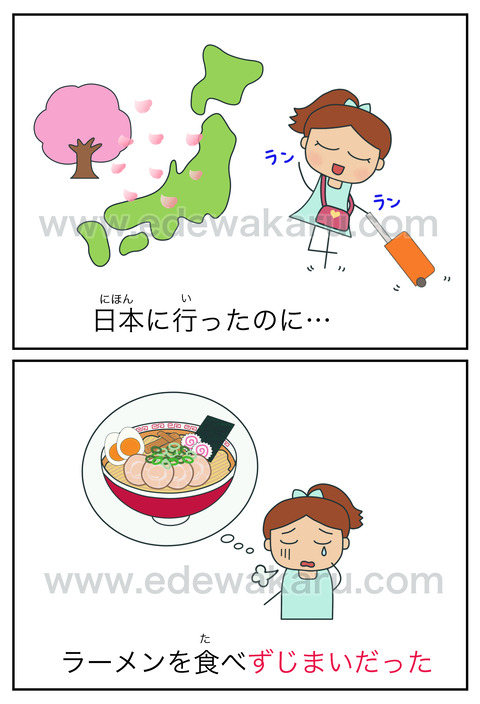
日本に行ったのにラーメンを食べずじまいだった
→日本に行ったのにラーメンを食べないで帰ってきたEven though I went to Japan, I ended up leaving without eating ramen. →Even though I went to Japan, I came back without eating ramen.
留学中旅行に行きたかったが、結局どこにも行けずじまいで帰国してしまった
→留学中旅行に行きたかったが、結局どこにも行かないで帰国してしまったI wanted to travel while studying abroad, but in the end I returned home without going anywhere. →I wanted to travel while studying abroad, but in the end I returned home without going anywhere.
好きな子がいたが、「好きだ」と言えずじまいだった
→好きな子がいたが、「好きだ」と言えないで終わってしまったThere was someone I liked, but I ended up never telling them, “I like you.” →There was someone I liked, but I ended up not being able to say, “I like you.”
今週こそ(復習:〜こそ)歯医者に行きたいが、忙しくて行かずじまいになりそうだ
→今週こそ歯医者に行きたいが、忙しくて 行かないで終わりそうだI want to go to the dentist this week, of all weeks (Review: 〜こそ), but I’m so busy that I’ll probably end up not going. →I want to go to the dentist this week, of all weeks, but I’ll probably end up not going.
Read the original source text
Meaning
〜しないで終わる
How to use it
動詞[ない形]+ずじまい
Explanation
「〜ずじまい」は「したかったこと」や「しなければいけなかったこと」を結局しないで終わってしまったという意味の文型です。 この文型を使うと
残念・後悔・失望
などの気持ちを強調する文型です😮
「〜できなかったので本当に残念だ」というように過去形の文で使われることが多いですね😉
くらべてわかる日本語表現文型辞典
Meaning
Expresses that things ended without the hoped-for or expected A happening.
How to use it
A ずじまい
[Verb—ない form] ずじまい
Notes
【Note 1】
・「する」 becomes 「せず」.
In context 4 examples
好きな彼女に愛を告白できずじまいで、卒業してしまった。
I graduated without ever managing to confess my love to the girl I liked.
その事件の犯人がだれなのか結局わからずじまいだった。
In the end, we never found out who the culprit in that incident was.
みんな待っていたが、彼はパーティーに姿を見せずじまいだった。
Everyone was waiting, but he never showed up at the party.
彼は市長選への立候補が噂されていたが、結局出馬せずじまいだった。
There were rumors that he would run for mayor, but in the end he never entered the race.
Read the original source text
Meaning
期待・希望のAがない状態でことが終わってしまったことを表す。
How to use it
Aずじまい
[動詞-ない形]ずじまい
Notes
【注意1】
・「する」は「せず」になる。
日本語NET JLPT文法解説まとめ
Meaning
End up without doing ~
Used when you want to say that something ended without your doing what you had intended to do.
How to use it
V (ない form) + ずじまい
※ しない becomes せずじまい.
Explanation
"ended up not"
Used when you want to say that you ended up not doing something you had intended to do.
① The 「ず」 in 「ずじまい」 expresses negation, and 「じまい」 means "end."
② It often includes feelings of regret or disappointment.
① "ず" in "ずじまい" expresses negation, and "じまい" signifies "end."
② It often includes feelings of regret or disappointment.
In context 11 examples
ジョンさんとはケンカしてから、仲直りできずじまいで卒業してしまった。
After John and I fought, we graduated without ever making up.
見たいと思っていた映画の上映が終わってしまった。忙しくてなかなか時間が作れず、見ずじまいだった。
The movie I’d wanted to see finished its run. I was so busy that I could never find the time, and ended up not seeing it.
たくさん本を買ったけど、結局読まずじまいで売ってしまった。
I bought a lot of books, but ended up selling them without reading them after all.
せっかく日本へ旅行したのに、日本料理を食べずじまいで帰ることになった。
Even though I went all the way to Japan, I ended up going home without eating Japanese food.
旅行ガイドを持っていったが、使わずじまいだった。
I took a travel guide with me, but ended up not using it.
今年こと彼女を作ろうと思っていたが、結局作れずじまいで男友達とクリスマスを過ごすことになった。
I’d thought I’d get a girlfriend this year, but in the end I couldn’t, and had to spend Christmas with my guy friends.
気になっている子に「好きだ!」と言えずじまいで、卒業してしまった。
I graduated without ever managing to tell the girl I liked, “I love you!”
結局彼がどうして怒っていたのか、わからずじまいだった。
In the end, I never found out why he had been angry.
「今年こそ絶対痩せる」と目標を立てたが、ダイエットせずじまいで終わってしまった。
I set a goal of “definitely losing weight this year,” but ended up not dieting at all.
友達から「今度、東京に行くから、会えたら会おう!」と連絡が来たが、結局会えずじまいだった。
A friend contacted me saying, “I’m going to Tokyo sometime soon, so let’s meet if we can!” but in the end we never managed to meet.
夏に向けて、水着を買ったものの、結局一度も着ずじまいだった。
I bought a swimsuit for summer, but ended up never wearing it even once.
Read the original source text
Meaning
〜しないで終わる
「しようと思っていたことをしないまま、終わってしまった」と言いたい時に使う。
How to use it
V(ナイ形)ない + ずじまい
※しない → せずじまい
Explanation
"ended up not"
Used when you want to say that you ended up not doing something you had intended to do.
①「ずじまい」の「ず」は否定を表し「じまい」は「終わり」を表す。
②残念な気持ち、後悔の気持ちが含まれることが多い。
① "ず" in "ずじまい" expresses negation, and "じまい" signifies "end."
② It often includes feelings of regret or disappointment.
毎日のんびり日本語教師
Meaning
Wanting to do something but ultimately ending up not doing it
How to use it
Verb ない-form + ずじまい
Explanation
Attaches to the verb ない-form and means “to end up not doing something.” “~ず” expresses negation, and “じまい” means an ending. Note, however, that with “する,” it becomes “せずじまい.”
It is often used when something one originally wanted to do could not be realized for some reason. Therefore, it carries a nuance of disappointment or regret. It can only be used for things that have already happened.
Notes
Nothing in particular.
In context 7 examples
しようしようと思いつつも、今週も結局運動せずじまいだった。
Although I kept thinking I really should exercise, in the end I didn’t exercise this week either.
家賃も水道代も払えずじまいで、ついに電気も止められてしまった。
I ended up unable to pay either the rent or the water bill, and finally they cut off my electricity too.
ずっと待ってたのに、会えずじまい。
I’d been waiting all this time, but we never got to meet.
メイクに挑戦しようと思ってメイク道具は買ったものの、結局今の今まで手をつけずじまい。
I bought makeup tools thinking I would try doing makeup, but in the end I never got around to using them.
時間がなくて金閣寺には行けずじまいだった。
I ran out of time and never got to visit Kinkaku-ji.
今日郵便局行こうと思ったけど自分が思ってた以上に忙しくて今日も行けずじまいになってしまった。
I thought I’d go to the post office today, but I was busier than I’d expected, and ended up not going again today.
お見かけはしたのですが、結局挨拶できずじまいですみませんでした。
I did see you, but in the end I didn’t get to greet you. I’m sorry.
Read the original source text
Meaning
~したいけど結局~しないで終わる
How to use it
動ない形+ずじまい
Explanation
動ない形に接続して「~しないで終わる」という意味を表します。「~ず」は否定を表し、「じまい」は終わりを表します。ただし「する」の場合は「せずじまい」になる点に注意。
元々したかったことが何らかの原因によって実現できなかったときによく用います。そのため、残念な感情や後悔のニュアンスが含まれます。既に発生したことにのみ使えます。
Notes
特になし