AIUEO JLPT Grammar
Meaning
「たい」is an auxiliary verb expressing the speaker’s desire or wish, used after the masu-stem of verbs and conjugating similarly to adjectives. To express the desires of a third party,「〜たがる」is used. Similar to "want to ...” in English.
How to use it
Verb ます-form + たい
In context 5 examples
映画を見たい。
I want to watch a movie.
お茶を飲みたいです。
I would like to have some tea.
今日は時間がなくて、映画を見たくても見られませんでした。
I didn’t have time today, so even though I wanted to watch a movie, I couldn’t.
夕飯を一緒に作りたかった。
I wanted to cook dinner together.
水を買いたくて、コンビニに行きました。
I went to the convenience store to buy some water.
Read the original source text
Meaning
「たい」is an auxiliary verb expressing the speaker’s desire or wish, used after the masu-stem of verbs and conjugating similarly to adjectives. To express the desires of a third party,「〜たがる」is used. Similar to "want to ...” in English.
How to use it
動詞ます形+たい
Explanation · 日本語
「たい」は、話し手の希望や願望を表す助動詞で、動詞のます形に接続して、形容詞と同じように活用します。また、第三者の希望を表現するときは、「〜たがる」を使います。
文法
Meaning
A sentence pattern that expresses a desire or wish to do something.
How to use it
V (ます-form stem) + たい
Notes
This pattern cannot be used to say what a third person (such as he or she) wants to do.
「〜たいですか」 cannot be used when speaking to someone of higher status (using it is rude).
It conjugates like an い-adjective.
→ 行きたいです (want to go) / 行きたくないです (don't want to go) / 行きたかったです (wanted to go) / 行きたくなかったです (didn't want to go)
In context 13 examples
夏休みは海に行きたいです。
I want to go to the beach during summer vacation.
今夜はラーメンが食べたいです。
I want to eat ramen tonight.
日本語をもっと勉強したいです。
I want to study Japanese more.
週末は映画をみたいです。
I want to watch a movie this weekend.
早く結婚したい。
I want to get married soon.
あ〜、早く家に帰りたい。
Ah, I want to go home soon.
国の家族に会いたいです。
I want to see my family back home.
韓国語も勉強したいです。
I want to study Korean too.
今日は家で休みたいです。
I want to relax at home today.
将来は日本の会社で働きたいです。
I want to work at a Japanese company in the future.
今日はどこへも行きたくないです。
I don't want to go anywhere today.
ホラー映画は苦手ですから、見たくないです。
I'm not good with horror movies, so I don't want to watch one.
お金がたくさんあったら、何をしたいですか。
If you had a lot of money, what would you want to do?
Read the original source text
Meaning
行為の欲求や希望などを表す文型。
How to use it
V(ます形)ます + たい
Notes
第三人称(彼、彼女など)のしたいことを言う時は、この文型は使えない。
目上の人に「〜たいですか」は使えない(使うと失礼)。
い形容詞と同じように活用する。
→ 行きたいです / 行きたくないです / 行きたかったです / 行きたくなかったです
Bunpro Grammar Reference
Meaning
Want to do
How to use it
Verb[stem]+ たい
Verb[stem]+ たくない
Verb[stem]+ た かった
Verb[stem]+ たくなかった
Verb[stem]+ たいです
Verb[stem]+ たくないです(1)
Verb[stem]+ た かったです
Verb[stem]+ たくなかったです(2)
(1) たくありません
(2) たくありませんでした
Nuance
A word that primarily points out things that the speaker wants to do.
Explanation
たい is an auxiliary verb that is used to express things that you would like to do (want). To use たい, it needs to be added to the same conjugation base form of a verb that ます would be attached to.
今夜はピザが食べたい。
Tonight, I want to eat pizza.
プロの歌手と歌いたい。
I want to sing with a professional singer.
When using たい, the thing that is 'wanted' can either be marked with を, or が. The difference in nuance is that something marked with が is considered to be wanted more. たい is conjugated in the same way as い-Adjectives, meaning that the negative, past, or past-negative forms may also be used.
虫は食べたくない。
I don't want to eat insects.
警察官になりたかった。
I wanted to become a police officer.
昔は先生になりたくなかった。
In the past, I did not want to become a teacher.
たい is only used for expressing things that 'you' want, or repeating information/asking questions about what other people want. It may not be used to make guesses about what other people 'may' want, unless asking them directly.
何が食べたい?
What do you want to eat?
オレンジジュースを飲みたかったの?
Did you want to drink orange juice?
Caution
たい is not used to tell other people that you want them to do something. This is done with ~てほしい.
あなたはご飯を作りたい。
As for you, I want to make dinner. (This can never mean 'I want you to make dinner for me', and is a fairly unnatural sentence)
Caution
たい is not usually used when giving invitations (asking someone if they want to do something with you). In these cases ~ませんか is far more natural.
アカネも行きたい?
Akane, do you want to go too? (Sounds more like a question than an invitation)
In context 21 examples
- 日本に行きたい。
I want to go to Japan.
- 虫は食べたくない。
I don't want to eat insects.
- プロの歌手と歌いたい。
I want to sing with a professional singer.
- 昔は先生になりたくなかった。
In the past, I did not want to become a teacher.
- オレンジジュースを飲みたかったの?
Did you want to drink orange juice?
- 警察官になりたかった。
I wanted to become a police officer.
- 今夜はピザが食べたい。
Tonight, I want to eat pizza.
- 何が食べたい?
What do you want to eat?
- 来年日本に行きたい。
Next year, I want to go to Japan.
- 早く食べたい。
I want to eat soon.
- サッカーをしたいです。
I want to play soccer.
- 文法を勉強したいです。
I want to study grammar.
- もう帰りたい。
I already want to go home.
- お風呂に入りたい。
I want to take a bath.
- この薬を飲みたくない。
I don't want to drink this medicine.
- バスで行きたい。
I want to go by bus.
- 綺麗になりたい。
I want to become beautiful.
- 公園に遊びに行きたくない。
I don't want to go play in the park.
- 質問に答えたかった。
I wanted to answer the question.
- あなたはご飯を作りたい。
As for you, I want to make dinner. (This can never mean 'I want you to make dinner for me', and is a fairly unnatural sentence)
- アカネも行きたい?
Akane, do you want to go too? (Sounds more like a question than an invitation)
DoJG 日本語文法辞典(全集)
Meaning
Want (to do something); would like (to do something)
How to use it
Vます | たい | |
| 話したい | Want to talk |
| 食べたい | Want to eat |
Explanation
An auxiliary adjective which expresses a desire to do something.
In context 6 examples
私は日本へ行きたい・たいです。
I want to go to Japan.
僕は今ピザを・が食べたい・たいです。
I want to eat pizza now.
鈴木さんはアメリカへ行きたがっている・います。
Mr. Suzuki is showing signs of wanting to go to America. / Mr. Suzuki wants to go to America.
僕は冷たいビールを・が飲みたい。
I want to drink a cold beer.
今日は何を・が食べたいですか。
What do you want to eat today?
三木さんは車を買いたがっている。
Mr. Miki wants to buy a car.
どんなときどう使う 日本語表現文型辞典
Meaning
(I) want to
How to use it
Vます+たい
Explanation
1)話す人の行為の欲求、希望を表す。相手の欲求や希望を聞く場合にも使う。
2)イ形容詞と同じように活用する。
3)他動詞の場合は ❹ のように「ビールを飲む」→「ビールが飲みたい」のように「を」が「が」に変わることが多い。
4)3人称の欲求を表す場合、そのまま文末には使えない。 ❸ のように「がっている・と言っている・と思っている・ようだ」などをつける必要がある。
5)丁寧に聞く場合や、目上の人には直接使わないほうがいい。
◆ △(おみやげ屋で)課長、何が買いたいですか。
→○課長、何をお買いになりますか。
2)Conjugates like an イ-adjective.
3)Transitive verbs, like in sentence ❹ , often take particle が rather than を. ビールを飲む (drink beer) ビールが飲みたい (I want to drink beer).
4)Cannot be used at the end of sentences expressing desires in the third person. Necessary to append expressions such as in sentence ❸ : がっている, と言っている, と思っている and ようだ.
1)Expresses speaker's desires and hopes for action. Also used to ask about desires and hopes of others.
5)Best not to use directly toward social superiors or when asking something politely.
In context 5 examples
夏休みには富士山に登りたいです。
I want to climb Mount Fuji during summer vacation.
君は将来何になりたいの。
What do you want to be in the future?
森さんは林さんに会いたくないと言っています。
Mori says he doesn’t want to see Hayashi.
ああ、暑い。冷たいビールが飲みたいなあ。
Ah, it’s hot. I’d love a cold beer.
きのうアニメの映画を見に行きました。わたしはあまり見たくなかったんですが、弟が見たいと言ったので見たんです。
Yesterday I went to see an animated movie. I didn’t really want to, but my younger brother said he wanted to see it, so I went.
Read the original source text
Meaning
(I) want to
How to use it
Vます+たい
Explanation
1)話す人の行為の欲求、希望を表す。相手の欲求や希望を聞く場合にも使う。
2)イ形容詞と同じように活用する。
3)他動詞の場合は ❹ のように「ビールを飲む」→「ビールが飲みたい」のように「を」が「が」に変わることが多い。
4)3人称の欲求を表す場合、そのまま文末には使えない。 ❸ のように「がっている・と言っている・と思っている・ようだ」などをつける必要がある。
5)丁寧に聞く場合や、目上の人には直接使わないほうがいい。
◆ △(おみやげ屋で)課長、何が買いたいですか。
→○課長、何をお買いになりますか。
2)Conjugates like an イ-adjective.
3)Transitive verbs, like in sentence ❹ , often take particle が rather than を. ビールを飲む (drink beer) ビールが飲みたい (I want to drink beer).
4)Cannot be used at the end of sentences expressing desires in the third person. Necessary to append expressions such as in sentence ❸ : がっている, と言っている, と思っている and ようだ.
1)Expresses speaker's desires and hopes for action. Also used to ask about desires and hopes of others.
5)Best not to use directly toward social superiors or when asking something politely.
絵でわかる日本語
Meaning
If 〜 were possible (I’d like to … / I wish you would … / try doing it, if you can)
How to use it
Verb [dictionary form] + ものなら (〜たい / 〜て欲しい / 〜てみろ)
* In many cases, the dictionary form of a potential verb is used.
Explanation
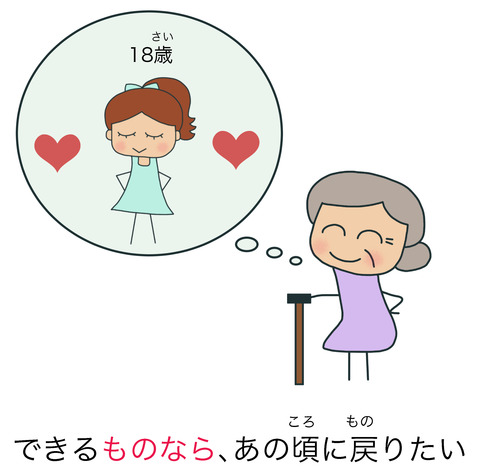
“〜ものなら…たい” is a grammar pattern that expresses a “wish / expectation” about something thought to be impossible to achieve. It has almost the same meaning as the conditional “〜なら” studied at N4, but using “〜ものなら” emphasizes that there is little chance it will come true. Example ④ is an idiomatic expression, so you may hear it in dramas 😀 In most cases, this pattern is used in the form “〜ものなら…たい,” so it’s good to memorize it as is 😉
[For advanced learners]
This pattern attaches to the “dictionary form of a verb,” but that verb is almost always a “stative verb.” You probably studied “stative verbs” in beginner Japanese. Typical examples include “ある,” “いる,” “できる,” and “わかる” 😊 Beginner grammar is more complex and important than N1 grammar. The more advanced you become, the more likely you are to forget beginner grammar, so if you’re aiming even higher, review it thoroughly and keep working so you can speak beautiful Japanese 😆
[The “もの” series]
〜たいものだ・〜てほしいものだ
〜たものだ
〜たものではない
〜というもの (Nというもの)
〜ないものだろうか
〜ないものは〜ない
〜もの・〜んだもの
〜ものか
〜ものがある
〜ものだ (feeling/emotion)
〜ものだ (inherent property / general way of thinking)
〜ものだ・〜ものではない
〜もので・〜ものだから
〜ものと思っていた
〜ものなら
〜ものの
〜ものを
〜ようものなら
In context 4 examples
できるものなら、あの頃に戻りたい
→もしできるなら、あの頃(若かった頃)に戻りたいIf I could, I’d like to go back to those days. →If it were possible, I’d like to go back to those days (when I was young).
休めるものなら、1週間くらい休みたい
→もし休むことが可能なら、1週間くらい休みたいIf I could take time off, I’d like to take about a week off. →If taking time off were possible, I’d like to take about a week off.
たばこは高いし体に悪いし、やめられるものならやめたいよ
→たばこは高いし 体に悪いし、やめることが可能ならやめたいよCigarettes are expensive and bad for you, so if I could quit, I’d like to. →Cigarettes are expensive and bad for you, so if quitting were possible, I’d like to.
やれるものならやってみろよ【慣用的表現】
→もしやれると思うなら、やってみろよIf you think you can do it, go ahead and try! [idiomatic expression] →If you think you can do it, go ahead and try!
Read the original source text
Meaning
もし〜が可能なら(…したい/…て欲しい/…てみろ)
How to use it
動詞[原形]+ものなら(〜たい/〜て欲しい/〜てみろ)
*多くの場合「可能動詞の原形」を使う
Explanation
「〜ものなら…たい」は実現が不可能だと思うことに対する「願望・期待」を表す文法です。N4で勉強した仮定形の「〜なら」とほとんど同じ意味ですが、
「〜ものなら」を使うと実現する可能性が少ないということを強調します。 例文④は慣用的表現ですのでドラマなどで聞く機会があるかもしれませんね😀この文法はほとんどの場合
「〜ものなら…たい」
の形で使われますので、そのまま覚えておくといいですね😉
【上級レベルの人へ】
この文法は「動詞の原形」につきますが、その
動詞はほとんど「状態動詞」
です。「状態動詞」は初級日本語で勉強したと思います。代表的なものは「ある」「いる」「できる」「わかる」などですね😊初級の文法はN1のもの以上に複雑で重要です。上級になればなるほど初級文法は忘れがちですので、更に上を目指す人は復習をしっかりして、きれいな日本語を話せるようにがんばってくださいね😆
【「もの」シリーズ】
〜たいものだ・〜てほしいものだ
〜たものだ
〜たものではない
〜というもの(Nというもの)
〜ないものだろうか
〜ないものは〜ない
〜もの・〜んだもの
〜ものか
〜ものがある
〜ものだ(感慨)
〜ものだ(本来の性質・一般的な考え方)
〜ものだ・〜ものではない
〜もので・〜ものだから
〜ものと思っていた
〜ものなら
〜ものの
〜ものを
〜ようものなら
日本語文型辞典
Meaning
Expresses the speaker’s (or, in a question, the listener’s) desire or strong wish for an action to be realized. It conjugates like an adjective. To emphasize the object, as in ①, replace the particle 「を」 with 「が」 and use 「…がR-たい」. The direct expression of desire is often softened, as in ⑦ and ⑧, by using 「…たいんです」 or 「…たいと思っています」. Also, in situations that call for politeness, it is usual to avoid direct expressions of desire such as 「なにか飲みたいですか」 and instead say 「なにか飲みますか」 or 「飲物はいかがですか」. 「…たい(です)」 cannot be used to describe a third party’s desire. In that case, use 「…たがる」 or an expression of conjecture such as 「…らしい」 or 「…ようだ」. Alternatively, report it in a quotation, such as 「…と言っています」.
However, there are cases where it can be used if it does not end a sentence.
Used as an introduction to a polite request.
See 「たがる」
How to use it
R-たい
R-たいんですが
R-たがる
In context 15 examples
ああ、暑い。なにか冷たいものが飲みたい。
Ah, it’s hot. I’d like something cold to drink.
A:子供はこんな時間までテレビを見てはいけません。
B:ぼく、はやく大人になりたいなあ。A: Children shouldn’t watch TV this late. B: I want to grow up quickly.
老後は暖かい所でのんびり暮らしたい。
When I’m old, I’d like to live a leisurely life somewhere warm.
その町には若い頃の苦い思い出があって、二度と行きたくない。
I have bitter memories of that town from when I was young, and I never want to go there again.
大学をやめたくはなかったのだが、どうしても学資が続かなかった。
I didn’t want to quit university, but I just couldn’t afford the tuition anymore.
今は単身赴任だが、来年3月までになんとか家族そろって住むところを見つけたい。
I’m currently posted away from my family, but somehow I’d like to find a place for all of us to live together by next March.
A:来月も続けて受講されますか。
B:続けたいんですが、ちょっと時間がなくて。A: Will you continue taking the course next month? B: I’d like to continue, but I don’t have much time.
A:将来はどうなさるんですか。
B:インテリア・デザインの会社で働きたいと思っていますが、まだわかりません。A: What are you going to do in the future? B: I’m thinking I’d like to work for an interior design company, but I’m not sure yet.
(例) 森田さんは古い車を売りたいらしい。
息子は友達となにかあったのか、学校に行きたくないと言っています。(Example) It seems Morita wants to sell his old car. I don’t know if something happened with his friends, but my son says he doesn’t want to go to school.
(例) 和夫はバイクを買いたくて、夏休みはずっとガソリンスタンドで働いていた。
ツアーに参加したい人は15日までに申し込んで下さい。(Example) Kazuo wanted to buy a motorcycle, so he worked at a gas station throughout summer vacation. Anyone who wants to join the tour should apply by the 15th.
A:住民登録について聞きたいんですが、何番の窓口でしょうか。
B:3番ヘどうぞ。A: I’d like to ask about resident registration. Which counter should I go to? B: Please go to counter 3.
A:フェスティバルの日程が知りたいんですが。
B:そこにパンフレットがありますから、お持ち下さい。A: I’d like to know the festival schedule. B: There are brochures over there, so please take one.
A:すみません、ちょっとお聞きしたいんですが。
B:はい、なんでしょう。A: Excuse me, I’d like to ask you something. B: Yes, what is it?
自信がない人ほどいばりたがるものだ。
The less confident a person is, the more they tend to act superior.
入社後一年はやめたがる人が多いが、それを過ぎるとたいていはながく勤めるようだ。
Many people want to quit within their first year at a company, but after that, most seem to stay for a long time.
Read the original source text
Meaning
話し手(疑問文の時は聞き手)の行為の実現にたいする欲求、強い願望を表す。形容詞と同じ活用。①のように対象を強調するときは、助詞「を」を「が」に変え、「…がR-たい」を使う。⑦⑧のように「…たいんです」「…たいと思っています」を用いて直接的な言い方をやわらげることも多い。また、丁寧さが必要とされる場面では「なにか飲みたいですか」のような直接的な欲求表現を避けて、「なにか飲みますか」「飲物はいかがですか」などの言い方をするのが普通。第三者の欲求を述べるのに「…たい(です)」を使うことはできない。そのときは「…たがる」を使ったり「…らしい」「…ようだ」などの推量表現を使う。また、「…と言っています」などの引用の形で報告する。
ただし、文を言い切る場合でなければ、使える場合もある。
丁寧な依頼の前置きとして使う。
⇾たがる
How to use it
R-たい
R-たいんですが
R-たがる
日本語文型辞典 英語版
Meaning
B:ぼく、はやく大人になりたいなあ。
I really wish I could be a grown-up soon.
B:続けたいんですが、ちょっと時間がなくて。
I’d like to continue, but I just don’t have time.
B:インテリア・デザインの会社で働きたいと思っていますが、まだわかりません。
I’m thinking I would like to work for an interior design company, but I’m not sure yet.
Expresses the desire or strong wish of the speaker (or the listener, in the case of an interrogative sentence) to accomplish a certain act. Conjugated in the same way as adjectives. When emphasizing the object, as in
(1)
, the particle を is changed to が and the form ...がR-たい is used. R-たい expressions are often softened by using the forms -たいんです or -たいと思っています, as in
(7)
and
(8)
. Also, in situations when politeness is required, it is usual to avoid direct expressions such as なにか飲みたいですか (Do you want something to drink?) and use なにか飲みますか (Will you have something to drink?) or 飲物はいかがですか (May I offer you something to drink?) instead.
...たい(です)cannot be used to express the wish or desire of a third person. In such cases, the form ...たがる, or expressions of conjecture such as ...らしい and ...ようだ, are used instead. Quotation forms such as ...と言っていますmay also be used to report a third person’s wish.
(例)森田さんは古い車を売りたいらしい。
Apparently Morita-san wants to sell his old car.
(例)息子は友達となにかあったのか、学校に行きたくないと言っています。
I don’t know if my son had some kind of trouble with a friend or what, but he’s saying he doesn’t want to go to school.
However, R-たい can sometimes be used for a third person, when it does not come at the end of a sentence.
(例)和夫はバイクを買いたくて、夏休みはずっとガソリンスタンドで働いていた。
Kazuo wanted to buy a motorcycle, so he worked all summer at a gas station.
(例)ツアーに参加したい人は 15 日までに申し込んで下さい。
Those who want to join the tour, please apply by the 15th.
B:3番へどうぞ。
Please go to Counter No.
3.
B:そこにパンフレットがありますから、お持ち下さい。
Please take a copy of the pamphlet over there.
B:はい、なんでしょう。
Yes, what is it?
Used to preface a polite request.
→
How to use it
1. R-たい
2. R-たいんですが
3. R-たがる
In context 13 examples
ああ、暑い。なにか冷たいものが飲みたい。
Wow, it’s so hot. I want to drink something cold.
A:子供はこんな時間までテレビを見てはいけません。
Children shouldn’t watch TV until this late.
老後は暖かい所でのんびり暮らしたい。
I want to spend my old age living a peaceful, unhurried life in a warm place.
その町には若い頃の苦い思い出があって、二度と行きたくない。
I have bitter memories of that town from when I was young, so I never want to go there again.
大学をやめたくはなかったのだが、どうしても学資が続かなかった。
I didn’t want to drop out of university, but I just couldn’t manage to pay the expenses.
今は単身赴任だが、来年3月までになんとか家族そろって住むところを見つけたい。
Now my job has me working away from my family, but by March of next year, one way or another, I want to find a place for us all to live together.
A:来月も続けて受講されますか。
Will you continue taking classes next month?
A:将来はどうなさるんですか。
What will you do in the future?
A:住民登録について聞きたいんですが、何番の窓口でしょうか。
I’d like to inquire about resident registration. Which counter would that be?
A:フェスティバルの日程が知りたいんですが。
I’d like to know the schedule of the festival.
A:すみません、ちょっとお聞きしたいんですが。
Excuse me, could I ask you something...?
自信がない人ほどいばりたがるものだ。
It’s the people who lack confidence who like to throw their weight around the most.
入社後一年はやめたがる人が多いが、それを過ぎるとたいていはながく勤めるようだ。
Many employees want to quit within their first year of joining the company, but once they get past the first year, they tend to stay for a long time.
Read the original source text
Meaning
B:ぼく、はやく大人になりたいなあ。
I really wish I could be a grown-up soon.
B:続けたいんですが、ちょっと時間がなくて。
I’d like to continue, but I just don’t have time.
B:インテリア・デザインの会社で働きたいと思っていますが、まだわかりません。
I’m thinking I would like to work for an interior design company, but I’m not sure yet.
Expresses the desire or strong wish of the speaker (or the listener, in the case of an interrogative sentence) to accomplish a certain act. Conjugated in the same way as adjectives. When emphasizing the object, as in
(1)
, the particle を is changed to が and the form ...がR-たい is used. R-たい expressions are often softened by using the forms -たいんです or -たいと思っています, as in
(7)
and
(8)
. Also, in situations when politeness is required, it is usual to avoid direct expressions such as なにか飲みたいですか (Do you want something to drink?) and use なにか飲みますか (Will you have something to drink?) or 飲物はいかがですか (May I offer you something to drink?) instead.
...たい(です)cannot be used to express the wish or desire of a third person. In such cases, the form ...たがる, or expressions of conjecture such as ...らしい and ...ようだ, are used instead. Quotation forms such as ...と言っていますmay also be used to report a third person’s wish.
(例)森田さんは古い車を売りたいらしい。
Apparently Morita-san wants to sell his old car.
(例)息子は友達となにかあったのか、学校に行きたくないと言っています。
I don’t know if my son had some kind of trouble with a friend or what, but he’s saying he doesn’t want to go to school.
However, R-たい can sometimes be used for a third person, when it does not come at the end of a sentence.
(例)和夫はバイクを買いたくて、夏休みはずっとガソリンスタンドで働いていた。
Kazuo wanted to buy a motorcycle, so he worked all summer at a gas station.
(例)ツアーに参加したい人は 15 日までに申し込んで下さい。
Those who want to join the tour, please apply by the 15th.
B:3番へどうぞ。
Please go to Counter No.
3.
B:そこにパンフレットがありますから、お持ち下さい。
Please take a copy of the pamphlet over there.
B:はい、なんでしょう。
Yes, what is it?
Used to preface a polite request.
→
How to use it
1. R-たい
2. R-たいんですが
3. R-たがる
日本語NET JLPT文法解説まとめ
Meaning
A sentence pattern that expresses a desire or wish to do something.
How to use it
V (ます-form)ます + たい
Explanation
"want to do"
Used to express the speaker’s desire to do something.
This sentence pattern cannot be used to say what a third person (he, she, etc.) wants to do.
「〜たいですか」cannot be used when speaking to someone senior to you; it is rude.
It conjugates in the same way as い-adjectives.
→ 行きたいです / 行きたくないです / 行きたかったです / 行きたくなかったです
This sentence pattern cannot be used to describe what the third person (he, she, etc.) wants to do. If you use this sentence pattern to a superior/senior person, it is rude. So it’ better not to use it to them.
In context 13 examples
夏休みは海に行きたいです。
I want to go to the beach during summer vacation.
今夜はラーメンが食べたいです。
I want to eat ramen tonight.
日本語をもっと勉強したいです。
I want to study Japanese more.
週末は映画をみたいです。
I want to watch a movie this weekend.
早く結婚したい。
I want to get married soon.
あ〜、早く家に帰りたい。
Ah, I want to go home soon.
国の家族に会いたいです。
I want to see my family back home.
韓国語も勉強したいです。
I want to study Korean too.
今日は家で休みたいです。
I want to relax at home today.
将来は日本の会社で働きたいです。
I want to work at a Japanese company in the future.
今日はどこへも行きたくないです。
I don't want to go anywhere today.
ホラー映画は苦手ですから、見たくないです。
I'm not good with horror movies, so I don't want to watch one.
お金がたくさんあったら、何をしたいですか。
If you had a lot of money, what would you want to do?
Read the original source text
Meaning
行為の欲求や希望などを表す文型。
How to use it
V(ます形)ます + たい
Explanation
"want to do"
Used to express the speaker’s desire to do something.
第三人称(彼、彼女など)のしたいことを言う時は、この文型は使えない。
目上の人に「〜たいですか」は使えない(使うと失礼)。
い形容詞と同じように活用する。
→ 行きたいです / 行きたくないです / 行きたかったです / 行きたくなかったです
This sentence pattern cannot be used to describe what the third person (he, she, etc.) wants to do. If you use this sentence pattern to a superior/senior person, it is rude. So it’ better not to use it to them.
NINJAL 日本語文型データベース
Meaning
Expresses that the speaker has a desire or wish to make “〜” happen.
How to use it
Notes
When focusing simply on the object of a desire or wish, that object may be marked with “~が” rather than “~を.”
The subject is usually first person. When expressing a third person’s desire, it is used together with an expression of hearsay or judgment, such as “〜と言っている・〜そうだ・〜がっている・〜ようだ.”
It changes forms like an i-adjective, such as “〜たくない・〜たかった・〜たくて.”
In context 8 examples
大学生になったら、一人暮らしを始めたいです。
When I become a university student, I want to start living on my own.
ああ、のどがかわいた。冷たい水が飲みたい。
Ah, I’m thirsty. I want to drink some cold water.
「すみません、東京駅に行きたいんですが」「東京駅ですか。あの角を曲がると正面に見えますよ」
“Excuse me, I want to go to Tokyo Station.” “Tokyo Station? If you turn that corner, you’ll see it straight ahead.”
先生「この部分、言いたいことはわかるけど、ちょっと表現を変えたほうがいいですよ」
Teacher: “I understand what you’re trying to say here, but you should change the wording a little.”
親「こうちゃん、もう夕方だから、おうちに帰るよ」子「嫌だ。僕、まだ帰りたくないよ」
Parent: “Ko-chan, it’s already evening, so we’re going home.” Child: “No! I don’t want to go home yet.”
「本当のことを言うと、彼女とは別れたくなかったんですが……」
“To tell the truth, I didn’t want to break up with her, but…”
田中さんは、子どもの頃、美容師になりたかったそうだ。
I hear Tanaka-san wanted to become a hairdresser when she was a child.
娘がバレエを習いたがっているが、どうしようか。
My daughter wants to take ballet lessons. I wonder what I should do.
Read the original source text
Meaning
話し手が〜を実現する欲求や願望を持っていることを表します。
How to use it
Notes
単純に欲求や願望の対象物だけに焦点を当てる場合は、その対象物を「~を」ではなく「~が」で示すことがあります。
主語はふつう一人称です。第三者の欲求を表す場合は、「〜と言っている・〜そうだ・〜がっている・〜ようだ」などの伝聞や判断を表す表現を一緒に使います。
「〜たくない・〜たかった・〜たくて」などのように、イ形容詞と同じ形に変化します。
Yokubi — The Common Grammar Guide (https://yoku.bi)
Explanation
In this lesson, we're learning three ways we can express desire or intent in Japanese.
The "volitional" form, おう/よう, says that you want to or will do something, or invites volition in other people like "let's X". It's also used in compound constructions about volitional action. The volitional form of godan verbs is -ou, and the volitional form of ichidan verbs is よう. It's pronounced with a "long o", not お plus う.
Note: we will learn this usage of と with 思う in a later section, don't worry too much about it now.
The volitional form of です is でしょう and of だ is だろう. These usually "invite an idea", like conjecture or possibility.
The second way to express desire is たい. たい is an い-adjective-like auxiliary that attaches the same way as ます.
In the last example sentence, を is acceptable too. In respect to が and を, たい works similarly to potential verbs. Either が or を can be used to mark the object/target of desire, although different verbs may have specific preferences about one or the other. Don't try to memorize this, just know it exists and is valid Japanese.
The last way to express wanting is with 欲しい, an い-adjective.
Note: Similarly to たい, ほしい also falls into the category of quirky adjectives where が marks the object of desire, and can sometimes be replaced with を. However, unlike with たい, をほしい is very much less proper and less common. You might still see it, but a lot of people will consider it awkward Japanese. It's best to avoid using it.
Another quirk of ほしい is that it can be used as auxiliary after the て form of a verb to issue soft commands or requests.
It can sound a bit more impersonal and indirect than てください, and it can also be used to provide general advice about what you'd like someone to do from your point of view. The important thing to remember is that you use がほしい to talk about yourself, and てほしい to talk about others.
In context 2 examples
死にたい
I want to die.
アイスが食べたい
I want to eat ice cream.
IMABI
Personal Desire: ~たい
Read this IMABI lesson ↗Explanation
Personal Desire: ~たい
In this lesson, we will learn about the auxiliary ~たい, which is responsible for expressing personal desire. Typically, it is defined as inherently describing first-person desire, but as we will also see, it can be extended to third-person desire so long when combined with supposition from a first-person perspective.
Conjugating w/ Auxiliary ~たい
The auxiliary ~たい attaches regularly to the 連用形 of verbs as follows:
Verb ClassBasic Form+ ~たい
一段 Verbs食べる (to eat)食べたい (I want to eat)
五段 Verbs飲む (to drink)飲みたい (I want to drink)
するする (to do)したい (I want to do)
来る来る (to come)来(き)たい (I want to come)
であるである (to be)でありたい (I want to stay being)
Meanwhile, the auxiliary ~たい itself conjugates as an adjective (形容詞). The grammatical implications of this are vastly reaching, but let’s first familiarize ourselves with its basic conjugations.
Plain SpeechPolite Speech
Non-Past~たい~たいです
Negative~たくない~たくありません
~たくないです
Past~たかった~たかったです
Negative Past~たくなかった~たくありませんでした
~たくなかったです
て Form~たくて←
Particle Usage
What particle to use in conjunction with ~たい requires that you understand what kind of verbal predicate you are using.
[Intransitive Verb + ~たい]
If the main verb is intransitive, then there is by default no object in the sentence. However, there may still be an indirect object in the form of a destination or recipient. In these cases, said indirect object is normally marked with the particle に or a similar structure (such as と or へ).
1. 邪魔になりたくありません。
I don’t want to become a bother.
2. 温泉に行きたいのですが、どこがいいでしょうか。
I’d like to go to a hot spring, but where is good?
3. 北海道へ行きたいです。
I want to go to Hokkaido.
4. 寒いですから、外へ行きたくないです。
It’s cold outside, so I don’t want to go out there.
5. 映画を観に行きたいです。
I want to go see a movie.
When the particle に follows the 連用形 of a verb to indicate the direction of where the agent is heading to perform said action, the subordinate clause containing said verb is nominalized by being rendered as a location. Meaning, [映画を観] functions as one larger nominal phrase (体言), and the use of を is consistent with the grammar of the subordinate clause inside it. The particle associated with ~たい is chosen based on the main verb it is conjugated with.
[Nominal Predicate w/ である + ~たい]
Noun predicates with である, the copula verb, have neither an object nor an indirect object. As for でありたい, it describes the desire to intrinsically be (stay as) whatever state the noun is in. Also different from the prior scenario, the predicate itself need not necessarily be in first-person, but the situation described is directly affecting the speaker.
6. 子供の可能性が広げられる世の中でありたい。
I want the world to be one in which (we) can expand (our) children’s potential.
7. 私は良い人でありたいです。
I strive to be a good person.
Similarly, we also find でいたい, which describes wanting to stay being a certain way, indicating underlining personal action. This must always be first-person.
8. いつも笑顔でいたい。
I always want to have a smile on me.
9. 今の私のままでいたいの。
I want to stay just the way I am!
How both these forms compare to ~に成りたい is that でありたい・でいたい indicate the desire of staying in a certain state, whereas ~に成りたい describes wanting “to become,” meaning the subject has not yet entered said state.
[Adjectival Predicate + ~たい]
~たい may be paired with true adjectives (形容詞) or adjectival nouns (形容動詞).
Adjectival-noun predicates are easier to handle as either でありたい or でいたい simply follows the stem of the adjectival noun.
In the case of adjectives, however, the verb ある or いる must first follow the く-連用形.
In either case, the difference between ある and いる are maintained, and we see that the adjectival portion of the predicate acts adverbially onto the main verb. Furthermore, ~たい still attaches to a verbal element, and not directly to an adjectival morpheme.
10. いつまでも美しくいたい!
I want to stay beautiful forever!
11. 健康でありたい、元気でありたい。
I want to be healthy; I want to be well.
12. 心は月のように円くありたい。
I want my heart to be round like the moon.
13. ほんとは自分らしくありたい、でも居場所がない。
I do really wish to be like myself, but I have nowhere that I belong.
From 『未成年』by Aqua Timez.
[Transitive Verb + ~たい]
▽If the main verb is transitive, が is the default particle for marking the object of desired action. Because ~たい is adjectival, this renders the structure as directly translating as “desirable that one be doing X action.”
The reason why the object of the once transitive verb is now marked by が can be explained by a phenomenon known as ergativity, in which the subject marker manifests as the same morpheme as the object marker of a transitive verb in specific circumstances, ~たい being one of those circumstances.
14. 私はそれが知りたくて堪らないのです。
I just can’t help but want to know that.
15. 私はKの死に顔が一目見たかったのです。
I wanted one glance at K’s face at his deathbed.
From 『こゝろ』by 夏目漱石.
It is important that you do not confuse the が here with the normal subject particle が. Also remember that in subordinate clauses which directly modify nouns, the ‘subject’ of that clause may nonetheless take either が or の.
16. 自分{の・が}聞きたいことはまだ聞けないでいる。
As of yet, I have still been unable to ask what I want.
を + [transitive verb + ~たい]
Traditionally, the use of を to mark the object of a [transitive verb + ~たい] construct had been deemed ungrammatical due to the ergative nature of the auxiliary. Indeed, in Early Modern Japanese literature, sentences which would likely take を today by most speakers often took が, even to the point of hypercorrection (Ex. 17).
17. 私は先生といっしょにあすこいらが散歩してみたい。
I’d like to experience going on a walk over there together with you, Sensei.
From 『こゝろ』by 夏目漱石.
散歩する is intransitive, and the use of the particle を should be viewed as indicating a place in space being traversed. This usage of the case particle を is treated separately from its use as a typical object marker with transitive verbs, and so を ought to appear here accordingly.
To the contrary of this, even before Modern Japanese1, the use of を with transitive predicates has been observed, as well as in the same works which exemplified the language standards put in place in Standard Japanese at the turn of the 20th century.
18a. 孝行をしたいときには親はなし。
18b. 孝行のしたい自分に親はなし。
When I (finally) feel like performing filial piety, my parents are no longer alive.
This rather famous proverb is traditionally iterated as 18b., indicating that が, or alternatively の when in a subordinate clause directly modifying a noun, was indeed once the prescriptively correct choice; however, the modern rendition 18a. clearly shows the propensity speakers have today of using を.
19. 私は今より一層淋しい未来の私を我慢する代わりに、淋しい今の私を我慢したいのです。
I would rather endure my current sad self in exchange for enduring my far sadder future self.
From『こゝろ』by 夏目漱石.
In the last century, the use of を over が has greatly accelerated, and perhaps in the near future, が may end up becoming unnatural.
Meanwhile, a few questions still remain on how を + ~たい is actually used, and how it differs, if at all, from が + ~たい.
①What situations are there in which を + ~たい remains ungrammatical?
②What nuance differences can be made based on choosing が over を?
The drive for using を over が rests in a desire to match what sort of emphasis the speaker wishes to get across. First, let’s consider how the following two sentences may differ in nuance.
20a. コーヒーが飲みたい。
20b. コーヒーを飲みたい。
I want to drink coffee.
The first difference that can be noted is where emphasis is placed in the sentence. In Ex. 20a., the focus is on the noun コーヒー. This is in line with the object of one’s desire being expressed as the subject of the desired state of being. It also makes it clear that the speaker is not interested in drinking anything else. In Ex. 20b., greater focus is placed on the action itself, but the emphasis is weaker as an effect, as you could just as easily replace the verb with any other action (Ex. 20c)
20c. コーヒーを捨てたい。
I want to toss out the coffee.
Exs. 20a-c. can be further distinguished by the sort of question that might have prompted each respective statement.
20a’. 何が飲みたいの? → コーヒーが飲みたい。
What do you want to drink? → I want to drink coffee.
20b-c’. コーヒーをどうしたいの?→ コーヒーを{飲みたい・捨てたい}。
What do you want to do with the coffee? → I want to drink/toss out the coffee.
Yet another observation can be made here: whenever が is used to mark the object, the predicate containing ~たい tends to immediately follow2, whereas when を marks the object, other phrases – どう being an example of this – are frequently inserted between [noun + を] and the predicate containing ~たい.
21. 海が見たくて海に来ぬ3。
I wanted to see the sea, so I have come to the sea.
By the poet 石川啄木.
22. 妻が己の過去に対して持つ記憶を、なるべく純白に保存しておいてやりたいのが私の唯一の希望なのですから、私が死んだ後でも、妻が生きている以上は、あなた限りに打ち明けられた私の秘密として、すべてを腹の中にしまっておいて下さい。
I would like to keep the memory that my wife has of me to stay as pure as possible, and with that being my sole wish, even after I have died, for as long as my wife shall live, I ask that you please store away all the secrets which I have opened up to you about in your heart of hearts.
From 『こゝろ』by 夏目漱石.
23. さらに物語を面白くしたいのです。
I want to make the story ever more interesting.
24. この話題に触れるための、新しいキャラクターを作りたい。
I want to create a character that touches on this topic.
Grammar Note: As far as word order is concerned, the clause [この話題に触れるために] could have been inserted between [新しいキャラクターを] and [作りたい].
Another point to consider is the logic behind the questions and answers in Ex. 20 affecting the phrasing itself.
①It is logical for a speaker to conceive of 「コーヒーが」as a response to the question of 飲みたいの?because it is not readily obvious from the predicate in the question alone what the listener wants to drink.
②Suppose instead that the listener already has the desire to toss out the coffee. For the speaker to then ask the listener 何を? would be illogical. The object is already obvious, but the action intended is what the speaker would be clarifying.
Again, we see that が heavily stresses the object of desire, whereas を is better suited to indicate typical desire to do something. Indeed, because all other volitional grammar in Japanese is inherently transitive, and because the verbs at hand here are transitive themselves too, the ergative nature of ~たい is overwritten to favor the power of choice the speaker has in exercising their want.
All being said, when asking the general public whether を + ~たい is proper at all, you get a range of answers from not acceptable (largely from older generations and/or those who favor the grammar rules they learned in school) to being completely acceptable (largely from younger generations and/or those reflecting on how they actually speak).
Interchangeability is highest between が・を the simpler the clause containing ~たい is, which is the greatest driving force behind the perception regarding the grammaticality of it all.
25. ピザ{が・を}食べたいです。
I want to eat pizza.
26. 絵{が・を}描きたい!
I want to draw pictures!
27. ポケモンのグッズ{が・を}買いたいです。
I want to buy Pokémon goods.
28. 主治医にお礼の手紙{が・を}出したいのですが、失礼でしょうか。
I want to send the physician (that was in charge of my care) a thank-you letter, but would that be rude?
Instances of No Particle (∅)
Of course, there are scenarios in which no particle is expected with ~たい.
▽With Adverbial Nouns
With adverbial nouns such as [interrogatives + か] and counter phrases, が・を are not necessary, as they may modify the verbal predicate containing ~たい adverbially. This is actually the norm, but が・を may still be used.
29. 何か{∅・を・が}飲みたいです。
I want to drink something.
30. さっきご飯を食べたのに、もう何か{∅ ◎・を・が △}食べたい!
I already want to eat something even though I ate dinner just a moment ago!
31. どれか一冊{∅・を・が△}買いたい。
I want to buy one of the books.
Nouns functioning as the object with adverbial particles typically do not get marked with が・を – ex. も, など, なんか, まで. It must be noted, though, that も +が・を, in particular, is ungrammatical. Adverbial phrases of any sort that do not contain a direct object for が・を to logically attach would simply be modifying the predicate (main verb).
32. 私は妻にはなんにも知らせたくないのです。
I don’t want to tell my wife about any (of it).
33. 飯なんか食いたくない。
I don’t wanna eat dinner or nothin’!
34. もちろん、食べても何の問題もありませんが、生の大根なんか{∅・を}食べたくないのなら、無理してまで食べるには及びませんよ。
Of course, there is nothing wrong with eating it, but if you don’t want to eat raw daikon or the sort, there is no need for you to push yourself to eat it anyway.
35. 今までもやりたくないことはあったけど、今回ほど酷くありません。
Even up until now, there have been things I didn’t want to do, but not as horrible as this time.
Grammar Note: Here, 今までも “even up until now” simply modifies the predicate of its clause [やりたくない], and we see that the “want” phrase is
▽The dropping of object marking is quite common. This can either be indicative of casual speech, but the presence of が・を is notably also optional with する verbs. Of course, the presence of が・を cannot be overlooked, as when they are used, they carry the same respective effects as we have discussed.
36. 何食べたいかわからない。
I don’t know what I want to eat.
37. キス{が・を・∅}したいだけ!
I just want to kiss!
~たい W/ Second & Third Person
There are two scenarios in which ~たい may be paired with second person.
①When used in a question or any grammar point that suggests the predicate is probably true.
②When used in a conditional statement, which is subsequently based on the speaker’s judgment of the situation.
38. 東京に行きたいですか。
Do you want to go to Tokyo?
39. 日本に旅行したいですか。
Do you want to travel to Japan?
40. 何{が・を}食べたい? (Plain)
What do you want to eat?
41. ライブに行きたいでしょう?
Don’t you want to go to the live performance?
42. そんなに買いたいなら、売ってあげるよ。
If you want to buy it that badly, I’ll sell it to you.
43. 相談したかったらいつでもおいで!
I’m here if you need someone to talk to!
As for third person, there are three separate scenarios in which ~たい is used.
①In narration in which the narrator is in control of the third-person perspective of the character(s). This may also be extended to common sense statements.
②When paired with an auxiliary indicating supposition such as ~らしい (seem that…) or ~そうだ (hear that…).
③When paired with ~と{思っている4・考えている・言っている}. In each event, ~たい is followed by the citation particle と and then followed by a verb indicating thought or talking. This, however, is not limited to third person. As such, it is actually more natural for the final verb to still be then followed by a suppositional auxiliary.
44. 学校に行きたくてもいけない人もいる。
There are also people want to go to school who can’t.
45. セスさんは辛いものを食べたいそうです。
I hear Seth-san wants to eat spicy food.
46. 自分の人生について考えるとき、だれもが一度しか人生を悔いのないように生きたいと思っているだろう。
I’m sure everyone wants to live a life without regret, with it being the only one they have, when they think about their own life.
More Examples 用例
47. もう勉強したくないです。
I don’t want to study anymore.
48. 私はどんな勉強がしたいのか?
What sort of studies do I want to do?
49. コーヒー{を 〇・が△}ゆっくり飲みたい。
I want to slowly drink coffee.
50. 私は死ぬ前にたった一人でいいから、他人を信用して死にたいと思っている。
Just one person is all I need, it’s just before I die, I want to trust someone, then die.
51. 数年前、ローリエを使いたくて月桂樹を植えました。
Several years ago, I wanted to use bay leaves, and so I planted a bay tree.
The Origin of ~たい (スルーOK)
History tells a lot about “why” things behave the way they do, and the reason for why ~が is used at all with ~たい can be explained by looking at the history of it and the grammar surrounding it. The historical discussion that is to follow is NOT required for you to read or grasp, but it does provide the “why” to this dilemma.
Why ~たい Takes が
Unlike when the auxiliary ~ない attaches itself to verbs, the resulting phrases made with the auxiliary ~たい do appear to function adjectivally. Yet, the verbal component cannot be overlooked, either.
Ergativity
When the subject marker of an intransitive verb manifests as the same morpheme as the object marker of a transitive verb, that verb is said to be an ergative verb. Meaning, the use of が to seemingly mark the object of verbs with ~たい can be explained without having to posit that the particle が is functioning any differently than it normally does. This is because the ergative nature of the ~たい construct allows が to remain a subject marker; however, the role that that subject plays, semantically, is parallel to the object of the transitive iteration of the sentence (without ~たい).
Ergative grammar need not be pervasive to be valid, which is a common misconception for those unfamiliar with the concept, as it is neither found in English nor in many other languages. Its subtle appearance in Japanese grammar can, in fact, be attributed to stative (predicates which describe a state) grammar having a symbiotic relationship with ergative verbal grammar in the broader category of stative-transitive predicates, which we learned about in Lesson 22.
/po-/ 欲: The Original Morpheme for Desire
In Old Japanese, ~たい did not exist, nor did its immediate predecessor ~まほし, which utilizes the older version of 欲しい in its etymology. Desire, at this time, could be described with the root /po-/ 欲 – with various affixes to choose from to produce a similar spectrum of options to describe desire as found in Modern Japanese: /-ru/, /-su/, /-si/, and /-ri-su/ → 欲る, 欲す, 欲し, 欲りす. From these forms alone, we can already make three observations that directly affect how desire-related phrasing works today.
①The default means of describing desire is transitive in nature, and is therefore subject to the various affixation that arises with such verbs to fine tune nuancing.
②Simultaneously, there too exists an adjectival means of describing a desirable circumstance. In which case, all such adjectives in Japanese are created by affixing /-shii/ to the basic transitive verb form.
③All these forms are still etymologically related to the modern 欲しい, but it is at best a derivative from a verbal root.
The verb 欲る simply worked as “to desire,” and it too only depicted personal desire. In practice, its 連用形 was predominantly used, and as what happens from time to time in Japanese morphology, this led to the formation of 欲りす for describing the strong desire of anyone, which eventually gave rise to 欲(ほっ)す, which still exists in Modern Japanese in limited capacity as 欲する, which is notably still a transitive verb.
All while, there still has always existed the adjectival form 欲し, which either depicted a desirable circumstance or the object of one’s desire. The affix /-si/ (equivalent to Modern Japanese /-shii/) unequivocally describes emotional state of beings, and in the process, it changes the sentence structure to match accordingly by forming adjectival predicates.
We even see が work its magic with 欲し in the pattern ~が欲し when it followed the 連用形 of verbs5, as it functioned precisely the same as ~たい would in Modern Japanese. The action is portrayed as a desirable state the speaker wishes to be in, all while there is still an object in the sentence being ergatively rendered as the subject of the resulting adjectival expression.
Adjectival predicates, by nature, do not take, and have never taken, objects marked with を. However, the issue presented when the subject (主体) is stated alongside the grammatical subject of what is desirable is apparent. Yet, if 欲し is analyzed as the ergative rendition of its transitive forms, then a direct parallel can also be made with ~たい. It is both logical for the object of desire to be stated as the subject of a mental state of being and for the constructs used to depict such states to be derived from active transitive verb constructs via ergative grammar.
Furthermore, Japanese already allows the same case particle to be used consecutively onto a following element so long as it is not functioning exactly the same way as the first instance, thus explaining sentences such as:
52. 僕がやりたいんだ!
I want to do it!
The “it,” although omitted, is still inherently the object of desired action by the speaker.
The Etymology of ~たい
How, then, did ~たい come about if it is not directly linked to any derivate of the original morpheme for “to want”?
The going theory suggests that it derives from the amalgamation of the adjective 甚(いた)し fusing with the 連用形 of verbs. This adjective had various meanings – of which “to be excessive,” “to be amazing,” and “to be tough (as in a situation)” – but for any of these meanings to result in an auxiliary indicating “desire” would require a number of leaps in logic for which there are no intermediary stages to prove said trajectory. Indeed, the adjective 労たし in Classical Japanese meaning “to be incredibly adorable,” which does undoubtedly derive from 甚し, certainly describes a desirable state, but it is notably not describing an emotionally desirable state of being of the speaker, nor in the third-person.
Another possible route for the emergence of ~たい can be found in other existing grammar found in Old Japanese: that being the ending ~しがな. This ending either directly followed the 連用形 of verbs or the 連用形 of perfect auxiliary verbs. It indicated a personal yearning of the speaker similarly to how ~たいなあ works in Modern Japanese. Not so surprisingly, we see ~し present. However, as is made evident from the grammar of sentences which used this sentence ending, the verb structures remained transitive, making it clear that it at least started out as a separate morpheme – joining the long list of final particles that have littered Japanese sentences since antiquity.
However, changes based off association have occurred elsewhere in Japanese. The most extreme yet example is the replacement of the auxiliary verb ~ず with the auxiliary adjective ~ない. Dialectal conjugations of its predecessor clearly indicate that it did derive from ~ず, yet however it happened, we are stuck with an ending that conjugates as an adjective in Modern Japanese.
Typically, when the affix /-shii/ (= /-si/ in Classical Japanese) attaches to verbs to create adjectives describing the speaker’s mental state of desiring something, it does so by attaching itself to the 未然形, as this is the base responsible for states which have yet to occur. Examples include 望ましい, 好ましい, 願わしい, and 思わしい, all of which may roughly translate as “desirable.”
What all these verbs share in common is that their 未然形 ends in /a/. By association, it is possible that the combination of て, the 連用形 of the perfect auxiliary つ from Classical Japanese, underwent an irregular sound change to sound more like other instances of the adjectival affix /-si/ attaching to verbs. Then, by this newly found association, ergative grammar along with functioning as an adjective would both be acquired traits made in the process. Also, by being partially derived from the 未然形 of a perfect auxiliary, the state of being described is then rendered as having yet to happen.
Ultimately, by Late Middle Japanese, ~たし – the direct predecessor of ~たい – had supplanted ~がほし and ~まくほし(まほし)as the auxiliary for personal desire, and through this exchange, it naturally inherited ergativity.
Subsequently, no sooner than ~たい had appeared in everyday speech, the use of を for when ~たい is paired with transitive verbs has been observed, indicating that the ergative grammar of the ending has never been enough momentum to completely override the transitivity of the verbs themselves.
Grammatical Parallel Examples to ~たい・欲しい
All while this was occurring, other ergative transformations were occurring elsewhere in the Japanese language to once purely transitive constructs for desire – that being the emergence of 好きだ and 嫌いだ from their verbal forms 好く and 嫌う respectively, suggesting that transitive verb morphemes have a natural tendency to produce ergative forms which take on adjectival morphology to assist with better marking said relationship via the existing case system of Japanese.
The use of を with [transitive verb + ~たい] has been observed since the Muromachi Period (室町時代), which matches the time period when the ending itself became widespread. This refutes English as the sole reason for the rise of を in this grammar. However, English’s role as a catalyst to hasten the replacement of が with を appears irrefutable. ↩︎
This is not a requirement. ↩︎
来(き)ぬ in modern grammar would be rendered as 来た(のだ). ↩︎
We will investigate in a future lesson how to use ~たいと思う as well as many other applications of ~たい not touched on in this lesson. ↩︎
Example of this can be found in Poem 1059 of the 万葉集:
ありがほし住みよき里の荒るらく惜しも
What a shame it is to see a village so comfortable to live at, which I’ve wanted to live at, fall into ruin. ↩︎
In context 55 examples
邪魔になりたくありません。
I don’t want to become a bother.
温泉に行きたいのですが、どこがいいでしょうか。
I’d like to go to a hot spring, but where is good?
北海道へ行きたいです。
I want to go to Hokkaido.
寒いですから、外へ行きたくないです。
It’s cold outside, so I don’t want to go out there.
映画を観に行きたいです。
I want to go see a movie.
子供の可能性が広げられる世の中でありたい。
I want the world to be one in which (we) can expand (our) children’s potential.
私は良い人でありたいです。
I strive to be a good person.
いつも笑顔でいたい。
I always want to have a smile on me.
今の私のままでいたいの。
I want to stay just the way I am!
いつまでも美しくいたい!
I want to stay beautiful forever!
健康でありたい、元気でありたい。
I want to be healthy; I want to be well.
心は月のように円くありたい。
I want my heart to be round like the moon.
ほんとは自分らしくありたい、でも居場所がない。
I do really wish to be like myself, but I have nowhere that I belong.
私はそれが知りたくて堪らないのです。
I just can’t help but want to know that.
私はKの死に顔が一目見たかったのです。
I wanted one glance at K’s face at his deathbed.
自分{の・が}聞きたいことはまだ聞けないでいる。
As of yet, I have still been unable to ask what I want.
私は先生といっしょにあすこいらが散歩してみたい。
I’d like to experience going on a walk over there together with you, Sensei.
孝行をしたいときには親はなし。
When I (finally) feel like performing filial piety, my parents are no longer alive.
孝行のしたい自分に親はなし。
When I (finally) feel like performing filial piety, my parents are no longer alive.
私は今より一層淋しい未来の私を我慢する代わりに、淋しい今の私を我慢したいのです。
I would rather endure my current sad self in exchange for enduring my far sadder future self.
コーヒーが飲みたい。
I want to drink coffee.
コーヒーを飲みたい。
I want to drink coffee.
コーヒーを捨てたい。
I want to toss out the coffee.
海が見たくて海に来ぬ3。
I wanted to see the sea, so I have come to the sea.
妻が己の過去に対して持つ記憶を、なるべく純白に保存しておいてやりたいのが私の唯一の希望なのですから、私が死んだ後でも、妻が生きている以上は、あなた限りに打ち明けられた私の秘密として、すべてを腹の中にしまっておいて下さい。
I would like to keep the memory that my wife has of me to stay as pure as possible, and with that being my sole wish, even after I have died, for as long as my wife shall live, I ask that you please store away all the secrets which I have opened up to you about in your heart of hearts.
さらに物語を面白くしたいのです。
I want to make the story ever more interesting.
この話題に触れるための、新しいキャラクターを作りたい。
I want to create a character that touches on this topic.
ピザ{が・を}食べたいです。
I want to eat pizza.
絵{が・を}描きたい!
I want to draw pictures!
ポケモンのグッズ{が・を}買いたいです。
I want to buy Pokémon goods.
主治医にお礼の手紙{が・を}出したいのですが、失礼でしょうか。
I want to send the physician (that was in charge of my care) a thank-you letter, but would that be rude?
何か{∅・を・が}飲みたいです。
I want to drink something.
さっきご飯を食べたのに、もう何か{∅ ◎・を・が △}食べたい!
I already want to eat something even though I ate dinner just a moment ago!
どれか一冊{∅・を・が△}買いたい。
I want to buy one of the books.
私は妻にはなんにも知らせたくないのです。
I don’t want to tell my wife about any (of it).
飯なんか食いたくない。
I don’t wanna eat dinner or nothin’!
もちろん、食べても何の問題もありませんが、生の大根なんか{∅・を}食べたくないのなら、無理してまで食べるには及びませんよ。
Of course, there is nothing wrong with eating it, but if you don’t want to eat raw daikon or the sort, there is no need for you to push yourself to eat it anyway.
今までもやりたくないことはあったけど、今回ほど酷くありません。
Even up until now, there have been things I didn’t want to do, but not as horrible as this time.
何食べたいかわからない。
I don’t know what I want to eat.
キス{が・を・∅}したいだけ!
I just want to kiss!
東京に行きたいですか。
Do you want to go to Tokyo?
日本に旅行したいですか。
Do you want to travel to Japan?
何{が・を}食べたい? (Plain)
What do you want to eat?
ライブに行きたいでしょう?
Don’t you want to go to the live performance?
そんなに買いたいなら、売ってあげるよ。
If you want to buy it that badly, I’ll sell it to you.
相談したかったらいつでもおいで!
I’m here if you need someone to talk to!
学校に行きたくてもいけない人もいる。
There are also people want to go to school who can’t.
セスさんは辛いものを食べたいそうです。
I hear Seth-san wants to eat spicy food.
自分の人生について考えるとき、だれもが一度しか人生を悔いのないように生きたいと思っているだろう。
I’m sure everyone wants to live a life without regret, with it being the only one they have, when they think about their own life.
もう勉強したくないです。
I don’t want to study anymore.
私はどんな勉強がしたいのか?
What sort of studies do I want to do?
コーヒー{を 〇・が△}ゆっくり飲みたい。
I want to slowly drink coffee.
私は死ぬ前にたった一人でいいから、他人を信用して死にたいと思っている。
Just one person is all I need, it’s just before I die, I want to trust someone, then die.
数年前、ローリエを使いたくて月桂樹を植えました。
Several years ago, I wanted to use bay leaves, and so I planted a bay tree.
僕がやりたいんだ!
I want to do it!
~たい w/Other Grammar
Read this IMABI lesson ↗Explanation
~たい w/Other Grammar
In this lesson, we will be expanding our knowledge on the auxiliary ~たい by seeing it used in combination with other grammar points and conjugations, which will also provide us many opportunities to compare it with synonymous structures.
~てもらいたい・ていただきたい
~てほしい, even when polite, is not the most polite way to tell someone that you would like them do to something for you. In this case you are implying that you are to be receiving a favor, and therefore, ~てもらいたい (~ていただきたい being more honorific) would be most appropriate.
1. 銀行に行ってきてもらいたいんですが。
I would like you to go to the bank.
2. 先生に参加していただきたいんですが。
We’d like you to attend, Professor.
3. 私に出て行ってもらいたいと言われました。
I was told that (they) would like for me to leave.
4. 何が何でもこの人に政治家になってもらいたい。
I want this person to a politician no matter what.
5. きょうは誰にも家に来てもらいたくない。
I don’t want anyone to come to my house today.
~られたい
It may come as a surprise that the auxiliary ~たい can be paired with the passive.
~られたい is very similar semantically and grammatically to ~てもらいたい. Both roughly indicate that X (person) wants (Y) to do the V (verb) in question (onto Z (direct object)).
6a. 両親に褒められたい。
6b. 両親に褒めてもらいたい。
6a. I want to be complimented by my parents.
6b. I want for my parents to compliment me.
The purpose of ~たい in either sentence is to show the desire of the wisher (usually the speaker) for the action of the predicate to realize. If the wisher wants their parents to compliment them, both a and b sound natural.
The short answer as to how these endings differ is that ~られたい is used irrespective of the good intent Y (the agent) may provide the wisher (X) out of a simple desire for Y to carry out said V (action) that extends to them (X), being most natural with situations in which X (the wisher), has the least amount of control.
Meanwhile, with ~てもらいたい, X (the wisher) is actively involved in pressuring Y to do said V (action), implying also that V is only natural to happen.
7. 妻から頓死したと思われたいのです。(No Involvement by the Wisher)
I want my wife to think that I suddenly died.
8. 飼い主さんは、「この家に来てよかった」とわんこに思ってもらいたいんでしょう?(Major Involvement by the Wisher)
Don’t (you as the) pet owner want (your) dog to think they’re so glad they came to your home?
Because the agent of ~られたい (Y) ultimately performs the desired action of X regardless of X’s intent, this greatly limits the verbs that can be used with it. As for the verbs that can be frequently seen, verbs involving assessment such as 見る (to view (as))・認める (to recognize (as)), verbs of emotion such as 愛する (to love)・嫌う (to detest), verbs of physical force (often with violence/sexual) nuances in which Y exerts unilateral force onto X such as 叱る (to scold)・振り回す (to manipulate)・殴る (to strike/hit/punch), etc.
9. 愛されたい、でも愛そうとしない。
I want to be loved, but I make no attempt to love.
10. 他人によく見られたい。
I want to be watched by others.
11. あたしももっと見られたいの。
I want (you) to look at me more, too.
12. 殴られたくなければ先に殴らなければいい。
If you don’t want to get punched, then just don’t punch first.
Conversely, there is no such semantic restrictions on ~てもらいたい. Although it is not as likely to be used, comparatively speaking, with verbs with bad imagery, grammatically there would be nothing wrong with using said verbs so long as the force Y is exerting is (partially) due to X pressuring Y to do said action. This is where the “favor” aspect of もらう lies.
13a. 友達に英語を教えてもらいたいです。〇
13b. 友達に英語を教えられたいです。X
As Ex. 13 demonstrates, ~られたい and ~てもらいたい are not fully interchangeable, and even in sentences in which they can replace the other, it may not always be the case that they roughly mean the same thing either. When a difference does arise, the semantic weight Y has is always the culprit.
14a. 懐かしい写真を見せられたい。
I want to be shown a nostalgic photo.
14b. 懐かしい写真を見せてもらいたい。
I want (someone in mind) to show me a nostalgic photo.
Lastly, one instance in which ~られたい is quite common is in formal written language in which the writer is making a neutral plea for the audience to consider something.
15. この件について再検討されたい。
I would ask that this case be re-examined.
16. ご参照されたい。
I would ask that (you = the reader(s)) reference (this).
~たいと思う
The auxiliary ~たい is frequently followed by the citation particle と and followed with verbs of utterance such as 言う (to say) and thought such as 思う (to think) and 考える (to ponder/contemplate).
17. アメリカに行きたいと思います。
I would like to go to America.
18. 母は10年ぶりにアメリカに行きたいと言っています。
My mother is saying she wants to go to America for the first time in 10 years.
19. 初めてアメリカに行ってみたいと考えています。
I’m thinking about visiting America for the first time.
Japanese has an overall tendency of avoiding direct statements, and this also pertains to general statements of want, as that is arguably the neediest anyone could ever sound. As such, it is arguably more common to hear ~たいと思う over ~たい when relaying one’s desire to act to others. It is also generally more appropriate when announcing one’s course of action, and as Ex. 22 shows, this remains true in tangents.
20. 今やりたいと思うことは今しかできないことなんだ!
What I want to do now, I can only do now!
21. 投資を始めたいと思うのですが、何から始めたら良いのか、どこに行けば良いのか分かりませんし、周りに投資してる知人もいないので誰か教えてください。
I want to start making investments, but I don’t know where best to start, or even where I should go, and since I don’t have anyone around me who does investing, could someone please teach me?
22. ということで、早速着替えたいなと思うんですけども、きょうはね、あたし、もう首から上は準備してきちゃってるんで、普段はね、メイクとかもちゃんとやってもらって、ヘアセットをちゃんとやってもらって着替えるんですけども、きょうは先に着替えていきたいなと思います。
On that note, I’d like to get changed right away, but today, I’ve already come prepped (for the moment) from the neck up, so normally, I’d have (them) do my makeup properly, and then have (them) do my hair, then get changed, but today, I’d like to get changed first.
23. 楽しんでいきたいなと思います!
I’m hoping to go have a fun time!
When to use 考える over 思う depends on whether the speaker is simply stating a wish to do something (→思う) or leaning more towards the planning aspect behind said desire to do something (→ 考える). Of course, other citation verbs with their own nuancing can be used too – ex. 予定する (to plan), 主張する (to insist).
24. わたくしは「いまび」の開発に携わりたいと考えております。
I wish to participate in the development of “IMABI.”
25. 何歳くらいまで働きたいと考えていますか?
To roughly what age are you hoping to work?
In most textbooks, including those directed at native instructors, ~たいと思っている and equivalent structures are described as a means of expressing third-person want.
26. ケイトさんは動物園内の店でカレーが食べたいと思っています。
Kate-san is wanting to eat curry at a place inside the zoo.
In reality, such sentences are not so common in natural, spoken Japanese – without the aid of the narrator’s control – requiring that some sort of evidential auxiliary such as ~そうだ or ~らしい be affixed to ~たいと思っている to overcome the speaker stating an absolute fact about another person’s thoughts.
27. 別れたいと思っているらしい彼氏が今日鍵を返しに来るらしいのですが鍵だけドアポケットに入れて帰ってしまう可能性はありますか?
My boyfriend, who apparently wants to break up with me, is apparently returning his keys (to me) today, but is there the possibility he’ll leave only his keys in (our) door pocket and leave?
28. 男の人は役に立ちたいと思っているそうだ。
Men, it seems from what I’ve heard, want to be of use.
29. 大学生は、バイトを始めたいと思ったらすぐに決めたいと思っているようだ。
It appears that college students want to decide (on where they want to work) just as soon as they think about wanting to start a part-time job.
In either case, the role of ~ている does not indicate grammatical person, which is at the root of the unnaturalness of its bare (no other inflection) use for a third-person interpretation; rather, its role of denoting a state that has existed before the present that is ongoing is what is at hand, and it is the assumption that a state of that nature could be objectively applied to the thoughts of others. With all this considered, ~たいと思っている is actually found more often in first-person sentences, as third-person interpretations require a contextual basis.
~たいものだ
The final particle ~ものだ may be seen with the auxiliary ~たい to strongly assert the speaker’s want.
30. 早く家に帰ってポケモンをやりたいもんだ。
I just wanna get home right away and play Pokémon.
31. 少しでも早く縁を切りたいもんだと思うんだけど。
It’s just that I wanna ties (with the person) the quicker the better.
32. 自分へのご褒美に買いたいもんだ。
I wanna buy (it) as a reward to myself.
~たいところだ
The compound particle ~ところだ helps indicate the moment in which the speaker has a certain desire.
33. 一杯飲め!と言いたいところだけど、運転だから辞めとけ。
This is when I’d like to say “have a drink!” but since you’re driving, stop while you’re ahead.
~たさ・たげ
The auxiliary ~たい may also be paired with the nominalizing suffix ~さ as well as the suffix ~気(げ), and both allow the speaker to create conjecture about what a third person is hoping for based on their appearance. Whereas ~さ indicates the observation in a rather objective light, ~気(げ) portrays the observation in a flippant manner or that the other person is giving off that air.
34. 獲物を追うように、あるいは怖いもの見たさにつられて彼らはのそりのそりと集まって来たのだ。
They creep up on him as if they were hunting him as prey, or at the very least out of a curiosity to see something frightening.
35. しかし、いかにも見慣れた風だと言いたげに、美羽の反応は冷ややかだった。
Yet, Miu’s reaction was cold, as if to say she had seen (the same thing) all too much.
36. これしきのことでは動じはしないと言いたげだ。
It’s as if (he) were saying that this sort of thing could hardly put (him) down.
37. 何だ、俺のせいだと言いたげだな。
The heck, it’s like you wanna say it’s my fault or somethin’!
~たい +Supposition Auxiliaries
The auxiliary ~たい, as we have seen, captures first hand emotional desire to act, and it is this distinction that explains its general use in first person as well as when it objectively states third person desire in a narrative tone.
As we have learned, ~たがる demonstrates a very affirmative judgment on third-person want by the speaker, but what if your observation is conjecture at best? Then, as with anything else, you may use any of the suppositional auxiliaries in Japanese to indicate how it is you, as the speaker, got to the conclusion that someone else wants to do something.
~たいようだTo appear that… wants to…
~たいみたいだTo look like… wants to…
~たそうだTo seemingly want to…
~たいそうだTo hear that… wants to…
~たいらしい… apparently wants to…
We have already seen these endings used with ~たい earlier, albeit with ~と思う intervening. Without ~と思う intervening, the observations made sound a tad more certain than otherwise.
38. 太郎は水が飲みたいようだ。
It appears that Taro wants to drink water.
39. 亜紀ちゃんはね、智也君と話したいみたいだよ?
You know, Aki-chan looks like she wants to talk to you, Tomoya-kun?
40. こんな贈り物を用意しているとはよほど俺に愛されたいらしいな。
It goes to show how much you must really want to be loved by me for you to have prepared this sort of gift for me.
41. 橋本君って世界で一番派手な結婚式をぶち挙げたいそうだな。
I hear Hashimoto-kun wants to have the most flashy wedding in the world.
The attributive renditions ~たいような・たいみたいな are incredibly common, especially when describing one’s thoughts, with want, of course, being interjected.
42. 優しさに包まれたいような、優しさを壊してみたいような、相反する衝動に駆られました。
I was driven by the contradicting impulses of wanting to be surrounded by kindness and wanting to destroy it.
43.「閉じ込めてしまいたい」みたいな想いが込められた曲だった。
It was a song full of the feeling of like wanting to “close oneself off.”
As for ~たそうだ, you will often see it rendered as ~たそうな when attributing “seemingly wanting to…” to someone. You may also see ~たそうにする, indicates how another person is seemingly wanting to do something, and it is their mannerisms that are giving off that impression.
44. ご飯を食べたそうにしている猫の仕草が可愛い!
The gestures that the cat makes as it seems like it wants to eat are so cute!
45. 部下が早く帰りたそうにこちらを見ている。
My subordinate is looking over at my like he is wanting to go home already.
46. 子供が何か話したそうな顔をしていれば、大人はすぐにわかるものじゃ。
When a child has that look on their face that they want to talk about something, adults will always tell right away.
Incidentally, suppositional auxiliaries may even follow ~たがる. This, in turn, adds an objective spin to how the speaker’s impression of the willful intent of another person came about, but the role ~たがる plays is to make it clear that whatever the intent of that third person may be, it is very much evident.
47. 市民たちは、安定した日常(生活)に戻りたがっているようだ。
The citizens look like they are wanting to return to stable everyday (life).
48. 誰もがおまえの婿になりたがっているそうだよ。
I hear that everyone’s trying to become your groom.
49. 若手ながら職場のエースとして活躍する部下〇〇さんが会社を辞めたがっているらしいのです。
This underling ##-san at work who is truly active in the workplace as an ace placer despite his young age is apparently wanting to quit.
50. 企業が高卒を取りたがっているらしいです。
Companies are seemingly wanting to get their hands on high-school graduates.
Returning to the Basics
To conclude, let’s revisit how other aspects of basic grammar interact with the auxiliary ~たい.
▽~たくなる: Indicates entering the state of wanting to do something.
51. 仕事から逃げたくなった。
I then wanted to escape from my work.
52. 好きな人からのLINEなら即返事をしたくなるような気がしますが、そうでもない女性もいるようですよ。
You would think that (they) would want to instantly respond to a LINE that’s from the person they like, but it appears there are also women who aren’t like that.
53. なんか醤油付けたくなりそうな気がするね。
I feel like I’d wanna add soy sauce to it or somethin’.
▽~たい + Nominalizer の: The nominalizer の allows predicates with ~たい to then be further modified in the confines of a nominal phrase. In doing so, the nominalizer の may also be found in other environments such as ~のだ (also ~んだ) to indicate reasoning, as well as in hypotheticals such as in ~のなら (also ~んなら), all of which can be used with ~たい.
54. 私が言いたいのはそこなんです!
That’s exactly what I’m wanting to say!
55. 眠りたいのを我慢して自室へと向かった。
Enduring the urge of wanting to sleep, I headed off to my room.
56. やっぱ俺は寿司を食いたかったんだ。
So I really did wanna eat some sushi.
57. 今は独りになりたいんだ。
Right now, I (just) want to be alone, (is what I’m saying).
▽~たい + Nominalizer こと: The nominalizer こと has a far higher 名詞性 (noun-like quality) than the nominalizer の, and this is especially true with ~たい. Though the nominalizing effect that こと has is undeniable in Exs. 58-60, it can be truly rationalized as an “entity,” whereas の in Exs. 54-57 only serves a grammatical role.
58. 言いたいことがあります。
I have something I want to say.
59. 会社から家に帰った後にしたくないことは何?
What’s something you don’t want to do after you get home from work?
60. やりたいことはやっちゃえばいい。
Go ahead and do what you want to do.
▽~たい(という)+Noun: It is imperative that ~たい be able to modify nouns directly in its 連体形. Interjecting ~という is most common with complex scenarios that the speaker is trying to map onto the following noun. No matter the complexity of the subordinate clause, ~たい remains quite objective, and because of how ~たい is being used in an attributive phrase, it is equally likely that the clause in question is in third person as it would be in first person.
61. 実は「人生うまくいかない」と感じたなら、それは「人生変えたい」という意志の表れでもあり、人生を好転させるチャンスでもあります。
Actually, when you sense that “life isn’t fairing well” for you, that is indicative of your will to “want to change your life,” and is even a chance to turn your life around for the better.
62. 市民ワークショップを開いた上で取り壊したい方針だが、取り壊したくても今まで誰も踏み込めなかった。
It’s been our course of action to want to demolish (it) upon hosting a workshop with the citizens, but despite our wish to demolish it, as of yet, not one has been able to make a move on it.
63. 日本にも、オーガニックで国民に安全な食材を食べさせたいというふう1な気持ちを持っている方もたくさんいらっしゃるに違いありません。
There are undoubtedly many people in Japan who are of the state of mind to want to have the people eat food that is organic and safe for them to eat.
▽~たし: Occasionally, you will come across the Classical Japanese form of ~たい in set phrases and older language.
64. 至急御返事下されたし2。
If ask that you respond without delay.
65. 本日の会議に必要との事なので至急連絡されたし。
With it being required for (our) meeting today, I ask that you get in touch (with me) as soon as possible.
風 may literally be interpreted here as “such a way as…” and its use is incredibly common in the spoken language to the point that it can even be viewed as a filler word. ↩︎
The honorific nature of されたし is underscored by its currently perceived commanding tone, but it still occasionally spotted in the workplace in to-the-point exchanges, albeit in top-down-oriented interactions. ↩︎
In context 68 examples
銀行に行ってきてもらいたいんですが。
I would like you to go to the bank.
先生に参加していただきたいんですが。
We’d like you to attend, Professor.
私に出て行ってもらいたいと言われました。
I was told that (they) would like for me to leave.
何が何でもこの人に政治家になってもらいたい。
I want this person to a politician no matter what.
きょうは誰にも家に来てもらいたくない。
I don’t want anyone to come to my house today.
両親に褒められたい。
6a. I want to be complimented by my parents.
両親に褒めてもらいたい。
6a. I want to be complimented by my parents.
妻から頓死したと思われたいのです。(No Involvement by the Wisher)
I want my wife to think that I suddenly died.
飼い主さんは、「この家に来てよかった」とわんこに思ってもらいたいんでしょう?(Major Involvement by the Wisher)
Don’t (you as the) pet owner want (your) dog to think they’re so glad they came to your home?
愛されたい、でも愛そうとしない。
I want to be loved, but I make no attempt to love.
他人によく見られたい。
I want to be watched by others.
あたしももっと見られたいの。
I want (you) to look at me more, too.
殴られたくなければ先に殴らなければいい。
If you don’t want to get punched, then just don’t punch first.
友達に英語を教えてもらいたいです。〇
I want my friend to teach me English. 〇
友達に英語を教えられたいです。X
I want to be taught English by my friend. X
懐かしい写真を見せられたい。
I want to be shown a nostalgic photo.
懐かしい写真を見せてもらいたい。
I want (someone in mind) to show me a nostalgic photo.
この件について再検討されたい。
I would ask that this case be re-examined.
ご参照されたい。
I would ask that (you = the reader(s)) reference (this).
アメリカに行きたいと思います。
I would like to go to America.
母は10年ぶりにアメリカに行きたいと言っています。
My mother is saying she wants to go to America for the first time in 10 years.
初めてアメリカに行ってみたいと考えています。
I’m thinking about visiting America for the first time.
今やりたいと思うことは今しかできないことなんだ!
What I want to do now, I can only do now!
投資を始めたいと思うのですが、何から始めたら良いのか、どこに行けば良いのか分かりませんし、周りに投資してる知人もいないので誰か教えてください。
I want to start making investments, but I don’t know where best to start, or even where I should go, and since I don’t have anyone around me who does investing, could someone please teach me?
ということで、早速着替えたいなと思うんですけども、きょうはね、あたし、もう首から上は準備してきちゃってるんで、普段はね、メイクとかもちゃんとやってもらって、ヘアセットをちゃんとやってもらって着替えるんですけども、きょうは先に着替えていきたいなと思います。
On that note, I’d like to get changed right away, but today, I’ve already come prepped (for the moment) from the neck up, so normally, I’d have (them) do my makeup properly, and then have (them) do my hair, then get changed, but today, I’d like to get changed first.
楽しんでいきたいなと思います!
I’m hoping to go have a fun time!
わたくしは「いまび」の開発に携わりたいと考えております。
I wish to participate in the development of “IMABI.”
何歳くらいまで働きたいと考えていますか?
To roughly what age are you hoping to work?
ケイトさんは動物園内の店でカレーが食べたいと思っています。
Kate-san is wanting to eat curry at a place inside the zoo.
別れたいと思っているらしい彼氏が今日鍵を返しに来るらしいのですが鍵だけドアポケットに入れて帰ってしまう可能性はありますか?
My boyfriend, who apparently wants to break up with me, is apparently returning his keys (to me) today, but is there the possibility he’ll leave only his keys in (our) door pocket and leave?
男の人は役に立ちたいと思っているそうだ。
Men, it seems from what I’ve heard, want to be of use.
大学生は、バイトを始めたいと思ったらすぐに決めたいと思っているようだ。
It appears that college students want to decide (on where they want to work) just as soon as they think about wanting to start a part-time job.
早く家に帰ってポケモンをやりたいもんだ。
I just wanna get home right away and play Pokémon.
少しでも早く縁を切りたいもんだと思うんだけど。
It’s just that I wanna ties (with the person) the quicker the better.
自分へのご褒美に買いたいもんだ。
I wanna buy (it) as a reward to myself.
一杯飲め!と言いたいところだけど、運転だから辞めとけ。
This is when I’d like to say “have a drink!” but since you’re driving, stop while you’re ahead.
獲物を追うように、あるいは怖いもの見たさにつられて彼らはのそりのそりと集まって来たのだ。
They creep up on him as if they were hunting him as prey, or at the very least out of a curiosity to see something frightening.
しかし、いかにも見慣れた風だと言いたげに、美羽の反応は冷ややかだった。
Yet, Miu’s reaction was cold, as if to say she had seen (the same thing) all too much.
これしきのことでは動じはしないと言いたげだ。
It’s as if (he) were saying that this sort of thing could hardly put (him) down.
何だ、俺のせいだと言いたげだな。
The heck, it’s like you wanna say it’s my fault or somethin’!
太郎は水が飲みたいようだ。
It appears that Taro wants to drink water.
亜紀ちゃんはね、智也君と話したいみたいだよ?
You know, Aki-chan looks like she wants to talk to you, Tomoya-kun?
こんな贈り物を用意しているとはよほど俺に愛されたいらしいな。
It goes to show how much you must really want to be loved by me for you to have prepared this sort of gift for me.
橋本君って世界で一番派手な結婚式をぶち挙げたいそうだな。
I hear Hashimoto-kun wants to have the most flashy wedding in the world.
優しさに包まれたいような、優しさを壊してみたいような、相反する衝動に駆られました。
I was driven by the contradicting impulses of wanting to be surrounded by kindness and wanting to destroy it.
「閉じ込めてしまいたい」みたいな想いが込められた曲だった。
It was a song full of the feeling of like wanting to “close oneself off.”
ご飯を食べたそうにしている猫の仕草が可愛い!
The gestures that the cat makes as it seems like it wants to eat are so cute!
部下が早く帰りたそうにこちらを見ている。
My subordinate is looking over at my like he is wanting to go home already.
子供が何か話したそうな顔をしていれば、大人はすぐにわかるものじゃ。
When a child has that look on their face that they want to talk about something, adults will always tell right away.
市民たちは、安定した日常(生活)に戻りたがっているようだ。
The citizens look like they are wanting to return to stable everyday (life).
誰もがおまえの婿になりたがっているそうだよ。
I hear that everyone’s trying to become your groom.
若手ながら職場のエースとして活躍する部下〇〇さんが会社を辞めたがっているらしいのです。
This underling ##-san at work who is truly active in the workplace as an ace placer despite his young age is apparently wanting to quit.
企業が高卒を取りたがっているらしいです。
Companies are seemingly wanting to get their hands on high-school graduates.
仕事から逃げたくなった。
I then wanted to escape from my work.
好きな人からのLINEなら即返事をしたくなるような気がしますが、そうでもない女性もいるようですよ。
You would think that (they) would want to instantly respond to a LINE that’s from the person they like, but it appears there are also women who aren’t like that.
なんか醤油付けたくなりそうな気がするね。
I feel like I’d wanna add soy sauce to it or somethin’.
私が言いたいのはそこなんです!
That’s exactly what I’m wanting to say!
眠りたいのを我慢して自室へと向かった。
Enduring the urge of wanting to sleep, I headed off to my room.
やっぱ俺は寿司を食いたかったんだ。
So I really did wanna eat some sushi.
今は独りになりたいんだ。
Right now, I (just) want to be alone, (is what I’m saying).
言いたいことがあります。
I have something I want to say.
会社から家に帰った後にしたくないことは何?
What’s something you don’t want to do after you get home from work?
やりたいことはやっちゃえばいい。
Go ahead and do what you want to do.
実は「人生うまくいかない」と感じたなら、それは「人生変えたい」という意志の表れでもあり、人生を好転させるチャンスでもあります。
Actually, when you sense that “life isn’t fairing well” for you, that is indicative of your will to “want to change your life,” and is even a chance to turn your life around for the better.
市民ワークショップを開いた上で取り壊したい方針だが、取り壊したくても今まで誰も踏み込めなかった。
It’s been our course of action to want to demolish (it) upon hosting a workshop with the citizens, but despite our wish to demolish it, as of yet, not one has been able to make a move on it.
日本にも、オーガニックで国民に安全な食材を食べさせたいというふう1な気持ちを持っている方もたくさんいらっしゃるに違いありません。
There are undoubtedly many people in Japan who are of the state of mind to want to have the people eat food that is organic and safe for them to eat.
至急御返事下されたし2。
If ask that you respond without delay.
本日の会議に必要との事なので至急連絡されたし。
With it being required for (our) meeting today, I ask that you get in touch (with me) as soon as possible.
Read the original source text
Explanation
~たい w/Other Grammar
In this lesson, we will be expanding our knowledge on the auxiliary ~たい by seeing it used in combination with other grammar points and conjugations, which will also provide us many opportunities to compare it with synonymous structures.
~てもらいたい・ていただきたい
~てほしい, even when polite, is not the most polite way to tell someone that you would like them do to something for you. In this case you are implying that you are to be receiving a favor, and therefore, ~てもらいたい (~ていただきたい being more honorific) would be most appropriate.
1. 銀行に行ってきてもらいたいんですが。
I would like you to go to the bank.
2. 先生に参加していただきたいんですが。
We’d like you to attend, Professor.
3. 私に出て行ってもらいたいと言われました。
I was told that (they) would like for me to leave.
4. 何が何でもこの人に政治家になってもらいたい。
I want this person to a politician no matter what.
5. きょうは誰にも家に来てもらいたくない。
I don’t want anyone to come to my house today.
~られたい
It may come as a surprise that the auxiliary ~たい can be paired with the passive.
~られたい is very similar semantically and grammatically to ~てもらいたい. Both roughly indicate that X (person) wants (Y) to do the V (verb) in question (onto Z (direct object)).
6a. 両親に褒められたい。
6b. 両親に褒めてもらいたい。
6a. I want to be complimented by my parents.
6b. I want for my parents to compliment me.
The purpose of ~たい in either sentence is to show the desire of the wisher (usually the speaker) for the action of the predicate to realize. If the wisher wants their parents to compliment them, both a and b sound natural.
The short answer as to how these endings differ is that ~られたい is used irrespective of the good intent Y (the agent) may provide the wisher (X) out of a simple desire for Y to carry out said V (action) that extends to them (X), being most natural with situations in which X (the wisher), has the least amount of control.
Meanwhile, with ~てもらいたい, X (the wisher) is actively involved in pressuring Y to do said V (action), implying also that V is only natural to happen.
7. 妻から頓死したと思われたいのです。(No Involvement by the Wisher)
I want my wife to think that I suddenly died.
8. 飼い主さんは、「この家に来てよかった」とわんこに思ってもらいたいんでしょう?(Major Involvement by the Wisher)
Don’t (you as the) pet owner want (your) dog to think they’re so glad they came to your home?
Because the agent of ~られたい (Y) ultimately performs the desired action of X regardless of X’s intent, this greatly limits the verbs that can be used with it. As for the verbs that can be frequently seen, verbs involving assessment such as 見る (to view (as))・認める (to recognize (as)), verbs of emotion such as 愛する (to love)・嫌う (to detest), verbs of physical force (often with violence/sexual) nuances in which Y exerts unilateral force onto X such as 叱る (to scold)・振り回す (to manipulate)・殴る (to strike/hit/punch), etc.
9. 愛されたい、でも愛そうとしない。
I want to be loved, but I make no attempt to love.
10. 他人によく見られたい。
I want to be watched by others.
11. あたしももっと見られたいの。
I want (you) to look at me more, too.
12. 殴られたくなければ先に殴らなければいい。
If you don’t want to get punched, then just don’t punch first.
Conversely, there is no such semantic restrictions on ~てもらいたい. Although it is not as likely to be used, comparatively speaking, with verbs with bad imagery, grammatically there would be nothing wrong with using said verbs so long as the force Y is exerting is (partially) due to X pressuring Y to do said action. This is where the “favor” aspect of もらう lies.
13a. 友達に英語を教えてもらいたいです。〇
13b. 友達に英語を教えられたいです。X
As Ex. 13 demonstrates, ~られたい and ~てもらいたい are not fully interchangeable, and even in sentences in which they can replace the other, it may not always be the case that they roughly mean the same thing either. When a difference does arise, the semantic weight Y has is always the culprit.
14a. 懐かしい写真を見せられたい。
I want to be shown a nostalgic photo.
14b. 懐かしい写真を見せてもらいたい。
I want (someone in mind) to show me a nostalgic photo.
Lastly, one instance in which ~られたい is quite common is in formal written language in which the writer is making a neutral plea for the audience to consider something.
15. この件について再検討されたい。
I would ask that this case be re-examined.
16. ご参照されたい。
I would ask that (you = the reader(s)) reference (this).
~たいと思う
The auxiliary ~たい is frequently followed by the citation particle と and followed with verbs of utterance such as 言う (to say) and thought such as 思う (to think) and 考える (to ponder/contemplate).
17. アメリカに行きたいと思います。
I would like to go to America.
18. 母は10年ぶりにアメリカに行きたいと言っています。
My mother is saying she wants to go to America for the first time in 10 years.
19. 初めてアメリカに行ってみたいと考えています。
I’m thinking about visiting America for the first time.
Japanese has an overall tendency of avoiding direct statements, and this also pertains to general statements of want, as that is arguably the neediest anyone could ever sound. As such, it is arguably more common to hear ~たいと思う over ~たい when relaying one’s desire to act to others. It is also generally more appropriate when announcing one’s course of action, and as Ex. 22 shows, this remains true in tangents.
20. 今やりたいと思うことは今しかできないことなんだ!
What I want to do now, I can only do now!
21. 投資を始めたいと思うのですが、何から始めたら良いのか、どこに行けば良いのか分かりませんし、周りに投資してる知人もいないので誰か教えてください。
I want to start making investments, but I don’t know where best to start, or even where I should go, and since I don’t have anyone around me who does investing, could someone please teach me?
22. ということで、早速着替えたいなと思うんですけども、きょうはね、あたし、もう首から上は準備してきちゃってるんで、普段はね、メイクとかもちゃんとやってもらって、ヘアセットをちゃんとやってもらって着替えるんですけども、きょうは先に着替えていきたいなと思います。
On that note, I’d like to get changed right away, but today, I’ve already come prepped (for the moment) from the neck up, so normally, I’d have (them) do my makeup properly, and then have (them) do my hair, then get changed, but today, I’d like to get changed first.
23. 楽しんでいきたいなと思います!
I’m hoping to go have a fun time!
When to use 考える over 思う depends on whether the speaker is simply stating a wish to do something (→思う) or leaning more towards the planning aspect behind said desire to do something (→ 考える). Of course, other citation verbs with their own nuancing can be used too – ex. 予定する (to plan), 主張する (to insist).
24. わたくしは「いまび」の開発に携わりたいと考えております。
I wish to participate in the development of “IMABI.”
25. 何歳くらいまで働きたいと考えていますか?
To roughly what age are you hoping to work?
In most textbooks, including those directed at native instructors, ~たいと思っている and equivalent structures are described as a means of expressing third-person want.
26. ケイトさんは動物園内の店でカレーが食べたいと思っています。
Kate-san is wanting to eat curry at a place inside the zoo.
In reality, such sentences are not so common in natural, spoken Japanese – without the aid of the narrator’s control – requiring that some sort of evidential auxiliary such as ~そうだ or ~らしい be affixed to ~たいと思っている to overcome the speaker stating an absolute fact about another person’s thoughts.
27. 別れたいと思っているらしい彼氏が今日鍵を返しに来るらしいのですが鍵だけドアポケットに入れて帰ってしまう可能性はありますか?
My boyfriend, who apparently wants to break up with me, is apparently returning his keys (to me) today, but is there the possibility he’ll leave only his keys in (our) door pocket and leave?
28. 男の人は役に立ちたいと思っているそうだ。
Men, it seems from what I’ve heard, want to be of use.
29. 大学生は、バイトを始めたいと思ったらすぐに決めたいと思っているようだ。
It appears that college students want to decide (on where they want to work) just as soon as they think about wanting to start a part-time job.
In either case, the role of ~ている does not indicate grammatical person, which is at the root of the unnaturalness of its bare (no other inflection) use for a third-person interpretation; rather, its role of denoting a state that has existed before the present that is ongoing is what is at hand, and it is the assumption that a state of that nature could be objectively applied to the thoughts of others. With all this considered, ~たいと思っている is actually found more often in first-person sentences, as third-person interpretations require a contextual basis.
~たいものだ
The final particle ~ものだ may be seen with the auxiliary ~たい to strongly assert the speaker’s want.
30. 早く家に帰ってポケモンをやりたいもんだ。
I just wanna get home right away and play Pokémon.
31. 少しでも早く縁を切りたいもんだと思うんだけど。
It’s just that I wanna ties (with the person) the quicker the better.
32. 自分へのご褒美に買いたいもんだ。
I wanna buy (it) as a reward to myself.
~たいところだ
The compound particle ~ところだ helps indicate the moment in which the speaker has a certain desire.
33. 一杯飲め!と言いたいところだけど、運転だから辞めとけ。
This is when I’d like to say “have a drink!” but since you’re driving, stop while you’re ahead.
~たさ・たげ
The auxiliary ~たい may also be paired with the nominalizing suffix ~さ as well as the suffix ~気(げ), and both allow the speaker to create conjecture about what a third person is hoping for based on their appearance. Whereas ~さ indicates the observation in a rather objective light, ~気(げ) portrays the observation in a flippant manner or that the other person is giving off that air.
34. 獲物を追うように、あるいは怖いもの見たさにつられて彼らはのそりのそりと集まって来たのだ。
They creep up on him as if they were hunting him as prey, or at the very least out of a curiosity to see something frightening.
35. しかし、いかにも見慣れた風だと言いたげに、美羽の反応は冷ややかだった。
Yet, Miu’s reaction was cold, as if to say she had seen (the same thing) all too much.
36. これしきのことでは動じはしないと言いたげだ。
It’s as if (he) were saying that this sort of thing could hardly put (him) down.
37. 何だ、俺のせいだと言いたげだな。
The heck, it’s like you wanna say it’s my fault or somethin’!
~たい +Supposition Auxiliaries
The auxiliary ~たい, as we have seen, captures first hand emotional desire to act, and it is this distinction that explains its general use in first person as well as when it objectively states third person desire in a narrative tone.
As we have learned, ~たがる demonstrates a very affirmative judgment on third-person want by the speaker, but what if your observation is conjecture at best? Then, as with anything else, you may use any of the suppositional auxiliaries in Japanese to indicate how it is you, as the speaker, got to the conclusion that someone else wants to do something.
~たいようだTo appear that… wants to…
~たいみたいだTo look like… wants to…
~たそうだTo seemingly want to…
~たいそうだTo hear that… wants to…
~たいらしい… apparently wants to…
We have already seen these endings used with ~たい earlier, albeit with ~と思う intervening. Without ~と思う intervening, the observations made sound a tad more certain than otherwise.
38. 太郎は水が飲みたいようだ。
It appears that Taro wants to drink water.
39. 亜紀ちゃんはね、智也君と話したいみたいだよ?
You know, Aki-chan looks like she wants to talk to you, Tomoya-kun?
40. こんな贈り物を用意しているとはよほど俺に愛されたいらしいな。
It goes to show how much you must really want to be loved by me for you to have prepared this sort of gift for me.
41. 橋本君って世界で一番派手な結婚式をぶち挙げたいそうだな。
I hear Hashimoto-kun wants to have the most flashy wedding in the world.
The attributive renditions ~たいような・たいみたいな are incredibly common, especially when describing one’s thoughts, with want, of course, being interjected.
42. 優しさに包まれたいような、優しさを壊してみたいような、相反する衝動に駆られました。
I was driven by the contradicting impulses of wanting to be surrounded by kindness and wanting to destroy it.
43.「閉じ込めてしまいたい」みたいな想いが込められた曲だった。
It was a song full of the feeling of like wanting to “close oneself off.”
As for ~たそうだ, you will often see it rendered as ~たそうな when attributing “seemingly wanting to…” to someone. You may also see ~たそうにする, indicates how another person is seemingly wanting to do something, and it is their mannerisms that are giving off that impression.
44. ご飯を食べたそうにしている猫の仕草が可愛い!
The gestures that the cat makes as it seems like it wants to eat are so cute!
45. 部下が早く帰りたそうにこちらを見ている。
My subordinate is looking over at my like he is wanting to go home already.
46. 子供が何か話したそうな顔をしていれば、大人はすぐにわかるものじゃ。
When a child has that look on their face that they want to talk about something, adults will always tell right away.
Incidentally, suppositional auxiliaries may even follow ~たがる. This, in turn, adds an objective spin to how the speaker’s impression of the willful intent of another person came about, but the role ~たがる plays is to make it clear that whatever the intent of that third person may be, it is very much evident.
47. 市民たちは、安定した日常(生活)に戻りたがっているようだ。
The citizens look like they are wanting to return to stable everyday (life).
48. 誰もがおまえの婿になりたがっているそうだよ。
I hear that everyone’s trying to become your groom.
49. 若手ながら職場のエースとして活躍する部下〇〇さんが会社を辞めたがっているらしいのです。
This underling ##-san at work who is truly active in the workplace as an ace placer despite his young age is apparently wanting to quit.
50. 企業が高卒を取りたがっているらしいです。
Companies are seemingly wanting to get their hands on high-school graduates.
Returning to the Basics
To conclude, let’s revisit how other aspects of basic grammar interact with the auxiliary ~たい.
▽~たくなる: Indicates entering the state of wanting to do something.
51. 仕事から逃げたくなった。
I then wanted to escape from my work.
52. 好きな人からのLINEなら即返事をしたくなるような気がしますが、そうでもない女性もいるようですよ。
You would think that (they) would want to instantly respond to a LINE that’s from the person they like, but it appears there are also women who aren’t like that.
53. なんか醤油付けたくなりそうな気がするね。
I feel like I’d wanna add soy sauce to it or somethin’.
▽~たい + Nominalizer の: The nominalizer の allows predicates with ~たい to then be further modified in the confines of a nominal phrase. In doing so, the nominalizer の may also be found in other environments such as ~のだ (also ~んだ) to indicate reasoning, as well as in hypotheticals such as in ~のなら (also ~んなら), all of which can be used with ~たい.
54. 私が言いたいのはそこなんです!
That’s exactly what I’m wanting to say!
55. 眠りたいのを我慢して自室へと向かった。
Enduring the urge of wanting to sleep, I headed off to my room.
56. やっぱ俺は寿司を食いたかったんだ。
So I really did wanna eat some sushi.
57. 今は独りになりたいんだ。
Right now, I (just) want to be alone, (is what I’m saying).
▽~たい + Nominalizer こと: The nominalizer こと has a far higher 名詞性 (noun-like quality) than the nominalizer の, and this is especially true with ~たい. Though the nominalizing effect that こと has is undeniable in Exs. 58-60, it can be truly rationalized as an “entity,” whereas の in Exs. 54-57 only serves a grammatical role.
58. 言いたいことがあります。
I have something I want to say.
59. 会社から家に帰った後にしたくないことは何?
What’s something you don’t want to do after you get home from work?
60. やりたいことはやっちゃえばいい。
Go ahead and do what you want to do.
▽~たい(という)+Noun: It is imperative that ~たい be able to modify nouns directly in its 連体形. Interjecting ~という is most common with complex scenarios that the speaker is trying to map onto the following noun. No matter the complexity of the subordinate clause, ~たい remains quite objective, and because of how ~たい is being used in an attributive phrase, it is equally likely that the clause in question is in third person as it would be in first person.
61. 実は「人生うまくいかない」と感じたなら、それは「人生変えたい」という意志の表れでもあり、人生を好転させるチャンスでもあります。
Actually, when you sense that “life isn’t fairing well” for you, that is indicative of your will to “want to change your life,” and is even a chance to turn your life around for the better.
62. 市民ワークショップを開いた上で取り壊したい方針だが、取り壊したくても今まで誰も踏み込めなかった。
It’s been our course of action to want to demolish (it) upon hosting a workshop with the citizens, but despite our wish to demolish it, as of yet, not one has been able to make a move on it.
63. 日本にも、オーガニックで国民に安全な食材を食べさせたいというふう1な気持ちを持っている方もたくさんいらっしゃるに違いありません。
There are undoubtedly many people in Japan who are of the state of mind to want to have the people eat food that is organic and safe for them to eat.
▽~たし: Occasionally, you will come across the Classical Japanese form of ~たい in set phrases and older language.
64. 至急御返事下されたし2。
If ask that you respond without delay.
65. 本日の会議に必要との事なので至急連絡されたし。
With it being required for (our) meeting today, I ask that you get in touch (with me) as soon as possible.
風 may literally be interpreted here as “such a way as…” and its use is incredibly common in the spoken language to the point that it can even be viewed as a filler word. ↩︎
The honorific nature of されたし is underscored by its currently perceived commanding tone, but it still occasionally spotted in the workplace in to-the-point exchanges, albeit in top-down-oriented interactions. ↩︎