絵でわかる日本語
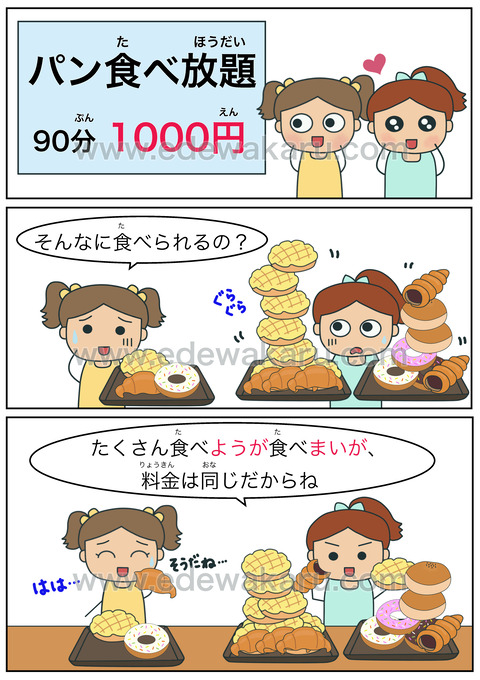
Meaning
Whether one does ~ or doesn’t
How to use it
Verb [volitional form] + ようが + Verb [dictionary form] + まいが
Verb [volitional form] + ようと + Verb [dictionary form] + まいと
Explanation
「AようがAまいが〜」 is a sentence pattern meaning “Whether one does A or doesn’t do A, ~.” The same verb goes in both instances of 「A」. It is used to say that something happens regardless of whether A is done. Let’s review 「まい」. When 「する」 is used for 「A」, the forms are:
「Aしようが、Aしまいが」「Aしようが、Aするまいが」「Aしようが、Aすまいが」
[Example]
Whether you participate or not, you have to pay the membership fee.
=Whether you participate or not, you have to pay the membership fee.
=Whether you participate or not, you have to pay the membership fee.
There are many sentence patterns that include 「よう」, so learn to distinguish them as you review 😉
【List of sentence patterns that include 「よう」】
In context 5 examples
食べ放題では、たくさん食べようが食べまいが料金は同じだ
→たくさん食べても食べなくても、料金は同じだAt an all-you-can-eat restaurant, the price is the same whether you eat a lot or not. → The price is the same whether you eat a lot or don’t.
パーティーに参加しようが参加しまいが、会費を払わなきゃいけない
→参加しても参加しなくても、会費を払わなきゃいけないWhether you attend the party or not, you have to pay the membership fee. → You have to pay the membership fee whether you attend or not.
雨が降ろうが降るまいが、イベントは行われるそうだ
→雨が降っても降らなくても、イベントは行われるそうだI hear the event will take place whether it rains or not. → I hear the event will take place whether it rains or not.
結婚しようがしまいが、私の勝手でしょ!
→結婚してもしなくても、私の勝手でしょ!Whether I get married or not is my business, isn’t it? → Whether I get married or not is my business, isn’t it?
元カレに新しい彼女がいようがいまいが、私には関係ないわ
→新しい彼女がいてもいなくても、私には関係ないわWhether my ex has a new girlfriend or not has nothing to do with me. → Whether he has a new girlfriend or not has nothing to do with me.
Read the original source text
Meaning
〜しても〜しなくても
How to use it
動詞[意向形]+ようが+動詞[辞書形]+まいが
動詞[意向形]+ようと+動詞[辞書形]+まいと
Explanation
「AようがAまいが〜」は「AしてもAしなくても〜」という意味の文型です。「A」には同じ動詞が入り、「AしてもAしなくても、関係なく〜」と言いたい時に使われます。「まい」の復習をしておきましょう。「A」に「する」が入る場合は、
「Aしようが、Aしまいが」「Aしようが、Aするまいが」「Aしようが、Aすまいが」
になります。
[例文]
参加しようが参加
しまいが、会費は払わなきゃいけない
=参加しようが参加
するまいが、会費は払わなきゃいけない
=参加しようが参加
すまいが、会費は払わなきゃいけない
「よう」がつく文型はたくさんありますので、区別して覚えておきましょう😉
【「よう」がつく文型リスト】
くらべてわかる日本語表現文型辞典
Meaning
Meaning 1: Whether A is done or not, whether A is the case or not, in the end B.
Meaning 2: A dismissive way of saying that it makes no difference to the speaker whether someone else does A or not.
How to use it
Explanation
【Contrast 1, 2】
「AようがBようがC」 (Meaning 1, p. 317)
Notes
【Note 1】
・For i-adjectives, na-adjectives, and nouns, A₂ may be omitted.
In context 8 examples
一度開封してしまったら、使おうが使うまいが、返品はできない。
Once it has been opened, it can’t be returned whether you use it or not.
寮で夕食を食べようと食べまいと、寮費は一月3万円です。
Whether or not you eat dinner at the dorm, the dorm fee is 30,000 yen a month.
高かろうが、高くなかろうが、ほしいものはほしい。
Whether it’s expensive or not, I want what I want.
病気だろうが、なかろうが、仕事は休めない。
Whether I’m sick or not, I can’t take time off work.
先生に頼もうが頼むまいが君の自由だ。
It’s up to you whether you ask the teacher or not.
彼女が彼と結婚しようがしまいが、私には関係ないことだ。
Whether she marries him or not has nothing to do with me.
真実を話そうと話すまいと、あなた自身で決断することだ。
Whether to tell the truth or not is a decision you have to make yourself.
人に迷惑をかけようとかけまいと君にとやかく言われることではない。
Whether or not you cause trouble for others is none of your business to lecture me about.
Read the original source text
Meaning
意味1:Aをしてもしなくても、Aであってもなくても、結局はB。
意味2:Aをしてもしなくても話し手には関係ないと、他者を突き放した言い方。
How to use it
Explanation
【対比1,2】
「AようがBようがC」(意味1 P.317)
Notes
【注意1】
・イ形容詞、ナ形容詞、名詞のときは、A₂が省略できる。
IMABI
Whether/No Matter… Or…: V1 ~(よ)う{が・と}V1+~まい{が・と}
Read this IMABI lesson ↗Explanation
Whether/No Matter… Or…: V1 ~(よ)う{が・と}V1+~まい{が・と}
Over the past few lessons, we have learned how to conjugate with the auxiliary verbs ~(よ)う and ~まい for their respective predicate types. In these lessons, we learned that they all share two things in common: expressing volition and expressing supposition, with one group doing so in the affirmative (~(よ)う・だろう) and the other group do so in the negative (~まい).
In this lesson, we will learn how these dual volitional/suppositional endings are used to create contrastive conditions in the vein of “whether/no matter… or…” Though analogous to V1 ~ても V1 ~なくても, this pattern is far more emphatic and reflective of the speaker’s conviction.
First, let’s go over how to conjugate with these auxiliaries.
Predicate Type+~(よ)う+~まい
一段動詞見よう見(る)まい
五段動詞言おう言うまい
サ変しようしまい
するまい
すまい
カ変来(こ)よう来(こ)まい
来るまい
形容詞新しかろうX
形容動詞簡単だろう
簡単であろう簡単であるまい
だ・である~だろう
~であろう~であるまい
~ない~なかろうX
Next, there are several commonalities that define this pattern which will be true across all these predicate types:
While the basic pattern juxtaposes the affirmative and negative volitional/suppositional auxiliaries with the same base predicate, the negative element may be swapped out for the antonym of the first.
While “no matter/whether… (or not)” implies more than one element, in practice, only one has to be spoken for the pattern to be valid, with the opposite – however the opposite is formed – implied.
This pattern is not limited to just two elements being juxtaposed, and the chain can keep going so long as there are conditions that the speaker states shall not heed the main clause from coming to pass.
The full of repetition of all complements found for Predicate1 in the second element is rare (Ex. 8) but not impossible.
In addition to these commonalities, there is a slight difference in nuance between using the conjunctive particle が and the conjunctive particle と.
Predicate1 ~(よ)うが (Predicate1 ~まいが): Most often used to describe scenarios which directly concern the mental state/reality of the speaker, while also characterized said scenario as frankly and/or as crudely as possible.
Predicate1 ~(よ)うと (Predicate1 ~まいと): Most often used to describe scenarios which are detached or indirectly related to (one’s) reality, making it most suitable for really letting one’s analogies and hypotheticals go wild; however, this does not take away from how the main predicate remains true.
Out of brevity, the second element is still to be understood as being either Predicate1 ~まい{が・と} or Predicate2 ~(よ)う{が・と}.
V1 ~(よ)う{が・と}(V1+~まい{が・と})
Vi~(よ)う{が・と}(V2+~(よ)う{が・と})
First, let’s investigate how this pattern affects verbal predicates. With verbs, the nature of the volitional/suppositional auxiliaries depends on the verb’s semantics, which we will go into further detail upon having seen some example sentences.
1. 君が行こうと行くまいと俺の勝ちだ。
Whether you go or don’t go, the victory is mine.
2. 人が来ようと来まいと、パーティーを開く予定には変わりはないんだ。
Whether people come or not, I’m still going to throw the party.
3. 信じようと信じまいと真実は変わらない。
Whether you believe it or not, the truth will not change.
4. 実際に謝ろうと謝るまいと、本気で悔いていれば違いはないのですか。
Whether you actually apologize or not, would there not be any difference if you truly regretted (your actions)?
5. 手術をしようがしまいが、間に合わない。
Whether I undergo surgery or not, it won’t make it in time.
6. 肺癌は、たばこを吸おうが吸うまいが、罹るときは罹ってしまう。
Lung cancer, whether you smoke or not, is something you get when you get it.
7. 何をしようと私の知ったことではありません。
Whatever you do, I know nothing about it.
Sometimes, the juxtaposed second element is not the exact antonym of the first, but there must still be a stark contrast between the two, such as, but not excluded to, spears falling from the sky instead of water.
8. 雨が降ろうが槍が降ろうが、決して揺らぐことがない。
Come hell or high water, I shan’t waver.
Literally: Whether it rains water or spears, I shan’t waver.
Partial Ellipsis w/ する Verbs
Ellipsis of the nominal root of a する verb occurs provided that said predicate is repeated. While zero ellipsis in this environment is not ungrammatical, it is unnecessarily verbose and would be subject to being corrected.
9. 不倫しようがしまいがその人の人生なんだし、好きにさせてやればいいと思うし、赤の他人がどうこう言う問題じゃないと思うんです。
Whether someone commits infidelity or not, that’s a matter of that person’s life, and I feel we ought to let (people) do what they please and that it’s not a matter complete strangers ought to fuss about.
10. 結婚しようが結婚しまいがストレスが少ないのが一番大事!
Whether you get married or not, the most important thing is to have as little stress as possible!
~ていよう{が・と}~(て)いまい{が・と}
It turns out that base verb in its て form may be ellipsed in the second element when the forms ~ていよう ~ていまい are being juxtaposed.
11. 自覚していようがしていまいが、誰の心にも差別や偏見は潜んでいる。
Whether we are aware of it or not, discrimination and prejudice lurk in everyone’s heart.
12. 自覚していようがいまいが、それぞれ自分が主人公の物語を紡いでいます。
Whether we realize it or not, each of us is weaving our own story as the protagonist.
13. 口に出そうと出すまいと、意識していようといまいと、観客が恋愛や犯罪や麻薬や戦争や反乱を通して求めているのは、結局、詩的・・・
Whether they say it or not, whether they are aware of it or not, what audiences are looking for through love, crime, drugs, war, and rebellion is ultimately poetry…
14. 意識していようとしていまいと,我々は常に「決断」しています。
Whether we are aware of it or not, we are constantly making “decisions.”
Volition VS Supposition
This grammar point is a great bridging context between the notions of volition and supposition. Determining which is which in the context of verbal predicates requires us to consider whether or not the verbs are non-volitional by nature.
15. 私たちが一緒に行こうが行くまいが、彼女にとっては関係ないのです。
It doesn’t matter to her whether we go with her or not.
16. 次の旅行にあなたが一緒に行こうが行くまいが気にしない。
I don’t care if you come with me on the next trip or not.
17. うまく行こうが行くまいがやってみるしかない。
Whether it works or not, all you can do is try.
These examples show how even with the same verb, volition is not necessarily a constant.
Firstly, for volition to be involved, there must be an agent. While Ex. 15 and Ex. 16 check out with clear agents, the agent is notably not the speaker in Ex. 16, and as for Ex. 17, no agent is present at all, which renders 行く as a non-volitional verb in that context.
With this in mind, there must be a reason for why Japanese utilizes the same auxiliaries in these unique scenarios, and that reason lies in how modality is perceived, and the scale of modality at hand here is the involvement of agents being tied to the perceived certainty of the act/event itself. This allows the same verb to differ in volition depending on the context as well as explain why the same endings can be used with all verbs. This leads us to the following relationships between volition and supposition.
VolitionAgent?Supposition
HighOneself/One’s GroupAbsolute certainty on executing said volition.
MediumOthersSpeculative as to whether said volition will be carried out.
NoneNo AgentLikelihood that the situation will occur.
Granted, these endings are being followed by conjunctive particles, meaning the modality statement is being dismissed as a mute point in the context of the main clause happening regardless. As a result, we actually do not know whether the juxtaposed conditions will even occur, making these three unique environments all that more similar within the context of this pattern.
15. 私たちが一緒に行こうが行くまいが、彼女にとっては関係ないのです。
It doesn’t matter to her whether we go with her or not.
Returning to Ex. 15, 行く was marked as being used in a volitional capacity. In isolation, the forms 行こう and 行くまい would be statements on the agent’s willingness to execute said action or not. With the conjunctive particle が in the picture, the agent carrying out [行こう][行くまい] does not matter for the main clause to be true, which is precisely the nature of the contrastive relationship being made.
The Dialectal ~しようがしよ(う)まいが
In the dialects in and around Nagoya1, you will encounter a variant of this pattern with verbal predicates: ~(よ)うが~よ(う)まいが . While と may still be used instead of が, が is used extensively more, perhaps due to cadence.
18. PCR検査をしようがしよまいが、昨日愛知県で100人以上が新たに感染したことには変わりがない訳です。
Whether you take a COVID PCR test or not, that doesn’t change the fact that over 100 people were newly infected yesterday in Aichi Prefecture.
Adj1 ~かろう{が・と} Adj1 ~なかろう{が・と}
The same can be said regarding the relationship between volition and supposition as it pertains to adjectival predicates. These predicates do not have agents, although subjects may be affected by the conditions set forth by them.
Part of Speech未然形Ex. PredicateEx. of Pattern
形容詞–karo–寒かろう寒かろうが寒くなかろうが※
※Insofar, we have only seen instances of this grammar in which the same word is repeated but in the pattern “Predicate1affirm. ~かろう{が・と}Predicate1neg. ~かろう{が・と}, but perhaps due to how adjectival predicates pertain to states, it is far more common for the second element to be the antonym of the first:
寒かろうが寒くなかろうが (△) → 寒かろうが暑かろうが ◎
This can be extended to the other predicates as well, but we will leave such variation for after we have at least had the chance to see its basic realization with all predicate types. Nonetheless, contexts can be cherrypicked to allow for the repetition of the same adjective.
19. 寒かろうが暑かろうが、試合を中止しないよ。
Whether it’s hot or cold, I won’t postpone the game.
20. 古かろうが新しかろうが、そんなもの買ったとしても、あてにならないよ。
Whether it’s old or new, even if you were to buy something like that, it won’t do you any good.
21. 母さんが夜なべをして、手袋、編んでくれた。木枯らし吹いちゃ、冷たかろうに、せっせと編んだんだよ。
Mother knitted mittens for me on her night ship. Even though it was supposed to be cold with the wintry breeze blowing, she diligently knitted it.
From 『母さんの歌』.
22. 美しかろうが醜かろうが、人間は人間だ。
Whether beautiful or ugly, a human is human.
23. 黒かろうが白かろうが、蝶を俺のトカゲのエサとしか思えない。
Whether they’re white or black, I can only think of butterflies as food for my lizard.
24. 寒かろうが寒くなかろうが、どうせ冬を避けては通れないのでどっちでもいいね。
Whether it’s cold or not cold, since there’s no avoiding winter anyway, it doesn’t matter either way.
N/Adj. N1であろう・だろう}{が・と}+ N/Adj. N1であるまい{が・と}
Due to the use of the copula, there is additional morphological variation with nominal and adjectival noun predicates that does not appear for the other predicate types.
When the copula だ is used, the opposite of だろう is でなかろう.
When the copula である is used, the opposite of であろう is であるまい.
Whether だ-ellipsis occurs, which occurs as follows.
No EllipsisW/ Ellipsis
N/Adj. N1{であろう・だろう}{が・と}N/Adj. N1であるまい{が・と}N/Adj. N1{であろう・だろう}{が・と}(で)なかろう{が・と}
25. 真実であろうが真実であるまいが、関係はない。
Whether it’s true or it’s not true, I have no part in it.
26. 障碍者であろうが(で)なかろうが、店員として働いている以上、責任はあるだろう?
Whether the person was disabled or not, the (employee) is responsible (for his actions) so long as he is working (there) as an employee.
27. 国際結婚であろうと(で)なかろうと、最初の一年はキツい。
Whether you’re in an international marriage or not, the first year is tough.
28. 休日であろうが、なかろうが、その店は営業している。
Holiday or not, that store is open for business.
29. 彼女が実の犯人であろうとなかろうと、中国で有罪の判決が言い渡されたから、もうすぐ処刑されるだろう。
Whether or not she’s the true criminal or not, because she’s been found guilty in China, she will probably be executed soon.
30. 雨天うてんだろうと決行するつもりです。
I plan to carry it out even in rainy weather.
31. 子供だろうが容赦ようしゃはしない。
Even as children, they don’t show mercy.
32. どんな人だろうと、この映画は楽しめます。
No matter what kind of person you are, you can enjoy this movie.
33. 真実であろうが嘘であろうが、まだ関係はない。
Whether it’s true or a lie, I still have no part in it.
The Ungrammaticality of Pred.1 ~(よ)う{が・と}+ Pred.1~なかろう{が・と}
With the opposite of だろう being でなかろう, and with でなかろう involving the auxiliary ~ない, you may wonder if ~なかろう can replace ~まい for verbal predicates.
Firstly, in isolation, as a typical auxiliary form, ~なかろう can be used with verbal predicates just as much as it can with the other predicate types, serving as an intermediary form between ~まい and ~ないだろう.
34. 夢が実現{しまい・しなかろう}が、真剣に取り組んだ確実な実績を周りの人に見て頂くこと、それが大切だと思っています。
Even if my dream doesn’t come true, I think it’s important for the people around me to see the tangible results of my hard work.
35. 理解{できなかろう・できまい}が現に在るものを、見ないようにして振舞っていたら、後々そこでつまづくのは、むしろ当然だろう。
Even if you’re not able to comprehend it, if you act like you do see what actually exists (in front of you), it’s only obvious that you’d suffer setbacks over those things in the long run.
~なかろう only denotes supposition; the control of agency is outside the control of the speaker, and thus, cannot be determined definitively. Consequently, while the actual execution of volition is not pertinent to the main clause ultimately coming to pass with V1 ~(よ)う{が・と}(V1~まい{が・と}) or V1~(よ)う{が・と}(V2~(よ)う{が・と}), juxtaposition of said executions of volition still occurs. This means the use of ~なかろう over ~まい, at the very least, is out of the question for volitional verbs with agents in full control of the execution of the contrastive clauses.
As for mid-tier volitional and non-volitional verbs, or contexts in which a verb is of said vein, we find that parallelism more often that not prevents the juxtaposing of ~(よ)う and ~なかろう, as the opposite of ~なかろう out to be ~だろう.2
36a. 存在していようが存在していなかろうが・・・ X
36b. 存在していようが(して)いまいが ・・・〇
Whether (it) exists or not…
In everyday conversation, however, しよう{が・と}しなかろう{が・と}does in fact appear, which is the natural consequence of sentences like Exs. 34-35 being grammatical: with the suppositional meaning of the pattern employed, volition is not (entirely) in play, thus this morphological variation is valid within such contexts3 and notably distinct nuance-wise.
37. 私は「地球が温暖化しようがしなかろうがどっちでもいい派」です。なんて無責任な、て思われる方もおられるでしょう。(No Volition/Agent)
I’m of the opinion that “whether global warming happens or not, it doesn’t matter.” Now, I’m some of you may think that is irresponsible (of me).
38. 翻訳は誰でも書けますが、注意点は機械翻訳に頼りすぎない事です。 別に翻訳しようがしなかろうが個人の自由だし。(Agent’s Volition/Control Not Emphasized)
Anyone can write up a translation, but be careful not to rely too much on mechanical translations. Anyway, it’s one’s personal choice whether to translate or not.
39. 消毒しようがしなかろうがうつるもんはうつるよなぁー!(Result Of Act Technically Out of Control of Agent)
Whether you disinfect or not, you’re gonna catch what’s contagious!
As for the existential verb ある, because the opposite of ある is ない as opposed to あらない, あろう{が・と}なかろう{が・と}. Following what we learned for ~でない, that also means あろう{が・と}あるまい{が・と}is possible, although not as common due to cadence.
40. 神の力があろうとなかろうと、それは変わりません。
Whether we have the power of the gods or not, that will not change.
41. お金があろうがあるまいが、土地なんか買わない。
Whether I have the money or not, I won’t be buying land (or the like).
This dialect region also exhibits ~まい following the 未然形 of all parts of speech, with /yo/ intervening for 一段, サ変, and カ変 verbs. For 五段 verbs, the 未然形 may end in either /a/ or /o/ when paired with ~まい. ↩︎
~だろう never replaces the use of ~(よ)う in this pattern. Perhaps in a future stage of Japanese, this placement might occur for non-volitional verbs first, but such replacement would be unlikely so long as ~(よ)う maintains its suppositional meaning, and the pattern at large would likely be completely replaced by ~ても~なくても before that were to ever get to happen. ↩︎
The sheer absence of this morphological variation in grammar reference materials, including those for the JLPT, vs the overwhelmingly high number of examples found online is worth further study to see why it is overlooked. ↩︎
In context 42 examples
君が行こうと行くまいと俺の勝ちだ。
Whether you go or don’t go, the victory is mine.
人が来ようと来まいと、パーティーを開く予定には変わりはないんだ。
Whether people come or not, I’m still going to throw the party.
信じようと信じまいと真実は変わらない。
Whether you believe it or not, the truth will not change.
実際に謝ろうと謝るまいと、本気で悔いていれば違いはないのですか。
Whether you actually apologize or not, would there not be any difference if you truly regretted (your actions)?
手術をしようがしまいが、間に合わない。
Whether I undergo surgery or not, it won’t make it in time.
肺癌は、たばこを吸おうが吸うまいが、罹るときは罹ってしまう。
Lung cancer, whether you smoke or not, is something you get when you get it.
何をしようと私の知ったことではありません。
Whatever you do, I know nothing about it.
雨が降ろうが槍が降ろうが、決して揺らぐことがない。
Come hell or high water, I shan’t waver.
不倫しようがしまいがその人の人生なんだし、好きにさせてやればいいと思うし、赤の他人がどうこう言う問題じゃないと思うんです。
Whether someone commits infidelity or not, that’s a matter of that person’s life, and I feel we ought to let (people) do what they please and that it’s not a matter complete strangers ought to fuss about.
結婚しようが結婚しまいがストレスが少ないのが一番大事!
Whether you get married or not, the most important thing is to have as little stress as possible!
自覚していようがしていまいが、誰の心にも差別や偏見は潜んでいる。
Whether we are aware of it or not, discrimination and prejudice lurk in everyone’s heart.
自覚していようがいまいが、それぞれ自分が主人公の物語を紡いでいます。
Whether we realize it or not, each of us is weaving our own story as the protagonist.
口に出そうと出すまいと、意識していようといまいと、観客が恋愛や犯罪や麻薬や戦争や反乱を通して求めているのは、結局、詩的・・・
Whether they say it or not, whether they are aware of it or not, what audiences are looking for through love, crime, drugs, war, and rebellion is ultimately poetry…
意識していようとしていまいと,我々は常に「決断」しています。
Whether we are aware of it or not, we are constantly making “decisions.”
私たちが一緒に行こうが行くまいが、彼女にとっては関係ないのです。
It doesn’t matter to her whether we go with her or not.
次の旅行にあなたが一緒に行こうが行くまいが気にしない。
I don’t care if you come with me on the next trip or not.
うまく行こうが行くまいがやってみるしかない。
Whether it works or not, all you can do is try.
PCR検査をしようがしよまいが、昨日愛知県で100人以上が新たに感染したことには変わりがない訳です。
Whether you take a COVID PCR test or not, that doesn’t change the fact that over 100 people were newly infected yesterday in Aichi Prefecture.
寒かろうが暑かろうが、試合を中止しないよ。
Whether it’s hot or cold, I won’t postpone the game.
古かろうが新しかろうが、そんなもの買ったとしても、あてにならないよ。
Whether it’s old or new, even if you were to buy something like that, it won’t do you any good.
母さんが夜なべをして、手袋、編んでくれた。木枯らし吹いちゃ、冷たかろうに、せっせと編んだんだよ。
Mother knitted mittens for me on her night ship. Even though it was supposed to be cold with the wintry breeze blowing, she diligently knitted it.
美しかろうが醜かろうが、人間は人間だ。
Whether beautiful or ugly, a human is human.
黒かろうが白かろうが、蝶を俺のトカゲのエサとしか思えない。
Whether they’re white or black, I can only think of butterflies as food for my lizard.
寒かろうが寒くなかろうが、どうせ冬を避けては通れないのでどっちでもいいね。
Whether it’s cold or not cold, since there’s no avoiding winter anyway, it doesn’t matter either way.
真実であろうが真実であるまいが、関係はない。
Whether it’s true or it’s not true, I have no part in it.
障碍者であろうが(で)なかろうが、店員として働いている以上、責任はあるだろう?
Whether the person was disabled or not, the (employee) is responsible (for his actions) so long as he is working (there) as an employee.
国際結婚であろうと(で)なかろうと、最初の一年はキツい。
Whether you’re in an international marriage or not, the first year is tough.
休日であろうが、なかろうが、その店は営業している。
Holiday or not, that store is open for business.
彼女が実の犯人であろうとなかろうと、中国で有罪の判決が言い渡されたから、もうすぐ処刑されるだろう。
Whether or not she’s the true criminal or not, because she’s been found guilty in China, she will probably be executed soon.
雨天うてんだろうと決行するつもりです。
I plan to carry it out even in rainy weather.
子供だろうが容赦ようしゃはしない。
Even as children, they don’t show mercy.
どんな人だろうと、この映画は楽しめます。
No matter what kind of person you are, you can enjoy this movie.
真実であろうが嘘であろうが、まだ関係はない。
Whether it’s true or a lie, I still have no part in it.
夢が実現{しまい・しなかろう}が、真剣に取り組んだ確実な実績を周りの人に見て頂くこと、それが大切だと思っています。
Even if my dream doesn’t come true, I think it’s important for the people around me to see the tangible results of my hard work.
理解{できなかろう・できまい}が現に在るものを、見ないようにして振舞っていたら、後々そこでつまづくのは、むしろ当然だろう。
Even if you’re not able to comprehend it, if you act like you do see what actually exists (in front of you), it’s only obvious that you’d suffer setbacks over those things in the long run.
存在していようが存在していなかろうが・・・ X
Whether (it) exists or not…
存在していようが(して)いまいが ・・・〇
Whether (it) exists or not…
私は「地球が温暖化しようがしなかろうがどっちでもいい派」です。なんて無責任な、て思われる方もおられるでしょう。(No Volition/Agent)
I’m of the opinion that “whether global warming happens or not, it doesn’t matter.” Now, I’m some of you may think that is irresponsible (of me).
翻訳は誰でも書けますが、注意点は機械翻訳に頼りすぎない事です。 別に翻訳しようがしなかろうが個人の自由だし。(Agent’s Volition/Control Not Emphasized)
Anyone can write up a translation, but be careful not to rely too much on mechanical translations. Anyway, it’s one’s personal choice whether to translate or not.
消毒しようがしなかろうがうつるもんはうつるよなぁー!(Result Of Act Technically Out of Control of Agent)
Whether you disinfect or not, you’re gonna catch what’s contagious!
神の力があろうとなかろうと、それは変わりません。
Whether we have the power of the gods or not, that will not change.
お金があろうがあるまいが、土地なんか買わない。
Whether I have the money or not, I won’t be buying land (or the like).
AIUEO JLPT Grammar
Meaning
This sentence pattern emphasizes that, regardless of a situation or action, the result or will does not change. It is used to indicate that a certain action or situation does not affect the outcome.
How to use it
Verb (volitional form) が + Verb (dictionary form) + まいが; Verb (volitional form) と + Verb (dictionary form) + まいと
In context 5 examples
彼が賛成しようとするまいと、私はこの計画を進めるつもりです。
Whether he agrees or not, I intend to move forward with this plan.
雨が降ろうが降るまいが、ピクニックに行きます。
Whether it rains or not, I will go on the picnic.
彼らが努力しようとするまいと、成功するかどうかは運次第だ。
Whether they try or not, whether they succeed depends on luck.
私が行こうが行くまいが、彼らは予定通りに始めるだろう。
Whether I go or not, they will probably start as planned.
彼が信じようが信じまいが、これは真実だ。
Whether he believes it or not, this is the truth.
Read the original source text
Meaning
This sentence pattern emphasizes that, regardless of a situation or action, the result or will does not change. It is used to indicate that a certain action or situation does not affect the outcome.
How to use it
動詞意向形が+動詞辞書形+まいが動詞意向形と+動詞辞書形+まいと
Explanation · 日本語
この文型は、ある行動や状況に対して、その行動をするかしないか、状況がそうであるかそうでないかに関わらず、結果や意志が変わらないことを強調する表現です。
Bunpro Grammar Reference
Meaning
Even if, No matter what, Whether or not, [Emphatic], Volitional + が
How to use it
Even if / No matter what
Verb [おう] + が(1)
Verb[まい] + が(1)
Noun + だろう.(2) + が(1)
[な]Adjective + だろう(2) + が(1)
[い]Adjective[い̶]+ かろう + が(1)
Whether or not
Verb [おう] + が(1) + Verb[まい] + が(1)
Noun (A) + だろう(2) + が(1) + Noun (B) だろう(2) + が(1)
[な]Adjective1 + だろう(2) + が(1) + [な]Adjective2 + だろう(2) + が(1)
[い]Adjective[い̶]+ かろう + が(1) + [い]Adjective[い̶]+ かろう + が(1)
(1) と
(2) であろう
Nuance
A slightly formal construction which highlights the speaker's strong will to disregard (A). No matter what (A), (B).
Explanation
When both the positive and negative volitional auxiliary verbs are combined with a verb in Japanese, it has the nuance of 'whether or not (A)', the result will be (B)'. This is quite emphatic, and has a literal meaning similar to 'say it does (A) or say it doesn't (A), it will still be (B)'.
As a reminder, the positive auxiliary verbs of volition are either う or よう, depending on what they are being connected to, while the negative auxiliary verb of volition is まい. Either the case marking particle が or と will appear after both the positive and the negative, with が being slightly more common.
忘年会に出席しようが出席するまいが、会費はみんなからもらっています。
Whether you attend the year-end party or not, we will collect the admissions fee from everyone.
雨が降ろうが降るまいが、明日は絶対に釣りに行くと決めた。
Whether it rains or not, I have decided to go fishing tomorrow.
While this structure is primarily seen after verbs, it is important to remember that other auxiliary verbs such as だ can be conjugated in the same way, as can い-Adjectives with the less common かろう structure. This means that nouns, な-Adjectives and い-Adjectives can also appear using a similar grammar pattern. However, because the negative volitional まい cannot pair with these structures, an antonym will usually appear with them instead, with both words using the う or よう positive volitional.
楽しかろうが楽しくなかろうが、学校は子供の仕事だから学校には行かなくてはだめだ。
Whether it is fun or not, school is a child's job, so you must go to school.
安全だろうが安全でなかろうが、2メートル以上の場所に上がる場合は安全帯を必ず装着してください。
Whether it is safe or not, always wear a safety belt when you climb to a place higher than 2 meters.
犬であろうが猫であろうが、どちらにしても動物なので軽い気持ちで買ってはいけない。
Whether it is a dog or a cat, they are both animals, so they must not be bought on a whim.
Based primarily on the use of volitionals, this grammar pattern will often indicate the speaker's strong will or opinion that will not change regardless of (A).
In context 17 examples
- 何年がかかろうと、ドラゴンボールを見つけるつもりだ!
Even if it takes many years, I intend to find the dragon balls!
- 忘年会に出席しようが出席するまいが、会費はみんなからもらっています。
Whether you attend the year-end party or not, we will collect the admissions fee from everyone.
- 安全だろうが安全でなかろうが、2メートル以上の場所に上がる場合は安全帯を必ず装着してください。
Whether it is safe or not, always wear a safety belt when you climb to a place higher than 2 meters.
- 犬であろうが猫であろうが、どちらにしても動物なので軽い気持ちで買ってはいけない。
Whether it is a dog or a cat, they are both animals, so they must not be bought on a whim.
- 雨が降ろうが降るまいが、明日は絶対に釣りに行くと決めた。
Whether it rains or not, I have decided to go fishing tomorrow.
- 楽しかろうが楽しくなかろうが、学校は子供の仕事だから学校には行かなくてはだめだ。
Whether it is fun or not, school is a child's job, so you must go to school.
- 人が何と言おうが、ずっとあなたを愛しています!
No matter what people say, I will always love you!
- 商品は上質であろうが悪質であろうが、よく売れるものはよく売れる。
Whether the product is of good quality or low quality, if it sells well, it sells well.
- 友達が生きていようが生きていまいが、私は彼らのために歌い続ける。
Whether my friends are alive or not, I will still sing songs for them.
- 生徒が授業に出席しようが出席するまいが、私はきちんと授業を進めていく。
Whether or not students attend, I will proceed with my lecture as planned.
- 日本語の勉強が難しかろうが易しかろうが、流暢に話せるようになるまで勉強する。
Whether learning Japanese is difficult or easy, I will learn until I become fluent.
- 誰に反対されようが、僕は同性婚を支持する気持ちを変えないつもりだ。
No matter who I am opposed by, I intend to not change my feelings of endorsing same-sex marriage.
- 出発時にどんなに晴れていようがいまいが、夏の沖縄へ行くなら台風への対策もするべきです。
No matter how clear it is when you depart, if you're going to Okinawa in summer, you ought to take measures against typhoons.
- 私のルームメイトは動物が大嫌いだ。犬だろうが猫だろうが、動物を飼うのに猛反対してくる。
My roommate hates animals. No matter whether it is a dog or a cat, she will fiercely oppose owning one.
- 僕が幼い頃に蒸発してしまった父が今再婚していようが再婚していまいが、僕には関係ない。
Regardless of whether my father, who disappeared without a trace in my youth, is now getting remarried or not, it is none of my business.
- 娘が離婚しようが離婚しまいが、私は娘が幸せならそれ以上は何も求めません。
Whether or not my daughter gets a divorce, as long as she is happy, I do not wish for anything more than that.
- 日本語能力試験のために沢山の参考書を買おうと、それを実際に使いこなさないなら意味が無い。
Even if you buy heaps of reference books for the JLPT, if you don't actually use them until you get the knack of it, there is no meaning.
NINJAL 日本語文型データベース
Meaning
Used to strongly assert that the outcome is completely unaffected, whether or not ~ occurs.
How to use it
Notes
The same verb comes in both instances of “〜.” A sentence expressing the speaker’s judgment or intention often follows “〜うが〜まいが,” but a sentence expressing an already established fact is also possible.
In context 4 examples
大雪が降ろうが降るまいが、バスの運転手は仕事を休めない。
Whether or not there’s heavy snow, the bus driver can’t take the day off.
あなたが神を信じようが信じるまいが、私には関係ないことです。
Whether you believe in God or not is none of my concern.
離職しようがするまいが、僕の自由意志じゃないか。僕は自分で決める。
Whether I quit my job or not is my own choice, isn’t it? I’ll decide for myself.
私は自分の好きな絵を描きたいだけだ。それが世間に受け入れられようが受け入れられまいが構わない。
I just want to paint pictures that I like. I don’t care whether they are accepted by the public or not.
Read the original source text
Meaning
〜が成立する場合もしない場合も、それに全く影響されないと強く言いたいときに使います。
How to use it
Notes
2つの「〜」には、同じ動詞がきます。「〜うが〜まいが」の後には、話し手の判断や意志などを表す文がくることが多いですが、すでに成立した事実を表す文でもいいです。