AIUEO JLPT Grammar
Meaning
This sentence pattern highlights expressing criticism or dissatisfaction without trying or verifying something. It is often used to encourage someone to try first before complaining.
How to use it
Verb te-form + ても + みないで
In context 5 examples
やってみてもみないで、無理だと言わないでほしい。
Don’t say it’s impossible without even trying it!
聞いてもみないで、拒否するのはおかしいよ。
It’s strange to refuse without even hearing it out.
見てもみないで、興味がないなんて言わないで。
Don’t say you’re not interested without even looking at it.
読んでもみないで、つまらないと判断しないで。
Don’t judge it as boring without even reading it.
挑戦してもみないで、できないと言うのは早すぎる。
It’s too soon to say you can’t do it without even trying.
Read the original source text
Meaning
This sentence pattern highlights expressing criticism or dissatisfaction without trying or verifying something. It is often used to encourage someone to try first before complaining.
How to use it
動詞て形ても+みないで
Explanation · 日本語
この文型は、何かを試すことや確認することをせずに批判や不満を述べることを強調する表現です。よく使われるのは、不平や不満を言う人に対して、まず試してみるべきだということを伝える場面です。
絵でわかる日本語
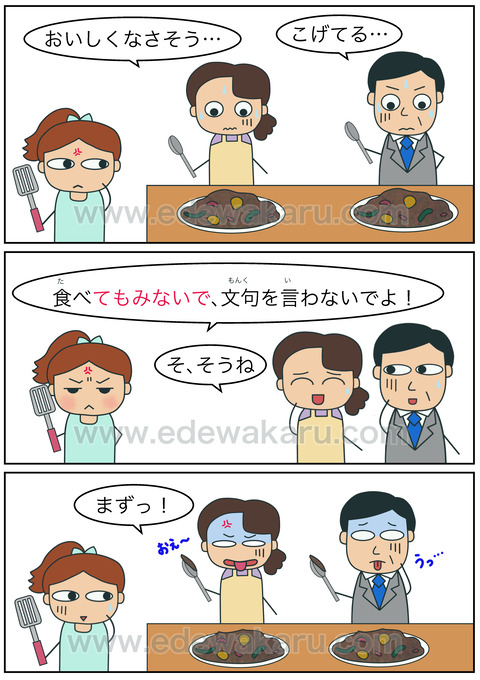
Meaning
Without having done 〜
Without doing 〜
How to use it
Verb [て-form] + てもみないで
Explanation
“〜てもみないで” is a sentence pattern meaning “without having done 〜” or “without doing 〜.” It emphasizes “without having done 〜” or “without doing 〜” and expresses reproach or criticism.
Be sure to review sentence patterns that use “〜てみる” 😊
In context 5 examples
食べてもみないで、文句を言わないでよ!!
→食べていないのに、文句を言わないでよ!!Don’t complain when you haven’t even tried it!! → Don’t complain when you haven’t eaten any!!
やってもみないであきらめるのはよくない
→やらないであきらめるのはよくないIt’s not good to give up without even trying. → It’s not good to give up without trying.
この本を読んでもみないで、なんでおもしろくないなんて言いきれるの?
→読んでいないのに、なんでおもしろくないなんて言いきれるの?How can you say this book isn’t interesting when you haven’t even read it? → How can you say this book isn’t interesting when you haven’t read it?
彼女は、どうしたらいいか考えてもみないで泣いてばかりいる
→どうしたらいいか考えないで、泣いてばかりいるShe just keeps crying without even thinking about what she should do. → She just keeps crying without thinking about what she should do.
A:この漢字の読み方がわからないな…先生に聞きに行こうっとB:自分で調べてもみないで、何でも先生に聞くのはどうかと思うよ
→自分で調べていないのに、何でも先生に聞くのはどうかと思うよA: I don’t know how to read this kanji… I’ll go ask the teacher. B: I don’t think you should ask the teacher about everything without even looking it up yourself. → I don’t think you should ask the teacher about everything when you haven’t even looked it up yourself.
Read the original source text
Meaning
〜していないのに
〜ないで
How to use it
動詞[て形]+てもみないで
Explanation
「〜てもみないで」は「〜していないのに」「〜ないで」という意味の文型です。これは「〜していないのに」「〜ないで」というのを強調し、非難や批判する気持ちを表します。
「〜てみる」がつく文型を復習しておきましょう😊
毎日のんびり日本語教師
How to use it
Verb te-form + もみないで~
Explanation
Indicates that the preceding action has not been performed.
It can be rephrased as “~をしてもいないのに” (“even though one hasn’t even done ~”) and conveys blame or criticism.
It has the same meaning as “~しないで,” but while “~しないで” can describe an accompanying circumstance, as in “財布を持たないで出かけた” (“I went out without my wallet”), “~てもみないで” cannot be used this way.
Notes
The “~てみる” series
In context 4 examples
ろくに調べてもみないで、それが正しいと信じ込むのは良くない。
It’s not good to become convinced something is correct without even looking into it properly.
やってもみないで諦めるのは私のやり方ではない。
Giving up without even trying is not my way.
やってもみないで文句を言うのは止めてください。
Please stop complaining without even trying it.
やってもみないで、事の成否を疑うな。
Don’t doubt whether it will succeed or fail without even trying it.
Read the original source text
How to use it
動て形+もみないで~
Explanation
前件の動作が行われていない状態を表します。
「~をしてもいないのに」と言い換えられ、非難、批判の感情を含みます。
「~しないで」と同じ意味は同じですが、「~しないで」は「財布を持たないで出かけた」のように付帯状況を表すことができる一方、「~てもみないで」にこの用法はありません。
Notes
「~てみる」シリーズ