AIUEO JLPT Grammar
Meaning
This sentence pattern is used when indicating that something is created or thought of based on a specific thing, like an idea, plan, or work. It refers to the elements that form the foundation of the item or concept.
How to use it
Noun + を + もとに (+ して)
In context 5 examples
この映画は、実際にあった事件をもとに作られた。
This movie was made based on a true event.
彼は長年の経験をもとにして、この本を書いた。
He wrote this book based on his years of experience.
アンケート結果をもとに、新商品の開発が進められた。
The development of the new product was based on the survey results.
研究結果をもとに、新しい理論が提唱された。
A new theory was proposed based on the research results.
統計データをもとに、マーケティング戦略を立てます。
We develop a marketing strategy based on statistical data.
Read the original source text
Meaning
This sentence pattern is used when indicating that something is created or thought of based on a specific thing, like an idea, plan, or work. It refers to the elements that form the foundation of the item or concept.
How to use it
名詞を+もとに(+して)
Explanation · 日本語
この文型は、特定の物事や情報に基づいて、何かを作ったり考えたりするときに使われる表現で、アイデアや計画、作品などの土台となる要素を示します。
Bunpro Grammar Reference
Meaning
Based on, From, According to
How to use it
Noun + をもとに(して)
Noun + をもとにした + Noun
Nuance
An expression showing that (A) is the basis or foundation from which (B) is going off.
Explanation
When linked to a noun, を元に is an expression that indicates that something is 'based on (A)', 'from (A)', or 'according to (A)'. This is a combination of を, the noun 元 'origin', and に. The literal meaning is similar to 'with (A) as the origin, (B)', and is used primarily to reference a source from which something is created or started.
このドラマは実際に起こったことをもとに作られたそうだ。
Apparently, this TV show was created based on actual events.
研究の結果をもとにレポートを書いてください。
Please write a report based on the results of the research.
私はこのデータをもとにこのグラフを作成しました。
I created this graph based on this data.
Most of the time, をもとに will be written without kanji, but it is also possible to see it as を元に.
As this grammar pattern is mainly used to highlight an origin of creation, it will often be seen in sentences that use verbs like 書く 'to write', できる 'to be able', and 作る 'to make'.
Caution
を元に 'based on' differs to に基づいて 'based on', in that に基づいて indicates a foundation from which the judgement or conclusion of (B) is made, while を元に focuses more on being a source of inspiration for (B), or enabling (B).
彼は法律に基づいて処分されるだろう。
He will be receiving punishment according to the law.
彼は法律をもとに処分されるだろう。
He will be punished based on the law.
Fun Fact
Although 元に is perhaps the most common, either 基に or 下に may also be used in various circumstances. You can read about the slight variances in nuances online, but for the most part, they are as follows.
基に - With the root of (A), with a direct link or connection to (A).
元に - With the beginning or origin of (A).
下に - At the base of (A).
In context 17 examples
- これはクックパッドを元に作ったうどんです。
This is udon made according to Cookpad.
- このドラマは実際に起こったことをもとに作られたそうだ。
Apparently, this TV show was created based on actual events.
- 研究の結果をもとにレポートを書いてください。
Please write a report based on the results of the research.
- 私はこのデータをもとにこのグラフを作成しました。
I created this graph based on this data.
- このインタビューを元に記事を書いてください。
Please write an article based on this interview.
- 息子の足跡を元に後を追った。
I pursued my son based on his footprints.
- 電話帳を元に宛名を書いてください。
Please write the name and address according to the telephone book.
- そんな主観を元に恨まれても困るよ。
If you feel bitter about it based on that personal opinion, I will not be thrilled.
- 編物の本を元に編んだらうまくできた。
When I knitted according to the knitting book, it turned out well.
- そんな不正確な情報を元に怪しむなんてどうかしている。
To suspect (something) based on such inaccurate information is crazy.
- 親の経験を元に育児のアドバイスをもらっている。
I am receiving child rearing advice based on my parent's experience.
- 市町村のホームページを元に移転先を決めました。
I decided to move based on the town's homepage.
- 税金の総額は年度の収入を元にして計算される。
The amount of tax is calculated based on revenue in a fiscal year.
- この恋愛漫画は実際に起こったことを元に作られているらしい。
I heard that this romance manga is based on actual events.
- 本当の魚の姿を元にしたロボットは普通の魚とともに暮らし、海洋生物についてのデータを収集しています。
Robots based on the shape of an actual fish are living with ordinary fish and are collecting data about marine life.
- 彼は法律に基づいて処分されるだろう。
He will be receiving punishment according to the law.
- 彼は法律をもとに処分されるだろう。
He will be punished based on the law.
どんなときどう使う 日本語表現文型辞典
Meaning
derived from
How to use it
N + をもとに(して)
Explanation
をもとに(して)
~を素材にして/~からヒントを得て
1)あるものが生み出される素材を表す。後には、「書く・話す・作る・創作する」などの意味を持つ文が来る。
2)「にもとづいて」と意味が似ているが、「をもとにして」は、それから具体的な素材を得るだけであり、精神的に離れずにという気持ちは薄い。
3)後に名詞が来る場合は ❸ ❹ のように「をもとにしたN」という形になる。
1)Describes material that creates something. Clauses with meanings of 書く, 話す,作る, 創作する, etc. follow.
2)Similar in meaning to にもとづいて, but をもとにして has less feeling of emotional inability to gain distance, and focuses instead of obtaining concrete materiel.
3)When followed by a noun, becomes をもとにした N, as in sentences ❸ and ❹ .
In context 4 examples
ひらがなとかたかなは漢字をもとにして生まれたものである。
Hiragana and katakana were created based on kanji.
北欧の古い歌をもとに、新しい音楽に作りかえたのがこの曲です。
This piece was created by reworking an old Nordic song into new music.
ポップスの中には有名なクラシックの曲の一部をもとにしたものがある。
Some pop songs are based on parts of famous classical pieces.
最近、戦争体験者の話してくれたことをもとにしたテレビドラマが多い。
Recently, there have been many TV dramas based on stories told by people who experienced the war.
Read the original source text
Meaning
derived from
How to use it
N+をもとに(して)
Explanation
をもとに(して)
~を素材にして/~からヒントを得て
1)あるものが生み出される素材を表す。後には、「書く・話す・作る・創作する」などの意味を持つ文が来る。
2)「にもとづいて」と意味が似ているが、「をもとにして」は、それから具体的な素材を得るだけであり、精神的に離れずにという気持ちは薄い。
3)後に名詞が来る場合は ❸ ❹ のように「をもとにしたN」という形になる。
1)Describes material that creates something. Clauses with meanings of 書く, 話す,作る, 創作する, etc. follow.
2)Similar in meaning to にもとづいて, but をもとにして has less feeling of emotional inability to gain distance, and focuses instead of obtaining concrete materiel.
3)When followed by a noun, becomes をもとにした N, as in sentences ❸ and ❹ .
絵でわかる日本語
Usage 1
Read this source entry ↗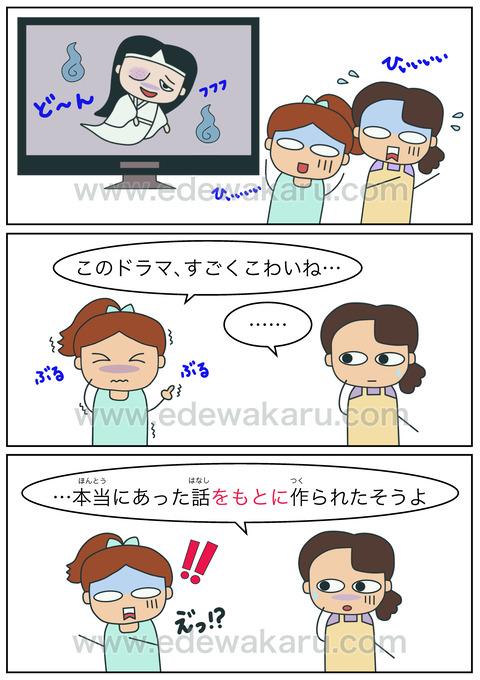
Meaning
use ... as a basis for ...
make ... using ... as the material
use ... as the subject matter for ...
How to use it
Noun [dictionary form] + をもとに
Noun [dictionary form] + をもとにして
Noun [dictionary form] + をもとにした + noun
Explanation
“〜をもとに” is a grammar pattern meaning “do something using ... as a basis” or “make something using ... as the material.” It is used when you want to say that something new is made using something as material or a basis.
〜をもとに can be changed to 〜をもとにして.
When a noun follows, the form is 〜をもとにした + noun.
[Example]
Write a book based on your own experiences.
= Write a book based on your own experiences.
Let’s review the pattern similar to 〜をもとに 😊
[Related patterns]
In context 5 examples
娘:このドラマ、すごくこわいね…母:本当にあった話をもとに作られたそうよ
→本当にあった話を題材にして作られたそうよDaughter: This drama is really scary… Mother: I hear it was made based on a true story. →I hear it was made using a true story as its subject matter.
ひらがなは漢字をもとにつくられた
→ひらがなは漢字を基本につくられたHiragana was created based on kanji. →Hiragana was created using kanji as its basis.
この商品は女子高生(じょしこうせい)のアイデアをもとに作られた
→女子高生のアイデアを基本に作られたThis product was created based on an idea from a high school girl. →It was created using a high school girl’s idea as its basis.
彼は自分の経験をもとに、本を書いた
→自分の経験を題材に、本を書いたHe wrote a book based on his own experiences. →He wrote a book using his own experiences as the subject matter.
調査結果(ちょうさけっか)をもとに、レポートを書きます
→調査結果を基本に、レポートを書きますI will write a report based on the survey results. →I will write a report using the survey results as its basis.
Read the original source text
Meaning
〜を基本にして〜する
〜を素材にして〜をつくる
〜を題材に〜する
How to use it
名詞[辞書形]+をもとに
名詞[辞書形]+をもとにして
名詞[辞書形]+をもとにした+名詞
Explanation
「〜をもとに」は「〜を基本にして〜する」「〜を素材にして〜をつくる」という意味の文型です。この文型は「〜を素材や基本にして、何か新しいものをつくる」と言いたい時に使われます。
「〜をもとに」は「〜をもとにして」にチェンジすることができます。
また、
後ろに名詞がくる場合は「〜をもとにした+名詞」になります。
[例]
自分の経験
をもとに、本を書く
=自分の経験
をもとにして、本を書く
「〜をもとに」に似ている文型を復習しておきましょう😊
【関連文型】
Usage 2
Read this source entry ↗Meaning
use ... as a basis for ...
make ... using ... as the material
use ... as the subject matter for ...
How to use it
Noun [dictionary form] + をもとに
Noun [dictionary form] + をもとにして
Noun [dictionary form] + をもとにした + noun
Explanation
“〜をもとに” is a grammar pattern meaning “do something using ... as a basis” or “make something using ... as the material.” It is used when you want to say that something new is made using something as material or a basis.
〜をもとに can be changed to 〜をもとにして.
When a noun follows, the form is 〜をもとにした + noun.
[Example]
Write a book based on your own experiences.
= Write a book based on your own experiences.
Let’s review the pattern similar to 〜をもとに 😊
[Related patterns]
Read the original source text
Meaning
〜を基本にして〜する
〜を素材にして〜をつくる
〜を題材に〜する
How to use it
名詞[辞書形]+をもとに
名詞[辞書形]+をもとにして
名詞[辞書形]+をもとにした+名詞
Explanation
「〜をもとに」は「〜を基本にして〜する」「〜を素材にして〜をつくる」という意味の文型です。この文型は「〜を素材や基本にして、何か新しいものをつくる」と言いたい時に使われます。
「〜をもとに」は「〜をもとにして」にチェンジすることができます。
また、
後ろに名詞がくる場合は「〜をもとにした+名詞」になります。
[例]
自分の経験
をもとに、本を書く
=自分の経験
をもとにして、本を書く
「〜をもとに」に似ている文型を復習しておきましょう😊
【関連文型】
日本語文型辞典
Meaning
Basic information: Nをもとに(して). Means “using something as material, a hint, a basis, and so on.” When modifying a noun, it takes the form “NをもとにしたN,” as in ⑤. Examples: ① I wrote the screenplay based on a true story. ② It is not good to judge people based only on rumors. ③ I would like to make a romantic movie based on legends passed down in this region. ④ Relief supplies were procured based on reports from the investigation team. ⑤ I completed a work based on historical fact.
Read the original source text
Meaning
基本情報Nをもとに(して)説明「あるものを材料・ヒント・根拠などにして」という意味を表す。名詞を修飾する時は⑤のように「NをもとにしたN」になる。例文① 実際にあった話をもとにして脚本を書いた。② 人のうわさだけをもとにして人を判断するのはよくない。③ この地方に伝わる伝説をもとにして、女フ想的な映画を作ってみたい。④ 調査団からの報告をもとに救援物資の調達が行われた。⑤ 史実をもとにした作品を書き上げた。
日本語文型辞典 英語版
Meaning
【をもとに】[Nをもとに(して)]
Means “taking a particular thing as material, a hint, or the basis for (something).” When it modifies a noun, as in example
(5)
, it becomes NをもとにしたN.
In context 5 examples
実際にあった話をもとにして脚本を書いた。
I wrote the screenplay based on a true story.
人のうわさだけをもとにして人を判断するのはよくない。
It is not good to judge people only on the basis of gossip.
この地方に伝わる伝説をもとにして、幻想的な映画を作ってみたい。
I want to make a fantasy movie based on a traditional legend of this area.
調査団からの報告をもとに救援物資の調達が行われた。
Relief supplies were procured on the basis of the report of the inquiry commission.
史実をもとにした作品を書き上げた。
I wrote a work based on historical fact.
くらべてわかる日本語表現文型辞典
Meaning
A is the basis or foundation for B.
How to use it
AをもとにB (AをもとにしてB)
[Noun—∅] をもとに
In context 4 examples
これは事実をもとに書かれた小説である。
This is a novel written based on facts.
警察は目撃者の情報をもとにして、犯人のモンタージュ写真を作った。
The police made a composite sketch of the culprit based on a witness’s information.
彼は退職金をもとに商売を始めた。
He started a business using his retirement allowance as capital.
私は日本での経験をもとに、帰国後は両国のために働きたい。
Based on my experience in Japan, I want to work for both countries after returning home.
Read the original source text
Meaning
AはBの基礎・土台。
How to use it
AをもとにB(AをもとにしてB)
[名詞-∅]をもとに
毎日のんびり日本語教師
How to use it
Noun + をもとに(して)
Noun + をもとにした + noun
Explanation
It indicates something that serves as material, a source, grounds, or a reference.
The kanji is 「基(もと)」.
Notes
Nothing in particular.
In context 7 examples
これは実話をもとに描いた絵本です。
This is a picture book based on a true story.
膨大なデータをもとに未来を予測する。
Predict the future based on enormous amounts of data.
この短編小説は実際に起きた事件をもとに書かれている。
This short story is based on an incident that actually happened.
彼女の経験をもとにアドバイスしてくれました。
She gave me advice based on her experience.
お客さまの声をもとに今後とも改善に努めてまいります。
We will continue striving to make improvements based on our customers’ feedback.
戦時中の状況を実体験をもとに語っていただいた。(以实际体验为基础讲述了战争时期的情况。)
They spoke about conditions during wartime based on their own firsthand experience. (They spoke about conditions during wartime based on actual experience.)
新たな体験をもとに新しい価値観が形成されていく。
New experiences shape new values.
Read the original source text
How to use it
名詞+をもとに(して)
名詞+をもとにした+名詞
Explanation
材料、素材、根拠となるもの、参考となるものを表します。
漢字は「基(もと)」です。
Notes
特になし
文法
Meaning
using ~ as material / a basis / a standard / a reference
How to use it
N + をもとにして
In context 10 examples
このドラマは実話をもとにして、作られたそうだ。
I hear this drama was made based on a true story.
日本の漫画をもとにして、たくさんのアニメやゲームが作られている。
Many anime and games are made based on Japanese manga.
これは彼の子供の時の経験をもとにして作られた小説です。
This is a novel based on his childhood experiences.
漢字をもとにして、ひらがなとカタカナが作られました。
Hiragana and katakana were created based on kanji.
アンケート結果をもとにして、レポートを書きます。
I’ll write a report based on the survey results.
試験の結果をもとにして、合格か不合格か判断します。
We’ll determine whether someone passed or failed based on the exam results.
食べログの評価をもとにして、どのレストランにするか決めましょう。
Let’s decide which restaurant to choose based on the Tabelog ratings.
過去5年間のテストデータをもとにして、次のテストに出そうな問題を分析します。
We’ll analyze the kinds of questions likely to appear on the next test based on the test data from the past five years.
これまでの経験をもとに本を書こうと思っている。
I’m thinking of writing a book based on my experiences so far.
今日の会議で出たアイデアをもとにして、次に作るべき製品を考えましょう。
Let’s think about what product we should make next based on the ideas from today’s meeting.
Read the original source text
Meaning
~を素材/基本/基準/参考にして
How to use it
N + をもとにして
日本語NET JLPT文法解説まとめ
Meaning
using ~ as material / a basis / a standard / a reference
How to use it
N + をもとにして
Explanation
based on ~
In context 10 examples
このドラマは実話をもとにして、作られたそうだ。
I hear this drama was made based on a true story.
日本の漫画をもとにして、たくさんのアニメやゲームが作られている。
Many anime and games are made based on Japanese manga.
これは彼の子供の時の経験をもとにして作られた小説です。
This is a novel based on his childhood experiences.
漢字をもとにして、ひらがなとカタカナが作られました。
Hiragana and katakana were created based on kanji.
アンケート結果をもとにして、レポートを書きます。
I’ll write a report based on the survey results.
試験の結果をもとにして、合格か不合格か判断します。
We’ll determine whether someone passed or failed based on the exam results.
食べログの評価をもとにして、どのレストランにするか決めましょう。
Let’s decide which restaurant to choose based on the Tabelog ratings.
過去5年間のテストデータをもとにして、次のテストに出そうな問題を分析します。
We’ll analyze the kinds of questions likely to appear on the next test based on the test data from the past five years.
これまでの経験をもとに本を書こうと思っている。
I’m thinking of writing a book based on my experiences so far.
今日の会議で出たアイデアをもとにして、次に作るべき製品を考えましょう。
Let’s think about what product we should make next based on the ideas from today’s meeting.
Read the original source text
Meaning
~を素材/基本/基準/参考にして
How to use it
N + をもとにして
Explanation
based on ~