絵でわかる日本語
Meaning
~ and nothing but ~
How to use it
Verb [dictionary form]+ばかりで
い-adjective [remove ーい]+ばかりで
な-adjective [remove ーな]+ばかりで
Explanation
「AばかりでB」is a grammar pattern meaning “B with only A.” A negative expression goes in “B,” and it carries the speaker’s
negative evaluation.
[Examples]
① This novel was long and nothing else; it wasn’t interesting.
[Negative evaluation]
Not interesting
② This dish is expensive and nothing else; it isn’t tasty at all.
[Negative evaluation]
Not tasty
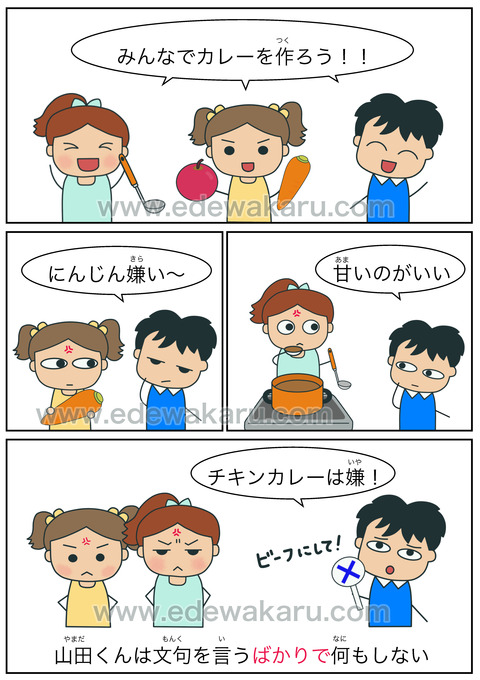
③ Yamada-kun does nothing but complain.
[Negative evaluation] It makes me angry because he does nothing.
(Review: get angry)
④ This job is nothing but busy, and the pay isn’t good.
[Negative evaluation] I dislike it because the pay isn’t good.
⑤ Sports are nothing but tiring; they’re not fun.
[Negative evaluation]
Not fun
There are many grammar patterns that use 「〜ばかり」, so review them carefully 😉
[The “ばかり” series]
〜たばかり
〜てばかりいる・〜てばかりだ
〜てばかりはいられない・〜てばかりもいられない
〜と言わんばかりに・〜とばかりに
〜とばかり思っていた
〜とばかりは言えない
〜ばかり (quantity word+ばかり)
〜ばかりだ
〜ばかりだ (preparation complete)
〜ばかりで
〜ばかりでなく〜も
〜ばかりに
〜ばかりの (metaphor)
〜ばかりは
〜んばかり
In context 5 examples
山田くんは、文句を言うばかりで何もしない→山田くんは、文句を言うだけで何もしない
Yamada-kun does nothing but complain. → Yamada-kun only complains and does nothing.
この料理は高いばかりで、まったくおいしくない
→この料理は高いだけで、まったくおいしくない(復習:まったく〜ない)This dish is expensive and nothing else; it isn’t tasty at all. → This dish is only expensive; it isn’t tasty at all. (Review: まったく〜ない)
この小説は長いばかりで、おもしろくなかった
→この小説は長いだけで、おもしろくなかったThis novel was long and nothing else; it wasn’t interesting. → This novel was only long; it wasn’t interesting.
この仕事は忙しいばかりで給料がよくない
→この仕事は忙しいだけで給料がよくないThis job is nothing but busy, and the pay isn’t good. → This job is only busy, and the pay isn’t good.
スポーツなんて、疲れるばかりで楽しくないよ
→スポーツなんて、疲れるだけで楽しくないよ(復習:〜など・〜なんか・〜なんて)Sports are nothing but tiring; they’re not fun. → Sports are only tiring; they’re not fun. (Review: 〜など・〜なんか・〜なんて)
Read the original source text
Meaning
〜だけで〜
How to use it
動詞[辞書形]+ばかりで
い形容詞[ーい]+ばかりで
な形容詞[ーな]+ばかりで
Explanation
「AばかりでB」は「AだけでBだ」という意味を表す文型です。「B」には否定表現(ひていひょうげん)が入り、話し手の
マイナス評
がきます。
[例]
①この小説は長い
ばかりで、おもしろくなかった
【マイナス評価】
おもしろくない
②この料理は高い
ばかりで
まったくおいしくない
【マイナス評価】
おいしくない
③山田くんは、文句を言う
ばかりで
何もしない
【マイナス評価】何もしないから
腹が立つ
(復習:腹が立つ)
④この仕事は忙しい
ばかりで
給料がよくない
【マイナス評価】給料がよくないから
嫌だ
⑤スポーツなんて、疲れる
ばかりで
楽しくないよ
【マイナス評価】
楽しくない
「〜ばかり」を使う文型はたくさんありますので、しっかりと復習をしておきましょう😉
【「ばかり」シリーズ】
〜たばかり
〜てばかりいる・〜てばかりだ
〜てばかりはいられない・〜てばかりもいられない
〜と言わんばかりに・〜とばかりに
〜とばかり思っていた
〜とばかりは言えない
〜ばかり(数量詞+ばかり)
〜ばかりだ
〜ばかりだ(準備完了)
〜ばかりで
〜ばかりでなく〜も
〜ばかりに
〜ばかりの(比喩)
〜ばかりは
〜んばかり
くらべてわかる日本語表現文型辞典
Meaning
The situation is only A, and not B. The speaker is dissatisfied with the situation of B.
How to use it
A ばかりで B ない
[Verb—dictionary form] ばかりで
[i-adjective—い] ばかりで
[na-adjective—な] ばかりで
[Noun—∅] ばかりで
Explanation
【Contrast 1】
「AばかりがBではない」 (Meaning 1, p. 278)
「AばかりでBない」 expresses that there is only A and not B, while 「AばかりがBではない」 expresses that what is included in B is not only A; there are other things besides A.
○(彼は)酒を飲むばかりで、何も食べない。 — (He) does nothing but drink alcohol and eats nothing.
○酒を飲むばかりが、ストレス解消法ではない。 — Drinking alcohol is not the only way to relieve stress.
Notes
【Note 1】
・「Bない」 may be omitted, with the speaker’s judgment following in the next clause.
○ただ働くばかりで(楽しいこともなく)一生を終わる人もいる。 — Some people spend their whole lives doing nothing but work (with no enjoyable experiences).
In context 4 examples
このカバンは重いばかりで、ちっとも入らない。
This bag is just heavy and doesn’t hold anything at all.
私が聞いても、父は笑っているばかりで何も答えてくれなかった。
Even when I asked him, my father just smiled and didn’t answer at all.
都会はビルばかりで空が見えない。
The city is nothing but buildings, and you can’t see the sky.
有名な教授の講義を受けたが、退屈なばかりでおもしろくなかった。
I attended a famous professor’s lecture, but it was only boring and not at all interesting.
Read the original source text
Meaning
Aという状況だけで、Bではない。Bの状況は話し手にとって不満を感じるものである。
How to use it
AばかりでBない
[動詞-る形]ばかりで
[イ形-い]ばかりで
[ナ形-な]ばかりで
[名詞-∅]ばかりで
Explanation
【対比1】
「AばかりがBではない」(意味1 P.278)
「AばかりでBない」はAだけであってBではないことを表し、「AばかりがBではない」はBのなかに含まれるのはAだけではない、Aのほかにもあることを表す。
○(彼は)酒を飲むばかりで、何も食べない。
○酒を飲むばかりが、ストレス解消法ではない。
Notes
【注意1】
・「Bない」が省略されて、話し手の判断が後文にくることがある。
○ただ働くばかりで(楽しいこともなく)一生を終わる人もいる。
毎日のんびり日本語教師
How to use it
Verb dictionary form + ばかりで
I-adjective + ばかりで
Na-adjective stem + な + ばかりで
Explanation
Expresses the speaker's negative evaluation of a thing or state that has no other aspects at all; the following clause takes a negative expression.
Notes
The 「ばかり」 series
In context 8 examples
この店の料理は見た目だけが美しいばかりで、肝心の味は伴っていない。
The food at this restaurant looks beautiful, but it lacks the most important thing: flavor.
文句を言うばかりで何一つ手伝ってくれない。
All he does is complain; he doesn't help with a single thing.
運動なんて苦しいばかりで一向にやりたいと思わない。
Exercise is nothing but painful, and I have no desire to do it at all.
顔が綺麗なばかりで、性格が悪すぎる。
She has a pretty face, but her personality is too awful.
このゲームは難しいばかりでクリアできない。
This game is nothing but difficult, and I can't beat it.
必死に働いても大変なばかりで苦しいだけだ。
Even when I work desperately hard, it's nothing but grueling and painful.
うちの子は正直で生真面目なばかりで、臨機応変な行動をとれずにいる。
My child is honest and overly serious, and can't act flexibly to suit the situation.
法事なんて面倒なばかりで何のメリットもない。
Memorial services are nothing but a hassle and have no benefits at all.
Read the original source text
How to use it
動辞形+ばかりで
い形容詞+ばかりで
な形容詞語幹+な+ばかりで
Explanation
他の側面が一切ない物事や状態に対する話し手の否定的な評価を述べ、後項では否定的な表現がきます。
Notes
「ばかり」シリーズ