AIUEO JLPT Grammar
Meaning
This sentence pattern expresses realizing or understanding something as a result of an event or action. It is used when emphasizing that a new situation or awareness arises as a result of something.
How to use it
Verb (て-form) + はじめて
In context 5 examples
失敗してはじめて、自分の弱さに気づいた。
It was only after failing that I realized my own weaknesses.
社会人になってはじめて、お金を稼ぐことの大変さが分かった。
It was only after becoming a working adult that I realized how hard it is to earn money.
病気になってはじめて、健康の大切さに気づいた。
It was only after getting sick that I realized the importance of health.
一人暮らしをしてはじめて、時間の管理が難しいと感じた。
It was only after living alone that I felt how difficult it is to manage time.
会社に入ってはじめて、本当の責任感を学んだ。
It was only after joining the company that I learned what true responsibility is.
Read the original source text
Meaning
This sentence pattern expresses realizing or understanding something as a result of an event or action. It is used when emphasizing that a new situation or awareness arises as a result of something.
How to use it
動詞て形+はじめて
Explanation · 日本語
この文型は、ある出来事や行動が起こった結果、何かを実感したり、理解したりすることを表す表現です。何かがきっかけとなり、新しい状況や認識が生まれることを強調したいときに使われます。
絵でわかる日本語
Meaning
Only after ~ did ~ finally happen
How to use it
Verb [て-form]+てはじめて
Explanation
「〜てはじめて」 is a sentence pattern meaning “only after ~ did ~ finally happen.” It means “only then, after ~, did I finally understand ~,” and is used when you want to say that as a result of experiencing something, you learned something you hadn’t known or noticed something you hadn’t realized. It may help to remember some words that often follow 「〜てはじめて」 😊
[Words often used after 「〜てはじめて」]
・〜てはじめて+
realize・become aware
・〜てはじめて+
understand
・〜てはじめて+
learn
and so on
[For advanced learners]
「〜てはじめて」 also means “given the condition of ~, one can do ~” or “if ~ is possible, then ~ is possible” 😮
[Example]
Only after I became able to support myself through my own efforts could I be called independent.
→ If I become able to support myself through my own efforts, I can be called independent.
*「食べていく」 means “earn money and make a living.”
The words often used with 「〜てはじめて」 are mostly fixed, so it may help to learn them together 😉
(Review: 〜ておく)
In context 5 examples
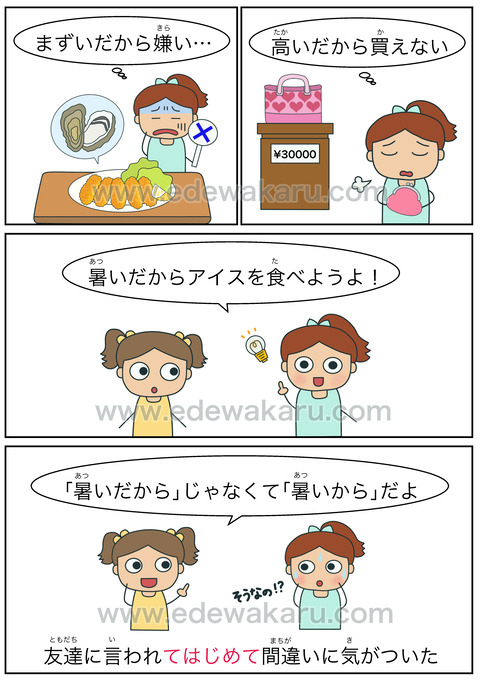
友達に言われてはじめて間違いに気がついた
→友達に言われてから、やっと間違いに気がついた[今までずっと間違いに気づいていなかった]It was only when my friend told me that I realized my mistake. → It was only after my friend told me that I finally realized my mistake. [Until then, I hadn’t realized I was making a mistake.]
日本語が話せるようになってはじめて、日本語を勉強する楽しさがわかった
→日本語が話せるようになってから、やっと日本語を勉強する楽しさがわかった[日本語が話せるようになるまで、楽しさがわからなかった]Only after I became able to speak Japanese did I understand the joy of studying Japanese. → It was only after I became able to speak Japanese that I finally understood the joy of studying it. [Until I could speak Japanese, I didn’t understand the joy of studying it.]
外国に住んではじめて、日本の良さに気づくことができた
→外国に住んでから、やっと日本の良さに気づくことができた[外国に住むまで、日本の良さを知らなかった]Only after living abroad was I able to appreciate what is good about Japan. → It was only after living abroad that I was finally able to appreciate what is good about Japan. [Until I lived abroad, I didn’t know what was good about Japan.]
子供を産んではじめてお母さんの大変さがわかった
→子供を産んでから、やっとお母さんの大変さがわかった[子供を産むまで、お母さんの大変さを知らなかった]Only after having a child did I understand how hard it is to be a mother. → It was only after having a child that I finally understood how hard it is to be a mother. [Until I had a child, I didn’t know how hard it is to be a mother.]
病気になってはじめて健康のありがたさを知るものだ
→病気になってから、やっと健康のありがたさを知るものだ[病気になるまで、健康なのは当然だと思っていた]It is only when you become ill that you learn to appreciate good health. → It is only after becoming ill that you finally learn to appreciate good health. [Until I became ill, I took being healthy for granted.]
Read the original source text
Meaning
〜てから、やっと〜した
How to use it
動詞[て形]+てはじめて
Explanation
「〜てはじめて」は「〜てから、やっと〜した」という意味の文型です。この文型は「〜てから、その時になって、やっと〜がわかった」とう意味で、何かを経験した結果、「今まで知らなかったことを知ったり、気づいていなかったことに気づいた」と言いたい時に使います。「〜てはじめて」とよく一緒に使われる言葉をいくつか覚えておくといいと思います😊
[「〜てはじめて」の後ろによく使われる言葉]
・〜てはじめて+
気がつく・気づく
・〜てはじめて+
わかる
・〜てはじめて+
知る
など
【上級レベルの人へ】
「〜てはじめて」には「〜の条件があって、〜できる」「〜ができたら、〜できる」という意味もあります😮
[例]
自分の力だけで食べていけるようになっ
てはじめて、一人前と言える
→自分の力で食べていけるようになったら、一人前と言える
*「食べていく」とは「お金を稼いで生活する」という意味です
「〜てはじめて」とよく使われる言葉はほとんど決まっていますので、一緒に覚えておくといいと思います😉
(復習:〜ておく)
くらべてわかる日本語表現文型辞典
Meaning
Meaning 1: An expression in which, after situation A occurs, B is a first experience or action.
Meaning 2: B precisely because of A. B would be inconceivable without A; B did not exist before A.
How to use it
AてはじめてB (AてはじめてのB)
[Verb—て-form] はじめて
In context 8 examples
日本に来てはじめて生の魚を食べた。
It was only after coming to Japan that I ate raw fish for the first time.
明日は子どもが幼稚園に入ってはじめての運動会だ。
Tomorrow is the first sports day since my child started kindergarten.
生まれてはじめて人を好きになったのは中学生の時です。
The first time I fell in love with someone was when I was in middle school.
結婚してはじめて夫が作った料理はハンバーグだった。
The first dish my husband cooked after we got married was hamburger steak.
人に言われてはじめて自分の欠点に気づくものだ。
It’s only when someone points it out that you realize your own shortcomings.
今やわれわれの生活はコンピューターがあってはじめて機能すると言っても過言ではない。
It is no exaggeration to say that our lives today function only because we have computers.
文字というのは技術より個性があってはじめて味わいが出るのだ。
Writing only gains its charm when it has individuality as well as technique.
あなたが来てくれてはじめてパーティーは楽しくなるのよ。
The party only becomes fun when you come.
Read the original source text
Meaning
意味1:Aの事態、状態になってからBは最初の体験、行為であるという表現。
意味2:AからこそB。AがなければBは考えられない。Aの前にBはなかった。
How to use it
AてはじめてB(AてはじめてのB)
[動詞-て形]はじめて
日本語NET JLPT文法解説まとめ
Meaning
“Only after doing ~, for the first time...”
An expression used to describe something one understood or realized after experiencing it for the first time, having never done it before.
The preceding clause describes the event that prompted what is stated in the following clause.
How to use it
Vて + はじめて
Explanation
"it is not until ~ that"
A phrase used to express something that was understood or noticed for the first time after experiencing it. The event that triggered the realization is described in the preceding clause.
In context 14 examples
子供を産んではじめて、母の強さがわかりました。
Only after giving birth did I understand how strong mothers are.
ガンになってはじめて、健康のありがたさがわかりました。
Only after getting cancer did I understand how precious good health is.
東京にきてはじめて、自分の住む田舎との違いに気づいた。
Only after coming to Tokyo did I notice the difference from the rural area where I live.
東南アジア旅行してはじめて、日本が豊かであることに気づいた。
Only after traveling in Southeast Asia did I realize that Japan is prosperous.
一人暮らしをしてはじめて、親のありがたさがわかりました。
Only after living alone did I understand how much I should appreciate my parents.
彼がこの会社からいなくなってはじめて、この会社にとって必要な人物であることがわかった。
Only after he left this company did I realize that he was an essential person for it.
社会人になってはじめて、責任感を持つようになった。
Only after becoming a working adult did I start to feel a sense of responsibility.
日本に来てはじめて、力士を生で見ました。
Only after coming to Japan did I see a sumo wrestler in person.
就職活動をしてみてはじめて、仕事を見つけるのが大変だということがわかった。
Only after trying job hunting did I realize how difficult it is to find work.
学校の英語の成績はよく、自信もあったが、海外に来てはじめて自分の英語はまだまだだということを理解した。
I did well in English at school and was confident, but only after coming overseas did I realize how much more I still had to learn.
海外でぼったくりの被害にあってはじめて、日本にいるときよりも一層注意が必要であると理解した。
Only after being overcharged while traveling abroad did I realize that I needed to be even more careful than when I’m in Japan.
先輩に指摘されてはじめて、間違いに気がついた。
Only after my senior colleague pointed it out did I notice the mistake.
親が亡くなってはじめて、親のありがたさがわかった。
Only after my parents died did I realize how much I should appreciate them.
歯医者にいってはじめて、虫歯があることを知った。
Only after going to the dentist did I find out I had a cavity.
Read the original source text
Meaning
"〜して、その時はじめて・・・”
以前はしたことがなく、初めて経験してわかったこと・気づいたことを言う表現
後件で述べる事柄のきっかけになった出来事を前件で述べる。
How to use it
Vて + はじめて
Explanation
"it is not until ~ that"
A phrase used to express something that was understood or noticed for the first time after experiencing it. The event that triggered the realization is described in the preceding clause.
毎日のんびり日本語教師
Meaning
Only after doing ~, finally do ~
How to use it
Verb, te-form + はじめて
Verb, te-form + みてはじめて
Explanation
The first part describes some kind of experience, and the second part describes something one finally realized through that experience, or something one had not paid attention to before but then noticed.
In many cases, the second part uses verbs such as 「分かる」「知る」「できる」.
Notes
In example (6), 「はじめて(第一次)」 is an ordinary usage unrelated to the grammar, describing a first-time experience.
In this case, a comma may be placed before 「はじめて」. (7)
In context 6 examples
今まで好きっていう感情がよく分からなかったけど、彼に出会えてはじめて分かったような気がする。
I never really understood the feeling of being in love before, but I feel like I only understood it after meeting him.
指摘されてはじめて間違いに気づいた。(被指出之后才注意到错误)
I only noticed the mistake after it was pointed out to me.
実家を離れてはじめて親のありがたみを知った。(离家之后才知父母之恩。)
It was only after leaving my family home that I realized how grateful I am to my parents.
子育ての大変さって、やってみてはじめてわかる。
You only understand how hard raising children is after trying it.
飼ってみてはじめて自分が猫アレルギーだと気づいた。
It was only after trying to keep a cat that I realized I was allergic to them.
日本に来てはじめて本物のお寿司を食べた。
I ate real sushi for the first time after coming to Japan.
Read the original source text
Meaning
~してからやっと~する
How to use it
動て形+はじめて
動て形+みてはじめて
Explanation
前項には何らかの経験を述べ、後項ではその経験を通してようやく気付いたことや、今まで注意していなかったことに気付いたことを述べます。
多くの場合、後項では「分かる」「知る」「できる」などの動詞が用いられます。
Notes
例文(6)の「はじめて(第一次)」は文法とは関係のない一般的な用法で、最初の経験について述べています。
この時、「はじめて」の前に読点が打たれたりします。(7)
NINJAL 日本語文型データベース
Meaning
Used when saying that something that had not happened before occurs after experiencing or going through ~. It emphasizes that ~ is necessary for what follows to come about.
How to use it
Vてはじめて
Notes
After “〜てはじめて” comes a clause expressing that something is realized, something new happens, or one becomes aware of something.
In context 6 examples
自分のことに自分で責任がとれるようになってはじめて、大人になったと言えるのです。
Only when you become able to take responsibility for yourself can you be said to have become an adult.
今までどうもうまくいかなかった私の野菜作り。プロの指導を受けてはじめて、満足のいく収穫ができるようになった。
My vegetable gardening had never gone well until now. Only after receiving guidance from a professional did I become able to get a satisfactory harvest.
法案はただ発案するだけでは日の目をみない。国会の厳しい審議を通ってはじめて成立するのだ。
A bill does not see the light of day just by being proposed. It only comes into effect after passing rigorous debate in the Diet.
何事も基礎を大事にしなければならない。しっかりした基礎があってはじめて、応用ができるのだ。
You must value the basics in everything. Only with a solid foundation can you apply what you have learned.
スマートフォンをなくしてはじめて、自分がどんなにそれに依存していたか気がつきました。
Only after losing my smartphone did I realize how dependent I was on it.
自分の子どもが生まれて初めて、親の大変さがわかった。
Only after having a child of my own did I understand how hard it is to be a parent.
Read the original source text
Meaning
〜という経験や事態を経て、今までなかったことが起こると言いたいときに使います。後のことの成立のためには「~」が必要だと強調する言い方です。
How to use it
Vてはじめて
Notes
「〜てはじめて」の後には、実現する・新しいことが起こる・あることに気がつくといった意味を表す文がきます。
文法
Meaning
“Only after doing ~, for the first time...”
An expression used to describe something one understood or realized after experiencing it for the first time, having never done it before.
The preceding clause describes the event that prompted what is stated in the following clause.
How to use it
Vて + はじめて
In context 14 examples
子供を産んではじめて、母の強さがわかりました。
Only after giving birth did I understand how strong mothers are.
ガンになってはじめて、健康のありがたさがわかりました。
Only after getting cancer did I understand how precious good health is.
東京にきてはじめて、自分の住む田舎との違いに気づいた。
Only after coming to Tokyo did I notice the difference from the rural area where I live.
東南アジア旅行してはじめて、日本が豊かであることに気づいた。
Only after traveling in Southeast Asia did I realize that Japan is prosperous.
一人暮らしをしてはじめて、親のありがたさがわかりました。
Only after living alone did I understand how much I should appreciate my parents.
彼がこの会社からいなくなってはじめて、この会社にとって必要な人物であることがわかった。
Only after he left this company did I realize that he was an essential person for it.
社会人になってはじめて、責任感を持つようになった。
Only after becoming a working adult did I start to feel a sense of responsibility.
日本に来てはじめて、力士を生で見ました。
Only after coming to Japan did I see a sumo wrestler in person.
就職活動をしてみてはじめて、仕事を見つけるのが大変だということがわかった。
Only after trying job hunting did I realize how difficult it is to find work.
学校の英語の成績はよく、自信もあったが、海外に来てはじめて自分の英語はまだまだだということを理解した。
I did well in English at school and was confident, but only after coming overseas did I realize how much more I still had to learn.
海外でぼったくりの被害にあってはじめて、日本にいるときよりも一層注意が必要であると理解した。
Only after being overcharged while traveling abroad did I realize that I needed to be even more careful than when I’m in Japan.
先輩に指摘されてはじめて、間違いに気がついた。
Only after my senior colleague pointed it out did I notice the mistake.
親が亡くなってはじめて、親のありがたさがわかった。
Only after my parents died did I realize how much I should appreciate them.
歯医者にいってはじめて、虫歯があることを知った。
Only after going to the dentist did I find out I had a cavity.
Read the original source text
Meaning
"〜して、その時はじめて・・・”
以前はしたことがなく、初めて経験してわかったこと・気づいたことを言う表現
後件で述べる事柄のきっかけになった出来事を前件で述べる。
How to use it
Vて + はじめて
DoJG 日本語文法辞典(全集)
Meaning
Not until; only after; for the first time
How to use it
Vて | 初めて | |
| 読んで初めて | Only after you read |
Explanation
A phrase which expresses the idea that someone does something or something happens only after something else happens or something else is done.
In context 6 examples
アメリカへ来て初めて竜巻を見た。
It was not until I came to America that I saw a tornado.
日本で生活して初めて日本人のものの考え方が分かってきた。
It was not until I lived in Japan that I started to understand how Japanese people think.
日本語を勉強して初めて外国語を学ぶ面白さを知った。
I didn't realise how interesting learning a foreign language was until I studied Japanese.
考えは文字にしてみて初めてはっきりすることが多い。
It is often not until you write down your idea that it becomes clear.
病気になって初めて健康の有り難さが分かる。
It is only after you become ill that you realise the value of health.
生まれて初めて刺身を食べた。
I ate sashimi for the first time in my life.
どんなときどう使う 日本語表現文型辞典
Meaning
it is/ was not until…that
How to use it
Vて + はじめて
Explanation
~た後でようやく
「Vてはじめて…」の形で、あることをする前はそうではなかったが、した後、それがきっかけとなってやっと「…であること」がわかった、または「…」になるという意味。
After speaker does something, becomes an impetus that leads to realization or new development.
In context 3 examples
入院してはじめて健康のありがたさがわかりました。
It was only after I was hospitalized that I realized how precious good health is.
スポーツは自分でやってみてはじめてそのおもしろさがわかるのです。
You only understand how enjoyable sports are after you try playing them yourself.
大きな仕事は十分な準備があってはじめて成功するのだ。
A major undertaking succeeds only when it has been thoroughly prepared for.
Read the original source text
Meaning
it is/ was not until…that
How to use it
Vて+はじめて
Explanation
~た後でようやく
「Vてはじめて…」の形で、あることをする前はそうではなかったが、した後、それがきっかけとなってやっと「…であること」がわかった、または「…」になるという意味。
After speaker does something, becomes an impetus that leads to realization or new development.