AIUEO JLPT Grammar
Meaning
This sentence pattern is used to express that something may be the cause of an uncertain event. It is used when the speaker’s guess or assumption is involved, and it can be applied to both positive and negative outcomes.
How to use it
Verb + せいか; adjective + せいか; adjectival noun + な + せいか; noun + の + せいか
In context 5 examples
最近疲れているせいか、仕事に集中できない。
Maybe because I’ve been tired lately, I can’t concentrate on my work.
運動を始めたせいか、体調が良くなった。
Maybe because I started exercising, my health has improved.
ビタミンCのサプリを飲んでいるせいか、肌がきれいになった。
Maybe it's because of the vitamin C supplements I take that my skin has become smoother.
新しい勉強方法を試したせいか、記憶力が良くなった。
Maybe because I tried a new study method, my memory has improved.
新しいプロジェクトを始めたせいか、仕事が充実している。
Maybe because I started a new project, my work feels fulfilling.
Read the original source text
Meaning
This sentence pattern is used to express that something may be the cause of an uncertain event. It is used when the speaker’s guess or assumption is involved, and it can be applied to both positive and negative outcomes.
How to use it
動詞+せいか形容詞+せいか形容動詞な+せいか名詞の+せいか
Explanation · 日本語
この文型は、明確ではないが、原因が特定の何かかもしれないことを表すときに使われる表現です。話者の推測や仮定を含む場合に使われます。良い結果や悪い結果の両方に使うことができます。
絵でわかる日本語
Meaning
Because … was the cause … (something bad happened)
How to use it
Verb [plain form] + せいで・せいか
い-adjective [dictionary form] + せいで・せいか
な-adjective [dictionary form] + せいで・せいか
Noun [dictionary form] + のせいで・せいか
Explanation
Like「〜おかげで」(review: 〜おかげで), 「〜せいで」is a sentence pattern that expresses a cause or reason, meaning “... happened because ... was the cause/reason.”
Be sure to remember that 「〜せいで」must be followed by a [bad result] 😮
【Supplementary explanation】
Like「〜おかげで」, 「〜せいで」also has the form 「〜せいか」😮
「〜せいか」is used when the cause is not clearly known. It may help to remember it as “probably because …, … happened” 😊 One thing to be careful about is that
「〜せいで」can only be used for bad results, while「〜せいか」can be used for both good and bad results 😨
[Summary]
⭕️I took the medicine
せいで
and got sleepy 【bad result】
⭕️I took the medicine
せいか
and got sleepy 【bad result】
❌I took the medicine
せいで
and my headache went away 【good result】
⭕️I took the medicine
せいか
and my headache went away 【good result】
If you remember that「〜せいか」can be used for both good and bad results, I think you’ll find it a very simple and easy pattern 😉
【Related sentence patterns】
In context 3 examples
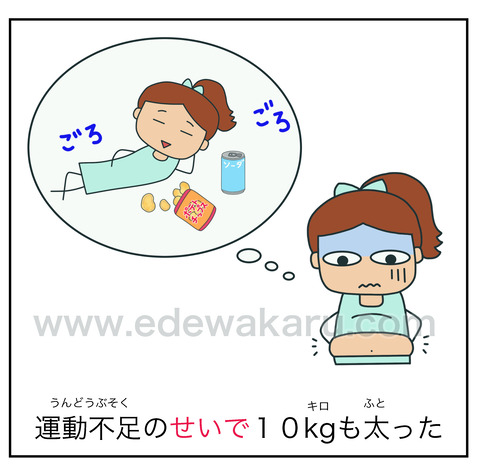
運動不足のせいで10kgも太った
→運動不足が原因で10kgも太ったI gained as much as 10 kg because I didn’t get enough exercise. →I gained as much as 10 kg because lack of exercise was the cause.
薬を飲んだせいで眠くなってきた
→薬を飲んだのが原因で眠くなってきたI’ve started feeling sleepy because I took the medicine. →I’ve started feeling sleepy because taking the medicine was the cause.
大雨のせいで電車が遅れ、遅刻してしまった
→大雨が原因で電車が遅れ、遅刻してしまったBecause of the heavy rain, the train was delayed and I ended up being late. →The train was delayed and I ended up being late because the heavy rain was the cause.
Read the original source text
Meaning
〜が原因で…(悪いことが起こった)
How to use it
動詞[普通形]+せいで・せいか
い形容詞[辞書形]+せいで・せいか
な形容詞[辞書形]+せいで・せいか
名詞[辞書形]+のせいで・せいか
Explanation
「〜せいで」は「〜おかげで」(復習:〜おかげで)と同じように、
原因・理由を表す文型で「〜が原因・理由で…が起こった」という意味で使用されます。
「〜せいで」は後ろに必ず【悪い結果】を表す
ということをしっかりと覚えておきましょう😮
【補足説明】
「〜せいで」は「〜おかげで」と同じように、「〜せいか」という形もあります😮
「〜せいか」は原因がはっきりわかっていない時に使用されます。「たぶん〜が原因で…が起こった」というように覚えておくといいですね
😊1つ気をつけなければいけないことは、
「〜せいで」は悪い結果にしか使用できませんが「〜せいか」はいい結果にも悪い結果にも使えるというところです
😨
[まとめ]
⭕️薬を飲んだ
せいで
眠くなった【悪い結果】
⭕️薬を飲んだ
せいか
眠くなった【悪い結果】
❌薬を飲んだ
せいで
頭痛が治った【いい結果】
⭕️薬を飲んだ
せいか
頭痛が治った【いい結果】
「〜せいか」は悪い結果にもいい結果にも使えるというのを覚えておけば、とてもシンプルで簡単な文型だと思います😉
【関連文型】
NINJAL 日本語文型データベース
Meaning
Used when you want to say without asserting a causal relationship that something may have happened because of a particular cause or reason.
「気のせいか」 is an idiomatic expression.
How to use it
V plain form+せいか
i-A plain form+せいか
na-A plain form+せいか (however, 「na-Aだ」→「na-Aな+せいか・na-Aである+せいか」)
Nの+せいか・N plain form+せいか (however, 「Nだ」→「Nの+せいか・Nである+せいか」)
Notes
The result is often negative, but sometimes whether the result is good or bad is irrelevant.
A sentence expressing the speaker’s hope or intention, or a sentence addressing the other person, does not follow 「~せいか」.
In context 22 examples
おなかがすいているせいか、何でもおいしそうに見える。
Maybe because I’m hungry, everything looks delicious.
今日は風がないせいか、昨日よりいくぶん寒さが和らいでいるように感じる。
Maybe because there’s no wind today, it feels somewhat less cold than yesterday.
風邪薬を飲んだせいか、頭がぼんやりして集中できない。
Maybe because I took cold medicine, my head feels foggy and I can’t concentrate.
私は子どもの頃あまり勉強しなかったせいか、ごく常識的なことも知らないことがある。
Maybe because I didn’t study much as a child, there are things that even I don’t know that are common knowledge.
その人とは初めて会ったが、年が近いせいか、共通の話題が多くて話しやすかった。
It was my first time meeting that person, but perhaps because we were close in age, we had many topics in common and it was easy to talk.
電波が悪いせいか、インターネット動画が何度も途切れてしまう。
Maybe because the signal is poor, the online video keeps cutting out.
この料理は見栄えがよくないせいか、子どもたちはあまり食べたがらない。おいしいのに。
Perhaps because this dish doesn’t look appetizing, the children don’t want to eat much of it. Even though it’s delicious.
この前行った遊園地がよほど楽しかったせいか、子どもは遊園地の話ばかりしている。
Perhaps because the amusement park we went to the other day was so much fun, my child talks about nothing but amusement parks.
このところあまり寒くなかったせいか、12月に入っても年末という感じがしない。
Perhaps because it hasn’t been very cold lately, it still doesn’t feel like the end of the year even though December has begun.
時間が遅めなせいか、スーパーで買い物する客はまばらだ。
Perhaps because it’s rather late, there are few customers shopping at the supermarket.
この辺りの商店街は駅から近くて便利なせいか、かなりにぎわっている。
Perhaps because the shopping street around here is conveniently close to the station, it’s quite lively.
息子は楽天的であるせいか、叱られてもあまり気にしていない様子だ。
Perhaps because my son is optimistic, he doesn’t seem to mind much even when he is scolded.
換気が十分でないせいか、部屋に湿気がこもっている。
Perhaps because the room isn’t ventilated enough, the humidity is building up inside.
習い始めたばかりのフランス語でフランス人に話しかけてみたが、発音が下手だったせいか、全然通じなかった。
I tried speaking to a French person in the French I’d only just started learning, but perhaps because my pronunciation was poor, they couldn’t understand me at all.
思いついたアイディアについて同僚に話してみたけど、説明が具体的じゃなかったせいか、あまり興味を持ってもらえなかった。
I told a colleague about an idea I’d come up with, but perhaps because my explanation wasn’t concrete, they didn’t show much interest.
年のせいか、最近疲れやすくなった。
Maybe because of my age, I’ve been getting tired easily lately.
気のせいか、この店は前よりサービスが悪くなったようだ。
Maybe it’s just my imagination, but the service at this shop seems worse than before.
親が酒飲みのせいか、私も若い頃から酒が好きだった。
Perhaps because my parent likes drinking, I’ve liked alcohol since I was young, too.
同じテニスクラブの出身であるせいか,あの二人のプレースタイルは似ている。
Perhaps because they came from the same tennis club, those two have similar playing styles.
キャベツのスープを作ったが、キャベツがおいしい時期じゃないせいか、変な味になってしまった。
I made cabbage soup, but perhaps because cabbage isn’t in season, it turned out tasting strange.
その日は連休中だったせいか、スーパーには生鮮品が少なかった。
Perhaps because that day fell during a long weekend, there wasn’t much fresh produce at the supermarket.
資料館と書かれている建物に入ってみたが、観光シーズンでなかったせいか、客がまばらで寂しい雰囲気だった。
I went into a building marked “museum,” but perhaps because it wasn’t tourist season, there were few visitors and the atmosphere was lonely.
Read the original source text
Meaning
〜が原因・理由で、ある結果になったのかもしれないと因果関係を断定しないで言いたいときに使います。
「気のせいか」は慣用的な言い方です。
How to use it
V普通形+せいか
i-A普通形+せいか
na-A普通形+せいか(ただし、「na-Aだ」→「na-Aな+せいか・na-Aである+せいか」)
Nの+せいか・N普通形+せいか(ただし、「Nだ」→「Nの+せいか・Nである+せいか」)
Notes
よくない結果の場合が多いですが、結果がいい悪いに関係ない場合もあります。
「~せいか」の後には、話し手の希望・意向を表す文や相手への働きかけの文はきません。