AIUEO JLPT Grammar
Meaning
「〜まくる」 connects to the masu-stem of verbs to describe performing an action intensely, repeatedly, or excessively.
How to use it
Verb masu-form + まくる
In context 5 examples
これからは好きなことをやりまくるつもりだ。
From now on, I plan to do what I love.
彼女は文句を言いまくりました。
She kept complaining.
彼はお金を使いまくっています。
He spends a lot of money.
週末はテレビを見まくって、家から一歩も出なかった。
I watched TV all weekend and didn’t leave the house.
昨日の夜は食べまくった。
I ate a lot last night.
Read the original source text
Meaning
「〜まくる」 connects to the masu-stem of verbs to describe performing an action intensely, repeatedly, or excessively.
How to use it
動詞ます形+まくる
Explanation · 日本語
「〜まくる」は、動詞ます形に接続して、ある動作を激しく繰り返す、または過度に行うことを表す表現です。
文法
Meaning
Do 〜 a great deal
Describes an action being repeated many times or continued.
How to use it
V (ます-form) + まくる
In context 5 examples
よし!ストレス発散のために今日は、歌いまくるぞ。
All right! I'm going to sing my heart out today to relieve some stress.
昨日、ゲームをしまくったので目が痛いです。
I played games like crazy yesterday, so my eyes hurt.
台湾旅行で、友達と写真を撮りまくった。
On my trip to Taiwan, I took tons of pictures with my friends.
仕事でミスしまくって、散々上司に怒られた。
I made tons of mistakes at work and got chewed out by my boss over and over.
A:今晩、トムさんと焼肉食べ放題に行くんだけど、キムさんも来る?
B:えっ、行きたい。
A:いいね。じゃあ、今夜はとことん食べまくろう。A: I'm going to an all-you-can-eat yakiniku place with Tom tonight. Kim, do you want to come too? B: Huh? I'd love to. A: Great. Then tonight, let's eat to our hearts' content.
Read the original source text
Meaning
とてもたくさん~する
動作をたくさん繰り返したり、継続する様子。
How to use it
V(ます形) + まくる
Bunpro Grammar Reference
Meaning
Like crazy, Keep doing (without a second thought), Nothing but, On and on, Do … all around, To do a lot of, One after another, All over, Keep, Everything, Constantly, All the time
How to use it
Verb[stem](*) + まくる
Verb[て]+ Verb[て]+ Verb[stem](*) + まくる
(*) Verb has to be volitional (can be controlled by the will of a doer)
Nuance
A strong grammar point, implying that (A) is being purposely done like crazy. (A) just keeps rolling and rolling on.
Explanation
まくる is a verb that is attached to the conjunctive form of other verbs in order to show that (A) is being done over and over, a lot, or with a great amount of vigor. It comes from the verb う-Verb 捲る 'to roll', or 'to turn', so means 'to do (A) around and again'. Common translations include 'to (A) like crazy', 'to do nothing but (A)', and 'to constantly do (A)'.
As mentioned, this structure is attached to the conjunctive form of other verbs.
昨日は釣具屋でルアーを買いまくったから、来週までご飯とふりかけで我慢しなきゃいけない。
I bought a bunch of lures at the tackle shop yesterday, so I have to put up with eating rice and furikake until next week.
久しぶりに実家に帰って、母の料理を食べまくってるから少し太ってきた。
I have started to gain some weight because I've been eating so much of my mom's food, ever since I came to visit my family after a long time.
昨日はカラオケで歌いまくったから、声が全然でない。
I sang like crazy at the karaoke last night, so I lost my voice.
This structure may be used both in positive or negative contexts, and it is quite common for the nuance of まくる to indicate that (A) is being done recklessly, or with abandon. This implies that the speaker isn't thinking about the consequences of doing (A) repeatedly, if any may exist.
Caution
The (A) verb must be something that is volitional, meaning that the speaker must have control over it and its repetition.
しゃっくりが出まくりすぎて苦しい。
I am having a hard time breathing because I am hiccuping like crazy. (Unnatural Japanese)
In context 16 examples
- はやせとなおとは狂ったように踊って踊って踊りまくった。
Hayase and Naoto danced like crazy.
- 昨日はカラオケで歌いまくったから、声が全然でない。
I sang like crazy at the karaoke last night, so I lost my voice.
- 昨日は釣具屋でルアーを買いまくったから、来週までご飯とふりかけで我慢しなきゃいけない。
I bought a bunch of lures at the tackle shop yesterday, so I have to put up with eating rice and furikake until next week.
- 久しぶりに実家に帰って、母の料理を食べまくってるから少し太ってきた。
I have started to gain some weight because I've been eating so much of my mom's food, ever since I came to visit my family after a long time.
- 「最近、チョコを食べまくっているからちょっと太った。」
'I've been eating chocolate like crazy lately, so I've gained some weight.'
- 締め切りが近いから、原稿を書きまくった。
Because the deadline is close, I was writing the draft like crazy.
- 時間さえあれば走りまくっている彼の足はたくましいです。
He, who runs like crazy so long as he has time, has strong legs.
- ストレス発散でメイク道具を買いまくったせいで金欠になった。
Due to buying makeup goods one after the other to relieve stress, I have no money.
- 私はシャイで、それなのに人と会うと逆に喋りまくってしまいます。
I am shy, although when I meet people, I unfortunately talk like crazy.
- いくら心配だからって、電話をかけまくるのはどうかと思うよ。
Regardless of how worried you are, it’s not right to just call constantly.
- 「まさはるさんは新車購入したから毎日乗りまくっているらしいよ。」
'I heard that Masaharu-san bought a new car and has been driving it all the time, every single day.'
- 「よしこって喋るのが大好きだ。ベラベラしゃべりまくるから彼女には我慢できない。」
'Yoshiko loves to talk. She talks nonstop, like crazy so I can't stand her.'
- 応援中に叫びまくったせいで、喉が痛くなってしまいました。
Due to screaming like crazy while cheering, my throat got sore.
- 90年代にはあのアニメが大ヒットした。私はファンになって以来、アニメグッズを買いまくっている。
In the 90s, that anime was a big hit. I have been a fan ever since and I've been buying anime goods like crazy.
- うざき:「ゴールデンウィーク何か用事あるの?」
さくらい:「せっかくだから毎日朝から晩までゲームをやりまくりたいんだ。」Uzaki: 'Do you have plans for the golden week? ' Sakurai: 'It's a rare opportunity, so I want to play games every day like crazy, from dusk till dawn.'
- しゃっくりが出まくりすぎて苦しい。
I am having a hard time breathing because I am hiccuping like crazy. (Unnatural Japanese)
絵でわかる日本語
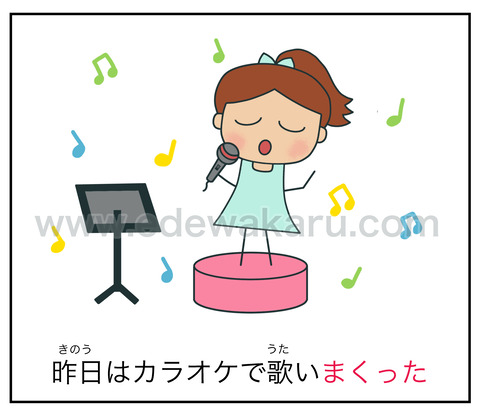
Meaning
Do ~ a great deal.
Repeat ~ over and over.
How to use it
Verb [ます-form] + まくる
Explanation
“〜まくる” means “to do a great deal of ~” and is used to say “to do ~ intensely, over and over.” 😀 It is used with volitional verbs, not with all verbs. Also, when you want to emphasize the number of times or the intensity, use the expression “〜て〜て〜まくる” 😮
[Examples]
昨日はカラオケで歌って歌って歌いまくった
Yesterday I sang and sang and sang my heart out at karaoke.
景色がきれいだったので写真を撮って撮って撮りまくった
The scenery was beautiful, so I took and took and took photos.
This pattern does not appear very often in reference books, so there are few opportunities to study it, but it is often used in conversation, so I think it’s good to learn it 😄
In context 3 examples
昨日はカラオケで歌いまくった
→昨日はカラオケですごくたくさん歌ったYesterday, I sang a ton at karaoke. →Yesterday, I sang a great deal at karaoke.
先週末はゲームをしまくった
→先週末はすごくたくさんゲームをしたI played a ton of games last weekend. →I played a great many games last weekend.
景色がきれいだったので写真を撮りまくった
→景色がきれいだったので、とてもたくさん写真を撮ったThe scenery was beautiful, so I took a ton of photos. →The scenery was beautiful, so I took a great many photos.
Read the original source text
Meaning
すごくたくさん〜する
何度も繰り返して〜する
How to use it
動詞[ます形]+まくる
Explanation
「〜まくる」は「すごく〜をたくさんする」という意味で「激しく何回も〜する」と言いたい時に使用します
😀全ての動詞ではなく、
意志動詞に使われます。また、
回数や激しさを強調したい場合は「〜て〜て〜まくる」という言い方を使います
😮
[例]
昨日はカラオケで
歌って歌って歌いまくった
景色がきれいだったので写真を
撮って撮って撮りまくった
参考書に載っていることがあまりありませんので、勉強する機会が少ないですが、会話でよく使いますので覚えておくといいと思います😄
くらべてわかる日本語表現文型辞典
Meaning
Doing A a great deal, doing A repeatedly, or a state in which A continues with increasing momentum.
How to use it
A まくる (A₁て A₁て A₂まくる)
[Verb—ます-form] まくる
In context 4 examples
最近、彼は株取引で大成功し、稼ぎまくっているらしい。
Apparently, he recently made a big success of stock trading and is raking in money.
店頭の商品がすべて半額と聞いて、買って買って買いまくった。
When I heard that every item in the store was half price, I bought and bought and bought.
仕事では新しい契約が取れたし、ボーナスは倍増するし、宝くじは当たるし、最近、こわいぐらいツキまくっている。
At work, I landed a new contract, my bonus doubled, I won the lottery—lately, I’ve been so lucky it’s almost scary.
部下が失敗ばかりして頼りないので、部長は朝からキレまくっている。
Since his subordinates keep making mistakes and are so unreliable, the department head has been losing his temper all morning.
Read the original source text
Meaning
とてもAする、たくさんAする、勢いづいてAが続く様子。
How to use it
Aまくる(A₁てA₁てA₂まくる)
[動詞-ます形]まくる
毎日のんびり日本語教師
Meaning
furiously
intensely
How to use it
Verb ます-form + まくる
Verb て-form + verb て-form + verb ます-form + まくる
Explanation
Expresses doing an action repeatedly and intensely.
There is also an emphatic form 「~て~て~まくる」, as in 「勝って勝って勝ちまくる」 (keep winning and winning).
Notes
Nothing in particular.
In context 18 examples
7月に入ってから勝ちまくり、一気に首位に躍り出た。
Since July began, they’ve been racking up wins and shot straight to the top of the standings.
仕事でミスしまくって自信がなくなった。
I made so many mistakes at work that I lost confidence.
朝から晩まで遊びまくる。(从早玩到晚。)
Play nonstop from morning till night. (从早玩到晚。)
悔しくて泣いて、泣いて、泣きまくった。
I was so frustrated that I cried and cried and cried.
料理注文しまくったせいで会計が怖い。
I ordered so many dishes that I’m afraid to see the bill.
プールで子どもみたいにはしゃぎまくった。(在游泳池像小孩子一样兴奋。)
I got wildly excited at the pool like a child. (在游泳池像小孩子一样兴奋。)
日焼けで腕の皮が剥けまくっている。(晒黑的手臂的皮剥落了。)
The skin on my arms is peeling like crazy from sunburn. (晒黑的手臂的皮剥落了。)
うちの猫が初めて聞く雷の音にビビりまくっている。(我家的猫第一次听到雷声吓了一跳。)
My cat is absolutely terrified by the sound of thunder, which it is hearing for the first time. (我家的猫第一次听到雷声吓了一跳。)
昼間寝まくったから眠くない。
I slept a ton during the day, so I’m not sleepy.
この4日間で青森から東京までをバイクで走りまくった。
Over these four days, I rode my motorcycle nonstop from Aomori to Tokyo.
美味しいものを食べまくった。
I ate loads of delicious food.
この5連休で生活リズムが乱れまくった。
My routine got completely disrupted over this five-day weekend.
大掃除で要らないものを捨てまくった。
I threw out loads of things I didn’t need while doing a thorough cleaning.
日焼けして肌が荒れまくってる。
My skin got terribly irritated from sunburn.
蚊に刺されまくって夜中に起きた。
I got bitten by mosquitoes so many times that I woke up in the middle of the night.
子どもが壁中にシールを貼りまくったから叱った。
I scolded my child for sticking stickers all over the walls.
夜更かししまくって授業中に睡眠取った。
I stayed up late so much that I slept during class.
子どもの頃は親に迷惑かけまくっていた。
When I was a child, I caused my parents so much trouble.
Read the original source text
Meaning
拼命地
激烈地
How to use it
動ます形+まくる
動て形+動て形+動ます形+まくる
Explanation
動作を何度も激しく繰り返す様子を表します。
「勝って勝って勝ちまくる」のように、「~て~て~まくる」で更に強調する言い方もあります。
Notes
特になし