Bunpro Grammar Reference
Meaning
So much that, Extremely, Very
How to use it
Verb + のなんのって
[い]Adjective + のなんのって
[な]Adjective + な + のなんのって
Nuance
A very casual phrase, used to emphasize a huge degree of (A). Especially when that degree cannot be expressed with simple words.
Explanation
のなんのって is a casual phrase that is used in spoken Japanese to indicate that the word before it is 'excessively (A)', or 'extremely (A)'. This structure consists of the case marking particle の, the pre-noun adjectival 何の 'what kind of', and って, an abbreviation of という 'to say'.
The literal meaning of 'and to say it's (A) or something' just indicates that something is so (A) that if it is not that then the speaker doesn't know what to call it.
This structure will be seen after い-Adjectives, な-Adjectives followed by な, and verbs.
あんな痩せているのにあの量一人で食べちゃうなんて、びっくりしたのなんのって。
I was extremely surprised that such a skinny guy could eat that amount of food all by himself.
名古屋の夏は暑いのなんのって、外に出た瞬間シャツが汗でびっしょりになるんだよ。
It is so hot in Nagoya in the summer that the moment you step outside, your shirt will be drenched in sweat.
あの建物は丈夫なのなんのって、去年あった震度7の地震までも耐えたんだよ。
That building is so sturdy that it even withstood last year's earthquake that measured 7 on the Japanese seismic scale.
のなんのって itself is a more condensed variation of ~の~ないのって, which has the same meaning, but has (A) appear in both the positive and negative for 'to say it's (A) or not (A), (B)', where (B) will usually be a phrase explaining the extent of (A). Occasionally (B) will be left unsaid, as ~の~ないのって itself is always used to mean 'extremely (A)'.
彼は食べるの食べないのって、三十分で三キロも肉を一人で食べた。
He eats so much that he ate 3 kg of meat in 30 minutes all by himself.
あのジェットコースターは大人でも失神するほど怖いの怖くないのって。
That rollercoaster is so scary that even an adult would pass out.
In context 17 examples
- お母さんが「勉強しろ」ってうるさいのなんのって、もう家に帰りたくないよ…。
My mom is extremely annoying with comments like 'study!', and I don't want to go home anymore.
- あの建物は丈夫なのなんのって、去年あった震度7の地震までも耐えたんだよ。
That building is so sturdy that it even withstood last year's earthquake that measured 7 on the Japanese seismic scale.
- 彼は食べるの食べないのって、三十分で三キロも肉を一人で食べた。
He eats so much that he ate 3 kg of meat in 30 minutes all by himself.
- あんな痩せているのにあの量一人で食べちゃうなんて、びっくりしたのなんのって。
I was extremely surprised that such a skinny guy could eat that amount of food all by himself.
- 名古屋の夏は暑いのなんのって、外に出た瞬間シャツが汗でびっしょりになるんだよ。
It is so hot in Nagoya in the summer that the moment you step outside, your shirt will be drenched in sweat.
- あのジェットコースターは大人でも失神するほど怖いの怖くないのって。
That rollercoaster is so scary that even an adult would pass out.
- あの旅館の女将さんは愛想が悪いのなんのって、もう二度と行くもんか!
That ryokan's proprietress' amiability was so bad that there is no way I would ever go there again!
- ジャングルの中でワニと出くわした時は焦ったのなんのって、もう死ぬかと思ったよ!
I was extremely startled when I happened upon a crocodile in the jungle that I thought I was going to die!
- 東京の夏は蒸し暑いのなんのって、少し歩いただけで気持ち悪くなるくらいです。
Tokyo's summer is extremely humid, so much so that it feels gross even if you just walked around a little bit.
- 夫の実家は広いのなんのって、庭には沢山の木が植えられていてプールもあるんだよ!
My husband's family home is extremely spacious. There are lots of trees planted in the garden, and even a pool!
- A(エー):「疲れた顔だね。」
B(ビー):「昨日は騒音で眠れなかったから、もう眠いのなんのって・・・」A: 'You look tired!' B: 'I couldn't sleep yesterday because it was noisy, so I am already extremely sleepy…'
- A(エー):「今買ったケーキはどう?食べてみたい。」
B(ビー):「ケーキおいしいのなんのって、もう完食しちゃったほど。」A: 'How is the cake we bought today? I want to try.' B: 'It was so delicious (to the point) that I ate it all already.'
- A(エー):「田舎はどうだった?」
B(ビー):「よかったよ。静かなのなんのって虫の音が聞こえる。とてもリラックスできた。」A: 'How was the countryside?' B: 'Great! It was so quiet that one could hear the insects chirping. I was really able to relax.'
- 友達は日帰り旅行について話す、A(エー):「で、お腹がすいてなかった?」
B(ビー):「そりゃお腹がすいたのなんのって、一人でご飯三杯も食べたよ。」Friends talking about a day trip, A: 'And then? Weren't you hungry?' B: 'I was extremely hungry. I ate three bowls of rice by myself!'
- 「あそこのエンジニアが下手クソでさ。修理が上手くないのなんのって。修理から一日経っただけでまた壊れたんだよ。」
'That engineer is absolutely terrible (at his job). He is extremely unskillful! Only one day after 'repairs' it broke again.'
- A(エー):「おにづか先生って、強いんだって。」
B(ビー):「強いのなんのって一人で十人ほどを倒しちゃいましてね。」A: 'I heard that Onizuka-sensei is strong.' B: 'He is so strong that he took down ten people by himself...'
- 僕の部活の顧問の先生の態度は酷いのなんのって、体罰と暴言が原因で解雇させられました。
My club's advisory teacher's behavior was so cruel that he was discharged because of physical punishment and verbal abuse.
DoJG 日本語文法辞典(全集)
Meaning
So (~ that); so much/well (~ that); so ~ and
How to use it
(i) {V/Adjectiveい}informal | のなんのって | |
| {効く/効いた}のなんのって | Something is/was so effective that ~ |
| {速い/速かった}のなんのって | Something is/was so fast that ~ |
(ii) Adjectiveなstem{な/だった} | のなんのって | |
| 下手{な/だった}のなんのって | Someone is/was so bad at something that ~ |
Explanation
A phrase to emphasize that something/someone is/was in an extreme state or that someone does/did something to a great extent
In context 11 examples
甘いのなんのって私は一口食べて全部残してしまいました。
It was so sweet that I ate one bite and left the rest.
飲んだのなんのって彼らは5本の酒を全部空けてしまった。
They drank so much; they completely emptied five bottles of sake.
かゆいのなんのって一晩中寝られなかった。
It was so itchy that I couldn't sleep all night.
重いのなんのって二人でも持ち上がりませんでした。
It was so heavy that even two people couldn't lift it.
海の醍醐味を味わうなら、ホエールウォッチングだ。実際に見るクジラは、大きいのなんのって、すごい迫力だよ。
If you want to experience the true charm of the ocean, try whale watching. When seen in real life, whales are so huge they take your breath away.
もう少しで釣れたのに糸が切れて魚は海の中。結構大きかったので悔しかったのなんのって!
I almost had it, but the line broke and the fish went back into the sea. It was really big, so I was so disappointed!
A:試合はどうだった? B:いやもう、ひどいのなんのって、話したくもないよ。
A: How was the game? B: Oh, no, it was so terrible! I don't even want to talk about it.
不便なのなんのって一番近くのスーパーに行くのに1時間もかかるんです。
It's so inconvenient; it takes up to an hour to get to the nearest supermarket.
朝日岳の山々はちょうど見事に色づいていてきれいなのなんのって。思わず時間を忘れて、しばらく見入ってしまいました。
The Asahidake Mountains had just turned colours and were so beautiful. Without realizing it, I stared at them for a while, completely forgetting the time.
驚いたのなんのって、しばらくは言葉も出なかった。
I was so surprised that I couldn't even speak for a while.
この望遠鏡、よく見えるのなんのって土星の輪まではっきり見えたよ。
I could see so well with this telescope; I could even see Saturn's rings clearly.
絵でわかる日本語
Meaning
Very …
Extremely …
How to use it
Verb・adjective[plain form]+のなんのって
Explanation
“〜のなんのって” is a sentence pattern expressing an extreme degree, as in “very …,” “extremely …,” or “incredibly ….” It is used to convey surprise or a sense that something is unexpected. (Review: 〜を込めて・〜を込めた)
【Supplementary explanation】
“〜のなんのって” is a shortened form of “〜の〜ないのって.” 😮
[Examples]
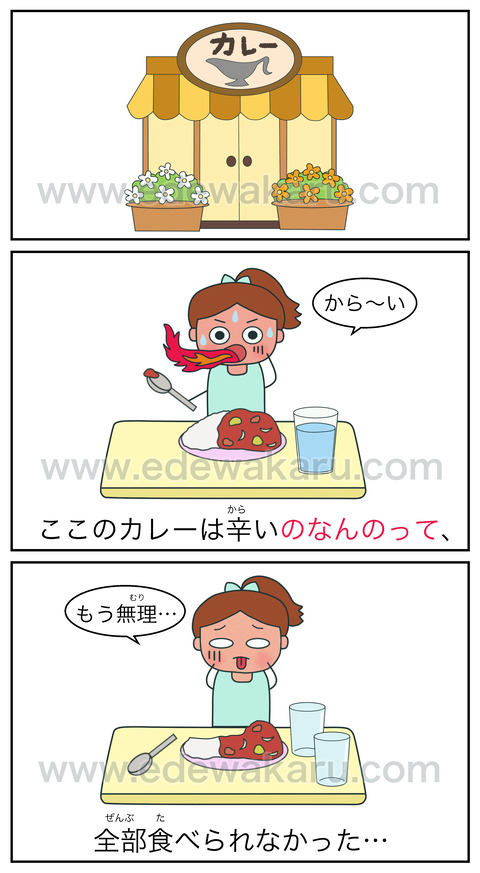
あそこのカレーは辛い
のなんのって、全部食べられなかった
=あそこのカレーは辛い
の
辛く
ないのって、全部食べられなかった
The curry over there was so spicy that I couldn’t finish it.
=The curry over there was so spicy—not spicy, you could say—that I couldn’t finish it.
彼女は飲む
のなんのって、1人でビールを10杯も飲んだ
=彼女は飲む
の
飲ま
ないのって、1人でビールを10杯も飲んだ
She drinks like crazy; she drank ten whole beers by herself.
=She drinks and drinks—not that she doesn’t drink—she drank ten whole beers by herself.
“〜のなんのって” and “〜の〜ないのって” are spoken expressions used with friends and family. 😊 Give them a try in conversation. 😉
In context 4 examples
ここのカレーは辛いのなんのって、全部食べられなかった
→ここのカレーはとても辛くて、全部食べられなかったThe curry here is so spicy that I couldn’t finish it. →The curry here was very spicy, so I couldn’t finish it.
山田さんはきれいなのなんのって、まるで人形のようだったよ
→山田さんはとてもきれいで、まるで人形のようだったよYamada is incredibly beautiful, just like a doll. →Yamada is very beautiful, just like a doll.
彼女は飲むのなんのって。1人でビールを10杯も飲んだよ(復習:数量詞+も)
→彼女はすごく飲む。1人でビールを10杯も飲んだよShe drinks like crazy. She drank ten whole beers by herself. (Review: quantity word+も) →She drinks a lot. She drank ten whole beers by herself.
あのバッグは高いのなんのって、買おうにも買えなかったよ(復習:〜ようにも〜ない)
→あのバッグはとても高くて、買おうにも買えなかったThat bag was so expensive that I couldn’t buy it even though I wanted to. (Review: 〜ようにも〜ない) →That bag was very expensive, so I couldn’t buy it even though I wanted to.
Read the original source text
Meaning
とても〜だ
すごく〜
How to use it
動詞・形容詞[普通形]+のなんのって
Explanation
「〜のなんのって」は「とても〜だ」「すごく〜」「非常に〜」というように程度がすごいことを表す文型です。驚きや、意外だという気持ちを込めて使います(復習:〜を込めて・〜を込めた)
【補足説明】
「〜のなんのって」は「〜の〜ないのって」の短い形です😮
[例]
あそこのカレーは辛い
のなんのって、全部食べられなかった
=あそこのカレーは辛い
の
辛く
ないのって、全部食べられなかった
彼女は飲む
のなんのって、1人でビールを10杯も飲んだ
=彼女は飲む
の
飲ま
ないのって、1人でビールを10杯も飲んだ
「〜のなんのって」「〜の〜ないのって」は話し言葉で、友達や家族と使われる文型です
😊みなさんも、会話で使ってみてくださいね😉