絵でわかる日本語
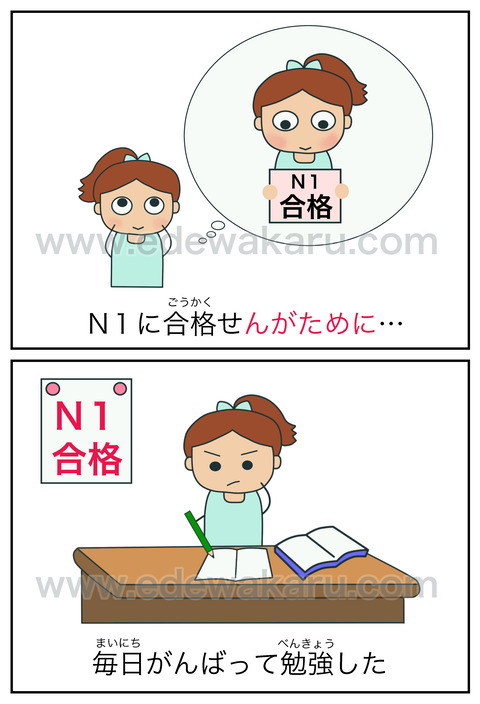
Meaning
(purpose) in order to 〜
How to use it
Verb [ない-form] + んがために
Verb [ない-form] + んがための + noun
Explanation
“〜んがために” is a grammar pattern that expresses purpose, meaning “in order to 〜.” It is very old-fashioned and is not used in conversation. The verb’s [ない-form] is changed to “ん,” but in the case of “する,” as in example ①, it becomes “〜せんがために” 😮 There are several set expressions, so remember them 😉
生きんがために
→in order to live
得んがために
→in order to obtain
Also, the “に” in “〜んがために” can be omitted 😊
[Examples]
N1に合格せんがために
→合格せんがため
レポートを書き上げんがために
→書き上げんがため
Remember that it is sometimes used in written language 😀
In context 3 examples
N1に合格せんがために、毎日がんばって勉強した
→N1に合格するために、毎日がんばって勉強したIn order to pass N1, I studied hard every day. →In order to pass N1, I studied hard every day.
レポートを書き上げんがために、昨日は徹夜した
→レポートを書き上げるために、昨日は徹夜したI stayed up all night yesterday in order to finish writing the report. →I stayed up all night yesterday in order to finish writing the report.
大金を得んがために、犯罪を犯した
→大金を得るために、犯罪を犯したHe committed a crime in order to obtain a large sum of money. →He committed a crime in order to obtain a large sum of money.
Read the original source text
Meaning
(目的)〜ために
How to use it
動詞[ない形]+んがために
動詞[ない形]+んがための+名詞
Explanation
「〜んがために」は「〜ために」と目的を表す文型です。とても古い言い方ですので、会話で使われることはありません。動詞の[ない形]を「ん」にチェンジして使いますが、例文①のように「
する」の場合は「〜せんがために」になります
😮慣用表現がいくつかありますので覚えておきましょう😉
生きんがために
→生きるために
得んがために
→得るために
また
「〜んがために」の「に」は省略できます
😊
[例]
N1に合格せ
んがために
→合格せ
んがため
レポートを書き上げ
んがために
→書き上げ
んがため
書き言葉として使われることはありますので覚えておきましょう😀
IMABI
~ために III: ~んがために & ~がために
Read this IMABI lesson ↗Explanation
~ために III: ~んがために & ~がために
In this lesson, we will return our focuses to the phrase ~ために once more. This time, we will learn how this phrase can be preceded by the particle が instead of the usual particle の when after nominal phrases. In doing so, we will look at three different patterns.
N + ~がために
V + ~んがために
V + ~がために
※While the 連体形 alone suffices to denote a modifier, ~が・の were frequently in between adjectival/verbal predicates and the modified noun despite being otherwise ungrammatical in vernacular speech.
Archaic Use of が: 連体修飾格
In the past, the particles が and の shared far more interchangeability than they do today. It was once possible to use が to mark an attribute to the same degree の does today. Nowadays, this is limited to particular words (mostly place names) and grammatical structures. As が’s use with ~ために in this fashion is a given, below are a handful of examples found in words still used commonly today.
i. 我わが家や
One’s home/family
ii. 自由じゆうが丘おか
Jiyūgaoka
iii. 鬼おにヶが島しま
Onigashima (Island of Ogres)
Terminology Note: As indicated by the title of this section, this use of が in linguistic terms is referred to as the 連体修飾格 (adnominal modifier case).
Noun + ~がために
When ~がために directly follows a noun, it is essentially the same as ~のために. The only difference is that ~がために is literary and is never used in the spoken language. Other aspects of a sentence also tend to be old-fashioned when it is used. Depending on what kind of noun precedes it, ~がために can either mark an objective or a cause/reason.
1. 誰たが為ために株かぶは上あがる。
For whom do stocks rise?
Word Note: 誰が為 should not be read as だれがため. 誰 was originally た, and this pronunciation is preserved in this expression.
2. 何なにがために生いきているのかを知しらずに盲目的もうもくてきな日送ひおくりをしていた。
I was blindly living my days not knowing what I was living for.
3. 遠とおく京師けいしを離はなれていたので、玄機げんきがために力ちからをいたすことができなかった。
Since (he) was far away from the capital, he was unable to render assistance to Genki.
From 魚玄機ぎょげんき by 森鷗外もりおうがい.
Word Note: 京師 is an outdated term that can refer to old capitals of countries which use(d) Chinese characters. Thus, in context it can refer to cities such as Beijing, Xi’an, Seoul, Kyoto, etc.
4. 彼かれは父ちちの貧まずしきがために、充分じゅうぶんなる教育きょういくを受うけなかった。
Due to his father being poor, he did not receive a proper education.
Grammar Notes:
1. 貧しき is the original 連体形 of the adjective 貧しい. With ~がために following, the phrase 父の貧しき is essentially nominalized, and the use of the particle の is simply for marking the subject of a subordinate clause.
2. なる is the original 連体形 of the copula.
5. 亡なき者ものの為ための仏事ぶつじではなく、まさに我わが為ための仏事ぶつじであった。
Instead of it being a memorial service for the deceased individual, it was like it was a memorial service for myself.
6. 当初とうしょの考かんがえには、我わが日本国にほんこくの不文不明ふぶんふめいなるは教育きょういくのあまねからざるがためのみ、教育きょういくさえ行届いきとどけば文明富強ぶんめいふきょうは日ひを期きしていたすべし、との胸算きょうさんにてありしが、さて今日こんにちにいたりて実際じっさいの模様もようを見みるに、教育きょういくはなかなかよく行いきとどきて字じを知しる者ものも多おおく、一芸一能いちげいいちのうに達たっしたる専門せんもんの学者がくしゃも少すくなからずして、まずもって前年ぜんねんの所望しょもうはやや達たっしたる姿すがたなれども、これがために国くにの文明富強ぶんめいふきょうをいたしたるの証拠しょうことては、甚はなはだ少すくなきが如ごとし。
My initial thought was that the illiterate and ignorant state of our nation Japan was solely due to education not being widespread and that so long as education were scrupulous, we would someday attain a rich and powerful civilization; however, looking at our actual current state, though education has come along well with many having learned to read and there being far from few expert scholars gifted in their particular skills, and though this is the rather accomplished state of what I had previously desired in the first place, it all seems far too little as the evidence for our nation having accomplished forging a rich and powerful civilization.
Grammar Notes:
1. The particle は is seen directly after the 連体形 of the auxiliary verb ~なり—なる. In Classical grammar, it is possible for は to directly follow the 連体形 of a verbal phrase. The Modern Japanese equivalent of ~なるは would be ~であることは. Thus, the verbal phrase is nominalized, allowing ~がため(に) to follow.
2. The particle に is deleted in ~がために due to the presence of the particle のみ.
3. あまねからざる is the 連体形 of the negative form of the Classical adjective あまねし 【遍し/普し】, which did not survive into the modern language. It translates into Modern Japanese as 広く行き渡っている.
4. The auxiliary verb ~べし has various meanings, but in this passage, it is equivalent to できるだろう.
5. ~にてありしが = ~であったが.
6. The ~たる in 達したる and いたしたる is the 連体形 of ~たり, the original 終止形 of the auxiliary verb ~た.
7. なれども = であるけれども.
8. Modern Japanese equivalents of ~が如し include ~と同じだ, ~のようだ, and ~の通りだ. Grammatically speaking, the が used in this expression is the same as in ~がため(に).
9. The Modern Japanese equivalent of ~とて is ~と言っては.
Verb + ~んがために
In the grammar pattern ~んがために, ~ん is the contracted form of the Classical auxiliary verb ~む, which is the predecessor of the auxiliary verbs of volition ~よう and ~う. Here, ~ん is in the 連体形, which means the verbal phrase it is a part of functions as a noun. As such, ~がために attaches normally. Although unnatural, a literal translation into Modern Japanese of this pattern would be ~ようとすることのために.
As is the case with ~よう and ~う, ~ん follows the 未然形 of verbs. To visualize how this pattern connects to each kind of verb, below is a conjugation chart.
/eru/-Ichidan Verb 得る + んがために → 得んがために (to gain)
/iru/-Ichidan Verb 見る + んがために → 見んがために (to look)
/u/-Godan Verb 救う + んがために → 救わんがために (to save)
/ku/-Godan Verb 築く + んがために → 築かんがために (to build)
/gu/-Godan Verb 稼ぐ + んがために → 稼がんがために (to earn)
/su/-Godan Verb 示す + んがために → 示さんがために (to show)
/tsu/-Godan Verb 保つ + んがために → 保たんがために (to maintain)
/nu/-Godan Verb 死ぬ + んがために → 死なんために (to die)
/mu/-Godan Verb 読む + んがために → 読まんがために (to read)
/ru/-Godan Verb 成る + んがために → 成らんがために (to become)
Suru (Verb) する + んがために → せんがために (to do)
Kuru くる + んがために → こんがために (to come)
The basic sentence pattern used for this expression is “A + Vんがために + B.” Whereas “A + Vために + B” either expresses a certain reason/objective A to bring about a certain outcome B,” this pattern emphasizes that B is the only means by which objective A can be accomplished. Thus, it is highly nuanced.
However, it is most often not the case that the speaker would have thought long and hard about the situation to come to the conclusion that is being expressed. Rather, the situation being described is very much “last resort” in feel, and the circumstance the experiencer is facing is mostly a very difficult and/or abnormal dilemma.
This, though, does not mean that the situation overall must be dire or necessarily pressing. There is an almost spontaneous realization on the part of the experiencer that A must be done for B to happen. In other words, the action described in A is usually impulsive and not indicative of planning. A can also be described as a breakthrough action that disrupts the status quo.
As was the case for the uses of ~ために we learned early on in our studies, the particle に can be seen omitted as is often the case for this particle in the written language. This expression can also be seen as ~んがための when used to modify another nominal phrase (Ex. 7).
7. 自分じぶんの利益りえきを得えんがための発言はつげんでは、人ひとの心こころを動うごかせない。
You can’t move people’s hearts with words only for one’s personal interest.
8. 彼かれは夢ゆめを実現じつげんさせんがため、上京じょうきょうした。
He moved to Tokyo to fulfill his dreams.
Sentence Note: The act of fulfilling his dreams is not what’s impulsive or last minute about the situation. Rather, it is implied that there must have been a sudden breakthrough on the will of the subject to finally break the status quo and pack his things and head for Tokyo.
9. 麻薬反対まやくはんたいという思おもいを示しめさんがために、彼かれはあらゆる方法ほうほうを試こころみた。
He tried out every method to show his thoughts for being against drugs.
10. 我わが子この無罪むざいを証明しょうめいせんがために、必死ひっしで証拠しょうこを探さがそうと誓ちかった。
I vowed to search desperately for proof to prove his own child’s innocence.
11. 彼かれは子供こどもを救すくわんがために、命いのちを落おとした。
He lost his life trying to save the child.
12. 彼かれは、漢検かんけん1いっ級きゅうに合格ごうかくせんがために、毎日必死まいにちひっしで頑張がんばった。
He did his best every day desperately to pass the Kanken Level 1.
13. 国会こっかいで法案ほうあんを通とおさんがため、首相しゅしょうは根回ねまわし工作こうさくを開始かいしした。
The Prime Minister began to pull strings to get the bill through the Diet.
14. 社長しゃちょうにならんがために、色々いろいろな裏工作うらこうさくをしていたといわれる。
It is said that (he) did all sorts of maneuvering behind the scenes to become the company president.
15. ただ一流大学いちりゅうだいがくに入はいらんがために勉強べんきょうしている人ひとが多おおい。
There are a lot of people that are studying to just get into a first-rate university.
16. 民衆みんしゅうを教育きょういくせんがために、多おおくの学校がっこうは建たてられたのである。
Many schools were built to educate the masses.
17. 支配者が権力を保たんがために、強硬手段を取った。
The ruler took strong measures to maintain power.
18. 我々われわれは、 世界せかいの将来しょうらいに平和へいわと繁栄はんえいを築きずかんがために努力どりょくしている。
We are endeavoring to build peace and prosperity to the future of the world.
19. ある時ときは、その子供達こどもたちの持もつ欠点けってんを正ただしく直なおさんがために、また足たらざるものを補おぎなわんがために話はなしの題材だいざいを選えらぶこともあれば、その心持こころもちで語かたられるでありましょう。
Other times, if there were moments in which to choose the theme of the story to properly correct the shortcomings of the children or to supplement what they lacked, I would surely be able to narrate with that disposition.
From 『童話どうわを書かく時ときの心』 by 小川未明おがわみめい.
20. 〇まるの韻字いんじを持もって来こんがために、無理むりにこじつけたもので品しなを落おとしたようです。
It seems I lowered the quality (of the poem) by unreasonably straining it to bring about the rhyming word #.
Word Note: 韻字 are characters placed at the end of a stanza in Chinese prose to add rhyme.
21. 漢文かんぶんにおける「句読法くとうほう」は、中国文ちゅうごくぶんを日本語式にほんごしきに読よまんがために日本にほんで考案こうあんされたものである。
The “punctuation rules” found in Kanbun were devised in Japan to read Chinese works in a Japanese style.
Culture Note: Kanbun is Classical Chinese literature primarily written by Japanese people.
22. 生活費せいかつひを稼かせがんがために一生懸命いっしょうけんめい(に)働はたらいている。
I am working my utmost to earn my living expenses.
23. 即すなわち、イエス様さまは死しなんがために死しに得うべき状態じょうたいを取とり、我われらと同おなじ血肉ちにくを具そなえたのである。
In other words, Jesus took a state in which death was possible to die, therefore possessing flesh and blood just like us.
Sentence Note: It is not implied that Jesus took human form impulsively to die. However, atonement of humanity’s sin via death was a predicate to Jesus’ descent, and taking a form in which it was possible to die was the only means available, which is why 死なんがために is used.
24. 神様かみさまは、己おのれを見みんがために愛あいを創造そうぞうせざるを得えなかった。
God had no choice but to create love to assess Himself.
Sentence Note: Similarly to Ex. 23, it is not necessarily the case that God’s action in B is a result of A being an impulsive drive. Although this may be true, A should be interpreted more so as B being the only result that could fulfill objective A.
Verb/Adj. + ~がために
~がために may also be seen directly after verbal/adjectival predicates in either the non-past or past tense. This is also old-fashioned and almost entirely limited to the written language. Its purpose is to express an atypical reason/cause that brings about an atypical result. This atypical result is not painted in any particularly positive or negative light, but it does provide a rather neutral tone to often serious statements.
25. 融資ゆうしを受うけてしまったがために差さし押おさえが目前もくぜんに迫せまってきた。
The seizure (of my assets) came close at hand due to the financing I had received.
26. 彼女かのじょは、太腿ふとももに脂肪しぼうが付ついてしまったがために、着きたいものが着きられないという切せつない経験けいけんを味あじわった。
She tasted the painful experience of not being able to wear what she wanted because she had put on fat in her thighs.
27. 人ひとに馴なれてしまったがために、周囲しゅういを警戒けいかいしなくなって捕食者ほしょくしゃに食たべられてしまったり、放はなしても帰かえってきてしまったりするという鳥とりも少すくなくない。
There are also far from few birds who get eaten by predators because they are no longer wary of their surroundings or who end up returning even after being released because they became too tame with people.
28. 彼かれは殺人犯さつじんはんの息子むすこに生うまれてしまったがために日陰ひかげの人生じんせいを歩あゆまざるを得えなかった。
He had no choice but to go through life in the shadows due to being born as the son of a murderer.
~がために can also be seen as an emphatic yet literary version of the objective marking ~ために. This usage is less common than the one above, so much so that it is sometimes perceived as a mistake. Using it broadly as a replacement of ~ために, however, would be a misuse of this pattern. Ultimately, the tone given off by this use of ~がために is somewhat “matter-of-fact” but in a very composed and authoritative manner.
29. この海うみが見みたいがために、毎朝起まいあさおきる気きがするのだった。
(She) felt the urge to wake up in the morning to see the ocean.
From 『光の雨』 by 立松和平たてまつわへい.
30. 私わたしが、何なんか子供達こどもたちに向むかってお話はなしをするとしたら、まず、それがどんな子供達こどもたちであるかを知しろうとするでしょう。次つぎに、いくつ位くらいであるかを見みます。それによって話はなしを選えらび、よく分わかるようにしたいがためです。
If I were to narrate something to children, I would first try to know what kind of children they are. Then, I would see how old there are. I’d choose my story based on that so that they can understand well.
From 『童話どうわを書かく時ときの心』 by 小川未明おがわみめい.
31. 故ゆえに子こを教おしえるがためには労ろうを憚はばかるべからず、財ざいを愛いとしむべからず。
Therefore, one mustn’t have scruples about the work or be attached to ones riches in order to teach a child.
From 『教育きょういくの事』 by 福沢諭吉ふくざわゆきち.
32. その青年せいねんは毎日、「日本語にほんごの本ほん」を読よみたいがために青空文庫あおぞらぶんこを利用りようしている。
That young man uses Aozora Bunko every day to read “Japanese books.”
Sentence Note: The ~がために used in this sentence can be seen as marking both a reason and an objective.
In context 43 examples
誰たが為ために株かぶは上あがる。
For whom do stocks rise?
何なにがために生いきているのかを知しらずに盲目的もうもくてきな日送ひおくりをしていた。
I was blindly living my days not knowing what I was living for.
遠とおく京師けいしを離はなれていたので、玄機げんきがために力ちからをいたすことができなかった。
Since (he) was far away from the capital, he was unable to render assistance to Genki.
彼かれは父ちちの貧まずしきがために、充分じゅうぶんなる教育きょういくを受うけなかった。
Due to his father being poor, he did not receive a proper education.
貧しき is the original 連体形 of the adjective 貧しい. With ~がために following, the phrase 父の貧しき is essentially nominalized, and the use of the particle の is simply for marking the subject of a subordinate clause.
Instead of it being a memorial service for the deceased individual, it was like it was a memorial service for myself.
なる is the original 連体形 of the copula.
Instead of it being a memorial service for the deceased individual, it was like it was a memorial service for myself.
亡なき者ものの為ための仏事ぶつじではなく、まさに我わが為ための仏事ぶつじであった。
Instead of it being a memorial service for the deceased individual, it was like it was a memorial service for myself.
当初とうしょの考かんがえには、我わが日本国にほんこくの不文不明ふぶんふめいなるは教育きょういくのあまねからざるがためのみ、教育きょういくさえ行届いきとどけば文明富強ぶんめいふきょうは日ひを期きしていたすべし、との胸算きょうさんにてありしが、さて今日こんにちにいたりて実際じっさいの模様もようを見みるに、教育きょういくはなかなかよく行いきとどきて字じを知しる者ものも多おおく、一芸一能いちげいいちのうに達たっしたる専門せんもんの学者がくしゃも少すくなからずして、まずもって前年ぜんねんの所望しょもうはやや達たっしたる姿すがたなれども、これがために国くにの文明富強ぶんめいふきょうをいたしたるの証拠しょうことては、甚はなはだ少すくなきが如ごとし。
My initial thought was that the illiterate and ignorant state of our nation Japan was solely due to education not being widespread and that so long as education were scrupulous, we would someday attain a rich and powerful civilization; however, looking at our actual current state, though education has come along well with many having learned to read and there being far from few expert scholars gifted in their particular skills, and though this is the rather accomplished state of what I had previously desired in the first place, it all seems far too little as the evidence for our nation having accomplished forging a rich and powerful civilization.
The particle は is seen directly after the 連体形 of the auxiliary verb ~なり—なる. In Classical grammar, it is possible for は to directly follow the 連体形 of a verbal phrase. The Modern Japanese equivalent of ~なるは would be ~であることは. Thus, the verbal phrase is nominalized, allowing ~がため(に) to follow.
The particle は appears directly after the 連体形 of the auxiliary verb ~なり—なる. In Classical grammar, は can directly follow the 連体形 of a verbal phrase. The Modern Japanese equivalent of ~なるは is ~であることは. Thus, the verbal phrase is nominalized, allowing ~がため(に) to follow.
The particle に is deleted in ~がために due to the presence of the particle のみ.
The particle に is omitted from ~がために because of the presence of the particle のみ.
あまねからざる is the 連体形 of the negative form of the Classical adjective あまねし 【遍し/普し】, which did not survive into the modern language. It translates into Modern Japanese as 広く行き渡っている.
あまねからざる is the 連体形 of the negative form of the Classical adjective あまねし 【遍し/普し】, which did not survive into the modern language. In Modern Japanese, it translates as 広く行き渡っている.
The auxiliary verb ~べし has various meanings, but in this passage, it is equivalent to できるだろう.
The auxiliary verb ~べし has various meanings, but in this passage it is equivalent to できるだろう.
~にてありしが = ~であったが.
~にてありしが = ~であったが.
The ~たる in 達したる and いたしたる is the 連体形 of ~たり, the original 終止形 of the auxiliary verb ~た.
The ~たる in 達したる and いたしたる is the 連体形 of ~たり, the original 終止形 of the auxiliary verb ~た.
なれども = であるけれども.
なれども = であるけれども.
Modern Japanese equivalents of ~が如し include ~と同じだ, ~のようだ, and ~の通りだ. Grammatically speaking, the が used in this expression is the same as in ~がため(に).
Modern Japanese equivalents of ~が如し include ~と同じだ, ~のようだ, and ~の通りだ. Grammatically speaking, the が in this expression is the same as the が in ~がため(に).
The Modern Japanese equivalent of ~とて is ~と言っては.
The Modern Japanese equivalent of ~とて is ~と言っては.
自分じぶんの利益りえきを得えんがための発言はつげんでは、人ひとの心こころを動うごかせない。
You can’t move people’s hearts with words only for one’s personal interest.
彼かれは夢ゆめを実現じつげんさせんがため、上京じょうきょうした。
He moved to Tokyo to fulfill his dreams.
麻薬反対まやくはんたいという思おもいを示しめさんがために、彼かれはあらゆる方法ほうほうを試こころみた。
He tried out every method to show his thoughts for being against drugs.
我わが子この無罪むざいを証明しょうめいせんがために、必死ひっしで証拠しょうこを探さがそうと誓ちかった。
I vowed to search desperately for proof to prove his own child’s innocence.
彼かれは子供こどもを救すくわんがために、命いのちを落おとした。
He lost his life trying to save the child.
彼かれは、漢検かんけん1いっ級きゅうに合格ごうかくせんがために、毎日必死まいにちひっしで頑張がんばった。
He did his best every day desperately to pass the Kanken Level 1.
国会こっかいで法案ほうあんを通とおさんがため、首相しゅしょうは根回ねまわし工作こうさくを開始かいしした。
The Prime Minister began to pull strings to get the bill through the Diet.
社長しゃちょうにならんがために、色々いろいろな裏工作うらこうさくをしていたといわれる。
It is said that (he) did all sorts of maneuvering behind the scenes to become the company president.
ただ一流大学いちりゅうだいがくに入はいらんがために勉強べんきょうしている人ひとが多おおい。
There are a lot of people that are studying to just get into a first-rate university.
民衆みんしゅうを教育きょういくせんがために、多おおくの学校がっこうは建たてられたのである。
Many schools were built to educate the masses.
支配者が権力を保たんがために、強硬手段を取った。
The ruler took strong measures to maintain power.
我々われわれは、 世界せかいの将来しょうらいに平和へいわと繁栄はんえいを築きずかんがために努力どりょくしている。
We are endeavoring to build peace and prosperity to the future of the world.
ある時ときは、その子供達こどもたちの持もつ欠点けってんを正ただしく直なおさんがために、また足たらざるものを補おぎなわんがために話はなしの題材だいざいを選えらぶこともあれば、その心持こころもちで語かたられるでありましょう。
Other times, if there were moments in which to choose the theme of the story to properly correct the shortcomings of the children or to supplement what they lacked, I would surely be able to narrate with that disposition.
〇まるの韻字いんじを持もって来こんがために、無理むりにこじつけたもので品しなを落おとしたようです。
It seems I lowered the quality (of the poem) by unreasonably straining it to bring about the rhyming word #.
漢文かんぶんにおける「句読法くとうほう」は、中国文ちゅうごくぶんを日本語式にほんごしきに読よまんがために日本にほんで考案こうあんされたものである。
The “punctuation rules” found in Kanbun were devised in Japan to read Chinese works in a Japanese style.
生活費せいかつひを稼かせがんがために一生懸命いっしょうけんめい(に)働はたらいている。
I am working my utmost to earn my living expenses.
即すなわち、イエス様さまは死しなんがために死しに得うべき状態じょうたいを取とり、我われらと同おなじ血肉ちにくを具そなえたのである。
In other words, Jesus took a state in which death was possible to die, therefore possessing flesh and blood just like us.
神様かみさまは、己おのれを見みんがために愛あいを創造そうぞうせざるを得えなかった。
God had no choice but to create love to assess Himself.
融資ゆうしを受うけてしまったがために差さし押おさえが目前もくぜんに迫せまってきた。
The seizure (of my assets) came close at hand due to the financing I had received.
彼女かのじょは、太腿ふとももに脂肪しぼうが付ついてしまったがために、着きたいものが着きられないという切せつない経験けいけんを味あじわった。
She tasted the painful experience of not being able to wear what she wanted because she had put on fat in her thighs.
人ひとに馴なれてしまったがために、周囲しゅういを警戒けいかいしなくなって捕食者ほしょくしゃに食たべられてしまったり、放はなしても帰かえってきてしまったりするという鳥とりも少すくなくない。
There are also far from few birds who get eaten by predators because they are no longer wary of their surroundings or who end up returning even after being released because they became too tame with people.
彼かれは殺人犯さつじんはんの息子むすこに生うまれてしまったがために日陰ひかげの人生じんせいを歩あゆまざるを得えなかった。
He had no choice but to go through life in the shadows due to being born as the son of a murderer.
この海うみが見みたいがために、毎朝起まいあさおきる気きがするのだった。
(She) felt the urge to wake up in the morning to see the ocean.
私わたしが、何なんか子供達こどもたちに向むかってお話はなしをするとしたら、まず、それがどんな子供達こどもたちであるかを知しろうとするでしょう。次つぎに、いくつ位くらいであるかを見みます。それによって話はなしを選えらび、よく分わかるようにしたいがためです。
If I were to narrate something to children, I would first try to know what kind of children they are. Then, I would see how old there are. I’d choose my story based on that so that they can understand well.
故ゆえに子こを教おしえるがためには労ろうを憚はばかるべからず、財ざいを愛いとしむべからず。
Therefore, one mustn’t have scruples about the work or be attached to ones riches in order to teach a child.
その青年せいねんは毎日、「日本語にほんごの本ほん」を読よみたいがために青空文庫あおぞらぶんこを利用りようしている。
That young man uses Aozora Bunko every day to read “Japanese books.”
Read the original source text
Explanation
~ために III: ~んがために & ~がために
In this lesson, we will return our focuses to the phrase ~ために once more. This time, we will learn how this phrase can be preceded by the particle が instead of the usual particle の when after nominal phrases. In doing so, we will look at three different patterns.
N + ~がために
V + ~んがために
V + ~がために
※While the 連体形 alone suffices to denote a modifier, ~が・の were frequently in between adjectival/verbal predicates and the modified noun despite being otherwise ungrammatical in vernacular speech.
Archaic Use of が: 連体修飾格
In the past, the particles が and の shared far more interchangeability than they do today. It was once possible to use が to mark an attribute to the same degree の does today. Nowadays, this is limited to particular words (mostly place names) and grammatical structures. As が’s use with ~ために in this fashion is a given, below are a handful of examples found in words still used commonly today.
i. 我わが家や
One’s home/family
ii. 自由じゆうが丘おか
Jiyūgaoka
iii. 鬼おにヶが島しま
Onigashima (Island of Ogres)
Terminology Note: As indicated by the title of this section, this use of が in linguistic terms is referred to as the 連体修飾格 (adnominal modifier case).
Noun + ~がために
When ~がために directly follows a noun, it is essentially the same as ~のために. The only difference is that ~がために is literary and is never used in the spoken language. Other aspects of a sentence also tend to be old-fashioned when it is used. Depending on what kind of noun precedes it, ~がために can either mark an objective or a cause/reason.
1. 誰たが為ために株かぶは上あがる。
For whom do stocks rise?
Word Note: 誰が為 should not be read as だれがため. 誰 was originally た, and this pronunciation is preserved in this expression.
2. 何なにがために生いきているのかを知しらずに盲目的もうもくてきな日送ひおくりをしていた。
I was blindly living my days not knowing what I was living for.
3. 遠とおく京師けいしを離はなれていたので、玄機げんきがために力ちからをいたすことができなかった。
Since (he) was far away from the capital, he was unable to render assistance to Genki.
From 魚玄機ぎょげんき by 森鷗外もりおうがい.
Word Note: 京師 is an outdated term that can refer to old capitals of countries which use(d) Chinese characters. Thus, in context it can refer to cities such as Beijing, Xi’an, Seoul, Kyoto, etc.
4. 彼かれは父ちちの貧まずしきがために、充分じゅうぶんなる教育きょういくを受うけなかった。
Due to his father being poor, he did not receive a proper education.
Grammar Notes:
1. 貧しき is the original 連体形 of the adjective 貧しい. With ~がために following, the phrase 父の貧しき is essentially nominalized, and the use of the particle の is simply for marking the subject of a subordinate clause.
2. なる is the original 連体形 of the copula.
5. 亡なき者ものの為ための仏事ぶつじではなく、まさに我わが為ための仏事ぶつじであった。
Instead of it being a memorial service for the deceased individual, it was like it was a memorial service for myself.
6. 当初とうしょの考かんがえには、我わが日本国にほんこくの不文不明ふぶんふめいなるは教育きょういくのあまねからざるがためのみ、教育きょういくさえ行届いきとどけば文明富強ぶんめいふきょうは日ひを期きしていたすべし、との胸算きょうさんにてありしが、さて今日こんにちにいたりて実際じっさいの模様もようを見みるに、教育きょういくはなかなかよく行いきとどきて字じを知しる者ものも多おおく、一芸一能いちげいいちのうに達たっしたる専門せんもんの学者がくしゃも少すくなからずして、まずもって前年ぜんねんの所望しょもうはやや達たっしたる姿すがたなれども、これがために国くにの文明富強ぶんめいふきょうをいたしたるの証拠しょうことては、甚はなはだ少すくなきが如ごとし。
My initial thought was that the illiterate and ignorant state of our nation Japan was solely due to education not being widespread and that so long as education were scrupulous, we would someday attain a rich and powerful civilization; however, looking at our actual current state, though education has come along well with many having learned to read and there being far from few expert scholars gifted in their particular skills, and though this is the rather accomplished state of what I had previously desired in the first place, it all seems far too little as the evidence for our nation having accomplished forging a rich and powerful civilization.
Grammar Notes:
1. The particle は is seen directly after the 連体形 of the auxiliary verb ~なり—なる. In Classical grammar, it is possible for は to directly follow the 連体形 of a verbal phrase. The Modern Japanese equivalent of ~なるは would be ~であることは. Thus, the verbal phrase is nominalized, allowing ~がため(に) to follow.
2. The particle に is deleted in ~がために due to the presence of the particle のみ.
3. あまねからざる is the 連体形 of the negative form of the Classical adjective あまねし 【遍し/普し】, which did not survive into the modern language. It translates into Modern Japanese as 広く行き渡っている.
4. The auxiliary verb ~べし has various meanings, but in this passage, it is equivalent to できるだろう.
5. ~にてありしが = ~であったが.
6. The ~たる in 達したる and いたしたる is the 連体形 of ~たり, the original 終止形 of the auxiliary verb ~た.
7. なれども = であるけれども.
8. Modern Japanese equivalents of ~が如し include ~と同じだ, ~のようだ, and ~の通りだ. Grammatically speaking, the が used in this expression is the same as in ~がため(に).
9. The Modern Japanese equivalent of ~とて is ~と言っては.
Verb + ~んがために
In the grammar pattern ~んがために, ~ん is the contracted form of the Classical auxiliary verb ~む, which is the predecessor of the auxiliary verbs of volition ~よう and ~う. Here, ~ん is in the 連体形, which means the verbal phrase it is a part of functions as a noun. As such, ~がために attaches normally. Although unnatural, a literal translation into Modern Japanese of this pattern would be ~ようとすることのために.
As is the case with ~よう and ~う, ~ん follows the 未然形 of verbs. To visualize how this pattern connects to each kind of verb, below is a conjugation chart.
/eru/-Ichidan Verb 得る + んがために → 得んがために (to gain)
/iru/-Ichidan Verb 見る + んがために → 見んがために (to look)
/u/-Godan Verb 救う + んがために → 救わんがために (to save)
/ku/-Godan Verb 築く + んがために → 築かんがために (to build)
/gu/-Godan Verb 稼ぐ + んがために → 稼がんがために (to earn)
/su/-Godan Verb 示す + んがために → 示さんがために (to show)
/tsu/-Godan Verb 保つ + んがために → 保たんがために (to maintain)
/nu/-Godan Verb 死ぬ + んがために → 死なんために (to die)
/mu/-Godan Verb 読む + んがために → 読まんがために (to read)
/ru/-Godan Verb 成る + んがために → 成らんがために (to become)
Suru (Verb) する + んがために → せんがために (to do)
Kuru くる + んがために → こんがために (to come)
The basic sentence pattern used for this expression is “A + Vんがために + B.” Whereas “A + Vために + B” either expresses a certain reason/objective A to bring about a certain outcome B,” this pattern emphasizes that B is the only means by which objective A can be accomplished. Thus, it is highly nuanced.
However, it is most often not the case that the speaker would have thought long and hard about the situation to come to the conclusion that is being expressed. Rather, the situation being described is very much “last resort” in feel, and the circumstance the experiencer is facing is mostly a very difficult and/or abnormal dilemma.
This, though, does not mean that the situation overall must be dire or necessarily pressing. There is an almost spontaneous realization on the part of the experiencer that A must be done for B to happen. In other words, the action described in A is usually impulsive and not indicative of planning. A can also be described as a breakthrough action that disrupts the status quo.
As was the case for the uses of ~ために we learned early on in our studies, the particle に can be seen omitted as is often the case for this particle in the written language. This expression can also be seen as ~んがための when used to modify another nominal phrase (Ex. 7).
7. 自分じぶんの利益りえきを得えんがための発言はつげんでは、人ひとの心こころを動うごかせない。
You can’t move people’s hearts with words only for one’s personal interest.
8. 彼かれは夢ゆめを実現じつげんさせんがため、上京じょうきょうした。
He moved to Tokyo to fulfill his dreams.
Sentence Note: The act of fulfilling his dreams is not what’s impulsive or last minute about the situation. Rather, it is implied that there must have been a sudden breakthrough on the will of the subject to finally break the status quo and pack his things and head for Tokyo.
9. 麻薬反対まやくはんたいという思おもいを示しめさんがために、彼かれはあらゆる方法ほうほうを試こころみた。
He tried out every method to show his thoughts for being against drugs.
10. 我わが子この無罪むざいを証明しょうめいせんがために、必死ひっしで証拠しょうこを探さがそうと誓ちかった。
I vowed to search desperately for proof to prove his own child’s innocence.
11. 彼かれは子供こどもを救すくわんがために、命いのちを落おとした。
He lost his life trying to save the child.
12. 彼かれは、漢検かんけん1いっ級きゅうに合格ごうかくせんがために、毎日必死まいにちひっしで頑張がんばった。
He did his best every day desperately to pass the Kanken Level 1.
13. 国会こっかいで法案ほうあんを通とおさんがため、首相しゅしょうは根回ねまわし工作こうさくを開始かいしした。
The Prime Minister began to pull strings to get the bill through the Diet.
14. 社長しゃちょうにならんがために、色々いろいろな裏工作うらこうさくをしていたといわれる。
It is said that (he) did all sorts of maneuvering behind the scenes to become the company president.
15. ただ一流大学いちりゅうだいがくに入はいらんがために勉強べんきょうしている人ひとが多おおい。
There are a lot of people that are studying to just get into a first-rate university.
16. 民衆みんしゅうを教育きょういくせんがために、多おおくの学校がっこうは建たてられたのである。
Many schools were built to educate the masses.
17. 支配者が権力を保たんがために、強硬手段を取った。
The ruler took strong measures to maintain power.
18. 我々われわれは、 世界せかいの将来しょうらいに平和へいわと繁栄はんえいを築きずかんがために努力どりょくしている。
We are endeavoring to build peace and prosperity to the future of the world.
19. ある時ときは、その子供達こどもたちの持もつ欠点けってんを正ただしく直なおさんがために、また足たらざるものを補おぎなわんがために話はなしの題材だいざいを選えらぶこともあれば、その心持こころもちで語かたられるでありましょう。
Other times, if there were moments in which to choose the theme of the story to properly correct the shortcomings of the children or to supplement what they lacked, I would surely be able to narrate with that disposition.
From 『童話どうわを書かく時ときの心』 by 小川未明おがわみめい.
20. 〇まるの韻字いんじを持もって来こんがために、無理むりにこじつけたもので品しなを落おとしたようです。
It seems I lowered the quality (of the poem) by unreasonably straining it to bring about the rhyming word #.
Word Note: 韻字 are characters placed at the end of a stanza in Chinese prose to add rhyme.
21. 漢文かんぶんにおける「句読法くとうほう」は、中国文ちゅうごくぶんを日本語式にほんごしきに読よまんがために日本にほんで考案こうあんされたものである。
The “punctuation rules” found in Kanbun were devised in Japan to read Chinese works in a Japanese style.
Culture Note: Kanbun is Classical Chinese literature primarily written by Japanese people.
22. 生活費せいかつひを稼かせがんがために一生懸命いっしょうけんめい(に)働はたらいている。
I am working my utmost to earn my living expenses.
23. 即すなわち、イエス様さまは死しなんがために死しに得うべき状態じょうたいを取とり、我われらと同おなじ血肉ちにくを具そなえたのである。
In other words, Jesus took a state in which death was possible to die, therefore possessing flesh and blood just like us.
Sentence Note: It is not implied that Jesus took human form impulsively to die. However, atonement of humanity’s sin via death was a predicate to Jesus’ descent, and taking a form in which it was possible to die was the only means available, which is why 死なんがために is used.
24. 神様かみさまは、己おのれを見みんがために愛あいを創造そうぞうせざるを得えなかった。
God had no choice but to create love to assess Himself.
Sentence Note: Similarly to Ex. 23, it is not necessarily the case that God’s action in B is a result of A being an impulsive drive. Although this may be true, A should be interpreted more so as B being the only result that could fulfill objective A.
Verb/Adj. + ~がために
~がために may also be seen directly after verbal/adjectival predicates in either the non-past or past tense. This is also old-fashioned and almost entirely limited to the written language. Its purpose is to express an atypical reason/cause that brings about an atypical result. This atypical result is not painted in any particularly positive or negative light, but it does provide a rather neutral tone to often serious statements.
25. 融資ゆうしを受うけてしまったがために差さし押おさえが目前もくぜんに迫せまってきた。
The seizure (of my assets) came close at hand due to the financing I had received.
26. 彼女かのじょは、太腿ふとももに脂肪しぼうが付ついてしまったがために、着きたいものが着きられないという切せつない経験けいけんを味あじわった。
She tasted the painful experience of not being able to wear what she wanted because she had put on fat in her thighs.
27. 人ひとに馴なれてしまったがために、周囲しゅういを警戒けいかいしなくなって捕食者ほしょくしゃに食たべられてしまったり、放はなしても帰かえってきてしまったりするという鳥とりも少すくなくない。
There are also far from few birds who get eaten by predators because they are no longer wary of their surroundings or who end up returning even after being released because they became too tame with people.
28. 彼かれは殺人犯さつじんはんの息子むすこに生うまれてしまったがために日陰ひかげの人生じんせいを歩あゆまざるを得えなかった。
He had no choice but to go through life in the shadows due to being born as the son of a murderer.
~がために can also be seen as an emphatic yet literary version of the objective marking ~ために. This usage is less common than the one above, so much so that it is sometimes perceived as a mistake. Using it broadly as a replacement of ~ために, however, would be a misuse of this pattern. Ultimately, the tone given off by this use of ~がために is somewhat “matter-of-fact” but in a very composed and authoritative manner.
29. この海うみが見みたいがために、毎朝起まいあさおきる気きがするのだった。
(She) felt the urge to wake up in the morning to see the ocean.
From 『光の雨』 by 立松和平たてまつわへい.
30. 私わたしが、何なんか子供達こどもたちに向むかってお話はなしをするとしたら、まず、それがどんな子供達こどもたちであるかを知しろうとするでしょう。次つぎに、いくつ位くらいであるかを見みます。それによって話はなしを選えらび、よく分わかるようにしたいがためです。
If I were to narrate something to children, I would first try to know what kind of children they are. Then, I would see how old there are. I’d choose my story based on that so that they can understand well.
From 『童話どうわを書かく時ときの心』 by 小川未明おがわみめい.
31. 故ゆえに子こを教おしえるがためには労ろうを憚はばかるべからず、財ざいを愛いとしむべからず。
Therefore, one mustn’t have scruples about the work or be attached to ones riches in order to teach a child.
From 『教育きょういくの事』 by 福沢諭吉ふくざわゆきち.
32. その青年せいねんは毎日、「日本語にほんごの本ほん」を読よみたいがために青空文庫あおぞらぶんこを利用りようしている。
That young man uses Aozora Bunko every day to read “Japanese books.”
Sentence Note: The ~がために used in this sentence can be seen as marking both a reason and an objective.
文法
Meaning
in order to (achieve a goal)
How to use it
V (ない-form) ない + んがために
※ する becomes せんがために
Notes
This is an old-fashioned expression and is hardly ever used in conversation.
It is sometimes used in writing or speeches.
In context 5 examples
来年、自分の店を出さんがために、今一生懸命お金をためている。
I’m saving money hard now in order to open my own shop next year.
外国人の彼氏を作らんがために、毎週、国際交流パーティーに参加している。
I go to international exchange parties every week in order to get a foreign boyfriend.
1年でJLPT N1に合格せんがために、毎日10時間以上勉強している。
I study more than ten hours every day in order to pass the JLPT N1 within a year.
新商品を来月までに完成させんがために、毎日会社に泊まり込んで頑張っている。
I’m working hard and staying overnight at the office every day in order to complete the new product by next month.
試合に勝たんがために、反則を犯してしまった彼は試合後、相手チームや観客、たくさんの人から非難を浴びた。
He committed a foul in order to win the match, and afterward was criticized by the opposing team, the spectators, and many others.
Read the original source text
Meaning
(目的を達成する)ために
How to use it
V(ナイ形)ない + んがた目に
※「する」は「せんがために」となる
Notes
古い表現で、会話で使うことはほとんどない。
書面やスピーチなどで使うことがある。
くらべてわかる日本語表現文型辞典
Meaning
Do B for the purpose of A. It emphasizes that A is the speaker’s sole purpose for doing B.
How to use it
AんがためにB (AんがためB/AんがためのB)
[Verb—ない form] んがために
Explanation
[Contrast 1]
“AんとしてB” (Meaning 1, p. 347)
“AんとしてB” means doing B in an attempt to do A. “AんがためにB” emphasizes A as the reason for doing B: why do B? It is for A.
○私は彼に追いつかんとして、努力している。(追いつくように努力している) — I am making an effort to catch up with him. (I am working hard so that I can catch up.)
○私は彼に追いつかんがために、努力している。(追いつくことが努力をする唯一の目的である) — I am making an effort to catch up with him. (Catching up is the sole purpose of my efforts.)
○非常ベルを押さんとして、手をのばした。 — He reached out to press the emergency button.
×非常ベルを押さんがために、手をのばした。 — He reached out to press the emergency button.
○私はこんなつまらないことをせんがために、ここに来たのではない。 — I did not come here in order to do something so trivial.
×私はこんなつまらないことをせんとして、ここに来たのではない。 — I did not come here trying to do something so trivial.
“AためにB” (Meaning 1, p. 126)
Notes
[Note 1]
・Because A is emphasized, B often involves “not choosing one’s means” or “doing something one normally would not do.”
○彼女はきれいにならんがために、整形手術までした。 — She even had plastic surgery in order to become beautiful.
×彼女はきれいにならんがために、化粧をした。 — She put on makeup in order to become beautiful.
In context 4 examples
戦後の荒廃した日本で人々は生きんがために、どんなことでもしなければならなかった。
In postwar Japan, devastated by the war, people had to do anything and everything in order to survive.
参加することに意義があるオリンピックなのに、最近では勝たんがために薬の力を借りる選手までいる始末だ。
Even though the Olympics are supposed to value taking part, these days some athletes even resort to drugs in order to win.
入学試験に合格せんがための勉強など、つまらない。
Studying just to pass the entrance exam is boring.
売らんがための過激な広告は排除されるべきだ。
Excessive advertising aimed solely at making sales should be eliminated.
Read the original source text
Meaning
Aを目的としてB。Aこそが話し手にとってBの唯一の目的だと強調している。
How to use it
AんがためにB(AんがためB/AんがためのB)
[動詞-ない形]んがために
Explanation
【対比1】
「AんとしてB」(意味1 P.347)
「AんとしてB」はAをしようとして、そのためにBをするという意味であり、「AんがためにB」はBをするのはなぜかというと、それはAのためだとAを強調している。
○私は彼に追いつかんとして、努力している。(追いつくように努力している)
○私は彼に追いつかんがために、努力している。(追いつくことが努力をする唯一の目的である)
○非常ベルを押さんとして、手をのばした。
×非常ベルを押さんがために、手をのばした。
○私はこんなつまらないことをせんがために、ここに来たのではない。
×私はこんなつまらないことをせんとして、ここに来たのではない。
「AためにB」(意味1 P.126)
Notes
【注意1】
・Aを強調しているため、Bには「手段を選ばない」「普通ではしない」ということが来ることが多い。
○彼女はきれいにならんがために、整形手術までした。
×彼女はきれいにならんがために、化粧をした。
日本語NET JLPT文法解説まとめ
Meaning
in order to (achieve a goal)
How to use it
V (ない-form stem) ない + んがために
※「する」 becomes 「せんがために」.
Explanation
To achieve (a goal).
This is an old-fashioned expression and is almost never used in conversation.
It is sometimes used in writing or speeches.
In context 5 examples
来年、自分の店を出さんがために、今一生懸命お金をためている。
I’m saving money hard now in order to open my own shop next year.
外国人の彼氏を作らんがために、毎週、国際交流パーティーに参加している。
I go to international exchange parties every week in order to get a foreign boyfriend.
1年でJLPT N1に合格せんがために、毎日10時間以上勉強している。
I study more than ten hours every day in order to pass the JLPT N1 within a year.
新商品を来月までに完成させんがために、毎日会社に泊まり込んで頑張っている。
I’m working hard and staying overnight at the office every day in order to complete the new product by next month.
試合に勝たんがために、反則を犯してしまった彼は試合後、相手チームや観客、たくさんの人から非難を浴びた。
He committed a foul in order to win the match, and afterward was criticized by the opposing team, the spectators, and many others.
Read the original source text
Meaning
(目的を達成する)ために
How to use it
V(ナイ形)ない + んがた目に
※「する」は「せんがために」となる
Explanation
To achieve (a goal).
古い表現で、会話で使うことはほとんどない。
書面やスピーチなどで使うことがある。
毎日のんびり日本語教師
Meaning
in order to ~
How to use it
Verbない-form + んがため(に)
Verbない-form + んがための + noun
Explanation
A sentence pattern that expresses purpose. It is hardly ever used in conversation and is a formal expression used mainly in writing.
It conveys a strong determination to achieve the purpose.
Note that 「する」 becomes 「せんがため」.
Notes
Similar grammar: 「【N1文法】~ことのないよう(に)/ことがないよう(に)」
Similar grammar: 「【N1文法】~べく」
In context 10 examples
自分の店を持たんがため、必死で働いている。
I’m working desperately in order to have a shop of my own.
試合で勝たんがため、毎日の練習を怠らない。
I never neglect my daily practice so that I can win the match.
戦争とは、権力を奪取せんがために起こされたものである。(战争是为了夺取权力而发生的。)
War is something that is waged in order to seize power. (War is waged to seize power.)
これもまた夢を叶えんがためのことだ。
This, too, is in order to make a dream come true.
政府や経済界には、いまだに現状を維持せんがための政策や取り組みが目立つ。
Even now, policies and initiatives aimed at maintaining the status quo are conspicuous among the government and business community.
生きんがために食べる。(为了生存而吃饭。)
We eat in order to live. (We eat to survive.)
目標を達成せんがために日々努力してきた。(为了达成目标每天都在努力。)
I have worked hard day after day in order to achieve my goal. (I have been working hard every day to achieve my goal.)
夢を叶えんがための努力を欠かさない。(为了实现梦想而不断努力。)
I never fail to make an effort in order to make my dreams come true. (I keep working hard to make my dreams come true.)
私はこの世界に、何事かをなさんがために生まれてきたのだ。
I was born into this world in order to accomplish something.
僅かな幸福を得んがため、いくたの苦悩に身を震わす。
I tremble with anguish again and again in order to attain a little happiness.
Read the original source text
Meaning
~するために
How to use it
動ない形+んがため(に)
動ない形+んがための+名詞
Explanation
目的を表す文型です。口語で使われることはほぼなく、主に書き言葉で使われる硬い表現です。
目的達成に対する強い意志が含まれます。
「する」は「せんがため」になる点に注意してください。
Notes
似ている文法「【N1文法】~ことのないよう(に)/ことがないよう(に)」
似ている文法「【N1文法】~べく」