絵でわかる日本語
Meaning
Indicates a goal, destination, direction, or addressee
How to use it
Noun[dictionary form]+に向けて
Explanation
“〜に向けて” is a sentence pattern that indicates a 【goal】, 【destination】, 【direction】, or 【addressee】.
Goal
→with … as the goal・aiming for …
Destination
→with … as the destination
Direction
→in the direction of …
Addressee
→toward … / addressing …
[Examples]
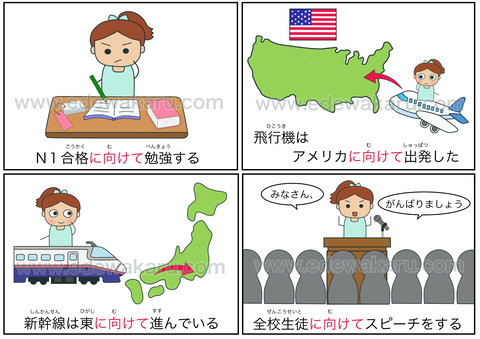
①N1合格
に向けて
勉強する
【Goal】
Study with passing N1 as the goal.
②飛行機はアメリカ
に向けて
出発した
【Destination】
The plane departed for America.
③新幹線は東
に向けて
進んでいる
【Direction】
The bullet train is heading east.
④全校生徒
に向けて
スピーチをする
【Addressee】
Give a speech to all the students.
⑤彼は背中をドア
に
向けて
立っている
【Direction】
He is standing with his back toward the door.
⑥試合
に向けて
練習する
【Goal】
Practice for the match.
⑦ゴール
に向けて
走り出した
【Destination】
He started running toward the goal.
⑧大統領は国民
に向けて
演説をした
【Addressee】
The president gave a speech to the people.
You may not get many opportunities to study “〜に向かって,” but it may be useful to remember it. 😊
Read the original source text
Meaning
目標・目的地・方向・相手を表す
How to use it
名詞[辞書形]+に向けて
Explanation
「〜に向けて」は[目標][目的地][方向][相手]を表す文型です。
目標
→〜を目標に・〜を目指して
目的地
→〜を目的地として
方向
→〜の方向に
相手
→〜に対して
[例]
①N1合格
に向けて
勉強する
【目標】
②飛行機はアメリカ
に向けて
出発した
【目的地】
③新幹線は東
に向けて
進んでいる
【方向】
④全校生徒
に向けて
スピーチをする
【相手】
⑤彼は背中をドア
に
向けて
立っている
【方向】
⑥試合
に向けて
練習する
【目標】
⑦ゴール
に向けて
走り出した
【目的地】
⑧大統領は国民
に向けて
演説をした
【相手】
「〜に向かって」は勉強する機会があまりないかもしれませんが、覚えておくといいと思います😊
毎日のんびり日本語教師
How to use it
Noun + に向け
Noun + に向けて
Explanation
It has four broad meanings.
① Direction
Attached to a noun denoting a place or direction, it indicates that something moves in that direction. It can also indicate the direction of a person's posture or gaze.
② Destination
Attached to a noun denoting a place, it indicates the destination of a person's or object's movement. A verb of movement is used in the following part.
③ Target
Attached to a noun denoting a person, organization, or group, it indicates taking some kind of stance toward them or making some kind of appeal to them.
④ Goal
Attached to a noun denoting a goal, it indicates taking some kind of action to achieve it.
In each case, the particle can be changed to form “~へ向け/~へ向けて.”
Notes
Nothing in particular.
In context 8 examples
北に向けて飛行機が飛んで行った。(飞机朝北飞去。)
The plane flew off toward the north. (The plane flew north.)
息子は背を私に向けて反抗している。
My son is defying me with his back turned toward me.
3時間前に山頂へ向けて出発したが、いまだ辿り着かない。
We set out for the summit three hours ago, but still haven't arrived.
FWに向けパスを出したが、惜しくもオフサイドでうまく通らなかった。
I passed the ball toward the forward, but it was unfortunately offside and didn't get through.
聴衆に向けて演説をする。
He gives a speech to the audience.
A国は各国に向けて強気の姿勢を貫いている。
Country A is maintaining a hard-line stance toward other countries.
来月のスピーチコンテストに向け、毎日特訓している。
I’m training intensively every day for next month’s speech contest.
この問題の解決に向け、人員を増やして取り組んでいる。
We are working to resolve this problem by increasing the staff.
Read the original source text
How to use it
名詞+に向け
名詞+に向けて
Explanation
大きく4つの意味があります。
①方向
場所や方角を表す名詞に接続して、物がその方向へと移動すること。または、人の姿勢や視線の方向を表します。
②目的地
場所を表す名詞に接続に接続して、人や物の移動の目的地を表します。後項では移動系の動詞が用いられます。
③相手
人や組織・団体を表す名詞に接続して、それらに対して何らかの態度を取ること、または何かを訴えることを表します。
④目標
目標となる物事を表す名詞に接続して、それを実現するために何らかの行動をすることを表します。
それぞれ「~へ向け/~へ向けて」と、助詞が変わっても構いません。
Notes
特になし