DoJG 日本語文法辞典(全集)
Meaning
Since; only
How to use it
(i) Vinformal past | (っ) きり | |
| 出た(っ) きり(帰らない) | (someone has never returned) since he left home |
| 買った(っ) きり(使わない) | (someone has never used something) since he bought it |
(ii) Noun | きり | Where Noun=noun of time |
| 今日きり | Only today |
| 今週きり | Only this week |
| 今年きり | Only this year |
(iii) Demonstrative Pronoun | (っ) きり | |
| これ(っ) きり | Only this much/only this time |
| それ(っ) きり | (only that much/only that time); since then |
| あれ(っ) きり | (only that much/only that time); since then |
(iv) Number+Counter | (っ) きり | |
| 二人(っ) きり | Only two (students, etc.) |
| 三枚(っ) きり | Only three (CDs, etc.) |
| 四本(っ) きり | Only four (pencils, etc.) |
Explanation
(っ)きり A conjunction indicating that since something occurred, nothing has happened and the resultant situation remains unchanged; a particle indicating a strict limitation in terms of number/quantity.
In context 12 examples
山下氏は1964年に日本を出た(っ)きり日本には一度も帰っていない。
Mr. Yamashita hasn't returned to Japan even once since he left in 1964.
ソウルにいるのも今夜きりです。
This is my last night (literally: the only night left) in Seoul.
彼女とは十年以上も前にパリで会ったきりで、その後どうしているのか、全然知らない。
I haven't seen her since we met in Paris more than 10 years ago and I have no idea how she's been doing since then.
小学校六年の時に別れたっきりの同級生に気づかれるなんて、ひょっとして私って小学校の時から顔が変わってないんだろうか。
My classmate, whom I hadn't seen since we left 6th grade, recognized me. I wonder if I look the same as I did in elementary school (literally: my face has not changed since my grade school days).
フロイトの本はずいぶん前に読んだっきりなので、内容のほとんどは忘れてしまいました。
It's been a long time since I read Freud's books, so I've forgotten almost all of the content.
父は雪の日に倒れて、腰の骨を折ってから、寝たきりになってしまった。
My father fell on a snowy day and broke his hip, and since then he's been lying in bed.
それっきりなの?もっとたくさんちょうだい。
Is this all (literally: only this much)? Give me more, please.
もう会うのはこれっきりにしましょう。
Let's make this the last (literally: only) time we see each other.
十年前に別れて二人はそれきりだった。
The two parted 10 years ago and have never seen each other since.
彼からはあれっきり何も連絡がないの?
You haven't heard anything from him since then?
夏休みも今日一日きりで終わっちゃうね。
Today is the last day (literally: the only day left) of summer vacation, isn't it?
私は母と二人っきりで暮らしています。
I live alone with my mother.
絵でわかる日本語
Meaning
The last time 〜 happened, and since then, ... not
How to use it
Verb [た-form] + きり〜ない
Explanation
“〜たり…ない” is a sentence pattern meaning “〜 happened for the last time, and since then, ... not.” In most cases, it is used when the speaker wants to emphasize feelings of anxiety or regret, or that they are worried. 😀
[For those who want to learn more]
Some people insert “っ” and say “〜たっきり…ない” when using “〜たきり…ない,” but the meaning is the same. 😊
[Example]
I haven’t seen her since we had a fight.
Also remember that expressions such as “これっきり,” “それっきり,” and “あれっきり” are used. 😀
[Example]
I went to Japan on a trip five years ago, but haven’t gone since then.
This pattern is also often used in conversation, so learn it well. 😉
In context 3 examples
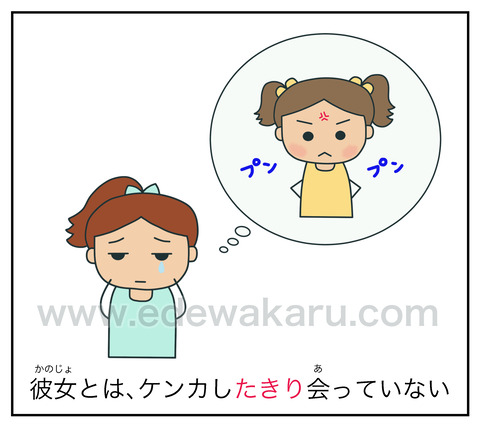
彼女とは、ケンカしたきり会っていない
→彼女とは、ケンカしたのが最後で、その後ずっと会っていないI haven’t seen her since we had a fight. → The last time I saw her was when we had a fight, and I haven’t seen her since.
娘はアメリカに行ったきり帰ってこない
→娘はアメリカに行ったのが最後で、その後帰ってこないMy daughter went to America and hasn’t come back. → The last time she came back was when my daughter went to America; she hasn’t come back since.
日本には5年前に旅行に行ったきり行っていない
→日本には5年前に旅行に行ったのが最後で、その後ずっと行っていないI haven’t been to Japan since I went there on a trip five years ago. → The last time I went to Japan was on a trip five years ago, and I haven’t been since.
Read the original source text
Meaning
〜したのが最後で、その後ずっと…ない
How to use it
動詞[た形]+きり〜ない
Explanation
「〜たり…ない」は「〜したのが最後で、その後ずっと…ない」という意味を表す文型です。この文型はほとんどの場合、
話者の不安な気持ちや残念だと思う気持ち、心配しているようすを強調したい時に使われます
😀
【余裕がある人へ】
「〜たきり…ない」を使う時に
「〜たっきり…ない」
というように「っ」を入れる人もいますが、意味は同じです😊
[例]
彼女とは、ケンカをし
たっきり
会ってい
ない
また、「これっきり」「それっきり」「あれっきり」という言い方もあるというのを覚えておきましょう😀
[例]
日本には5年前に旅行に行きましたが、
それっきり
行っていません
会話でもよく使う文型ですのでしっかりと覚えておきましょう😉
日本語文型辞典 英語版
Meaning
Spoken version of きり.
→
In context 3 examples
ふたりっきりで話しあった。
We talked it over just between the two of us.
一晩中つきっきりで看病した。
I never left his side all night.
家を飛び出して行ったっきり戻って来ない。
He bolted out of the house and won’t come back.
Read the original source text
Meaning
Spoken version of きり.
→
くらべてわかる日本語表現文型辞典
Meaning
An expression emphasizing that A is the only one.
How to use it
Aっきり (Aぽっきり)
[Noun—∅] っきり
Notes
【Note 1】
・It is idiomatic, so it only occurs in set expressions.
・“Number + ぽっきり” emphasizes that the amount is exactly that price, no more and no less.
○今なら5000円ぽっきりでカニが食べ放題。 — Right now, you can eat all the crab you want for exactly 5,000 yen.
In context 4 examples
一人っきりの食卓はさびしいものだ。
Eating alone at the table is a lonely thing.
子どもが巣立ち、また夫婦二人っきりになった。
The children left the nest, and once again it was just the two of us as a couple.
沖縄には一度っきりしか行ったことがない。
I’ve only been to Okinawa once.
同窓会は楽しかったな。これっきりにしないでまた会おうじゃないか。
The reunion was fun. Let’s not let this be the last time—let’s meet again.
Read the original source text
Meaning
Aだけであると強調する表現。
How to use it
Aっきり(Aぽっきり)
[名詞-∅]っきり
Notes
【注意1】
・慣用的なので、決まった表現しかない。
・「数+ぽっきり」は、ちょうどその金額だ。それ以上でも以下でもないという強調表現。
○今なら5000円ぽっきりでカニが食べ放題。