DoJG 日本語文法辞典(全集)
Meaning
When it comes to; if it is true that ~; if it is the case that ~; if it turns out that ~
How to use it
(i) Noun | となると | |
| 映画となると | When it comes to movies |
(ii) Sinformal | となると | Exception: XがNounとなると |
| 彼が来るとなると | If it is true that he is coming |
| 彼女が病気となると | If it is the case that she is ill |
Explanation
A phrase which expresses the idea "when it comes to" or "if it is true that".
In context 9 examples
私は機械のこととなると何も分からない。
When it comes to mechanical things, I don't understand anything.
彼が手伝ってくれないとなると誰かほかの人を頼むしかない。
If it's true that he is not going to help us, we'll have no alternative but to ask someone else.
勉はギャンブルとなると人が変わってしまう。
When it comes to gambling, Tsutomu becomes another person.
日本語が出来る科学者となると数がかなり限られてくる。
When it comes to scientists who can speak Japanese, the number is quite limited.
何でも仕事となると楽なものはない。
Nothing is easy (literally: There is nothing easy) when it comes to work.
彼が参加できないとなるとこのプロジェクトは考え直さなければならない。
If it turns out that he cannot participate (in this project), we'll have to reconsider it.
秘密が漏れたとなるとこの計画は変更しなければならない。
If it is true that the secret (of this plan) has leaked, we must change it.
彼が新しい社長になるとなると経営方針がかなり変わるだろう。
If he turns out to be the new president, the management policy will probably be considerably different.
この仕事は簡単そうに見えるが、一人でするとなると結構大変だ。
This job looks easy, but if (it is the case that) you do it by yourself, it will be quite tough.
日本語文型辞典
Meaning
Used at the beginning of a sentence to mean “given that fact.” The first part states something the speaker has just learned or what someone else has said, and the latter part expresses a judgment the speaker has drawn from that information. It may take forms such as 「だとなると/そうだとなると」.
Follows a clause and means “in a case like …” or “if things come to a situation like ….” It may describe a realistic or hypothetical situation; context determines which. 「もし/かりに」 may be used for hypothetical matters.
An idiomatic expression meaning “when actually carrying it out.” It is often followed by an expression that means that in such a situation things naturally turn out a certain way.
Follows a noun and means “when that matter becomes a topic or issue.” It is followed by an expression meaning that one takes an attitude different from usual when that matter becomes an issue.
Follows an interrogative expression and means “when the matter of … becomes an issue.” It is followed by a negative expression meaning that a solution or implementation is impossible or difficult.
⇾ともなると
How to use it
となると
…となると
N/Na(だ)となると
A/V となると
いざとなると
N(のこと)となると
…かとなると
Nともなると
In context 16 examples
A:先生はご病気で昨日入院されました。
B:となると、しばらく授業は休講ということになりますね。A: The teacher was admitted to the hospital yesterday because of an illness. B: In that case, classes will be suspended for a while, then.
長期予報によれば今年の梅雨は空梅雨になるとのことだ。となると、野菜の値段の高騰や、水不足の心配が予想される。
According to the long-range forecast, this year's rainy season will be unusually dry. If so, vegetable prices are expected to soar, and there may be concerns about water shortages.
医学部に進むとなると相当にお金がかかるだろう。
If I go on to medical school, it will probably cost a great deal.
彼は、決断するまでは時間がかかるが、やるとなると実行するのは早い。
He takes a long time to make a decision, but once he decides to do something, he acts quickly.
いざ、海外に行くとなると、事前の準備が大変だ。
When it actually comes to going abroad, the preparations beforehand are a lot of work.
仮に、このまま水不足が続くとなると営業時間を短縮しなければならなくなる。
If, hypothetically, the water shortage continues like this, we will have to shorten our business hours.
この時間になっても帰っていないとなると、何かの事件に巻き込まれている可能性がある。
If they still haven't come home by this time, they may have been caught up in some kind of incident.
現場に残された指紋が彼のものと一致するとなると、彼が犯人である公算が高い。
If the fingerprints left at the scene match his, there's a strong chance he is the culprit.
これほど大企業の経営状態が悪いとなると、不況はかなり深刻ということになる。
If the business conditions of such a large company are this bad, it means the recession is quite serious.
社長がそう言っているとなると、変更はほとんど不可能でしょう。
If the president is saying that, a change will probably be nearly impossible.
危険は承知の手術だが、いざとなると不安になるものだ。
I know the operation is dangerous, but when the moment comes, one can't help feeling uneasy.
スピーチは原稿を何度も読んで練習してきたが、いざとなるとあがってしまいうまくしゃべれなかった。
I practiced for the speech by reading the script many times, but when the moment came, I got nervous and couldn't speak well.
芸能人のスキャンダルとなると、マスコミは夢中になって追跡する。
When it comes to celebrity scandals, the media pursues them obsessively.
試験問題のこととなると学生は急に真剣になる。
When the subject is exam questions, students suddenly become serious.
どうすればこの問題を解決できるかとなると、簡単には答えられない。
When it comes to how to solve this problem, I can't answer easily.
実際にだれがその危険な仕事にあたるかとなると、積極的な人は一人もいない。
When it comes to who will actually take on that dangerous job, not a single person is willing.
Read the original source text
Meaning
文頭に用いて、「そのような事実をふまえると」という意味を表す。前半にはその場で話し手が新たに知ったことがらや、他の人の発言内容が述べられ、後半ではそのような情報に基づいてそこから話し手が導き出した判断が表される。「だとなると/そうだとなると」のような形をとることもある。
節を受けて、「…のような場合は」「…のような状況になった場合は」という意味を表す。現実的な状況を言う場合と、仮定的な状況を言う場合があるが、どちらの意味かは文脈による。仮定的なことがらには「もし/かりに」が用いられることがある。
「実際に実行する場合は」という意味の慣用的表現。後ろにはそのような状況では自然にそうなってしまうといった意味の表現が続くことが多い。
名詞を受け、「そのことが話題/問題になるときは」という意味を表す。後ろには、そのことが問題になると普通とは違う態度をとるといった意味を表す表現が続く。
疑問表現を受けて、「…のことが問題になると」という意味を表す。後ろにはそれに対する解決・実行が不可能だ、困難だという否定的な意味の表現が続く。
⇾ともなると
How to use it
となると
…となると
N/Na(だ)となると
A/V となると
いざとなると
N(のこと)となると
…かとなると
Nともなると
絵でわかる日本語
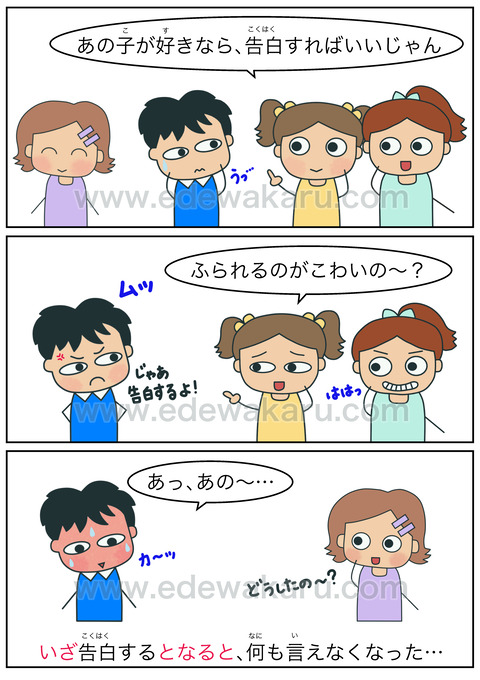
Meaning
When it actually comes time to ~
How to use it
いざ + Verb [dictionary form] + となると
いざ + Noun [dictionary form] + となると
Explanation
「いざ〜となると」 is a sentence pattern meaning “when it actually comes time to ~.” It is used to say, “When the situation to actually do ~ arises, I can’t do it,” or “When it actually comes time to do ~, I find it difficult.” It expresses the feeling that even something you always thought you could do easily is surprisingly hard or more difficult than you expected when it actually comes time to do it. The expressions 「いざとなると」 and 「いざとなったら」 are also used, so learn them together.
[Examples]
I tried to confess my feelings, but when the moment came, I couldn’t say anything.
I tried to confess my feelings, but when the moment came, I couldn’t say anything.
「いざ〜となると」 is a commonly used pattern, so make sure to learn it 😉
In context 3 examples
留学するのが夢だったが、いざ行くとなると少し不安になってきた
→実際に行くと決まると、少し不安になってきたStudying abroad had been my dream, but now that it’s actually time to go, I’m starting to feel a little anxious. → Once it was actually decided that I would go, I started to feel a little anxious.
試合に向けて毎日練習をしてきたが、いざ試合となると練習通りにはいかなかった
→実際に試合をしている時は、練習通りにはいかなかったI had practiced every day for the match, but when it came to the actual match, things didn’t go as they had in practice. → During the actual match, things didn’t go as they had in practice.
言うのは簡単だが、いざやるとなると、なかなかできないものだ
→実際やるとなると、なかなかできないものだIt’s easy to say, but when it actually comes time to do it, it’s hard to get it done. → When it actually comes time to do it, it’s hard to get it done.
Read the original source text
Meaning
実際に〜する時になると
How to use it
いざ+動詞[辞書形]+となると
いざ+名詞[辞書形]+となると
Explanation
「いざ〜となると」は「実際に〜する時になると」という意味の文型です。「実際に〜する状況になると、〜できない」「実際に〜する時になると、〜するのは難しいと感じる」と言いたい時に使われます。いつもは「簡単にできる」と思っていることでも、実際にそれをすることになった時に、「〜するのは意外に大変だ」「〜するのは、思っていたよりも難しい」と感じる気持ちを表します。「いざとなると」「いざとなったら」という言い方もありますので、一緒に覚えておきましょう。
[例]
告白しようとしたが、
いざとなると
何も言えなくなった
告白しようとしたが、
いざとなったら
何も言えなくなった
「いざ〜となると」は、よく使われる文型ですので覚えておきましょう😉
どんなときどう使う 日本語表現文型辞典
Usage 1
Meaning
when it comes to
How to use it
N+となると
Explanation
となると〈話題〉
~のような特別なことは
1)ある話題を取り上げ、その話題の持っている本質的な条件や事情を思い浮かべて、それに関する話者の判断や感想を述べるときに使う。
2)後の文は話者の判断文。話者の意向を表す文は来ない。
◆ × 日本は科学技術が進んだが、宇宙開発となるとわたしもやってみたいことだ。→○日本は科学技術が進んだが、宇宙開発となるとまだまだ先が長い。
1)Speaker conveys judgment or impressions concerning conditions or situation of given topic.
2)Clause following pattern is speaker's judgment. Speaker's intention is not reflected.
In context 3 examples
専門の生物学では今までいろいろな動物を扱ったが、自分の赤ん坊となるとどう扱っていいのかわからない。
In my field of biology, I’ve dealt with all kinds of animals, but when it comes to my own baby, I don’t know how to handle them.
現在、台風などの予報についてはかなりの水準に達しているが、地震の予知となると、まだまだだ。
At present, forecasts for things like typhoons have reached a fairly high level, but when it comes to predicting earthquakes, we still have a long way to go.
わたしはどんな魚の料理も好きです。でも、サメとなると料理法も知らないし、食べる気もしません。
I like dishes made from any kind of fish. But when it comes to shark, I don’t know how to cook it and don’t feel like eating it.
Read the original source text
Meaning
when it comes to
How to use it
N+となると
Explanation
となると〈話題〉
~のような特別なことは
1)ある話題を取り上げ、その話題の持っている本質的な条件や事情を思い浮かべて、それに関する話者の判断や感想を述べるときに使う。
2)後の文は話者の判断文。話者の意向を表す文は来ない。
◆ × 日本は科学技術が進んだが、宇宙開発となるとわたしもやってみたいことだ。→○日本は科学技術が進んだが、宇宙開発となるとまだまだ先が長い。
1)Speaker conveys judgment or impressions concerning conditions or situation of given topic.
2)Clause following pattern is speaker's judgment. Speaker's intention is not reflected.
Usage 2
Meaning
if…happens, then
How to use it
N/〔plain form〕+となると
Explanation
となると〈新事態の仮定・確定〉
もしそうなった場合は/そうなったのなら
妻:そう。太郎が大阪転勤となると、これからメールや電話のやりとりで忙しくなるね。
学生:そうか。夏休み前にレポートを書くとなると、ちょっと大変だなあ。
A:え、この駐車場が使えないとなると、ちょっと不便だなあ。
B:たばこの値上がりとなると、喫煙者は減るでしょうね。
1)「もしそういう事態になった場合は、別の新しい事態が発生する」と言いたいときに使う。
2) ❶ ❷ は「もし、仮に」とそういう事態を仮定して言う場合で、 ❸ ❹ は、「そういうことに決まったのなら」と既定の事態を言う場合である。
1)If one situation arises so will another.
2)Sometimes supposes some hypothetical situation, as in sentences ❶ and ❷ . Also describes prearranged state (if such a thing is decided), as in sentences ❸ and ❹ .
In context 4 examples
夫:太郎が大阪へ行くことになるかもしれないよ。
Husband: Taro may end up going to Osaka.
学生:試験の成績が悪い場合は、レポートを書かされるらしいよ。
Student: Apparently, if you get a bad exam score, they make you write a report.
管理人:こちらの駐車場は工事中なので、しばらく使えません。
Manager: This parking lot is under construction, so it can’t be used for a while.
A:たばこの税金が上がったらしいですよ。
A: Apparently, the tax on cigarettes has gone up.
Read the original source text
Meaning
if…happens, then
How to use it
N/〔普通形〕+となると
Explanation
となると〈新事態の仮定・確定〉
もしそうなった場合は/そうなったのなら
妻:そう。太郎が大阪転勤となると、これからメールや電話のやりとりで忙しくなるね。
学生:そうか。夏休み前にレポートを書くとなると、ちょっと大変だなあ。
A:え、この駐車場が使えないとなると、ちょっと不便だなあ。
B:たばこの値上がりとなると、喫煙者は減るでしょうね。
1)「もしそういう事態になった場合は、別の新しい事態が発生する」と言いたいときに使う。
2) ❶ ❷ は「もし、仮に」とそういう事態を仮定して言う場合で、 ❸ ❹ は、「そういうことに決まったのなら」と既定の事態を言う場合である。
1)If one situation arises so will another.
2)Sometimes supposes some hypothetical situation, as in sentences ❶ and ❷ . Also describes prearranged state (if such a thing is decided), as in sentences ❸ and ❹ .
日本語NET JLPT文法解説まとめ
Meaning
If that were to happen
An expression used to state the speaker's opinion or evaluation; used when one wants to say that if one assumes “~,” the situation would be different.
How to use it
V(plain form) + となると
イA(plain form) + となると
ナAだ + となると
Nだ + となると
In context 4 examples
大型台風が上陸するとなると、周辺の農作物にかなり影響が出るだろう。
If a large typhoon were to make landfall, it would probably have a considerable impact on the surrounding crops.
将来、もらえる年金が減るとなると、今のうちにしっかりと貯金しておかなければならないだろう。
If the pension we'll receive in the future is going to decrease, we'll probably have to save diligently while we still can.
これ以上、消費税率が上がるとなると、国民の生活はますます厳しくなるだろう。
If the consumption tax rate rises any further, people's lives will probably become increasingly difficult.
A:申し訳ございません。現在、メンテナンス中のためエレベーターは使えません。
A: We sincerely apologize. The elevator is currently under maintenance and cannot be used.
Read the original source text
Meaning
もしそうなったら
話し手の意見や評価を言う表現で、「〜」と仮定したら、状況は異なると言いたい時に使う。
How to use it
V(普通形) + となると
イA(普通形) + となると
ナAだ + となると
Nだ + となると
日本語文型辞典 英語版
Meaning
B:となると、しばらく授業は休講ということになりますね。
If that’s so, then our lessons will probably be canceled for a while, right?
Used in the sentence-initial position and expresses the meaning “based on that reality.” The first clause is either something that the speaker has newly learned about or something mentioned by someone else. The second clause contains the opinion that the speaker arrives at based on that information.
Follows a clause to express the meanings “in such a case” or “when such a case arises.” Depending on the context, it can be used to talk about an actual situation or an assumed one. For a hypothetical situation, expressions such as もし/かりに are used.
An idiomatic expression with the meaning “in the case of actually implementing (something).” The second clause often continues with an expression to show that the outcome was a natural result of the situation.
Follows a noun to express the meaning “at the time that the matter becomes an issue/problem.” The latter half of the sentence continues with an expression to show that an attitude contrary to the usual one is taken when the issue arises.
Follows a query to express the meaning “when this becomes a problem.” The latter half follows with a negative expression to show that the solution or implementation is impossible or challenging.
How to use it
1. となると
2. ...となると[N/Na (だ)となると][A/V となると]
3. いざとなると
4. N(のこと)となると
5. ...かとなると
6. Nともなると→
In context 16 examples
A:先生はご病気で昨日入院されました。
The professor was hospitalized yesterday because of illness.
長期予報によれば今年の梅雨は空梅雨になるとのことだ。となると、野菜の値段の高騰や、水不足の心配が予想される。
The long range forecast says that this year’s rainy season will be a dry one. In that case, steep increases in the price of vegetables and concerns about water shortages can be expected.
医学部に進むとなると相当にお金がかかるだろう。
Proceeding on to medical school will likely cost a considerable amount of money.
彼は、決断するまでは時間がかかるが、やるとなると実行するのは早い。
For him, it takes a long time to make a decision, but when he does take action, he moves on it quickly.
いざ、海外に行くとなると、事前の準備が大変だ。
If sometime you do go overseas, the preparations beforehand are considerable.
仮に、このまま水不足が続くとなると営業時間を短縮しなければならなくなる。
Should the current water shortage continue like this, we may have to shorten our hours of operation.
この時間になっても帰っていないとなると、何かの事件に巻き込まれている可能性がある。
When she still hasn’t come home at this late hour, there’s a possibility that she’s been involved in some incident.
現場に残された指紋が彼のものと一致するとなると、彼が犯人である公算が高い。
If his fingerprints match those left at the scene, there’s a high probability that he’s the criminal.
これほど大企業の経営状態が悪いとなると、不況はかなり深刻ということになる。
When the operations of a large corporation are as bad as this, the recession can be said to be rather serious.
社長がそう言っているとなると、変更はほとんど不可能でしょう。
If the company president said something like that, any revision is almost impossible.
危険は承知の手術だが、いざとなると不安になるものだ。
There’s expected risk in any surgery, but when it actually happens, we get uneasy.
スピーチは原稿を何度も読んで練習してきたが、いざとなるとあがってしまい、うまくしゃべれなかった。
I reviewed the manuscript over and over and practiced the speech, but when it came time to do it, I got a bad case of nerves and couldn’t deliver it well.
芸能人のスキャンダルとなると、マスコミは夢中になって追跡する。
When it comes to a celebrity scandal, the mass media pursue it relentlessly.
試験問題のこととなると学生は急に真剣になる。
When the lesson turns to a possible exam question, the students suddenly get serious.
どうすればこの問題を解決できるかとなると、簡単には答えられない。
If I am asked what to do to solve this problem, I can’t give a simple answer.
実際にだれがその危険な仕事にあたるかとなると、積極的な人は一人もいない。
If you want to know who actually is to undertake such a risky task, there’s not a single person who has come forward.
Read the original source text
Meaning
B:となると、しばらく授業は休講ということになりますね。
If that’s so, then our lessons will probably be canceled for a while, right?
Used in the sentence-initial position and expresses the meaning “based on that reality.” The first clause is either something that the speaker has newly learned about or something mentioned by someone else. The second clause contains the opinion that the speaker arrives at based on that information.
Follows a clause to express the meanings “in such a case” or “when such a case arises.” Depending on the context, it can be used to talk about an actual situation or an assumed one. For a hypothetical situation, expressions such as もし/かりに are used.
An idiomatic expression with the meaning “in the case of actually implementing (something).” The second clause often continues with an expression to show that the outcome was a natural result of the situation.
Follows a noun to express the meaning “at the time that the matter becomes an issue/problem.” The latter half of the sentence continues with an expression to show that an attitude contrary to the usual one is taken when the issue arises.
Follows a query to express the meaning “when this becomes a problem.” The latter half follows with a negative expression to show that the solution or implementation is impossible or challenging.
How to use it
1. となると
2. ...となると[N/Na (だ)となると][A/V となると]
3. いざとなると
4. N(のこと)となると
5. ...かとなると
6. Nともなると→
文法
Meaning
If that happens
An expression used to give the speaker’s opinion or evaluation, when they want to say that the situation would be different if “~” were assumed.
How to use it
V (plain form) + となると
いA (plain form) + となると
ナAだ + となると
Nだ + となると
In context 4 examples
大型台風が上陸するとなると、周辺の農作物にかなり影響が出るだろう。
If a large typhoon were to make landfall, it would probably have a considerable impact on the surrounding crops.
将来、もらえる年金が減るとなると、今のうちにしっかりと貯金しておかなければならないだろう。
If the pension we'll receive in the future is going to decrease, we'll probably have to save diligently while we still can.
これ以上、消費税率が上がるとなると、国民の生活はますます厳しくなるだろう。
If the consumption tax rate rises any further, people's lives will probably become increasingly difficult.
A:申し訳ございません。現在、メンテナンス中のためエレベーターは使えません。
B:えっ、使えないとなると、困るなぁ。15階まで階段で行けってこと?A: We apologize. The elevator is currently unavailable because it is undergoing maintenance. B: What? If it can’t be used, that’s a problem. Are you saying I have to take the stairs to the 15th floor?
Read the original source text
Meaning
もしそうなったら
話し手の意見や評価を言う表現で、「〜」と仮定したら、状況は異なると言いたい時に使う。
How to use it
V(普通形) + となると
イA(普通形) + となると
ナAだ + となると
Nだ + となると
IMABI
When it Comes to II “When it Comes to…” II:となると, となったら, & となれば
Read this IMABI lesson ↗Explanation
“When it Comes to…” II: となると, となったら, & となれば
All three of these phrases share certain commonalities. When the speaker knows/hears of a certain situation, the speaker feels, as an effect of that circumstance, that something important has to be noted. What is duly noted typically involves some sort of idea, decision, or reference to common knowledge.
~となると: When it comes to…/if it were to come to…
~となると is used to make assertions involving the speaker’s notion, idea, decision, or reference to common knowledge regarding a certain situation. This situation involves some form of change, whether it be literal or simply one’s change in perception. There is always some sort of contrast implied. The use of the particle と versus the other conditional particles provides a rather objective tone and definitive quality to the statement. It also makes it more appropriate in formal writing than the other variations of this pattern we’ll see later in this lesson.
As far as utility is concerned, this pattern can follow nouns, verbs (non-past and past tense form), and adjectives (non-past and past tense form).
1. 大学院だいがくいんに進すすむとなると、一生懸命勉強いっしょうけんめいべんきょうしなければならない。
When it comes to proceeding to graduate school, you must study very hard.
Sentence Note: Here, the contrast implied is that if you were not to proceed to graduate school or pursue something else, you may not have to study near as hard, but because the change at hand is going to graduate school, the speaker feels impelled to tell the user what the natural consequence of that decision will be.
2. 解散かいさんとなると、総選挙そうせんきょの争点そうてんは消費税しょうひぜいになってしまう。
If it were to come to the dissolution (of the government assembly), the consumer tax would end up becoming the issue at hand in the general election.
3. 今日きょうはかなり寒さむい。。。となるとラーメンかうどんが食たべたくなります。
Today is quite cold…with that being the case, I’ll want to eat ramen or udon.
Sentence Note: As demonstrated by Ex. 3, this pattern may be used at the initial position of a sentence. This is the case for the other variants of this grammatical pattern we have yet to study closely, which are to be detailed later in this lesson.
4. 英語えいごを話はなせない親おやが来くるとなると、入国審査にゅうこくしんさが心配しんぱいです。
If my parents, who can’t speak English, were to come, I’d worry about their immigration checks.
5. 車選くるまえらび、ましてや中古車ちゅうこしゃとなると、マーケットは幅広はばひろく選択肢せんたくしがいっぱいです!
As for choosing cars, especially more so when it comes to used cars, the market is extensive and full of options!
Spelling Note: ましてや may seldom be spelled as 況してや.
6. ギャンブルにおける税金ぜいきんとなると、あまりピンと来こない人ひとも多おおいとは思おもいますが、獲得かくとくした賞金次第しょうきんしだいによっては税金ぜいきんを支払しはらう必要ひつようが出でてきます。
As far as taxes in gambling are concerned, I think this doesn’t come intuitively to a lot of people, but depending on the prize money you earn, it becomes necessary to pay taxes.
7. 香川かがわさんはあまり飲のまない人ひとなんですが、飲のむとなると、徹底的てっていてきに飲のむ人ひとですよ。
Mr. Kagawa doesn’t drink that much, but when he does drink, he’s the kind of person who hits the bottle.
Sentence Note: This pattern is perfect to establish generalizations that involve some change in circumstance. Ex. 7 is a perfect example of this. The change in circumstance is Mr. Kagawa being in the position of imbibing. The generalization is that when he does hit the bottle, he goes all out.
8. え、本当ほんとうに?暑あついとなると、持もってく服ふくを考かんがえ直なおさなくちゃなあ。
What, really? If it’s going to be hot (there), I’ll have to rethink what clothes to bring…
Sentence Note: It’s important to note that it is not implied that the place the speaker is going to has become hot. Rather, the speaker’s perception of what the temperature is like has changed.
9. 個人こじんへの影響えいきょうとなると、また少すこし違ちがってきます。
Where effects on the individual are concerned, it is once again a little different.
You mustn’t blindly associate every instance of ~となると with this grammatical pattern. The reason for this is that sometimes, like in Ex. 10, the final と is the citationと.
10. この財政問題ざいせいもんだいは日本経済にっぽんけいざいに大おおきなマイナス影響えいきょうとなると言いえよう。
One could say that this economic problem will be a great, negative impact to the Japanese economy.
~ともなると: Especially when it comes to…
~ともなると is a more emphatic version of above. It enhances the implied sense of certainty that the speaker wishes to convey. As a result from the change in tone, this form is used a lot more in speech than the above.
11. 夏なつともなると、蒸むし暑あつい九州きゅうしゅうよりは北海道ほっかいどうに行いきたくなる。
Especially when it comes to summer, one feels like going to Hokkaido rather than humid Kyushu.
12. 数すうヶか月げつの海外旅行かいがいりょこうともなると、計画けいかくを立たてなければならないですね。
Especially when it comes to vacationing abroad for several months, you must make a plan, you know.
13. 平日へいじつは人ひとが少すくないですが、休日きゅうじつともなると、朝あさっぱらから観光客かんこうきゃくで道路どうろが渋滞じゅうたいしてしまいます。
On weekdays there are few people out, but especially on holidays, the streets become congested starting early in the morning.
14. 12じゅうに月がつともなると、町まちにはジングルベルのメロディーが溢あふれる。
Definitely when it comes to December, the town is flooded with the melody of jingle bells.
15. 憲法改正けんぽうかいせいともなると、色々いろいろなアイデアが出でてきて、とても面白おもしろく議論ぎろん(が)出来できるようになるでしょう。
Definitely when it comes to revising the constitution, all sorts of ideas would come forth, and we’d surely be able to have very interesting debates.
~となったら: If it were…/when it comes to…
~となったら is used more frequently in the spoken language than ~となると, but it still finds itself used most frequently in the written language. The sentences that result with this variation are typically more hypothetical in nature than those with ~となると. This is due to the use of the particle たら. In a sense, it is far more deeply tied to the translation “if it were…”
As far as the utility of ~となったら is concerned, it too can follow nouns, verbs, or adjectives. You’ll see that it can be paired with both the non-past and past tense forms of a verb, which is the same as for ~となると. Choosing the past tense form, as is demonstrated in Ex. 19 and Ex. 20, causes the statement to be based on a point in time in the past and the speaker is choosing to refer back to that instance.
16. 彼女かのじょが日本初にほんはつの女性首相じょせいしゅしょうとなったら、それは国際舞台こくさいぶたいにおける欧米おうべいトレンドの更さらなる勝利しょうりとなるだろう。
If she were to become Japan’s first female prime minister, that would likely be a further win to Western trends on the international stage.
17. これが関東圏かんとうけんへの直接被害ちょくせつひがいや津波つなみとなったら、パニックになっていたかもしれない。
If this were concerned with direct damage or tsunami to the Kanto region, (the public) may have been in a panic.
18. 津波つなみとなったら危あぶないところで、今日きょうも避難勧告ひなんかんこくが出でていた。
With it being dangerous if it really were to come to a tsunami, an evacuation advisory had been called today as well.
19. 相手あいてが怪我けがをしたとなったら、話はなしは別べつになってしまいます。
If the/your opponent had become injured, that’d be a different story.
20. 土偶どぐうが出土しゅつどしたとなったら、それだけで開拓かいたくの手ては止とめられます。
If dogū were to have been excavated, that alone would stop the means for development.
Word Note: Dogū are small humanoid/animal figures of prehistoric Japan.
21. LINEのグループとかで、″退室たいしつしました″となったら気きになるものですか?
Are you bothered when you see “left group” in groups on LINE and what not?
22. 現在検出げんざいけんしゅつされている放射能ほうしゃのうは、地下水汚染ちかすいおせんとなったら、その土壌どじょうで育そだつ農作物のうさくもつはすべて放射性物質ほうしゃせいぶっしつを取とり込こむことになるのだろう。
If the radiation currently being detected were to contaminate ground water, all the crops nourished by the soil would surely take in the radioactive material.
23. 退職たいしょくするとなったら、誰だれしも(が)円満退社えんまんたいしゃしたいと思おもっています。
When it comes to resigning, I think everyone wants to resign from one’s free will.
24. プロ野球やきゅうの試合しあいでも雨天中止うてんちゅうしとなったら、別べつの日程にっていでするんでしょうか。
If even a professional baseball match were to be canceled due to rain, would it be played on a different date?
25. イギリスがEU離脱りだつとなったらどうなるか。
What will become of England if it leaves the EU?
26. 専業主婦せんぎょうしゅふは離婚りこんするとなったら、その後ごの生活せいかつはどうなるんですか。
If a housewife were to get divorced, what becomes of her livelihood afterward?
27. 満席まんせきが続つづくとなったら、それは凄すごいなあと思おもうんですが。
I think it’d be pretty awesome if it were to continue being full. (Occupancy)
28. 日本政府にっぽんせいふが破綻はたんもしくは破綻はたんの危機ききとなったら、生いき残のこる企業きぎょうや業種ぎょうしゅは何なにでしょうか?
If the Japanese government were to go into bankruptcy, or if there were a bankruptcy crisis, what would be the companies and industries that would survive?
29. いざアメリカに移住いじゅうするとなったら、手続てつづきが大変たいへんだよ。
If one were to (suddenly) now immigrate to America, the procedures would be difficult.
30. こうなったら、もうやるっきゃない。
If it comes to this, I’ll have no choice but to do it.
~ともなったら: Especially when it comes to…
Although not as common as adding も to the other variants of this grammatical pattern, ~ともなったら is more emphatic than its counterpart without も.
31. 一晩ひとばんの駐車料金ちゅうしゃりょうきんに加くわえてタクシー代だいともなったら、大変たいへんな金額きんがくになってしまう。
Especially when it comes to taxi fees in addition to a night’s worth of parking fees, that’d end up being a terrible amount of money.
32. 一向いっこうに進すすまず立たちっぱなしともなったら、ストレスが溜たまってしまう。
Especially if it came to just standing on one’s feet for a long time and not moving forward at all, stress would build up.
33. 裁判さいばんともなったら財産ざいさんが押おさえられるというイメージもあるかと思おもいます。
Especially when it comes to court, you might have an image of your assets being seized.
34. 昭和時代しょうわじだいでは、18じゅうはっ歳さいにもなったら許婚きょこんがいるのが当あたり前まえで、決きまっていないともなったら、笑わらいものになったらしい。
In the Showa Period, it was only natural to have a fiancé even at 18, and it seems that you were laughed at if it was the case that you hadn’t been committed to someone yet.
35. お泊とまり旅行りょこうともなったら、絶対ぜったいにエッチするはずだと思おもう。
Especially when it comes to traveling to stay overnight together, I think that you’d undoubtedly have sex.
~となれば: When/if it comes to…
You may have wondered how the use of the particle と is tied to these expressions. You should know at this point that the particle に is typically the particle of choice for なる. However, it is important to understand that the use of the particle に can only demonstrate literal change from one state to another.
The nuances that we have seen thus far involving comparison to other possible situations cannot be expressed with the particle に. The particle と helps establish the “when it comes to…” interpretation. In other words, we are focusing on the situation with these speech patterns. In Ex. 31, the speaker uses に to simply illustrate a change in president and what that president might do once in office.
36. ムン氏しが大統領だいとうりょうになれば、どんな政策せいさくを出だすんだろう。
When Moon (Jae-in) becomes president, I wonder what sort of policies he’ll issue.
The use of ~となれば over the other variants seen thus far is done so to add more of an emotional flair to the sentence. It, like ~となったら, is more likely to be used in the spoken language than ~となると, but because the focus on change in circumstance and relating it to other outcomes is not always something that people employ in conversation, you will not hear this used every day. However, these patterns are still used quite a bit.
37. 東京とうきょうオリンピックが中止ちゅうしとなれば様々さまざまな影響えいきょうが出でてくるかと思おもいます。
If the Tokyo Olympics became suspended, I think there would be various effects.
38. この10じゅう人にんを打うち倒たおし優勝ゆうしょうとなれば、すごい事ことですね。
It would be amazing if (he) defeated these ten people and claimed victory.
39. 自みずから不倫ふりんしたとなれば、不利ふりな離婚りこんは仕方しかたがないんでしょうか。
If you yourself committed adultery, would an unfavorable divorce be inevitable?
40. あんなに苦くるしんだことも、今いまとなれば大たいしたことではなかったと感かんじます。
When it comes to now, I feel that having suffered all that much wasn’t such a big deal.
41. 都知事とちじが失脚しっきゃくしたとなれば、 政界せいかいの人材不足じんざいぶそくが懸念けねんされるのは当然とうぜんだ。
If it comes to the governor of Tokyo falls from the position, it’s certain that the lack of talented people in the political world will be of concern.
42. 中検ちゅうけん1級きゅうを取得しゅとくしたとなれば、もう中国語ちゅうごくごをマスターしたといってもいいでしょう。
If (he) is to achieve Level 1 of the Chinese Proficiency Test, it’d be safe to say that he’s mastered Chinese.
43. 一気いっきに4よん本ほんも抜歯ばっししたとなれば、普段ふだんと違ちがう顔かおになってしまうこともあるだろう。
If you get four teeth removed in one go, you’ll definitely end up having a different face than normal.
44. となれば、もう諦あきらめるしかないだろう。
If it comes to that, there’d be no other choice but to just give up.
45. アメリカが北朝鮮きたちょうせんを武力攻撃ぶりょくこうげきするとなれば日本政府にっぽんせいふの最大さいだいの関心事かんしんじは拉致被害者らちひがいしゃの救出きゅうしゅつについてでしょう。
If it comes to America launched an armed attack on North Korea, the greatest concern of the Japanese government would likely be about the rescue of abductees.
~ともなれば: Especially when/if it comes to…
The use of the particle も adds an extra layer of assertiveness to the statement. It also goes well with the emotional flair that the use of the particle ば provides.
46. マイホームを購入こうにゅうするともなれば、あれこれと考かんがえることは多おおくなりそうですね。
Especially when it comes to buying one’s own home, it seems a lot of people would ponder about this and that, huh.
47. 真夏日まなつびともなれば室温しつおんも普段ふだんより上あがります。
Especially when it comes to midsummer days, indoor temperatures also rise higher than normal.
48. 正月しょうがつともなれば田畑たはたは雪ゆきに埋うもれて新鮮しんせんな野菜やさいはほとんどありません。
Especially when it comes to New Year, the fields are buried in snow and there are hardly any fresh vegetables.
49. 解散かいさん・総選挙そうせんきょともなれば、野党やとうは必死ひっしにあらを探さがす。
Especially when it comes to (parliamentary) dismissal and general elections, the opposition party searches desperately for faults.
50. 高級こうきゅうなお寿司屋すしやさんに行いくともなれば、少すこしいつもとは違ちがうお洒落しゃれをして気合きあいを入いれたいと思おもうかもしれません。
Especially when it comes to going to a high grade sushi place, you probably might think to dress a little more stylish than usual and get psyched for it.
In context 50 examples
大学院だいがくいんに進すすむとなると、一生懸命勉強いっしょうけんめいべんきょうしなければならない。
When it comes to proceeding to graduate school, you must study very hard.
解散かいさんとなると、総選挙そうせんきょの争点そうてんは消費税しょうひぜいになってしまう。
If it were to come to the dissolution (of the government assembly), the consumer tax would end up becoming the issue at hand in the general election.
今日きょうはかなり寒さむい。。。となるとラーメンかうどんが食たべたくなります。
Today is quite cold…with that being the case, I’ll want to eat ramen or udon.
英語えいごを話はなせない親おやが来くるとなると、入国審査にゅうこくしんさが心配しんぱいです。
If my parents, who can’t speak English, were to come, I’d worry about their immigration checks.
車選くるまえらび、ましてや中古車ちゅうこしゃとなると、マーケットは幅広はばひろく選択肢せんたくしがいっぱいです!
As for choosing cars, especially more so when it comes to used cars, the market is extensive and full of options!
ギャンブルにおける税金ぜいきんとなると、あまりピンと来こない人ひとも多おおいとは思おもいますが、獲得かくとくした賞金次第しょうきんしだいによっては税金ぜいきんを支払しはらう必要ひつようが出でてきます。
As far as taxes in gambling are concerned, I think this doesn’t come intuitively to a lot of people, but depending on the prize money you earn, it becomes necessary to pay taxes.
香川かがわさんはあまり飲のまない人ひとなんですが、飲のむとなると、徹底的てっていてきに飲のむ人ひとですよ。
Mr. Kagawa doesn’t drink that much, but when he does drink, he’s the kind of person who hits the bottle.
え、本当ほんとうに?暑あついとなると、持もってく服ふくを考かんがえ直なおさなくちゃなあ。
What, really? If it’s going to be hot (there), I’ll have to rethink what clothes to bring…
個人こじんへの影響えいきょうとなると、また少すこし違ちがってきます。
Where effects on the individual are concerned, it is once again a little different.
この財政問題ざいせいもんだいは日本経済にっぽんけいざいに大おおきなマイナス影響えいきょうとなると言いえよう。
One could say that this economic problem will be a great, negative impact to the Japanese economy.
夏なつともなると、蒸むし暑あつい九州きゅうしゅうよりは北海道ほっかいどうに行いきたくなる。
Especially when it comes to summer, one feels like going to Hokkaido rather than humid Kyushu.
数すうヶか月げつの海外旅行かいがいりょこうともなると、計画けいかくを立たてなければならないですね。
Especially when it comes to vacationing abroad for several months, you must make a plan, you know.
平日へいじつは人ひとが少すくないですが、休日きゅうじつともなると、朝あさっぱらから観光客かんこうきゃくで道路どうろが渋滞じゅうたいしてしまいます。
On weekdays there are few people out, but especially on holidays, the streets become congested starting early in the morning.
12じゅうに月がつともなると、町まちにはジングルベルのメロディーが溢あふれる。
Definitely when it comes to December, the town is flooded with the melody of jingle bells.
憲法改正けんぽうかいせいともなると、色々いろいろなアイデアが出でてきて、とても面白おもしろく議論ぎろん(が)出来できるようになるでしょう。
Definitely when it comes to revising the constitution, all sorts of ideas would come forth, and we’d surely be able to have very interesting debates.
彼女かのじょが日本初にほんはつの女性首相じょせいしゅしょうとなったら、それは国際舞台こくさいぶたいにおける欧米おうべいトレンドの更さらなる勝利しょうりとなるだろう。
If she were to become Japan’s first female prime minister, that would likely be a further win to Western trends on the international stage.
これが関東圏かんとうけんへの直接被害ちょくせつひがいや津波つなみとなったら、パニックになっていたかもしれない。
If this were concerned with direct damage or tsunami to the Kanto region, (the public) may have been in a panic.
津波つなみとなったら危あぶないところで、今日きょうも避難勧告ひなんかんこくが出でていた。
With it being dangerous if it really were to come to a tsunami, an evacuation advisory had been called today as well.
相手あいてが怪我けがをしたとなったら、話はなしは別べつになってしまいます。
If the/your opponent had become injured, that’d be a different story.
土偶どぐうが出土しゅつどしたとなったら、それだけで開拓かいたくの手ては止とめられます。
If dogū were to have been excavated, that alone would stop the means for development.
LINEのグループとかで、″退室たいしつしました″となったら気きになるものですか?
Are you bothered when you see “left group” in groups on LINE and what not?
現在検出げんざいけんしゅつされている放射能ほうしゃのうは、地下水汚染ちかすいおせんとなったら、その土壌どじょうで育そだつ農作物のうさくもつはすべて放射性物質ほうしゃせいぶっしつを取とり込こむことになるのだろう。
If the radiation currently being detected were to contaminate ground water, all the crops nourished by the soil would surely take in the radioactive material.
退職たいしょくするとなったら、誰だれしも(が)円満退社えんまんたいしゃしたいと思おもっています。
When it comes to resigning, I think everyone wants to resign from one’s free will.
プロ野球やきゅうの試合しあいでも雨天中止うてんちゅうしとなったら、別べつの日程にっていでするんでしょうか。
If even a professional baseball match were to be canceled due to rain, would it be played on a different date?
イギリスがEU離脱りだつとなったらどうなるか。
What will become of England if it leaves the EU?
専業主婦せんぎょうしゅふは離婚りこんするとなったら、その後ごの生活せいかつはどうなるんですか。
If a housewife were to get divorced, what becomes of her livelihood afterward?
満席まんせきが続つづくとなったら、それは凄すごいなあと思おもうんですが。
I think it’d be pretty awesome if it were to continue being full. (Occupancy)
日本政府にっぽんせいふが破綻はたんもしくは破綻はたんの危機ききとなったら、生いき残のこる企業きぎょうや業種ぎょうしゅは何なにでしょうか?
If the Japanese government were to go into bankruptcy, or if there were a bankruptcy crisis, what would be the companies and industries that would survive?
いざアメリカに移住いじゅうするとなったら、手続てつづきが大変たいへんだよ。
If one were to (suddenly) now immigrate to America, the procedures would be difficult.
こうなったら、もうやるっきゃない。
If it comes to this, I’ll have no choice but to do it.
一晩ひとばんの駐車料金ちゅうしゃりょうきんに加くわえてタクシー代だいともなったら、大変たいへんな金額きんがくになってしまう。
Especially when it comes to taxi fees in addition to a night’s worth of parking fees, that’d end up being a terrible amount of money.
一向いっこうに進すすまず立たちっぱなしともなったら、ストレスが溜たまってしまう。
Especially if it came to just standing on one’s feet for a long time and not moving forward at all, stress would build up.
裁判さいばんともなったら財産ざいさんが押おさえられるというイメージもあるかと思おもいます。
Especially when it comes to court, you might have an image of your assets being seized.
昭和時代しょうわじだいでは、18じゅうはっ歳さいにもなったら許婚きょこんがいるのが当あたり前まえで、決きまっていないともなったら、笑わらいものになったらしい。
In the Showa Period, it was only natural to have a fiancé even at 18, and it seems that you were laughed at if it was the case that you hadn’t been committed to someone yet.
お泊とまり旅行りょこうともなったら、絶対ぜったいにエッチするはずだと思おもう。
Especially when it comes to traveling to stay overnight together, I think that you’d undoubtedly have sex.
ムン氏しが大統領だいとうりょうになれば、どんな政策せいさくを出だすんだろう。
When Moon (Jae-in) becomes president, I wonder what sort of policies he’ll issue.
東京とうきょうオリンピックが中止ちゅうしとなれば様々さまざまな影響えいきょうが出でてくるかと思おもいます。
If the Tokyo Olympics became suspended, I think there would be various effects.
この10じゅう人にんを打うち倒たおし優勝ゆうしょうとなれば、すごい事ことですね。
It would be amazing if (he) defeated these ten people and claimed victory.
自みずから不倫ふりんしたとなれば、不利ふりな離婚りこんは仕方しかたがないんでしょうか。
If you yourself committed adultery, would an unfavorable divorce be inevitable?
あんなに苦くるしんだことも、今いまとなれば大たいしたことではなかったと感かんじます。
When it comes to now, I feel that having suffered all that much wasn’t such a big deal.
都知事とちじが失脚しっきゃくしたとなれば、 政界せいかいの人材不足じんざいぶそくが懸念けねんされるのは当然とうぜんだ。
If it comes to the governor of Tokyo falls from the position, it’s certain that the lack of talented people in the political world will be of concern.
中検ちゅうけん1級きゅうを取得しゅとくしたとなれば、もう中国語ちゅうごくごをマスターしたといってもいいでしょう。
If (he) is to achieve Level 1 of the Chinese Proficiency Test, it’d be safe to say that he’s mastered Chinese.
一気いっきに4よん本ほんも抜歯ばっししたとなれば、普段ふだんと違ちがう顔かおになってしまうこともあるだろう。
If you get four teeth removed in one go, you’ll definitely end up having a different face than normal.
となれば、もう諦あきらめるしかないだろう。
If it comes to that, there’d be no other choice but to just give up.
アメリカが北朝鮮きたちょうせんを武力攻撃ぶりょくこうげきするとなれば日本政府にっぽんせいふの最大さいだいの関心事かんしんじは拉致被害者らちひがいしゃの救出きゅうしゅつについてでしょう。
If it comes to America launched an armed attack on North Korea, the greatest concern of the Japanese government would likely be about the rescue of abductees.
マイホームを購入こうにゅうするともなれば、あれこれと考かんがえることは多おおくなりそうですね。
Especially when it comes to buying one’s own home, it seems a lot of people would ponder about this and that, huh.
真夏日まなつびともなれば室温しつおんも普段ふだんより上あがります。
Especially when it comes to midsummer days, indoor temperatures also rise higher than normal.
正月しょうがつともなれば田畑たはたは雪ゆきに埋うもれて新鮮しんせんな野菜やさいはほとんどありません。
Especially when it comes to New Year, the fields are buried in snow and there are hardly any fresh vegetables.
解散かいさん・総選挙そうせんきょともなれば、野党やとうは必死ひっしにあらを探さがす。
Especially when it comes to (parliamentary) dismissal and general elections, the opposition party searches desperately for faults.
高級こうきゅうなお寿司屋すしやさんに行いくともなれば、少すこしいつもとは違ちがうお洒落しゃれをして気合きあいを入いれたいと思おもうかもしれません。
Especially when it comes to going to a high grade sushi place, you probably might think to dress a little more stylish than usual and get psyched for it.