日本語文型辞典 英語版
Meaning
By attaching to stems of the verbs such as やる, する, and 言う, it indicates someone’s action that is taken without caring about others around him/her. The speaker’s negative assessment of the situation is inferred. There is an idiomatic expression 勝手放題にする (doing as one likes).
Indicates that something can be done with no restriction, or freely. It is often used in conjunction with verbs such as 食べる and 飲む. As in the case of
(3)
, it can mean “without taking any particular action, leave things as they are.”
How to use it
1. R-(たい)ほうだい
2. R-ほうだい
In context 6 examples
近所の子供たちは、後片付けもせずに、家の中を散らかし放題に散らかして帰っていった。
The neighborhood children went home without tidying up, leaving my home strewn with things hither and yon.
誰も叱らないものだから、子供達はやりたいほうだい部屋の中を散らかしている。
Because nobody scolds them, the children make as much of a mess as they like in the room.
口の悪い姉は相手の気持ちも考えずいつも言いたい放題だ。
My sharp-tongued sister always speaks her mind without caring how the other person may feel.
バイキング料理というのは、同じ料金で食べほうだいの料理のことだ。
“Viking cuisine” means that one can eat as much as one likes for a set price.
《ビアホールの広告》2000 円で飲み放題。
《Beer Hall advertisement》Drink as much as you like for 2,000 yen.
病気をしてからは、あんなに好きだった庭いじりもできず、庭も荒れ放題だ。
Since he became ill, he hasn’t been able to enjoy working in the garden like he used to, and the garden has gone wild.
Read the original source text
Meaning
By attaching to stems of the verbs such as やる, する, and 言う, it indicates someone’s action that is taken without caring about others around him/her. The speaker’s negative assessment of the situation is inferred. There is an idiomatic expression 勝手放題にする (doing as one likes).
Indicates that something can be done with no restriction, or freely. It is often used in conjunction with verbs such as 食べる and 飲む. As in the case of
(3)
, it can mean “without taking any particular action, leave things as they are.”
How to use it
1. R-(たい)ほうだい
2. R-ほうだい
絵でわかる日本語
Usage 1
Read this source entry ↗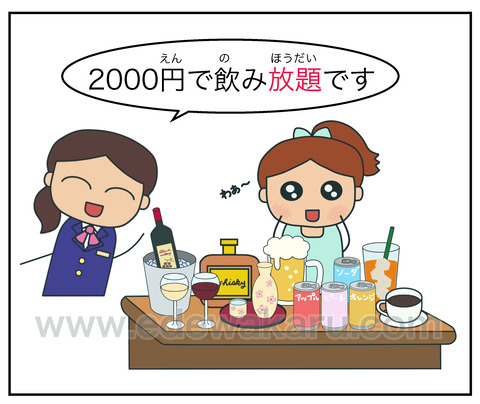
Meaning
Do as much of ~ as you want.
How to use it
Verb [ます-form] + 放題
Verb [ます-form] + たい放題
Explanation
“〜放題” means “do as much of ~ as you want” and is used to say “do as much as you like.” It is used to mean “you can do ~ freely, without limits.” At shops and restaurants, expressions such as “食べ放題” (all-you-can-eat), “飲み放題” (all-you-can-drink), and “詰め放題” (fill a bag as much as you can) are common; at karaoke boxes, “歌い放題” (sing as much as you want) is also often used.
“〜放題” also has a usage that expresses a negative evaluation, meaning “it’s unpleasant/troublesome that someone does as much of ~ as they want,” so let’s review that too 😉
In context 5 examples
2000円で飲み放題です
→2000円で飲みたいだけ飲めますYou can drink as much as you want for 2,000 yen. →For 2,000 yen, you can drink as much as you want.
ネットカフェではインターネットが使い放題だ
→ネットカフェではインターネットを使いたいだけ使うことができるAt an internet café, you can use the internet as much as you want. →At an internet café, you can use the internet as much as you want.
あそこのカラオケボックスは、5時間歌い放題で1000円らしいよ!
→5時間、1000円で歌いたいだけ歌うことができるらしいよ!I hear that karaoke place over there lets you sing as much as you want for five hours for 1,000 yen! →I hear you can sing as much as you want for five hours for 1,000 yen!
3000円でお寿司が食べ放題だったので、元を取るためにウニばかり食べた
→3000円でお寿司が食べたいだけ食べることができたので、ウニばかり食べたSushi was all-you-can-eat for 3,000 yen, so I ate nothing but sea urchin to get my money’s worth. →I could eat as much sushi as I wanted for 3,000 yen, so I ate nothing but sea urchin.
夫:にんじんを20本も買ったのか!?妻:ええ。だって、袋に詰め放題で200円だったんだもの
→袋に詰めたいだけ詰めることができて、2000円だったんだものHusband: You bought as many as 20 carrots?! Wife: Yes. They were 200 yen because you could stuff as many as you wanted into a bag. →Because we could stuff as many as we wanted into a bag, and it was 2,000 yen.
Read the original source text
Meaning
〜たいだけ〜する
How to use it
動詞[ます形]+放題
動詞[ます形]+たい放題
Explanation
「〜放題」は「〜たいだけ〜する」という意味で「好きなだけ〜する」と言いたい時に使用します。「制限なく、自由に〜できる」と言いたい時に使われます。お店やレストランなどで「
食べ放題」「
飲み放題」「
詰め放題」、またカラオケボックスなどでは「
歌い放題」などがよく使用されています。
「〜放題」には、「好きなだけ〜して嫌だ/迷惑だ」というマイナス評価を表す用法もありますので復習しておきましょう😉
Usage 2
Read this source entry ↗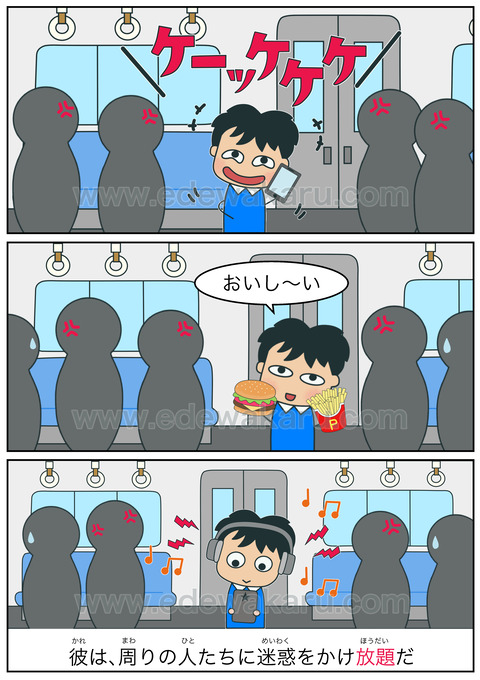
Meaning
Do as much of ~ as you want, to someone’s annoyance.
Do as much as you like, so it’s a nuisance.
How to use it
Verb [ます-form] + たい放題
Explanation
“〜放題” and “〜たい放題” are sentence patterns meaning “it’s troublesome that someone does as much of ~ as they want” or “it’s a nuisance that someone does whatever they like.” They express the speaker’s negative evaluation, as in “I dislike it because they do as much as they want without considering others.” The set expressions 「好き放題」 and 「勝手放題(かってほうだい)」 are also used.
[Set expressions]
好き放題
・勝手放題
→Acting however one pleases
[For advanced learners]
This pattern also has the meaning “to leave something alone without doing anything” 😮
[Example]
That house has been unoccupied for nearly 20 years, so both the house and the garden are 荒れ放題 (left completely untended).
That house has been unoccupied for nearly 20 years, so both the house and the garden are in a state of being very overgrown and neglected.
“〜放題” can also mean “freely, without limits,” so learn that usage too 😉
[Related grammar patterns]
In context 5 examples
彼は、周りの人たちに迷惑をかけ放題だ
→彼は、周りの人たちにすごく迷惑をかけているHe is constantly causing trouble for the people around him. →He is causing a great deal of trouble for the people around him.
彼女は人の気持ちを考えず、いつも言いたい放題だ
→彼女は人の気持ちを考えず、いつも自分が言いたいことを言いたいだけ言うShe never considers other people’s feelings and always says whatever she wants. →She never considers other people’s feelings and always says as much as she wants to say.
兄は、散らかり放題の部屋でゲームをしてばかりいる
→すごく散らかっている部屋で、ゲームをしてばかりいるMy older brother does nothing but play games in his completely messy room. →He does nothing but play games in a very messy room.
お金持ちだからといって、使いたい放題にお金を使わせるのはよくないと思う
→使いたいだけ、子供にお金を使わせるのはよくないと思うI don’t think it’s good to let children spend as much money as they want just because they’re rich. →I don’t think it’s good to let children spend as much money as they want.
あんなやりたい放題の経営では、社員がやめていくのも無理はない
→自分がやりたいことをやりたいだけやるような経営では、社員がやめても無理はないWith management that does whatever it wants like that, it’s no wonder employees are leaving. →With management that does as much as it wants of whatever it wants to do, it’s no wonder employees are leaving.
Read the original source text
Meaning
〜たいだけ〜して嫌だ
好きなだけ〜するから、迷惑だ
How to use it
動詞[ます形]+たい放題
Explanation
「〜放題」「〜たい放題」は「〜たいだけ〜するから、困る」「好きなだけ〜するから、迷惑だ」という意味の文型です。相手のことを考えずに「好きなだけ〜するから、嫌だ」というように話し手のマイナス評価を表します。慣用表現(かんようひょうげん)に
「好き放題」「勝手放題(かってほうだい)」
があります。
[慣用表現]
好き放題
・
勝手放題
→自分の好きなように行動する
【上級レベルの人へ】
この文型には
「何もしないでそのままにしておく」
という意味もあります😮
[例]
あの家はもう20年近く誰も住んでいないので、家も庭も
荒れ放題
だ
あの家はもう20年近く誰も住んでいないので、家も庭も
すごく荒れている状態
だ
「〜放題」には「制限なく、自由に〜」という意味もありますので一緒に覚えておきましょう😉
【関連文型】
日本語文型辞典
Meaning
Attached to the continuative form of verbs such as 「やる」「する」「言う」, it expresses acting however one pleases, without consideration for others. It carries the speaker’s negative judgment. Other idiomatic expressions include 「勝手放題にする」.
It expresses doing something freely, without restriction. It is often used with words such as 「食べる・飲む」. Also, as in ③, it means leaving things to take their course without actively doing anything about them.
How to use it
R-(たい)ほうだい
R-ほうだい
In context 6 examples
近所の子供たちは、後片付けもせずに、家の中を散らかし放題に散らかして帰っていった。
The neighborhood children left after making a complete mess of the house, without even cleaning up after themselves.
誰も叱らないものだから、子供達はやりたいほうだい部屋の中を散らかしている。
Since no one scolds them, the children are making a mess of the room as much as they like.
口の悪い姉は相手の気持ちも考えずいつも言いたい放題だ。
My sharp-tongued older sister always says whatever she likes without considering how the other person feels.
バイキング料理というのは、同じ料金で食べほうだいの料理のことだ。
A buffet is a meal where you can eat as much as you like for the same price.
≪ビアホールの広告≫2000円で飲み放題。
〈Beer hall advertisement〉 All-you-can-drink for 2,000 yen.
病気をしてからは、あんなに好きだった庭いじりもできず、庭も荒れ放題だ。
Since I got sick, I haven’t been able to do the gardening I used to love so much, and the garden has become completely overgrown.
Read the original source text
Meaning
「やる」「する」「言う」などの動詞の連用形に付いて、他者への配慮無しに好きなように振舞うことを表す。話し手のマイナス評価が含まれる。他に慣用的な表現に「勝手放題にする」などがある。
制限なく自由に出来る様子を表す。「食べる・飲む」などの言葉といっしょに使われることが多い。また、③のように「そのことに対して積極的には何もせずに、なるがままに任せておくこと」を表す。
How to use it
R-(たい)ほうだい
R-ほうだい
毎日のんびり日本語教師
Meaning
as much as one likes
as one pleases
freely
without restraint
How to use it
Verb ます-form + 放題
Verb ます-form + たい放題
Explanation
Attached to the verb ます-form, it means doing as much as one wants to, to one’s heart’s content.
The expression 「好き放題」 (as one pleases) is also used.
A similar grammar pattern is “【N0 Grammar】~三昧(ざんまい).” This attaches only to nouns and expresses a similar meaning.
Notes
Similar grammar: “【N0 Grammar】~三昧(ざんまい)”
In context 7 examples
焼肉食べ放題大人一人3000円
All-you-can-eat yakiniku: ¥3,000 per adult.
赤ちゃんは泣くのが仕事だから、泣きたい放題泣かせておけばいい。
Crying is a baby’s job, so you can just let them cry as much as they want.
いつも些細な事からつい言いたい放題言ってしまって喧嘩になる。
We always end up arguing because we say whatever we want over the smallest things.
現在キャンペーン中で、海外ドラマが見放題だそうだ。
Apparently there’s currently a campaign offering unlimited access to overseas TV dramas.
ネットでは匿名性にかこつけて、無責任な発言をしたい放題している。
Online, people use anonymity as an excuse to make irresponsible comments to their heart’s content.
この店のビール飲み放題には、2時間という時間制限がある。
The all-you-can-drink beer at this restaurant is subject to a two-hour time limit.
子供には自分の好きなようにやりたい放題させておけばいい。(让孩子按照自己喜欢的去做就可以了。)
You can just let children do whatever they want, however they like. (让孩子按照自己喜欢的去做就可以了。)
Read the original source text
Meaning
随便
随心所欲
自由
放任
How to use it
動ます形+放題
動ます形+たい放題
Explanation
動ます形に接続して、思う存分したいだけするという意味を表します。
「好き放題」という言い方もあります。
似ている文法に「【N0文法】~三昧(ざんまい)」があります。こちらは名詞にのみ接続して似たような意味を表します。
Notes
似ている文法「【N0文法】~三昧(ざんまい)」