絵でわかる日本語
Usage 1
Read this source entry ↗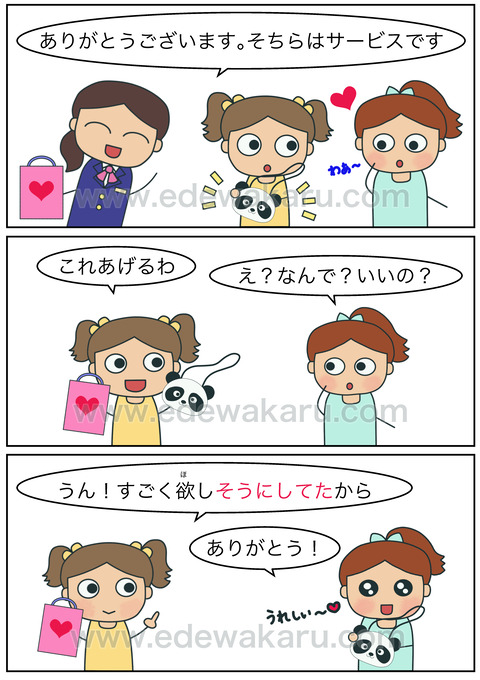
Meaning
〜 looks 〜
Looks like 〜
How to use it
い-adjective [remove い] + そうにする
い-adjective [remove い] + そうにしている
な-adjective [remove な] + そうにする
な-adjective [remove な] + そうにしている
Explanation
“Aそうにする・Aそうにしている” is a sentence pattern meaning “looks A.” It is used when a person or animal appears to be A.
“A” is an adjective expressing [an emotion] or [a sensation], or “〜たい” or “欲しい.”
It can be changed to “〜そうだ,” which expresses appearance.
[Example]
Because they look like they really want it
= Because it looks like they really want it
There are many sentence patterns that use “そう,” so be sure to review them 😊
In context 6 examples
A:これあげるわB:えっ、なんで?いいの?A:うん。すごく欲しそうにしてたから
→すごく欲しそうだからA: Here, you can have this. B: Huh? Why? Are you sure? A: Yeah. You looked like you really wanted it. → Because it looks like you really want it.
彼女が寒そうにしていたので、コートを貸してあげた
→寒そうだったので、コートを貸してあげたShe looked cold, so I lent her my coat. → She looked cold, so I lent her my coat.
授業中(じゅぎょうちゅう)、山田くんは眠そうにしていた
→眠そうだったDuring class, Yamada looked sleepy. → He looked sleepy.
痛そうにしていたので、病院へ連れて行った
→痛そうだったので、病院へ連れて行ったThey looked like they were in pain, so I took them to the hospital. → They looked like they were in pain, so I took them to the hospital.
A:あの子は、とても悲しそうにしているねB:うん。彼氏とケンカでもしたのかな…
→とても悲しそうだねA: That child looks very sad. B: Yeah. I wonder if they had a fight with their boyfriend… → They look very sad.
姉:このバッグ、あげるわ妹:くれるの?なんで?姉:だって、このバッグを見るたびに欲しそうにするんだもの妹:お姉ちゃん、ありがとう〜
→見るたびに欲しそうな顔をするんだものOlder sister: I’ll give you this bag. Younger sister: You’ll give it to me? Why? Older sister: Because every time you see this bag, you look like you want it. Younger sister: Thanks, big sis~ → Because every time you see it, you make a face like you want it.
Read the original source text
Meaning
〜そうだ
〜そうな様子
How to use it
い形容詞[ーい]+そうにする
い形容詞[ーい]+そうにしている
な形容詞[ーな]+そうにする
な形容詞[ーな]+そうにしている
Explanation
「Aそうにする・Aそうにしている」は「Aそうだ」という意味の文型です。人や動物がAそうな様子の時に使います。
「A」には[感情]や[感覚]を表す形容詞や「〜たい」や「欲しい」が入ります。
様態を表す「〜そうだ」にチェンジすることができます。
[例]
すごく欲し
そうにしている
から
=すごく欲し
そうだ
から
「そう」がつく文型はたくさんありますので復習をしておきましょう😊
Usage 2
Read this source entry ↗Meaning
〜 looks 〜
Looks like 〜
How to use it
い-adjective [remove い] + そうにする
い-adjective [remove い] + そうにしている
な-adjective [remove な] + そうにする
な-adjective [remove な] + そうにしている
Explanation
“Aそうにする・Aそうにしている” is a sentence pattern meaning “looks A.” It is used when a person or animal appears to be A.
“A” is an adjective expressing [an emotion] or [a sensation], or “〜たい” or “欲しい.”
It can be changed to “〜そうだ,” which expresses appearance.
[Example]
Because they look like they really want it
= Because it looks like they really want it
There are many sentence patterns that use “そう,” so be sure to review them 😊
Read the original source text
Meaning
〜そうだ
〜そうな様子
How to use it
い形容詞[ーい]+そうにする
い形容詞[ーい]+そうにしている
な形容詞[ーな]+そうにする
な形容詞[ーな]+そうにしている
Explanation
「Aそうにする・Aそうにしている」は「Aそうだ」という意味の文型です。人や動物がAそうな様子の時に使います。
「A」には[感情]や[感覚]を表す形容詞や「〜たい」や「欲しい」が入ります。
様態を表す「〜そうだ」にチェンジすることができます。
[例]
すごく欲し
そうにしている
から
=すごく欲し
そうだ
から
「そう」がつく文型はたくさんありますので復習をしておきましょう😊
毎日のんびり日本語教師
How to use it
い-adjective stem + そうにする/そうにしている
な-adjective stem + そうにする/そうにしている
Explanation
Used with adjectives of emotion or sensation, this expresses that (someone else) is behaving as though they feel that way.
It can be rephrased as 「~そうだ」.
Note the following exceptions regarding how it connects.
Exceptions
~そう
良い
良さそう(よさそう)
無い
無さそう(なさそう)
Notes
The 「~そう」 series
In context 8 examples
昔は自信無さそうにしていたのに、今ではすっかり一人前だ。
They used to seem unconfident, but now they're fully grown-up.
野良猫が何か食べたそうにして、こっちを見ている。
A stray cat is looking over here as if it wants something to eat.
座りたそうにしているおじいさんに席を譲ってあげた。
I gave up my seat to an old man who looked like he wanted to sit down.
後輩が帰りたそうにしていたので、帰らせてあげた。
My junior seemed like they wanted to go home, so I let them leave.
彼はホラー映画を見ても全然怖くなさそうにしていてすごい。
It's amazing how he doesn't seem scared at all, even when watching horror movies.
応援していたチームが負け、とても残念そうにしている。
The team I was rooting for lost, and I look very disappointed.
みんな暑そうにしていたので、クーラーをつけた。
Everyone looked hot, so I turned on the air conditioner.
階段から落ちてめちゃくちゃ痛そうにしている。
They look like they're in tremendous pain after falling down the stairs.
Read the original source text
How to use it
イ形語幹+そうにする/そうにしている
ナ形語幹+そうにする/そうにしている
Explanation
感情・感覚形容詞について、(相手が)まさにそのような振る舞いをしていることを表します。
「~そうだ」に言い換えることができます。
接続に関して、以下の例外に注意してください。
例外
~そう
良い
良さそう(よさそう)
無い
無さそう(なさそう)
Notes
「~そう」シリーズ